
We have previously discussed the work of the Warwick Manufacturing Group on mitigating potential battery degradation by “intelligently managing V2G technology”. In a recent press release the EV-elocity project refers to a new WMG paper on that subject, reporting that:
A number of studies have identified the strategic importance of charging infrastructure to support the introduction of electrified vehicles (EVs) and to underpin consumer acceptance of the technology. For this reason, considerable research has been undertaken to evaluate the different facets of the technology, including the ability to charge at higher rates of electrical power, the introduction of smart charging (V1G) that allows dynamic management of the charging process in terms of both power and charge time and vehicle-to-grid (V2G) that enables bidirectional energy flow between the vehicle and the supply. In recent years, the term V2G has become more generalised to V2X, to acknowledge the variability in which the EV may be integrated, either to the grid or behind-the-meter, for example within a local electrical network, such as a building (V2B).
Irrespective of the exact nature of the integration method, understanding the impact of different strategies on battery degradation is a key requirement that may ultimately underpin consumer acceptance. Only a few studies have examined the potential impact of V2G operation on battery degradation. Often their assertion is that the increased charge-throughput will negatively impact battery life. These works often neglect that the battery will equally degrade through a process of calendar-ageing in which the retained capacity of the battery reduces as the battery is stored at no-load.
As highlighted in these results from the EV-elocity project, the nature of the degradation is highly complex with dependencies that crosscut: the state of charge (SOC) of the battery with respect to the optimal SOC storage condition and the duration of the parking interval. To further compound the challenge, experimental results shows that the optimal SOC point varies with battery life.
The paper referred to is open access and entitled “A Study of Reduced Battery Degradation Through State-of-Charge Pre-Conditioning for Vehicle-to-Grid Operations“. The abstract begins as follows:
Transport electrification is a key enabler to reduce fossil fuel depletion and related carbon dioxide emissions. However, critical barriers exist in terms of battery costs and their expected life. Vehicle-to-grid technology can bring benefits to both the electrical power grid and electric vehicle owners, while its practical implementation faces challenges due to the concerns over accelerated battery degradation. This paper presents a comprehensive study on reduced Lithium-ion battery degradation through state-of-charge pre-conditioning strategies that allow an electric vehicle to participate in vehicle-to-grid operations during periods in which the vehicle is parked. Energy capacity reduction of the electric vehicle battery are predicted using semi-empirical ageing models, which have been built and validated to capture the degradation behaviours of the battery with respect to both calendar and cycling ageing. Five charging strategies for battery state-of-charge pre-conditioning have been developed to evaluate the ability to mitigate battery ageing before commencing vehicle-to-grid operations. Simulation studies on battery degradation utilizing such charging mechanisms under two different operational profiles have been undertaken.
At this point you may be wondering exactly what the various charging mechanisms entail? Here’s a summary of the assorted strategies from the press release:
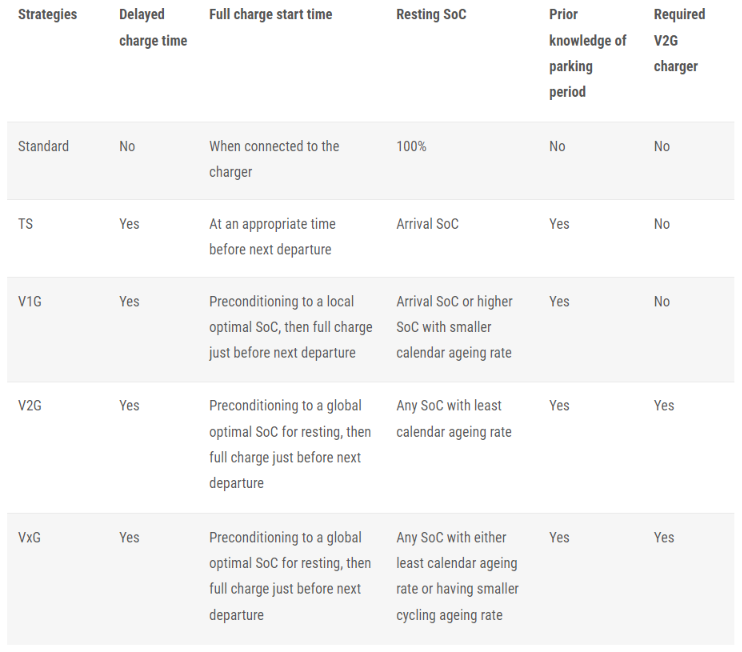
and here’s a summary of the results:
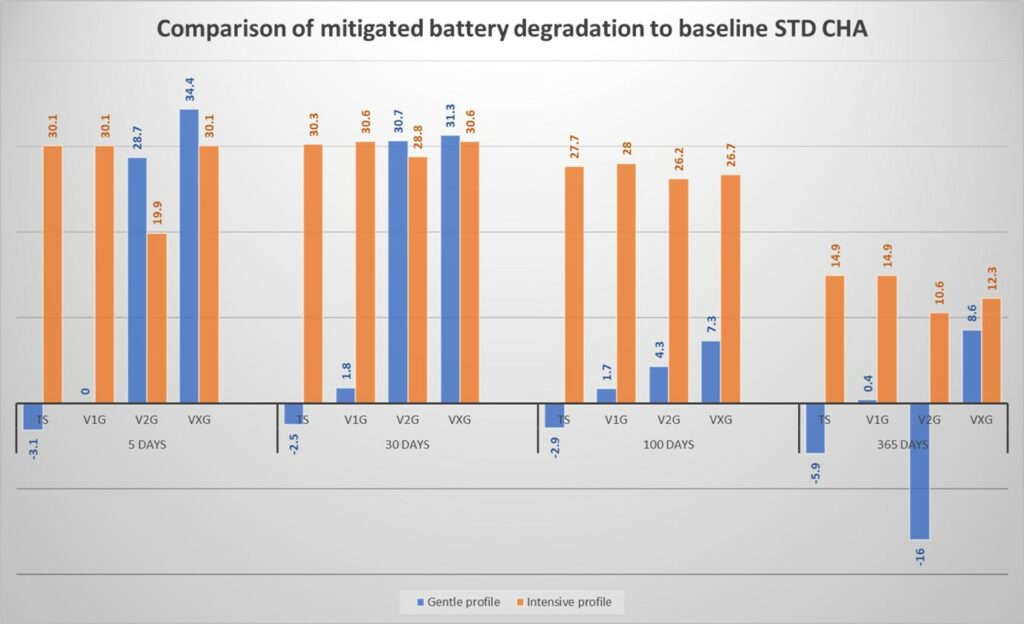
Going back to the abstract from the Bui et al. paper, the brief conclusions are that:
The analytical results show that the proposed charging strategies do not accelerate battery degradation and are capable of mitigating the total ageing process from 7.3 – 26.7% for the first 100 days of operational life and gradually vary to 8.6 – 12.3% for one-year continual operation compared to the reference standard charging approach.
To summarise, leaving your electric vehicle plugged in and “fully charged” is not good for the “state of health” of its traction battery. Here’s a video from Euan McTurk that delivers a similar message: