Is Distributed Energy Storage on Ofgem’s Roadmap?

In the first of my reports from the Regen SW “Community Energy Markets” conference in Bristol last Thursday I’ll be highlighting references in several of the presentations to what I like to call “Distributed Energy Storage“, which encompasses a whole lot more than just the battery packs in electric vehicles.

The first person to mention the subject was Jeff Hardy, who is Head of Future Consumers & Sustainability at Ofgem. His presentation was on the topic of “Non-traditional business models: Supporting transformative change in the energy market” which deserves an article all of its own in due course. However whilst discussing “rapid technological innovation” Jeff pointed out that “battery storage is the current flavour of the month”. After that Sonya Bedford, Head of Renewable Energy at Stephens Scown solicitors, also hinted at the subject in her talk about “Local supply models” in which she mentioned “Demand Side Response” and “Local Balancing Units”.

At the conclusion of the morning session Merlin Hyman, chief executive of Regen SW and our host for the day, asked if there were any questions from the floor. Nobody else seemed very keen to put their hand up, so I waved my arm in the air and was duly invited to stand up, state my name and affiliation, and then pose the panel a question. In the event I actually asked two. The first was to enquire if anybody else present was interested in international smart grid standards apart from me, since the LBUs that Sonya had mentioned seemed to me to come within the remit of the IEC 62325 standard working group which I am part of. Then I asked the panel whether the battery packs in electric vehicles were anywhere near being “flavour of next month” in the UK as yet.

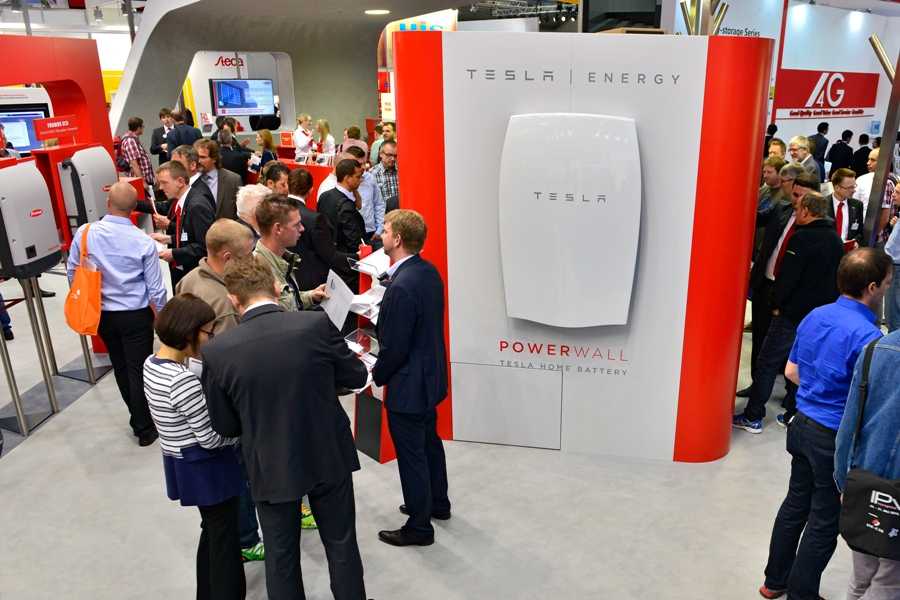
Nobody responded to my first question, but Merlin framed my second question to the panel in terms of the recent “Powerwall” announcement from Tesla Energy. I was both pleased and somewhat surprised when Jeff pointed out that V2G was indeed on his radar screen, since he is “fascinated by EVs” and the “traditional battery worries have been overcome by technology”. Sonya was then good enough to mention that I had said much the same thing at the AGM of Exeter Community Energy earlier in the week.

After lunch James Owen, commercial director of Public Power Solutions, started off by giving us a history lesson about local electricity generation in the UK.  Then he went on to discuss the benefits of “Local Balancing Units”, “street level storage solutions” and “a true local smart micro-grid” amongst other things, using both Swindon and the Danish island of Bornholm as examples. James freely admitted to having pinched an infographic of Bornholm, so I’ve taken the liberty of pinching one of his! Here is PPS’s template for a future Bristol, or Bornholm, or the Isle of Wight, or anywhere else in Europe for that matter.
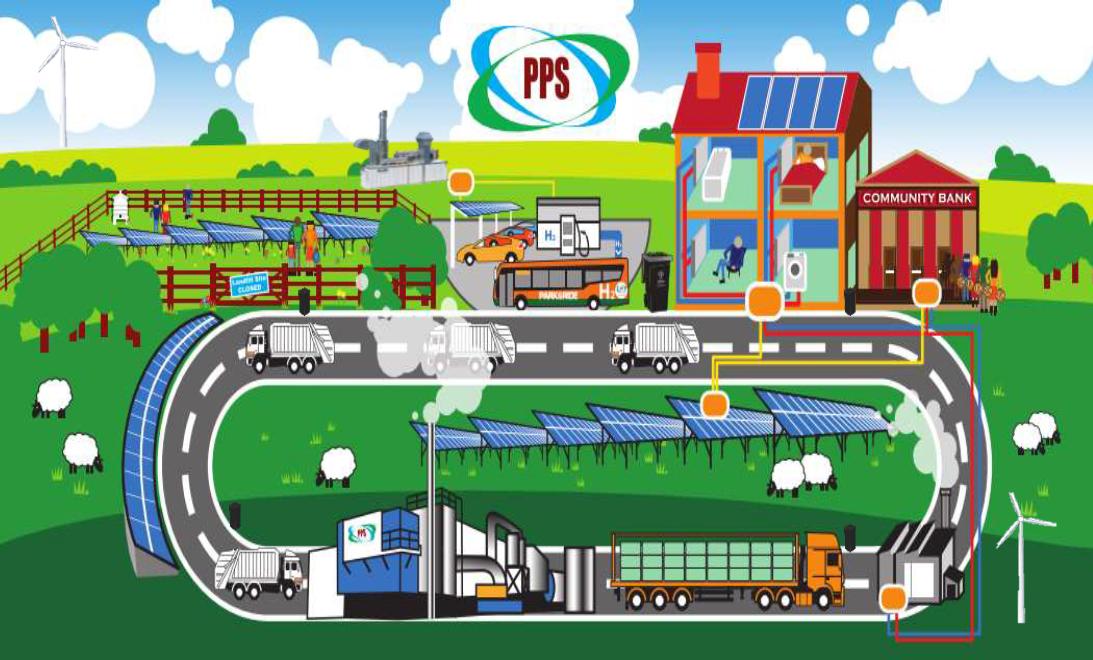
See if you can spot the difference between this version and the one on the PPS web site. It seems those recent additions are Tesla Powerpacks, and in my own vision of a future sunny Southwest England the cars under the solar PV canopy at the park and ride would be connected to similar “black boxes” that incorporate V2G functionality.

Having finally got the preface out of the way, I’d like at long last to mention some alternative battery filled “black boxes” from suppliers other than Tesla Energy. For “grid scale” battery storage you can repurpose EV battery packs like Sumitomo, or use batteries designed for the task from the likes of Saft.

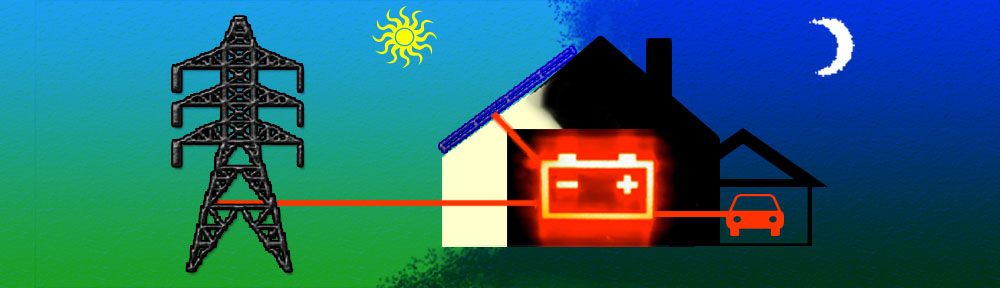
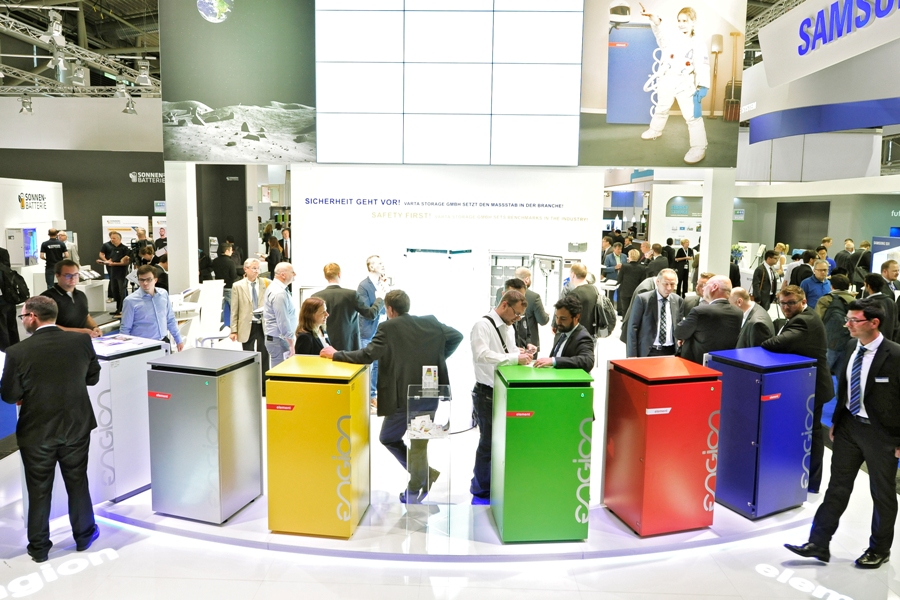
Moving down to the domestic scale I note that for some strange reason the solar PV equipped dwelling in a future Bristol/Bornholm lacks a V2x equipped garage similar to the one shown in the V2G banner at the top of this article. Moving indoors Moixa’s Maslow predates the Powerwall by a long way, and is designed to power a DC circuit for LED lighting, computers etc. Quite possibly prompted by Elon Musk‘s recent announcement, Samsung have also launched a domestic version of their modular Energy Storage System (or ESS for short). Stefan Quandt (of BMW fame) has launched the SolarWatt MyReserve, which has already won an award at the recent ees Europe exhibition over in Germany. Varta also launched their Engion Element “storage for beginners” at ees Europe. Here’s how they looked at the show:
and just in case you haven’t yet tasted the flavour of the month, here’s a Tesla Powerwall for your delectation:
As you’ve probably gathered by now I have a lot more to say about all of this and more, including covering Anthony Price of Swanbarton’s talk dedicated to “Local balancing using storage”. However for the moment at least I cannot help but wonder what Ofgem make of all this “rapid technological innovation”, not to mention the potential associated “non-traditional business models” and last but by no means least, international smart grid standards!
Carlos Ghosn Reveals Long Range Nissan LEAF

I visited Bristol yesterday to attend the Regen SW “Community Energy Markets” conference. More from me on the event in due course, but before that I must point out that Bristol is “European Green Capital” for 2015. Here’s a video revealing how Bristol looks from behind the wheel of the current Nissan LEAF:

Earlier this week BBC News revealed how Japan looks from behind the wheel of the current Nissan LEAF:

According to the BBC:

The boss of Nissan, Carlos Ghosn, has not been shy about expressing his disdain for hydrogen. Instead, Nissan is betting on lithium ion batteries.

Coincidentally earlier this week Carlos Ghosn spoke at the Nissan annual shareholder’s meeting in Yokohama. Here’s the “Technology” part of his presentation:

All forthcoming products will reflect Nissan’s commitment to delivering breakthroughs that advance vehicle safety, efficiency, and connectivity.

During our discussion later in this meeting, we will update you on Nissan’s plans to introduce an autonomous drive vehicle by 2020. We are continuing to develop this exciting technology.

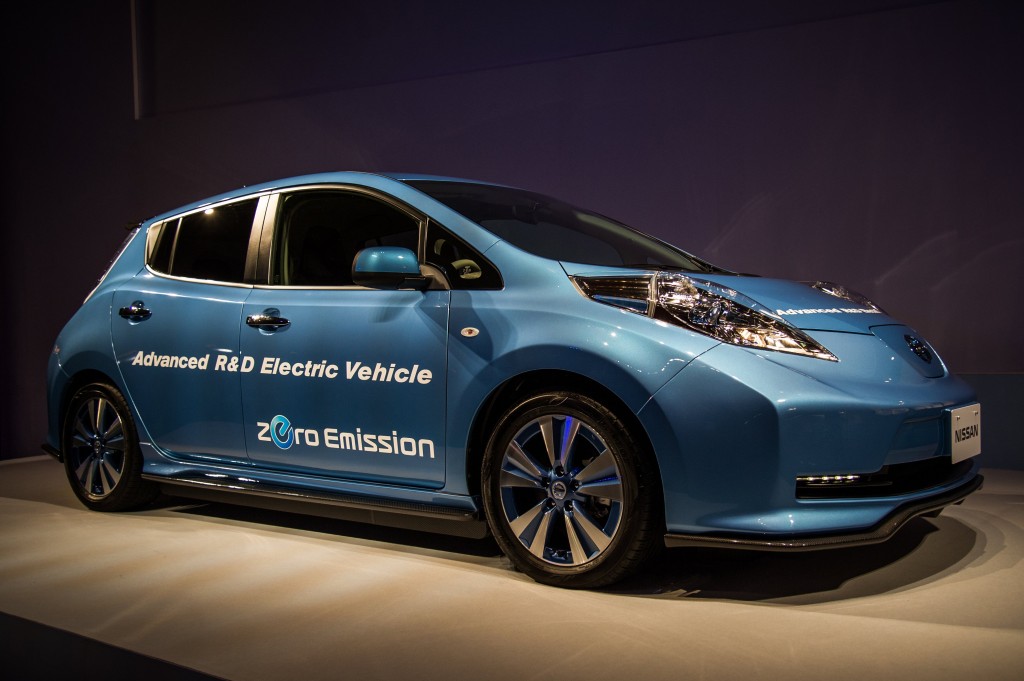
The vehicle that stands to my left features the latest versions of hardware and software that Nissan is developing.

The vehicle that stands to my right is another advanced technology breakthrough. It explores how far we can extend electric vehicle range by making changes to the battery.

Today there are only two reliable ways to increase electric vehicle range.

  • The first is to have a massive network of EV chargers, so that when you are away from home you have the ability to recharge easily.
  • The other option is to put a larger battery pack into the vehicle so that the driver enjoys greater range. However, with today’s level of technology, adding more battery means adding more cost.

As you know, Nissan has been one of the world’s foremost advocates for the development of recharging networks. With our efforts and the support of government and private sector partners, Japan has one of the most highly developed charging infrastructures in the world.

There are now more than 14,000 EV chargers, not including home chargers, in Japan. This means that EV drives already have the freedom to drive throughout mainland Japan without worrying about battery range.

Unlike customers in some other markets, where the charging networks are in earlier stages, customers in Japan who want to enjoy the benefits of driving a LEAF have no need to wait. Japan’s vast EV charging network already provides an incentive for you to move to Nissan’s zero-emission technology. And, during FY2015, the number of chargers in Japan will increase even further. However, that doesn’t mean we will become complacent and stop working to advance our battery and vehicle technologies.

We believe that, in the near future, Nissan can provide EV drivers with even greater “peace of mind” range, by offering comparative mobility to today’s conventional vehicles.

Nissan is exploring new materials and chemistry solutions in order to make thinner, lighter weight and less costly batteries. We foresee the day when you leave your home with a full charge, and are able to go about your day with no concerns…then return home with ample charge.

This video shows how we envision a routine day.

With this vision in mind, our advanced battery research will continue. But we will not wait for its completion to move forward. Later this year, you will hear more about our initial steps to increase EV range.

All of which puts me in mind of a couple of things a Nissan representative said in response to a question about “warranties” that was posed at the V2G workshop I attended earlier this month. It seems Nissan’s battery electric vehicle “warranty doesn’t prohibit V2G” and the “impact [of V2G] on the battery is insignificant”.

Solar PV Powered Public V2G Charging Launched in Utrecht

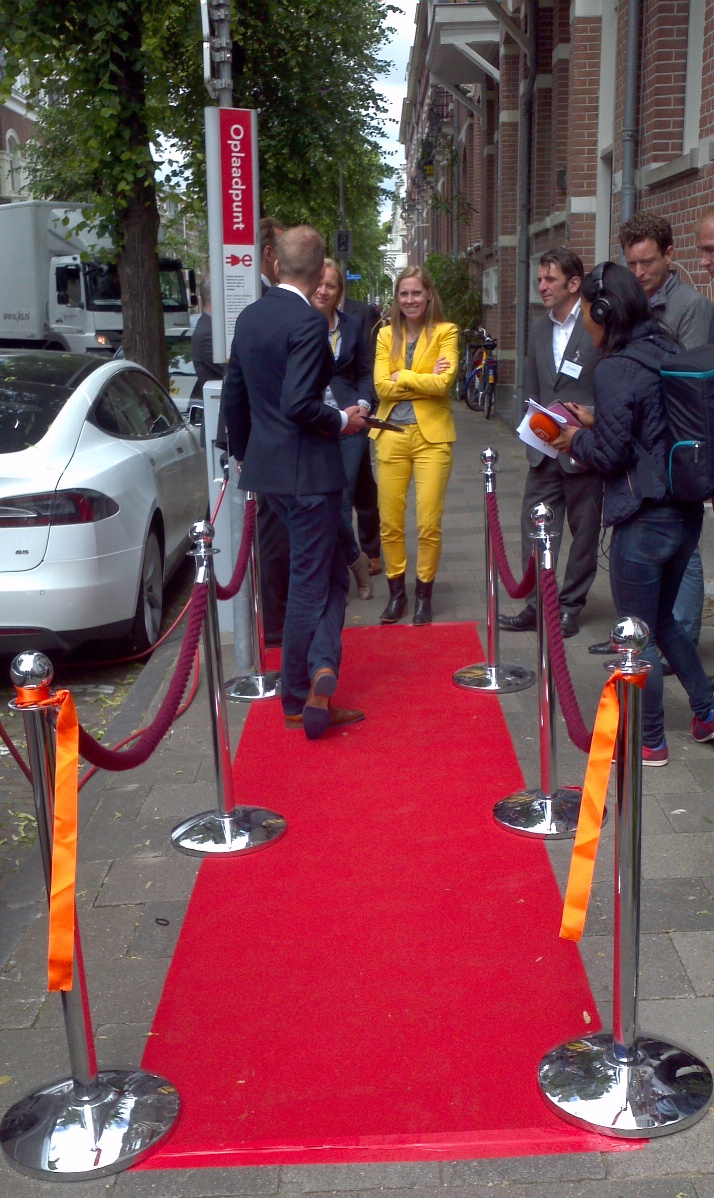
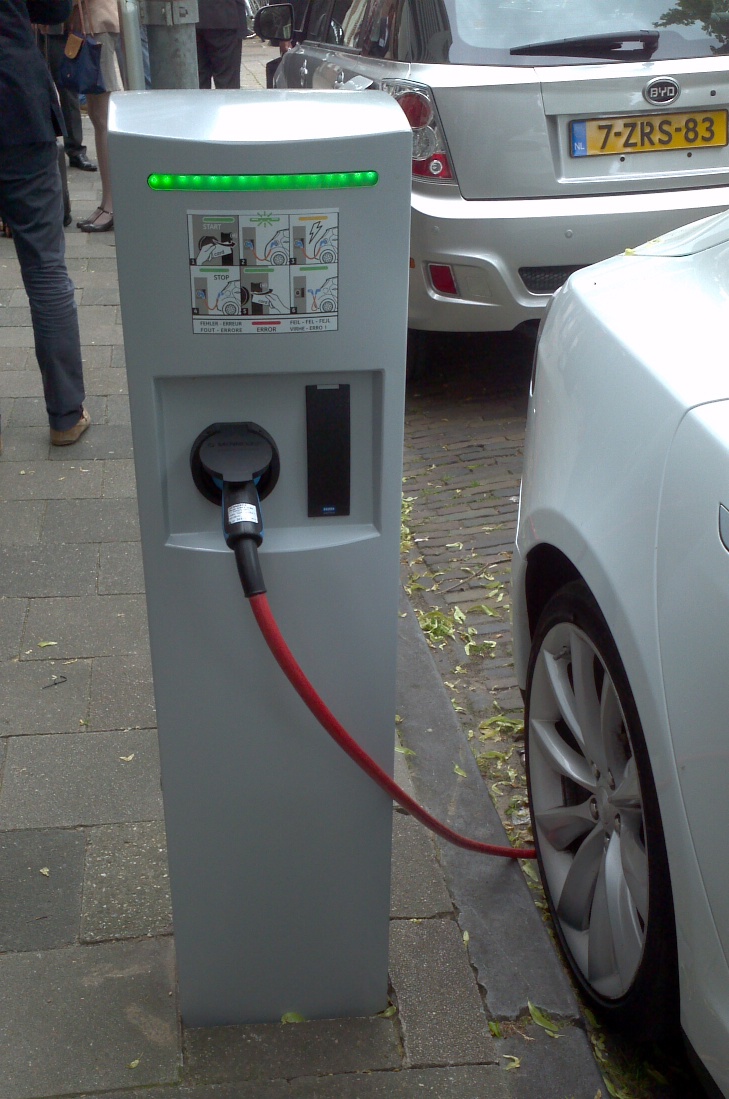
Earlier this week I attended a vehicle-to-grid workshop organised by Nissan Europe. This one was held in Utrecht in The Netherlands, where I discovered that the workshop coincided with the announcement of a new partnership between the City of Utrecht and a number of Dutch companies to ultimately deliver 120 “smart charging stations” across Utrecht. There’ll be more from me on the workshop itself in due course, but for now let’s take a close look at the world’s first publicly available solar powered V2G capable AC electric vehicle charging station:

The charging station itself is a GE DuraStation with added bi-directional capability. Sadly my wish of a few weeks ago has not yet come true, and the Tesla model S you can see in the foreground is still only capable of being charged by the DuraStation, which is IEC 61851/62196 mode 3 compliant. However the BYD e6 visible in the background IS able to discharge its batteries back to the local distribution grid.

This particular charger is situated outside the offices of LomboXnet, and hence integrated with the CHAdeMO compliant V2G system we reported on back in March, which stores the excess energy generated by the Solar PV installation at a nearby primary school. Here’s another angle on the event, showing Councillor Lot van Hooijdonk shortly after she cut the ribbon to officially open the charging station:

Another part of my wish from last month has also yet to come true. In Utrecht as in the United Kingdom, and despite the red carpet, whether you own an electric vehicle manufactured by Nissan, BYD or Tesla, and whether it prefers to be charged via CHAdeMO, IEC 62196 or a Supercharger, you still won’t get paid for allowing your battery pack to be used to provide an extremely useful service to the local distribution grid. However, perhaps mighty oaks from little acorns do eventually grow?

Whilst we wait to discover if/when/how that happens, here’s the video that Robin Berg of LomboXnet showed the attendees of the 3rd Nissan V2G workshop: