Over the last few days Octopus Energy have dropped some heavy hints about an “exciting announcement” at their Energy Tech Summit in London at 12:30 this afternoon. Here is what transpired at the appointed time:
As the video title puts it, Octopus CEO Greg Jackson launched the WORLD FIRST vehicle-to-grid EV bundle! As you can see from the video thumbnail, Greg was joined on stage by motoring journalist Quentin Willson and 1996 Formula One World Champion Damon Hill as he outlined the Octopus Power Pack consumer offer:
Power Pack Bundle gives a car lease, two-way charger, and a smart tariff for £299/month with 100% FREE smart charging – saving £1,000/year on fuel vs petrol.
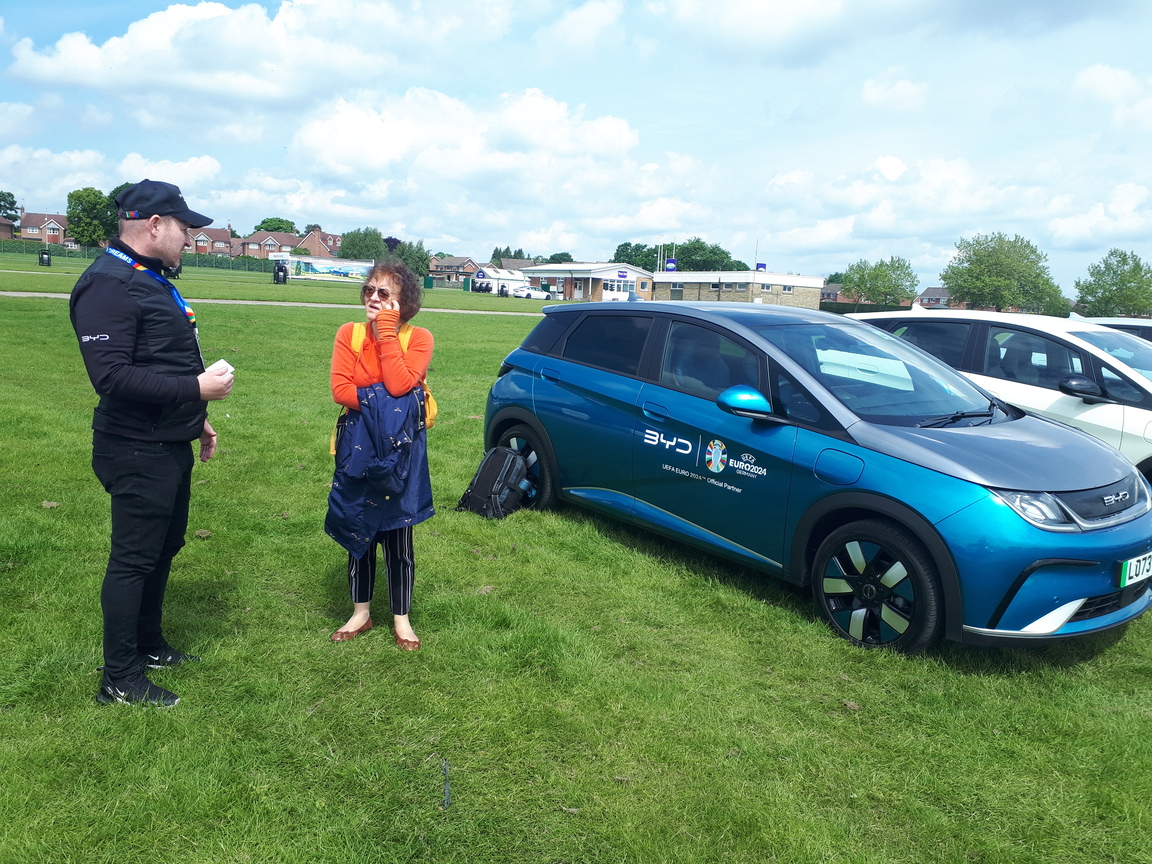
The EV part of the bundle is the BYD Dolphin, which I test drove when I was up in Harrogate last year to contribute to two V2x panel discussions at the Everything Electric North show:
Eleanor Warburton, Interim Director of Energy Systems Management and Security at Ofgem, has written an open letter to:
The CEOs of the Energy Networks Assocation, the Distribution Network Operators and National Grid ESO
Here are the first few paragraphs:
I am writing to you to emphasise the importance of the Open Networks Project and the flexibility-enabling activities it is driving forward, which remain a priority for Ofgem.
Flexibility at scale is essential for achieving net zero. We recognise there has been progress made in recent years in developing flexibility markets, but we are clear that further significant changes are needed to unlock the full value of flexibility.
In recent publications we proposed reforms to help unlock this value. We set out the need for fair and transparent rules and processes for procuring flexibility services, which are standardised to minimise friction. Flexibility service providers must be able to stack revenue and participate easily in open, transparent and coordinated markets.
There is strong support for the case for change and for our proposed direction of travel, however respondents raised concerns about a risk of hiatus in the growth of local flexibility markets.
We wish to emphasise that we see no reason for there to be any deceleration in progress and we strongly expect the Energy Networks Association (ENA) and Distribution Network Operators (DNOs) to continue to progress key flexibility enabling activities through the Open Networks Project. We are confident from our recent engagements that you, the ENA and DNOs, share this view too.
The importance of growing local flexibility markets and standardising rules and processes for procuring flexibility services is reflected in RIIO-ED2 arrangements and the Distribution System Operation (DSO) incentive. Any loss of momentum could impact DSO incentive performance, through both the stakeholder survey and the performance panel assessment.
The Open Networks Project has been pivotal to the growth of local flexibility markets in the UK and building on that to drive further, faster success is very much a priority for Ofgem. We look forward to seeing the progress it makes over the coming year.
We are not seeing the scale of distributed flexibility that we need due to market access and coordination issues. This is especially true for Consumer Energy Resources (CER) like electric vehicles and heat pumps. We need a flex-centric system which facilitates distributed flexibility, but it is not clear that this will emerge organically.
Ministers are discussing launching a public information campaign to encourage households to reduce their energy use this winter as fears grow over winter blackouts.
Households could be asked to turn their thermostats down and use their dishwashers and washing machines during the night and at times when energy demand is lower, under plans being discussed between the business department, energy companies and the network operator National Grid.
No names are mentioned of course, but allegedly:
Sources close to the discussions said that government officials and industry executives were determined to avoid blackouts disrupting the supply of energy to Britons’ homes. A public information campaign could help ease pressure on energy supplies during the winter. Ministers have so far resisted callsto tell consumers to cut their energy use, saying consumption of gas and electricity was a “decision for individuals”.
The article mentions the recent trial in Scotland run by Octopus Energy and SP Energy Networks, in which a financial incentive was offered to domestic consumers to shift the timing of their electricity demand.
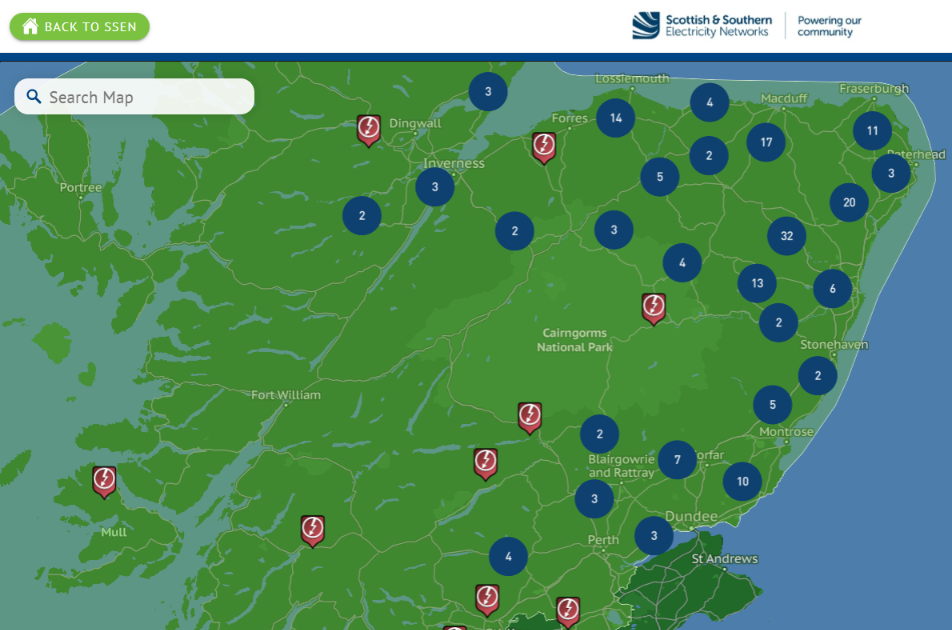
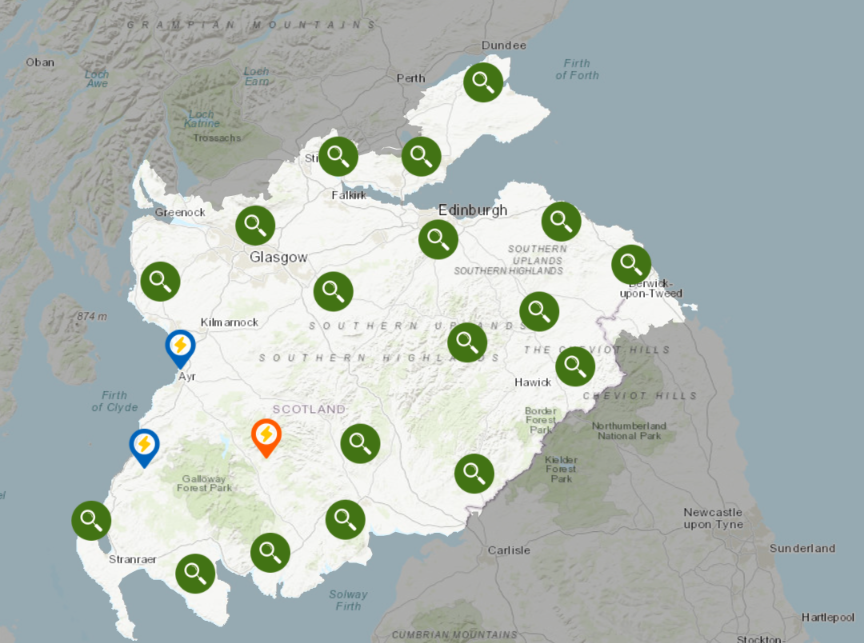
Over 2,500 Octopus Energy customers across Dumfries and Galloway participated in the six-week trial*. Directed to power up their usage when green energy supply was highest, households used 20MWh more energy across the six two-hour trial windows. Households who increased their usage by more than 10% were credited back all the energy they had used during the two-hour timeframe. Those who used more than 100% extra were credited double the amount they had used. Participating customers were rewarded with an average of £5 of free energy, with some saving up to £73.
According to The Guardian once again:
National Grid will lay out its outlook for winter energy supplies on Thursday, giving the first comprehensive assessment of the risk of blackouts this winter.
The eagerly awaited document should show how resilient Britain’s energy supplies are over the coming months. An early view, published in August, showed the UK should be able to meet its energy demand in the coming months. However, since then Norway has indicated it may prioritise supplying its domestic market over exporting power.
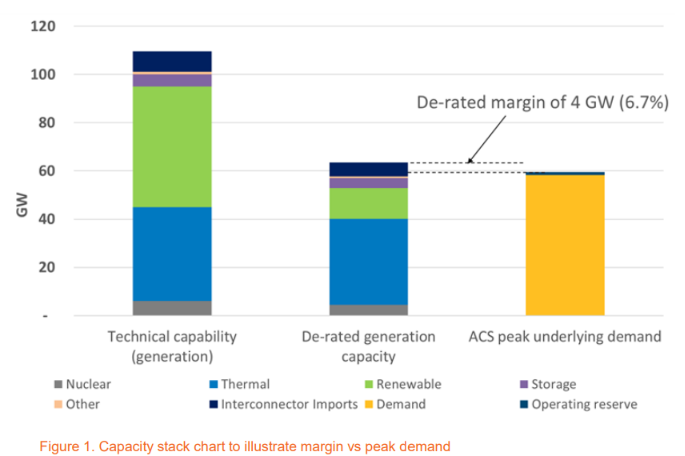
Here’s how things stacked up for the National Grid in August:
We eagerly await any changes revealed in tomorrow’s report!
[Edit – October 6th]
The National Grid Electricity System Operator has now published its “Winter Outlook Report” for 2022/23. Here is the executive summary in full:
Our first illustrative scenario examines what would happen if there were no electricity imports from continental Europe . In this scenario we would deploy our mitigation strategies – dispatching the retained coal units and our Demand Flexibility Service. By securing 4GW through these actions, we would maintain adequate margins and mitigate impacts on customers.
Our Demand Flexibility Service is new and innovative, and we have worked with suppliers, aggregators, industry, Ofgem and BEIS on the design to ensure it is ready for the winter and capable of delivering the required level of participation and response (2 GW+). It will launch on 1 November, and we are encouraging suppliers and aggregators to work with their customers to ensure the highest levels of engagement and participation. We see particular potential from commercial organisations who can shift their load from peak hours and have had positive feedback from British companies on this.
Without the Demand Flexibility Service, we would expect to see a reduction in margins. In this scenario on days when it was cold (therefore likely high demand), with low levels of wind (reduced available generation), there is the potential to need to interrupt supply to some customers for limited periods of time in a managed and controlled manner. However, we expect the mitigations outlined above to be effective.
A second, more extreme scenario, looks at a hypothetical escalation of the energy crisis in Europe such that there is insufficient gas supply available in Great Britain (in addition to no electricity available to import from continental Europe as per above scenario). In the unlikely event that escalation of the situation in Europe means that insufficient gas supply were to be available in Great Britain this would further erode electricity supply margins6 potentially leading to interruptions to customers for periods. All possible mitigating strategies, including our new measures, would be deployed to minimise the disruption.
Overall, this is likely to be a challenging winter for energy supply throughout Europe. We have taken extensive measures to try to mitigate the impacts for British consumers and expect that, under our base case, margins will be adequate. Nevertheless, there remain scenarios, driven principally by factors outside of Great Britain which could impact upon British electricity supplies. Plans are in place to ensure the impact is minimised and the overall security and integrity of Britain’s energy systems are protected.
Here too is the updated version of the “base case” supply margin chart shown above:
The chart is accompanied by these two provisos, amongst others:
Our base case assumes electricity imports from Europe are available at times when we need them to meet demand, delivering in line with their Capacity Market agreements, and that there is no disruption to gas supplies.
Our base case does not assume any material reduction of consumer demand due to high energy prices. It does not include any of our mitigation measures such as coal contracts or the Demand Flexibility Service as we would not expect to deploy them here.
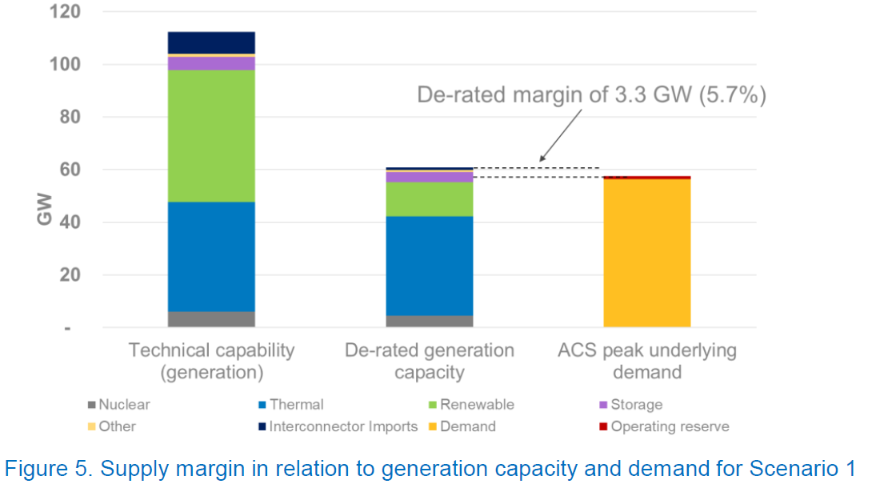
The winter outlook also considers “Scenario 1” in which there are “reduced electricity imports from Europe”:
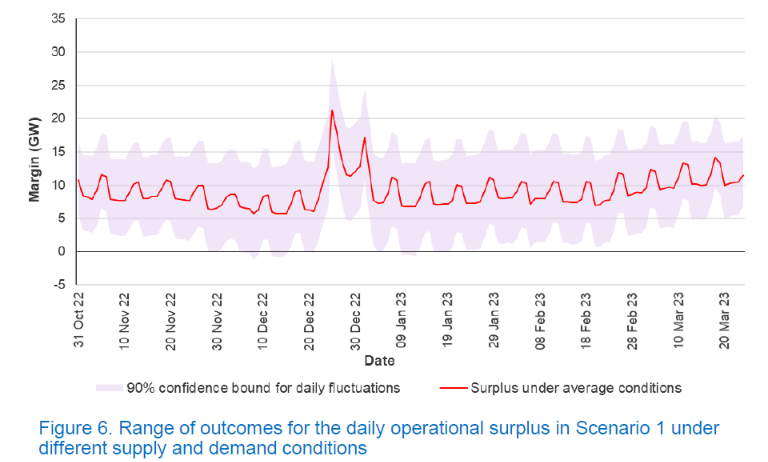
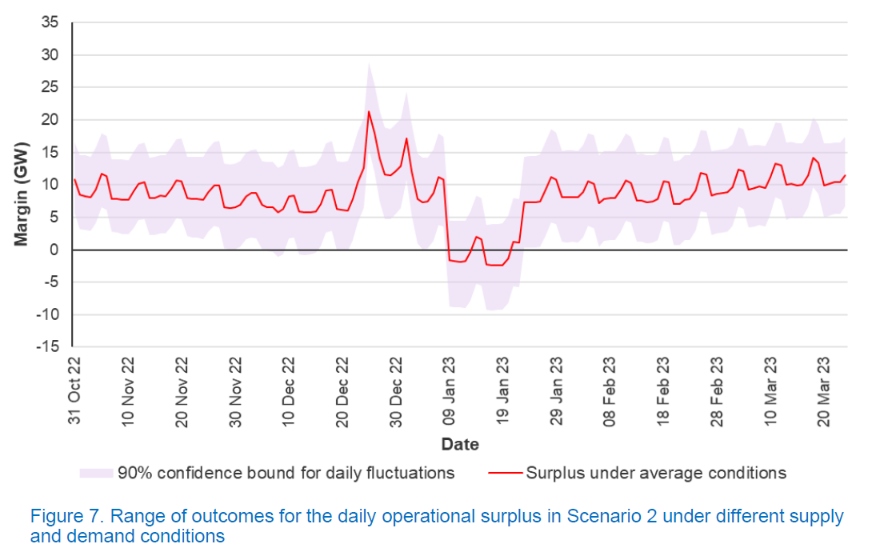
The bar chart is accompanied by a graph of “operational surplus”:
That shows National Grid’s “90% confidence” that the surplus will not turn negative over the winter. However now let’s take a look at “Scenario 2” in which there is in addition “insufficient gas supply in Great Britain”:
Due to the war in Ukraine and gas shortages in Europe, there is a significant risk that gas shortages could occur during the winter 2022/23 in Great Britain. As a result, there is a possibility that GB could enter into a Gas Supply Emergency.
Perhaps it would be prudent at this juncture for us all to cross our fingers and hope that the gas keeps arriving at Great British shores over the coming months, whether via pipeline or LNG tankers?
Though no power cuts are currently planned, in their winter outlook National Grid ESO raised the possibility of the need for planned national power cuts, in order to manage the possibility of energy demand outstripping the supply available.
Firstly, it’s important to know that before any emergency planned power cut instruction is given, National Grid ESO takes several steps to protect customers. These include:
* Encouraging additional generation through the supply market. * Asking heavy industrial users to limit their demand during peak periods. * Reducing domestic power demand – this could include paying customers to change how and when they use appliances like washing machines and dishwashers or reducing voltage across the country by a small percentage, which would be undetectable.
Procedures for emergency planned power cuts like this have existed for decades and are simulated in emergency exercises by the energy sector each year ahead of the winter.
If needed, the emergency procedures are designed to minimise the impact on customers as far as possible, by limiting power cuts to shorter periods in order to manage overall electricity demand. However, while the winter is expected to be challenging, there is no guarantee emergency measures will be necessary.
If an emergency power cut is implemented, customers in certain parts of the country would typically be without power for around three hours per day during the emergency.
Distribution network operators, which run the local power networks, would be legally instructed by National Grid ESO, which controls the flow of energy around the country, to disconnect power supplies using established procedures. These procedures are set out by the government in a document known as the Electricity Supply Emergency Code, sometimes referred to as ESEC. The procedures ensure that power is shared fairly across all customers during a national energy emergency…
If emergency power cuts are needed customers will be able to find their rota and what it means for them at powercut105.com by entering their postcode. The rota will only be published once emergency power cuts have been approved to take place.
[Edit – October 17th]
In an article in today’s Financial Times, energy correspondent Nathalie Thomas writes that:
National Grid’s chief executive has warned British households to prepare for blackouts between 4pm and 7pm on “really, really cold” weekdays in January and February in the event of reduced gas imports from Europe.
John Pettigrew said the company would have to impose rolling power cuts on “those deepest darkest evenings in January and February” if generators failed to secure enough gas from the continent to meet demand, particularly if the country suffers a cold snap.
Pettigrew’s comments at the Financial Times’s Energy Transition Summit came after National Grid, which oversees Britain’s electricity and gas systems, this month took the unusual step of setting out various “unlikely” scenarios in which Britain might not have sufficient energy supplies this winter.
[Edit – November 4th]
National Grid ESO’s Director of Corporate Affairs, Jake Rigg explained their Demand Flexibility Service on BBC Breakfast this morning. · According to a BBC article:
Households will be offered discounts on their electricity bills if they cut peak-time use on a handful of days over the winter, as part of National Grid’s efforts to avoid blackouts.
The network operator has announced details of the scheme, which it said could save households up to £100.
There will be 12 “test” days initially, designed to see how customers respond, between November and March.
But only homes with smart meters will be able to take part.
Only 14 million, less than half, of households in England, Scotland and Wales, where the scheme is being tested, have a smart electricity meter installed.
Customers taking part will be given 24 hours’ notice of a “test” day where they will be asked to reduce their peak-time electricity use if they can during a one-hour period identified by National Grid, likely to be between 16:00 and 19:00.
That could include delaying use of a tumble-dryer or washing machine, or cooking dinner in the microwave rather than the oven.
National Grid said it will pay energy suppliers, which will be required to sign up to the scheme to operate it for customers, £3 for every kilowatt-hour during the test periods.
Individual suppliers will decide how much customers will receive and whether the money is taken off bills, credited to accounts, or if there’s an option to withdraw the cash…
As yet another named storm arrives on the coast of North Cornwall the UK Government has just published what they describe as an “interim report” into the events of last November when Storm Arwen struck more northern parts of the nation. As the news release puts it :
The review was launched last year by the Business and Energy Secretary Kwasi Kwarteng in the wake of one of the worst storms in decades, with Storm Arwen bringing significant and widespread severe weather to the UK and leaving just under 1 million households experiencing power cuts, 59,101 of whom were without power for over 48 hours and 3,032 for a week or more.
Today’s Interim Report has identified early key findings and initial recommendations based on preliminary evidence including that call wait times for customers to speak to network operators were too high, and that some households, especially in rural areas, experienced unacceptably long power cuts.
Nearly 90% of those affected received compensation payments by 24 January, following the Business and Energy Secretary writing to network providers to ensure this was paid as soon as possible – with the timeliness of payments a key focus of the review.
As the government made clear at the time, it was completely unacceptable that thousands of homes were left without power for so long, which is why a specific review into how network operators responded to Storm Arwen was launched to identify lessons and recommendations for the management of future power disruption events.
Some of the key initial findings in the Interim Report include:
recognising that wait times for some customers to contact their network operator were unacceptably high, and recommending that more needs to be done to manage both the method and content of customer communications effectively during severe events to allow customers to make informed decisions about their welfare
identifying the unusual northerly wind as putting the network at more risk, recommending Network Operators and partners should better account for wind direction as well as speed and duration in their escalation thresholds
acknowledging there were unacceptably long power cuts to some households, especially those in rural areas, and recommending enhancing strategies to reduce the length of time customers remain off supply following severe and widespread power disruption
recommending that new processes should be established to ensure payment of compensation to affected customers occurs without delay
The review is in addition to the industry regulator Ofgem’s which is looking at how each individual network operator performed against the legal standards they are required to, such as whether network operators made sufficient investments in infrastructure in areas that experienced faults. Where operators did not meet these standards, Ofgem will consider if appropriate enforcement action needs to be taken against them.
Ofgem can impose financial penalties of up to 10% of a licensee’s turnover, make consumer redress orders and issue provisional/final orders, where appropriate, for breaches of relevant conditions and requirements under the Gas Act 1986 and the Electricity Act 1989.
A final report, detailing specific actions and delivery plans for their implementation, is due around the end of March 2022, when Ofgem will also publish findings from their review into the handling of the storm. In the meantime, the review will continue to work on the issues that have been identified, in order to learn lessons and develop recommendations for the prevention and management of storms.
A brief extract from the interim report itself discusses the primary causes of damage:
The impacts of Storm Arwen were felt across Great Britain’s electricity system, with 13 of the 14 network licence areas being affected, although to differing extents. The only network licence area not affected was UK Power Network’s London area.
In total, nearly 6,500 faults were recorded by the network operators, predominately to overhead line circuits. On the peak day of the storm, 27 November, Network Operators recorded 2,478 faults, 10 times more on average than a typical day. These faults on the electricity system resulted in just under 1 million customers being without electricity for between 3 minutes and 12 days. This equates to 3.2% of customers across Great Britain experiencing a power cut for more than three minutes as a result of Storm Arwen.
The damage inflicted by Storm Arwen on electricity networks was far more severe in some regions of Great Britain compared to others, with Scotland and Northern England, particularly along the Eastern Coast in regions such as Aberdeenshire, Northumberland and Yorkshire being the most affected.
The high number of fallen and broken trees was due to the high wind speeds from the north, which is not the prevailing wind direction for most of the UK. Trees grow to withstand winds coming from the prevailing direction, which in most cases is from the south-west. As a consequence, Storm Arwen brought down and uprooted/snapped more trees causing more faults on the electricity networks than similar wind speeds from the south-west would have done.
Storm Arwen caused relatively little damage to higher voltage lines, although this varied geographically, largely due to them being supported by more robust lattice towers, rather than wooden poles. The vast majority of faults occurred on the lower voltage lines. The main causes of failure were caused by:
Trees falling directly onto the overhead lines/wooden poles.
Flying debris bringing down/getting entangled in the overhead lines or on to equipment within the substations
Strong winds snapping overhead lines or wooden poles that support them.
Ice forming around the overhead lines causing them to break under the weight and additional resistance in the sustained high winds.
In some places underground cables are used in place of overhead lines. While more resilient to high winds, they pose other technical challenges, and the cost of undergrounding is between 2 and 20 times more expensive than overhead lines. The decision to invest in underground cables is driven by a balance of risk and costs that is regularly reviewed by operators and the regulator.
As you can see from the forecast above, very strong winds are forecast to hit the north east coast of Scotland later today, which will inevitably lead to a large number of power cuts.
The UK Met Office has now also issued a red weather warning for Storm Arwen:
In a press release this morning Ofgem, the United Kingdom’s energy regulator, announced that:
UKRI’s £2m Modernising Energy Data Access (MEDA) competition, which saw three rounds of increasingly competitive requirements to design and build a data access solution for the energy sector, completed the beta-stage build in July 2021. Icebreaker One, the competition winners, have developed Open Energy a non-profit service that provides data search, data access control and has been designed through collaborative industry groups.
Managed by UKRI as part of the MEDA project, Icebreaker One will deliver a pilot phase of Open Energy over the next 6 months to the end of February 2022. The aim of the pilot phase is to carry out further research and development activities that will prepare the product for public launch. This phase will include developing capabilities that enable organisational and data onboarding, developing further use-case(s), and delivering an operational pilot programme.
The Open Energy initiative has already delivered value in improving visibility and access to data in the sector. It aims to act as a key enabler to innovation, help to drive down costs for consumers and support an open data landscape.
UKRI, BEIS and Ofgem are supportive of energy data sharing solutions and we will work with industry over the coming months to ensure that these solutions can operate within the energy market.
Here is Gavin Starks from Icebreaker One with a brief overview of the Open Energy initiative:
We have previously commented on Tesla’s microgrid patent applications, and in related news we now bring you news of Tesla’s application for a UK power generation licence.
According to an article in today’s online edition of the energyst magazine:
Tesla Motors has applied for a UK power generation licence.
The company’s application, signed off by Tesla energy products sales director, Evan Rice, was published by energy regulator Ofgem.
The move suggests Tesla may be planning to build large-scale battery storage projects in the UK, as it has done in countries such as Australia, where it constructed a 100MW scheme in less than 100 days in late 2016.
However, it may mark Tesla’s first UK move into aggregation, as it eyes the virtual power plant (VPP) market.
The company’s ‘autobidder’ platform aims to make money from distributed batteries via real time trading and optimisation.
As well as its electric car business, Tesla also supplies battery storage for homes and businesses, plus solar roof tiles. The autobidder platform aims to harness everything from behind the meter home batteries to utility scale assets, bidding in flexibility to all available markets.
Tesla’s application to Ofgem reads as follows:
Tesla Motors Limited… hereby gives notice that it has made an application to the Gas and Electricity Markets Authority… for an electricity generation licence under section 6(1)(a) of the Electricity Act 1989 authorising it to generate electricity in the area specified in Schedule 1 for the purpose of giving a supply to any premises or enabling a supply to be so given.
SCHEDULE 1
SPECIFIED AREA
Great Britain, the territorial sea adjacent to Great Britain or in a Renewable Energy Zone.
where: Renewable Energy Zone has the meaning given by section 84(4) of the Energy Act 2004.
Our first thought regarding this interesting news here at V2G UK?
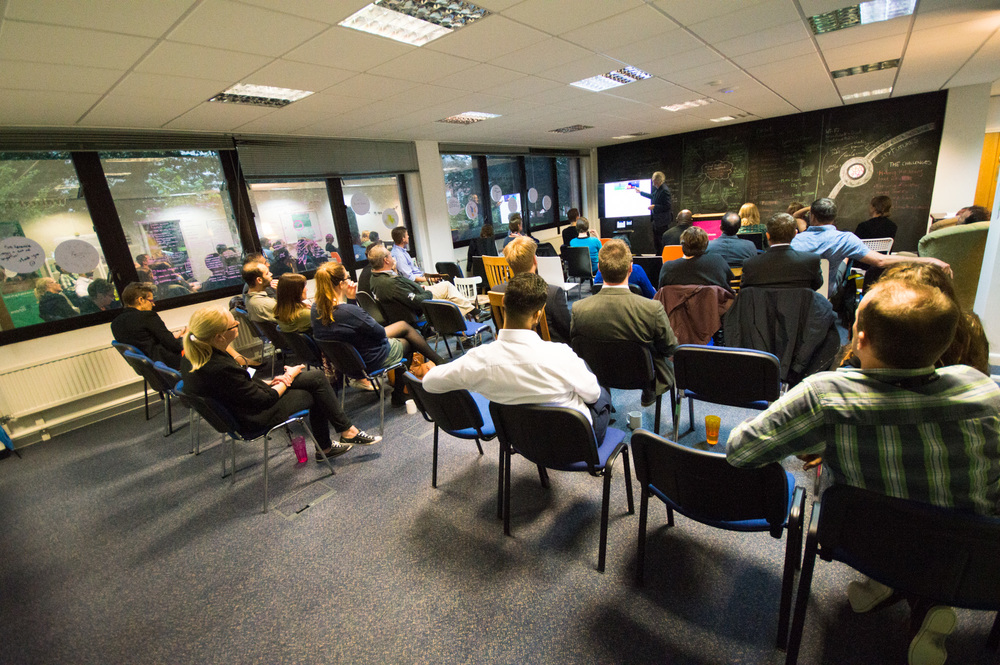
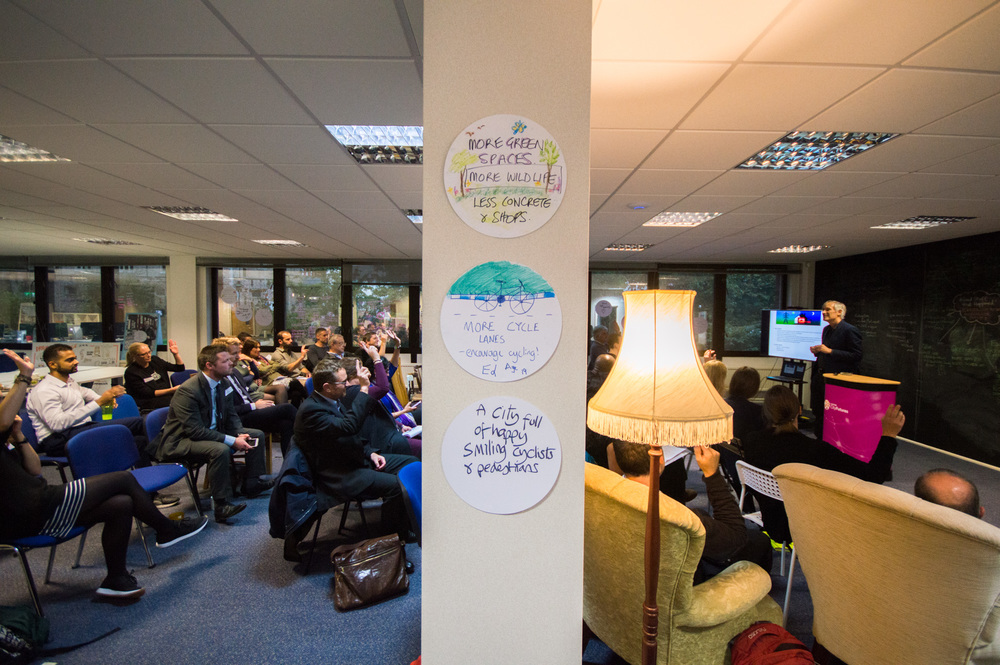
I’ve been out on the road this week, explaining the potential benefits of vehicle-to-grid technology to a variety of audiences. First up on Wednesday evening was the “Autumn Connect” event at Exeter City Futures, where I made a presentation entitled “V2G – How to simultaneously store energy and reduce congestion.”. I had the luxury of being allowed 5 minutes to present an “elevator pitch” on that subject to the assembled throng:
Here’s an expanded version of the PowerPoint slide deck I used. They all had Kasia’s “artist’s impression” of V2G in action at the top, so I’ll omit that part here. The first two slides are taken from a 2 minute pitch I presented at the Met Office on Thursday (see below) and have to conform to a template provided by the Knowledge Transfer Network. Hence:
V2G Limited
A small “smart grid” consultancy located amongst the wind and solar “farms” of North Cornwall
The “smart grid” is actually the “internet of big things”!
Producing embedded firmware for 35 years
Under a previous name provided multi-drop fleet routing interfaced to SAP for a FTSE 250 company
Long experience in electricity distribution. The Lucy Switchgear Gemini RTU firmware is our baby
Whilst we understand hardware our expertise is in designing software/firmware
Evangelising Vehicle-to-Grid technology for 5 years
I trust that is all self explanatory?! If not please see below or ask questions in the space made available for that purpose in the comments section at the bottom.
I always like to encourage some audience participation at these events, and Exeter City Futures delivered in spades! For the first time ever I didn’t need to blow my own bidirectional trumpet:
Timekeeper Lyndsey volunteered to blow the V2G trumpet for me, though ultimately it informed me that my time was up before I even managed to display the last slide, so make sure to read all about that below!
To make my “internet of big things” point I waved my trusty Raspberry Pi 3B at the audience. Here is what it looks like close up:
Dr. Sarah Ward from the University of Exeter correctly, if somewhat hesitantly, identified the mystery object. Now I’ve been programming the firmware (i.e. the software inside the hardware) in those sorts of devices for a very long time. 35 years ago single board computers were a lot slower and a lot bigger, but they still did the same sort of job. In those days they didn’t have USB ports like the Pi. Instead they had serial ports that conformed to the RS-232 standard. Getting two devices to talk to each other was always “interesting”!
I asked the audience to raise their hands if they’d previously heard of the “smart grid”. Quite a lot had:
Then I asked who had heard of the “internet of things”. Slightly more hands were raised. The point being that hardware a lot like the Raspberry Pi is at the heart of your smartphone, at the heart of the Smart Grid and (albeit in a smaller form factor) at the heart of the Internet of Things. The main difference being that the smart grid has been around quite a lot longer than the IoT! A point that some of my audience at the Met Office on Thursday seemed to agree with since they nodded their heads vigorously at that juncture!
Moving on to slide 2:
1. Our project idea
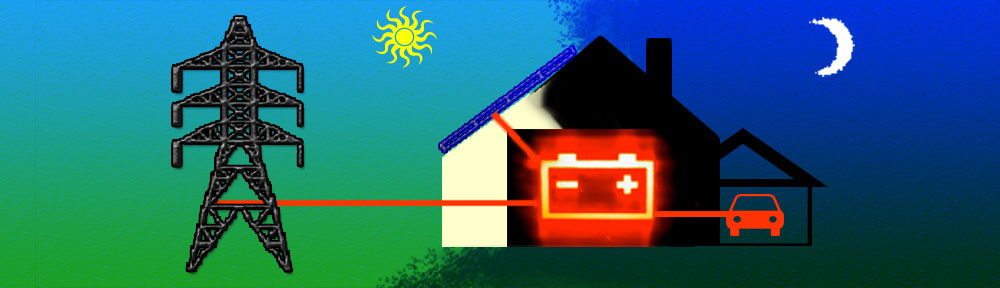
See the infographic above
North Cornwall is ideal!
Charge EVs on sunny lunchtimes
2. What’s innovative about it?
Nobody’s done it yet
On all sorts of levels!
Price signals / regulation?
3. The services we can offer?
Vast systems integration experience
Vast enthusiasm
AI for Energy Systems
4. The partners/services we seek?
Kite marked V2G hardware
An all electric car club
A suitable site
I asked the audience if it was obvious what the infographic represented. I was subsequently informed that a hand had gone up in the far corner of the room, but I didn’t notice at the time. To explain, imagine a conventional home with solar PV panels on the roof exporting excess electricity to the local distribution grid. Now add some static batteries in the utility room or the garage. Store any excess “free” energy generated when the sun is shining in that battery. When the household electric vehicle returns from the daily commute charge it up from the battery rather than from the mains, since by now the sun will be low in the sky or already below the horizon in winter.
If you have that basic hardware setup available then there’s lots of other things you can do with it! How about buying electricity from the grid when it’s cheap and storing it in your static and/or mobile batteries. Then just for starters you could sell it back to the grid when electricity’s more expensive? There are other possibilities too, which brings me on to slide 3:
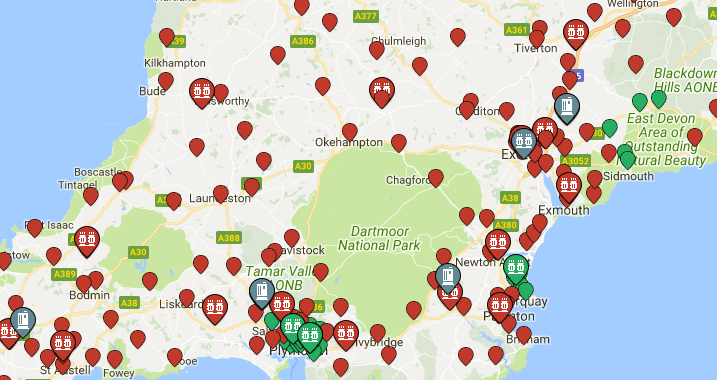
That’s a portion of Western Power Distribution‘s network constraint map. Note that most of Devon & Cornwall is plastered in red due to all the intermittent renewable electricity generation we have down here. One day (hopefully!) soon you’ll be able to earn money by allowing WPD to charge and discharge your batteries when it suits them, in order to help them cope with the stresses that intermittent generation can subject their electricity distribution grid to. The current fly in that particular pot of ointment are the rules and regulations currently enforced by Ofgem, which make it nigh on impossible for neighbouring energy “prosumers” to trade electricity with each other. Highlighting bullet point 2(c) I idly enquired if anybody else in the room “has had problems with Ofgem’s red tape?”. Not a single hand was raised in protest.
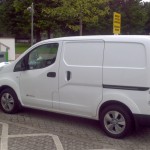
As regular readers will be aware, the town of Camelford in North Cornwall is an Air Quality Management Area (AQMA for short). Much like the centre of Exeter, the air quality in the centre of Camelford is fairly foul due to the noxious emissions of all the diesel engines that travel slowly through it. Electric vehicles can help with that, since they have no exhaust pipes and by and large use regenerative braking rather than rubbing dust off brake pads when they want to slow down. Hence slide 4 consisted of pictures of V2G capable examples of such vehicles, plus an image of the xStorage static battery storage device being produced from ex Nissan LEAF batteries by Eaton. An electric car club in Camelford and/or Exeter would be a small step along the road to reducing congestion and air pollution in both town and city centres, whilst V2G enabled vehicles in the fleet would also provide a mobile energy storage facility!
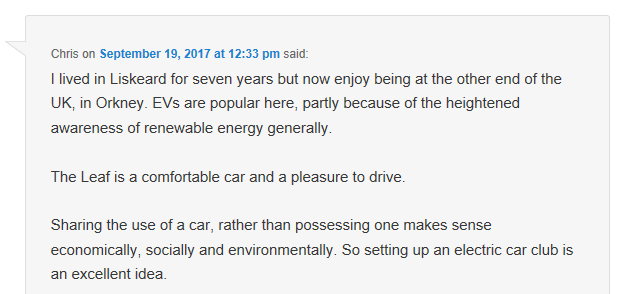
That’s about as far as I got on Wednesday before Lyndsey blew the metaphorical whistle on me, so I hastily concluded by mentioning this apposite comment from blog reader Chris:
It seems that struck a chord with at least one member of the audience. In the first image above you can see the back of Mark Hodgson’s head, if you know where to look. Mark’s Co-Cars car club certainly isn’t 100% electric, but it has just installed a couple of EV charging points in the Exeter area. That would seem to fit the bill for my bullet point 4(b) quite nicely?
Here’s the final slide I never had a chance to mention on Wednesday evening:
Of course solar PV isn’t the only form of RE generation, and batteries aren’t the only way of storing energy, at home or in the office. There’s also heat, and cold, and eddi & zappi: http://myenergi.uk/products/
What do you suppose that’s all about? To help answer that question let’s move on to Thursday and my trip to the Met Office. At least the previous evening’s rain had stopped:
I was presenting at a briefing event for Innovate UK’s Emerging and Enabling Technologies competition. I got the feeling that since this was (one of?) the first KTN briefing(s) held in Exeter most delegates weren’t making the most of the KTN’s “Meeting Mojo” facility. Anybody who ventured in there would have discovered that I was hoping to meet:
Partners who appreciate that the “Smart grid” is a subset of “The internet of things”, and predates the IoT!
whilst offering a potential consortium:
Smart Grid Consultancy: 5 years vehicle-to-grid, 15 years electricity distribution, 35 years system integration. Now with added blockchain!
Shortly before the event proper got underway I explained to the KTN’s Simon Yarwood, MC for the pitch session, that although I only had 2 slides in my deck I was actually representing 2 companies from a nascent V2G consortium. He graciously allowed me to overrun my allotted 2 minutes, and here’s what I added to the top two slides above:
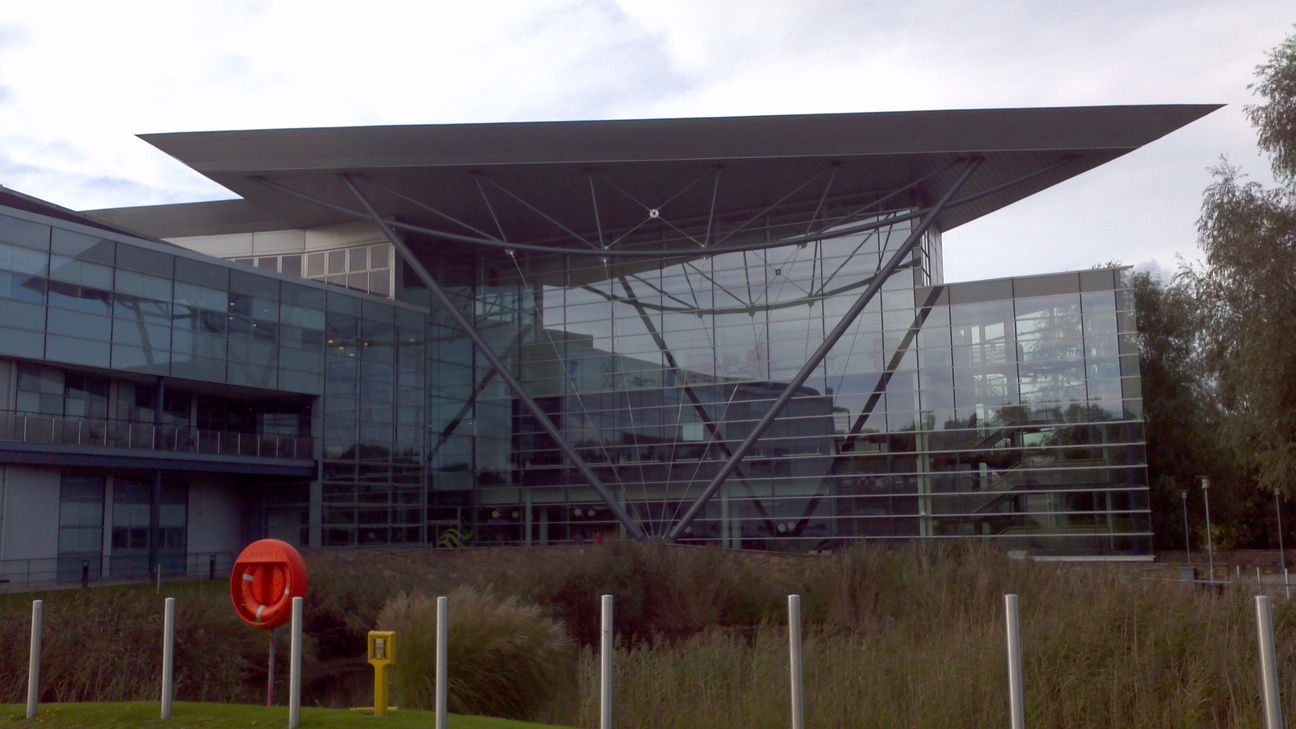
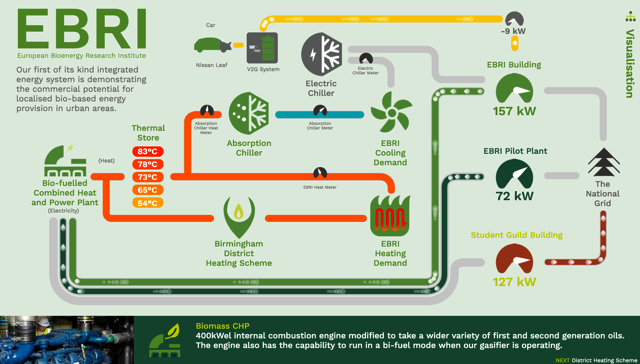
As you can see at the top of that page, a bidirectional charging station with associated static storage connected to a Nissan LEAF pool car is employed at EBRI as both an energy source and sink, in what is the UK’s first V2x pilot project. Strictly speaking it’s vehicle to building (V2B) rather than fully fledged V2G, but as far as the charging station itself is concerned that is of no consequence.
The BMS software at EBRI is now being further developed by Grid Edge Ltd. who assure me that it utilises various machine learning methods using a variety of inputs including weather forecasts, energy usage history, WiFi connections and football match schedules to optimise the overall energy use profile of the building and the assets within. As well as a modest amount of battery storage the EBRI building also includes energy storage in the form of large tanks of both hot and cold water in the basement, as indicated on the real time infographic shown above. That’s where the MyEnergi system depicted in slide 5 above comes in. It doesn’t use complex prediction or optimisation software, but it does attempt to sensibly direct the electricity generated by domestic solar PV panels to charge your EV, heat up your hot water, or if all else fails export some to the grid.
Electric Nation is an OFGEM funded electric vehicle “smart charging” trial project which:
Aims to provide local electricity network operators with the tools to be able to ensure that their networks can cope with [the] massive new challenge [of local electricity networks becoming overloaded], whilst avoiding replacing cables and substations.
The always entertaining Bobby Llewellyn explains the problem with a little help from Roger Hey, Future Networks Manager of Western Power Distribution:
As Roger puts it:
The more cars that you put in a single area, the more stress that you’re going to put on. The network was never really designed to have so many things all in one place. It was designed for powering people’s homes, for cooking. It wasn’t originally designed for transportation fuel as well!
Carl Sanderson of BMW UK adds:
What happens when, let’s say, 25% of the motoring public are plugging in their car at a similar time? Are we going to see massive blackouts? Are the lights going to go out? I think it’s a key point that needs addressing.
Andy Eastlake of the Low Carbon Vehicle Partnership suggests a solution:
One of the challenges is energy storage, and if we’re putting a huge energy storage capability into the cars can we use that to balance the grid?
To which Bobby responds:
So what you’re talking about then is very much vehicle-to-grid, [energy] going both ways, communicating smartly, the whole development of that technology?
Andy outlines the case for “smart charging” instead of full blown V2G, but adds:
There’s a problem with electricity tariffs. We’re not allowed to have lots and lots of electricity tariffs because the perception was the market will be too complex, so that’s one of the things holding back electricity supply companies in delivering creative tariffs.
Ben Godfrey, also from WPD, tells Bobby something he didn’t already know:
Effectively for every EV we connect to the network, it’s adding an extra house.
and points out that:
The interesting thing about vehicles as well is that they follow where people go. People move from town centres in the day, which is where we have the big load, to domestic places in the evening which also mirrors the load on the electricity network. If we could use the storage built into the vehicles to move that power from cities out into domestic areas then that would replace the need for us to put in extra cables which is going to cause disruption to the network.
If we can harness vehicle-to-grid then that can save us from building any extra cables, digging up roads and causing lots of disruption.
Bobby adds:
And potentially from building new power stations. You could time shift that power to a certain extent.
All in all a remarkable good advertisement for full blown V2G at the launch of a “smart charging” trial! First things first though. Is your home currently connected to Western Power Distribution’s network?
If so and if you have or are getting an electric vehicle and if you haven’t yet taken advantage of the UK Government’s home charger grant you may well be interested in finding out more about the Electric Nation trial:
Electric Nation is seeking to recruit over 500 electric vehicle (EV) owners (including pure electric and plug-in hybrids) to take part in the largest trial of its kind. Participants will charge their cars at home using a smart charger which can manage when and how their vehicle battery charges. The findings of the trial will help electricity network operators to manage the effect of the additional load caused by charging EVs on the local electricity network. This is essential for the security of electricity networks in the future and the decarbonisation of the transport sector which is responsible for approximately 21% of the UK’s greenhouse gas emissions.
In case the six letter acronym (SLA for short) in our title for today means nothing to you it stands for “Sustainable Energy Without The Hot Air“, the title of a 2008 book by David MacKay, who amongst other things is Regius Professor of Engineering at the University of Cambridge. We first mentioned SEWTHA back in 2012, when Bill Gates praised it in an interview with the Wall Street Journal. I mention it again today because my attention was drawn by a bit of a barney (BoB for short) on Twitter between Prof. MacKay and Jeremy Leggett, who amongst other things is a founding director of solar PV company Solarcentury.
First of all here’s the BoB in question, including the V2G UK addendum!
In case you would like to listen to the edition of Evan Davies’ “The Bottom Line” on the topic of “Renewable Energy” under discussion, here it is:
Evan’s guests were Jeremy Leggett, Juliet Davenport of Good Energy and Paul Cowley, managing director of RWE Energy UK. Here are of few of my own “edited highlights”:
01:30 JD – One of the examples is Wyke Farm Cheeses. When they wash down the dairy every night and when they make the cheese, that they then anaerobically digest which creates a gas and they generate power. That’s one of our generators.
02:37 JL – A small cottage with bespoke solar tiles. these are different from the modules you use in solar farms or on a big installation on a commercial roof because they really are tiles. They go straight on the battens of the house. They generate electricity. They’re waterproof.
08:45 ED – I also wanted to talk about the physical constraints on whether you can get, in a country like ours, to 100% renewables. I’ve been very influenced by a particular book called SEWTHA by David MacKay.
09:30 JL – That book was published a good few years ago now. It’s out of date and I don’t think Dr. MacKay even believes that any more.
10:18 JD – We did some work, following David MacKay’s book actually, and used the work that he did. He went on to be the scientific advisor to DECC. He developed these pathways/models and we used them to look at how hard can you push the system to get it 100%. The UK has sufficient resource, whether it’s wind, whether it’s solar, to get to 100% on the current usage. [My emphasis!]
One of the things about climate change, it’s going to change the way we use power as well. So we saw last year energy usage in the domestic gas market dropped by 10%. 2014 one of the warmest years ever. You’ve also had the highest ever wind power production this winter. We’ve seen a lot of storms come through… So the parameters that David used in that book, I think we’re now looking for Hot Air 2.0.
11:30 ED – To give another example from the book, taking that it’s out of date, to get 50 kWh per day per person, and we’re currently using 125 kWh per day, to get 50 from offshore wind would mean filling a sea area twice the size of Wales. It would be expensive. It would be a very big deal.
One of things here, and it’s been much under-discussed in this area, is not only do we need to get our current electricity decarbonised, but we’re talking about decarbonising the transport industry to a large degree, and David MacKay’s good on this. You’ve got to almost double or triple your electricity generation, so not only do we have to replace the nuclear power and the coal that’s falling out of use over the next decade. You’ve got to replace that and add in plug-in cars. [My emphasis!]
12:59 JD – That’s what really exciting about right now. We’ve got a different problem on our hands. We’re going to have different technologies coming through, and we’re going to have to figure out how consumers use that. And actually the car storage part is really interesting because each car has a battery in it, and suddenly you’ve got a flexible power source that you can either use for transport or potentially use within people’s homes. And that piece of technology hasn’t really been thought through, about what that can really deliver [Juliet’s emphasis!]
13:45 PC – We see it in the press all the time. Wind turbines not running because the wind’s not blowing! The reality is that turbines generate around 85% of the time. They start generating at a very low wind speed… and then builds up to an optimum wind speed.
14:13 ED – We haven’t got yet a very efficient mechanism for storing electricity have we?
14:25 JL – Things are moving so fast. Let’s not forget, Apple is going to be mass producing electric vehicles four years from now. That is their stated intent. Each one of those is going to be a little power plant, and who knows how they’re all going to be hooked up to each other? It’s going to move so fast Evan, and I think this is the criticism that people like me have of, you know good guys like David MacKay with his book. They’re still flogging the idea of these vast centralised, humongously expensive centralised power plants, nuclear in particular, that take 10 years to construct.
The upshot of all this, apart from the BoB? More and more people are mentioning the concept of vehicle-to-grid technology in public pronouncements here in the UK. Andrea Leadsom at DECC assures us that she’s “as keen as mustard” on energy storage. That is of course nice to hear, but what do Physics & Chemistry have to tell us about the hard realities of distributed energy storage? And what about DECC & Ofgem too, with their assorted rules and regulations?
I might also have a minor quibble about Juliet’s “hasn’t really been thought through” remark. Some people have been thinking quite hard about V2H and V2G for quite some time!