In a press release yesterday National Grid Group PLC announced that:
National Grid Electricity Transmission (NGET) has partnered with the Met Office on an innovative weather data project to help expand capacity on the electricity transmission network for wind and solar power.
The partnership is aiming to explore the value that can be derived from utilising higher specification weather forecasts to boost capacity on the electricity overhead transmission power lines, allowing more renewable energy to flow.
Currently, the electricity transmission system is limited by the individual power rating or capacity of the circuits connecting everyone across the country and, with the growth in renewable electricity generation, power flows across the existing grid infrastructure are changing, particularly at peak periods.
Historically, standard assumptions made for weather conditions have been conservative, therefore assets have operated at ratings lower than the actual capacity. To expand capacity, the £545k project, funded through the Ofgem’s Network Innovation Allowance mechanism, looks to utilise significant advances in weather forecasting by assessing the feasibility of integrating a cloud-based weather forecasting service into NGETs present Dynamic line rating (DLR) calculation methodology.
Assessing the DLR and varying the capacity of an overhead transmission power line dynamically, depends on the conductor’s physical properties as well as environmental factors such as wind speed, wind direction, ambient temperature, solar radiation etc. If the environmental conditions are favourable enough to cool the conductors sufficiently, more power can be pushed through the lines, relieving some of the network constraints – helping to meet the country’s energy needs.
Given that the United Kingdom’s energy needs are currently being met at great expense, let us all hope that every little helps.
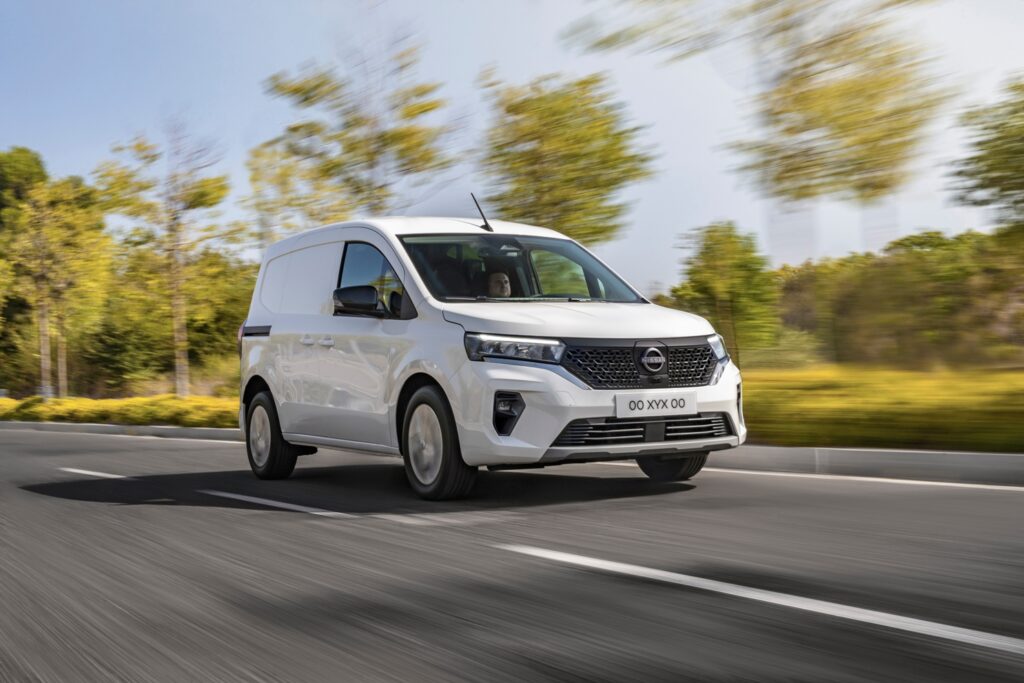
PARIS – Nissan reveals the next generation compact Light Commercial Vehicle (LCV), the all-new Townstar. With a fully electric powertrain in addition to a fuel-powered option, this new LCV range is primed to future-proof business operations and accelerate the transition towards electrification.
Demonstrating Nissan’s most technologically comprehensive LCV offering to date, the all-new Townstar brings a suite of 20+ technologies to the compact van offering, presenting a bold contender within the segment.
Building on the success of the Nissan e-NV200, a pioneer and leader in the electric LCV market, the fully electric version of the all-new Townstar is optimised to meet customer needs. With an enhanced 44kWh battery, advanced technology and low running costs the electric Townstar offers an efficient, sustainable mobility solution.
Here’s the Townstar launch video:
In view of the captions I cannot help but wonder when a right hand drive version will become available! In the meantime the press release tells us that:
The fully electric all-new Townstar will be equipped with a 44kWh battery and advanced technology. It will combine intelligent energy management and effective battery thermal cooling in one optimised package. The new van will replace the range offering of the e-NV200 and offer 245Nm of torque and 285km [range] (pending homologation)…
With a broad range of safety technologies and advanced driver assistance features such as Side Wind Assist and Trailer Sway Assist, the all-new Townstar provides a reassuring and confident experience behind the wheel. Intelligent Emergency Braking featuring Pedestrian and Cyclist Detection and Junction Assist, as well as Hands-Free Parking and Intelligent Cruise Control puts Townstar at the forefront of the category.
Nissan is integrating the Around View Monitor (AVM) for the first time in the compact van segment, democratising this cutting-edge technology. Using a suite of cameras, the system displays a 360-degree overview of the area around the vehicle, providing drivers with full peace of mind when parking in the city.
Customers of the fully electric all-new Townstar will also enjoy the innovative ProPILOT advanced driver assistance system. Supporting motorists with highway driving, the feature allows the vehicle to automatically slow to a full stop and accelerate by following the vehicle ahead, as well as keeping it centred in the lane – even around a gentle curve.
Convenient connectivity features such as E-Call, Apple CarPlay/Android Auto, and wireless phone charging will be available across the range from launch, with further enhanced Connected Services available from the launch of the fully electric version.
These connected services will be presented via an 8-inch touchscreen, which is linked to a 10-inch digital combimeter in front of the driver in the fully electric all-new Townstar.A
Built on the Alliance CMF-C platform, the all-new Townstar has been built from the ground up with quality and functionality in mind. It will bear the new Nissan brand logo, making it the first European model to be produced with it and the latest to be introduced under the Nissan NEXT transformation plan, which prioritizes sustainable growth and profitability across the company’s global operations.
The all-new Townstar van version has been developed to perfectly meet the needs of customers like SMEs who are looking for versatility, convenience, space and cargo on top of a hands-free parking system for complex city parking.
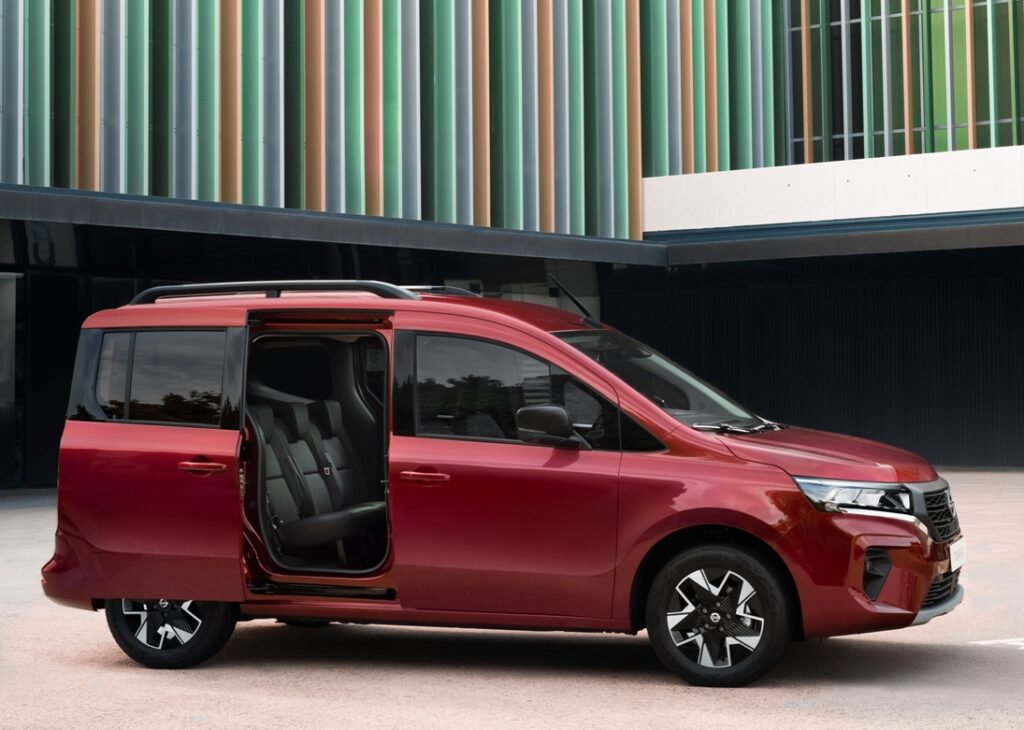
The combi version of the all-new Townstar will support families on the go with vast smart storage options that go up to 775 litres. From refined seat and door trims to a modern centre console and instrument panel finish, the all-new Townstar’s cabin welcomes customers with passenger-car-like comfort.
The fully electric all-new Townstar will reflect aesthetic cues of Ariya, including signature standard LED headlamps and an aerodynamic front shield integrating an intricate Kumiko pattern and a fresh V-motion design with daytime running lamps…
Featuring up to 3.9m3 of cargo space with a swivelling bulkhead, the new compact van can transport two Euro pallets and up to 800kg of cargo with ease, while the powerful powertrains allow the vehicle to offer a 1,500kg towing capacity, adapting to each businesses’ specific requirements.
The cargo area integrates large sliding doors on the side which facilitate unloading the van and the possibility to have 60/40 French doors with 180 degree opening or a tailgate at the rear. It also includes smart storage solutions and a dedicated space for on-board office tools.
Nissan presenta la nueva furgoneta Townstar: un cambio de juego dentro del mercado de Vehículos Comerciales Ligeros (LCV)
Unfortunately none of the above tells me what I really want to know, the ins and outs of (dis)charging the Townstar! Since there is no mention of it I can only assume that initial deliveries of the Townstar will not incorporate the vehicle-to-grid technology familiar from the e-NV200. However the Townstar specification sheet at the end of the press release does include some charging information:
Battery Capacity ( Usable )
44 kWh
Max. power
90kW (122HP)
Max. torque
245
Range estimation
Up to 285 (pending homologation)
Charging type AC
11 kw standard, or 22 kw optional
Charging type DC
75 DC in CCS
Charging time DC
0 to 80% 42 min
Battery cooling
Yes (with 22kW AC charger, or opt with 11kW)
If Nissan are working on incorporating V2G technology in the Townstar and/or the Ariya I wonder whether it will be AC or DC?
Last, but not necessarily least, here is a picture of the ICE Combi version of the Nissan Townstar:
Now I cannot help but wonder when we will be able to test drive one here in soggy South West England.
Australian Energy Regulator (AER) has filed a lawsuit against Neoen SA (NEOEN.PA), saying the French firm’s Tesla “Big Battery” in South Australia did not provide backup power during four months in 2019 for which it had received payment.
Neoen said it was disappointed with AER’s decision. It did not comment on the actual allegations.
On-demand power from storage is critical for preventing blackouts in Australia which is increasingly dependent on wind and solar farms from which energy is not always available.
Neoen’s Hornsdale Power Reserve was the world’s biggest battery when it was switched on in 2017, built after Tesla Inc (TSLA.O) Chief Executive Elon Musk said his firm could prevent blackouts in South Australia with its “Megapack” batteries….
AER said Hornsdale Power Reserve had offered to provide market services and was called on by the Australian Energy Market Operator to dispatch power in July to November 2019 during frequency disturbances – or power drops on the network – but that the energy was not supplied as needed.
“It is vital that generators do what they say they can do if we’re going to keep the lights on through the market’s transition to variable renewable generation,” said AER Chair Clare Savage.
The regulator is seeking fines and court costs for a “significant number of breaches” over the four-month period. Each breach of national electricity market rules carries a maximum penalty of A$100,000…
The AER action comes as Neoen faces potential delays with what will be its biggest battery in Australia, the 450 megawatt hour Victoria Big Battery, following a fire in one of its Tesla Megapacks.
On a press release a couple of days ago Sono Motors announced that:
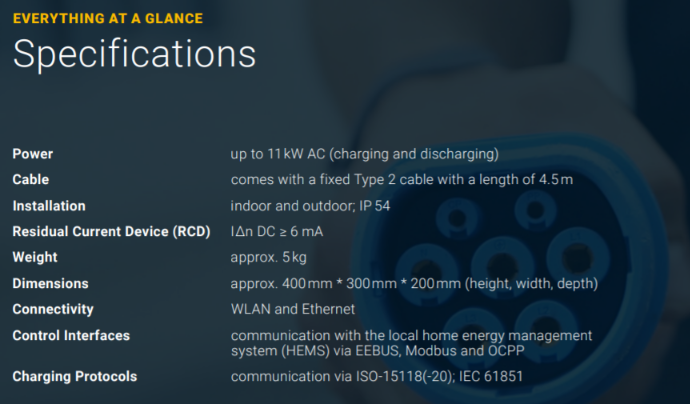
Mobility provider Sono Motors is fulfilling the Community’s desire for an affordable wall charging station, suitable for home charging, vehicle-to-grid (V2G) and vehicle-to-home (V2H) with the first bidirectional AC wallbox on the market. This brings the company a significant step closer to its vision of a world without fossil fuels. The wallbox enables the Sion to be used as a mobile power plant and also to feed stored electricity either back into their house or into the grid itself. Homeowners with photovoltaic systems especially save a large amount of money as they are able to use more of their own electricity without having to buy an expensive home storage system. The Sono wallbox charges and discharges the Sion with up to 11 kW via the integrated Type 2 charging cable, and will save up to 70% of costs incurred by DC bidirectional wallboxes available to date. It is already possible to reserve the new wallbox free of charge, delivery is expected to take place with the Sion start of production in 2023.
This is of course very exciting news, and Sono also address a question that we have been pondering for many years, and which we discussed in detail more recently with the British Standard Institution’s launch of its PAS 1878 specification for home energy management systems:
A home energy management system (HEMS) controls when the Sion is charged and discharged: the wallbox communicates with the HEMS via various protocols such as EEBUS, Modbus or OCPP. A recommendation as to which HEMS are compatible with the Sono wallbox will be available shortly after its sales launch. The Sono app and Sono infotainment can also be used to set the level of the vehicle’s battery at which discharging can be terminated. This ensures that it always has enough range to cover any mobility needs.
The specification for the Sono bidirectional wallbox looks like this:
That all looks very good, but there are a couple of flies in Sono’s ointment. Their wallbox won’t be available until 2023, and there appear to be no plans to release it in the United Kingdom.
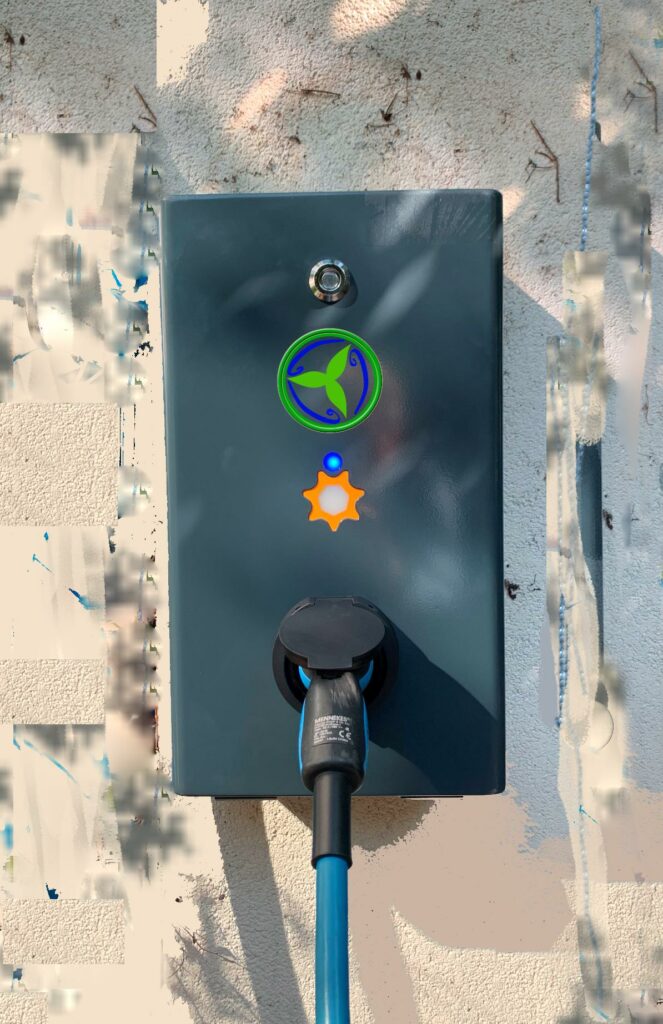
What’s more Sono’s copywriter needs a slight slap on the wrist. Here’s a picture of a 22 kW 3 phase bidirectional AC wallbox that has been available off the shelf for over a year!
Here’s Sono’s video explaining the benefits of their forthcoming, albeit less powerful, piece of equipment:
Perhaps Tillman would be good enough to appear in another Sion Motors video with more accurate commentary in the not too distant future?
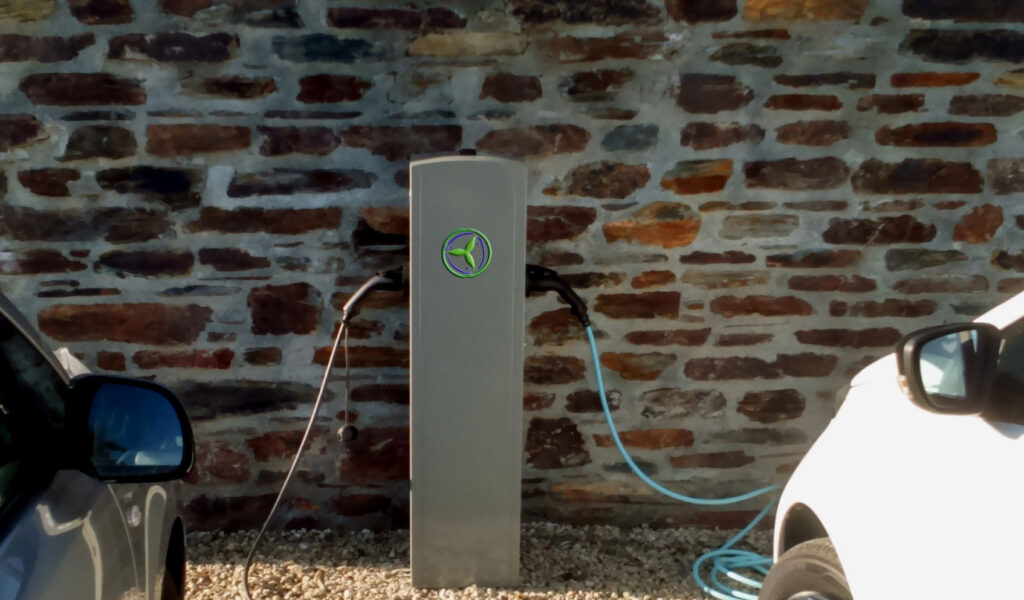
Finally, for the moment at least, here once again is a dual 22 kW bidirectional AC charging pillar that has been installed in our car park for over two years: