It’s been a very long time coming, but the International Standards Organisation has finally published what is formally known as ISO 15118-20:2022/Amd 1:2026. According to the ISO web site the amendment adds the following improvements to the previously published 15118-20 standard:
AC DER service, MCS service, and improved security concept
If the acronyms above seem somewhat opaque and your internet address indicates that you are located in the United Kingdom you will see this not entirely helpful notice when you click the link above, :
Sadly the associated British standard is not yet available for purchase from the BSI web site! Instead we are told:
Approval start date: 17/04/2026
Publication start date: 06/08/2026
Fortunately in all the circumstances I don’t need to wait for the BSI to start selling the document, or pay ISO CHF 227 for the original 15118-20 standard plus another CHF 227 for the new amendment. As a member of the committee that developed the standards I already have PDF copies on my hard drive.
Quoting extracts from the brief sample of the amendment provided on the ISO web site:
3.73 megawatt charging system MCS charging system according to IEC61851-23-3
3.76 distributed energy resource DER source of electric power that is not directly connected to a bulk power system EXAMPLE Generators and energy storage technologies capable of exporting active power to the electrical grid..
3.78 frequency droop curve parameterized curve of the frequency-watt function
3.87 ride-through ability to withstand voltage or frequency disturbances inside defined limits and to continue operating as specified
If you would like further insight into the implications of the above information, please do not hesitate to get in touch.
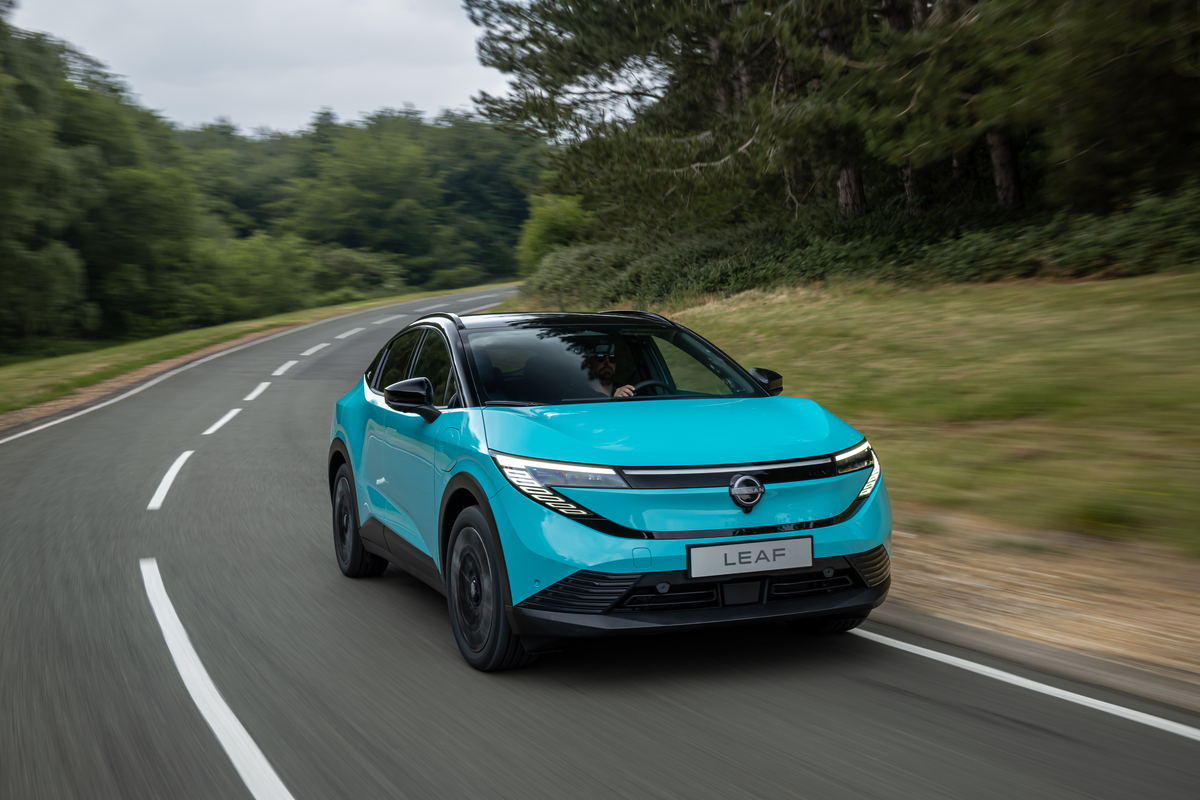
There have recently been a series of press releases from Nissan UK about their forthcoming range of electrically powered vehicles. At the end of May Nissan UK announced the electric MICRA. Yesterday they launched what was described as “The all-new LEAF“:
Today marks the debut of the all-new version of the Nissan LEAF – a British-built electric car icon.
The all-new Nissan LEAF is the next step in Nissan’s EV journey, building on its legacy as the world’s first mass-market electric car
The sleek, aerodynamic, and spacious crossover design comes with two battery options for an impressive range of up to 375 miles (WLTP), ensuring confident driving for everyday and long-distance trips
Delivers a fully connected mobility experience with Google built-in, dual 14.3” screens, and advanced driver assistance technologies
Built in Sunderland, UK, as part of Nissan’s EV36Zero initiative, supporting a sustainable electric future for Europe
This third generation of the pioneering LEAF continues to lead the charge in Nissan’s electrification strategy with a sleek design, significantly extended range, and intuitive technology that is seamlessly integrated for today’s connected driver.
Engineered to tackle key barriers to EV adoption, the all-new LEAF has a substantially increased maximum range of up to 375 miles on a single charge for a no-compromise driving experience. It also offers enhanced charging speeds (up to 260 miles of range in 30 minutes) and a suite of technologies that make both driving easier and EV ownership more rewarding.
Since its debut in 2010, the Nissan LEAF has sold close to 700,000 units worldwide, earning its place in history as the world’s first mass-market electric vehicle. Today, Nissan is ushering in a new chapter for this nameplate, re-designed and re-engineered to meet the needs of modern EV customers, while remaining true to its innovative roots…
Designed at Nissan’s Global Design Studio in Atsugi, Japan, the all-new LEAF introduces a stylish silhouette that reflects its dynamic character and aerodynamic efficiency. With a drag coefficient of just 0.25, its sleek design optimises airflow to enhance both performance and range. Flush door handles, a flowing roofline, full under floor cover, and sculpted surfaces create a modern profile, while its signature front and rear lighting delivers a distinct, high-tech identity on the road.
Pretty pictures and low drag coefficients are all very well, but “What about the all new LEAF’s V2x capabilities?” I hear you ask. Heading for the small print I learn that:
Renault have released more details about the forthcoming Renault 5, and it’s excellent news to our ears:
The future electric Renault 5 will be Renault’s first car to come with a bidirectional on-board charger.
Over the years we have covered at some length Renault’s experiments with ZOEs modified to include bi-directional capabilities, and we are pleased to hear that AC V2G will finally be going into production in the shape of the new Renault 5.
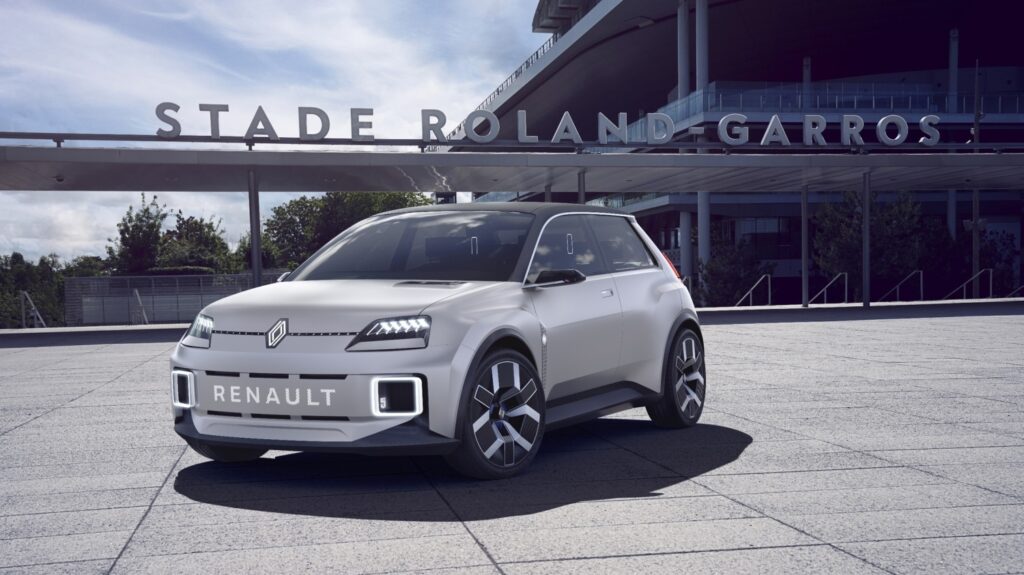
A previous press release revealed the external shape of the new R5 outside Stade Roland Garros:
Now we get to see the internals too! According to Renault:
On a press release a couple of days ago Sono Motors announced that:
Mobility provider Sono Motors is fulfilling the Community’s desire for an affordable wall charging station, suitable for home charging, vehicle-to-grid (V2G) and vehicle-to-home (V2H) with the first bidirectional AC wallbox on the market. This brings the company a significant step closer to its vision of a world without fossil fuels. The wallbox enables the Sion to be used as a mobile power plant and also to feed stored electricity either back into their house or into the grid itself. Homeowners with photovoltaic systems especially save a large amount of money as they are able to use more of their own electricity without having to buy an expensive home storage system. The Sono wallbox charges and discharges the Sion with up to 11 kW via the integrated Type 2 charging cable, and will save up to 70% of costs incurred by DC bidirectional wallboxes available to date. It is already possible to reserve the new wallbox free of charge, delivery is expected to take place with the Sion start of production in 2023.
This is of course very exciting news, and Sono also address a question that we have been pondering for many years, and which we discussed in detail more recently with the British Standard Institution’s launch of its PAS 1878 specification for home energy management systems:
A home energy management system (HEMS) controls when the Sion is charged and discharged: the wallbox communicates with the HEMS via various protocols such as EEBUS, Modbus or OCPP. A recommendation as to which HEMS are compatible with the Sono wallbox will be available shortly after its sales launch. The Sono app and Sono infotainment can also be used to set the level of the vehicle’s battery at which discharging can be terminated. This ensures that it always has enough range to cover any mobility needs.
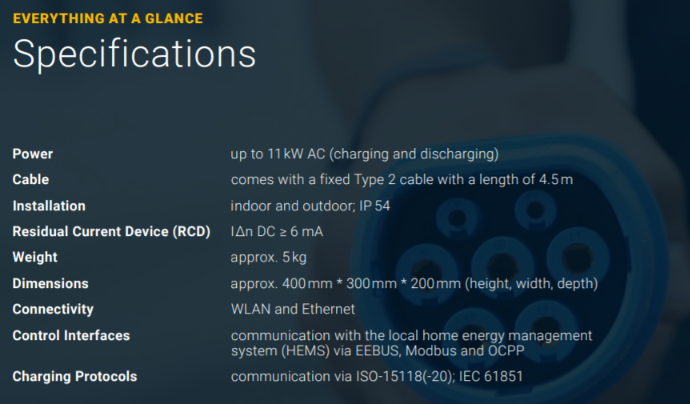
The specification for the Sono bidirectional wallbox looks like this:
That all looks very good, but there are a couple of flies in Sono’s ointment. Their wallbox won’t be available until 2023, and there appear to be no plans to release it in the United Kingdom.
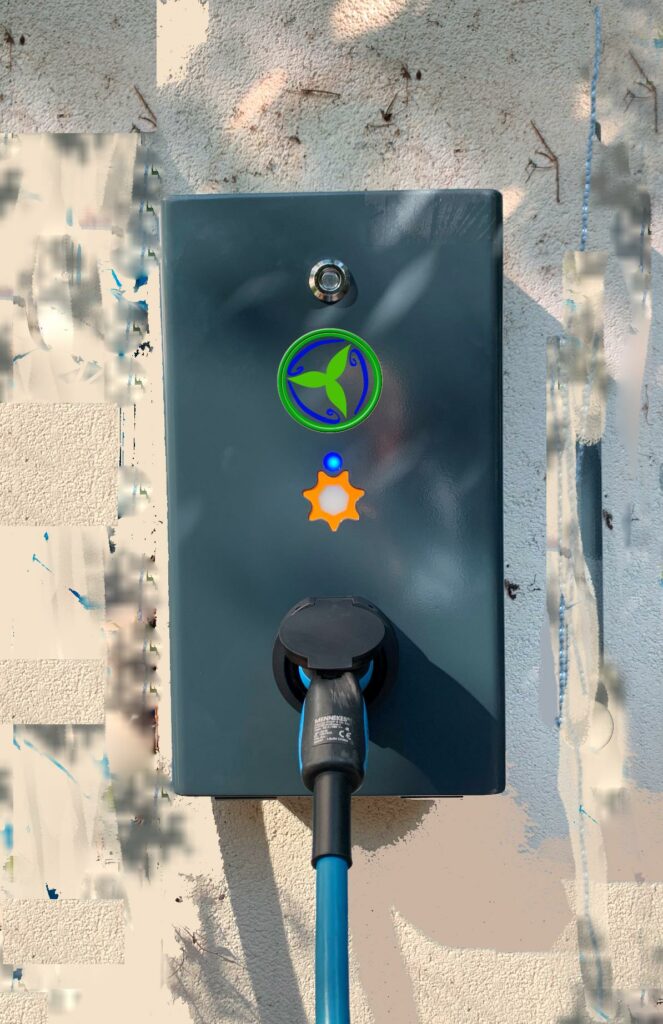
What’s more Sono’s copywriter needs a slight slap on the wrist. Here’s a picture of a 22 kW 3 phase bidirectional AC wallbox that has been available off the shelf for over a year!
Here’s Sono’s video explaining the benefits of their forthcoming, albeit less powerful, piece of equipment:
Perhaps Tillman would be good enough to appear in another Sion Motors video with more accurate commentary in the not too distant future?
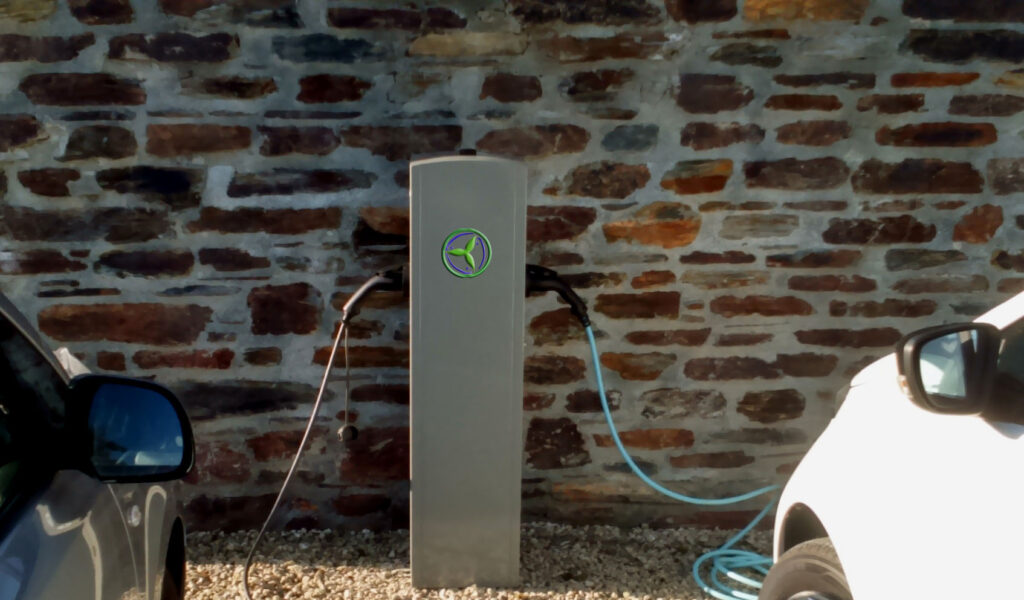
Finally, for the moment at least, here once again is a dual 22 kW bidirectional AC charging pillar that has been installed in our car park for over two years:
The United Kingdom’s Labour Party has issued two related press releases recently. According to the first one from September 21st:
Speaking on the Today programme, Shadow Chancellor John McDonnell announced that Labour will introduce 2.5 million interest free loans for the purchase of electric cars.
The loans of up to £33,000 will allow low to income households, those living in rural areas and independent contractors and SMEs middle to save on new electric cars. The government will cover the £1,500 cost of interest on a loan, with individuals saving up to £5,000 over time.
The scheme will ensure that access to the Electric Car Revolution is broadened beyond elites, as part of Labour’s vision of clean transport for everyone.
The interest-free loans will require participation in a mass trial of Vehicle-2-Grid technology which will allow the UK to transition to renewable energy.
This new technology will allow electric cars to store excess energy from the national grid, smoothing energy supply from renewable sources.
The scheme will boost the British automobile industry and support the UK’s transition away from petrol and diesel cars.
In order to jumpstart the transition to electric cars and tackle the climate emergency Labour will invest £3.6 billion into a mammoth expansion of the UK’s electric vehicle (EV) charging networks.
Labour’s rapid roll out of charging stations will eliminate concerns over driving range and lack of electric car charging infrastructure by providing enough electric charge points for 21.5 million electric cars – 65% of the UK’s fleet – by 2030. This would double the number of electric cars that the Conservatives are planning for by 2030.
The networks will be made up of ‘en-route’ Ultra-Fast charge stations along motorways, and a mixture of ‘about town’ Rapid and Ultra-Fast charge stations in more urban environments.
Electricity will be generated from renewable sources and distributed by Labour’s publicly owned grid and newly created National and Regional Energy Agencies. These bodies will also oversee the roll out of the EV charging networks and create up to 3,000 new jobs for electricians and network engineers.
These plans will create the infrastructure necessary to transition the UK away from fossil fuel driven cars to low-carbon electric cars – tackling climate change and boosting the UK’s automobile industry.
On the expansion of the UK’s EV charging networks charging Shadow Secretary for BEIS, Rebecca Long Bailey said:
“The Tories have sat on their hands as air pollution poisons our children and the climate emergency intensifies. Their inaction on electric charging infrastructure has held back the transition to cleaner vehicles and put our industry behind the curve.
“Labour is ready to jumpstart an Electric Car Revolution. We will roll out electric vehicle charging infrastructure to every city, town and village, and along our motorways.
“Under Labour, nobody buying an electric car needs to worry about running out of fuel.”
All of which is of course sweet music to our ears. Now all we need is for the Labour Party to win the forthcoming election! Failing that presumably a coalition with the Lib Dems and/or the Green Party would also approve of similar plans? Here’s our local Lib Dem candidate, Danny Chambers, inspecting the AC V2G charging post currently installed in our North Cornwall car park:
Today we are finally able to bring you exciting news of a large vehicle-to-grid installation in the Netherlands, with some unusual twists apart from the sheer number of charging stations.
In a thankfully English language article in PlaceTech it was reported earlier this week that:
Edge has delivered an office building for Triodos Bank in the Netherlands engineered to be sustainable inside and out with the latest circular construction principles designed throughout. The 135,000 sq ft office in Driebergen-Zeist, Netherlands was built with the intention to harmonise with the surrounding fauna and flora, on a construction level and beyond.
Please bear in mind that the article is referring to EDGE Technologies which is part of Dutch developer OVG Real Estate, and not the U2 guitarist!
After further description of the office building itself the article eventually gets to the part of the project of most interest to us. The solar PV covered car park:
The extensive use of renewable energy, reflected in over 3,000 m² of solar panels, as well as heat and cold storage, contributes to the energy neutrality of the building. The project encompasses ‘smart charging’ electric cars from solar energy and ‘Vehicle2grid’ technology. Vehicle2grid means that the cars cannot only be charged with solar energy but also discharged, which is called bi-directional charging. The cars become an active part of a ‘smart net’, which includes such benefits as being able to store solar energy.
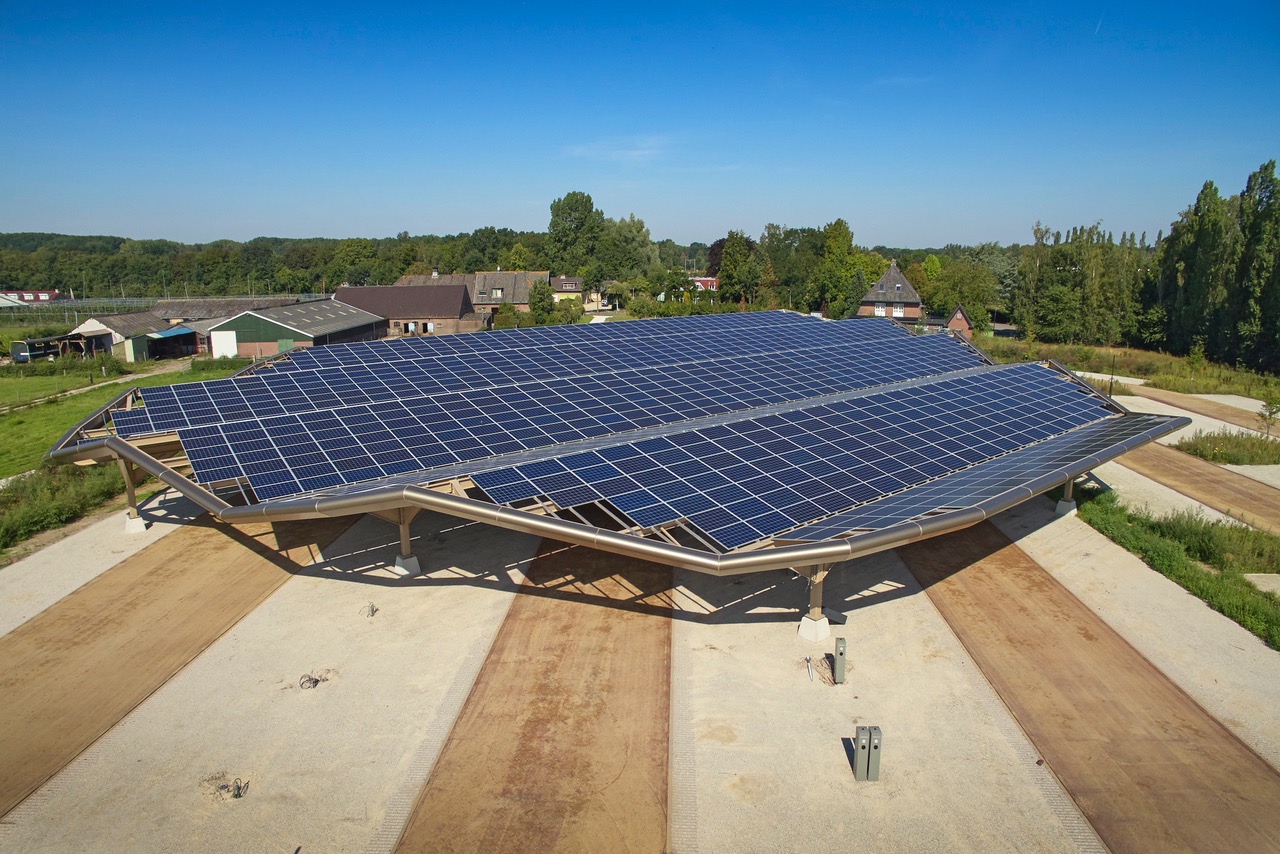
The PlaceTech article doesn’t go into any more detail than that but we certainly intend to, not least because the aerial view of the solar PV canopy reveals a number of electric vehicle charging stations that look identical to the one we have installed in our “wall to wall” V2G “living lab”:
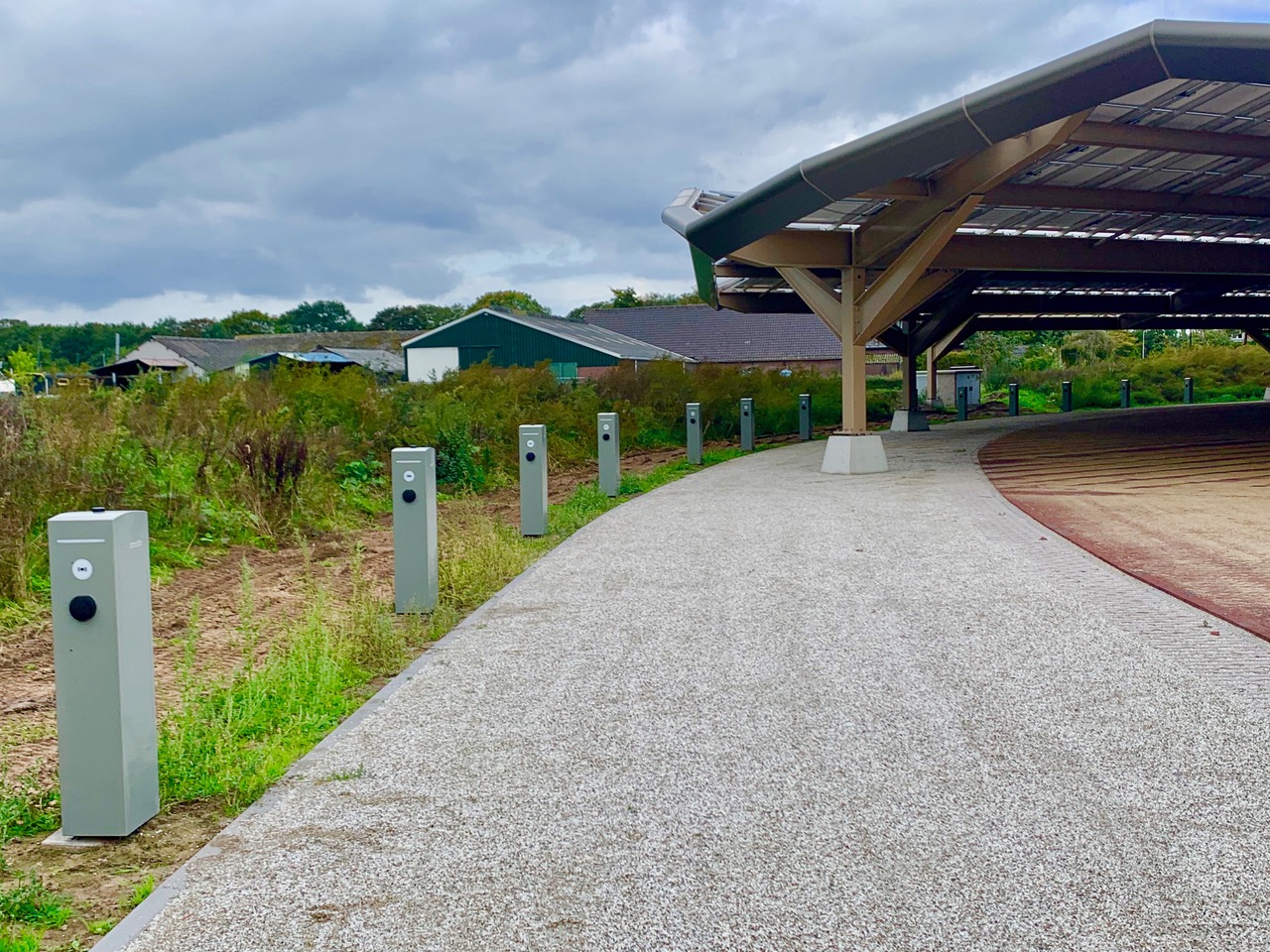
Taking a look at the new Triodos car park from ground level it becomes apparent that a large array of AC V2G capable charging stations are currently being installed, both under and around the solar PV canopy:
To find out more about what’s going on we’ve had to resort to Google Translate. According to a Dutch language article on the Triodos Bank web site from earlier this year:
The largest bidirectional charging plaza in the world is under construction at the new office building of Triodos Bank next to Driebergen-Zeist station. From this Autumn, 120 smart chargers will be able to store solar energy in the batteries of shared electric cars.
Triodos Bank have realised the project in close collaboration with developer EDGE Technologies and We Drive Solar. The bidirectional chargers are directly connected to 3,253 m² of solar panels and have a triple function. Electric cars can charge here. Cars whose battery is full enough can also supply power, so that the energy can be used in the office building or be fed back into the electricity grid.
Part of the plan is that Triodos Bank will replace its pool cars with 100% electric cars, so that they become part of the bidirectional charging ecosystem. Triodos Bank will investigate how, in addition to Triodos Bank employees, the residents of Zeist and the surrounding area can also use its shared electric cars. According to Triodos Bank director Matthijs Bierman “The plan fits in with our new ambitions in the field of sustainable mobility. We want to make car sharing as sustainable and attractive as possible. Not only for our employees, but also for the local community.”
Now 120 AC V2G charging stations sounds amazing, but where are 120 or more AC V2G capable electric cars going to come from? I can help answer that question, since I attended the launch of the We Drive Solar bi-directional ecosystem in Utrecht earlier this year. According to Renault:
A fleet of fifteen Zoe vehicles with vehicle-to-grid charging will be introduced in Europe over the course of 2019 to develop our future offerings in reversible charging and lay the groundwork for the future standards —with our partners’ help. These pilot schemes will begin today in Utrecht (the Netherlands) in an ecosystem developed by We Drive Solar and on Porto Santo Island (in the archipelago of Madeira, Portugal) with Empresa de Electricidade da Madeira, an energy supplier. Following these, more pilot schemes will be introduced in France, Germany, Switzerland, Sweden and Denmark.
So that explains 15 prototype AC V2G capable Renault ZOE’s across Europe in 2019, but that’s a lot less than 120 in the Triodos car park! As far as I am aware Renault have not announced when V2G enabled ZOEs will go into production, but when ultimately they do Triodos Bank will be ready! In the meantime I’m sure that plenty of “smart charging” will be going on in Driebergen-Zeist and across the Netherlands
All in all the project sounds a lot like a combination of our “Camelford Electric Car Club” and “Static and Mobile Distributed Energy Storage” projects, albeit on a much grander scale! That probably explains this remark by Robin Berg of We Drive Solar to Bobby Llewellyn at the recent Fully Charged LIVE event at Silverstone in the summer?
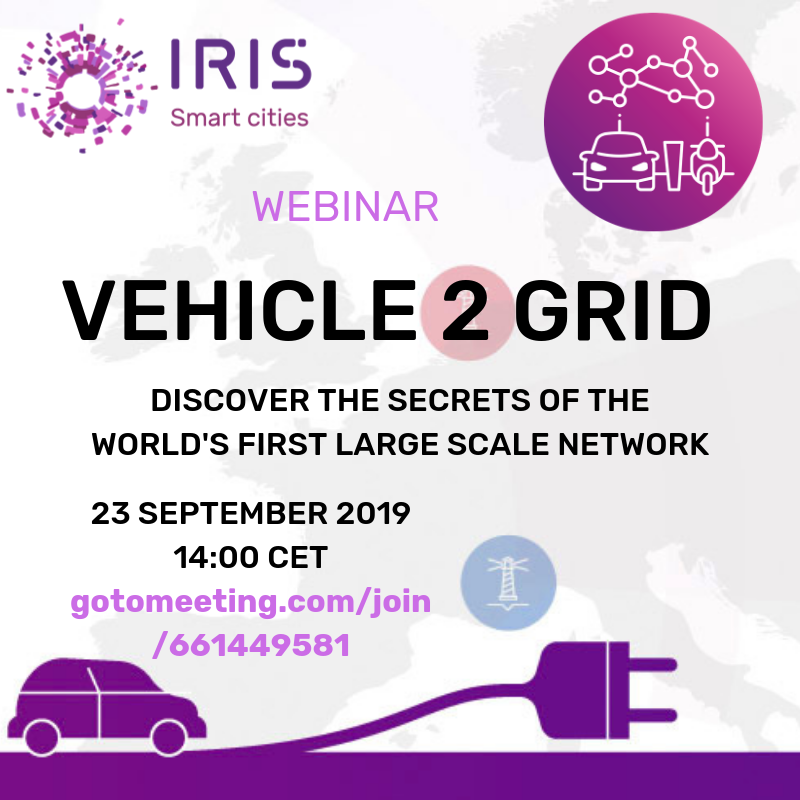
If you want to discover more about the We Drive Solar bi-directional ecosystem then please feel free to attend this webinar on September 23rd at 13:00 British Summer Time:
Groupe Renault, the European leader in electric vehicles, is beginning the first large-scale pilot schemes in reversible electric charging. Our alternating-current technology has the particularity of placing the reversible charger inside vehicles, so it just requires a simple, inexpensive adaptation of the existing charging terminals.
A fleet of fifteen Zoe vehicles with vehicle-to-grid charging will be introduced in Europe over the course of 2019 to develop our future offerings in reversible charging and lay the groundwork for the future standards —with our partners’ help. These pilot schemes will begin today in Utrecht (the Netherlands) in an ecosystem developed by We Drive Solar and on Porto Santo Island (in the archipelago of Madeira, Portugal) with Empresa de Electricidade da Madeira, an energy supplier. Following these, more pilot schemes will be introduced in France, Germany, Switzerland, Sweden and Denmark.
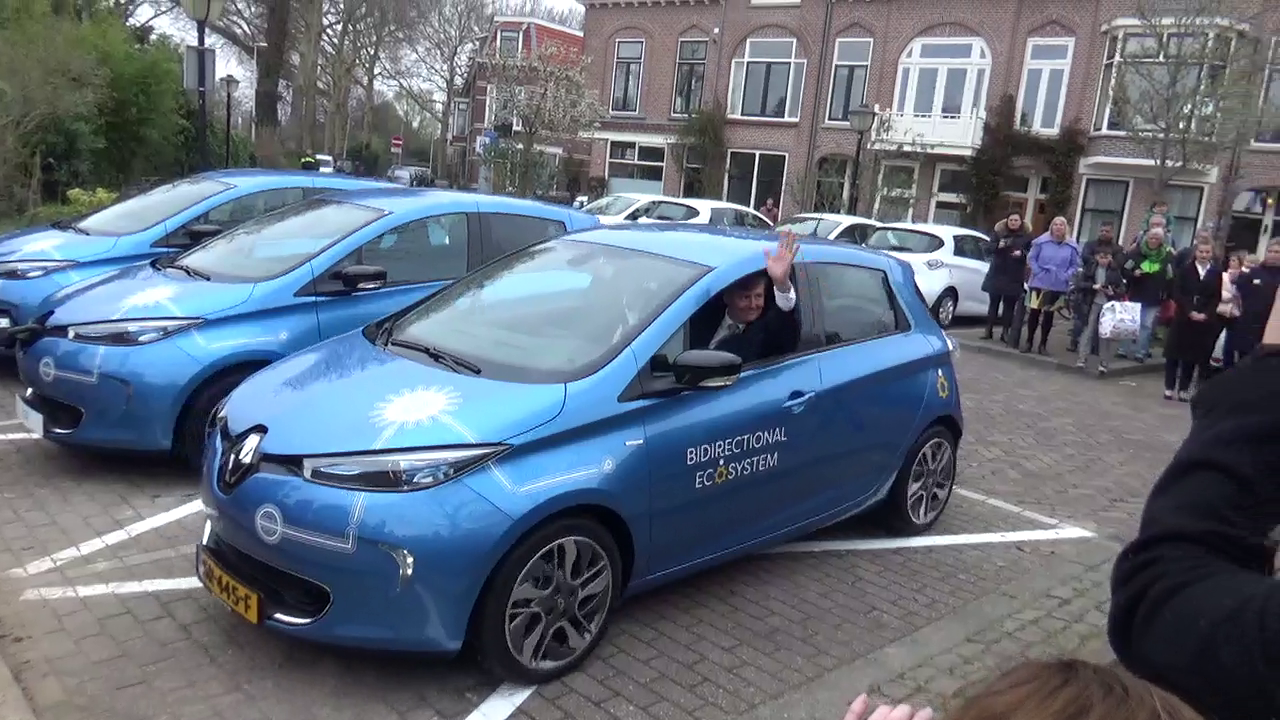
It looks like we’ll have to (metaphorically of course) twist someone’s arm at Renault to let us try one or more of their modified Zoes with AC V2G capability! I was at the launch in Utrecht today and spoke to a variety of representatives from Renault Netherlands and Renault France, who by and large seemed amenable to the idea of a suitably funded UK pilot project. Renault’s press release was of course accompanied by a variety of images. However I took lots of pictures of my own, and a fair few videos too. Here’s the three Zoes that were lined up in Utrecht today:
and here’s King Willem-Alexander of the Netherlands driving away in one of them, accompanied by Robin Berg of We Drive Solar:
Here too is a video recording of some of the excellent entertainment at the event, provided by the Hillsback Brassband:
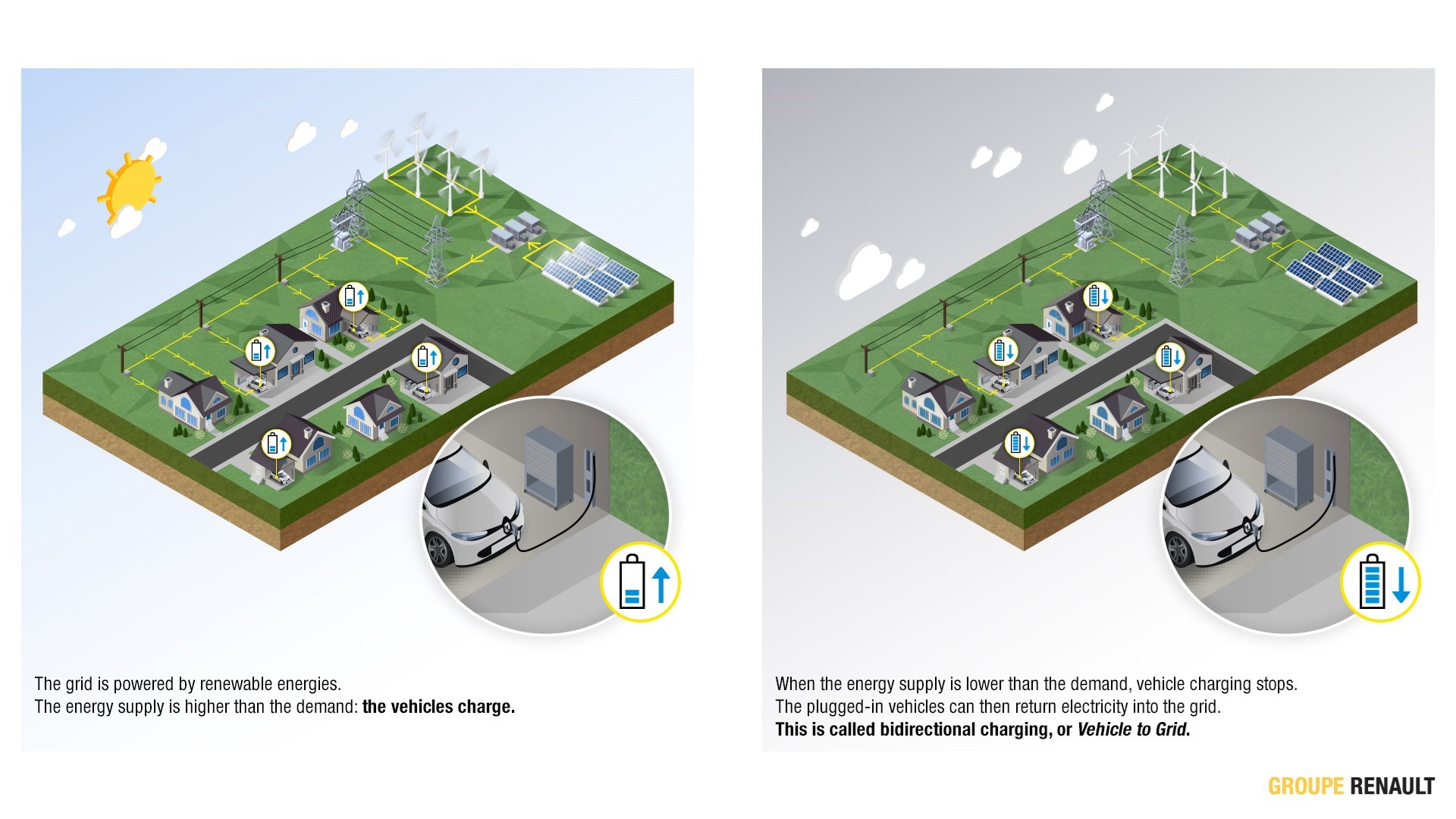
Invigorated by the brilliant brass section here’s one of the press release infographics that I couldn’t snap for myself. Renault’s visualisation of vehicle-to-grid technology in action:
2019 – Recharge bidirectionnelle
Charging during the day on the left. Discharging during the night on the right. Much like our very own V2G UK banner above! Renault’s press release continues:
Vehicle-to-grid charging — also called reversible charging — modulates the charging and discharging of electric-vehicle batteries in accordance with users’ needs and the grid’s supply of available electricity. Charging reaches its maximum level when the electricity supply exceeds demand, notably during peaks in production of renewable energy. But vehicles are also capable of injecting electricity into the grid during peaks in consumption. Electric vehicles can therefore serve units of temporary energy storage and become key drivers in the development of renewable energy. In this way, the electricity grid optimizes the supply of local renewable energy and reduces infrastructure costs. At the same time, customers enjoy greener, more economical consumption of electricity and are financially rewarded for serving the electricity grid.
Reversible charging will be piloted in several projects (electric ecosystems or mobility services) through seven countries and alongside various partners to lay the groundwork for Groupe Renault’s future offering. The aim is twofold: to measure large-scale feasibility and potential gains. In particular, these pilot schemes will help us:
Underline the technical and economic advantages of an onboard solution in electric vehicles
Demonstrate—in concrete terms—the value of services provided for the local and national electricity grid, such as encouraging consumption of solar and wind energy, checking the grid’s frequency or tension, and reducing infrastructure costs
Work on the regulatory frameworks of a mobile energy-storage scheme, detecting any pitfalls in it and offering concrete solutions
Establish common standards, the basic requirement for an industrial-scale roll-out.
I now have a few more videos of the event to go away and edit, but whilst those are being prepared here’s one that Renault provided earlier, illustrating both “Smart charging” and “Bidirectional smart charging”:
We have been following the development of the Sono Motors Sion “solar powered” electric vehicle with much interest for a while now. Here’s a new video from Robert Llewellyn’s “Fully Charged” series revealing recent progress by the Sono team:
Note in particular that at 10:35 into the video Jonny Smith says “It’s just so obvious you wonder whay it hasn’t been done before, followed by Fabian Duensing of Sion saying “This is, I would say, the secret weapon of this car”:
Through this one, the type 2 outlet, you can take back the energy from the battery of the car, not only to devices but to the grid.
Jonny clarifies:
So vehicle to grid?
To which Fabian responds:
So vehicle to grid! It’s not just hardware, it’s a lot of software as well, to make it able to actually do it.
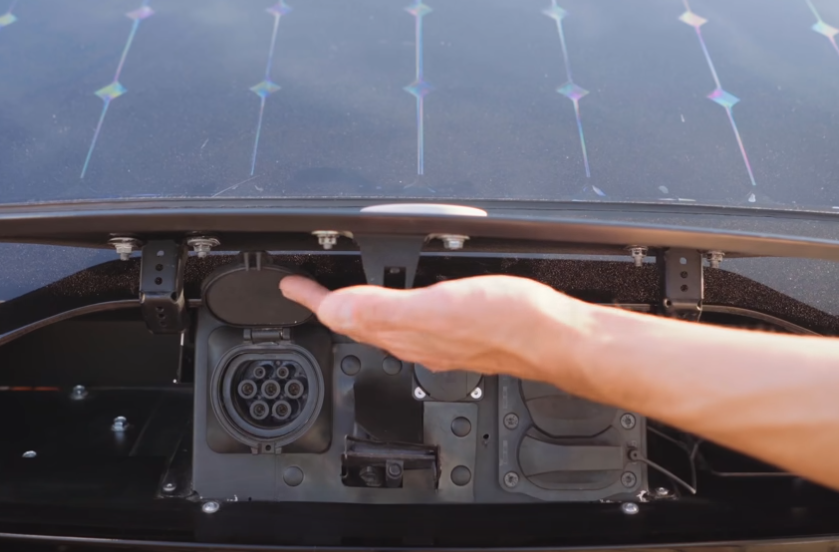
Note also that under the other side of the charging flap there is a CCS socket for DC rapid charging of the Sion’s battery pack on those long trips from the city into the countryside.