How do you solve a problem like Flexibility?

How do you catch a cloud and pin it down?
How do you find a word that means Flexibility?

We’ll get back to answering that question in due course. First some exciting news.

On November 22nd I attended the kick off meeting of a new International Electrotechnical Commission “smart grid” committee. This one is catchily entitled the “System Committee Smart Energy ad hoc Group 11 on Energy flexibility and residential DSR: common ground”, or “SyC SE ahG 11” for short.

If you follow the link just above you will discover that ahG 11’s mission is:

To consider the implementation of international residential flexibility system standards, their compatibility with national requirements, and propose best practice:

* To ensure the compatibility of end-to-end system solutions at international level,

* To identify emerging challenges related to the uptake of residential DSR,

* To consider terminology alignment, and

* To develop an accelerated report containing requirements for residential flexibility. This would give recommendations for alignment of existing national publications and flexibility projects under development with international standards. It would also identify, if relevant, the need for further standardization

Amongst other questions discussed at the kick off meeting was “How do you define the term ‘flexibility'”. Your mileage may vary of course, but since I spent 5 years of my life meeting 2 or 3 times per week on the committee developing the IEC 63110-1 document I will quote from the Committee Draft for Vote (CDV for short) of that international standard:

General concept of elasticity of resource use, (demand, storage, generation) modification of consumption and/or generation of energy/power, on an individual or aggregated level, in 371 reaction to an external signal (price signal or request) in order to provide a service within the energy system

Elasticity of resource use (demand, storage, generation), modification of consumption and/or generation of energy/power, on an individual or aggregated level, in reaction to an external signal (price signal or request) in order to provide a service within the energy system.

If you have strong objections to that definition please do not hesitate to join ahG 11, or failing that to send your preferred term of words to me so that I can bring it to the committee’s attention.

My other main action item before the next meeting in the New Year is to generate a list of existing standards, regulations etc. relevant to my particular area of expertise, which is bi-directional power transfer during electric vehicle (dis)charging (BPT for short). More commonly referred to as V2x. Since ahG 11’s term of reference includes the word “residential” this suggests an emphasis on vehicle-to-home technology (V2H for short) . However, homes are of course connected to the local electricity distribution grid, and are not forbidden from feeding electrical energy back into the grid as long as all the associated rules and regulations are adhered to.

Please let me or any other member of the committee know of any “standards” within your own area of expertise that may be relevant to “residential demand side response” (using the UK’s non standard nomenclature!), whether they be international, national, “industry de facto” or even the learnings from relevant “pilot projects”.

To give you a more graphic explanation of what we’re after, here is an extract from one of the documents on my own (by now rather long!) list; the first edition of the British Standards Institution‘s Publicly Available Specification 1878 (PAS 1878 for short)

Please feel free to suggest candidates for “standards” for communicating across any of the arrowed lines in the diagram, and alternative diagrams for that matter!
Volkswagen Announce V2H Trial For Their ID. Range of EVs

We got very excited here at V2G UK way back in February 2022 when Volkswagen announced in a press release that Markus Arand, head of brand and product communications at VW Commercial Vehicles, had said:

When you have solar panels on your home, for example, this car will be able to have a thing called bi-directional charging. You can give the energy from the ID. Buzz back to your home.

After a long wait VW have finally published a related press release. This one states that:

From now on, many models in the ID. Family now offer bidirectional charging with the “Vehicle to Home” function. With a home power station and the integrated Home Energy Management System (HEMS) from Volkswagen partner HagerEnergy GmbH, customers can cover as much of their household consumption as possible with their photovoltaic system. Both companies have launched a pilot project in Sweden in which an entire housing estate is being supplied with vehicles and the corresponding charging infrastructure.

Another pertinent piece of information is that:

Bidirectional charging is possible in all new models with the 77 kWh battery (net) and from ID. Software 3.5 or higher.

Note that the “small print” outlines a few constraints:

The discharging and bidirectional charging functions are no longer available once the intended operating time or energy quantity has been reached: Max energy quantities: Up to 10,000 kWh Discharging; Max operating hours: Up to 4,000 hours Discharging

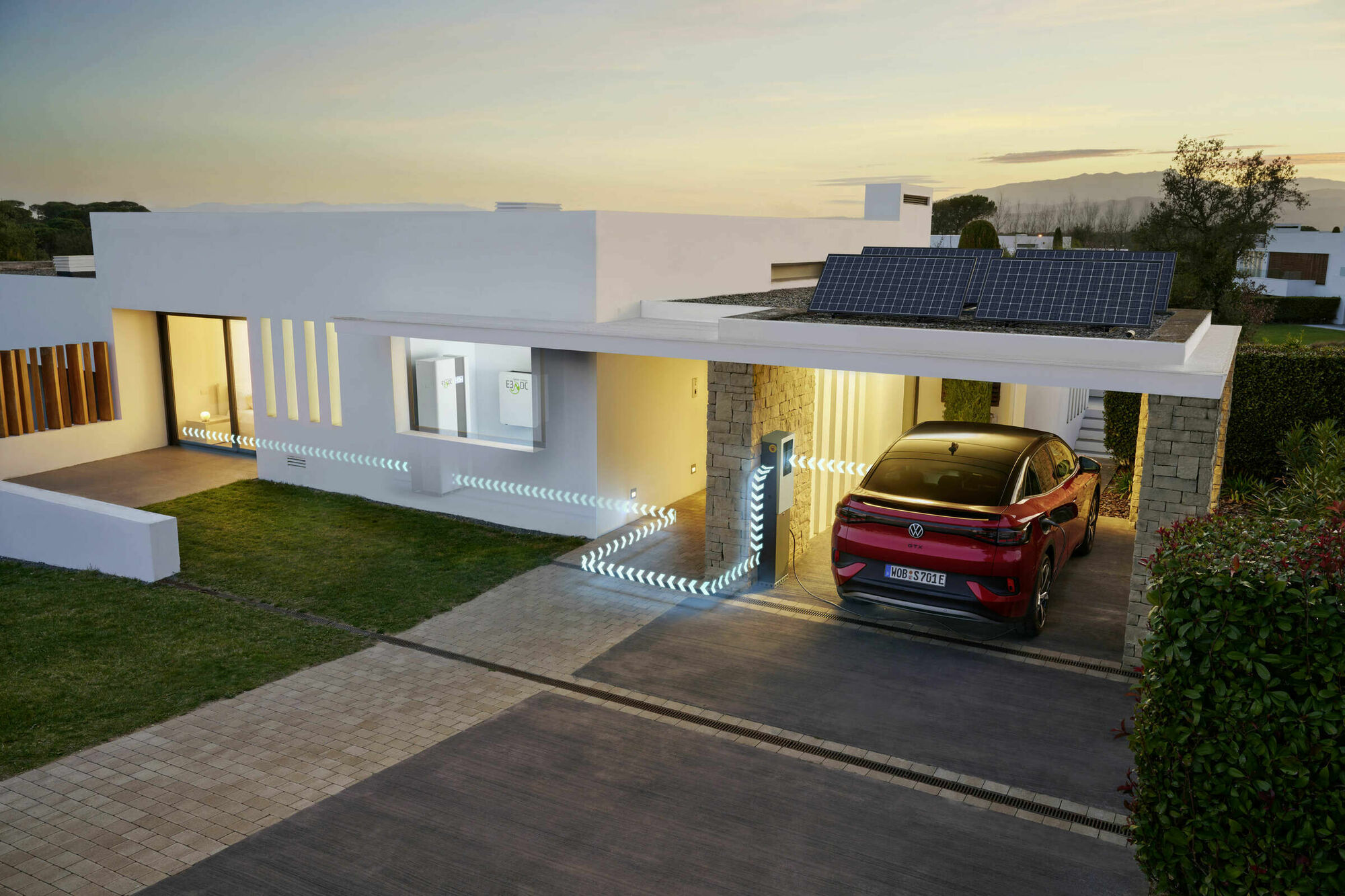
Here’s an image from the press release showing an “artist’s impression” of a VW ID.5 discharging electricity generated from a rooftop solar PV installation back into a home as dusk falls:

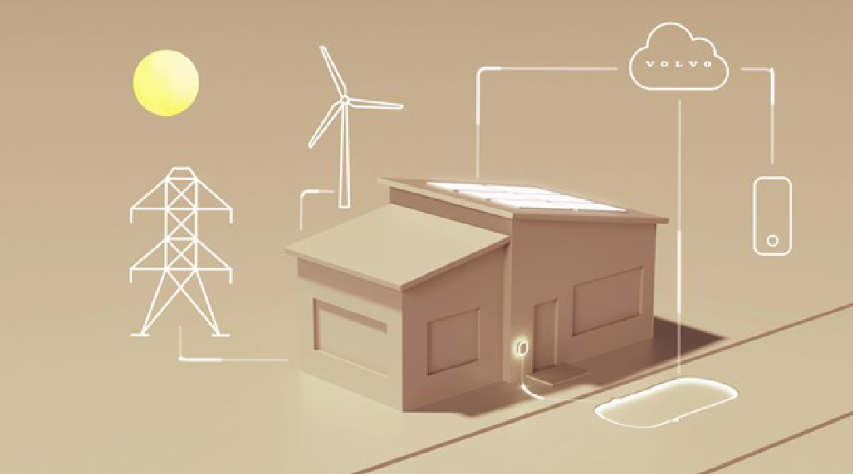
Compare and contrast the image with our own artist’s impression in the banner at the top of this article. It is now over 10 years old.

I cannot help but wonder when the first trial of Volkswagen’s exciting new V2H technology will ultimately start in a similarly equipped home here the United Kingdom, and when the current “constraints” might be raised or removed entirely?

General Motors Announces “Energy Ecosystem”

Back in March General Motors announced a vehicle-to-home pilot project in partnership with Pacific Gas and Electric. According to Mary Barra:

Bi-directional charging will help when there’s a power outage or additional demand, to really help supply energy and keep everybody having the energy they need to live their lives.

Now the next phase of General Motors’ master plan to beat Tesla at the energy game has been announced, in a press release yesterday:

The introduction of Ultium Home and Ultium Commercial, which in combination with the existing Ultium Charge 360, create a holistic ecosystem of energy management products and services that will be housed under a new business unit called GM Energy.

GM Energy’s connected product and service offerings are designed to offer cohesive energy management for home, commercial and EV customers, with solutions ranging from bi-directional charging, vehicle-to-home (V2H) and vehicle-to-grid (V2G) applications, to stationary storage, solar products, software applications, cloud management tools, microgrid solutions, hydrogen fuel cells and more. GM Energy’s services will also enable the sale of energy from EV and stationary storage batteries back to utilities during peak, high energy consumption periods, unlocking even more potential value for customers and increasing resiliency for the electrical grid.

Several large-scale companies across the U.S. have already agreed to work with GM Energy to provide energy solutions to customers and receive product or service offerings.

Among them is an agreement with SunPower, one of the nation’s leading solar technology and energy services providers. Together, the two companies will develop and offer customers a home energy system which will consist of integrated EV and battery solutions, solar panels and home energy storage. A primary feature of the home energy system is expected to enable drivers to deliver power to their homes with the battery in their compatible electric vehicle, designed to give them the ability to power their home’s necessities in a blackout or draw from stored energy during peak rate times. SunPower will also become a preferred installer for the home energy system and offer customers the opportunity to add solar to their home. The home energy system will be available alongside the retail launch of the 2024 Chevrolet Silverado EV, expected to begin production in fall 2023.

Tesla have of course yet to announce any plans for “the sale of energy from EV batteries”, but Tesla Energy predates GM Energy by several years. Will General Motors be able to catch up and overtake Tesla? Perhaps V2x technology will give GM an edge? Alternatively perhaps Tesla will also be offering V2x on their EVs by the time the 2024 Chevrolet Silverado EV starts production?

Watch this space!

The Volvo EX90 Will Support V2G!

In a press release yesterday Volvo Cars announced that:

The upcoming, fully electric Volvo EX90, which will be revealed on November 9, will be the first Volvo car to be hardware-ready for bi-directional charging capabilities. Initially becoming available in selected markets, bi-directional charging has the potential to help you make your energy utilisation cheaper, more efficient and sustainable. Paired with smart-charging capabilities coming to the Volvo Cars smartphone app, the Volvo EX90 will allow you to charge your car when demand from the grid and prices are low – usually meaning there are more renewable sources in the energy mix – and save that stored energy to be used later.
 
Once available, bi-directional charging in the Volvo EX90 could enable you to power your home, as well as other electric devices.

The press release wasn’t accompanied by any images of the EX90. I suppose all will be revealed on November 9th. However there is this video, entitled “What if your car could power your life?”. A very good question, which has been on our minds here at V2G UK for over a decade:

The video doesn’t include any images of the EX90 either, but it does include Volvo’s
Head of Electrification Ecosystem, Olivier Loedel, saying things like:

With the Volvo EX90 you can power your life.

You could use its battery in many ways, from topping up your electric bike when you’re out and about, to hooking up an outdoor cooking appliance for your weekend camping trip. It could even power your house during the expensive peak hours of the day.

The press release adds:

Depending on rules specific to each energy market, bi-directional charging could also allow customers to support the grid in different ways. This could include taking in more energy during times when there’s a surplus of renewable energy, or selling energy back during peak usage hours when there is more demand. If most cars have this functionality in the future, then the grid could be balanced more often. That could increase the overall sustainability of the grid by reducing potential energy waste from renewable sources at times when production outperforms demand.

and in the video Olivier adds:

Bi-directional charging will in the future become available through a customer offer including a wallbox and a Home Energy Management System that connects the car, wallbox and power meter of a house together…

Bi-directional charging could allow customers to sell electricity back to the power grid, for example during peak hours when demand is high:

Once again an EV OEM has come up with an infographic which bears a strange resemblance to the banner at the top of this page, which is now over ten years old. Apart from the cloud labelled “Volvo” that is! As Olivier puts it, “technical solutions to enable this are under way. We have done some research!”

All in all it sounds to me an awful lot like Volvo intend to deliver full blown vehicle-to-grid in the foreseeable future! However the press release does also include the following “small print”:

* Future technology and features are described, and capabilities may vary. Features may not be available in all markets and will not be standard in all markets or for all models.
* The bi-directional charging offer will initially be launched in selected markets. We are currently investigating which use cases we will be able to offer in different markets.
* We will equip the Volvo EX90 with the necessary hardware to support the grid, and we are currently assessing in which markets it would be possible to offer this to our customers.

Which does beget another few questions at the back of my mind. Such as:

  • “Will the Volvo EX90 and associated wallbox support AC or DC V2x?”,
  • “Will the UK be one of Volvo’s initial selected markets?”, and
  • “If so, when will this exciting technology finally become available to the (wo)man in the UK street?”

Watch this space!

Sono Announce AC V2G Wallbox

On a press release a couple of days ago Sono Motors announced that:

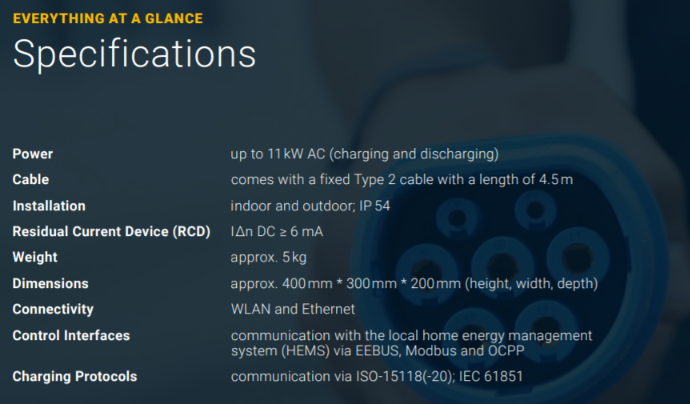
Mobility provider Sono Motors is fulfilling the Community’s desire for an affordable wall charging station, suitable for home charging, vehicle-to-grid (V2G) and vehicle-to-home (V2H) with the first bidirectional AC wallbox on the market. This brings the company a significant step closer to its vision of a world without fossil fuels. The wallbox enables the Sion to be used as a mobile power plant and also to feed stored electricity either back into their house or into the grid itself. Homeowners with photovoltaic systems especially save a large amount of money as they are able to use more of their own electricity without having to buy an expensive home storage system. The Sono wallbox charges and discharges the Sion with up to 11 kW via the integrated Type 2 charging cable, and will save up to 70% of costs incurred by DC bidirectional wallboxes available to date. It is already possible to reserve the new wallbox free of charge, delivery is expected to take place with the Sion start of production in 2023.

This is of course very exciting news, and Sono also address a question that we have been pondering for many years, and which we discussed in detail more recently with the British Standard Institution’s launch of its PAS 1878 specification for home energy management systems:

A home energy management system (HEMS) controls when the Sion is charged and discharged: the wallbox communicates with the HEMS via various protocols such as EEBUS, Modbus or OCPP. A recommendation as to which HEMS are compatible with the Sono wallbox will be available shortly after its sales launch. The Sono app and Sono infotainment can also be used to set the level of the vehicle’s battery at which discharging can be terminated. This ensures that it always has enough range to cover any mobility needs.

The specification for the Sono bidirectional wallbox looks like this:

That all looks very good, but there are a couple of flies in Sono’s ointment. Their wallbox won’t be available until 2023, and there appear to be no plans to release it in the United Kingdom.

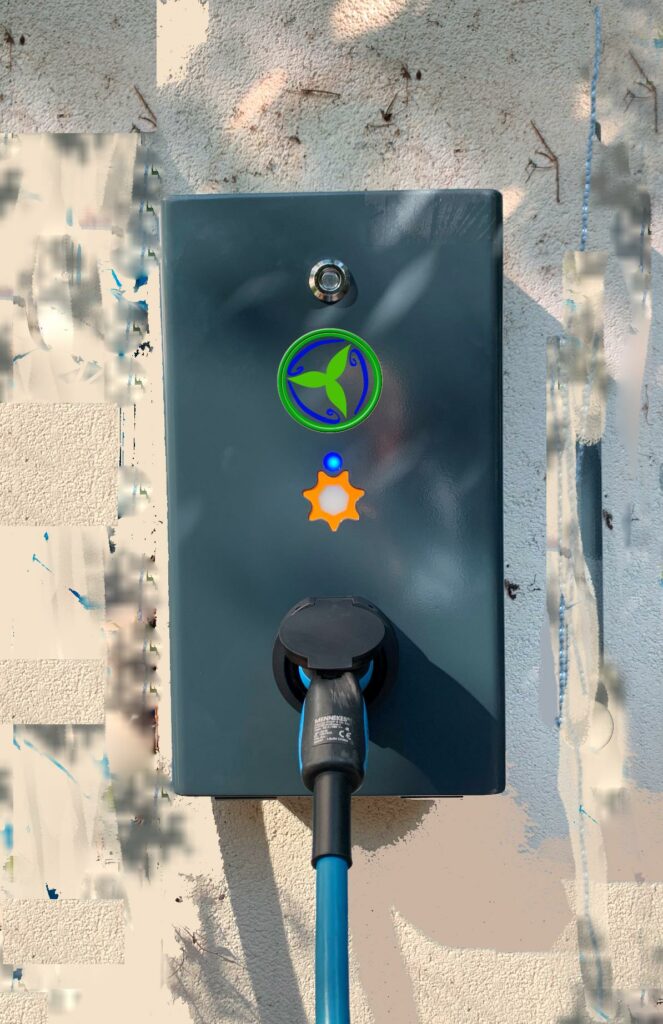
What’s more Sono’s copywriter needs a slight slap on the wrist. Here’s a picture of a 22 kW 3 phase bidirectional AC wallbox that has been available off the shelf for over a year!

Here’s Sono’s video explaining the benefits of their forthcoming, albeit less powerful, piece of equipment:

Perhaps Tillman would be good enough to appear in another Sion Motors video with more accurate commentary in the not too distant future?

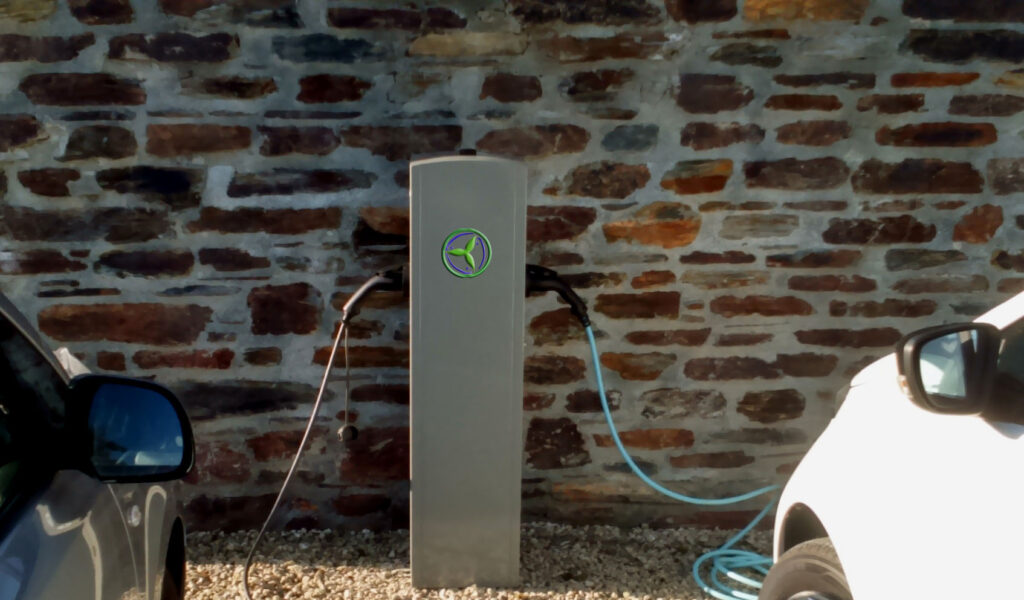
Finally, for the moment at least, here once again is a dual 22 kW bidirectional AC charging pillar that has been installed in our car park for over two years:

Nissan launches “Nissan Energy Solar” for the UK

In a press release today Nissan announced “Nissan Energy Solar“:

Nissan Energy Solar is the all-in-one solution that combines world-class residential solar panels with energy storage system to make the most of UK homes.

The solution has been designed to allow UK homeowners to reduce their energy bills and get more independence from the grid, allowing them to live more sustainably.

Traditionally, solar energy has been used to power home appliances during the day, but now with Nissan Energy Solar householders can collect and store the excess energy from their solar panels and use it during the night – even to charge their Nissan LEAF and e-NV200 – and on cloudy days.

Nissan launches Nissan Energy Solar: the ultimate all-in-one energy solution for UK homes

Nissan launches Nissan Energy Solar: the ultimate all-in-one energy solution for UK homes

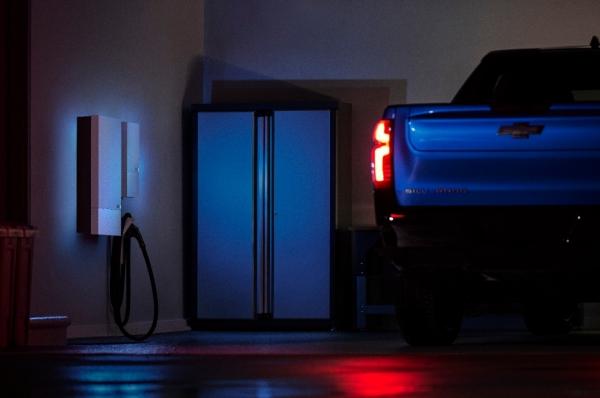
The accompanying image shows an xStorage static battery on the garage wall, but no electric vehicle is to be seen. No mention is made of discharging said absent electric vehicle, so Nissan’s new offering only delivers part of the functionality implied by our artist’s impression of our SaMDES project displayed at the top of the page.

The press release continues:

Francisco Carranza, Managing Director, Nissan Energy, Nissan Europe says ‘Solar panels have become the world’s fastest growing source of new energy and we’re thrilled to launch Nissan Energy Solar in the UK. Over 880,000 UK homes already have solar panels installed and they are seeing the benefits every day, from decreasing electricity bills to increasing property values.’

‘Nissan Energy Solar is just one step in supporting our commitment to investing in innovative energy solutions for a more sustainable future and intelligent way of living.’

The new product also includes a home energy management system that will allow users to control how and when they want to use their energy in real time as well as making the entire energy system more efficient and sustainable. The system reduces energy costs and carbon footprint for homeowners significantly, by automating energy flows, purposefully utilizing solar production peaks and storage capacities.

Nissan Energy Solar solution will start at £3881**.

Here’s the small print:

**Includes the supply and installation of a six panel solar system, Home Energy Management system, and VAT at 5%.

The xStorage unit shown in the garage obviously adds to that price, as would upgrading to the “most efficient” or “sleek integrated” solar PV panels. The product web site merely states “On sale soon” and provides no additional pricing information as yet.