California ISO Urges Electricity Conservation

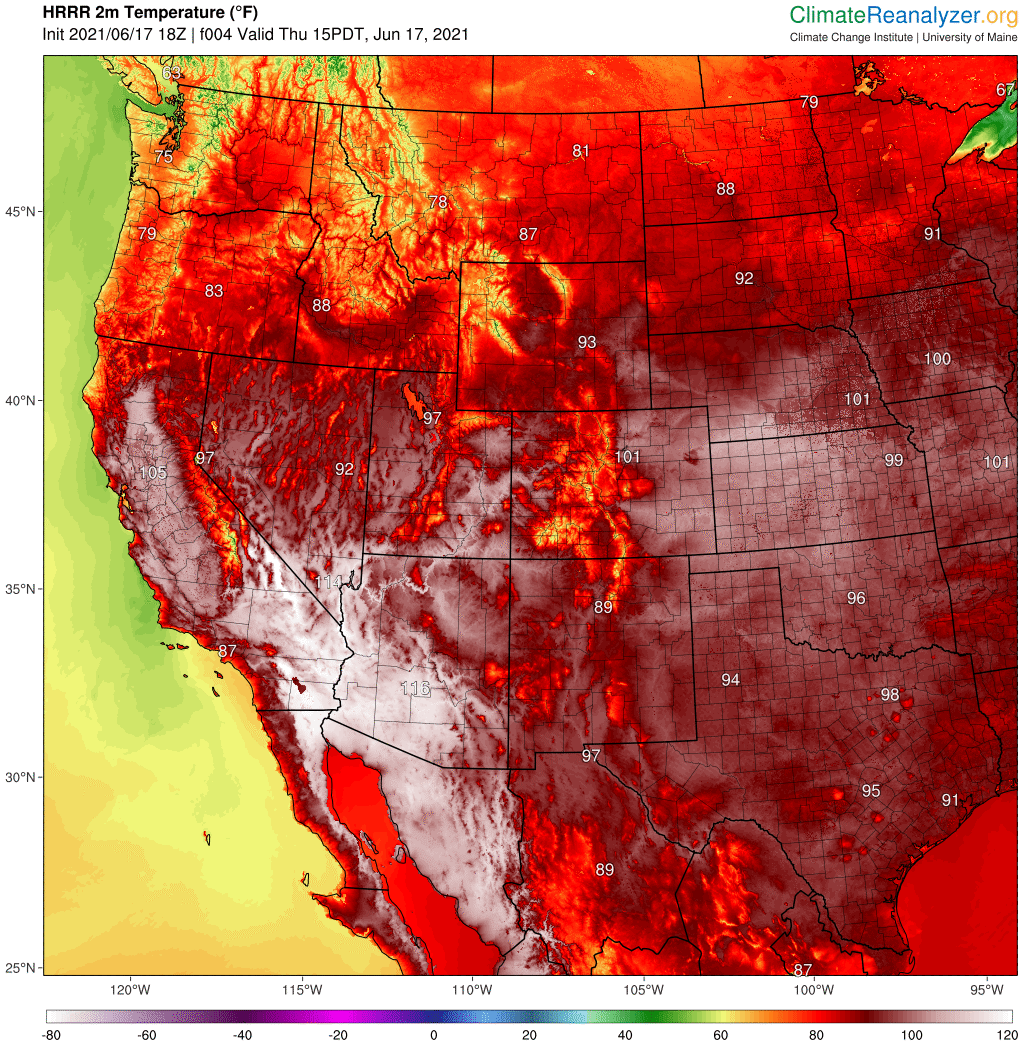
Midsummer’s Day is a few days away, and on the west coast of the United States things are heating up. Here is the surface temperature map for the western USA yesterday afternoon:
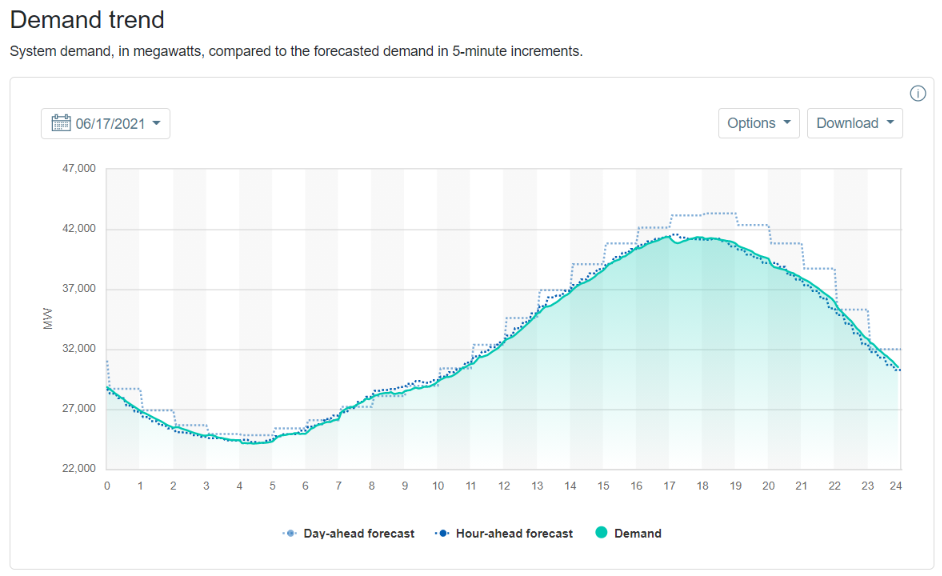
Those sort of temperatures mean that lots of air conditioning units are working hard, and consequently the California Independent System Operator (CAISO for short) called for a voluntary “Flex Alert” yesterday, in order to persuade its customers to voluntarily reduce electricity demand:

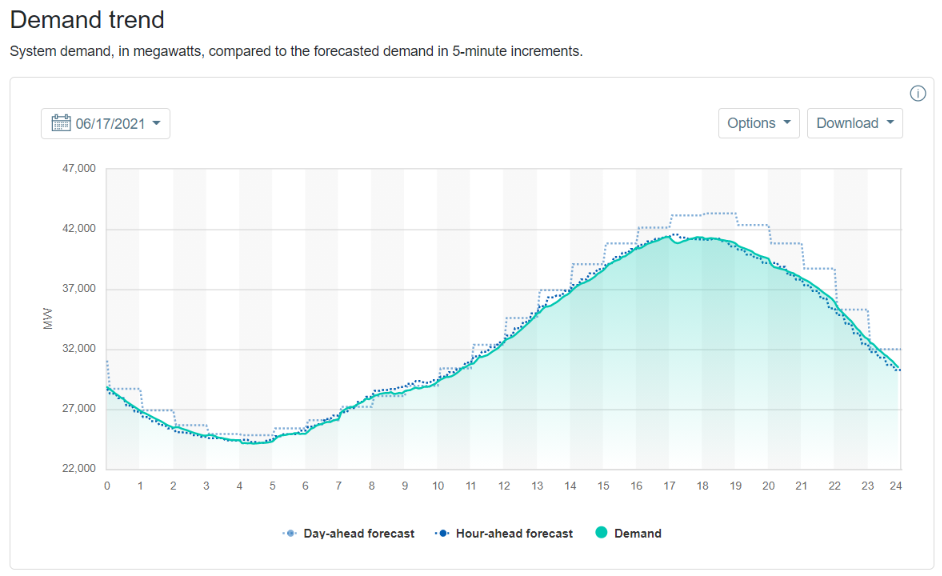
The desired aim seems to have been achieved, with the evening demand peak having been “shaved” somewhat, and with last year’s rolling blackouts averted so far in 2021:
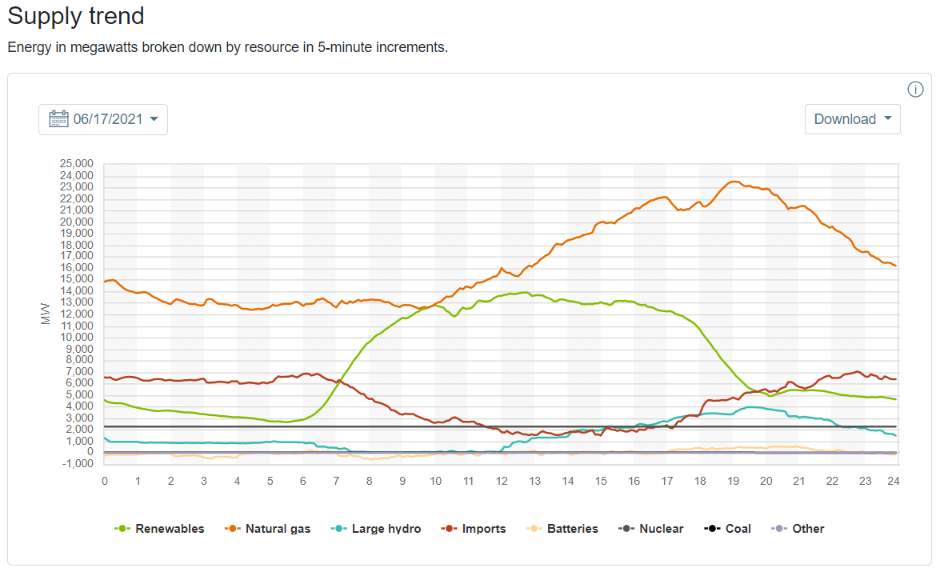
Here’s how the differing sources of electricity supply coped:
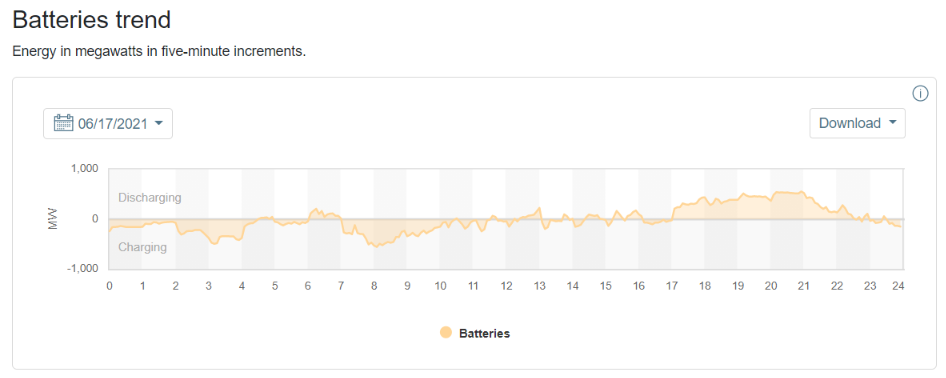
Here’s an expanded view of the contribution of the ever expanding amount Californian battery storage to electricity supply during the evening demand peak:
The California heat wave is forecast to continue today, as is another high peak in demand:
And so:

According to the California ISO news release:

Consumers are asked to conserve energy tonight and tomorrow evening by:

  • Setting thermostats to 78 degrees or higher, if health permits
  • Avoiding using major appliances
  • Turning off all unnecessary lights Consumers are also encouraged to use fans for cooling, and to unplug unused electrical items.

To be as comfortable as possible during the Flex Alert hours, consumers can take these steps earlier in the day:

  • Pre-cool your home by lowering the thermostat
  • Use major appliances, like your dishwasher, and clothes washer and dryer
  • Close window coverings to keep your home or apartment cool
  • Charge electronic devices
  • Charge electric vehicles

The ISO is continuing to monitor weather and grid conditions and will have additional announcements as information becomes available.
Merging/Migrating OCPP to IEC 63110

Today’s article is another in our occasional series endeavouring to explain the arcane world of international standards. Hence it is more technical than is usual here on the V2G UK blog, but it is possibly even more relevant than the latest V2x announcements from assorted electric vehicle manufacturers.

This morning I attended the first meeting of an IEC Technical Committee 69 Joint Working Group 11 task force set up to develop an “information document” aiming to provide helpful advice to EV charging station manufacturers as they develop future “smart grid” enabled products. This document will be more like the British Standards Institution’s recently released PAS 1878 “specification” than a full blown international standard, albeit hopefully nowhere near as long!

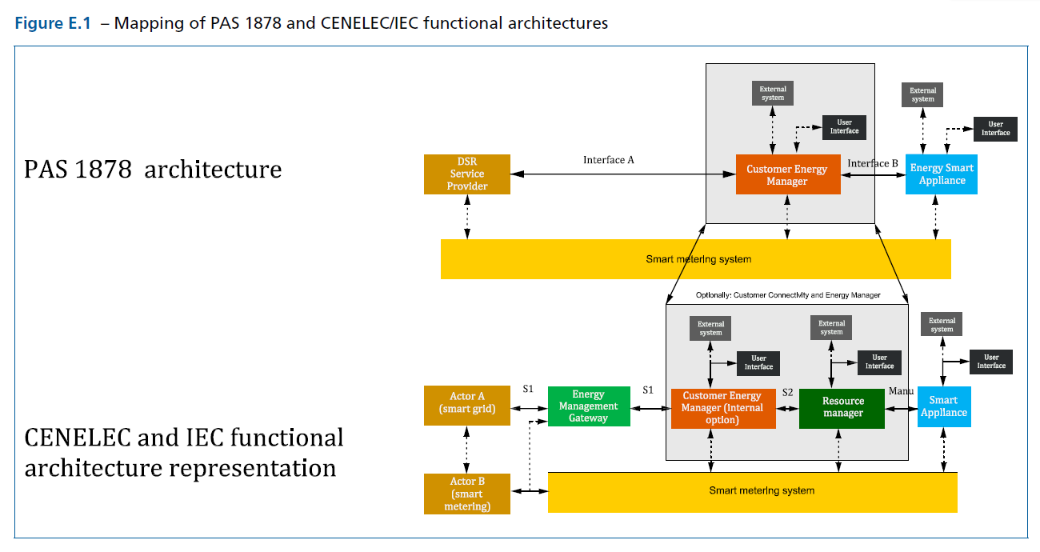
By way of an example of the sort of things that were discussed in the meeting here is an infographic from PAS 1878 which hopefully illustrates the extensive overlap between the BSI’s concept of a future “smart home” and the related concepts emerging from the work of the European CENELEC Technical Committee 205 and other standards development committees:

BSI PAS 1878 figure E.1.
PAS 1878 figure E.1. (Click to enlarge)

As annex E from the PAS explains:

This annex provides information on the relationship between the functional architecture described in this PAS and an amalgamation of the “smart grid” functional architecture included in several CENELEC and IEC standards. The representations in the CENELEC and IEC documents, whilst broadly similar, do differ slightly, hence the need for an amalgamated representation. The two architectures and how they are mapped are shown in Figure E.1. The CENELEC/IEC architecture is configured assuming that the CEM is internal to the consumer premises. As this is a functional architecture, a configuration with the CEM external to the consumer premises (e.g. in the cloud) is also permissible.

Figure E.1. shows the relationship between the PAS 1878 functional architecture and an amalgamated representation of the smart grid flexibility functional architecture depicted in several CENELEC and IEC standards, including BS EN 50491-12-1:2018, BS EN 50631-1:2017, PD IEC/TR 62746-2:2015, and prEN50491-12-2.

Expect to hear much more over the coming months and years about such esoteric things as the “Customer Energy Manager”, the “Resource Manager”, assorted “Demand Side Response Service Providers” and any number of other novel terms and acronyms. The diagram above is generic, but for the EV charging use case note that the charging station is equivalent to the “Smart Appliance” and the OCPP and/or IEC 63110 protocols are equivalent to “Interface B” in the top half of the diagram or the “Manufacturer protocol” in the lower half.

Hopefully that’s all crystal clear by now? If not hopefully it will become so by the time the newly constituted IEC task force has completed it’s work and you have read the resulting guidance document!