Regular readers may recall that in 2021 the British Standards Institution published the first edition of their Publicly Available Specification 1878 on the subject of “Energy smart appliances”? You may also recall that I wrote at the time:
A “smart” EV charging station is a special case of an interoperable Energy Smart Appliance.
The BSI has recently published a draft version of a new edition of the PAS 1878 specification, and is inviting comments from interested parties. Note that the deadline for submitting any such comments is July 9th 2025.
The BSI’s request for comments points out that:
This PAS specifies the following aspects of a system for the delivery of certain demand side response (DSR) services for domestic and small business premises…
This PAS is intended to be used by manufacturers of ESAs and CEMs.
NOTE 1 – Other audiences that might have an interest in this PAS are maintainers of ESAs, manufacturers and maintainers of interfacing products, software developers and service providers.
The introduction to the new draft includes the following information:
This is a full revision of the document, and introduces the following principal changes:
defined system architecture for both on-premises and hybrid cloud/on-premises implementations of ESAs and CEMs, and both 1-to-1 and 1-to-many CEM to ESA connections;
minimum requirements for secure communication between CEMs, ESAs and DSRSPs;
detailed sequence of DSR-based activities from consumer registration to decommissioning;
a move from OpenADR 2.0b to OpenADR 3.0 as the minimum application layer protocol to be supported by Interface A (between DSRSP-CEM);
the optional provision of flexibility performance requests from the DSRSP to enable ESAs to calculate relevant flexibility offers more easily;
updated compatibility with GB smart metering and a wide range of smart appliances – including EV charge points and battery storage;
new provisions for Open ADR 3 as the Interface A
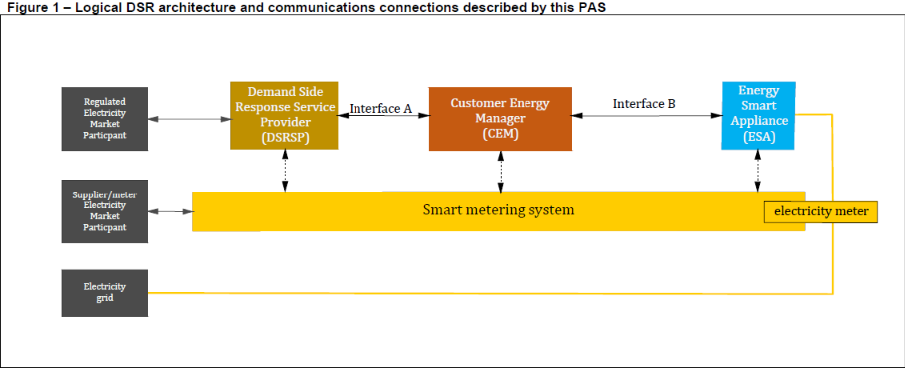
By way of a brief introduction to some of the assorted acronyms mentioned above, here is figure 1 from the draft PAS:
Clause 8 of the draft PAS includes these specific requirements regarding electric vehicle charging:
The smart EV chargepoint ESA shall be capable of reporting forecast power profiles based on operating capabilities, consumer preferences, including expected departure/arrival schedule and journey distance/ duration/characteristics, and external information, including estimates of EV battery capacity, EV state of charge (or state of charge if available via the charger – e.g. V2G, or accessible via the vehicle telematics) and EV physical operating limits. If a smart EV chargepoint supports V2G functionality and has been configured to present itself to the DSRSP as an ESA, it shall meet the information and messaging requirements specified in Clause 5 and Clause 6.
NOTE Smart EV chargepoints are not required to support V2G functionality.
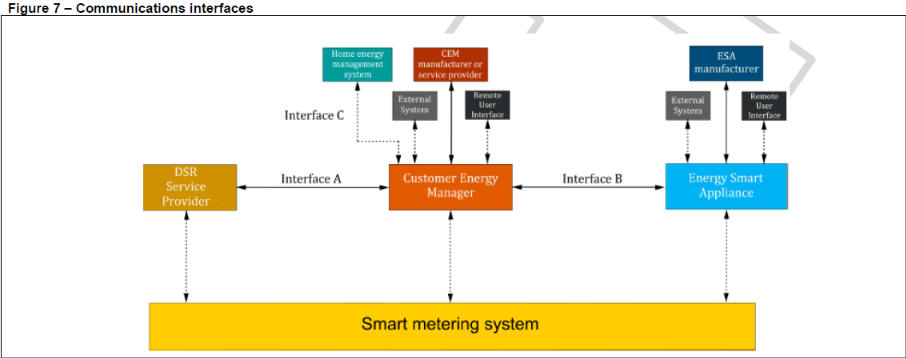
Clause 5 is entitled “Communications and messaging” and includes this diagram:
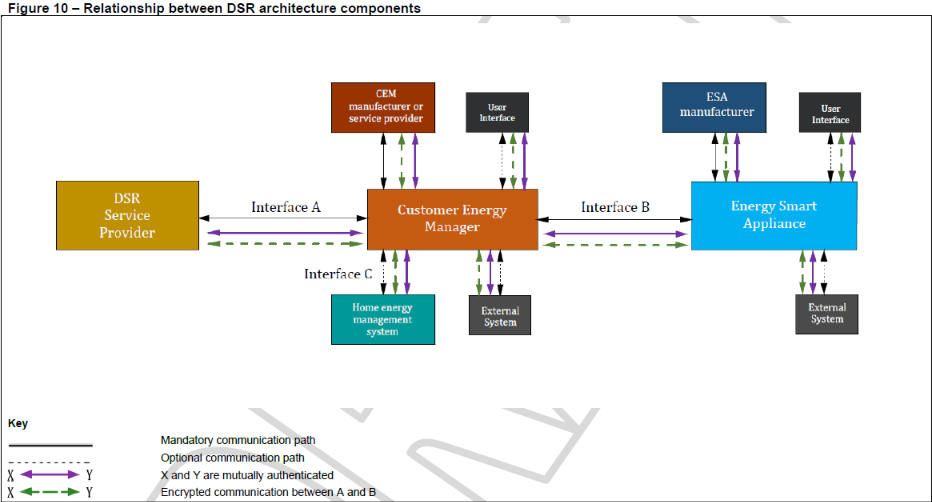
Clause 6 is entitled “Cyber security” and includes this diagram:
If you have any questions please do not hesitate to ask using the space provided for that purpose below.
This morning a new section was visible on the “Smart Tariffs” section of Octopus Energy’s web site. The new tariff is introduced by Constantine the friendly octopus as follows:
Octopus Power Pack: the UK’s first Vehicle-to-Grid tariff
Get free EV charging with our groundbreaking vehicle-to-grid (V2G) tariff
Add Octopus Power Pack to your regular tariff. We’ll set up your V2G charger to automatically manage your charging and discharging in the greenest way possible, so you can fill up for free.
A typical V2G driver could save £880 per year compared to Flexible Octopus, and £180 compared to Intelligent Octopus Go.
Power Pack represents the latest stage in our V2G rollout, following our wildly successful Powerloop V2G trial. It’s currently a beta tariff.
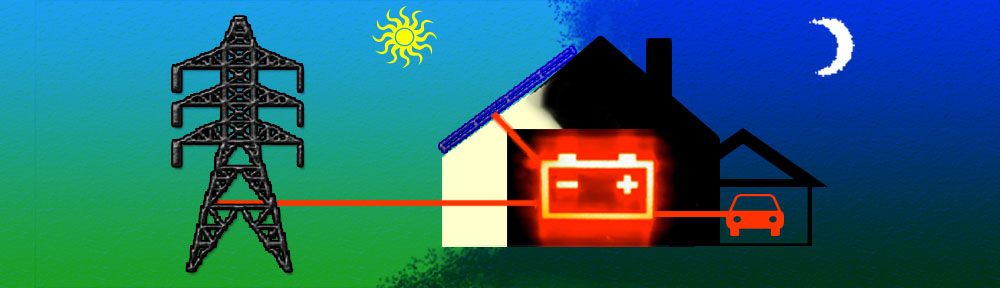
I cannot help but wonder if Constantine the intelligent octopus has been peeking at our decade old “artistic impression” of V2G technology in the domestic environment? See the banner above.
Ministers are discussing launching a public information campaign to encourage households to reduce their energy use this winter as fears grow over winter blackouts.
Households could be asked to turn their thermostats down and use their dishwashers and washing machines during the night and at times when energy demand is lower, under plans being discussed between the business department, energy companies and the network operator National Grid.
No names are mentioned of course, but allegedly:
Sources close to the discussions said that government officials and industry executives were determined to avoid blackouts disrupting the supply of energy to Britons’ homes. A public information campaign could help ease pressure on energy supplies during the winter. Ministers have so far resisted callsto tell consumers to cut their energy use, saying consumption of gas and electricity was a “decision for individuals”.
The article mentions the recent trial in Scotland run by Octopus Energy and SP Energy Networks, in which a financial incentive was offered to domestic consumers to shift the timing of their electricity demand.
Over 2,500 Octopus Energy customers across Dumfries and Galloway participated in the six-week trial*. Directed to power up their usage when green energy supply was highest, households used 20MWh more energy across the six two-hour trial windows. Households who increased their usage by more than 10% were credited back all the energy they had used during the two-hour timeframe. Those who used more than 100% extra were credited double the amount they had used. Participating customers were rewarded with an average of £5 of free energy, with some saving up to £73.
According to The Guardian once again:
National Grid will lay out its outlook for winter energy supplies on Thursday, giving the first comprehensive assessment of the risk of blackouts this winter.
The eagerly awaited document should show how resilient Britain’s energy supplies are over the coming months. An early view, published in August, showed the UK should be able to meet its energy demand in the coming months. However, since then Norway has indicated it may prioritise supplying its domestic market over exporting power.
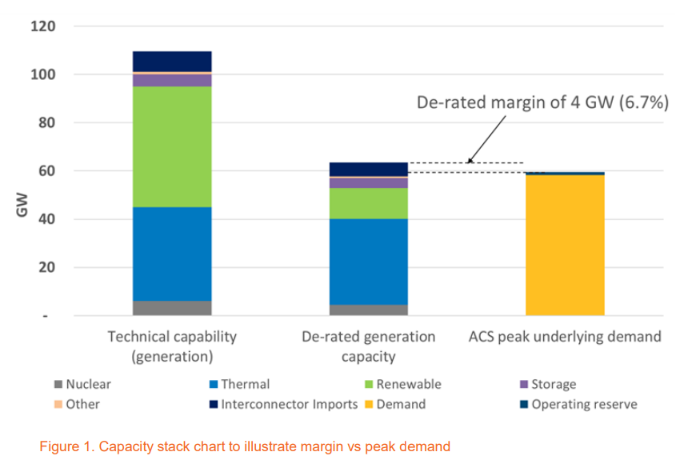
Here’s how things stacked up for the National Grid in August:
We eagerly await any changes revealed in tomorrow’s report!
[Edit – October 6th]
The National Grid Electricity System Operator has now published its “Winter Outlook Report” for 2022/23. Here is the executive summary in full:
Our first illustrative scenario examines what would happen if there were no electricity imports from continental Europe . In this scenario we would deploy our mitigation strategies – dispatching the retained coal units and our Demand Flexibility Service. By securing 4GW through these actions, we would maintain adequate margins and mitigate impacts on customers.
Our Demand Flexibility Service is new and innovative, and we have worked with suppliers, aggregators, industry, Ofgem and BEIS on the design to ensure it is ready for the winter and capable of delivering the required level of participation and response (2 GW+). It will launch on 1 November, and we are encouraging suppliers and aggregators to work with their customers to ensure the highest levels of engagement and participation. We see particular potential from commercial organisations who can shift their load from peak hours and have had positive feedback from British companies on this.
Without the Demand Flexibility Service, we would expect to see a reduction in margins. In this scenario on days when it was cold (therefore likely high demand), with low levels of wind (reduced available generation), there is the potential to need to interrupt supply to some customers for limited periods of time in a managed and controlled manner. However, we expect the mitigations outlined above to be effective.
A second, more extreme scenario, looks at a hypothetical escalation of the energy crisis in Europe such that there is insufficient gas supply available in Great Britain (in addition to no electricity available to import from continental Europe as per above scenario). In the unlikely event that escalation of the situation in Europe means that insufficient gas supply were to be available in Great Britain this would further erode electricity supply margins6 potentially leading to interruptions to customers for periods. All possible mitigating strategies, including our new measures, would be deployed to minimise the disruption.
Overall, this is likely to be a challenging winter for energy supply throughout Europe. We have taken extensive measures to try to mitigate the impacts for British consumers and expect that, under our base case, margins will be adequate. Nevertheless, there remain scenarios, driven principally by factors outside of Great Britain which could impact upon British electricity supplies. Plans are in place to ensure the impact is minimised and the overall security and integrity of Britain’s energy systems are protected.
Here too is the updated version of the “base case” supply margin chart shown above:
The chart is accompanied by these two provisos, amongst others:
Our base case assumes electricity imports from Europe are available at times when we need them to meet demand, delivering in line with their Capacity Market agreements, and that there is no disruption to gas supplies.
Our base case does not assume any material reduction of consumer demand due to high energy prices. It does not include any of our mitigation measures such as coal contracts or the Demand Flexibility Service as we would not expect to deploy them here.
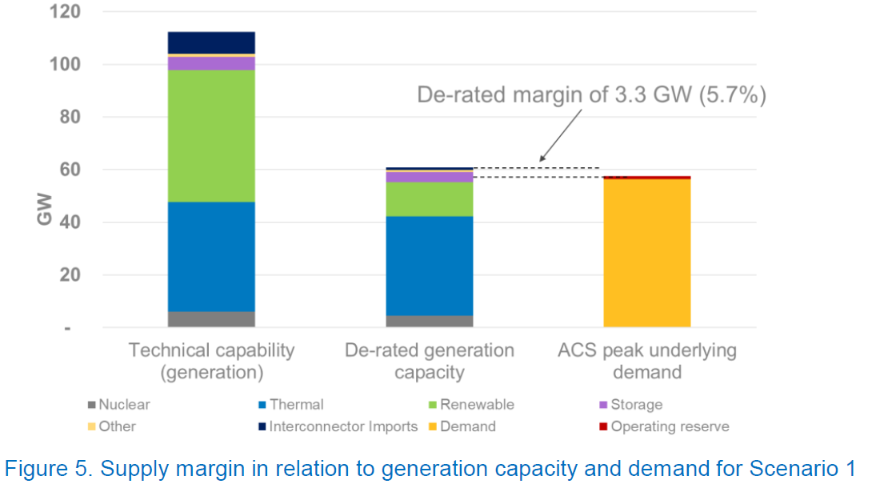
The winter outlook also considers “Scenario 1” in which there are “reduced electricity imports from Europe”:
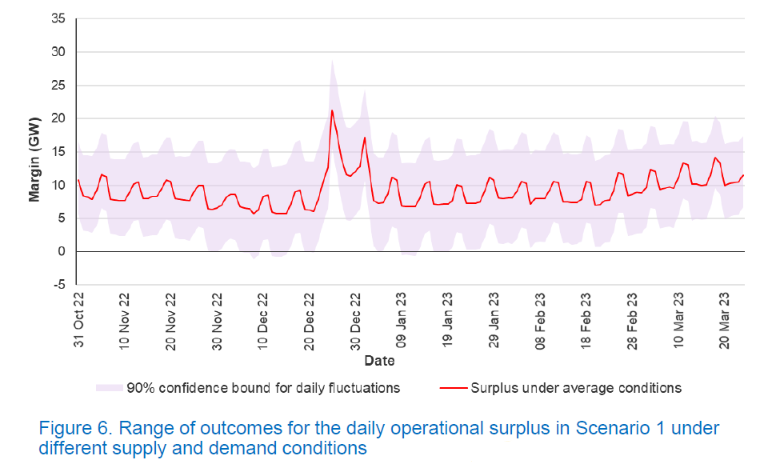
The bar chart is accompanied by a graph of “operational surplus”:
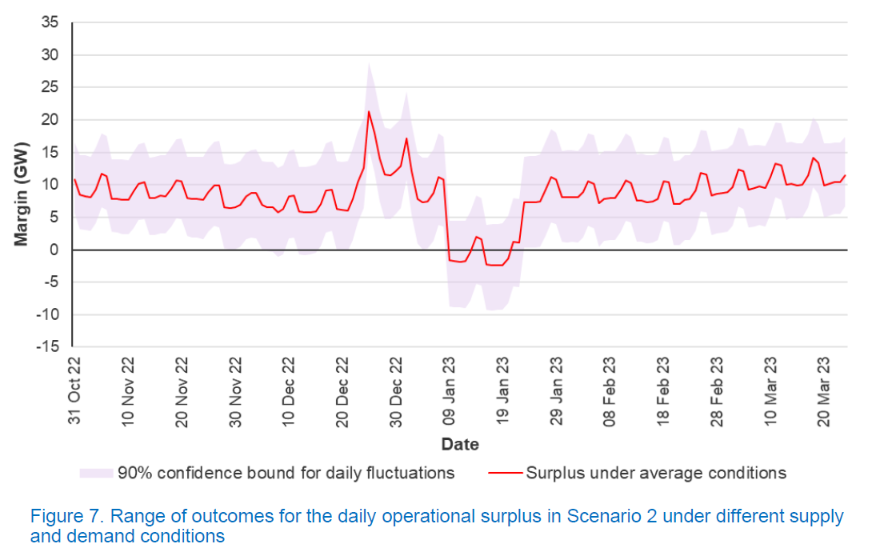
That shows National Grid’s “90% confidence” that the surplus will not turn negative over the winter. However now let’s take a look at “Scenario 2” in which there is in addition “insufficient gas supply in Great Britain”:
Due to the war in Ukraine and gas shortages in Europe, there is a significant risk that gas shortages could occur during the winter 2022/23 in Great Britain. As a result, there is a possibility that GB could enter into a Gas Supply Emergency.
Perhaps it would be prudent at this juncture for us all to cross our fingers and hope that the gas keeps arriving at Great British shores over the coming months, whether via pipeline or LNG tankers?
Though no power cuts are currently planned, in their winter outlook National Grid ESO raised the possibility of the need for planned national power cuts, in order to manage the possibility of energy demand outstripping the supply available.
Firstly, it’s important to know that before any emergency planned power cut instruction is given, National Grid ESO takes several steps to protect customers. These include:
* Encouraging additional generation through the supply market. * Asking heavy industrial users to limit their demand during peak periods. * Reducing domestic power demand – this could include paying customers to change how and when they use appliances like washing machines and dishwashers or reducing voltage across the country by a small percentage, which would be undetectable.
Procedures for emergency planned power cuts like this have existed for decades and are simulated in emergency exercises by the energy sector each year ahead of the winter.
If needed, the emergency procedures are designed to minimise the impact on customers as far as possible, by limiting power cuts to shorter periods in order to manage overall electricity demand. However, while the winter is expected to be challenging, there is no guarantee emergency measures will be necessary.
If an emergency power cut is implemented, customers in certain parts of the country would typically be without power for around three hours per day during the emergency.
Distribution network operators, which run the local power networks, would be legally instructed by National Grid ESO, which controls the flow of energy around the country, to disconnect power supplies using established procedures. These procedures are set out by the government in a document known as the Electricity Supply Emergency Code, sometimes referred to as ESEC. The procedures ensure that power is shared fairly across all customers during a national energy emergency…
If emergency power cuts are needed customers will be able to find their rota and what it means for them at powercut105.com by entering their postcode. The rota will only be published once emergency power cuts have been approved to take place.
[Edit – October 17th]
In an article in today’s Financial Times, energy correspondent Nathalie Thomas writes that:
National Grid’s chief executive has warned British households to prepare for blackouts between 4pm and 7pm on “really, really cold” weekdays in January and February in the event of reduced gas imports from Europe.
John Pettigrew said the company would have to impose rolling power cuts on “those deepest darkest evenings in January and February” if generators failed to secure enough gas from the continent to meet demand, particularly if the country suffers a cold snap.
Pettigrew’s comments at the Financial Times’s Energy Transition Summit came after National Grid, which oversees Britain’s electricity and gas systems, this month took the unusual step of setting out various “unlikely” scenarios in which Britain might not have sufficient energy supplies this winter.
[Edit – November 4th]
National Grid ESO’s Director of Corporate Affairs, Jake Rigg explained their Demand Flexibility Service on BBC Breakfast this morning. · According to a BBC article:
Households will be offered discounts on their electricity bills if they cut peak-time use on a handful of days over the winter, as part of National Grid’s efforts to avoid blackouts.
The network operator has announced details of the scheme, which it said could save households up to £100.
There will be 12 “test” days initially, designed to see how customers respond, between November and March.
But only homes with smart meters will be able to take part.
Only 14 million, less than half, of households in England, Scotland and Wales, where the scheme is being tested, have a smart electricity meter installed.
Customers taking part will be given 24 hours’ notice of a “test” day where they will be asked to reduce their peak-time electricity use if they can during a one-hour period identified by National Grid, likely to be between 16:00 and 19:00.
That could include delaying use of a tumble-dryer or washing machine, or cooking dinner in the microwave rather than the oven.
National Grid said it will pay energy suppliers, which will be required to sign up to the scheme to operate it for customers, £3 for every kilowatt-hour during the test periods.
Individual suppliers will decide how much customers will receive and whether the money is taken off bills, credited to accounts, or if there’s an option to withdraw the cash…
Today’s article is another in our occasional series endeavouring to explain the arcane world of international standards. Hence it is more technical than is usual here on the V2G UK blog, but it is possibly even more relevant than the latest V2x announcements from assorted electric vehicle manufacturers.
This morning I attended the first meeting of an IEC Technical Committee 69 Joint Working Group 11 task force set up to develop an “information document” aiming to provide helpful advice to EV charging station manufacturers as they develop future “smart grid” enabled products. This document will be more like the British Standards Institution’s recently released PAS 1878 “specification” than a full blown international standard, albeit hopefully nowhere near as long!
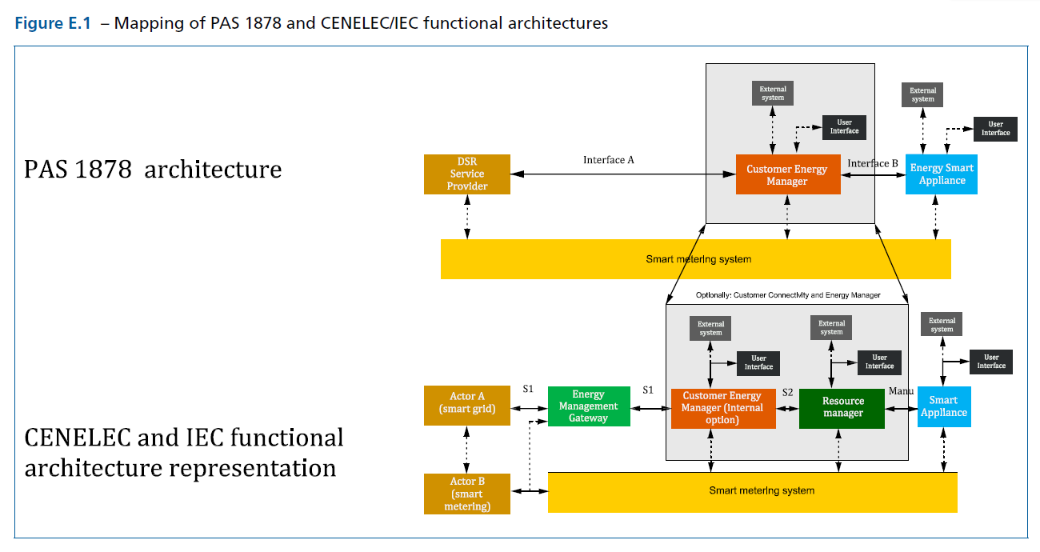
By way of an example of the sort of things that were discussed in the meeting here is an infographic from PAS 1878 which hopefully illustrates the extensive overlap between the BSI’s concept of a future “smart home” and the related concepts emerging from the work of the European CENELEC Technical Committee 205 and other standards development committees:
PAS 1878 figure E.1. (Click to enlarge)
As annex E from the PAS explains:
This annex provides information on the relationship between the functional architecture described in this PAS and an amalgamation of the “smart grid” functional architecture included in several CENELEC and IEC standards. The representations in the CENELEC and IEC documents, whilst broadly similar, do differ slightly, hence the need for an amalgamated representation. The two architectures and how they are mapped are shown in Figure E.1. The CENELEC/IEC architecture is configured assuming that the CEM is internal to the consumer premises. As this is a functional architecture, a configuration with the CEM external to the consumer premises (e.g. in the cloud) is also permissible.
Figure E.1. shows the relationship between the PAS 1878 functional architecture and an amalgamated representation of the smart grid flexibility functional architecture depicted in several CENELEC and IEC standards, including BS EN 50491-12-1:2018, BS EN 50631-1:2017, PD IEC/TR 62746-2:2015, and prEN50491-12-2.
Expect to hear much more over the coming months and years about such esoteric things as the “Customer Energy Manager”, the “Resource Manager”, assorted “Demand Side Response Service Providers” and any number of other novel terms and acronyms. The diagram above is generic, but for the EV charging use case note that the charging station is equivalent to the “Smart Appliance” and the OCPP and/or IEC 63110 protocols are equivalent to “Interface B” in the top half of the diagram or the “Manufacturer protocol” in the lower half.
Hopefully that’s all crystal clear by now? If not hopefully it will become so by the time the newly constituted IEC task force has completed it’s work and you have read the resulting guidance document!
Consumers who have upgraded to a smart meter as part of Britain’s national rollout are continuing to demonstrate high satisfaction with their new technology, and greater control over their energy bills.
Smart Energy GB, the national campaign for Britain’s smart meter rollout, today publishes the third Smart energy outlook, the largest independent barometer of national public opinion on energy and smart meters. The research surveys more than 10,000 people around the country.
More than half (52 per cent) of people with smart meters say their new meter is helping them save money
Eight in ten (80 per cent) people with smart meters have taken at least one step to reduce how much energy they use
Eight in ten (79 per cent) people with smart meters would recommend them to others
85 per cent of those with smart meters say they have a better understanding of what they are spending on energy
People with smart meters are more confident in the accuracy of their bills (81 per cent) when compared to those with traditional meters (64 per cent)
Three quarters of people with smart meters (75 per cent) say that they understand their energy bills, while just 61 per cent of people using traditional meters said the same
Nearly three quarters (72 per cent) of people with smart meters say that they have the information they need to choose the right energy tariff, far higher than those with traditional meters (57 per cent)
Just in case you are now wondering “How do smart meters work?” here’s a video explanation from Smart Energy GB:
I wonder how many of the people surveyed by Populus would be interested in having an electric vehicle capable of powering their home, together with a smart meter and a “Smart Grid” that allowed them to optimise the charging and discharging of their EV’s batteries to their own financial advantage?