According to an “exclusive” report in The Guardian:
Ministers are discussing launching a public information campaign to encourage households to reduce their energy use this winter as fears grow over winter blackouts.
Households could be asked to turn their thermostats down and use their dishwashers and washing machines during the night and at times when energy demand is lower, under plans being discussed between the business department, energy companies and the network operator National Grid.
No names are mentioned of course, but allegedly:
Sources close to the discussions said that government officials and industry executives were determined to avoid blackouts disrupting the supply of energy to Britons’ homes. A public information campaign could help ease pressure on energy supplies during the winter.
Ministers have so far resisted calls to tell consumers to cut their energy use, saying consumption of gas and electricity was a “decision for individuals”.
The article mentions the recent trial in Scotland run by Octopus Energy and SP Energy Networks, in which a financial incentive was offered to domestic consumers to shift the timing of their electricity demand.
Over 2,500 Octopus Energy customers across Dumfries and Galloway participated in the six-week trial*. Directed to power up their usage when green energy supply was highest, households used 20MWh more energy across the six two-hour trial windows.
Households who increased their usage by more than 10% were credited back all the energy they had used during the two-hour timeframe. Those who used more than 100% extra were credited double the amount they had used. Participating customers were rewarded with an average of £5 of free energy, with some saving up to £73.
According to The Guardian once again:
National Grid will lay out its outlook for winter energy supplies on Thursday, giving the first comprehensive assessment of the risk of blackouts this winter.
The eagerly awaited document should show how resilient Britain’s energy supplies are over the coming months. An early view, published in August, showed the UK should be able to meet its energy demand in the coming months. However, since then Norway has indicated it may prioritise supplying its domestic market over exporting power.
Here’s how things stacked up for the National Grid in August:
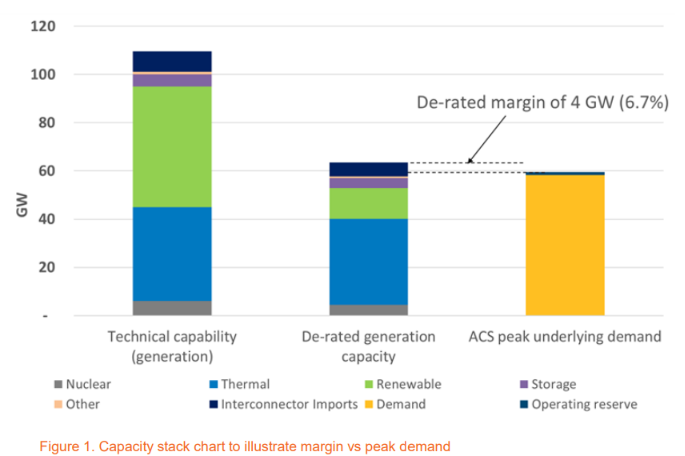
We eagerly await any changes revealed in tomorrow’s report!
[Edit – October 6th]The National Grid Electricity System Operator has now published its “Winter Outlook Report” for 2022/23. Here is the executive summary in full:
Our first illustrative scenario examines what would happen if there were no electricity imports from continental Europe . In this scenario we would deploy our mitigation strategies – dispatching the retained coal units and our Demand Flexibility Service. By securing 4GW through these actions, we would maintain adequate margins and mitigate impacts on customers.
Our Demand Flexibility Service is new and innovative, and we have worked with suppliers, aggregators, industry, Ofgem and BEIS on the design to ensure it is ready for the winter and capable of delivering the required level of participation and response (2 GW+). It will launch on 1 November, and we are encouraging suppliers and aggregators to work with their customers to ensure the highest levels of engagement and participation. We see particular potential from commercial organisations who can shift their load from peak hours and have had positive feedback from British companies on this.
Without the Demand Flexibility Service, we would expect to see a reduction in margins. In this scenario on days when it was cold (therefore likely high demand), with low levels of wind (reduced available generation), there is the potential to need to interrupt supply to some customers for limited periods of time in a managed and controlled manner. However, we expect the mitigations outlined above to be effective.
A second, more extreme scenario, looks at a hypothetical escalation of the energy crisis in Europe such that there is insufficient gas supply available in Great Britain (in addition to no electricity available to import from continental Europe as per above scenario). In the unlikely event that escalation of the situation in Europe means that insufficient gas supply were to be available in Great Britain this would further erode electricity supply margins6 potentially leading to interruptions to customers for periods. All possible mitigating strategies, including our new measures, would be deployed to minimise the disruption.
Overall, this is likely to be a challenging winter for energy supply throughout Europe. We have taken extensive measures to try to mitigate the impacts for British consumers and expect that, under our base case, margins will be adequate. Nevertheless, there remain scenarios, driven principally by factors outside of Great Britain which could impact upon British electricity supplies. Plans are in place to ensure the impact is minimised and the overall security and integrity of Britain’s energy systems are protected.
Here too is the updated version of the “base case” supply margin chart shown above:

The chart is accompanied by these two provisos, amongst others:
Our base case assumes electricity imports from Europe are available at times when we need them to meet demand, delivering in line with their Capacity Market agreements, and that there is no disruption to gas supplies.
Our base case does not assume any material reduction of consumer demand due to high energy prices. It does not include any of our mitigation measures such as coal contracts or the Demand Flexibility Service as we would not expect to deploy them here.
The winter outlook also considers “Scenario 1” in which there are “reduced electricity imports from Europe”:
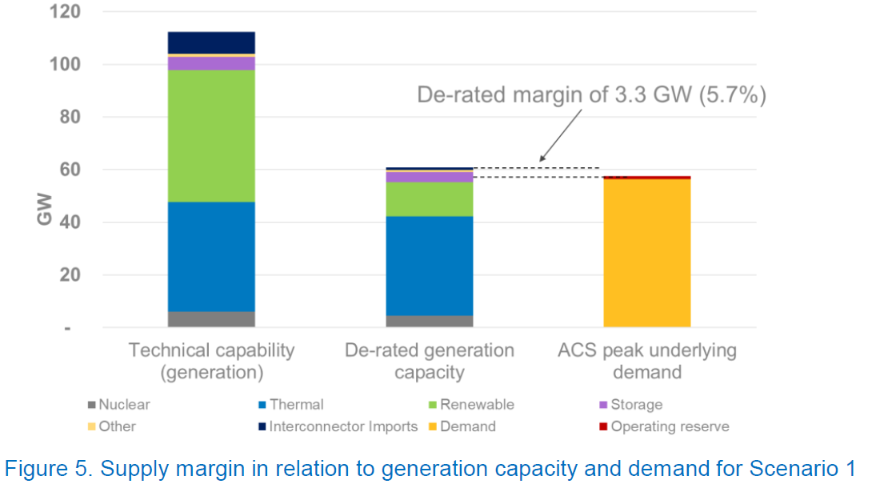
The bar chart is accompanied by a graph of “operational surplus”:
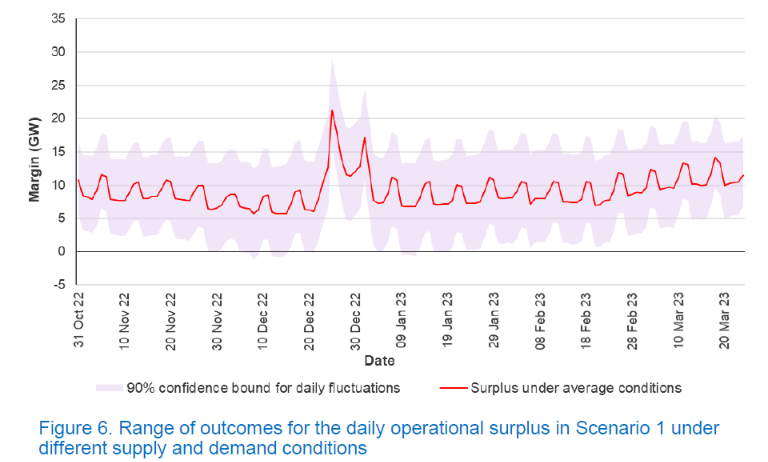
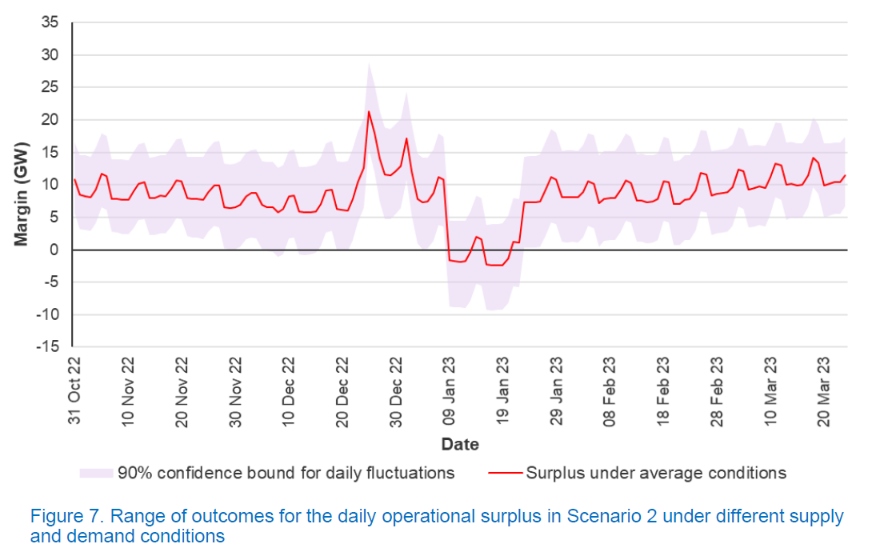
That shows National Grid’s “90% confidence” that the surplus will not turn negative over the winter. However now let’s take a look at “Scenario 2” in which there is in addition “insufficient gas supply in Great Britain”:
Note that according to Ofgem a few days ago:
Due to the war in Ukraine and gas shortages in Europe, there is a significant risk that gas shortages could occur during the winter 2022/23 in Great Britain. As a result, there is a possibility that GB could enter into a Gas Supply Emergency.
Perhaps it would be prudent at this juncture for us all to cross our fingers and hope that the gas keeps arriving at Great British shores over the coming months, whether via pipeline or LNG tankers?
[Edit – October 7th]The Energy Networks Association has published an article entitled “How planned emergency power cuts would work if they are needed this winter“. They state, in part, that:
[Edit – October 17th]Though no power cuts are currently planned, in their winter outlook National Grid ESO raised the possibility of the need for planned national power cuts, in order to manage the possibility of energy demand outstripping the supply available.
Firstly, it’s important to know that before any emergency planned power cut instruction is given, National Grid ESO takes several steps to protect customers. These include:
* Encouraging additional generation through the supply market.
* Asking heavy industrial users to limit their demand during peak periods.
* Reducing domestic power demand – this could include paying customers to change how and when they use appliances like washing machines and dishwashers or reducing voltage across the country by a small percentage, which would be undetectable.Procedures for emergency planned power cuts like this have existed for decades and are simulated in emergency exercises by the energy sector each year ahead of the winter.
If needed, the emergency procedures are designed to minimise the impact on customers as far as possible, by limiting power cuts to shorter periods in order to manage overall electricity demand. However, while the winter is expected to be challenging, there is no guarantee emergency measures will be necessary.
If an emergency power cut is implemented, customers in certain parts of the country would typically be without power for around three hours per day during the emergency.
Distribution network operators, which run the local power networks, would be legally instructed by National Grid ESO, which controls the flow of energy around the country, to disconnect power supplies using established procedures. These procedures are set out by the government in a document known as the Electricity Supply Emergency Code, sometimes referred to as ESEC. The procedures ensure that power is shared fairly across all customers during a national energy emergency…
If emergency power cuts are needed customers will be able to find their rota and what it means for them at powercut105.com by entering their postcode. The rota will only be published once emergency power cuts have been approved to take place.
In an article in today’s Financial Times, energy correspondent Nathalie Thomas writes that:
[Edit – November 4th]National Grid’s chief executive has warned British households to prepare for blackouts between 4pm and 7pm on “really, really cold” weekdays in January and February in the event of reduced gas imports from Europe.
John Pettigrew said the company would have to impose rolling power cuts on “those deepest darkest evenings in January and February” if generators failed to secure enough gas from the continent to meet demand, particularly if the country suffers a cold snap.
Pettigrew’s comments at the Financial Times’s Energy Transition Summit came after National Grid, which oversees Britain’s electricity and gas systems, this month took the unusual step of setting out various “unlikely” scenarios in which Britain might not have sufficient energy supplies this winter.
National Grid ESO’s Director of Corporate Affairs, Jake Rigg explained their
Demand Flexibility Service on BBC Breakfast this morning. · According to a BBC article:
Households will be offered discounts on their electricity bills if they cut peak-time use on a handful of days over the winter, as part of National Grid’s efforts to avoid blackouts.
The network operator has announced details of the scheme, which it said could save households up to £100.
There will be 12 “test” days initially, designed to see how customers respond, between November and March.
But only homes with smart meters will be able to take part.
Only 14 million, less than half, of households in England, Scotland and Wales, where the scheme is being tested, have a smart electricity meter installed.
Customers taking part will be given 24 hours’ notice of a “test” day where they will be asked to reduce their peak-time electricity use if they can during a one-hour period identified by National Grid, likely to be between 16:00 and 19:00.
That could include delaying use of a tumble-dryer or washing machine, or cooking dinner in the microwave rather than the oven.
National Grid said it will pay energy suppliers, which will be required to sign up to the scheme to operate it for customers, £3 for every kilowatt-hour during the test periods.
Individual suppliers will decide how much customers will receive and whether the money is taken off bills, credited to accounts, or if there’s an option to withdraw the cash…
Watch this space!