
UK Parliament Debates Energy Storage

It’s all go on the energy storage front in the UK. Yesterday not only was V2G mentioned in the mainstream media but it was also debated by a committee in the House of Commons. The summary of the Energy Bill [Lords] 2015-16 states that it is:

A Bill to make provision about the Oil and Gas Authority and its functions; to make provision about fees in respect of activities relating to oil, gas, carbon dioxide and pipelines; to make provision about wind power; and for connected purposes.

I presume energy storage must count as a “connected purpose”, since the proposed New Clause 14 which was under discussion yesterday, reads as follows:

Electricity storage

(1) Section 4 of the electricity Act 1989 is amended as follows.

(2) After subsection (1)(c) insert—

“(d) stores electricity for the purpose of giving a supply to any premises or enabling a supply to be so given,”

(3) At end of subsection (4) insert—

““Store” means the conversion of electricity into a form of energy which can be stored, the storing of the energy which has been so converted and the reconversion of the stored energy into electrical energy in devices with an individual capacity of more than 50MW.”

(4) Section 6 of the electricity Act 1989 is amended as follows.

(5) After subsection (1)(d) insert—

“(e) a licence authorising a person to store electricity for the purpose of giving a supply to any premises or enabling a supply to be so given (‘a storage licence’);”

(6) After subsection (2) insert—

“(2ZA) In addition to holding a storage licence, the same person may be a holder of—

(a) a distribution licence,

(b) a transmission licence, or

(c) a generation licence.

(2ZB) The Secretary of State may by order determine the circumstances under which a person may hold a storage licence in addition to a distribution licence, a transmission licence or a generation licence under subsection (2ZA).

Events in The House were recorded for posterity, and the debate about NC14 can be seen in this video:

In some of the edited highlights Dr. Alan Whitehead, who is Shadow Minister for Energy and Climate Change, pointed out that:

A number of the issues we have discussed in the Committee—intermittency of wind, base-load problems and a whole range of other issues—can begin to be addressed by battery storage of electricity.

For example, if a battery storage system is attached to a solar array, the life of that solar array can be extended far beyond the period during the day when the sun shines. Clearly, the power that comes from it can go right through the night. We are already seeing that effect, to a minor extent, with solar arrays on streetlights, but on a much larger scale it could revolutionise the way in which solar is used in future.

Battery storage can also be used in relation to wind. We have heard that wind, quite self-evidently, does not always blow, and sometimes when it does blow, it blows rather a lot. Ensuring that the capturing of that variability is smoothed out into a regular supply through the attachment of battery storage to the wind turbine is clearly a positive step forward as far as wind supply is concerned.

However Andrea Leadsom, who is The Minister of State at the Department of Energy and Climate Change ultimately responded by saying:

On this last new clause, I am as keen as mustard on electricity storage; it has a vital contribution to make to dealing with intermittency and I wish we were five years ahead—it will be interesting to see how much we have managed to achieve in creating this new ability to store intermittent generation.

New clause 14 would create a new licence category for electricity storage operators and allow other licence holders, such as generators and transmission and distribution network operators, to hold an electricity storage licence. The creation of a separate electricity storage licence is an option that is being considered by my Department and one of a number of issues for storage operators to be included in a call for evidence in the spring. This will enable us to test it against other options, which may be less regulatory and burdensome, more targeted and, importantly, faster to implement. So, much as I would love to say, on this very last new clause, that we agree with the hon. Gentleman, the problem is that licensing storage now would be premature. Indeed, the Electricity Storage Network, which is a key trade body for the storage industry, has criticised this new clause on the grounds that it

“pre-empts the current work by the Department” and

“may hinder, rather than help, the progress of well thought-out strategies to support … the storage industry.”

following which Dr. Whitehead withdrew his proposed amendment.

All of which does rather beg the question of what “well thought-out strategies to support the storage industry” here in the United Kingdom will eventually look like, and whether they will accommodate “EV owners”, “Communities” and/or “Aggregators” as well as Distribution Network Operators, Transmission System Operators and electricity generators, whether distributed or centralised.
V2G and Energy Storage are in the News. In the UK!

Spring is in the air here in the United Kingdom. Several of the people I debate the future of distributed energy storage with on a regular basis have been in the news this week!

First up was Mark Thompson of Innovate UK. According to the headline in an article in Utility Week:

EVs are stable energy storage asset, says Innovate UK

The article goes on to explain that:

Innovate UK has brushed aside ongoing fears around using electric and plug-in vehicles as an energy storage facility, insisting they present a “car park of energy storage” for UK network companies after 2025.

Innovate UK’s lead technologist for energy systems Mark Thompson said at a recent storage event that fears that using EV batteries for grid support will rapidly degrade the batteries are unfounded. Innovation projects already undertaken into EV charging reveal the batteries will be accessible to the grid 95 per cent of the time.

Thompson said “a lot of anxiety” around using EVs as energy storage centres on battery recycling, but tests show that using an EV battery to provide 7kW of grid support is equivalent to driving at just 20mph.

Mark went on to point out:

That is a modest amount of power but aggregated would be very useful for a distribution network operator. The stress level on that battery of sitting there continually pushing out 7kW compared to a 35 minute journey is a no-brainer, it’s an extremely calm and un-stressful environment for that vehicle. Car manufacturer Nissan has been very vocal on the potential benefits of using EVs for grid support because there really isn’t an issue compared to the complexities and stresses that the battery goes through for a pretty normal driving scenario.

If we can be clever and come up with the right business models to engage people in moving their charging and allow network operators to have some control, if we can be savvy about that then network investment costs are virtually zero until you are well into the 2020s

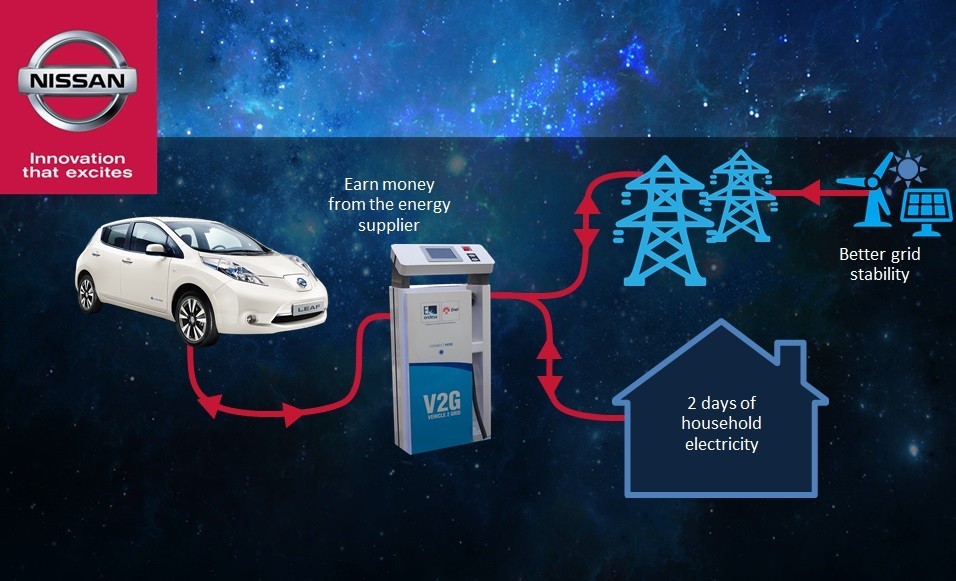
Here’s one of Nissan’s infographics showing how they see the technology working:

UK Plc “being savvy” and providing support for the “right business models” is another matter entirely however! Utility Week continued:

Projects such as My Electric Avenue have revealed that vehicles are sat stationary at either the home or workplace, both potential charging locations, 95 percent of the time making EVs a “stable storage asset”. Based on “very modest projections” there could be as many as 300,000 EV or hybrid vehicles on UK roads by 2025, presenting around 4GW of potential storage to the UK’s electricity system with very little network reinforcement required.

Having discussed the Utility Week article with Mark Thompson it seems they have misinterpreted a couple of points:

I didn’t wish to imply that cars would be 95% available, just that they are “parked for 95% of the time” but that data DNO projects such as My Electric Avenue and ETI analysis indicate that a “very healthy proportion” of plugins will be accessible over the 24 hour cycle for grid support given charging and use patterns. The 95% figure as currently illustrated is not of course realistic, but perhaps eventually grid “connected availability” may be in the region of 30-60% depending on the time of day, which in time will amount to a significant amount of grid connected resource.

Also, the 4GW figure should be 4GWh.

Here’s the original slide from Mark’s presentation, with the correct units clearly visible on the Y axis and in big letters towards the end of the headline:

Today the mainstream media picked up the story in the form of an article by Damian Carrington in The Guardian entitled “From liquid air to supercapacitors, energy storage is finally poised for a breakthrough”. Damian opens with a quote from Jill Cainey, director of the UK’s Electricity Storage Network.

It doesn’t always rain when you need water, so we have reservoirs – but we don’t have the same system for electricity.

A battery project can take 12-18 months from saying we will do it, to completion. California is aggressively pursuing a low-carbon agenda and they don’t want diesel [generator back-up] on the system. Amber Rudd is talking a lot about energy storage, but we need a clear regulatory steer. The planes are circling, but there is no runway to land on.

Next Mark Thompson is quoted once again, apparently from the Utility Week article rather than from his actual presentation:

Using electric car batteries as a smart storage network while still in the cars is a promising option in the future, according to Mark Thompson at Innovate UK, a government agency. He says there could be 4GW capacity – a nuclear power station is about 1GW – by 2025 across the 300,000 electric cars projected to be on UK roads by then. He says cars are stationary for 95% of the time and using them could save billions of pounds, removing the need for new power stations and power lines.

However the article continues:

While interest in energy storage projects in the UK is surging – a recent call from National Grid for 200MW of short-term storage was oversubscribed six times – it is starting from a low base: just 24MW has been installed compared to the 5,000MW the government’s official advisers, the Committee on Climate Change, envisages in a low-carbon nation in 2030.

In November, energy secretary Amber Rudd said: “Locally generated energy supported by storage, interconnection and demand response, offers the possibility of a radically different model… We are looking at removing regulations that are holding back smart solutions, such as demand side response and storage.”

Removing the regulations that are holding back smart solutions is one of the reasons Mark and Jill were already on my list of people to call this week. That’s because DECC’s current consultation about how to “Ensure Regulation in the Energy Sector Encourages Innovation” closes on February 11th!

Energy and Climate Change Committee Discusses V2G

Last year the United Kingdom’s House of Commons Energy and Climate Change Committee launched an inquiry into low carbon network infrastructure in the UK. Initially they sought written submissions of evidence, and are now televising live oral submissions to the committee. Fortunately these events are also recorded, and during the one that took place on January 12th there was much discussion of energy storage in general and electric vehicle batteries in particular. Here’s an extract:

Amongst a variety of other contributions you can hear the chair Angus MacNeil MP ask:

To what extent will electricity demand in future exhibit greater peaks and troughs due to the electrification of heat and transport? What changes will that make in demand?

The first expert witness to respond was Sara Bell, the Chief Executive of Tempus Energy:

I think that depends very much on how we manage that demand. Both the demands that you have mentioned are highly flexible, so that offers an enormous opportunity to match that demand to generation, and variable generation can be matched very successfully to that flexible demand. Every electric vehicle could be charged when we have excess renewable generation. There is a way, from an economic standpoint, of managing that sensibly.

The experts went on to discussheat pumps for bit, and then Dr Philipp Grünewald from the Environmental Change Institute at Oxford University pointed out that:

Electric vehicles could play a very interesting role in helping to balance the system, because they have inbuilt storage, but another debate is ongoing on the extent to which you want to use that type of storage for the grid. We might come back to that.

to which Dr Jill Cainey of the Electricity Storage Network added:

On electric vehicles, it is more that the charging is the critical thing that you need to control, not necessarily using the battery device for the system services. National Grid has a project in which it has looked at that — at providing frequency response.

You may correctly surmise from the name of this blog that I don’t entirely agree with Jill on that point! “Smart charging” certainly has its place, but so might “using EV batteries for system services” in a rather different market and regulatory environment to the current one. The panel discussed that issue a bit later in the proceedings. Sara Bell again:

We have not even started the process of making the demand side flexible. Tempus Energy is the only electricity supplier that unlocks flexibility in customer premises. We go to our customers and we put control and sensor technology into their premises so that we can move their demand. Every time — and I mean every time — we go into customer premises, they are using electricity at times in a very expensive way, completely unnecessarily, because no supplier has ever rewarded them for their flexibility before, so why should they bother?

We are one small new supplier. If the whole market operated like this, we would unlock a great deal of flexibility, which would reduce the total system cost.

Jill Cainey again:

There are some issues with capacity now. That is why we have the capacity market. I guess Electricity Storage Network would argue that that incentivises particular types of technology for security of supply but doesn’t necessarily support the new innovative approaches such as demand side and electricity storage because of the way that market has been designed…

There are technologies and approaches, such as demand side response and aggregation — aggregators are providing demand side response as well. We need to facilitate those approaches to move forward. That is a market approach.

That we can agree on 101%, and I also agree with Dr Gordon Edge who is Director of Policy at RenewableUK who said:

I would argue that some of the time-limiting steps are not technology but the regulatory market approaches. We need to be thinking about how we make the market so that these things, when they are economic, just happen automatically. At the moment, there are too many barriers.

and with Stephen Goldspink who is Director of Strategy and Business Development at Siemens Energy Management, who added that:

Technology and solutions are already available, as my colleagues has already said, so it is about how fast we deploy those technologies and the regulatory barriers that need to be removed to deploy them. Energy storage, demand side management, energy efficiency — all these things can support this capacity margin issue and put us on the journey to low-carbon networks much quicker.

Angus MacNeil then said:

Thank you. I understand what you are saying about regulatory barriers, but we will leave that section there.

Hence so will we, for the moment at least.

Catherine Mitchell Meets Exeter Community Energy

On Tuesday I attended a meeting organised by Exeter Community Energy. The theme for the evening was “UK Energy Policy and the role of community energy”, and the main speaker was Catherine Mitchell who is Professor of Energy Policy at Exeter University, and was a lead author in the Inter-Governmental Panel on Climate Change Working Group 3’s recent fifth assessment report. To summarise briefly, Catherine had many more good words to say about community energy than she did about Great British Energy Policy!

It quickly became apparent that Catherine felt that the change “from ‘dirty’ energy to sustainable energy” is happening much faster elsewhere in Europe, and further afield, than it is here in the UK. After taking a while to consider a suitable epithet she settled on “constipated” as the best descriptor of UK energy policy!

Energy is always political, and has become much more political under the coalition government. Rational evidence based decision making has stopped. The current focus is on nuclear power, with only lip service being paid to renewable generation, demand management, demand reduction and community energy generation.

What positive changes that are taking place are “moving in from Europe”. Catherine moved on to give an overview of the current state of play of electricity generation across Europe. Broadly demand in the 21st century has been constant, with a slight dip due to the recession in 2009. The renewables’ share of  total generation has been increasing throughout that period, and the most recent figures show much more renewable capacity being constructed than fossil fuels or nuclear.

In the UK wholesale prices are the 3rd highest in Europe, and interconnections with other countries, which are “very helpful for renewables”, are lacking. Great Britain and Poland “are trying to water down” the EU 2030 framework for climate and energy policies. Conventional utilities are however “under threat” due to the low marginal costs of renewable energy sources, which undermines their business model. However in the UK “self reinforcing governance” makes it hard for new entrants to challenge the “Big 6”, who currently have 91% of the UK electricity market, and even more for energy overall. However “despite this, there are some changes”.

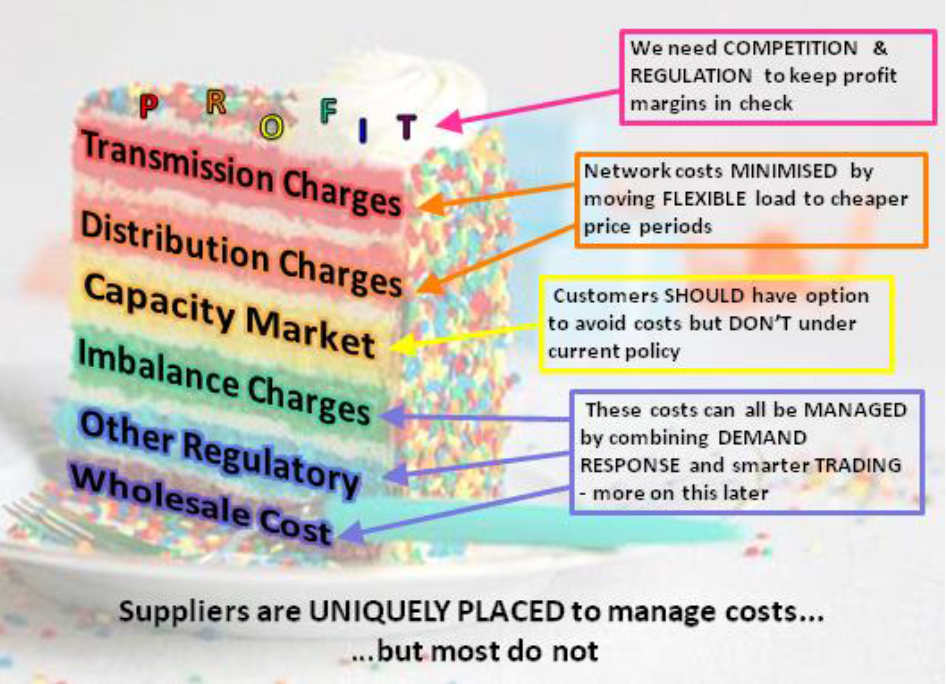
Community energy policy is “very inconsistent”, but there are new demand side entrants such as Tempus Energy, and new financial models from the likes of OVO Energy. Combined heat & power “is starting to come together”, but “the Big 6 don’t want to change. People need to start to do things differently”. Here’s how the UK energy cookie currently crumbles according to Tempus:

and here’s a video in which they explain how matters might be improved by using “a smarter approach for everybody”:

At that point the questions from the audience began. The one that most interested me concerned energy storage, and the possibility of getting paid for providing that useful service. According to Catherine “Norway is doing wonderful stuff, Germany has started, but there are no plans in Great Britain”. A member of the audience pointed out that the Renewable Energy Association had recently launched “UK Energy Storage” to lobby government, apparently:

The trade body for all storage technologies across the UK

I waved my hand in an endeavour to point out that the Electricity Storage Network has in fact been around for quite some time now, and say they are:

The industry association for the promotion of electrical energy storage.

However my turn to ask a question didn’t come around until right at the end of the evening. It seemed apparent that Catherine wasn’t very impressed by current UK energy markets, and I wondered:

Whether any future market based on “Anglo Saxon Capitalism” would be up to the job of solving the “energy/climate conundrum”?

Catherine assured me that she didn’t see capitalism going away for the foreseeable future. The slides from her presentation can be downloaded from the IGov web site.

Last year, in her role as an IPCC lead author, Catherine Mitchell also gave a presentation about UK energy policy at the Transformational Climate Science conference at Exeter University. Here it is:

Catherine also published an article on the IGov web site after that conference. For additional background information please also read:

“In Matters Of Climate Change, The Environmental Requirement Must Take Precedent Over Short Term Economic Goals”

Catherine’s conclusion was that:

We as individuals and communities in civil society have to do all we can to get our politicians, neighbours, businesses, energy suppliers and so on to take climate change seriously. Climate and energy policy must take note of the IPCC warning and act now.