
Energy and Climate Change Committee Discusses V2G

Last year the United Kingdom’s House of Commons Energy and Climate Change Committee launched an inquiry into low carbon network infrastructure in the UK. Initially they sought written submissions of evidence, and are now televising live oral submissions to the committee. Fortunately these events are also recorded, and during the one that took place on January 12th there was much discussion of energy storage in general and electric vehicle batteries in particular. Here’s an extract:

Amongst a variety of other contributions you can hear the chair Angus MacNeil MP ask:

To what extent will electricity demand in future exhibit greater peaks and troughs due to the electrification of heat and transport? What changes will that make in demand?

The first expert witness to respond was Sara Bell, the Chief Executive of Tempus Energy:

I think that depends very much on how we manage that demand. Both the demands that you have mentioned are highly flexible, so that offers an enormous opportunity to match that demand to generation, and variable generation can be matched very successfully to that flexible demand. Every electric vehicle could be charged when we have excess renewable generation. There is a way, from an economic standpoint, of managing that sensibly.

The experts went on to discussheat pumps for bit, and then Dr Philipp Grünewald from the Environmental Change Institute at Oxford University pointed out that:

Electric vehicles could play a very interesting role in helping to balance the system, because they have inbuilt storage, but another debate is ongoing on the extent to which you want to use that type of storage for the grid. We might come back to that.

to which Dr Jill Cainey of the Electricity Storage Network added:

On electric vehicles, it is more that the charging is the critical thing that you need to control, not necessarily using the battery device for the system services. National Grid has a project in which it has looked at that — at providing frequency response.

You may correctly surmise from the name of this blog that I don’t entirely agree with Jill on that point! “Smart charging” certainly has its place, but so might “using EV batteries for system services” in a rather different market and regulatory environment to the current one. The panel discussed that issue a bit later in the proceedings. Sara Bell again:

We have not even started the process of making the demand side flexible. Tempus Energy is the only electricity supplier that unlocks flexibility in customer premises. We go to our customers and we put control and sensor technology into their premises so that we can move their demand. Every time — and I mean every time — we go into customer premises, they are using electricity at times in a very expensive way, completely unnecessarily, because no supplier has ever rewarded them for their flexibility before, so why should they bother?

We are one small new supplier. If the whole market operated like this, we would unlock a great deal of flexibility, which would reduce the total system cost.

Jill Cainey again:

There are some issues with capacity now. That is why we have the capacity market. I guess Electricity Storage Network would argue that that incentivises particular types of technology for security of supply but doesn’t necessarily support the new innovative approaches such as demand side and electricity storage because of the way that market has been designed…

There are technologies and approaches, such as demand side response and aggregation — aggregators are providing demand side response as well. We need to facilitate those approaches to move forward. That is a market approach.

That we can agree on 101%, and I also agree with Dr Gordon Edge who is Director of Policy at RenewableUK who said:

I would argue that some of the time-limiting steps are not technology but the regulatory market approaches. We need to be thinking about how we make the market so that these things, when they are economic, just happen automatically. At the moment, there are too many barriers.

and with Stephen Goldspink who is Director of Strategy and Business Development at Siemens Energy Management, who added that:

Technology and solutions are already available, as my colleagues has already said, so it is about how fast we deploy those technologies and the regulatory barriers that need to be removed to deploy them. Energy storage, demand side management, energy efficiency — all these things can support this capacity margin issue and put us on the journey to low-carbon networks much quicker.

Angus MacNeil then said:

Thank you. I understand what you are saying about regulatory barriers, but we will leave that section there.

Hence so will we, for the moment at least.
Catherine Mitchell Meets Exeter Community Energy

On Tuesday I attended a meeting organised by Exeter Community Energy. The theme for the evening was “UK Energy Policy and the role of community energy”, and the main speaker was Catherine Mitchell who is Professor of Energy Policy at Exeter University, and was a lead author in the Inter-Governmental Panel on Climate Change Working Group 3’s recent fifth assessment report. To summarise briefly, Catherine had many more good words to say about community energy than she did about Great British Energy Policy!

It quickly became apparent that Catherine felt that the change “from ‘dirty’ energy to sustainable energy” is happening much faster elsewhere in Europe, and further afield, than it is here in the UK. After taking a while to consider a suitable epithet she settled on “constipated” as the best descriptor of UK energy policy!

Energy is always political, and has become much more political under the coalition government. Rational evidence based decision making has stopped. The current focus is on nuclear power, with only lip service being paid to renewable generation, demand management, demand reduction and community energy generation.

What positive changes that are taking place are “moving in from Europe”. Catherine moved on to give an overview of the current state of play of electricity generation across Europe. Broadly demand in the 21st century has been constant, with a slight dip due to the recession in 2009. The renewables’ share of  total generation has been increasing throughout that period, and the most recent figures show much more renewable capacity being constructed than fossil fuels or nuclear.

In the UK wholesale prices are the 3rd highest in Europe, and interconnections with other countries, which are “very helpful for renewables”, are lacking. Great Britain and Poland “are trying to water down” the EU 2030 framework for climate and energy policies. Conventional utilities are however “under threat” due to the low marginal costs of renewable energy sources, which undermines their business model. However in the UK “self reinforcing governance” makes it hard for new entrants to challenge the “Big 6”, who currently have 91% of the UK electricity market, and even more for energy overall. However “despite this, there are some changes”.

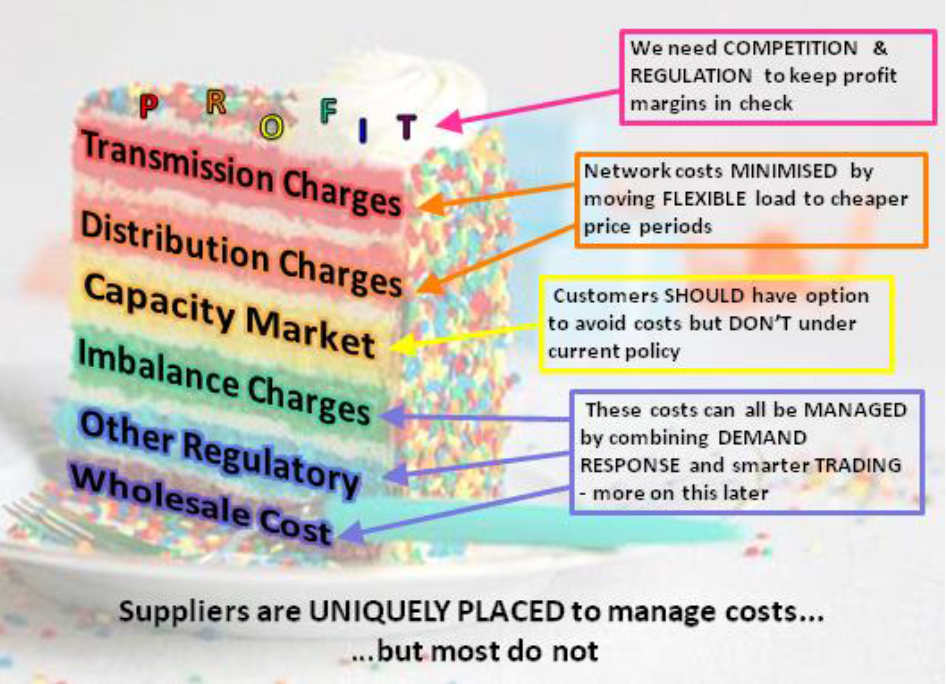
Community energy policy is “very inconsistent”, but there are new demand side entrants such as Tempus Energy, and new financial models from the likes of OVO Energy. Combined heat & power “is starting to come together”, but “the Big 6 don’t want to change. People need to start to do things differently”. Here’s how the UK energy cookie currently crumbles according to Tempus:

and here’s a video in which they explain how matters might be improved by using “a smarter approach for everybody”:

At that point the questions from the audience began. The one that most interested me concerned energy storage, and the possibility of getting paid for providing that useful service. According to Catherine “Norway is doing wonderful stuff, Germany has started, but there are no plans in Great Britain”. A member of the audience pointed out that the Renewable Energy Association had recently launched “UK Energy Storage” to lobby government, apparently:

The trade body for all storage technologies across the UK

I waved my hand in an endeavour to point out that the Electricity Storage Network has in fact been around for quite some time now, and say they are:

The industry association for the promotion of electrical energy storage.

However my turn to ask a question didn’t come around until right at the end of the evening. It seemed apparent that Catherine wasn’t very impressed by current UK energy markets, and I wondered:

Whether any future market based on “Anglo Saxon Capitalism” would be up to the job of solving the “energy/climate conundrum”?

Catherine assured me that she didn’t see capitalism going away for the foreseeable future. The slides from her presentation can be downloaded from the IGov web site.

Last year, in her role as an IPCC lead author, Catherine Mitchell also gave a presentation about UK energy policy at the Transformational Climate Science conference at Exeter University. Here it is:

Catherine also published an article on the IGov web site after that conference. For additional background information please also read:

“In Matters Of Climate Change, The Environmental Requirement Must Take Precedent Over Short Term Economic Goals”

Catherine’s conclusion was that:

We as individuals and communities in civil society have to do all we can to get our politicians, neighbours, businesses, energy suppliers and so on to take climate change seriously. Climate and energy policy must take note of the IPCC warning and act now.