How do you solve a problem like Flexibility?

How do you catch a cloud and pin it down?
How do you find a word that means Flexibility?

We’ll get back to answering that question in due course. First some exciting news.

On November 22nd I attended the kick off meeting of a new International Electrotechnical Commission “smart grid” committee. This one is catchily entitled the “System Committee Smart Energy ad hoc Group 11 on Energy flexibility and residential DSR: common ground”, or “SyC SE ahG 11” for short.

If you follow the link just above you will discover that ahG 11’s mission is:

To consider the implementation of international residential flexibility system standards, their compatibility with national requirements, and propose best practice:

* To ensure the compatibility of end-to-end system solutions at international level,

* To identify emerging challenges related to the uptake of residential DSR,

* To consider terminology alignment, and

* To develop an accelerated report containing requirements for residential flexibility. This would give recommendations for alignment of existing national publications and flexibility projects under development with international standards. It would also identify, if relevant, the need for further standardization

Amongst other questions discussed at the kick off meeting was “How do you define the term ‘flexibility'”. Your mileage may vary of course, but since I spent 5 years of my life meeting 2 or 3 times per week on the committee developing the IEC 63110-1 document I will quote from the Committee Draft for Vote (CDV for short) of that international standard:

General concept of elasticity of resource use, (demand, storage, generation) modification of consumption and/or generation of energy/power, on an individual or aggregated level, in 371 reaction to an external signal (price signal or request) in order to provide a service within the energy system

Elasticity of resource use (demand, storage, generation), modification of consumption and/or generation of energy/power, on an individual or aggregated level, in reaction to an external signal (price signal or request) in order to provide a service within the energy system.

If you have strong objections to that definition please do not hesitate to join ahG 11, or failing that to send your preferred term of words to me so that I can bring it to the committee’s attention.

My other main action item before the next meeting in the New Year is to generate a list of existing standards, regulations etc. relevant to my particular area of expertise, which is bi-directional power transfer during electric vehicle (dis)charging (BPT for short). More commonly referred to as V2x. Since ahG 11’s term of reference includes the word “residential” this suggests an emphasis on vehicle-to-home technology (V2H for short) . However, homes are of course connected to the local electricity distribution grid, and are not forbidden from feeding electrical energy back into the grid as long as all the associated rules and regulations are adhered to.

Please let me or any other member of the committee know of any “standards” within your own area of expertise that may be relevant to “residential demand side response” (using the UK’s non standard nomenclature!), whether they be international, national, “industry de facto” or even the learnings from relevant “pilot projects”.

To give you a more graphic explanation of what we’re after, here is an extract from one of the documents on my own (by now rather long!) list; the first edition of the British Standards Institution‘s Publicly Available Specification 1878 (PAS 1878 for short)

Please feel free to suggest candidates for “standards” for communicating across any of the arrowed lines in the diagram, and alternative diagrams for that matter!
The Electric Vehicles (Smart Charge Points) Regulations 2021

I’ve spent a busy few days covering the power cuts caused across the UK by Storm Arwen. Before she arrived on the scene I intended to go into more detail about Boris Johnson’s announcement last week about “New laws to supercharge the electric vehicle revolution”. Finally the time has come to look at some of those new laws in a bit more detail!

According to the preamble to “The Electric Vehicles (Smart Charge Points) Regulations 2021“, currently merely a “Draft Statutory Instrument”:

The Secretary of State, in exercise of the powers conferred by sections 15, 16, 17 and 18 of the Automated and Electric Vehicles Act 2018(1) (“the 2018 Act”), makes the following Regulations.

In accordance with section 18(4) of the 2018 Act, a draft of this instrument has been laid before Parliament and approved by a resolution of each House of Parliament.

The Secretary of State has consulted such persons as the Secretary of State considered appropriate in accordance with section 18(3) of the 2018 Act before making these Regulations.

PART 1
Introduction

Citation, commencement and extent
1.—(1) These Regulations may be cited as the Electric Vehicles (Smart Charge Points) Regulations 2021 and come into force on 30th June 2022.
(2) These Regulations extend to England and Wales and Scotland.

To summarise, if duly enacted by Parliament the following interesting extracts from the bill will come into force on 30th June 2022. Which is approximately 7 months from now:

Continue reading →

Electric Vehicles as “Energy Smart Appliances”

The British Standards Institution has just published a new “specification”, and unlike most BSI “standards” this one is free to download, as long as you don’t mind parting with an email address. As the download page puts it:

BSI is working with the UK Government to encourage the uptake of safe, secure and interoperable Energy Smart Appliances (ESAs). These are needed for the active management of demand on the electricity network, known as Demand Side Response (DSR). PAS 1878 is a critical component in this because it details the requirements and criteria necessary to make an energy smart appliance compatible with DSR activities.

At this point you may have a couple of question, such as “What on Earth is a PAS?”. The BSI have a ready answer for that question:

A PAS (Publicly Available Specification) is a fast-track standardization document – the result of an expert consulting service from BSI. It defines good practice for a product, service or process. It’s a powerful way to establish the integrity of an innovation or approach.

The next obvious question is “What has this got to do with electric vehicles and/or vehicle-to-grid technology?”. The answer to which is that a “smart” EV charging station is a special case of an interoperable Energy Smart Appliance. As the foreword to PAS 1878 states:

Continue reading →

Sero Group Announce “UK’s largest domestic DSR trial”

In a press release on Tuesday the Sero Group announced that:

FLATLINE, an industry led research project aiming to demonstrate the viability of a demand-side approach to energy management at domestic level, has reached a major milestone as residents move into three pilot homes at The Mill site in Cardiff.

Backed by the Department of Business, Energy & Industrial Strategy, the ‘Fixed Level Affordable Tariffs Led by Intelligently Networked Energy’ (FLATLINE) project aims to significantly reduce residents’ energy bills, using a combination of domestic Demand Side Response and demand shifting for both heat and electricity.

The specially built pilot homes at The Mill development site in Cardiff will be closely followed by a further 46 homes at a separate site, Parc Eirin in Tonyrefail – which will see first residents move in this autumn as the first phase of the 225 new home scheme is complete.

According to the “Zero Carbon Lifestyle” section of the Sero Homes web site:

Every Sero Home is built ready for future generations, and that includes the future of travel.

Our homes are built with three phase electricity – the “broadband” of power – and electric vehicle (EV) fast charging points. You can recharge your car at a Sero Home in less than four hours, compared to around twelve hours in a traditional home (or about three days on a 13amp plug).

Sero Homes’ class-leading recharging times are only useful if you can afford the car in the first place. To tackle this, on most of our sites we offer our residents an option to take an EV lease with inclusive miles bundled in.

It’s probably no coincidence that today Robert Llewellyn announced a new edition of his Fully Charged Show. An introduction to the “Affordable Eco Housing” at The Mill and Parc Eirin:

Continue reading →

BEAMA Recommends “Electrification by Design”

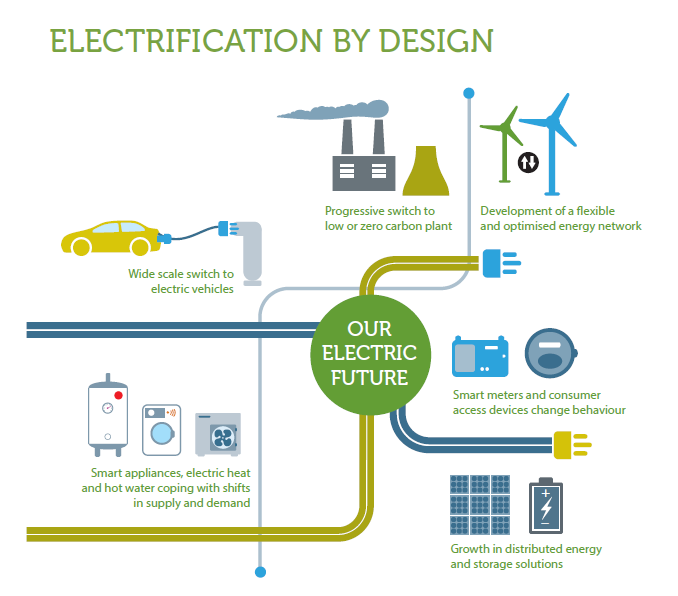
We’ve previously looked at the British Electrotechnical and Allied Manufacturers’ Association’s “Guide to Electric Vehicle Infrastructure“. Now they have released a new report which looks at electric vehicles in the context of the “transformation of our energy system”.

BEAMA summarise their “Electrification by Design” report with 6 “market design imperatives”:

Electrification by Design explores simple policy mechanisms and regional structure options to promote wide scale deployment of low to zero carbon electric systems.

  1. Electrification is a national need, but optimised, flexible energy systems will be delivered by regions and zones empowered to identify the most appropriate paths.

  2. Integrated and innovative finance packages are essential for market transformation.

  3. The supply chain must have sufficient capacity to promote sustainable growth.

  4. Consumers need confidence that services, systems and devices form part of a structured consumer journey. We need to navigate a critical path to electrification and decarbonisation.

  5. Demand Side Response needs concurrent and planned development of regulation, technology and markets.

  6. New and innovative ways of purchasing and providing energy services will emerge.

ElectrificationByDesign

We wholeheartedly agree with BEAMA’s recommendation that:

The first priority is the energy efficiency of buildings

“NegaWatts not MegaWatts” has long been a mantra of ours! Other recommendations regarding transport, energy storage, buildings and energy markets include:

  • Implement a mix of smart solutions such as managed charging, reinforcement and infrastructure upgrades to facilitate consumer uptake of EVs
  • Future proof the house building programme
  • Focus on the value of intelligent control and enable platforms that support interoperable services, systems and devices
  • Design markets so that all participants can engage with price signals and allow for market evolution as improved technology emerges
  • Keep the market open to new entrants to expand the range of service propositions to consumers
  • Co-locate storage, generation and charging at key large charging locations

Looking more closely at the section of the report devoted to electric vehicles, BEAMA have this to say:

A flexible and optimised energy system will balance the introduction of new technologies into buildings with the challenges these new loads can place on the network. This is particularly relevant to the sharp increase in electric vehicle charging infrastructure.

Technology that can perform load management or response functions can be connected to the network or deployed in the home, electric vehicles can be sold to the consumer and charging points installed, but without markets that allow providers to stack revenues and build their consumer propositions the potential value of this technology will never be realised.

I couldn’t have said it better myself! The UK Government is committed to a rapid electrification of road transport, but current energy markets represent a significant barrier to realising the potential of the technology. BEAMA add:

As the rollout of new technology and services continues without the right market conditions, their value is eroded or delayed. This is even without considering the lost upstream value and savings that these services could be providing to other market participants such as focused and planned infrastructure spending and energy management supported by Demand Side Response.

EVs are mentioned once again in the section of the report that discusses “passive consumers”:

Electric vehicle sales are rising rapidly and a well-functioning flexible energy system will reduce the impact of the ‘all electric’ switch to as little as a 5GW peak rise in electricity demand (8%), but only if we have the required level of engagement from consumers; in turn, this means getting the consumer proposition right.

Moving on to the “Transport” section of the report, our views begin to diverge from BEAMA’s slightly. They reiterate their 6th bullet point above:

Technology is likely to enable faster and faster charging rates, and reducing charging times to 5-10 minutes (similar to the time it takes to refuel a petrol or diesel car) could mark a tipping point for consumer interest. Another may be when ongoing innovation in battery technologies allows for a range similar to what is currently available from a tank of petrol or diesel.

Such technological development and deployment could also change the way consumers charge their vehicles, moving to centralised and co-located fast charging alongside or instead of slow charging. This could allow infrastructure investment to be better targeted. Centralising or co-locating the charging infrastructure with generation and storage can alleviate the pressure on local domestic low voltage networks.

Here at V2G UK we agree that “faster and faster charging rates” along major trunk routes are highly desirable, but we also believe that there is a place for the sort of technology summarised in the “artist’s impression” in our banner above. Alleviating the pressure on local domestic low voltage networks through the use of distributed generation and storage co-located with what BEAMA refers to as “slow charging rates”. Having renewable generation and energy storage located at your home or small business provides advantages that having similar, albeit larger and faster, facilities located on the nearest Shell forecourt does not! Particularly if you’re intent on the electrification of heating as well as transport, a topic which BEAMA also discuss at length in their new report.

As you have hopefully gathered by now, realising that vision will require a radical change to the UK’s energy markets, possibly even going beyond the significant changes recommended by BEAMA.

OVO Energy Embrace V2G

We’ve mentioned OVO Energy before, in the context of innovative financial models. Now we can mention them again, this time in the same sentence as our favourite three letter acronym! In a new section of their website devoted to electric vehicles OVO include an overview of V2G and demand side response (DSR for short). Please read the whole article, but here’s an extract:

The electric vehicle revolution will do more than reduce carbon emissions. Vehicle-to-grid technology (V2G), can give you ultimate control over your energy, and even make you money. Fancy getting your own mini power station? Then read on.

‘Vehicle to grid’ technology enables energy stored in electric vehicles to be fed back into the national electricity network (or ‘grid’) to help supply energy at times of peak demand. It’s just one technological advancement in a slew of new initiatives like ‘smart charging’ and ‘demand side response’ that are aimed at changing the way individuals, and businesses, use energy in the future. In short: the electric car revolution is tied into a whole new way of consuming energy.

We’re hurtling towards a place where ‘two-way’ electric car chargers can enable homeowners with electric cars to sell their energy back to the national network. It’s a smart idea when you consider that over 90% of cars are parked at any one time – which is a lot of energy just sitting there doing nothing. This technology will give you the opportunity to manage your energy your way, and potentially become energy self-sufficient, reducing everyone’s reliance on energy companies. Get solar panels fitted, then adopt vehicle to grid technology and your home could become a private mini-power station!

For some strange reason OVO don’t include a picture of this innovative new technology in action, so here’s one from the extensive V2G UK archives:

However they do include this image in the associated demand side response article:

together with this explanation:

Did you know that, as consumers, we are at the heart of a UK wide initiative to help secure our energy future? Not simply passive bill payers, our energy will, increasingly, be in our hands and our actions will play a crucial role in ensuring its security.

Demand side response or DSR is the unwieldy name of a programme that aims to rebalance our energy needs around the country. It will not only change how we produce energy, but also how we supply and use it. From manufacturing, public sector and big business to the householder, we all have a role to play.

Please read that article from cover to cover too. The OVO V2G article concludes:

We can help you charge your electric car everywhere, for less. Our EV Everywhere tariff is designed specially for owners of electric (and plugin hybrid) cars, and comes with fixed energy prices for two years, 100% renewable energy and free membership of Polar Plus, the UK’s biggest EV charging network.

Exciting times are afoot in the V2G sector here in the United Kingdom!

OECD Advocates Investment in Infrastructure

It’s a point we’ve been peddling for years now, but it looks like the OECD have at long last come to the conclusion that investment in infrastructure is in fact an excellent idea. By way of some proof that we haven’t been in a minority of one up to now, here’s The Economist from October 2014, underneath a picture of a parrot pushing up the daisies:

Germany’s chancellor, Angela Merkel, should allow France and Italy to slow the pace of their fiscal cuts; in return, those countries should accelerate structural reforms. Germany, which can borrow money at negative real interest rates, could spend more building infrastructure at home.

That would help, but not be enough. It is a bit like the early years of the euro debacle, before Mr Draghi’s whatever-it-takes pledge, when half-solutions only fed the crisis. Something radical is needed. The hitch is that European law bans many textbook solutions, such as ECB purchases of newly issued government bonds. The best legal option is to couple a dramatic increase in infrastructure spending with bond-buying by the ECB. Thus the European Investment Bank could launch a big (say €300 billion, or $383 billion) expansion in investments such as faster cross-border rail links or more integrated electricity grids — and raise the money by issuing bonds, which the ECB could buy in the secondary market.

Obviously here at V2G UK we were particularly keen on the bit about “more integrated electricity grids”. More recently the United Kingdom’s House of Commons Energy & Climate Change Select Committee put much the same message this way:

This promising new demand-side response technology has been disadvantaged in the auctions under the Government’s Capacity Market – meaning costs and emissions could be higher than necessary. Only a fraction of the £1 billion pounds that will be spent keeping the lights on through the Capacity Market will actually provide new capacity and just 0.4% will go on demand-side response – with most of the rest going to existing fossil fuel power stations, paying some of them to stand idle for much of the year.

Today the OECD announced its latest “Interim Economic Outlook” in a blaze of publicity under the headline “Stronger growth remains elusive: Urgent policy response is needed”:

Global GDP growth in 2016 is projected to be no higher than in 2015, itself the slowest pace in the past five years. Forecasts have again been revised down in light of disappointing recent data. Growth is slowing in many emerging economies with a very modest recovery in advanced economies and low prices depressing commodity exporters. Trade and investment remain weak. Sluggish demand is leading to low inflation and inadequate wage and employment growth.

Financial instability risks are substantial. Financial markets globally have been reassessing growth prospects, leading to falls in equity prices and higher market volatility. Some emerging markets are particularly vulnerable to sharp exchange rate movements and the effects of high domestic debt.

A stronger collective policy response is needed to strengthen demand. Monetary policy cannot work alone. Fiscal policy is now contractionary in many major economies. Structural reform momentum has slowed. All three levers of policy must be deployed more actively to create stronger and sustained growth. The recipe varies by country, especially with regard to needed structural reforms.

Diving into the depths of the OECD report itself, the bit that caught my attention runs as follows:

A stronger collective fiscal policy response is needed to support growth and provide a more favourable environment for productivity-enhancing structural policies. Governments in many countries are currently able to borrow for long periods at very low interest rates, which in effect increases fiscal space. Many countries have room for fiscal expansion to strengthen demand. This should focus on policies with strong short-run benefits and that also contribute to long-term growth.

A commitment to raising public investment collectively would boost demand while remaining on a fiscally sustainable path. Investment spending has a high-multiplier, while quality infrastructure projects would help to support future growth, making up for the shortfall in investment following the cuts imposed across advanced countries in recent years. These effects would be enhanced by, indeed need to be undertaken in conjunction with, structural reforms that would allow the private sector to benefit from the additional infrastructure; notably in the Europe Union, cross-border regulatory barriers are a significant obstacle.

Here’s a video of the proceedings in Paris earlier today:

The presentation was given by Catherine Mann, the OECD’s chief Economist, and the bit where she mentions the OECD’s concerns about the need for fiscal stimulus and investment in infrastructure is is around half an hour into the video:

Implementation of the “Juncker” investment plan has yet to deliver the targeted boost to investment. The further harmonisation in regulation needed to make the plan work also lags.

Note also Ms. Mann’s remark during the Q&A session, at around 48 minutes:

Fiscal spending on just any old thing, to the same white elephants, that is not the type of collective action that is going to generate the improvement in growth and the improvement in debt to GDP fiscal sustainability that we can see as possible. So our recipe is very much one that we started talking about more than a year ago. The recipe is we deploy the full set of tools that we have at our disposal as policymakers. Fiscal and monetary policy under the demand side, and a range of structural reforms that are unique to each country, depending on what it is they need to do.

V2G and Energy Storage are in the News. In the UK!

Spring is in the air here in the United Kingdom. Several of the people I debate the future of distributed energy storage with on a regular basis have been in the news this week!

First up was Mark Thompson of Innovate UK. According to the headline in an article in Utility Week:

EVs are stable energy storage asset, says Innovate UK

The article goes on to explain that:

Innovate UK has brushed aside ongoing fears around using electric and plug-in vehicles as an energy storage facility, insisting they present a “car park of energy storage” for UK network companies after 2025.

Innovate UK’s lead technologist for energy systems Mark Thompson said at a recent storage event that fears that using EV batteries for grid support will rapidly degrade the batteries are unfounded. Innovation projects already undertaken into EV charging reveal the batteries will be accessible to the grid 95 per cent of the time.

Thompson said “a lot of anxiety” around using EVs as energy storage centres on battery recycling, but tests show that using an EV battery to provide 7kW of grid support is equivalent to driving at just 20mph.

Mark went on to point out:

That is a modest amount of power but aggregated would be very useful for a distribution network operator. The stress level on that battery of sitting there continually pushing out 7kW compared to a 35 minute journey is a no-brainer, it’s an extremely calm and un-stressful environment for that vehicle. Car manufacturer Nissan has been very vocal on the potential benefits of using EVs for grid support because there really isn’t an issue compared to the complexities and stresses that the battery goes through for a pretty normal driving scenario.

If we can be clever and come up with the right business models to engage people in moving their charging and allow network operators to have some control, if we can be savvy about that then network investment costs are virtually zero until you are well into the 2020s

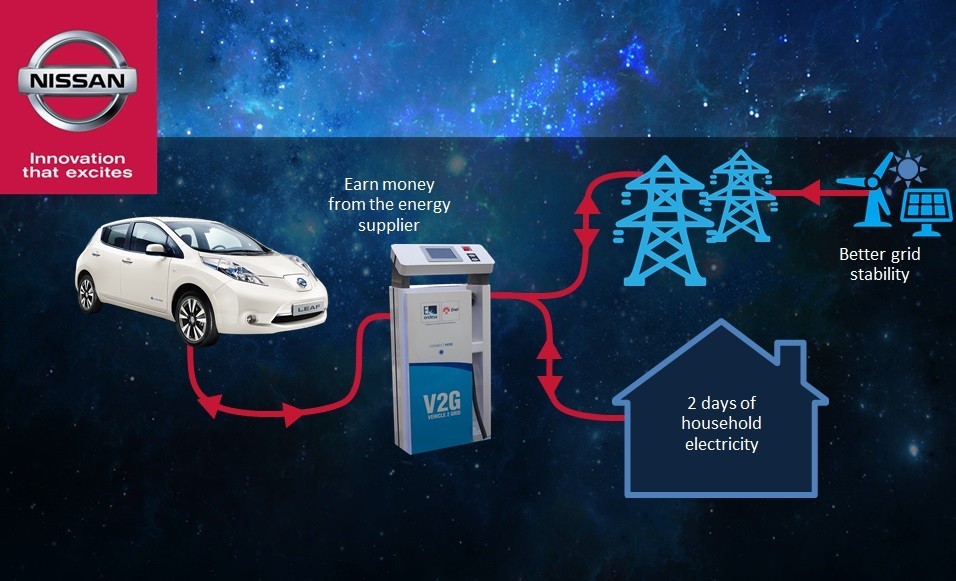
Here’s one of Nissan’s infographics showing how they see the technology working:

UK Plc “being savvy” and providing support for the “right business models” is another matter entirely however! Utility Week continued:

Projects such as My Electric Avenue have revealed that vehicles are sat stationary at either the home or workplace, both potential charging locations, 95 percent of the time making EVs a “stable storage asset”. Based on “very modest projections” there could be as many as 300,000 EV or hybrid vehicles on UK roads by 2025, presenting around 4GW of potential storage to the UK’s electricity system with very little network reinforcement required.

Having discussed the Utility Week article with Mark Thompson it seems they have misinterpreted a couple of points:

I didn’t wish to imply that cars would be 95% available, just that they are “parked for 95% of the time” but that data DNO projects such as My Electric Avenue and ETI analysis indicate that a “very healthy proportion” of plugins will be accessible over the 24 hour cycle for grid support given charging and use patterns. The 95% figure as currently illustrated is not of course realistic, but perhaps eventually grid “connected availability” may be in the region of 30-60% depending on the time of day, which in time will amount to a significant amount of grid connected resource.

Also, the 4GW figure should be 4GWh.

Here’s the original slide from Mark’s presentation, with the correct units clearly visible on the Y axis and in big letters towards the end of the headline:

Today the mainstream media picked up the story in the form of an article by Damian Carrington in The Guardian entitled “From liquid air to supercapacitors, energy storage is finally poised for a breakthrough”. Damian opens with a quote from Jill Cainey, director of the UK’s Electricity Storage Network.

It doesn’t always rain when you need water, so we have reservoirs – but we don’t have the same system for electricity.

A battery project can take 12-18 months from saying we will do it, to completion. California is aggressively pursuing a low-carbon agenda and they don’t want diesel [generator back-up] on the system. Amber Rudd is talking a lot about energy storage, but we need a clear regulatory steer. The planes are circling, but there is no runway to land on.

Next Mark Thompson is quoted once again, apparently from the Utility Week article rather than from his actual presentation:

Using electric car batteries as a smart storage network while still in the cars is a promising option in the future, according to Mark Thompson at Innovate UK, a government agency. He says there could be 4GW capacity – a nuclear power station is about 1GW – by 2025 across the 300,000 electric cars projected to be on UK roads by then. He says cars are stationary for 95% of the time and using them could save billions of pounds, removing the need for new power stations and power lines.

However the article continues:

While interest in energy storage projects in the UK is surging – a recent call from National Grid for 200MW of short-term storage was oversubscribed six times – it is starting from a low base: just 24MW has been installed compared to the 5,000MW the government’s official advisers, the Committee on Climate Change, envisages in a low-carbon nation in 2030.

In November, energy secretary Amber Rudd said: “Locally generated energy supported by storage, interconnection and demand response, offers the possibility of a radically different model… We are looking at removing regulations that are holding back smart solutions, such as demand side response and storage.”

Removing the regulations that are holding back smart solutions is one of the reasons Mark and Jill were already on my list of people to call this week. That’s because DECC’s current consultation about how to “Ensure Regulation in the Energy Sector Encourages Innovation” closes on February 11th!

DECC Launches a “Consultation to Ensure Regulation in the Energy Sector Encourages Innovation”!

This is such exciting news (to yours truly at least!) that I reproduce the United Kingdom’s Department of Energy & Climate Change’s announcement in full. From their headquarters in London:

Image courtesy of DECC

DECC has today launched a Consultation to ensure regulation in the energy sector encourages innovation.

DECC invites stakeholders to offer their views on how effective the current regulatory framework is in enabling innovation.

The consultation focuses on the activities of DECC and the Oil and Gas Authority, with other energy sector regulators undertaking parallel engagement exercises.

Lord Bourne commented:

  • Innovation has the power to transform the energy sector and the way we live every day.
  • We are committed to cutting red tape and creating industry environments that foster new ideas and give technologies a commercial edge.
  • Collaboration is key and I look forward to hearing the ideas from industry so we can ensure an innovative energy sector that works for hardworking families and businesses.

The Consultation on ensuring regulation encourages innovation will run for four weeks.

For more information and to have your say please email [email protected]

Rest assured that one way or another I shall be getting in touch with the innovation team at DECC before the deadline of 5 PM on February 11th 2016. Perhaps I’ll send them my past musings on the regulatory framework here in the United Kingdom? If you would like to do so as well all the small print is available from:

https://www.gov.uk/government/consultations/consultation-on-ensuring-regulation-encourages-innovation

which adds that:

In its Productivity Plan, the government required all departments to publish an Innovation Plan by spring 2016. The purpose of each Plan is to set out how departments and regulators are adapting legislation and enforcement frameworks to enable innovation in the form of emerging technologies and innovative business models.

This consultation enables stakeholders to offer their views on current regulatory activities led by DECC and the OGA and how they interact with energy sector innovation. Other regulators are conducting parallel engagement exercises, for which links and contacts are provided within the document.

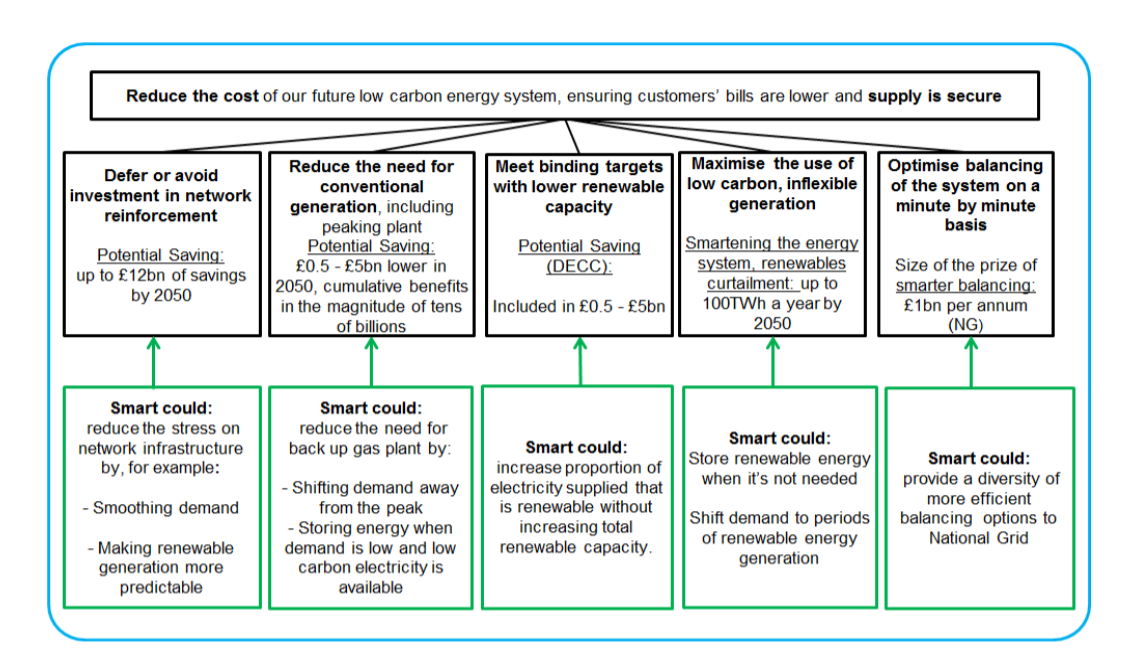
A related document from DECC, published last month and entitled “Towards a Smart Energy System“, is also well worth a read. It explains some smart energy innovations that the authors would presumably like to see implemented:

A smart, flexible energy system would involve incorporating new forms of flexibility in combination, including energy storage, demand side response (DSR), smart networks,as well as increasing interconnection. It could also involve energy efficiency improvements which target peak demand. Combining these solutions in a whole-system approach would help us achieve the following benefits:

  • Defer or avoid investment in network reinforcement.
  • Reduce the need for a significant increase in reserve generation capacity.
  • Meet binding climate change targets with less low carbon generation.
  • Make the best use of our low carbon generation.
  • Optimise balancing of our energy system on a minute-by-minute basis.

It also summarises some of the associated regulatory “barriers” currently facing us here in the UK:

We have identified some potential barriers that mean new forms of flexibility such as DSR and storage may not develop in a timely or adequate way. This includes market and regulatory barriers, where we need to take a whole system perspective in some of our policies and regulatory arrangementin the future. Existing business models may also mean incumbents have incentives to stick with the status quo. Cultural inertia and skills gaps within existing energy companies may also be a factor in slowing the uptake of these technologies. The presence of these barriers shows that further action is likely to be needed if we want to realise the full potential of smarter energy system.

Energy and Climate Change Committee Discusses V2G

Last year the United Kingdom’s House of Commons Energy and Climate Change Committee launched an inquiry into low carbon network infrastructure in the UK. Initially they sought written submissions of evidence, and are now televising live oral submissions to the committee. Fortunately these events are also recorded, and during the one that took place on January 12th there was much discussion of energy storage in general and electric vehicle batteries in particular. Here’s an extract:

Amongst a variety of other contributions you can hear the chair Angus MacNeil MP ask:

To what extent will electricity demand in future exhibit greater peaks and troughs due to the electrification of heat and transport? What changes will that make in demand?

The first expert witness to respond was Sara Bell, the Chief Executive of Tempus Energy:

I think that depends very much on how we manage that demand. Both the demands that you have mentioned are highly flexible, so that offers an enormous opportunity to match that demand to generation, and variable generation can be matched very successfully to that flexible demand. Every electric vehicle could be charged when we have excess renewable generation. There is a way, from an economic standpoint, of managing that sensibly.

The experts went on to discussheat pumps for bit, and then Dr Philipp Grünewald from the Environmental Change Institute at Oxford University pointed out that:

Electric vehicles could play a very interesting role in helping to balance the system, because they have inbuilt storage, but another debate is ongoing on the extent to which you want to use that type of storage for the grid. We might come back to that.

to which Dr Jill Cainey of the Electricity Storage Network added:

On electric vehicles, it is more that the charging is the critical thing that you need to control, not necessarily using the battery device for the system services. National Grid has a project in which it has looked at that — at providing frequency response.

You may correctly surmise from the name of this blog that I don’t entirely agree with Jill on that point! “Smart charging” certainly has its place, but so might “using EV batteries for system services” in a rather different market and regulatory environment to the current one. The panel discussed that issue a bit later in the proceedings. Sara Bell again:

We have not even started the process of making the demand side flexible. Tempus Energy is the only electricity supplier that unlocks flexibility in customer premises. We go to our customers and we put control and sensor technology into their premises so that we can move their demand. Every time — and I mean every time — we go into customer premises, they are using electricity at times in a very expensive way, completely unnecessarily, because no supplier has ever rewarded them for their flexibility before, so why should they bother?

We are one small new supplier. If the whole market operated like this, we would unlock a great deal of flexibility, which would reduce the total system cost.

Jill Cainey again:

There are some issues with capacity now. That is why we have the capacity market. I guess Electricity Storage Network would argue that that incentivises particular types of technology for security of supply but doesn’t necessarily support the new innovative approaches such as demand side and electricity storage because of the way that market has been designed…

There are technologies and approaches, such as demand side response and aggregation — aggregators are providing demand side response as well. We need to facilitate those approaches to move forward. That is a market approach.

That we can agree on 101%, and I also agree with Dr Gordon Edge who is Director of Policy at RenewableUK who said:

I would argue that some of the time-limiting steps are not technology but the regulatory market approaches. We need to be thinking about how we make the market so that these things, when they are economic, just happen automatically. At the moment, there are too many barriers.

and with Stephen Goldspink who is Director of Strategy and Business Development at Siemens Energy Management, who added that:

Technology and solutions are already available, as my colleagues has already said, so it is about how fast we deploy those technologies and the regulatory barriers that need to be removed to deploy them. Energy storage, demand side management, energy efficiency — all these things can support this capacity margin issue and put us on the journey to low-carbon networks much quicker.

Angus MacNeil then said:

Thank you. I understand what you are saying about regulatory barriers, but we will leave that section there.

Hence so will we, for the moment at least.