
Is Distributed Energy Storage on Ofgem’s Roadmap?

In the first of my reports from the Regen SW “Community Energy Markets” conference in Bristol last Thursday I’ll be highlighting references in several of the presentations to what I like to call “Distributed Energy Storage“, which encompasses a whole lot more than just the battery packs in electric vehicles.

The first person to mention the subject was Jeff Hardy, who is Head of Future Consumers & Sustainability at Ofgem. His presentation was on the topic of “Non-traditional business models: Supporting transformative change in the energy market” which deserves an article all of its own in due course. However whilst discussing “rapid technological innovation” Jeff pointed out that “battery storage is the current flavour of the month”. After that Sonya Bedford, Head of Renewable Energy at Stephens Scown solicitors, also hinted at the subject in her talk about “Local supply models” in which she mentioned “Demand Side Response” and “Local Balancing Units”.

At the conclusion of the morning session Merlin Hyman, chief executive of Regen SW and our host for the day, asked if there were any questions from the floor. Nobody else seemed very keen to put their hand up, so I waved my arm in the air and was duly invited to stand up, state my name and affiliation, and then pose the panel a question. In the event I actually asked two. The first was to enquire if anybody else present was interested in international smart grid standards apart from me, since the LBUs that Sonya had mentioned seemed to me to come within the remit of the IEC 62325 standard working group which I am part of. Then I asked the panel whether the battery packs in electric vehicles were anywhere near being “flavour of next month” in the UK as yet.

Nobody responded to my first question, but Merlin framed my second question to the panel in terms of the recent “Powerwall” announcement from Tesla Energy. I was both pleased and somewhat surprised when Jeff pointed out that V2G was indeed on his radar screen, since he is “fascinated by EVs” and the “traditional battery worries have been overcome by technology”. Sonya was then good enough to mention that I had said much the same thing at the AGM of Exeter Community Energy earlier in the week.

After lunch James Owen, commercial director of Public Power Solutions, started off by giving us a history lesson about local electricity generation in the UK.  Then he went on to discuss the benefits of “Local Balancing Units”, “street level storage solutions” and “a true local smart micro-grid” amongst other things, using both Swindon and the Danish island of Bornholm as examples. James freely admitted to having pinched an infographic of Bornholm, so I’ve taken the liberty of pinching one of his! Here is PPS’s template for a future Bristol, or Bornholm, or the Isle of Wight, or anywhere else in Europe for that matter.
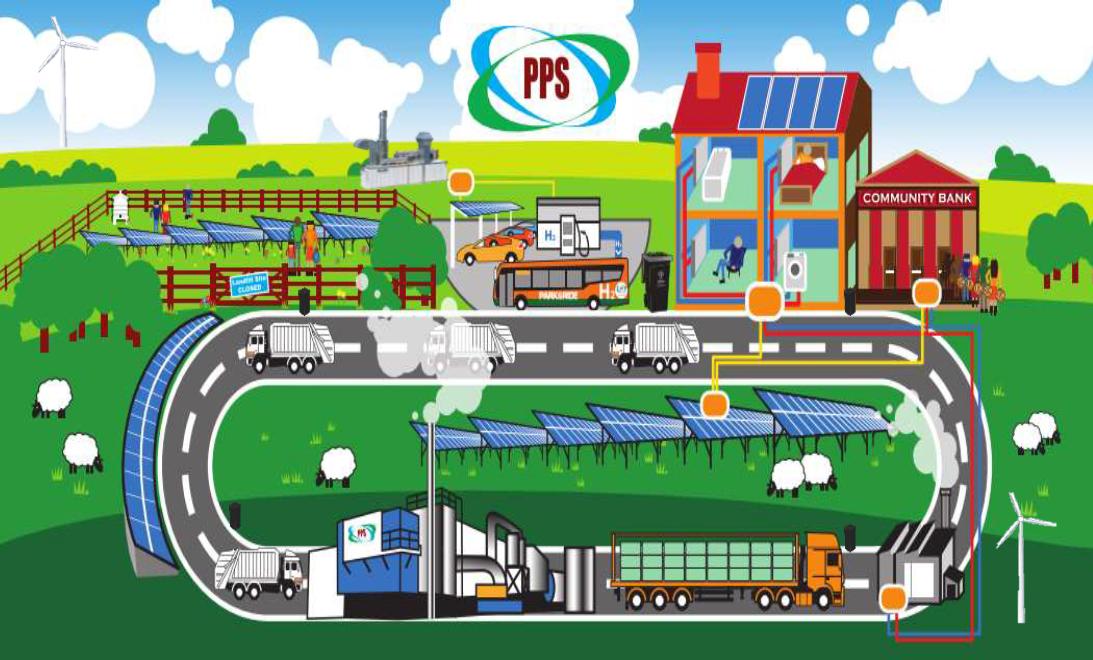
See if you can spot the difference between this version and the one on the PPS web site. It seems those recent additions are Tesla Powerpacks, and in my own vision of a future sunny Southwest England the cars under the solar PV canopy at the park and ride would be connected to similar “black boxes” that incorporate V2G functionality.

Having finally got the preface out of the way, I’d like at long last to mention some alternative battery filled “black boxes” from suppliers other than Tesla Energy. For “grid scale” battery storage you can repurpose EV battery packs like Sumitomo, or use batteries designed for the task from the likes of Saft.

Moving down to the domestic scale I note that for some strange reason the solar PV equipped dwelling in a future Bristol/Bornholm lacks a V2x equipped garage similar to the one shown in the V2G banner at the top of this article. Moving indoors Moixa’s Maslow predates the Powerwall by a long way, and is designed to power a DC circuit for LED lighting, computers etc. Quite possibly prompted by Elon Musk‘s recent announcement, Samsung have also launched a domestic version of their modular Energy Storage System (or ESS for short). Stefan Quandt (of BMW fame) has launched the SolarWatt MyReserve, which has already won an award at the recent ees Europe exhibition over in Germany. Varta also launched their Engion Element “storage for beginners” at ees Europe. Here’s how they looked at the show:

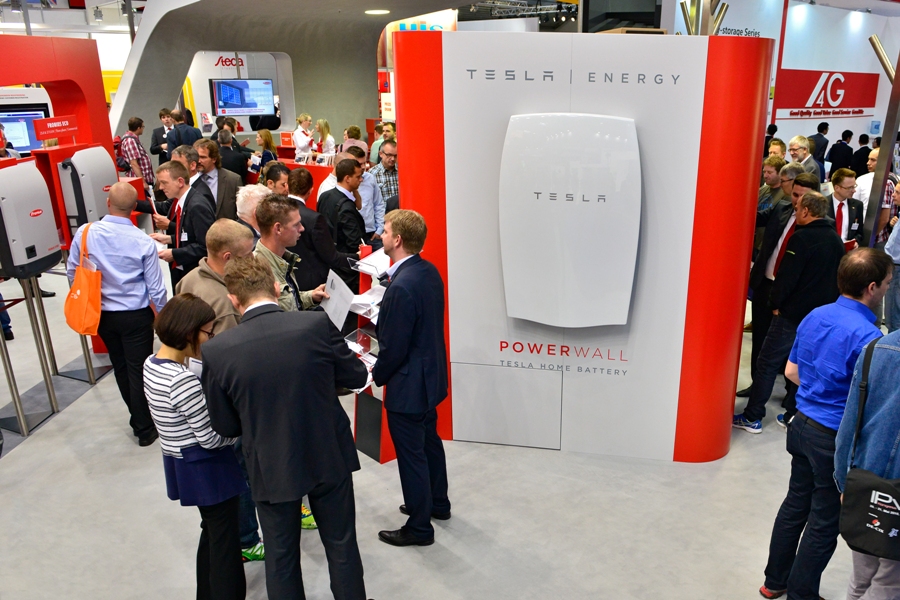
and just in case you haven’t yet tasted the flavour of the month, here’s a Tesla Powerwall for your delectation:
As you’ve probably gathered by now I have a lot more to say about all of this and more, including covering Anthony Price of Swanbarton’s talk dedicated to “Local balancing using storage”. However for the moment at least I cannot help but wonder what Ofgem make of all this “rapid technological innovation”, not to mention the potential associated “non-traditional business models” and last but by no means least, international smart grid standards!

The Resilience of the UK’s Electricity System

Coincident with yesterday’s “Fuelling the Debate” report by the House of Commons Energy and Climate Change Select Committee, the House of Lords Science and Technology Select Committee published a report of their own, entitled “The Resilience of the Electricity System“. The Committee say in their overview of the report that:

The Government should not be congratulated on keeping the lights on. It is not acceptable for an advanced economy, hugely dependent on electricity, to sail so close to the wind. It found that we have been forced to generate extra capacity in the system, using expensive measures with heavy reliance on fossil fuel generation. The report urges the Government to improve its long-term planning to avoid squeezing the capacity margin like this.

The Chair of the Committee, Lord Selborne, commented that:

We chose to look at this issue because, such is our increasing reliance on electricity, any blackouts have the potential to bring our communications and vital services to a grinding halt.

The encouraging finding from our investigation is that overall, the resilience of the electricity system is robust, and witnesses told us we have the most reliable transmission network in Europe. But our report found that the Government sailed too close to the wind, allowing the capacity margin, its safety net, to be squeezed too tightly before taking last minute measures. Moreover these measures, which came at a cost to the taxpayer, were in conflict with the Government’s wider aims to decarbonise electricity generation.

We’re entering new and unchartered territory. As we strive for more decarbonised electricity provision, it will become harder and harder to keep electricity affordable and to guarantee security of supply. These are the three irreconcilable pressures of the ‘energy trilemma’, and we feel that there is more the Government needs to do to inform the public about potential higher prices.

We found that new technologies mean that our electricity system is undergoing immense and radical change. The report stresses that the Government must stay ahead of the game, with dedicated investment into research and development across a wide range of technologies, and constant alertness to cyber‑threats. Only then can the Government ensure that it can weather any storm, and continue to keep the lights on in the long‑term.

Delving deep into the report itself, chapter 5 concerns itself with “Changing demand”, and paragraph 143 even mentions vehicle to grid technology, albeit not using that name:

Electric vehicles and electric heat pumps are two technologies that are expected to increase demand for electricity.

If electric vehicles are widely taken up then they will increase electricity demand, though this could be concentrated during off peak hours. On the other hand, a smart grid could allow battery-powered electric vehicles to supply power to the grid, e.g. during peak times when prices are high, and then to recharge during off peak hours. They could also further contribute to electricity security by providing a backup supply during power outages. Electric vehicles are not the only low carbon option for road transport – hydrogen and biofuels (2nd or 3rd generation) also offer potential.

Paragraph 144  goes on to point out that:

Electrification of large parts of the energy used for heating or transport “would change its time-of-use profile, placing ever increasing pressures on the electricity system.” Charging electric vehicles will bring complexity and it will be important that vehicle
charging management systems and standards are carefully designed. Vehicle charging is a manageable problem, since the overnight load can be fitted into the available system capacity. However simplistic charging management solutions will create unfortunate effects, such as cliffs of coordinated switch-on and switch-off. There are other issues that need to be addressed in designing an effective charging system. Unmanaged systems will contribute significantly to peak load, since people naturally
plug in at the point of arrival home and then charge through the evening peak. It is therefore critical that carefully designed vehicle charging management systems and standards at the national level are developed and incorporated into any large scale demonstrations and early roll-outs. These systems need to address both the capacity of the national system and also the local distribution system.

Plenty of sensible suggestions then, which at the end of the day leaves us coming to much the same conclusion as the House of Lords Select Committee:

We recommend that the Government supports research, development, demonstration and early deployment across a diverse range of technologies. This should include electricity supply, demand side response, storage and smarter networks [and V2G!].
Particular attention should be paid to technologies that could strengthen electricity system resilience and how these technologies fit together in systems.

Given budgetary constraints, there will be a need to prioritise some technologies over others. We recommend that the rationale for these choices is clear, transparent and made publicly available.

Implementing that final sentence would certainly be a big improvement over the current state of affairs!

Fuelling the Debate About the UK’s Energy Future

This morning the United Kingdom’s House of Commons Energy and Climate Change Select Committee published its latest report, entitled “Fuelling the debate: Committee successes and future challenges”. The introduction to the report states that:

The Energy and Climate Change Committee plays a central role in scrutinising and improving the Government’s policy and legislation.

We look in detail at three case studies – electricity market reform, competition in the energy market and shale gas – each of which highlights the key role we have played in holding the Government to account and improving policy and legislation. Finally, we set out our future vision for the UK energy system, based on the views and evidence provided by the wide range of stakeholders that we work with. We also explore the challenges which will need to be overcome in the next Parliament if the UK is to achieve its ambitious long-term climate and energy goals.

The committee has also just released a video summary of their activities over the last 5 years. Here it is:

In the video Tim Yeo, who is chair of the committee, says amongst other things that:

The cheapest form of energy is the energy we don’t use in the first place. Yet despite the fact that energy efficiency is one of the cheapest ways to cut greenhouse gas emissions and improve energy security and end fuel poverty, they were neglected in the Government’s original proposals. So the committee recommended that demand reduction and energy efficiency be placed at the very heart of Electricity Market Reform.

Unfortunately today the Government is still putting too much emphasis on building new electrical generating capacity, instead of promoting demand-side measures that would improve security of supply and also reduce consumer bills.

Here at V2G we cannot help but agree with those sentiments. We also cannot help but agree with Catherine Mitchell, Professor of Energy Policy at Exeter University, who according to a “Tweet” by the ECC select committee itself at least, pointed out this morning that:


Professor Mitchell’s slides for her presentation this morning can be downloaded from the IGov web site.

Energy and Climate Change Committee Criticise Capacity Market

The UK’s House of Commons Energy & Climate Change Select Committee issued a report today on the implementation of Electricity Market Reform which is highly critical of the new electricity capacity market. This may strike you (as it does me!) as a severe case of shutting the stable door after the horse has bolted, but nonetheless the executive summary puts it this way:

The Government’s flagship Electricity Market Reform was designed to drive investment in our energy infrastructure and manage the transition towards generating low-carbon, secure and cost-effective electricity. After years of planning, the Government has successfully put in place the necessary framework for the first Capacity Market and Contract-for-Difference (CfD) auctions under EMR, and DECC, National Grid and the Low Carbon Contracts Company have been helpful in preparing industry in the run-up to the auctions.

However, the speed at which participants have had to assimilate the complex policies have made it a challenging environment for smaller companies, and DECC is still failing to ensure that demand-side response (DSR) providers are given a level playing field in the Capacity Market. In order to avoid paying for more expensive generation capacity that may not be needed in the future, the Government should consider means to further support DSR in the Capacity market, for instance by increasing the contract length of DSR capacity agreements.

There also remain strong concerns around National Grid’s potential conflicts of interest as EMR Delivery Body, and it is important that clear steps are taken to ensure that it does not have an unfair commercial advantage in future Capacity Market auctions.

Speaking as one of those “smaller companies” it seems from our perspective that the playing field is indeed located on a rather steep slope! Tim Yeo, chairperson of the committee, said that:

Every consumer in the country is currently subsidising spare electricity generating capacity that may only be used for a few hours each year. But smart technology has now made it possible to reduce unnecessary electricity demand at peak times, thereby reducing the number of polluting power stations that need to be switched on. This could mean we can reduce the total electricity generating capacity that has to be maintained in future, bringing down costs for consumers while enabling us to reduce consumption of fossil fuels.

Yet this promising new demand-side response technology has been disadvantaged in the auctions under the Government’s Capacity Market – meaning costs and emissions could be higher than necessary. Only a fraction of the £1 billion pounds that will be spent keeping the lights on through the Capacity Market will actually provide new capacity and just 0.4% will go on demand-side response – with most of the rest going to existing fossil fuel power stations, paying some of them to stand idle for much of the year. Nearly a fifth of the capacity contracts already awarded are going to highly polluting coal power stations.

Which sums things up quite nicely for us. We would go even further than Tim Yeo. Not only should Demand Side Response be getting a better deal, so should distributed energy storage in general and V2x in particular. Tim does however also point out that:

The results of the first CfD auction for long term low-carbon contracts show that small companies or community energy projects are in danger of being shut out. The fact that the final strike prices were cheaper than the administrative price is a very positive result, but it casts further doubts over the value-for-money of the early contracts for renewables under the Levy Control Framework.

The committee’s concluding bullet points read as follows:

DECC’s upcoming review on EMR should focus hard on the issues voiced by stakeholders and raised in the Committee’s report. In particular, it should focus on:

  • The role of highly polluting coal and diesel fired power generation in the capacity market
  • How to facilitate cheaper and cleaner demand-side solutions to keep the lights on
  • How potential conflicts of interest with National Grid will be avoided or addressed
  • How engagement with small players can be improved

to which we would add one of our own:

How to design UK energy markets such that distributed storage and generation operate on a level playing field?