What Should Be In SEWTHA 2.0?

In case the six letter acronym (SLA for short) in our title for today means nothing to you it stands for “Sustainable Energy Without The Hot Air“, the title of a 2008 book by David MacKay, who amongst other things is Regius Professor of Engineering at the University of Cambridge. We first mentioned SEWTHA back in 2012, when Bill Gates praised it in an interview with the Wall Street Journal. I mention it again today because my attention was drawn by a bit of a barney (BoB for short) on Twitter between Prof. MacKay and Jeremy Leggett, who amongst other things is a founding director of solar PV company Solarcentury.

First of all here’s the BoB in question, including the V2G UK addendum!


In case you would like to listen to the edition of Evan Davies’ “The Bottom Line” on the topic of “Renewable Energy” under discussion, here it is:

http://bbc.in/1PIZD9G

Evan’s guests were Jeremy Leggett, Juliet Davenport of Good Energy and Paul Cowley, managing director of RWE Energy UK. Here are of few of my own “edited highlights”:

01:30 JD – One of the examples is Wyke Farm Cheeses. When they wash down the dairy every night and when they make the cheese, that they then anaerobically digest which creates a gas and they generate power. That’s one of our generators.

02:37 JL – A small cottage with bespoke solar tiles. these are different from the modules you use in solar farms or on a big installation on a commercial roof because they really are tiles. They go straight on the battens of the house. They generate electricity. They’re waterproof.

08:45 ED – I also wanted to talk about the physical constraints on whether you can get, in a country like ours, to 100% renewables. I’ve been very influenced by a particular book called SEWTHA by David MacKay.

09:30 JL – That book was published a good few years ago now. It’s out of date and I don’t think Dr. MacKay even believes that any more.

10:18 JD – We did some work, following David MacKay’s book actually, and used the work that he did. He went on to be the scientific advisor to DECC. He developed these pathways/models and we used them to look at how hard can you push the system to get it 100%. The UK has sufficient resource, whether it’s wind, whether it’s solar, to get to 100% on the current usage. [My emphasis!]

One of the things about climate change, it’s going to change the way we use power as well. So we saw last year energy usage in the domestic gas market dropped by 10%. 2014 one of the warmest years ever. You’ve also had the highest ever wind power production this winter. We’ve seen a lot of storms come through… So the parameters that David used in that book, I think we’re now looking for Hot Air 2.0.

11:30 ED – To give another example from the book, taking that it’s out of date, to get 50 kWh per day per person, and we’re currently using 125 kWh per day, to get 50 from offshore wind would mean filling a sea area twice the size of Wales. It would be expensive. It would be a very big deal.

One of things here, and it’s been much under-discussed in this area, is not only do we need to get our current electricity decarbonised, but we’re talking about decarbonising the transport industry to a large degree, and David MacKay’s good on this. You’ve got to almost double or triple your electricity generation, so not only do we have to replace the nuclear power and the coal that’s falling out of use over the next decade. You’ve got to replace that and add in plug-in cars. [My emphasis!]

12:59 JD – That’s what really exciting about right now. We’ve got a different problem on our hands. We’re going to have different technologies coming through, and we’re going to have to figure out how consumers use that. And actually the car storage part is really interesting because each car has a battery in it, and suddenly you’ve got a flexible power source that you can either use for transport or potentially use within people’s homes. And that piece of technology hasn’t really been thought through, about what that can really deliver [Juliet’s emphasis!]

13:45 PC – We see it in the press all the time. Wind turbines not running because the wind’s not blowing! The reality is that turbines generate around 85% of the time. They start generating at a very low wind speed… and then builds up to an optimum wind speed.

14:13 ED – We haven’t got yet a very efficient mechanism for storing electricity have we?

14:25 JL – Things are moving so fast. Let’s not forget, Apple is going to be mass producing electric vehicles four years from now. That is their stated intent. Each one of those is going to be a little power plant, and who knows how they’re all going to be hooked up to each other? It’s going to move so fast Evan, and I think this is the criticism that people like me have of, you know good guys like David MacKay with his book. They’re still flogging the idea of these vast centralised, humongously expensive centralised power plants, nuclear in particular, that take 10 years to construct.

The upshot of all this, apart from the BoB? More and more people are mentioning the concept of vehicle-to-grid technology in public pronouncements here in the UK. Andrea Leadsom at DECC assures us that she’s “as keen as mustard” on energy storage. That is of course nice to hear, but what do Physics & Chemistry have to tell us about the hard realities of distributed energy storage? And what about DECC & Ofgem too, with their assorted rules and regulations?

I might also have a minor quibble about Juliet’s “hasn’t really been thought through” remark. Some people have been thinking quite hard about V2H and V2G for quite some time!

DECC Launches a “Consultation to Ensure Regulation in the Energy Sector Encourages Innovation”!

This is such exciting news (to yours truly at least!) that I reproduce the United Kingdom’s Department of Energy & Climate Change’s announcement in full. From their headquarters in London:

Image courtesy of DECC

DECC has today launched a Consultation to ensure regulation in the energy sector encourages innovation.

DECC invites stakeholders to offer their views on how effective the current regulatory framework is in enabling innovation.

The consultation focuses on the activities of DECC and the Oil and Gas Authority, with other energy sector regulators undertaking parallel engagement exercises.

Lord Bourne commented:

  • Innovation has the power to transform the energy sector and the way we live every day.
  • We are committed to cutting red tape and creating industry environments that foster new ideas and give technologies a commercial edge.
  • Collaboration is key and I look forward to hearing the ideas from industry so we can ensure an innovative energy sector that works for hardworking families and businesses.

The Consultation on ensuring regulation encourages innovation will run for four weeks.

For more information and to have your say please email [email protected]

Rest assured that one way or another I shall be getting in touch with the innovation team at DECC before the deadline of 5 PM on February 11th 2016. Perhaps I’ll send them my past musings on the regulatory framework here in the United Kingdom? If you would like to do so as well all the small print is available from:

https://www.gov.uk/government/consultations/consultation-on-ensuring-regulation-encourages-innovation

which adds that:

In its Productivity Plan, the government required all departments to publish an Innovation Plan by spring 2016. The purpose of each Plan is to set out how departments and regulators are adapting legislation and enforcement frameworks to enable innovation in the form of emerging technologies and innovative business models.

This consultation enables stakeholders to offer their views on current regulatory activities led by DECC and the OGA and how they interact with energy sector innovation. Other regulators are conducting parallel engagement exercises, for which links and contacts are provided within the document.

A related document from DECC, published last month and entitled “Towards a Smart Energy System“, is also well worth a read. It explains some smart energy innovations that the authors would presumably like to see implemented:

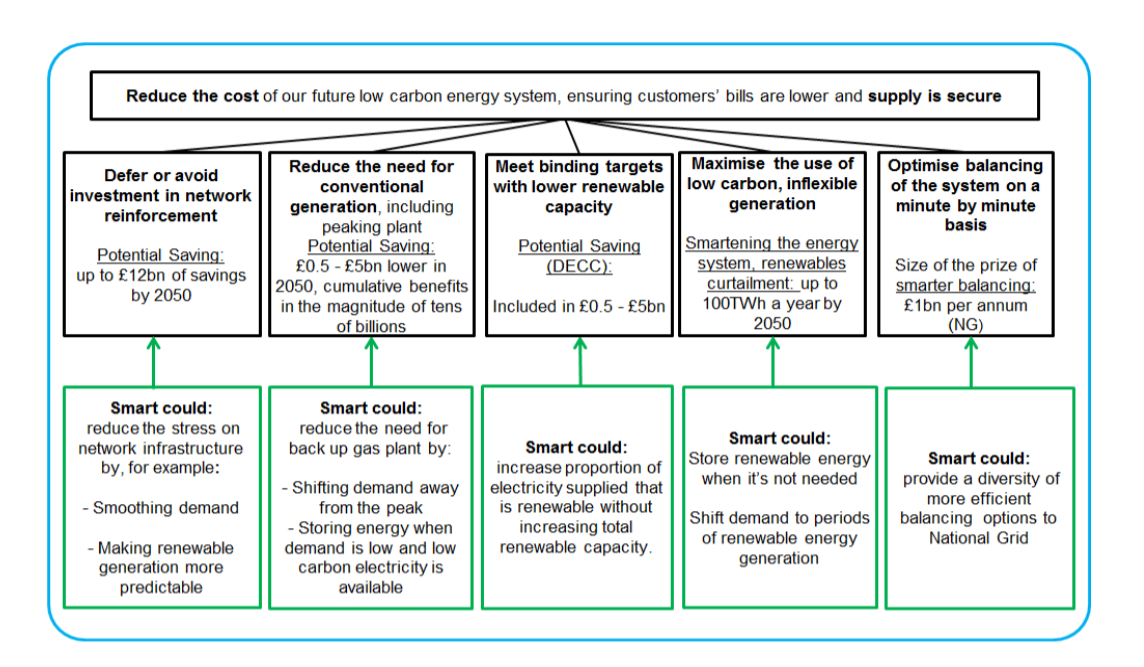
A smart, flexible energy system would involve incorporating new forms of flexibility in combination, including energy storage, demand side response (DSR), smart networks,as well as increasing interconnection. It could also involve energy efficiency improvements which target peak demand. Combining these solutions in a whole-system approach would help us achieve the following benefits:

  • Defer or avoid investment in network reinforcement.
  • Reduce the need for a significant increase in reserve generation capacity.
  • Meet binding climate change targets with less low carbon generation.
  • Make the best use of our low carbon generation.
  • Optimise balancing of our energy system on a minute-by-minute basis.

It also summarises some of the associated regulatory “barriers” currently facing us here in the UK:

We have identified some potential barriers that mean new forms of flexibility such as DSR and storage may not develop in a timely or adequate way. This includes market and regulatory barriers, where we need to take a whole system perspective in some of our policies and regulatory arrangementin the future. Existing business models may also mean incumbents have incentives to stick with the status quo. Cultural inertia and skills gaps within existing energy companies may also be a factor in slowing the uptake of these technologies. The presence of these barriers shows that further action is likely to be needed if we want to realise the full potential of smarter energy system.

An Open Letter to Mel Stride, George Osborne, David Cameron et al.

Productivity Plan? NegaWatts are cheaper than MegaWatts!


To: Mel Stride MP
Cc: William Dartmouth MEP
Cc: Ashley Fox MEP
Cc: Julie Girling MEP
Cc: Clare Moody MEP
Cc: Julia Reid MEP
Cc: Molly Scott Cato MEP


Hello again Mel,

Further to our previous conversations about UK plc’s so called energy policy, I urge you to protest in the strongest possible terms to Messrs Cameron and Osborne about the following paragraph in the Chancellor’s so called “Productivity Plan“:

“The government does not intend to proceed with the zero carbon Allowable Solutions carbon offsetting scheme, or the proposed 2016 increase in on-site energy efficiency standards.”

Do they not comprehend that NegaWatts are cheaper than MegaWatts? Do they not realise how many research hours at Exeter University they are unceremoniously flushing down the pan, or the effect those innocent sounding words will have on the forthcoming “South West Exeter” housing development in Teignbridge? Are they deliberately setting out to destroy investment in the “Energy Efficiency” and “Renewable Energy” industries in South West England in general, and in your constituency in particular, or do they simply have no idea what they are doing?

I await your substantive response at your earliest convenience, and preferably sooner.

Yours in shock,

Jim Hunt

Smart Grid Consultant
V2G Limited

P.S. According to Andrew Marr “We’re all still dancing on the precipice”

Renault-Nissan to Provide 200 Electric Vehicles for UN COP21 Paris Climate Conference

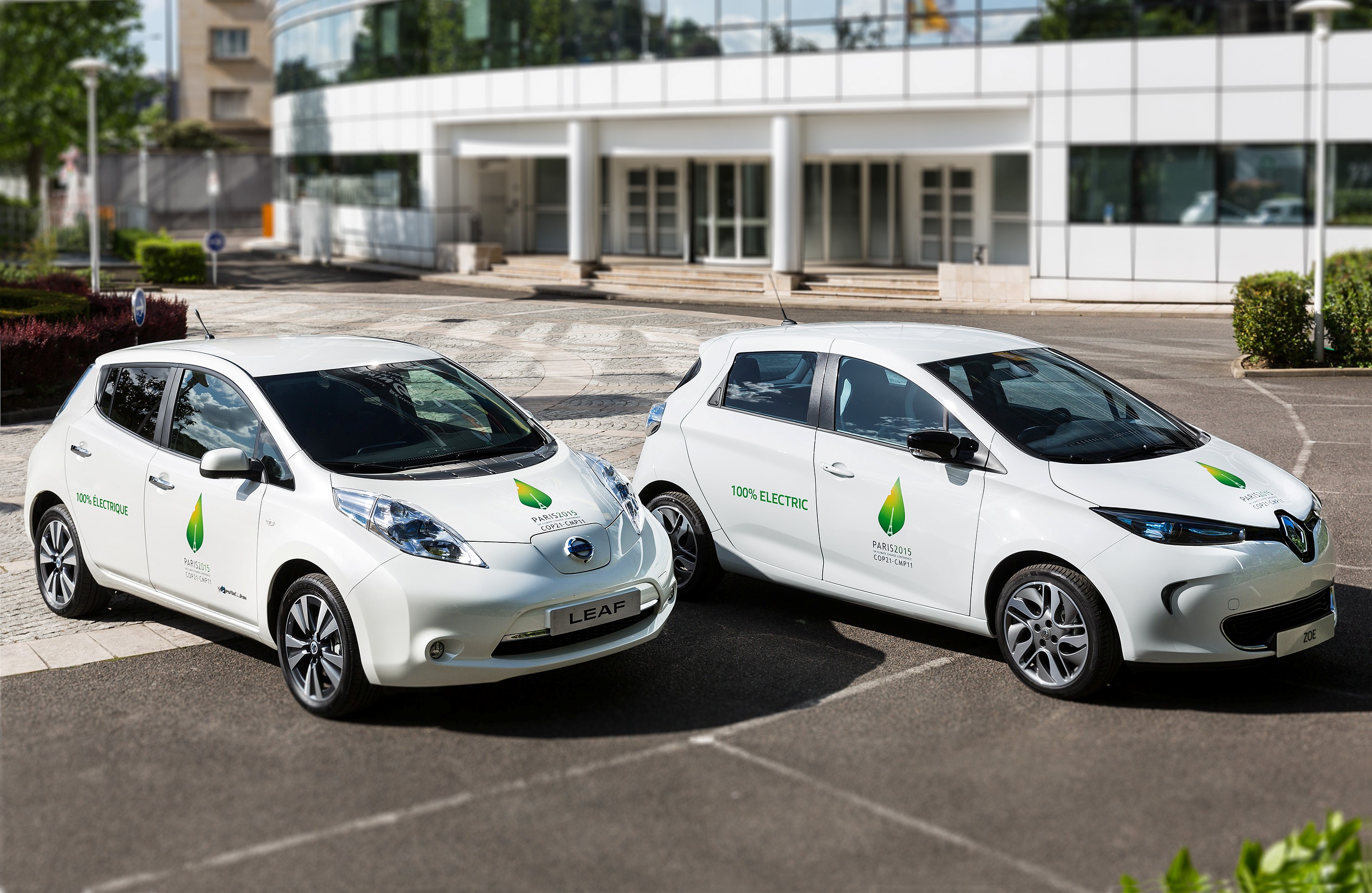
The Renault-Nissan Alliance announced today that they will provide a fleet of 200 all-electric vehicles as the official passenger-car provider for the United Nation’s COP21 climate conference in Paris later this year. The fleet of vehicles will include Renault’s ZOE and Kangoo Z.E. and Nissan’s LEAF and e-NV200. Here’s what a small part of it looks like:


According to the Alliance press release:

The partnership agreement was signed today between the Renault-Nissan Alliance and the General Secretary in charge of the preparation and organization of the 21st annual Conference of Parties (better known as COP21). The fully electric car fleet will shuttle delegates during the event from Nov. 30 to Dec. 11.

More than 20,000 U.N. participants from 195 countries are expected to attend the annual climate summit. It will be the first time the U.N. will use a zero-emission fleet for its entire passenger car shuttle at a COP event.

Laurent Fabius, the French Minister of Foreign Affairs and International Development and President of COP21, said that:

We are delighted to announce that the Renault-Nissan Alliance is an official partner of COP21 in Paris. Thanks to the Alliance’s fleet of 100% electric vehicles, it will contribute to our goal of achieving a carbon neutral event. The technology of electric vehicles helps reduce greenhouse gases in the transportation sector efficiently.

whilst Carlos Ghosn, Chairman and CEO of the Renault-Nissan Alliance, said that:

Electric vehicle technology is an efficient solution for a practical and affordable mode of transportation. This solution has a positive impact on the climate and air quality in our cities. It’s time to accelerate the shift to zero-emission mobility by working together with all parties concerned.

At this point in time I cannot help but wonder what Amber Rudd and her new team at DECC will make of being ferried around Paris in 100% electric vehicles later this year? Maybe they’ll be so impressed that they will follow the lead of Paris and:

Set up network[s] of more than 50 quick and standard charging stations powered by 100% renewable energy in strategic locations. The quick charging stations will be able to charge the EVs from 0 to 80% capacity in about 30 minutes.

Energy and Climate Change Committee Criticise Capacity Market

The UK’s House of Commons Energy & Climate Change Select Committee issued a report today on the implementation of Electricity Market Reform which is highly critical of the new electricity capacity market. This may strike you (as it does me!) as a severe case of shutting the stable door after the horse has bolted, but nonetheless the executive summary puts it this way:

The Government’s flagship Electricity Market Reform was designed to drive investment in our energy infrastructure and manage the transition towards generating low-carbon, secure and cost-effective electricity. After years of planning, the Government has successfully put in place the necessary framework for the first Capacity Market and Contract-for-Difference (CfD) auctions under EMR, and DECC, National Grid and the Low Carbon Contracts Company have been helpful in preparing industry in the run-up to the auctions.

However, the speed at which participants have had to assimilate the complex policies have made it a challenging environment for smaller companies, and DECC is still failing to ensure that demand-side response (DSR) providers are given a level playing field in the Capacity Market. In order to avoid paying for more expensive generation capacity that may not be needed in the future, the Government should consider means to further support DSR in the Capacity market, for instance by increasing the contract length of DSR capacity agreements.

There also remain strong concerns around National Grid’s potential conflicts of interest as EMR Delivery Body, and it is important that clear steps are taken to ensure that it does not have an unfair commercial advantage in future Capacity Market auctions.

Speaking as one of those “smaller companies” it seems from our perspective that the playing field is indeed located on a rather steep slope! Tim Yeo, chairperson of the committee, said that:

Every consumer in the country is currently subsidising spare electricity generating capacity that may only be used for a few hours each year. But smart technology has now made it possible to reduce unnecessary electricity demand at peak times, thereby reducing the number of polluting power stations that need to be switched on. This could mean we can reduce the total electricity generating capacity that has to be maintained in future, bringing down costs for consumers while enabling us to reduce consumption of fossil fuels.

Yet this promising new demand-side response technology has been disadvantaged in the auctions under the Government’s Capacity Market – meaning costs and emissions could be higher than necessary. Only a fraction of the £1 billion pounds that will be spent keeping the lights on through the Capacity Market will actually provide new capacity and just 0.4% will go on demand-side response – with most of the rest going to existing fossil fuel power stations, paying some of them to stand idle for much of the year. Nearly a fifth of the capacity contracts already awarded are going to highly polluting coal power stations.

Which sums things up quite nicely for us. We would go even further than Tim Yeo. Not only should Demand Side Response be getting a better deal, so should distributed energy storage in general and V2x in particular. Tim does however also point out that:

The results of the first CfD auction for long term low-carbon contracts show that small companies or community energy projects are in danger of being shut out. The fact that the final strike prices were cheaper than the administrative price is a very positive result, but it casts further doubts over the value-for-money of the early contracts for renewables under the Levy Control Framework.

The committee’s concluding bullet points read as follows:

DECC’s upcoming review on EMR should focus hard on the issues voiced by stakeholders and raised in the Committee’s report. In particular, it should focus on:

  • The role of highly polluting coal and diesel fired power generation in the capacity market
  • How to facilitate cheaper and cleaner demand-side solutions to keep the lights on
  • How potential conflicts of interest with National Grid will be avoided or addressed
  • How engagement with small players can be improved

to which we would add one of our own:

How to design UK energy markets such that distributed storage and generation operate on a level playing field?

UK Smart Grid Vision Lukewarm on V2G

Last week the United Kingdom’s Department of Energy & Climate Change published their new “Smart Grid Vision and Routemap“. According to DECC’s introduction to the document it:

Sets out the wide ranging benefits that smart grids will bring, for example: minimising consumer bills; allowing consumers to play a more active role in managing the energy system; increasing energy security; helping to facilitate the integration of low carbon technologies; and supporting economic growth.


Great Britain is already recognised as a European leader with respect to the investment in smart grid research and demonstration projects and has begun the nationwide rollout of smart meters, which will help improve network management and facilitate demand response. The Smart Grid Vision and Routemap outlines what action is now needed to build on this initial success to ensure the benefits are realised as soon as possible.

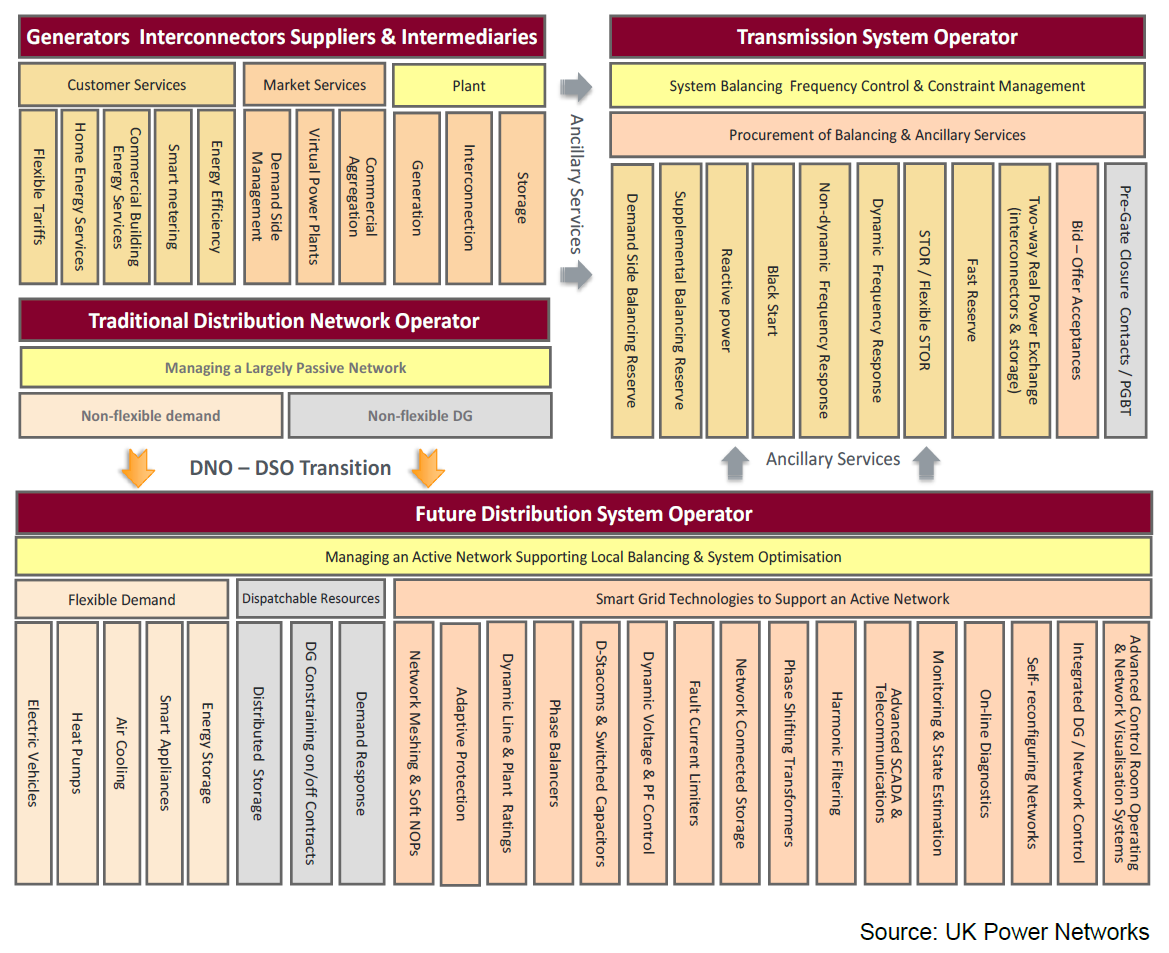
Delving into the routemap itself, I searched for any substantive reference to electric vehicles in general, or vehicle to grid technology in particular. Here’s what I managed to dig up. Firstly a diagram illustrating where EVs fit into the grand design of the future Great British Smart Grid:

February 2014 UK "Smart Grid Vision and Routemap" graphic

February 2014 UK "Smart Grid Vision and Routemap" graphic

Click on the image to see a larger version, where you will note it is anticipated that the “Traditional Distribution Network Operator, managing a largely passive network” will be transformed into a “Future Distribution System Operator, managing an active network supporting local balancing & system optimisation”. Electric vehicles are down in the extreme bottom left hand corner, under the heading of “Flexible Demand”, apparently totally separate from either “Energy Storage” or even “Distributed Storage”.

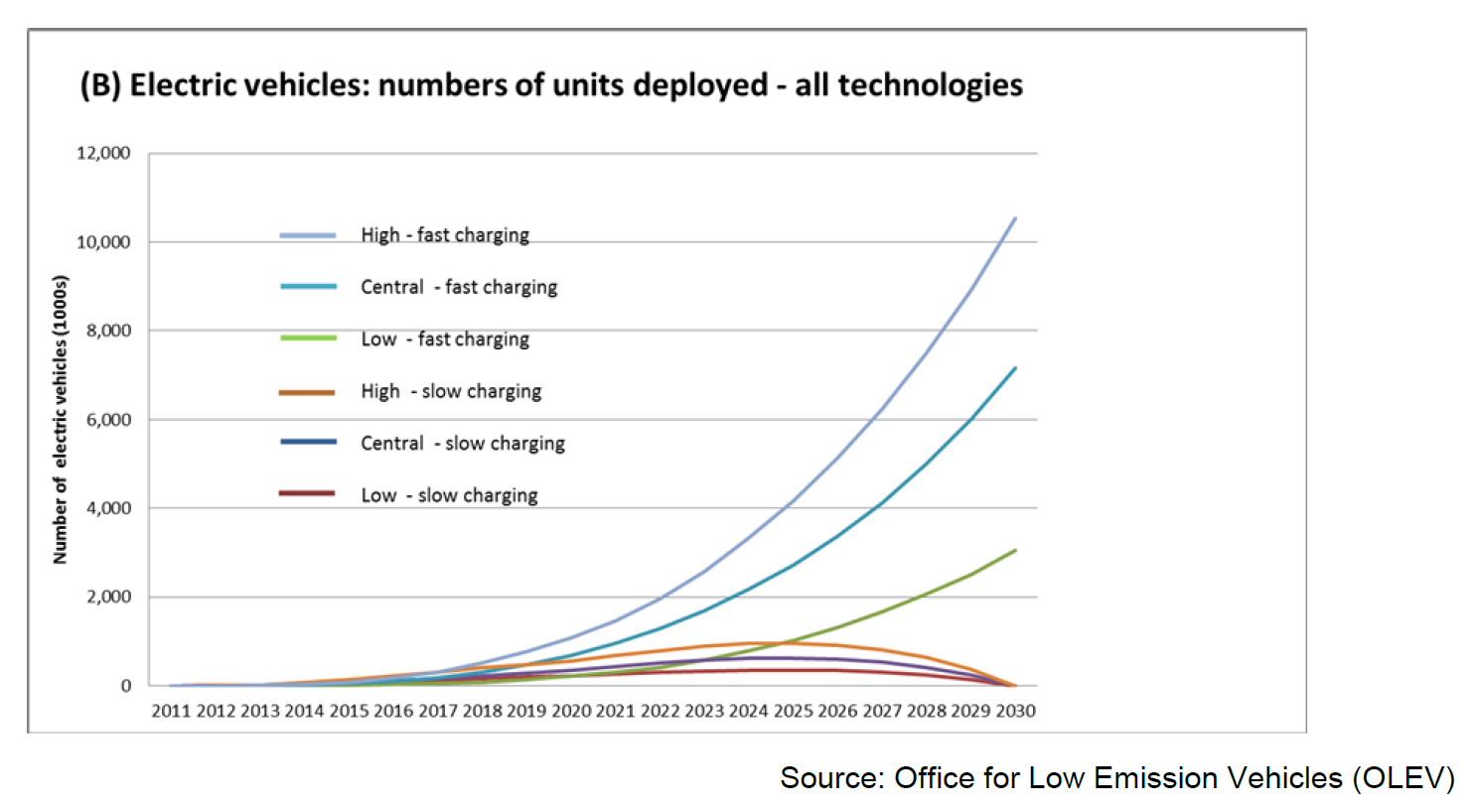
Secondly there is a forecast for the future growth in the number of EVs humming along the UK’s highways and byways, which looks like this:

February 2014 OLEV projection for number of electric vehicles deployed in the UK

February 2014 OLEV projection for number of electric vehicles deployed in the UK

The significant bullet points in the document that mention electric vehicles seem to think that an EV is much like a heat pump. A future British smart grid will:

  • Minimise consumer bills – more efficient use of network assets helps reduce the need to invest in costly infrastructure and ultimately reduces the costs passed through to consumer bills. It is estimated that by 2050, smart grids will reduce the cost of additional distribution reinforcement needed to accommodate the connection of low carbon technologies such as heat pumps, solar PV and electric vehicles by between £2.5bn and £12bn (a 20 to 30 per cent reduction)
  • Enable new low carbon technology to be deployed – heat pumps and electric vehicles will deliver significant carbon reductions, but will increase demand on the electricity network. Using smart grid technology to phase operating times, these devices can be incorporated into the network in conjunction with distributed generation to balance supply and demand, reducing the need for costly network reinforcement.

Finally there is a reference to another document, “Driving the future today – a strategy for ultra-low emission vehicles in the UK” from the Office for Low Emission Vehicles, which contains a few more bullet points about electric vehicles combined with smart grids:

  • The mass adoption of ULEVs will have significant implications for the energy sector at both a local and a national level. As the number of plug-in vehicles on our roads increases, so will the demand for electricity, placing additional pressures on the electricity system.
  • However, ULEVs can also help to balance the demand for electricity at peak periods and support the efficient use of energy by consumers. This will be facilitated by the introduction of intelligent power supply networks (smart grids) and the roll out of electricity smart meters across all domestic properties in the UK by 2020.
  • The majority of plug-in vehicle owners will charge their vehicles at home, at night time, during the off-peak period. This is not only most convenient for drivers, but also maximises the environmental and economic benefits of plug-in vehicles by using cheaper, lower carbon night-time electricity generation.
  • To help people charge at home as easily as possible, the Government is ensuring that smart metering in Great Britain includes the functionality to support charging of plug-in vehicles. This will allow recharging to happen when it is cheapest for consumers and the energy system (subject to appropriate technology in the chargepoint or plug-in vehicle).
  • Plug-in vehicles could also act as distributed energy storage during periods when renewable (or nuclear) electricity generation exceeds demand. This could happen during the life of the vehicle or as a potential end-of-life use for batteries. There may even be the potential for these vehicles to be used as an energy store, to power the house or feed electricity back to the grid at peak periods.

At long last a reference to something resembling V2G, or at the very least V2H! Moving on to page 71 of “Driving the future today” I finally found what I was searching for, an explicit (if somewhat grudging) reference to V2G technology. I reproduce it here in full:

Vehicle to home and vehicle to grid

As the smart grid and battery technologies develop, there may be the potential for plug-in vehicles to act as backup energy sources for homes and supplement the grid during peak demand periods. Nissan already offers a ‘power control system’ to its customers in Japan which allows their LEAF car to power a house for up to two days from its battery pack. Development of this technology was brought forward following the Fukushima nuclear reactor disaster.


There remain issues about the potential impact of taking charge from vehicles on battery life and the investment necessary to facilitate this on a large scale. However, Government will continue to talk to industry and researchers in this area and monitor developments.

Storage has the technical ability to provide a number of benefits to the electricity system – for example, smoothing supply profiles from variable generation and potentially reducing constraint costs by allowing generation to run during periods of low demand. It can also potentially save or defer network upgrade costs that may be required in the future to meet peak demand. Sixteen organisations have recently been awarded a share of £2 million by Government to help develop innovative storage solutions for energy. This funding is helping to drive forward innovation and encourage private sector investment.

The only trouble then is that none of those sixteen projects mention V2G or V2H, although both the the EVEREST project and Aston University’s Hybrid Batteries to Grid project refer to “‘Second Life’ EV batteries” but unfortunately not to EV batteries in situ. It rather sounds as though “Storage to Grid” (or S2G for short) is a more likely prospect here in the United Kingdom than fully fledged V2G.