
Has the Door Opened to a Very Different Car Industry?

On September 18th 2015 the United States Environmental Protection Agency issued a press release in which they stated that:

Today, EPA is issuing a notice of violation (NOV) of the Clean Air Act (CAA) to Volkswagen AG, Audi AG, and Volkswagen Group of America, Inc. (collectively referred to as Volkswagen). The NOV alleges that four-cylinder Volkswagen and Audi diesel cars from model years 2009-2015 include software that circumvents EPA emissions standards for certain air pollutants. California is separately issuing an In-Use Compliance letter to Volkswagen, and EPA and the California Air Resources Board (CARB) have both initiated investigations based on Volkswagen’s alleged actions.

“Using a defeat device in cars to evade clean air standards is illegal and a threat to public health,” said Cynthia Giles, Assistant Administrator for the Office of Enforcement and Compliance Assurance. “Working closely with the California Air Resources Board, EPA is committed to making sure that all automakers play by the same rules. EPA will continue to investigate these very serious matters.”

“Working with US EPA we are taking this important step to protect public health thanks to the dogged investigations by our laboratory scientists and staff,” said Air Resources Board Executive Officer Richard Corey. “Our goal now is to ensure that the affected cars are brought into compliance, to dig more deeply into the extent and implications of Volkswagen’s efforts to cheat on clean air rules, and to take appropriate further action.”

Here’s a video from The Financial Times which explains some more of the background to the story:

Four days previously Transport & Environment, who say they are “Europe’s leading NGO campaigning for cleaner transport” had issued a press release and an associated report in which they stated that:

Urban air in much of Europe is not fit to breathe, and vehicles, especially diesel cars, are the principal cause. High levels of particles, nitrogen oxides and unburned fuel create a cocktail of harmful pollution that is breathed by almost every urban European citizen. The effects are half a million premature deaths each year; a quarter of a million hospital admissions; and 100 million lost working days cumulatively costing over €900 billion. The crisis is taking place despite extensive EU laws that limit ambient air-pollution levels, total national emissions, and emissions from major sources including vehicles. The Commission has acted against 18 EU member states for breaching pollution levels but progress to tackle the problem is glacial. EU limits for air pollution are projected to be breached for at least another 15 years and levels will remain above World Health Organisation no-effect guidelines.

Following worldwide media coverage of the “VWGate” scandal, and in partial answer to the question posed in our title, The Economist certainly seems to think so. In an article in this weekend’s edition they say that:

The German carmaker’s… use of hidden software to deceive American regulators measuring emissions from diesel-engined cars has plunged VW into crisis. And as the scandal provokes further investigations it seems likely to throw into question a wider range of claims about emissions and fuel efficiency. It could thus be a blow to much of the industry—one that might be large enough to reshape it.

As well as being a threat to Germany’s export earnings, the scandal also menaces the brainchild of one of its most eminent engineers, Rudolf Diesel—at least as far as its future in cars is concerned. Diesel engines use fuel more efficiently than engines with spark plugs, and better efficiency reduces both drivers’ expenses and carbon-dioxide emissions. Those advantages have endeared diesel engines to thrifty Europeans with green governments; none too popular elsewhere in the world, they power half of Europe’s cars.

Unfortunately, the benefits come with costs. Diesel cars’ efficiency comes from burning their fuel at a higher temperature, and that means they turn more of the nitrogen in the air they use for burning into various oxides of nitrogen, collectively known as NOx. This does not have global climate effects on the same scale as those of carbon dioxide, which is the most important long-lived greenhouse gas. But it has far worse local effects, generating smogs and damaging plants and lungs. To make matters worse, the catalytic technologies used to deal with the NOx emitted by petrol engines are not well suited for use with diesels, requiring engine makers to deploy more complex and expensive alternatives. That is not a big problem for large engines like those of trucks and ships. But it is for small engines like those of cars.

In an associated editorial The Economist goes on to point out that:

The German carmaker has admitted that it installed software on 11m of its diesel cars worldwide, which allowed them to pass America’s stringent NOx-emissions tests. But once the cars were out of the laboratory the software deactivated their emission controls, and they began to spew out fumes at up to 40 times the permitted level. The damage to VW itself is immense. But the events of this week will affect other carmakers, other countries and the future of diesel itself.

VW’s skulduggery raises the question of whether other carmakers have been up to similar tricks, either to meet Europe’s laxer standards on NOx emissions or its comparable ones on fuel economy—and hence on emissions of carbon dioxide. BMW and Mercedes, VW’s two main German peers, rushed to insist that they had not.

Even if other makers of diesel vehicles have not resorted to the same level of deception as VW, the scandal could mean that these cars struggle to meet standards applied rigorously to both types of emission. Some fear that this may be the “death of diesel”. So be it. There is still scope to improve the venerable petrol engine; and to switch to cleaner cars that run on methane, hydrogen and electricity, or are hybrids. A multi-billion-dollar race is already under way between these various technologies, with makers often betting on several of them as the way to meet emissions targets. If VW’s behaviour hastens diesel’s death, it may lead at last, after so many false starts, to the beginning of the electric-car age.

Focussing on events here in the UK, The Daily Telegraph reports that:

A team of British scientists repeatedly warned the Government that emissions of a deadly pollutant from diesel cars far exceeded official safety levels. The scientists measured emissions from tens of thousands of diesel engine cars as they drove past sensors on roads in tests carried out since 2011.

The studies, funded by the Department for Environment, Food and Rural Affairs (Defra), showed that on average diesel cars emitted four times the legal limit of dangerous NOx gases.

Their findings appear to have been ignored by successive governments which have continued to offer generous tax subsidies to encourage people to buy diesel cars, which now account for half of new cars sold in the UK.

The scientific studies of roadside emissions were carried out by a team from King’s College London and paid for by Defra. The studies showed that NOx emissions have not declined since 2006 despite increasingly stringent requirements from the European Union.

Dr David Carslaw, who led the research, said: “What our studies show is that when these vehicles are officially tested they pass the European emissions standards but when you test them on the road they on average are emitting four times more NOx pollutant.

“We expected to see really substantial reductions in NOx emissions but that has not happened. There is a huge gap between what the manufacturers report and what is actually happening.” He added: “It has been known for some time and Defra are certainly aware that concentrations [of NOx] have not decreased.”

Here’s The Telegraph’s video summary of events thus far:

They continue with a claim that:

Suggestions of collusion between governments and the motoring industry have been bolstered by an allegation from a former transport minister that David Cameron agreed to delay imposing a new emissions limit after a personal request by Angela Merkel, the German chancellor, to protect her country’s motor industry.

Norman Baker, a former Liberal Democrat MP and transport minister in the Coalition, made the claims in a new book.

“Angela Merkel rang the Prime Minister and asked him effectively to defer the arrangements that had been carefully negotiated. He agreed to that, idiotically, and got something inconsequential in return,” said Mr Baker.

Evidently it will be quite some time before all the ramifications of “VWGate” become clear. If things pan out the way The Economist are suggesting perhap the landscape of the European motor industry will look very different in a few years time? However in the short term we here at V2G UK cannot wait to discover what the likes of David Cameron, Angela Merkel, DEFRA and the DfT have to say about the matter tomorrow morning!
SOLCER “Zero Carbon” House Wins “Innovation in Sustainability” Award

Prompted by last Friday’s bombshell from Westminster we bring you this only slightly stale news about an award winning “Zero Carbon House” developed by the Welsh School of Architecture at Cardiff University. The building does incorporate energy storage so we’re still on topic, and here’s a video that reveals how the “SOLCER House” manages to generate more energy than it uses, averaged over a calendar year:

As a Cardiff University press release revealed less than a month ago:

In a bid to meet tough targets for zero carbon housing, Professor Phil Jones and his team from Cardiff University’s Welsh School of Architecture developed the first low-cost energy positive house.

Designed and constructed as part of the Wales Low Carbon Research Institute’s (LCRI) SOLCER project, the house is the first to combine reduced energy demand, building integrated renewable energy supply and energy storage.

Professor Jones said: “We are proud of our house, and delighted to win this Award. Governments across the world, including the UK, have set a target of achieving zero carbon housing by 2019. We have to rise to that challenge and come-up with innovative new ways to build the homes of the future.”

The ‘Innovation in Sustainability’ Award, sponsored by leading law firm Geldards and IP Group, recognises the team’s outstanding contribution to the environment.

The SOLCER House is in the news again today, since the official launch is currently taking place near Bridgend in South Wales. According to the BBC:

Designers at Cardiff University say they have constructed the sort of house George Osborne once described as impossible. The chancellor scrapped a requirement for new homes to be zero carbon by 2016 because he said it would prove too expensive, but Cardiff University say they have built a house that exports more power to the grid than it uses, and crucially they say the cost fell within the normal budget for social housing.

A government spokesman said house builders needed to be given more time to develop low energy homes.

The house took just 16 weeks to construct and cost £1,000 per sq m – that’s within the range for social housing of £800 to £1,000 per sq m, the designers said. In future, they say its owners will make money from selling excess energy.

Here’s a slightly longer video that uses time-lapse photography to reveal how the house was constructed over those 16 weeks:

As the original press release concluded:

The story of the SOLCER house will be documented in academic journals and conferences, the project was supported by the European Regional Development Fund (ERDF).

The award was presented to Professor Phil Jones; Dr Joanne Patterson; Ester Coma (Welsh School of Architecture) and Andrew Davies (SIPs Wales) by Andrew Evans, Partner, Geldards Law Firm.

Do you suppose that George Osborne and David Cameron are qualified to comprehend academic architectural journals?

An Open Letter to Mel Stride, George Osborne, David Cameron et al.

Productivity Plan? NegaWatts are cheaper than MegaWatts!


To: Mel Stride MP
Cc: William Dartmouth MEP
Cc: Ashley Fox MEP
Cc: Julie Girling MEP
Cc: Clare Moody MEP
Cc: Julia Reid MEP
Cc: Molly Scott Cato MEP


Hello again Mel,

Further to our previous conversations about UK plc’s so called energy policy, I urge you to protest in the strongest possible terms to Messrs Cameron and Osborne about the following paragraph in the Chancellor’s so called “Productivity Plan“:

“The government does not intend to proceed with the zero carbon Allowable Solutions carbon offsetting scheme, or the proposed 2016 increase in on-site energy efficiency standards.”

Do they not comprehend that NegaWatts are cheaper than MegaWatts? Do they not realise how many research hours at Exeter University they are unceremoniously flushing down the pan, or the effect those innocent sounding words will have on the forthcoming “South West Exeter” housing development in Teignbridge? Are they deliberately setting out to destroy investment in the “Energy Efficiency” and “Renewable Energy” industries in South West England in general, and in your constituency in particular, or do they simply have no idea what they are doing?

I await your substantive response at your earliest convenience, and preferably sooner.

Yours in shock,

Jim Hunt

Smart Grid Consultant
V2G Limited

P.S. According to Andrew Marr “We’re all still dancing on the precipice”

An Open Letter to David Cameron and Ed Davey

It has just been announced to great fanfare by The Green Alliance on Valentine’s Day 2015 that:

In a highly unusual move the Prime Minister, Deputy Prime Minister and the Leader of the Opposition have agreed to work together across party lines to tackle climate change.

The agreement follows the launch of The Climate Coalition’s SHOW THE LOVE campaign which has reached millions across the UK, thousands of whom are wearing green hearts and telling the world what they love that could be lost to climate change.

The Green Alliance kindly provide video evidence that the signing of the agreement is not in actual fact merely a cruel hoax:

The agreement itself states that:

Climate change is one of the most serious threats facing the world today. It is not just a threat to the environment, but also to our national and global security, to poverty eradication and economic prosperity.

Acting on climate change is also an opportunity for the UK to grow a stronger economy, which is more efficient and more resilient to the risks ahead. It is in our national interest to act and ensure others act with us.

2015 offers a unique opportunity to accelerate that opportunity, with countries pledging their contributions to action before the world comes together at Paris at the end of the year to reach an agreement on tackling climate change. It is vital that this agreement is a success, and the UK will play its part in ensuring an ambitious outcome.

That is why we pledge:

  • To seek a fair, strong, legally binding, global climate deal which limits temperature rises to below 2°C.
  • To work together, across party lines, to agree [UK] carbon budgets”, which are required by law but which caused serious cabinet clashes in 2011.
  • To accelerate the transition to a competitive, energy-efficient low-carbon economy and to end the use of unabated coal for power generation.

Whilst that is of course all fine and dandy, the $64 gazillion question is in fact:

What will it actually take to limit temperature rises to below 2°C in practice in the real world?

The press release is accompanied by statements from a long list of the great and the good such as Al Gore, ex Vice-President of the United States of America, who gushes:

This agreement represents inspiring leadership and true statesmanship by all three men.  The political courage it represents on all sides is exactly what our world most needs in order to solve the climate crisis. Thank you! Thank you! And thank you!

which doesn’t answer that question. Then there’s Lord Nicholas Stern, Co-Chair of the Global Commission on the Economy and Climate, Chair of the Grantham Research Institute on Climate Change and the Environment at London School of Economics and Political Science, and President of the British Academy, who points out that:

I am glad to see the leaders of the three main Westminster parties giving their support to strong international and domestic action on climate change. The next UK Government will need to ensure a step change in the pace of the transition to a low-carbon economy in order to meet the statutory carbon budgets and to decarbonise the power sector by 2030.

A key part will be to end emissions from coal, which are twice those from natural gas per unit of electricity generated. The Coalition Government has already introduced regulations to prevent the construction of any new coal-fired power stations unless they are equipped with carbon capture and storage technology. We now need to bring a speedy end to coal-burning by existing power stations which release carbon dioxide and other pollutants into the atmosphere.

The transition to a low-carbon economy and investment in our cities and transport to make them more efficient, less congested and cleaner has great potential to drive a dynamic, more attractive and sustainable growth story for the UK, and indeed help the UK with design and technology it can take to the world. I hope that the leaders will embody their commitment to a low-carbon economy in overseas aid to help poor countries to overcome poverty and make their transition to low-carbon growth and to become more resilient to those impacts of climate change that cannot now be avoided.

That’s a bit closer to the mark, but no mention is made of Lord Stern’s previous statement that:

Climate change is the greatest market failure the world has ever seen.

However the most surprising thing, to your humble scribe at least, is that nowhere in amongst the gigatonnes of publicity have I been able to spot the name of Kevin Anderson, who is professor of energy and climate change in the School of Mechanical, Aeronautical and Civil Engineering at the University of Manchester. Last October he wrote an “Open Letter to the Prime Minister and Secretary of State at the Department of Energy & Climate Change“. Kevin’s letter includes lots of references and starts by saying:

The letter summarises why the IPCC’s carbon budgets for a “likely” chance of not exceeding the international community’s 2°C commitment, requires the EU to reduce the emissions from its energy system by 80% by 2030, with complete decarbonisation just a few years later.

and concludes that:

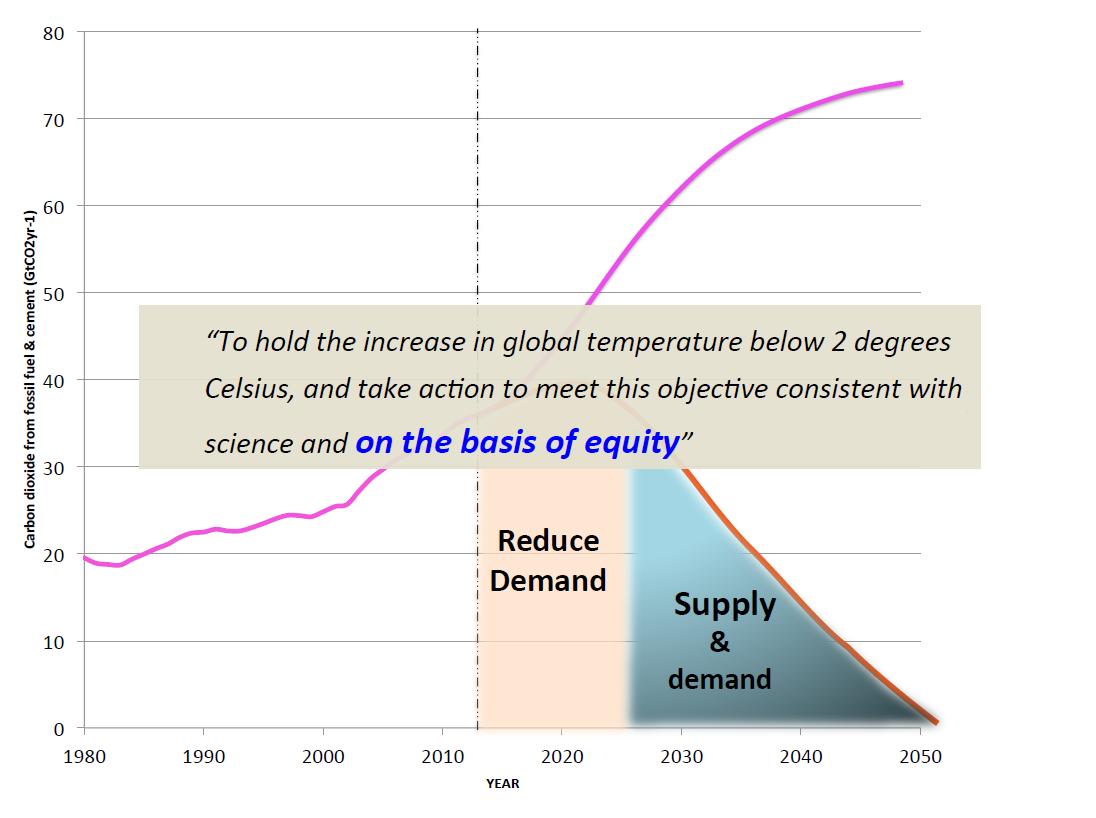
I understand the enormous political difficulties for European heads of state in developing a transparent and evidence-based mitigation agenda. However, the reasons for today’s climate dilemma reside in our prolonged abject failure to set in train an effective programme of mitigation. A quarter of a century on from the IPCC’s first report, the carbon intensity of a typical EU citizen’s lifestyle remains unchanged. I urge you to resist the vested interests calling for continued inaction and instead drive for an ambitious policy framework “consistent with science” and developed on “the basis of equity”. Ultimately, this will be the legacy we bequeath to future generations.

Now as luck would have it I attended a seminar given by Prof. Anderson to a group of climate scientists (plus your current correspondent) at Exeter University just two days ago. As further luck would have it I discovered on entering the room that my trusty surf camera was nestled at the bottom of my backpack, and Kevin kindly gave me permission to turn it on. Here is a small portion of what it managed to record for posterity:

You will note that amongst many other things Kevin asks rhetorically at 1:10:

What about 2°C?

and summarises his “recipe for success” with this graphic graphic:

He goes on to say that:

We can’t do [2°C] with low carbon supply. We can’t make the changes quick enough. You have to do something with our demand for energy, and that is very, very unpopular amongst all of us, all of our colleagues, all the policy makers, so basically the whole world, all the high emitting parts of the world, which is only a small proportion, none of us like this at all, and that’s why we don’t really like the science.

Which is one of the reasons I feel compelled to ask myself at this juncture, and not for the first time:

Why is there no mention of Professor Anderson’s letter in any of the recent hullabaloo, and how on Earth do David, Nick, Ed M. and Ed D. propose to actually hit their so lovingly enunciated target, particularly given the UK’s currently sadly “constipated” energy policy?

A copy of Professor Anderson’s slides from his presentation can be downloaded from the seminar archive web page.

The Nissan LEAF – Now Built In Britain

The very first British built LEAF electric vehicle has recently rolled off the production line at Nissan’s plant in Sunderland. British Prime Minister David Cameron was there to celebrate the event, as were some cameras. Here’s what one of them recorded:

Commenting on Nissan’s £420 million investment Mr. Cameron said that:

This plant, all of the people who work here, the cars being produced behind me, are the best possible rebuke to those who say “In Britain we can’t design things any more, we can’t make things any more or we can’t export things any more. You’ve shown here at Nissan in Sunderland that we can, and we can do it brilliantly.

As the reporter points out:

The new LEAF boasts over 100 improvements and uses an advanced lithium-ion battery, which is also manufactured at the Sunderland plant. Updates include an increased driving range of 123 miles or 199 km, and the ability to recharge in half the time of the first generation LEAF.


More than 54,000 LEAFs have been sold worldwide. Nissan says the new LEAF is the first in a number of pure electric vehicles that it plans to launch over the next few years.

Unfortunately no mention was made of the “vehicle to home” technology that Nissan have been trialling back home in Japan, let alone fully fledged V2G. Maybe Mr. Cameron will announce some significant Great British investments in the design of such esoteric devices in the near future?