Will the Energy Transition Only Benefit The Few?

That’s a question I’ve been wondering about since UK retail electricity prices started rising and suppliers started going bust in droves. And I am not the only one. Here’s Enel CEO Francesco Starace speaking to CNBC back in the summer:

If you look at Europe this [electricity price spike] was quite easy to predict. 2021 is the first year in which the ETS (Emissions Trading Scheme) gets into this mechanism of cutting quotas as the slack shows up, and that’s working, and I think that is something that everyone was expecting to work and it’s doing the job. The question is whether this will become too much, or whether politicians will be able to understand that they have to be part of this game, and use fiscal levers to mitigate the impact on the most vulnerable customers.

No doubt there are also other factors at work, but one way and another we here in the
United Kingdom seem be losing “this game” by many a mile at the moment.

Those “most vulnerable customers” are currently feeling the impact, as indeed are we when perusing our own electricity bills. I’ve been documenting that impact via videos of our own local friendly neighbourhood wind turbine at Upper Tremail when the wind is blowing, thanks to both Storm Arwen:

Continue reading →

DECC Launches a “Consultation to Ensure Regulation in the Energy Sector Encourages Innovation”!

This is such exciting news (to yours truly at least!) that I reproduce the United Kingdom’s Department of Energy & Climate Change’s announcement in full. From their headquarters in London:

Image courtesy of DECC

DECC has today launched a Consultation to ensure regulation in the energy sector encourages innovation.

DECC invites stakeholders to offer their views on how effective the current regulatory framework is in enabling innovation.

The consultation focuses on the activities of DECC and the Oil and Gas Authority, with other energy sector regulators undertaking parallel engagement exercises.

Lord Bourne commented:

  • Innovation has the power to transform the energy sector and the way we live every day.
  • We are committed to cutting red tape and creating industry environments that foster new ideas and give technologies a commercial edge.
  • Collaboration is key and I look forward to hearing the ideas from industry so we can ensure an innovative energy sector that works for hardworking families and businesses.

The Consultation on ensuring regulation encourages innovation will run for four weeks.

For more information and to have your say please email [email protected]

Rest assured that one way or another I shall be getting in touch with the innovation team at DECC before the deadline of 5 PM on February 11th 2016. Perhaps I’ll send them my past musings on the regulatory framework here in the United Kingdom? If you would like to do so as well all the small print is available from:

https://www.gov.uk/government/consultations/consultation-on-ensuring-regulation-encourages-innovation

which adds that:

In its Productivity Plan, the government required all departments to publish an Innovation Plan by spring 2016. The purpose of each Plan is to set out how departments and regulators are adapting legislation and enforcement frameworks to enable innovation in the form of emerging technologies and innovative business models.

This consultation enables stakeholders to offer their views on current regulatory activities led by DECC and the OGA and how they interact with energy sector innovation. Other regulators are conducting parallel engagement exercises, for which links and contacts are provided within the document.

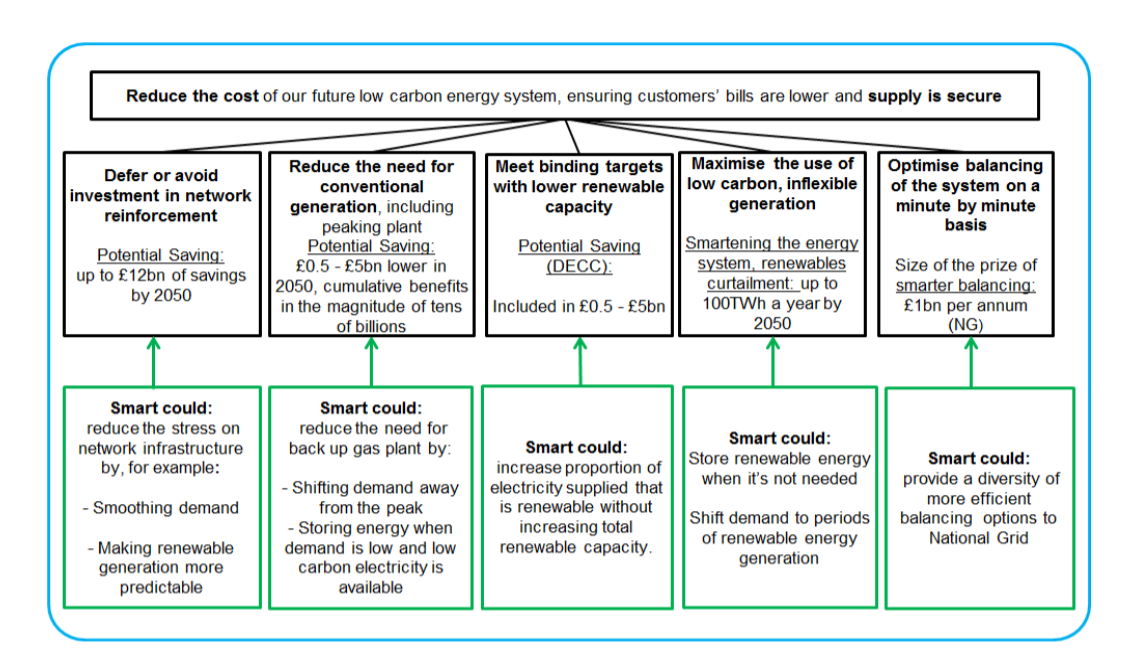
A related document from DECC, published last month and entitled “Towards a Smart Energy System“, is also well worth a read. It explains some smart energy innovations that the authors would presumably like to see implemented:

A smart, flexible energy system would involve incorporating new forms of flexibility in combination, including energy storage, demand side response (DSR), smart networks,as well as increasing interconnection. It could also involve energy efficiency improvements which target peak demand. Combining these solutions in a whole-system approach would help us achieve the following benefits:

  • Defer or avoid investment in network reinforcement.
  • Reduce the need for a significant increase in reserve generation capacity.
  • Meet binding climate change targets with less low carbon generation.
  • Make the best use of our low carbon generation.
  • Optimise balancing of our energy system on a minute-by-minute basis.

It also summarises some of the associated regulatory “barriers” currently facing us here in the UK:

We have identified some potential barriers that mean new forms of flexibility such as DSR and storage may not develop in a timely or adequate way. This includes market and regulatory barriers, where we need to take a whole system perspective in some of our policies and regulatory arrangementin the future. Existing business models may also mean incumbents have incentives to stick with the status quo. Cultural inertia and skills gaps within existing energy companies may also be a factor in slowing the uptake of these technologies. The presence of these barriers shows that further action is likely to be needed if we want to realise the full potential of smarter energy system.

European Commission Proposes the Redesign of European Electricity Markets

In a press release on Wednesday the European Commission announced that:

As part of the Energy Union strategy, today the Commission presented proposals to deliver a new deal for energy consumers, to launch a redesign of the European electricity market, to update energy efficiency labelling and to revise the EU Emissions Trading System.

The package is an important step towards implementing the Energy Union strategy with a forward looking climate change policy, launched as one of the political priorities of the Juncker Commission in February 2015. Today’s proposals give prominence to the “energy efficiency first” principle and put households and business consumers at the heart of the European energy market.

The most relevant section to us here at V2G UK reads as follows:

The Energy Union strategy is designed to help deliver our 2030 climate and energy targets and make sure that the European Union becomes the world leader in renewable energy. Achieving these goals will require a fundamental transformation of Europe’s electricity system including the redesign of the European electricity market.

Today’s Communication launches a Public Consultation on what the new electricity market design should look like in order to meet consumers’ expectations, deliver real benefits from new technology, facilitate investments, notably in renewables and low carbon generation; and recognise the interdependence of European Member States when it comes to energy security.

This should reap maximum benefits from cross-border competition and allow decentralised electricity generation, including for self-consumption and support the emergence of innovative energy service companies.

There is another press release that goes into the “new electricity market design” in more detail, explaining that:

Market design is the set of arrangements which govern how market actors generate, trade, supply and consume electricity and use the electricity infrastructure.

It is important that these arrangements, or in other words the design, can transform the energy system, and enable network operators, generators and consumers – both households and industry – to take full advantage of new technology.

The wholesale and retail markets should provide the basis for investment decisions, and boost the development of new services by innovative companies. In a network industry like electricity, an effective market design needs effective regulatory oversight, in particular distribution and transmission system operators.

The European Commission’s new electricity market design initiative aims to improve the functioning of the internal electricity market in order to allow electricity to move freely to where and when it is most needed, reap maximum benefits for society from cross-border competition and provide the right signals and incentives to drive the right investments, while fully integrating increasing shares of renewable energies.

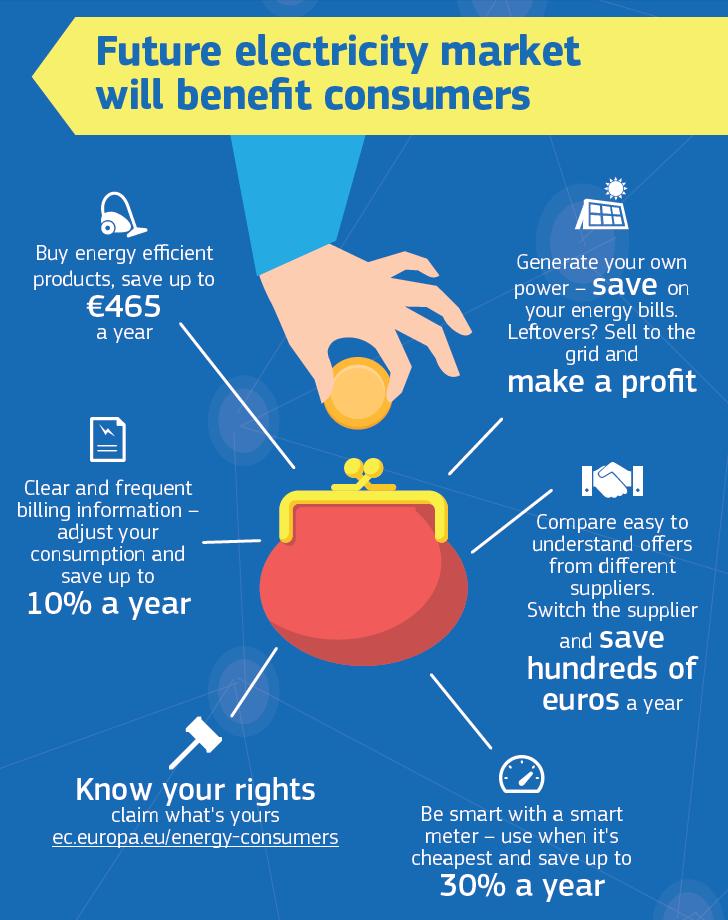
An accompanying document explains that “By adjusting demand, consumers can
save up to €5 billion a year”:

However as you can see there’s nothing in the infographic about how a future “European Energy Union” will help “prosumers” purses get filled to overflowing with euros thanks to making static and/or mobile distributed energy storage available to the local distribution grid at its hours of greatest need. It looks as though we’ll have to fill in a form “by Thursday 8 October 2015 at the latest” and let the EC know our views on that subject!


Is Distributed Energy Storage on Ofgem’s Roadmap?

In the first of my reports from the Regen SW “Community Energy Markets” conference in Bristol last Thursday I’ll be highlighting references in several of the presentations to what I like to call “Distributed Energy Storage“, which encompasses a whole lot more than just the battery packs in electric vehicles.

The first person to mention the subject was Jeff Hardy, who is Head of Future Consumers & Sustainability at Ofgem. His presentation was on the topic of “Non-traditional business models: Supporting transformative change in the energy market” which deserves an article all of its own in due course. However whilst discussing “rapid technological innovation” Jeff pointed out that “battery storage is the current flavour of the month”. After that Sonya Bedford, Head of Renewable Energy at Stephens Scown solicitors, also hinted at the subject in her talk about “Local supply models” in which she mentioned “Demand Side Response” and “Local Balancing Units”.

At the conclusion of the morning session Merlin Hyman, chief executive of Regen SW and our host for the day, asked if there were any questions from the floor. Nobody else seemed very keen to put their hand up, so I waved my arm in the air and was duly invited to stand up, state my name and affiliation, and then pose the panel a question. In the event I actually asked two. The first was to enquire if anybody else present was interested in international smart grid standards apart from me, since the LBUs that Sonya had mentioned seemed to me to come within the remit of the IEC 62325 standard working group which I am part of. Then I asked the panel whether the battery packs in electric vehicles were anywhere near being “flavour of next month” in the UK as yet.

Nobody responded to my first question, but Merlin framed my second question to the panel in terms of the recent “Powerwall” announcement from Tesla Energy. I was both pleased and somewhat surprised when Jeff pointed out that V2G was indeed on his radar screen, since he is “fascinated by EVs” and the “traditional battery worries have been overcome by technology”. Sonya was then good enough to mention that I had said much the same thing at the AGM of Exeter Community Energy earlier in the week.

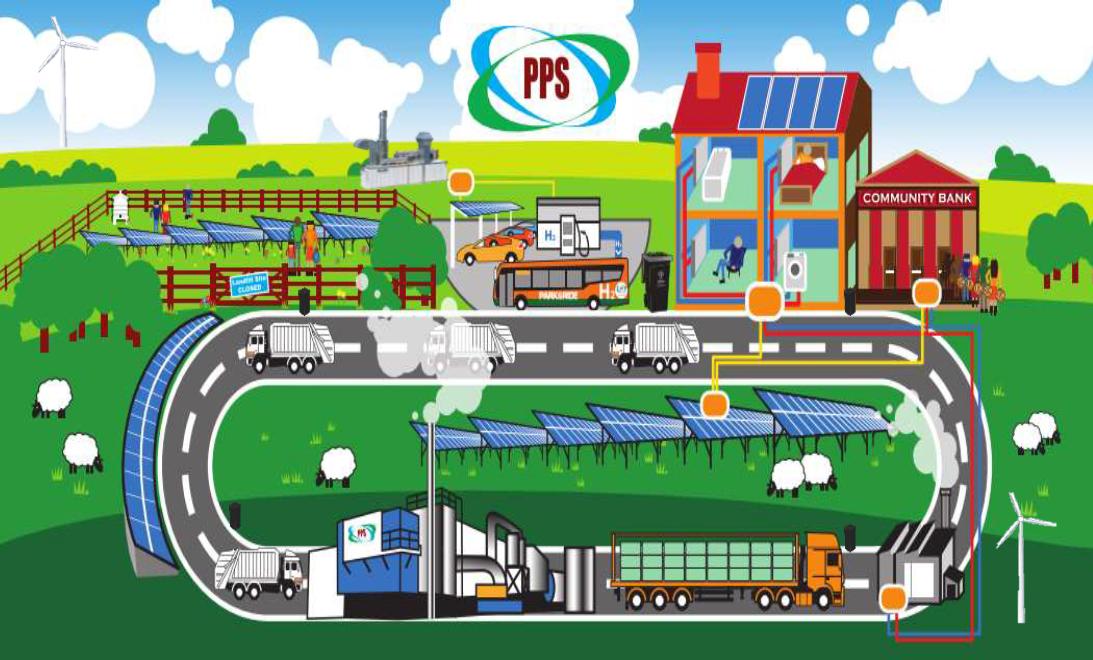
After lunch James Owen, commercial director of Public Power Solutions, started off by giving us a history lesson about local electricity generation in the UK.  Then he went on to discuss the benefits of “Local Balancing Units”, “street level storage solutions” and “a true local smart micro-grid” amongst other things, using both Swindon and the Danish island of Bornholm as examples. James freely admitted to having pinched an infographic of Bornholm, so I’ve taken the liberty of pinching one of his! Here is PPS’s template for a future Bristol, or Bornholm, or the Isle of Wight, or anywhere else in Europe for that matter.

See if you can spot the difference between this version and the one on the PPS web site. It seems those recent additions are Tesla Powerpacks, and in my own vision of a future sunny Southwest England the cars under the solar PV canopy at the park and ride would be connected to similar “black boxes” that incorporate V2G functionality.

Having finally got the preface out of the way, I’d like at long last to mention some alternative battery filled “black boxes” from suppliers other than Tesla Energy. For “grid scale” battery storage you can repurpose EV battery packs like Sumitomo, or use batteries designed for the task from the likes of Saft.

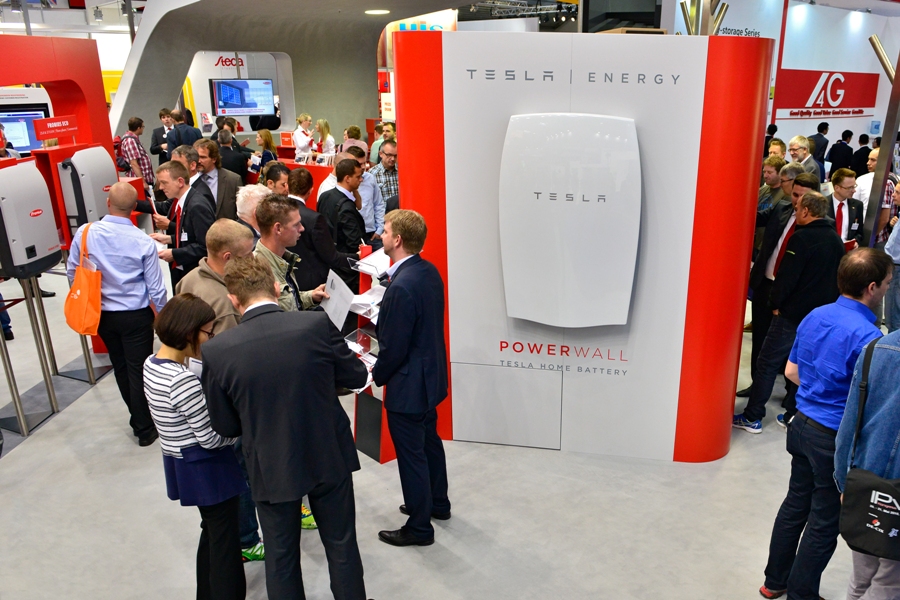
Moving down to the domestic scale I note that for some strange reason the solar PV equipped dwelling in a future Bristol/Bornholm lacks a V2x equipped garage similar to the one shown in the V2G banner at the top of this article. Moving indoors Moixa’s Maslow predates the Powerwall by a long way, and is designed to power a DC circuit for LED lighting, computers etc. Quite possibly prompted by Elon Musk‘s recent announcement, Samsung have also launched a domestic version of their modular Energy Storage System (or ESS for short). Stefan Quandt (of BMW fame) has launched the SolarWatt MyReserve, which has already won an award at the recent ees Europe exhibition over in Germany. Varta also launched their Engion Element “storage for beginners” at ees Europe. Here’s how they looked at the show:

and just in case you haven’t yet tasted the flavour of the month, here’s a Tesla Powerwall for your delectation:

As you’ve probably gathered by now I have a lot more to say about all of this and more, including covering Anthony Price of Swanbarton’s talk dedicated to “Local balancing using storage”. However for the moment at least I cannot help but wonder what Ofgem make of all this “rapid technological innovation”, not to mention the potential associated “non-traditional business models” and last but by no means least, international smart grid standards!

An Open Letter to David Cameron and Ed Davey

It has just been announced to great fanfare by The Green Alliance on Valentine’s Day 2015 that:

In a highly unusual move the Prime Minister, Deputy Prime Minister and the Leader of the Opposition have agreed to work together across party lines to tackle climate change.

The agreement follows the launch of The Climate Coalition’s SHOW THE LOVE campaign which has reached millions across the UK, thousands of whom are wearing green hearts and telling the world what they love that could be lost to climate change.

The Green Alliance kindly provide video evidence that the signing of the agreement is not in actual fact merely a cruel hoax:

The agreement itself states that:

Climate change is one of the most serious threats facing the world today. It is not just a threat to the environment, but also to our national and global security, to poverty eradication and economic prosperity.

Acting on climate change is also an opportunity for the UK to grow a stronger economy, which is more efficient and more resilient to the risks ahead. It is in our national interest to act and ensure others act with us.

2015 offers a unique opportunity to accelerate that opportunity, with countries pledging their contributions to action before the world comes together at Paris at the end of the year to reach an agreement on tackling climate change. It is vital that this agreement is a success, and the UK will play its part in ensuring an ambitious outcome.

That is why we pledge:

  • To seek a fair, strong, legally binding, global climate deal which limits temperature rises to below 2°C.
  • To work together, across party lines, to agree [UK] carbon budgets”, which are required by law but which caused serious cabinet clashes in 2011.
  • To accelerate the transition to a competitive, energy-efficient low-carbon economy and to end the use of unabated coal for power generation.

Whilst that is of course all fine and dandy, the $64 gazillion question is in fact:

What will it actually take to limit temperature rises to below 2°C in practice in the real world?

The press release is accompanied by statements from a long list of the great and the good such as Al Gore, ex Vice-President of the United States of America, who gushes:

This agreement represents inspiring leadership and true statesmanship by all three men.  The political courage it represents on all sides is exactly what our world most needs in order to solve the climate crisis. Thank you! Thank you! And thank you!

which doesn’t answer that question. Then there’s Lord Nicholas Stern, Co-Chair of the Global Commission on the Economy and Climate, Chair of the Grantham Research Institute on Climate Change and the Environment at London School of Economics and Political Science, and President of the British Academy, who points out that:

I am glad to see the leaders of the three main Westminster parties giving their support to strong international and domestic action on climate change. The next UK Government will need to ensure a step change in the pace of the transition to a low-carbon economy in order to meet the statutory carbon budgets and to decarbonise the power sector by 2030.

A key part will be to end emissions from coal, which are twice those from natural gas per unit of electricity generated. The Coalition Government has already introduced regulations to prevent the construction of any new coal-fired power stations unless they are equipped with carbon capture and storage technology. We now need to bring a speedy end to coal-burning by existing power stations which release carbon dioxide and other pollutants into the atmosphere.

The transition to a low-carbon economy and investment in our cities and transport to make them more efficient, less congested and cleaner has great potential to drive a dynamic, more attractive and sustainable growth story for the UK, and indeed help the UK with design and technology it can take to the world. I hope that the leaders will embody their commitment to a low-carbon economy in overseas aid to help poor countries to overcome poverty and make their transition to low-carbon growth and to become more resilient to those impacts of climate change that cannot now be avoided.

That’s a bit closer to the mark, but no mention is made of Lord Stern’s previous statement that:

Climate change is the greatest market failure the world has ever seen.

However the most surprising thing, to your humble scribe at least, is that nowhere in amongst the gigatonnes of publicity have I been able to spot the name of Kevin Anderson, who is professor of energy and climate change in the School of Mechanical, Aeronautical and Civil Engineering at the University of Manchester. Last October he wrote an “Open Letter to the Prime Minister and Secretary of State at the Department of Energy & Climate Change“. Kevin’s letter includes lots of references and starts by saying:

The letter summarises why the IPCC’s carbon budgets for a “likely” chance of not exceeding the international community’s 2°C commitment, requires the EU to reduce the emissions from its energy system by 80% by 2030, with complete decarbonisation just a few years later.

and concludes that:

I understand the enormous political difficulties for European heads of state in developing a transparent and evidence-based mitigation agenda. However, the reasons for today’s climate dilemma reside in our prolonged abject failure to set in train an effective programme of mitigation. A quarter of a century on from the IPCC’s first report, the carbon intensity of a typical EU citizen’s lifestyle remains unchanged. I urge you to resist the vested interests calling for continued inaction and instead drive for an ambitious policy framework “consistent with science” and developed on “the basis of equity”. Ultimately, this will be the legacy we bequeath to future generations.

Now as luck would have it I attended a seminar given by Prof. Anderson to a group of climate scientists (plus your current correspondent) at Exeter University just two days ago. As further luck would have it I discovered on entering the room that my trusty surf camera was nestled at the bottom of my backpack, and Kevin kindly gave me permission to turn it on. Here is a small portion of what it managed to record for posterity:

You will note that amongst many other things Kevin asks rhetorically at 1:10:

What about 2°C?

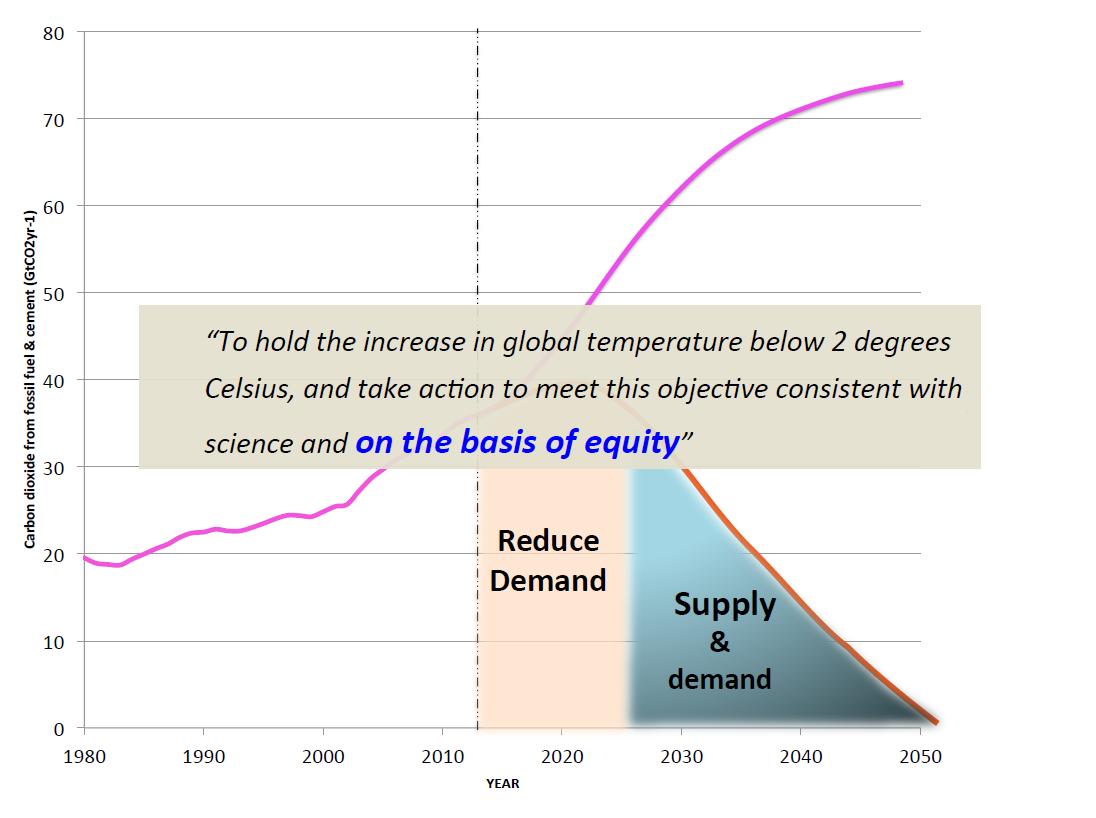
and summarises his “recipe for success” with this graphic graphic:

He goes on to say that:

We can’t do [2°C] with low carbon supply. We can’t make the changes quick enough. You have to do something with our demand for energy, and that is very, very unpopular amongst all of us, all of our colleagues, all the policy makers, so basically the whole world, all the high emitting parts of the world, which is only a small proportion, none of us like this at all, and that’s why we don’t really like the science.

Which is one of the reasons I feel compelled to ask myself at this juncture, and not for the first time:

Why is there no mention of Professor Anderson’s letter in any of the recent hullabaloo, and how on Earth do David, Nick, Ed M. and Ed D. propose to actually hit their so lovingly enunciated target, particularly given the UK’s currently sadly “constipated” energy policy?

A copy of Professor Anderson’s slides from his presentation can be downloaded from the seminar archive web page.

The First Great Dunchideock Blackout

At May’s film night in Dunchideock Village Hall it was announced that anybody interested in learning more about the recent power cut in the village could “read all about it” on this very web site. A cry was heard from the audience:

Which one is that then?

It has now been brought to my attention that the other end of the village has suffered far more from the absence of electricity this year than my own particular neck of the woods. Having engaged in further communications with some local residents and Western Power Distribution I have another long tale of woe to tell!

There was undoubtedly much wet and windy weather around the Haldon Hills earlier this year. According to the UK Met Office, handily situated just up the road in Exeter, in their summary of Winter 2013/14:

Winter 2014 was an exceptionally stormy season, with at least 12 major winter storms affecting the UK in two spells from mid-December to early January, and again from late January to mid-February. When considered overall, this was the stormiest period of weather experienced by the UK for at least 20 years. An analysis of pressure fields by the University of East Anglia suggests this winter has had more very severe gale days than any other winter season in a series from 1871.

All those storms didn’t appear to have any long lasting impact on the southern side of Dunchideock at the time, but the story is rather different slightly to the north. Here’s a map of Western Power Distribution’s high voltage electricity network in the area:
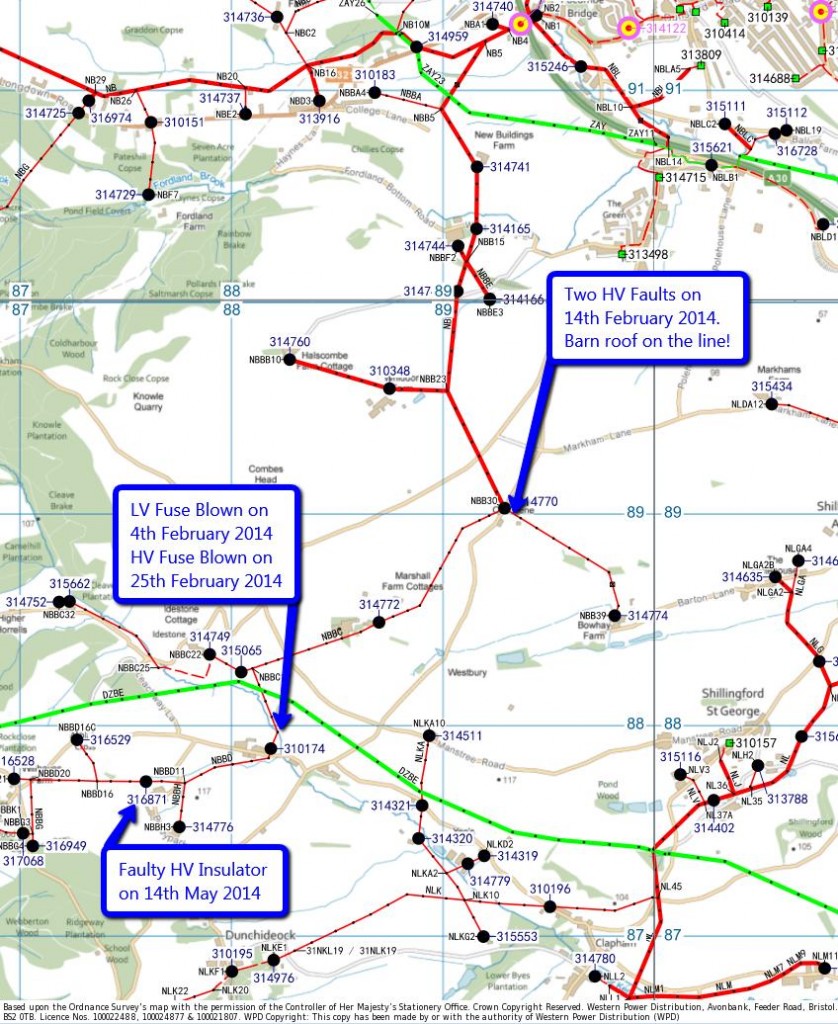
WPD map of 11 kV (red) and 33 kV (green) cables south and west of Exeter

WPD map of 11 kV (red) and 33 kV (green) cables south and west of Exeter

Hopefully it is now apparent to you that the northern part of Dunchideock is on a completely different “circuit” to the southern part. You can also see that there have been a few electricity supply issues over the past few months! Taking them in chronological order, the first outage was on Tuesday February 4th. It’s unlikely to be mere coincidence that on the same day the Met Office issued a press release saying that:

The stormy conditions are expected to bring damaging gusts of wind of up to 60 mph inland and perhaps as high as 80 mph along some southern and western coasts of Britain on Tuesday night and Wednesday. These severe gales, combined with further heavy rain may cause some disruption because of fallen trees and high waves in coastal areas.

The net result as far as northern Dunchideock was concerned was:

A power cut from 21:00 to 02:00 on the 5th. When the power went off alternate houses in the road came back on after a minute or so and stayed on.

According to Western Power Distribution the immediate cause was that:

One of two low voltage fuses blew (on a split phase transformer). Hence 50% of customers would be on supply.
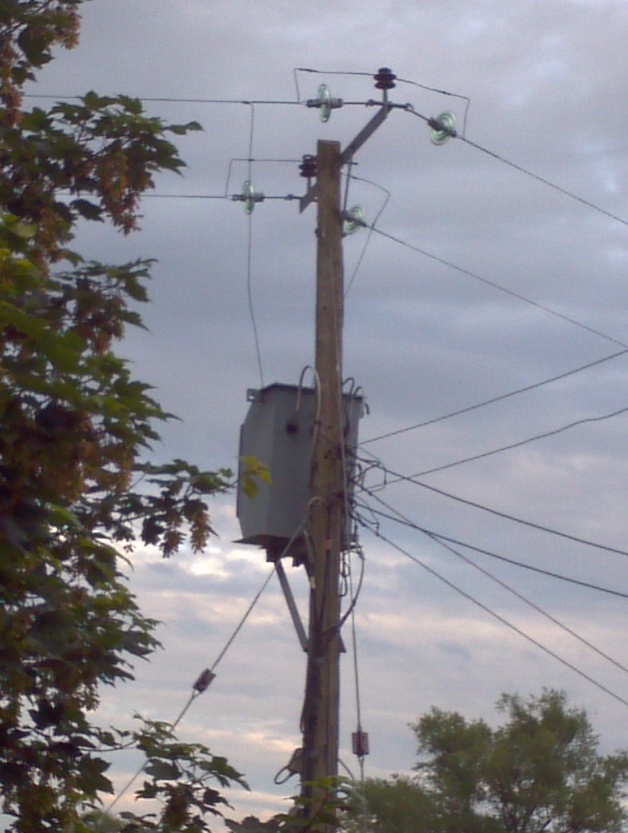
Transformer 31/0174 near Thornes Meadow, Dunchideock

Transformer 31/0174 near Thornes Meadow, Dunchideock

Ten days later the real “Great Dunchideock Blackout” occurred. According to the Met Office once again, in their forecast for Friday February 14th:

The Met Office was so concerned about the wind speeds on Wednesday a Red weather warning was issued for wind, the first red warning since January 2013. Extremely strong winds were seen in the south and northwest of England and parts of Wales.

We have another weather system crossing the UK on Friday bringing further heavy rain and very strong winds, leading to a number of weather warnings being put in place. The rain will push into the UK from the southwest during Friday morning, moving quickly north eastwards.

There are Yellow weather warnings for wind in place for the South coast and round into East Anglia with an Amber weather warning for wind along the South coast. We are expecting some gusts of around 60 miles per hour inland and perhaps 80 miles per hour in exposed areas along the coast itself. With these very strong winds large waves will push onto the coastline with dangerous conditions possible as well as some localised coastal flooding.

Here in Dunchideock, for the residents of Thornes Meadow at least, the result was a power cut lasting almost two days:

The second power cut was on 14th February at 19:30 and the electricity did not come back on until 14:00 on the 16th. Everybody in Thornes Meadow was off this time. The recorded messages of restoration times were continually put back.

As you may be able to imagine, in such circumstances Western Power Distribution had a very long list of problems to deal with. The immediate issues for Dunchideock were:

Two separate  High Voltage faults (conductors down due to trees and an entire barn roof being blown onto the line).

Due to the number of faults WPD had to bring in extra engineers from the Midlands and South Wales to help with the repairs. In normal circumstances the UK electricity market regulator Ofgem specifies a maximum 18 hour time limit on restoring electricity supplies. However in extreme circumstances this can relaxed. Ofgem themselves foresaw the potential difficulties, and issued a news release of their own on February 12th, stating that:

Severe weather is currently forecast across Great Britain. Electricity distribution companies, who own and operate the local networks, are making preparations ahead of this weather. We set rules on how quickly companies have to respond to restore power in both normal weather and severe weather conditions.

For severe weather there are different categories according to the severity of the storm. The category sets the amount of time companies have to restore power before compensation must be paid. The category is determined by the number of major faults experienced within a 24 hour period on the distribution company’s network.

The distribution company may be able to give an initial early view of what category the storm is but the data is checked and verified by us. The time you are off supply before being able to claim payments varies according to severity of storm. This is because the companies will have more work to do to fix faults.

  • Category 1: After 24 hours
  • Category 2: After 48 hours

In this case the storm was ultimately classified as category 2, and hence the unfortunate residents of Thornes Meadow are not entitled to any compensation despite being without any electricity supply for nearly two days.

Moving on to the next outage, which took place on “February 25th from 18:50 to 19:45” on which date there were no special press releases from the Met Office. Thankfully this power cut was of much shorter duration than the previous one, and was because:

A high voltage fuse operated. Restoration was via HV fuse replacement.

Finally we come to May 14th, when “a faulty high voltage insulator” led to a power cut in properties supplied by transformer 31/6871 in the vicinity of Dunchideock Church. Once again the weather wasn’t sufficiently inclement to warrant a Met Office press release.
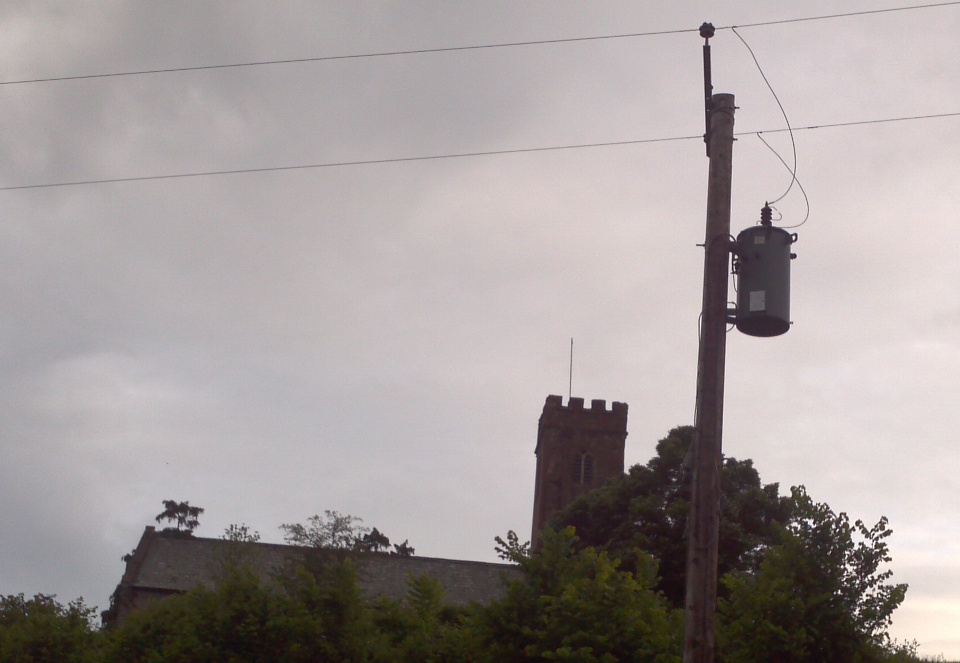
Transformer 31/6871 near Dunchideock Church

Transformer 31/6871 near Dunchideock Church

All of this additional information leads me to conjecture yet again about all those blown fuses and faulty insulators. What stresses and strains is our local electricity distribution network being subjected to these days by the combination of lots of inclement weather and renewable electricity generation, down here in not always Sunny South West England?

Rather too many for comfort would seem to be the answer, if Dunchideock’s recent experience is anything to go by.




Independent Body of Experts Needed to Inform Energy Policy

The Institute for Sustainability at Newcastle University have announced this week that:

The UK’s energy industry is fragmented and a ‘system architect’ is needed to inform technical decisions and take a holistic view of the energy system in order to secure the country’s future energy supply, experts are warning. Now academics at Newcastle University are calling on the Government to create an independent, expert body to inform energy policy.

The recommendation is included in a briefing note on energy policy, being sent today, 6 May 2014, to relevant MPs and other organisations, outlining a number of concerns about the fundamental problems facing the UK’s energy market. These include: energy storage and distribution; energy pricing models; lack of competition; and water use in electricity generation.

The press release goes on to quote Professor Phil Taylor, Director of the Newcastle Institute for Research on Sustainability, as saying that:

Energy is a hot topic at the moment and the Government has made some positive steps to open up competition in the market, but much more work is required – and quickly. There’s an urgent need to reduce carbon emissions while protecting the UK’s future energy security. It’s vital that politicians move beyond short-term political soundbites and instead support those initiatives that could make a real and sustainable difference.

The University is calling on the Government to establish a group of experts that can take a long-term view about what is required and inform technical decisions and energy policy in a more effective manner than the current situation. For instance, debate among policymakers focuses almost exclusively on issues of affordability and emissions reductions, ignoring the vital issue of the energy sector’s use of water. This thinking risks locking the UK into a future in which water availability could put energy security at risk, and power stations could be forced to reduce production or even shut down if there isn’t sufficient water available to keep them safely operational.

The briefing note itself elucidates:

The Energy Act received Royal Assent on 18 December 2013. The Act is designed to establish a legislative framework for the delivery of secure, affordable and low carbon energy. However, we are concerned that the Act does not take into account some of the more fundamental problems facing the energy market, putting the sustainability of the UK’s energy systems at risk. We believe there are five areas that need further consideration:

  1. Energy storage and distribution
  2. Energy pricing models
  3. Competition
  4. Water use in electricity generation
  5. The need for a system architect

Here at V2G we have long championed the cause of distributed energy storage, so we have nothing to quibble about with this from the first bullet:

The national electricity network… cannot feasibly be replaced. But it will struggle to cope with the substantial additional demands likely to be placed on it over the coming decades, such as decarbonisation and additional electrification of transport and heat demand.

Policymakers and energy providers need to do more to understand how and why customers use and generate energy, so they can look at ways to enable behaviour change and reduce demand on the network in peak times.

  • We need to find ways to store energy efficiently and effectively when plentiful and low carbon so it can be released during periods of high demand, high carbon or to keep the lights on after major storms have damaged network assets.
  • In addition, smart grids… will provide better understanding of when and why people use energy in the ways they do.

Moving on to competition:

The way energy provision is managed needs to be transformed. Currently, companies that develop and build energy generators, whether wind farms, solar panels or tidal turbines, have to sell the energy they produce on the wholesale market. This puts them at a serious disadvantage to the big six energy suppliers, who can generate energy and then sell it back to themselves at preferential rates, before selling it on to customers at a profit.

Agreed. Pricing models next:

  • Currently, energy companies make very small margins on each unit of energy produced, so they need to sell volume in order to make a profit. This leads to a bad deal for consumers, as there is no incentive for companies to help customers reduce their energy use.
  • Instead, energy providers should be rewarded for providing tools and techniques that help customers use energy efficiently and cost-effectively.

So far so good, but how might that second bullet be implemented in practice?

The Government needs to work with the energy industry to fundamentally change the way energy is priced, to enable us to move from a system where generation follows demand to one where demand is based on the cost of generation, storage and distribution at any given time.

For us here at V2G this is the 64,000 ExaPound (E£64k for short) question. That’s very easy to say Phil, but how on Earth do you achieve it in practice? Given the fact that I sit on international standards committees that discuss this sort of thing on a regular basis, perhaps I might rephrase the question as “What international standards for deregulated energy markets will be required in order to facilitate a system in which demand follows generation + storage at any given time?”

The Guardian “Energy Industry” section has published an article on this topic, but they seem to me to miss that vital (IMHO!) point. They lead off with a picture of some electricity pylons with no storage in sight, and say that:

The government must urgently establish a strategic authority to oversee the future growth of Britain’s ageing energy infrastructure, a study argues on Tuesday .

Academics at Newcastle University challenge the government’s market-based approach, saying the £100bn needed to secure energy security is not being delivered by a fragmented system that lacks central direction.

The academics, led by Prof Phil Taylor, argue that the country needs a “systems architect” and that energy, at least for the bulk of the population, is too cheap, which is leading to waste.

While the Labour party has already said it wants an energy security board, one leading figure in the industry has said that Taylor was highlighting that “nobody is in charge” of the country’s energy policy.

The Guardian doesn’t mention the word “standards” once, and neither do Newcastle University. Here are their concluding bullet points:

  • There are a number of problems facing the energy market, and policymakers need to think seriously about the wide ranging and long lasting effect their decisions will have.
  • The Government needs to ensure that the price of energy reflects the cost of storing and distributing it, as well as generating it, and that those firms that provide energy to the wholesale market are rewarded fairly with respect to those who sell it direct to consumers.
  • In addition, the impact of energy generation on water availability must be considered to avoid a future in which the UK faces power shortages and even blackouts.
  • Finally, the Government should make better use of independent experts when considering energy policy.

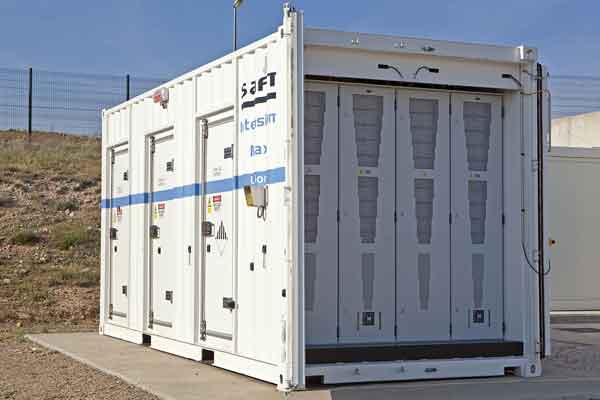
Hear, hear! To that last bullet point at the very least! For the Guardian and anybody else out there that might be interested, here’s what some storage in Spain looks like:

Saft 1 MW Li-ion storage module in northern Spain

Saft 1 MW Li-ion storage module at Tudela in northern Spain

Honda Joins Delaware Vehicle to Grid Project

Earlier this year we reported that the University of Delaware were running a pilot project in which a fleet of BMW Minis were actually earning money by providing a useful service to PJM Interconnection‘s electricity grid over the pond in North America.

Now comes news that Honda are taking part in the self same project. According to their press release:

Honda has joined a demonstration project for experimental vehicle-to-grid (V2G) technology aimed at providing a potentially valuable energy storage resource to the nation’s electrical grid while providing for more cost-effective ownership of plug-in electric vehicles.

The Honda technology builds off of the research conducted by the University of Delaware and now supported by NRG Energy, Inc.  NRG and the University of Delaware, through their eV2g joint venture, came online early in 2013 with the world’s first revenue-generating vehicle-to-grid project, demonstrating the controls, regulatory requirements, and market participation rules for selling energy storage from vehicles into the PJM Interconnection Regulation Market. Honda is supplying an Accord Plug-In Hybrid with added V2G capabilities to the University’s Science, Technology and Advanced Research (STAR) Campus to jointly investigate the potential of this technology to benefit the electrical grid, vehicle owners and society.

There were of course also a number of quotes from senior managers of the companies involved. Steven Center, vice president of the Environmental Business Development Office of American Honda Motor Co., Inc said that:

This technology has the potential to support both a cleaner and more efficient power grid and a more positive ownership experience for EV customers. With V2G technology, a network of PEVs becomes essentially a distributed energy storage system. It makes for an even stronger value equation for plug-in vehicles, with benefits for both the community and the vehicle user.

Willett Kempton, professor in the College of Earth, Ocean, and Environment and Research Director of the University of Delaware’s Center for Carbon-Free Power Integration said that:

The participation of global automakers like Honda will help demonstrate and refine the technology. The University of Delaware has been developing the technology so that vehicle batteries can be used not only for mobility but also for grid services.  It is a big step toward a future with widespread availability of the technology to have Honda join our demonstration with their V2G-capable car.

Finally Denise Wilson, NRG Executive Vice President and President, New Businesses said that:

As the U.S. adds more intermittent resources to the grid, finding a lower cost energy storage technology that also benefits electric vehicle drivers is a great opportunity. We see this demonstration by Honda as an important step in the development of vehicle to grid technology.

Much the same sort of sentiments apply here in the UK as we too “add more intermittent resources to the grid”. However I could not help but notice that once again nobody mentioned international standards!