With strong echoes of last summer’s announcement here in the UK of Octopus Energy’s Power Pack “World First vehicle-to-grid EV bundle”, Octopus Deutschland have just issued a German language press release along similar lines. Here is an extract, auto translated by Google:
Octopus Energy and Ford are introducing bidirectional vehicle-to-grid (V2G) charging for private customers in Germany. This collaboration will make electric cars an active part of the power grid. Starting in summer 2026, owners of a new Ford Capri or Ford Explorer will be able to benefit from significant cost advantages by using their vehicle as an energy storage device. These savings will allow for up to 16,000 kilometers of free driving per year.
With V2G (Vehicle-to-Grid), electric cars become flexible energy storage devices that can not only absorb energy but also feed it back into the grid. Octopus Energy’s solution prioritizes charging the vehicle during off-peak hours when electricity is cheap, and the vehicle feeds power back into the grid when it is most valuable – for example, in the early evening when demand is high. For electric car owners, this means that if their car is connected to the bidirectional wallbox at home, it works for them. Collectively, this makes a significant contribution to the stability of the German energy system and, ideally, reduces the cost of electricity for driving to zero.
In a press release yesterday Ford announced that the:
F-150 Lightning with available Ford Intelligent Backup Power can provide power and security during an electrical outage – the first electric truck in the U.S. to offer this capability; in the future, new features will offer additional ways to manage energy use and potentially save on energy costs.
Truck owners are used to tapping a variety of features – torque, towing capability and more – to get things done. Now, with the all-electric F-150® Lightning™ pickup, Ford is the first in the U.S. to offer the ability for customers to power their homes with an electric truck when the grid goes dark, providing innovative new capabilities that enhance the energy independence of its customers.
Ford and F-Series, America’s best-selling trucks for 45 years*, are partnering with Sunrun, the nation’s leading solar company, to enhance home energy management, leveraging the substantial onboard battery capability of the all-electric F-150 Lightning. Americans experienced the most power interruptions on record in 2020, according to the U.S. Energy Information Administration; and with F-150 Lightning, homeowners can use their truck to maintain their routines during brief or extended outages.
The press release was accompanied by this video:
https://youtu.be/oc3sQ2UcTlg
As the narrator puts it:
What if the next time the power went out, your pickup truck could electrify your home
A very good question! Which we here at V2G UK have been pondering for many a year.
Note that the narrator also points out that:
You’ll need a Ford Charge Station Pro, which comes with an F-150 Lightning Extended Range truck, and an available home integration system….
Siemens Smart Infrastructure announced it has worked with Ford on the Ford Charge Station Pro, a custom electric vehicle (EV) charger for the Ford F-150 Lightning. This innovative charger is the first bidirectional-ready EV solution set for release at retail customer scale to receive certification under the newly expanded Underwriters Laboratories (UL) 9741, an important industry-wide benchmark that ensures products meet safety standards. The new charge station also features a peak power of 19.2kW, achieving the maximum power rating currently available for a Level 2 charge station.
The Ford Charge Station Pro is needed to enable Ford Intelligent Backup Power, a system that allows the Ford-150 Lightning to become an interactive part of the home and be used as a power generation source during outages, the first electric truck to do so. In the future, additional features will be made available with firmware updates to the charger that will help customers interact even further with the grid.
“Together with Ford, Siemens is not only helping accelerate electric vehicle adoption in the residential space but is also empowering drivers to take more ownership of their energy future,” said John DeBoer, head of Siemens eMobility in North America. “The technology behind this charger is helping make charging at home more sustainable, more reliable, and more accessible. We’re incredibly proud to put our experience to work to help usher in a new era for electric vehicles and grid resiliency.”
Ford Charge Station Pro comes with the F-150 Lightning with extended-range battery. If your F-150 Lightning has a standard-range battery, it is available for purchase:
Price: $1,310.00 (plus shipping and installation)
As far as I can see there are no details available on the “home integration system” mentioned above.
P.S. It has come to our attention that at least one purveyor of EV “news” is peddling inaccurate information. Hence:
“On the ordering page of Ford’s website they have an inaccurate picture.”
Earlier this year I was on a couple of panel sessions on the topic of V2x technology at the Everything Electric NORTH event in Harrogate. Whilst there I took a look at the F-150 Lightning on show in the exhibition hall. Until now I have remained blissfully unaware that Everything Electric’s Robert Llewellyn recorded this exceedingly interesting interview with Ford CEO Jim Farley at the end of the previous year’s Fully Charged LIVE show in Harrogate:
Note in particular the part at 15:20 where Jim says:
The F-150, the main reason why people are buying the F-150, more than half the customers are new to a full size truck, is because it can power their house for 3 days. We didn’t know that a mobile battery on a work site was going to be that evocative as a reason to buy a vehicle. We thought it was going to be 0-60 4 seconds. We were wrong. So the exportable power turns out to be the main reason people are excited about the Lightning.
I remotely attended several sessions at the recently completed COP26 conference in Glasgow, but what with one thing and another I missed out on attending this one as it happened:
As you can already see it was organised by Scottish and Southern Electricity Networks (SSEN for short) and was hosted by Laura Sandys. Note in particular the part at 6:30 where Professor Malcolm McCulloch of Oxford University says that:
So the challenge is to say “How do we allow that potential problem and risk, how do we turn that around to be something that’s really a friend and an aid to the system?”
And the one thing that worries me right at the moment is that we’re seeing a huge uptake in electric vehicles over the last while, I mean it’s kind of fascinating that at the beginning of this year the most popular vehicle being sold was the Ford Focus, last three months it’s been the Tesla Model 3! That kinds of tells you what the change in our dynamics is looking at.
At the moment we’re missing a trick because most of the vehicles being sold except for a few Nissan’s and a few others don’t have vehicle-to-grid. In other words the power flows in only one direction, so all that huge amount of storage capacity that’s available on the grid, we’re talking about by the time we get to 2030 there’s enough energy in the batteries of our electric vehicles to power the UK for two days. That’s a tremendous amount of energy that’s sitting there, but if we don’t install V2G soon, really soon, that boat is going to pass and we’re going to have real trouble in trying to, or much more costly ways of doing that.
Needless to say we broadly agree with Malcolm’s analysis, and the conversation in Glasgow continued. Please watch the whole 30+ minutes, but now there is further news. The Local Energy Oxfordshire project (LEO for short) has just released a white paper authored by Origami Energy and the Low Carbon Hub catchily entitled “Vision on the inclusion of small (under 7kW) flexibility from the grid edge and its role in Future Energy System“. Please also read it from cover to cover, and note that it briefly (and belatedly!) mentions that:
In 2021, British Standards Institute as part of [its] Smart Energy Appliance programme published two standards designed to support [a] testing and certification programme to motivate greater potential for demand response from [the] residential sector.
Note also LEO’s recommendations:
Grid-edge flexibility has great potential to be the enabler of Net Zero as outlined by the “Leading the Way” FES scenario. However, t he two biggest challenges facing the inclusion of small flexibility from the grid edge into delivering Net Zero are societal participation and commercial environment. A common pillar to both challenges is the value of flexibility which only partially reflects the benefits delivered through the flexibility markets. Today, each flexibility market is monopsonistic (market dominated by one buyer), segregated and short-term (there is a lack of long term stability in the regulatory landscape). There is a need to standardise products and services across all flexibility markets to encourage greater transparency and involvement of flexibility as these flexibility markets grow.
To support the inclusion of grid-edge flexibility, the proposed recommendations include:
• To tailor the legislation and regulation to support the development of local communities who act collectively to manage their LCTs and interact with the flexibility markets and other users of the system at a single node (e.g. enabled by an iDNO) or multiple nodes.
• Create a new energy and carbon marketplace to encourage wider deployment of Smart Local Energy Systems where local generation and demand flexibility is recognised as being critical for a healthy and affluent society. The Flexible Services players are seen to add significant benefit to the local society and also provide support to the National scale economy.
• Align the energy policy, welfare policy and housing policy to deliver long-term strategy for Net Zero and beyond ensuring balanced distribution of costs and benefits associated with grid-edge flexibility and cost of energy.
In a press release a couple of days ago it was announced that:
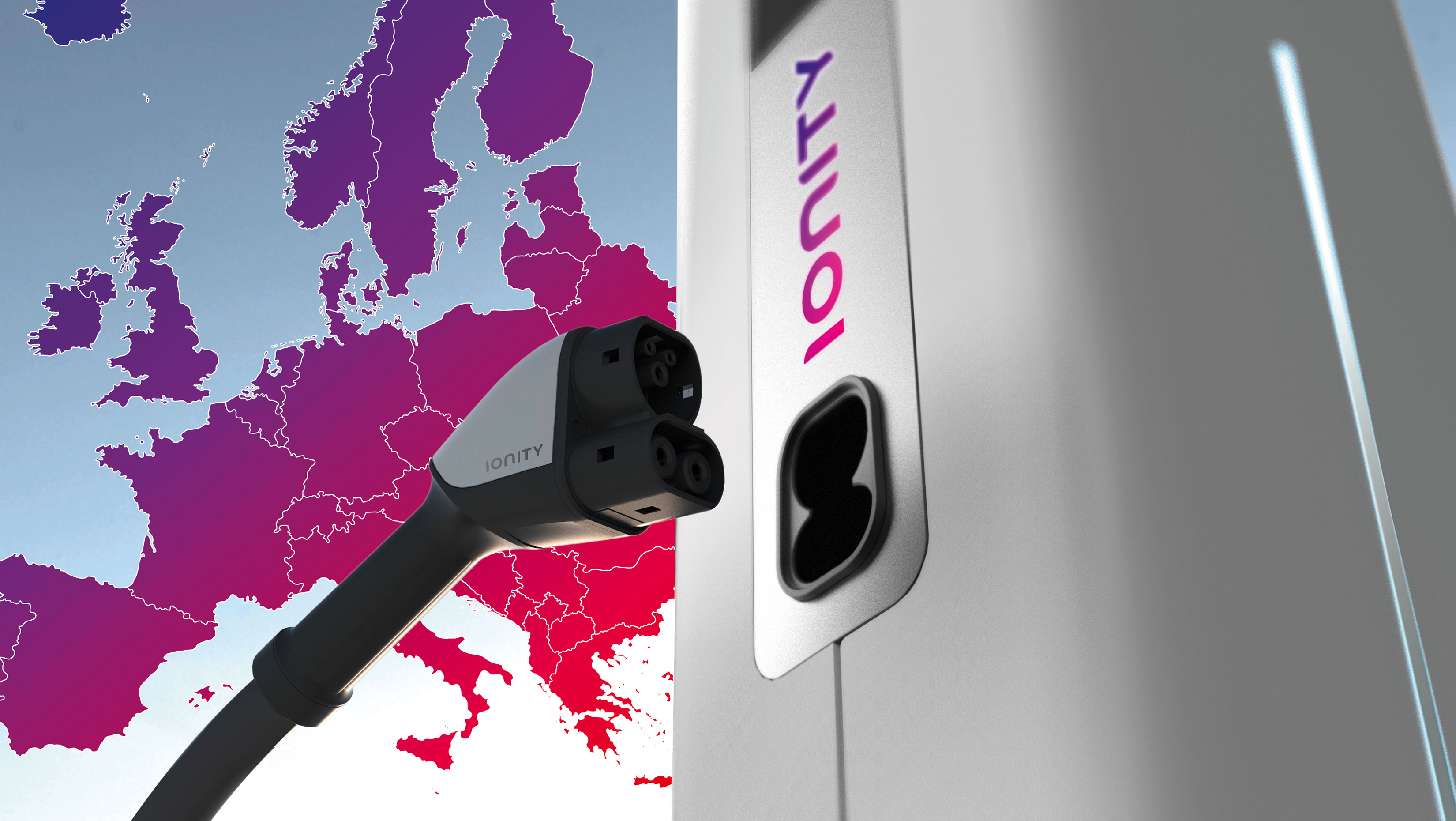
BMW Group, Daimler AG, Ford Motor Company and the Volkswagen Group with Audi and Porsche today announced joint venture IONITY that will develop and implement a High-Power Charging (HPC) network for electric vehicles across Europe. Launching approximately 400 HPC stations by 2020, IONITY will make long-distance journeys easier and marks an important step for electric vehicles.
Based in Munich, Germany, the joint venture is led by Chief Executive Officer Michael Hajesch and Chief Operating Officer Marcus Groll, with a growing team, set to number 50 by the start of 2018.
A total of 20 stations will be opened to the public this year, located on major roads in Germany, Norway and Austria, at intervals of 120 km, through partnerships with “Tank & Rast”, “CircleK” and “OMV. Through 2018, the network will expand to more than 100 stations, each one enabling multiple customers, driving different manufacturer cars, to charge their vehicles simultaneously.
As that image implies:
With a capacity of up to 350 kW per charging point, the network will use the European charging standard Combined Charging System to significantly reduce charging times compared to existing systems. The brand-agnostic approach and Europe-wide distribution is expected to help make electrified vehicles more appealing.
Unfortunately, from our perspective at least, it seems as though “Europe-wide” doesn’t currently include the United Kingdom. What’s more the new joint venture isn’t worldwide “brand-agnostic” either. It seems unlikely that any Japanese EV OEMs will be joining the group any time soon. When it comes to rapid charging they currently prefer the CHAdeMO connector!