With strong echoes of last summer’s announcement here in the UK of Octopus Energy’s Power Pack “World First vehicle-to-grid EV bundle”, Octopus Deutschland have just issued a German language press release along similar lines. Here is an extract, auto translated by Google:
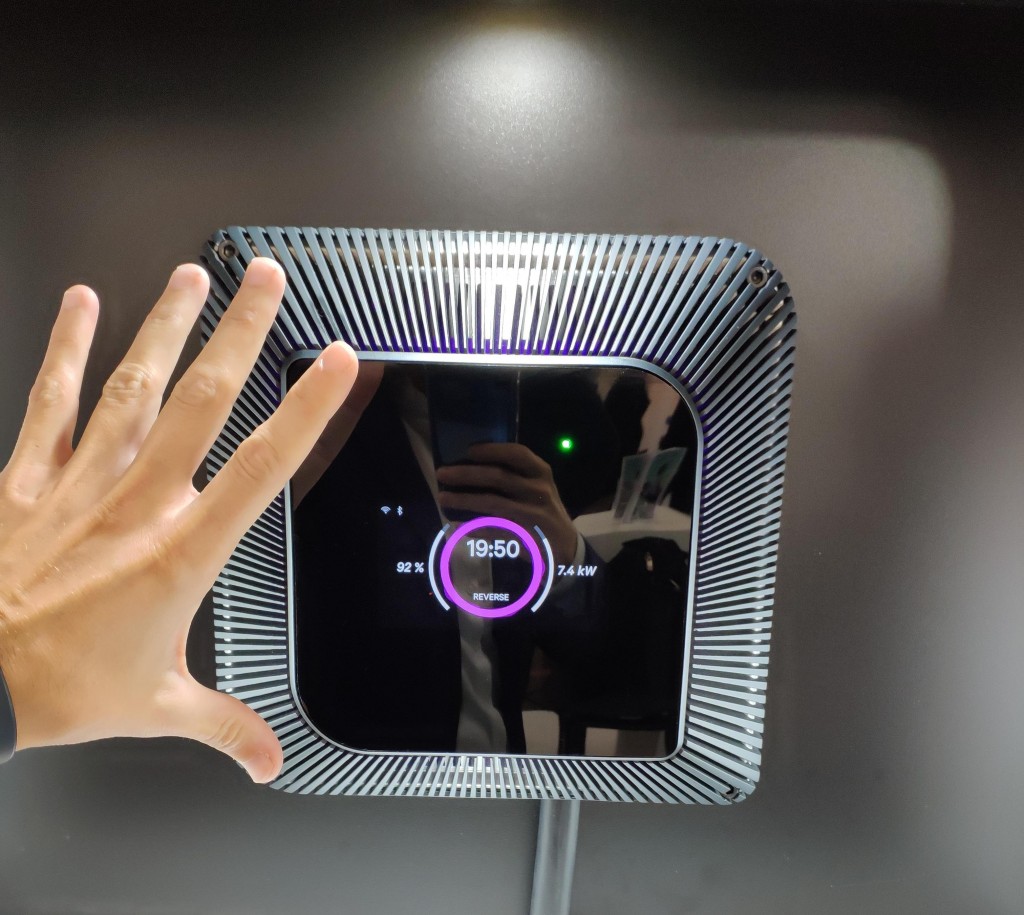
Octopus Energy and Ford are introducing bidirectional vehicle-to-grid (V2G) charging for private customers in Germany. This collaboration will make electric cars an active part of the power grid. Starting in summer 2026, owners of a new Ford Capri or Ford Explorer will be able to benefit from significant cost advantages by using their vehicle as an energy storage device. These savings will allow for up to 16,000 kilometers of free driving per year.
With V2G (Vehicle-to-Grid), electric cars become flexible energy storage devices that can not only absorb energy but also feed it back into the grid. Octopus Energy’s solution prioritizes charging the vehicle during off-peak hours when electricity is cheap, and the vehicle feeds power back into the grid when it is most valuable – for example, in the early evening when demand is high. For electric car owners, this means that if their car is connected to the bidirectional wallbox at home, it works for them. Collectively, this makes a significant contribution to the stability of the German energy system and, ideally, reduces the cost of electricity for driving to zero.
Given my evident enthusiasm for all things V2x, regular readers may be wondering why I have been more hesitant than most commentators to unequivocally applaud Greg Jackson’s announcement of Octopus Energy’s “Power Pack” retail vehicle-to-grid offer last week? £299 per month which covers all your electric mobility needs including “fuel”. What’s not to like? Surely it’s “a compelling consumer offer”, as I myself put it!
As already hinted at in my introductory article linked to above, perhaps it’s not quite so attractive if you are in fact a “prosumer”, with a few solar PV panels already installed on your very own roof? Here are some other recent items of news to ponder too. In these troubled times hackers are hard at work around the world. There was initial speculation that the recent Spanish “blackout” was a cyber attack. However, according to the BBC on April 29th:
The Spanish grid operator has ruled out a cyber attack as the cause of a massive power cut that crippled Spain, Portugal and parts of France on Monday.
Red Eléctrica’s operations director Eduardo Prieto said preliminary findings suggest “there was no kind of interference in the control systems” to imply an attack, echoing Portuguese Prime Minister Luís Montenegro the day before.
But the exact reason behind the cut is still unclear.
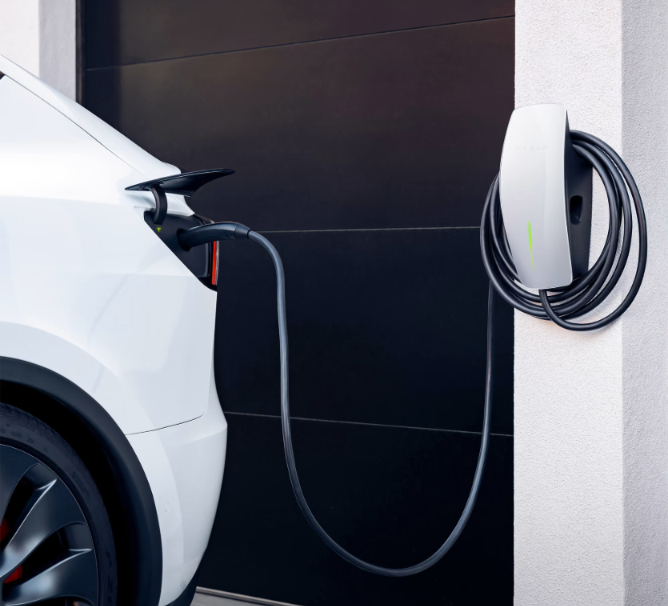
In January 2025, we participated in Pwn2Own Automotive with multiple targets. One of them was the Tesla Wall Connector — the home charger for electric vehicles (including non-Tesla ones)…
This article explains how we studied the device, how we built a Tesla car simulator to communicate with the charger, and how we exploited this logic bug during the competition.
The “hackers” of the Tesla wallbox wore “white hats”, but what might have happened if they had been wearing “black hats” instead? While you ponder your answer to that question, you may find it reassuring that the United Kingdom’s National Cyber Security Centre has been worrying about it for quite some time. According to the NCSC’s web site their mission is:
Making the UK the safest place to live and work online.
We support the most critical organisations in the UK, the wider public sector, industry, SMEs as well as the general public. When incidents do occur, we provide effective incident response to minimise harm to the UK, help with recovery, and learn lessons for the future.
The first example use case for their efforts reads:
Defending the digital infrastructure on which a sustainable world depends.
For example, by helping to protect a flexible energy system from cyber threats.
Image courtesy of ImageFX
In November 2023 the NCSC published a blog post that began as follows:
In 2020, the NCSC published a white paper on Preparing for Quantum-Safe Cryptography. This paper explained the threat that a possible future quantum computer – one much larger, and much more capable, than any that exist today – would pose to a large class of widely deployed cryptography. That cryptography is known as public-key cryptography (PKC). PKC is the enabling technology for secure communication at scale, on the internet and many other networks.
The same white paper also explains why NCSC’s recommended mitigation of the quantum computing threat is quantum-safe cryptography, or post-quantum cryptography (PQC). PQC is cryptography that is resistant to attack by quantum computers, and also to today’s digital, or classical, computers. Furthermore, PQC offers broadly equivalent functionality to the quantum-vulnerable PKC currently in use, and can be deployed in many of today’s devices (including PCs, smartphones etc.) with a software update.
This seems like a simple solution to the threat from a potentially disruptive technology. And conceptually, it is – but the migration to PQC is a very complicated undertaking. This blog explains why.
Do you suppose that Greg and/or the Octopus Power Pack team have read it?
Over the last few days Octopus Energy have dropped some heavy hints about an “exciting announcement” at their Energy Tech Summit in London at 12:30 this afternoon. Here is what transpired at the appointed time:
As the video title puts it, Octopus CEO Greg Jackson launched the WORLD FIRST vehicle-to-grid EV bundle! As you can see from the video thumbnail, Greg was joined on stage by motoring journalist Quentin Willson and 1996 Formula One World Champion Damon Hill as he outlined the Octopus Power Pack consumer offer:
Power Pack Bundle gives a car lease, two-way charger, and a smart tariff for £299/month with 100% FREE smart charging – saving £1,000/year on fuel vs petrol.
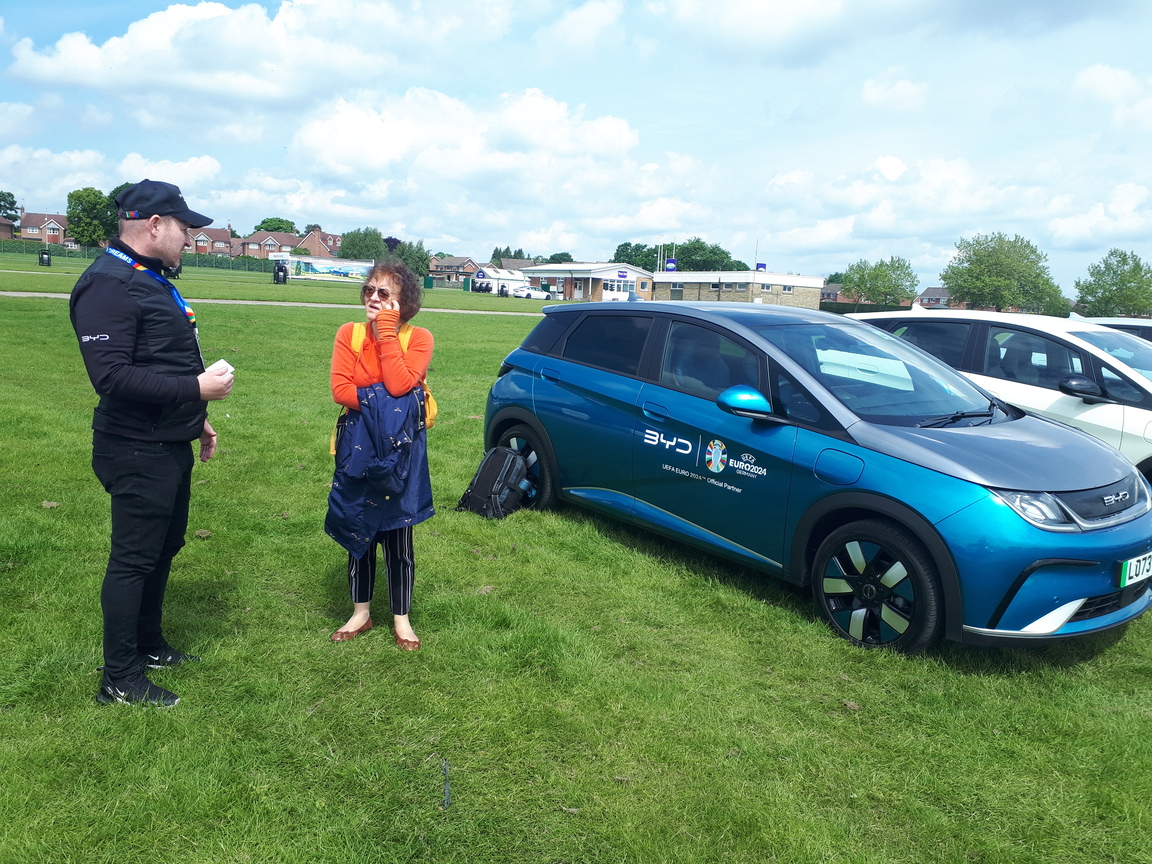
The EV part of the bundle is the BYD Dolphin, which I test drove when I was up in Harrogate last year to contribute to two V2x panel discussions at the Everything Electric North show:
Last week there was a significant “Energy Technology” announcement in Manchester. This article was supposed to be written/published last weekend, but Storm Darragh and our subsequent 20 hour power cut proved more than capable of disrupting the carefully laid plans of both mice and men!
Hastily returning to a rather damp Manchester on December 5th, here is a recording of the meat of the initial presentation by Devrim Celal, Chief Marketing and Flexibility Officer of KrakenFlex Limited, speaking at the launch of the “Mercury Consortium” at the “UK’s first energy tech superhub”:
Devrim’s presentation was followed by a panel session with representatives of four “manufacturers”, which we will cover at a future date. After a “networking break” there was another panel session with speakers from four “utilities”, introduced by Arshad Mansoor who is President and CEO of the Electric Power Research Institute. Here’s what Arshad had to say:
This morning a new section was visible on the “Smart Tariffs” section of Octopus Energy’s web site. The new tariff is introduced by Constantine the friendly octopus as follows:
Octopus Power Pack: the UK’s first Vehicle-to-Grid tariff
Get free EV charging with our groundbreaking vehicle-to-grid (V2G) tariff
Add Octopus Power Pack to your regular tariff. We’ll set up your V2G charger to automatically manage your charging and discharging in the greenest way possible, so you can fill up for free.
A typical V2G driver could save £880 per year compared to Flexible Octopus, and £180 compared to Intelligent Octopus Go.
Power Pack represents the latest stage in our V2G rollout, following our wildly successful Powerloop V2G trial. It’s currently a beta tariff.
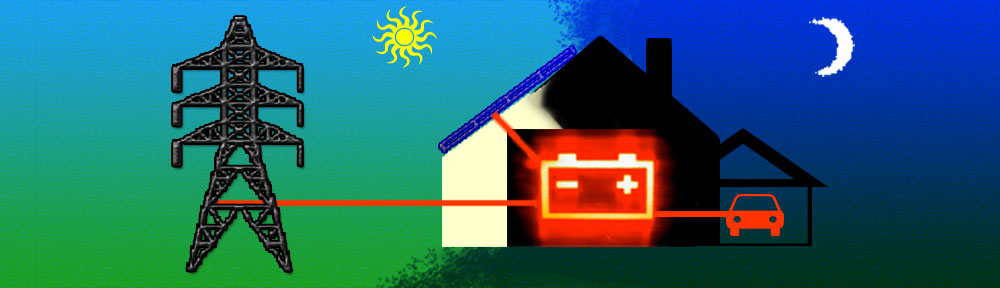
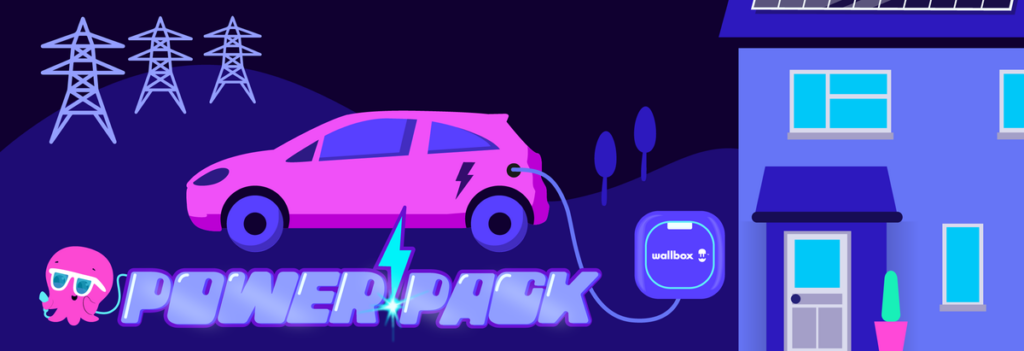
I cannot help but wonder if Constantine the intelligent octopus has been peeking at our decade old “artistic impression” of V2G technology in the domestic environment? See the banner above.
Ministers are discussing launching a public information campaign to encourage households to reduce their energy use this winter as fears grow over winter blackouts.
Households could be asked to turn their thermostats down and use their dishwashers and washing machines during the night and at times when energy demand is lower, under plans being discussed between the business department, energy companies and the network operator National Grid.
No names are mentioned of course, but allegedly:
Sources close to the discussions said that government officials and industry executives were determined to avoid blackouts disrupting the supply of energy to Britons’ homes. A public information campaign could help ease pressure on energy supplies during the winter. Ministers have so far resisted callsto tell consumers to cut their energy use, saying consumption of gas and electricity was a “decision for individuals”.
The article mentions the recent trial in Scotland run by Octopus Energy and SP Energy Networks, in which a financial incentive was offered to domestic consumers to shift the timing of their electricity demand.
Over 2,500 Octopus Energy customers across Dumfries and Galloway participated in the six-week trial*. Directed to power up their usage when green energy supply was highest, households used 20MWh more energy across the six two-hour trial windows. Households who increased their usage by more than 10% were credited back all the energy they had used during the two-hour timeframe. Those who used more than 100% extra were credited double the amount they had used. Participating customers were rewarded with an average of £5 of free energy, with some saving up to £73.
According to The Guardian once again:
National Grid will lay out its outlook for winter energy supplies on Thursday, giving the first comprehensive assessment of the risk of blackouts this winter.
The eagerly awaited document should show how resilient Britain’s energy supplies are over the coming months. An early view, published in August, showed the UK should be able to meet its energy demand in the coming months. However, since then Norway has indicated it may prioritise supplying its domestic market over exporting power.
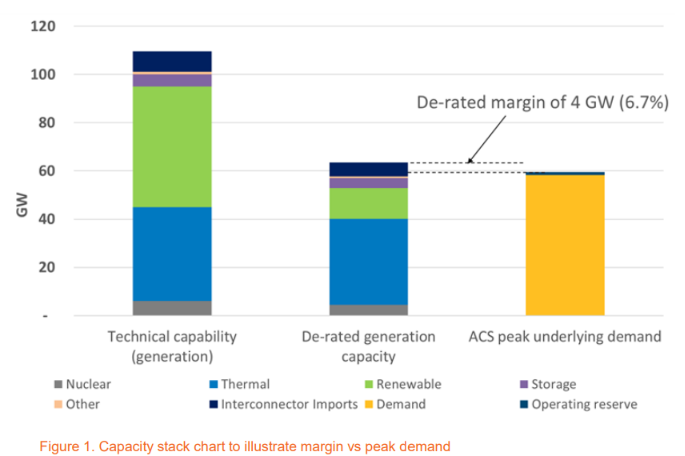
Here’s how things stacked up for the National Grid in August:
We eagerly await any changes revealed in tomorrow’s report!
[Edit – October 6th]
The National Grid Electricity System Operator has now published its “Winter Outlook Report” for 2022/23. Here is the executive summary in full:
Our first illustrative scenario examines what would happen if there were no electricity imports from continental Europe . In this scenario we would deploy our mitigation strategies – dispatching the retained coal units and our Demand Flexibility Service. By securing 4GW through these actions, we would maintain adequate margins and mitigate impacts on customers.
Our Demand Flexibility Service is new and innovative, and we have worked with suppliers, aggregators, industry, Ofgem and BEIS on the design to ensure it is ready for the winter and capable of delivering the required level of participation and response (2 GW+). It will launch on 1 November, and we are encouraging suppliers and aggregators to work with their customers to ensure the highest levels of engagement and participation. We see particular potential from commercial organisations who can shift their load from peak hours and have had positive feedback from British companies on this.
Without the Demand Flexibility Service, we would expect to see a reduction in margins. In this scenario on days when it was cold (therefore likely high demand), with low levels of wind (reduced available generation), there is the potential to need to interrupt supply to some customers for limited periods of time in a managed and controlled manner. However, we expect the mitigations outlined above to be effective.
A second, more extreme scenario, looks at a hypothetical escalation of the energy crisis in Europe such that there is insufficient gas supply available in Great Britain (in addition to no electricity available to import from continental Europe as per above scenario). In the unlikely event that escalation of the situation in Europe means that insufficient gas supply were to be available in Great Britain this would further erode electricity supply margins6 potentially leading to interruptions to customers for periods. All possible mitigating strategies, including our new measures, would be deployed to minimise the disruption.
Overall, this is likely to be a challenging winter for energy supply throughout Europe. We have taken extensive measures to try to mitigate the impacts for British consumers and expect that, under our base case, margins will be adequate. Nevertheless, there remain scenarios, driven principally by factors outside of Great Britain which could impact upon British electricity supplies. Plans are in place to ensure the impact is minimised and the overall security and integrity of Britain’s energy systems are protected.
Here too is the updated version of the “base case” supply margin chart shown above:
The chart is accompanied by these two provisos, amongst others:
Our base case assumes electricity imports from Europe are available at times when we need them to meet demand, delivering in line with their Capacity Market agreements, and that there is no disruption to gas supplies.
Our base case does not assume any material reduction of consumer demand due to high energy prices. It does not include any of our mitigation measures such as coal contracts or the Demand Flexibility Service as we would not expect to deploy them here.
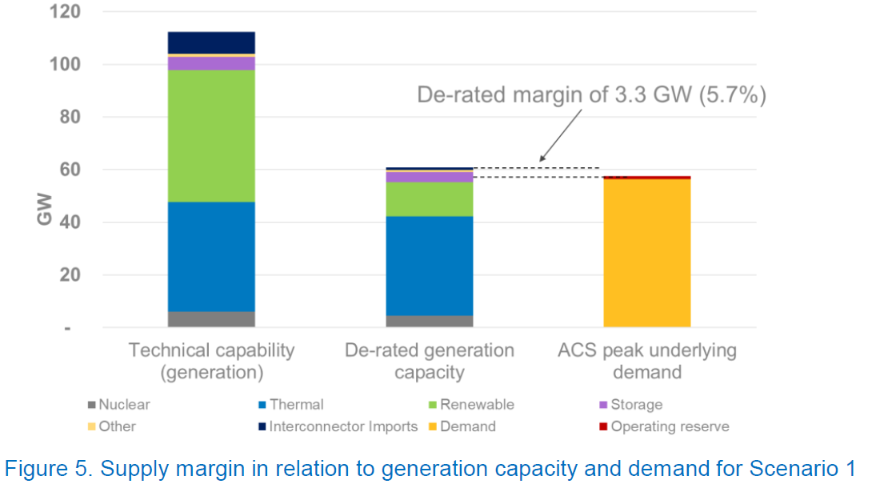
The winter outlook also considers “Scenario 1” in which there are “reduced electricity imports from Europe”:
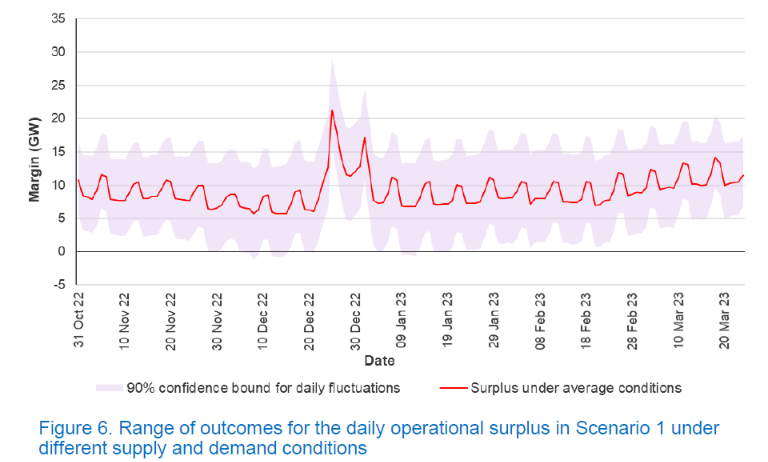
The bar chart is accompanied by a graph of “operational surplus”:
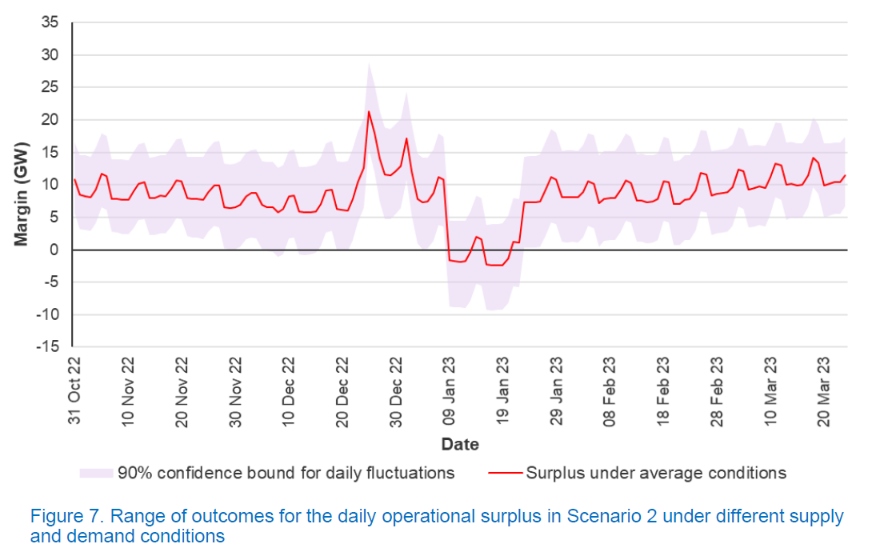
That shows National Grid’s “90% confidence” that the surplus will not turn negative over the winter. However now let’s take a look at “Scenario 2” in which there is in addition “insufficient gas supply in Great Britain”:
Due to the war in Ukraine and gas shortages in Europe, there is a significant risk that gas shortages could occur during the winter 2022/23 in Great Britain. As a result, there is a possibility that GB could enter into a Gas Supply Emergency.
Perhaps it would be prudent at this juncture for us all to cross our fingers and hope that the gas keeps arriving at Great British shores over the coming months, whether via pipeline or LNG tankers?
Though no power cuts are currently planned, in their winter outlook National Grid ESO raised the possibility of the need for planned national power cuts, in order to manage the possibility of energy demand outstripping the supply available.
Firstly, it’s important to know that before any emergency planned power cut instruction is given, National Grid ESO takes several steps to protect customers. These include:
* Encouraging additional generation through the supply market. * Asking heavy industrial users to limit their demand during peak periods. * Reducing domestic power demand – this could include paying customers to change how and when they use appliances like washing machines and dishwashers or reducing voltage across the country by a small percentage, which would be undetectable.
Procedures for emergency planned power cuts like this have existed for decades and are simulated in emergency exercises by the energy sector each year ahead of the winter.
If needed, the emergency procedures are designed to minimise the impact on customers as far as possible, by limiting power cuts to shorter periods in order to manage overall electricity demand. However, while the winter is expected to be challenging, there is no guarantee emergency measures will be necessary.
If an emergency power cut is implemented, customers in certain parts of the country would typically be without power for around three hours per day during the emergency.
Distribution network operators, which run the local power networks, would be legally instructed by National Grid ESO, which controls the flow of energy around the country, to disconnect power supplies using established procedures. These procedures are set out by the government in a document known as the Electricity Supply Emergency Code, sometimes referred to as ESEC. The procedures ensure that power is shared fairly across all customers during a national energy emergency…
If emergency power cuts are needed customers will be able to find their rota and what it means for them at powercut105.com by entering their postcode. The rota will only be published once emergency power cuts have been approved to take place.
[Edit – October 17th]
In an article in today’s Financial Times, energy correspondent Nathalie Thomas writes that:
National Grid’s chief executive has warned British households to prepare for blackouts between 4pm and 7pm on “really, really cold” weekdays in January and February in the event of reduced gas imports from Europe.
John Pettigrew said the company would have to impose rolling power cuts on “those deepest darkest evenings in January and February” if generators failed to secure enough gas from the continent to meet demand, particularly if the country suffers a cold snap.
Pettigrew’s comments at the Financial Times’s Energy Transition Summit came after National Grid, which oversees Britain’s electricity and gas systems, this month took the unusual step of setting out various “unlikely” scenarios in which Britain might not have sufficient energy supplies this winter.
[Edit – November 4th]
National Grid ESO’s Director of Corporate Affairs, Jake Rigg explained their Demand Flexibility Service on BBC Breakfast this morning. · According to a BBC article:
Households will be offered discounts on their electricity bills if they cut peak-time use on a handful of days over the winter, as part of National Grid’s efforts to avoid blackouts.
The network operator has announced details of the scheme, which it said could save households up to £100.
There will be 12 “test” days initially, designed to see how customers respond, between November and March.
But only homes with smart meters will be able to take part.
Only 14 million, less than half, of households in England, Scotland and Wales, where the scheme is being tested, have a smart electricity meter installed.
Customers taking part will be given 24 hours’ notice of a “test” day where they will be asked to reduce their peak-time electricity use if they can during a one-hour period identified by National Grid, likely to be between 16:00 and 19:00.
That could include delaying use of a tumble-dryer or washing machine, or cooking dinner in the microwave rather than the oven.
National Grid said it will pay energy suppliers, which will be required to sign up to the scheme to operate it for customers, £3 for every kilowatt-hour during the test periods.
Individual suppliers will decide how much customers will receive and whether the money is taken off bills, credited to accounts, or if there’s an option to withdraw the cash…
That’s a question I’ve been wondering about since UK retail electricity prices started rising and suppliers started going bust in droves. And I am not the only one. Here’s Enel CEO Francesco Starace speaking to CNBC back in the summer:
If you look at Europe this [electricity price spike] was quite easy to predict. 2021 is the first year in which the ETS (Emissions Trading Scheme) gets into this mechanism of cutting quotas as the slack shows up, and that’s working, and I think that is something that everyone was expecting to work and it’s doing the job. The question is whether this will become too much, or whether politicians will be able to understand that they have to be part of this game, and use fiscal levers to mitigate the impact on the most vulnerable customers.
No doubt there are also other factors at work, but one way and another we here in the United Kingdom seem be losing “this game” by many a mile at the moment.
Those “most vulnerable customers” are currently feeling the impact, as indeed are we when perusing our own electricity bills. I’ve been documenting that impact via videos of our own local friendly neighbourhood wind turbine at Upper Tremail when the wind is blowing, thanks to both Storm Arwen:
The introduction to a recent article on the Octopus Electric Vehicles blog about their Powerloop vehicle-to-grid trial reads as follows:
Powerloop is providing a crucial insight into the viability of Vehicle-to-Grid (V2G), as well as helping improve the customer experience for the installation of other smart technologies. The project is run by Octopus Electric Vehicles in partnership with UK Power Networks, Energy Saving Trust, ENGIE EV Solutions, Open Energi, Guidehouse and our sister company, Octopus Energy, Here, we discuss how Powerloop works, why V2G is so important, and how learnings from this project are helping UK Power Networks improve the broader smart technology onboarding process!
What is V2G?
Put simply, V2G enables an electric vehicle (EV) owner to be both the generator and the consumer of energy, using bi-directional charging technology to allow the user to charge and discharge their EV. This means that, unlike household appliances that can only receive energy, such as a kettle, the car’s battery becomes an energy asset that can transfer energy back to the grid.
However our readers located in UK Power Networks’ service area might be most interested in the following exciting information?
Powerloop is V2G in action, and is still open to new participants (just five spots remain!). Combining the Nissan LEAF with the Wallbox Quasar V2G charger, Powerloop is gathering real world data to help show how V2G can be a valuable asset to the UK’s energy network by helping flatten peak grid demand and making the most of renewable energy whilst using an EV.
By all means read the Octopus article in full, but if you want one of the last available chances to get a Wallbox Quasar on your own wall as part of the Powerloop V2G trial get in touch with Octopus PDQ!
This is a piece of electric vehicle smart charging (V1G for short) news rather than directly related to vehicle-to-grid technology. It is extremely interesting nonetheless. In a press release this morning it was announced that:
Octopus Energy and Ohme are today announcing a partnership to offer Octopus Energy customers the chance to have smart charging at home – enabling them to charge any electric car when Octopus’s green electricity is cheapest.
By integrating with Agile Octopus, the UK’s only smart time-of-use tariff, the Ohme cable and app brings smart charging to any home.
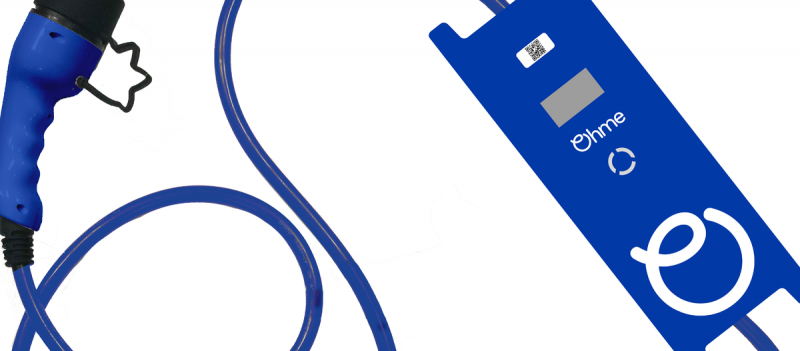
Here’s the image of Ohme’s new “smart cable” that accompanied the press release:
The press release continues:
Once the cable is connected, the driver can just open up the app and enter the amount they would like to charge their car and by when, and then let Ohme manage it for them. For example: “On weekdays, charge my car battery to 100% by 7am”. Ohme then uses the Octopus Agile API to automatically deliver the right amount of electricity when it is cheapest.
By optimising their charging in this smart way, Octopus Energy and Ohme estimate that customers using Ohme in parallel with the Agile Octopus tariff could save around £300 per year on their charging costs in comparison to charging on a typical industry standard variable tariff.
The cable will cost £399, but the first 1,000 Octopus Energy customers get a special launch price of £199.
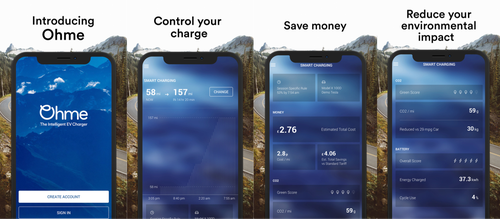
The Ohme cable is available for pre-order on the Octopus Energy web site. Whilst we wait for them to start shipping the new product, here’s an image of the Ohme app in action:
According to Ohme’s CEO, David Watson:
At Ohme we believe the future of transport is electric and that flexible home charging is the key to mass adoption. Ohme’s innovative smart charging cable is the first App-controlled, intelligent EV charger, that combined with Octopus’ smart energy tariffs, delivers real savings and environmental benefits. All you need to do is plug in and let Ohme do the rest.
I cannot help but think that the likes of Wallbox might well quibble with David’s “first app-controlled, intelligent EV charger” remark? The press release didn’t include a telephone number, but we’ll let you know Ohme’s thoughts on the matter when we manage to get hold of them.
[Edit – March 30th]
After desperately doing my due diligence I eventually managed to have a long chat with Ohme’s technical guru, Dan Hollingworth, yesterday evening. As I strongly suspected, the Ohme “smart cable” isn’t actually that smart, by V2G UK’s standards at least. It contains a microprocessor and a 4G modem, not unlike our sister company V2G EVSE’s “smart controller” except that it doesn’t optionally do WiFi, Bluetooth, 2.5 G, 3G, LTE-M and NB-IoT as well.
Ohme’s device doesn’t determine the electric vehicle (EV for short) battery pack’s state of charge by communicating with the EV through the cable. Instead it finds out that useful piece of information by using its 4G modem to communicate with assorted EV original equipment manufacturer’s (OEM for short) cloud platforms, which in turn communicate wirelessly with the EV the Ohme’s cable is plugged into using proprietary protocols.
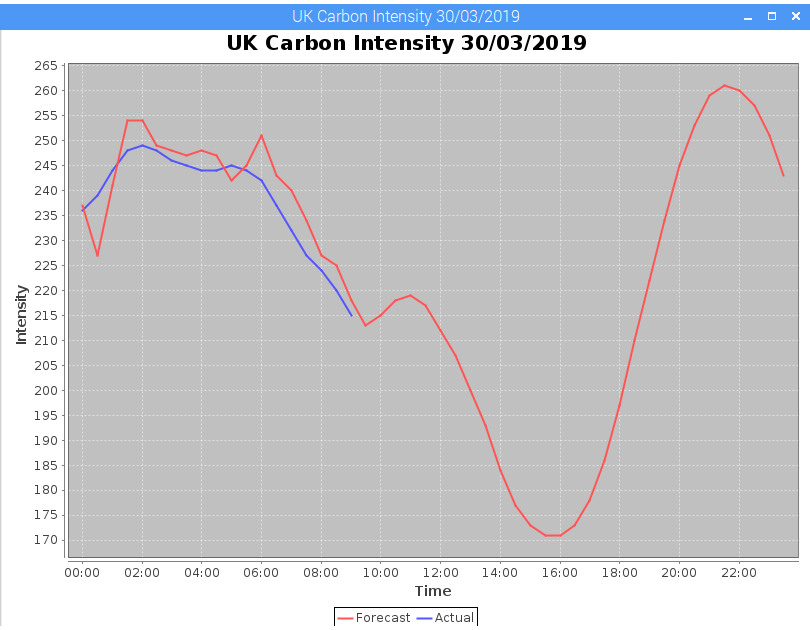
Ohme’s cloud platform is somewhat smarter since it communicates with National Grid’s Application Programming Interface (API for short) to forecast the “carbon intensity” of the UK Grid and thus determine the “greenness” of the electricity used to charge the EV to which the “smart cable” is attached. Here’s the current output of our open source example of how to go about doing that, generated by the V2G EVSE smart controller:
Ohme’s cloud platform also determines the price of electricity on Octopus Energy’s Agile or Go tariffs by communicating with the Octopus Energy API
Ohme’s smartphone application (app for short) allows the EV’s owner to instruct Ohme’s cloud based platform how much charge they’d like in their EV battery pack by when. On the basis of all the information Ohme’s cloud based platform has acquired it then uses version 1.6 of the Open Charge Point Protocol (OCPP for short) to instruct the cable when and how fast to charge the EV it’s connected to. In case it’s of interest here’s our open source smart charging station simulator, based on a mildly modified clone of Thomas Volden’s OCPP 1.6 library over on GitHub:
Last week, we had the unveiling of our newest flagship product – the new zappi range. The event was hosted at Millbank Tower overlooking the Thames and we were delighted to host some of the most influential people within the EV industry.
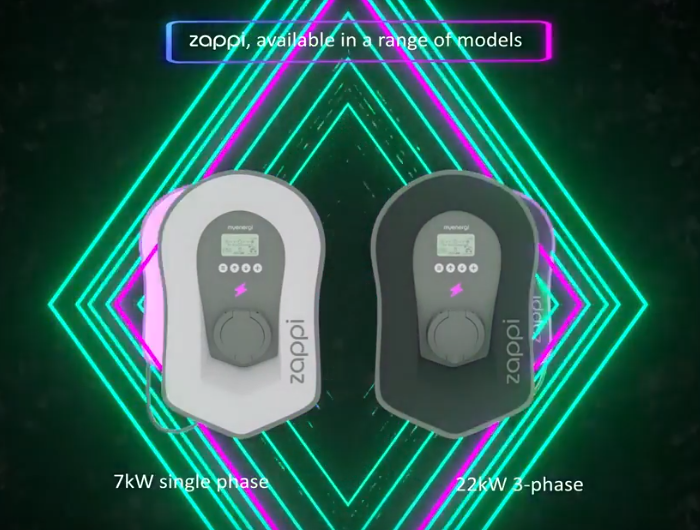
The stars of the show were the new zappi models: the single-phase, 7kW variant complete with its fresh makeover and the highly-anticipated three-phase, 22kW zappi– both available as tethered and untethered units. Details about the new soon to be released myenergi hub device and app, offering internet connectivity for remote control and live view of energy flow, were also presented to highlight the advancements of our exciting product range. As well as being able to perform as a regular charge point for customers who don’t have solar or wind on their property, these new exciting developments add significant value to our customers with grid-tied microgeneration systems – particularly when maximising the benefits of the zappi’s three different charging modes. The zappi maintains its ability to limit what grid supply it can take whilst looking to access any surplus green energy available, ensuring it remains the most eco and customer-friendly charge point on the market.
We have previously praised the virtues of the 7kW zappi, and now there’s a speedier 3 phase version too!
Not only that, but also:
One particular highlight from the launch that will be music to the ears for all the installers out there is that the new zappi complies with the BS7671 18th Edition regulations which comes into force January 2019 and is currently the only charge point available where in most cases an earth rod is not required during the install – an installer’s dream!
Apparently myenergi is also an investor’s dream, since the article continues:
Sir Terry Leahy, myenergi investor and former CEO of Tesco, offered words of wisdom and highlighted the positive steps being taken as we remain proud flag-bearers at the forefront of the rEVolution and our friend at Evergreen Smart Power, Andy McKay, gave an exciting and insightful look into the future of green energy. Robert Llewellyn, the former Red Dwarf actor who now fronts the YouTube channel, Fully Charged, was present to champion our cause and we had further support from Fiona Howarth of Octopus Energy who discussed the successful partnership they have with the myenergi team.
myenergi are taking advance orders now, and manufacturing starts in January 2019. Whilst we wait to see a zappi 2.0 in the flesh, here’s the launch video:
Note that:
The zappi eco-smart charge point varies the charging rate in response to available power.
zappi can work alongside battery storage and is an easy retrofit into any home scenario.