Storm Betty’s Forecast Threatens UK Power Cuts

This morning the Met Office in Exeter issued a warning of high winds due to the imminent arrival of Storm Betty, the second named storm of this tempestuous summer!

According to the press release:

Met Éireann have named Storm Betty as a low-pressure system which is also triggering Met Office warnings…

A Met Office yellow warning for wind covers coastal areas of western Wales, eastern Northern Ireland and parts of northwest England and southwest Scotland. Rain warnings have also been issued from late Friday and into Saturday for Northern Ireland and parts of Scotland.

According to the yellow warning for wind:

Power cuts may occur, with the potential to affect other services, such as mobile phone coverage

In such circumstances I have a penchant for recording “baseline” images of the UK’s distribution network operators’ power cut maps. I was rather surprised to discover that Northern Powergrid’s looked like this earlier today:

Zooming in on the map, it seems many of those alleged power outages have been “scheduled” in advance, some of which remain on the map despite having already been cancelled for today.

It remains to be seen how many “unscheduled” additions Storm Betty leaves in her wake.

[Update – August 18th 20:30]

The predicted “unscheduled” power cuts due to the passage of #StormBetty across the British Isles have begun.

Here are the current power outage maps of ESB Networks in Eire:

and National Grid in South West England:

[Update – August 18th 23:00]

It is clear tonight that inhabitants of Ireland are feeling the effects of Storm Betty far more than us here in South West England:

[Update – August 19th]

This morning National Grid’s power cut map doesn’t look significantly different to an average day:

Unfortunately the same cannot be said of the ESB Networks map:

or the NIE Networks map for that matter:

At 11:50 AM ESB Networks issued a press release:

Storm force winds associated with Storm Betty caused damage to the electricity network overnight affecting just over 70,000 homes, farms and businesses at the peak. As at 11.30am, just under 50,000 electricity customers remain without power with the damage mainly attributable to lightning and fallen trees on overhead lines as a result of the high winds.

Areas most impacted include counties in the South-East along with North Dublin, Dundalk, Portlaoise and Kilkenny.

All available resources are being deployed to respond to all electricity outages where safe to do so. ESB Networks crews have been working since first light and will work through this afternoon into this evening to restore power to as many customers as possible. A significant number of impacted customers will have their power restored by this evening. However, due to the scale of the damage to the electricity network, some customers in localised areas may remain without supply overnight.

To be continued…
Winter Storms Cut Power in California

We have previously reported on several occasions about power outages across California at the height of summer. By contrast today we report on outages in the midst of winter.

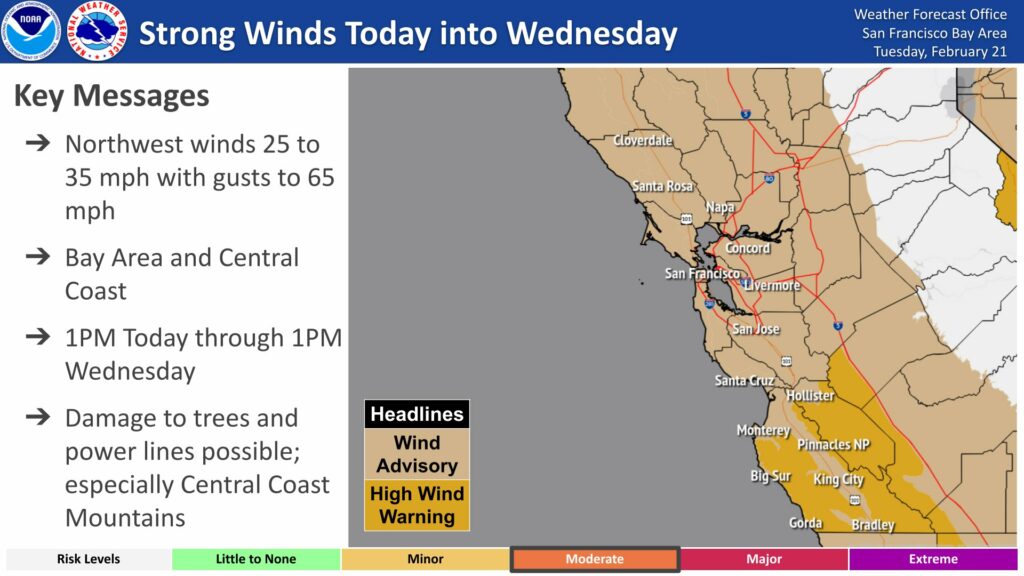
On Tuesday the United States’ National Weather Service’s San Francisco Bay area office issued a warning for high winds:

Note in particular the part about “damage to trees and power lines”. By Tuesday evening Pacific Gas and Electric had announced on their web site that:

As of 10 p.m., approximately 154,000 customers are without power in PG&E’s service area as heavy northwest winds impact electric equipment. More than 124,000 customers have been restored since 6 a.m.

PG&E crews will continue working through the night, safely and as quickly as possible to restore customers.

The NWS’s Weather Prediction Center also issued the following short term forecast for Wednesday:

A major winter storm is expected to deliver a large swath of heavy snow from the West Coast to the Northeast through Thursday…

The arrival of a large arctic air mass from Canada interacting with two energetic troughs/fronts forecast to move through the western half of the country will bring numerous weather hazards and highly anomalous temperatures coast-to-coast this week with almost all of the country experiencing some form of notable weather.

Continue reading →

More March Power Cuts in Cornwall

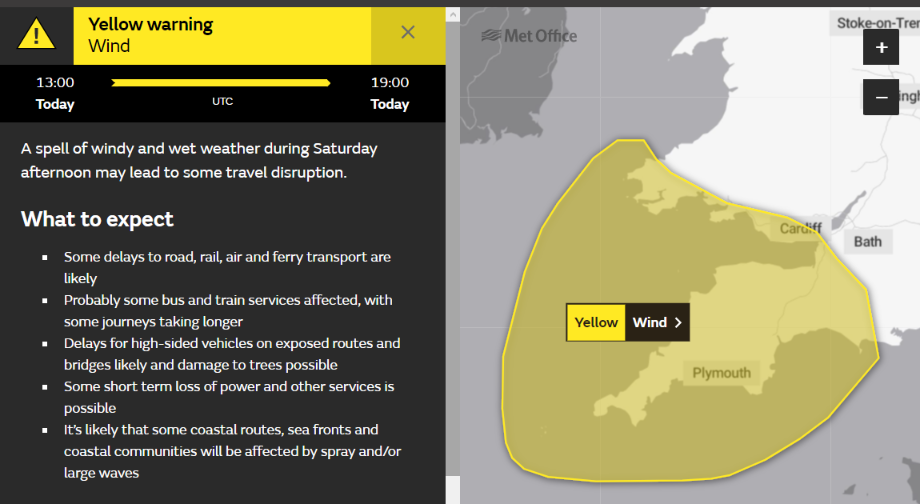
The UK’s Met Office has issued a yellow warning for wind and rain across South West England this afternoon:

As the Met Office point out:

Some short term loss of power and other services is possible.

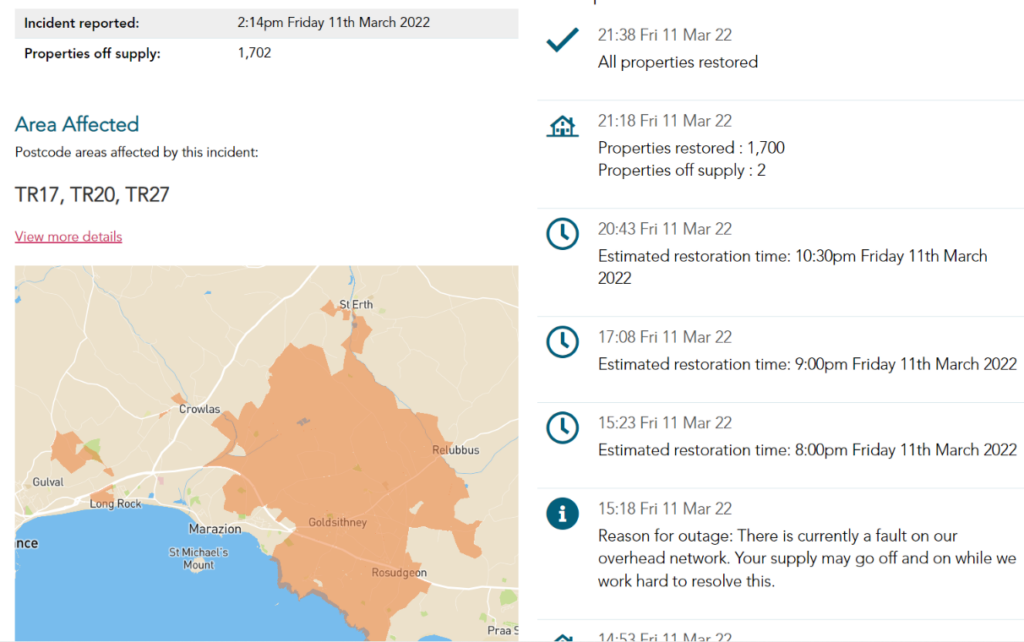
We would go somewhat further, and suggest that some power cuts are likely here in Cornwall. Not least because 1,702 properties near Marazion suffered a power cut yesterday afternoon:

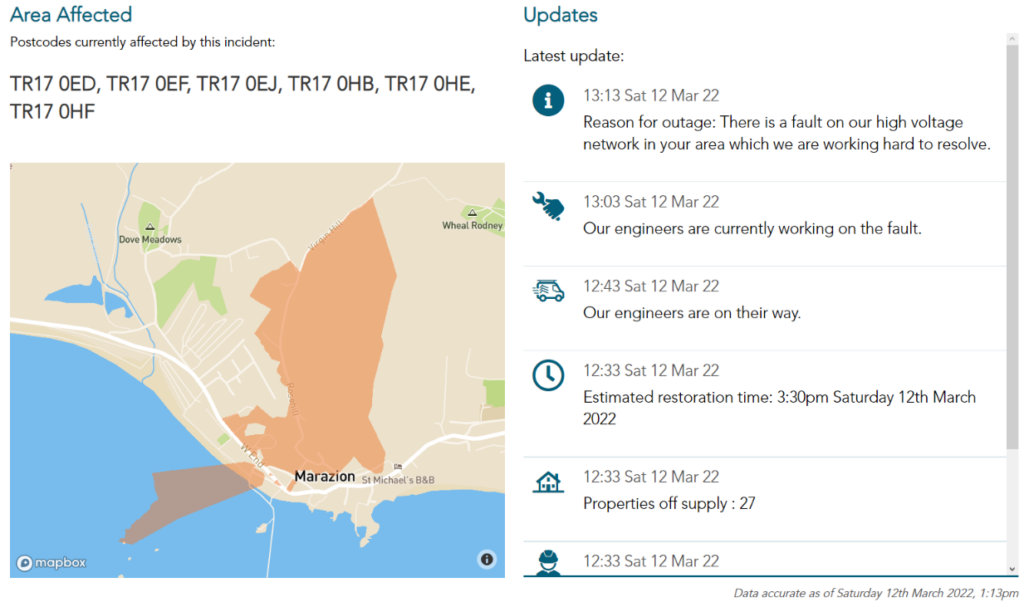
[Edit – 14:00 on March 12th]

Would you believe that this afternoon’s first Cornish power cut was in Marazion?

Watch this space!

Will the Energy Transition Only Benefit The Few?

That’s a question I’ve been wondering about since UK retail electricity prices started rising and suppliers started going bust in droves. And I am not the only one. Here’s Enel CEO Francesco Starace speaking to CNBC back in the summer:

If you look at Europe this [electricity price spike] was quite easy to predict. 2021 is the first year in which the ETS (Emissions Trading Scheme) gets into this mechanism of cutting quotas as the slack shows up, and that’s working, and I think that is something that everyone was expecting to work and it’s doing the job. The question is whether this will become too much, or whether politicians will be able to understand that they have to be part of this game, and use fiscal levers to mitigate the impact on the most vulnerable customers.

No doubt there are also other factors at work, but one way and another we here in the
United Kingdom seem be losing “this game” by many a mile at the moment.

Those “most vulnerable customers” are currently feeling the impact, as indeed are we when perusing our own electricity bills. I’ve been documenting that impact via videos of our own local friendly neighbourhood wind turbine at Upper Tremail when the wind is blowing, thanks to both Storm Arwen:

Continue reading →

Renewable Energy is the Work of Generations of Engineers?

Fresh from bemoaning the lack of grid-scale energy storage to support all the large scale solar PV parks currently being proposed here in not so sunny South West England, the latest edition of the IEEE Spectrum magazine landed on my doormat this morning.  In all the circumstances it would have been very handy if it had arrived this time last week, since it contains all sorts of statistics and arguments derived therefrom that support my position on that locally contentious issue!

In an article entitled “A Skeptic Looks at Alternative Energy” Vaclav Smil, a distinguished professor in the department of environment and geography at the University of Manitoba, bemoans (amongst other things) solar PV subsidies here in Northern Europe:

In June 2004 the editor of an energy journal called to ask me to comment on a just-announced plan to build the world’s largest photovoltaic electric generating plant. Where would it be, I asked—Arizona? Spain? North Africa? No, it was to be spread among three locations in rural Bavaria, southeast of Nuremberg.

I said there must be some mistake. I grew up not far from that place, just across the border with the Czech Republic, and I will never forget those seemingly endless days of summer spent inside while it rained incessantly. Bavaria is like Seattle in the United States or Sichuan province in China. You don’t want to put a solar plant in Bavaria, but that is exactly where the Germans put it. It happened for the best reason there is in politics: money. Welcome to the world of new renewable energies, where the subsidies rule—and consumers pay.

After laying his cards on the table at the outset Vaclav then lays into a wide range of renewable energy subsidies, making only two exceptions:

Without these subsidies, renewable energy plants other than hydroelectric and geothermal ones can’t yet compete with conventional generators. There are several reasons, starting with relatively low capacity factors—the most electricity a plant can actually produce divided by what it would produce if it could be run full time. The capacity factor of a typical nuclear power plant is more than 90 percent; for a coal-fired generating plant it’s about 65 to 70 percent. A photovoltaic installation can get close to 20 percent—in sunny Spain—and a wind turbine, well placed on dry land, from 25 to 30 percent. Put it offshore and it may even reach 40 percent. To convert to either of the latter two technologies, you must also figure in the need to string entirely new transmission lines to places where sun and wind abound, as well as the need to manage a more variable system load, due to the intermittent nature of the power.

I couldn’t have put it better myself, and I couldn’t have fitted it all into 5 minutes last Monday  either. If you have any interest in learning how to discern the difference between Green Energy and GreenWash I heartily recommend you read the article in full. Several times if necessary, until Vaclav’s message makes sense to you. To summarise, here’s his closing remark:

It is impossible to displace [the world’s fossil-fuel-based energy system] in a decade or two—or five, for that matter. Replacing it with an equally extensive and reliable alternative based on renewable energy flows is a task that will require decades of expensive commitment. It is the work of generations of engineers.

As if all that wasn’t enough, here’s a 45 minute video in which Bill Gates presents his views on energy policy in general, and Vaclav Smil in particular:

Finally here’s David MacKay’s “brilliant book” that Bill refers to around 18 minutes into his presentation. Sustainable energy, without the hot air.