The forthcoming summit of the G7 nations is taking place just down the road from the V2G UK office in North Cornwall. According to the G7 UK web site:
In June, Prime Minister Boris Johnson will welcome fellow G7 leaders to one of the most beautiful parts of the UK: Carbis Bay in Cornwall.
Other parts of the region will also play a key role in the Summit, including neighbouring St Ives, Falmouth and Newquay airport.
With over 400 miles of coastline, Cornwall’s stunning landscape provides a perfect setting for world leaders to come together and discuss how to respond to global challenges like coronavirus and climate change.
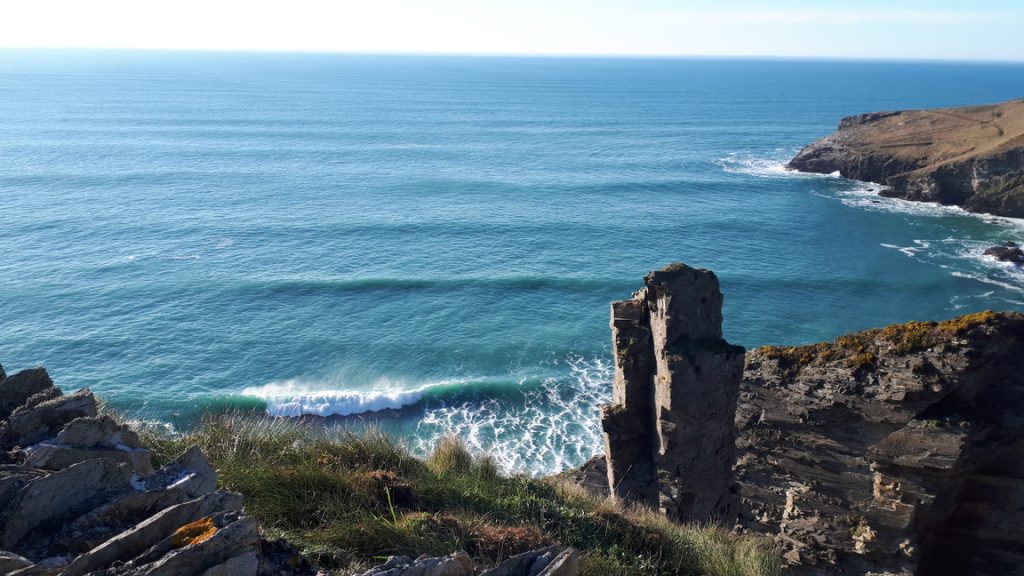
Here’s one of my recent pictures of some of that coastline, including part of Cornwall’s industrial heritage and some large waves!
Climate change is top of the G7 agenda along with Covid-19, and that must mean that UK and global energy policy will be somewhere very near the top as well. Obviously I’ll be reporting on what transpires in Carbis Bay in a month’s time, but for now here’s some topical G7 “tech” news:
V2G have recently relocated to North Cornwall. As a consequence I spent yesterday afternoon with Scott Mann, my new MP, at a meeting organised by the Federation of Small Businesses in Launceston:
Scott imparted a piece of news that hadn’t previously appeared on my radar screen. It seems there’s lots of lithium to be found down old Cornish tin mines! In a news release last month Cornish Lithium Ltd. announced:
Cornish Lithium, today announces that it plans to explore for, and to potentially develop, lithium contained in underground hot spring brines in Cornwall.
The presence of lithium in hot spring brines in Cornwall has been known since the mid-1800s but this was regarded as a curiosity, given there was no developed market for the metal at that time. New technology now offers the potential to extract lithium from these hot spring brines and to supply product to the rapidly growing battery market for electric cars and for power storage.
Cornish Lithium has entered into definitive mineral rights agreements with Strongbow Exploration (listed on the Toronto Stock Exchange, TSX-V: SBW) and Mineral Exploration Limited, and has signed a Heads of Agreement with Tregothnan Estates, to carry out exploration for, and development of, lithium in hot spring brines within the majority of the mineral rights held by these entities.
Rights secured by Cornish Lithium will allow the Company to undertake what it believes to be the largest, single, unified mineral exploration programme in Cornwall’s history.
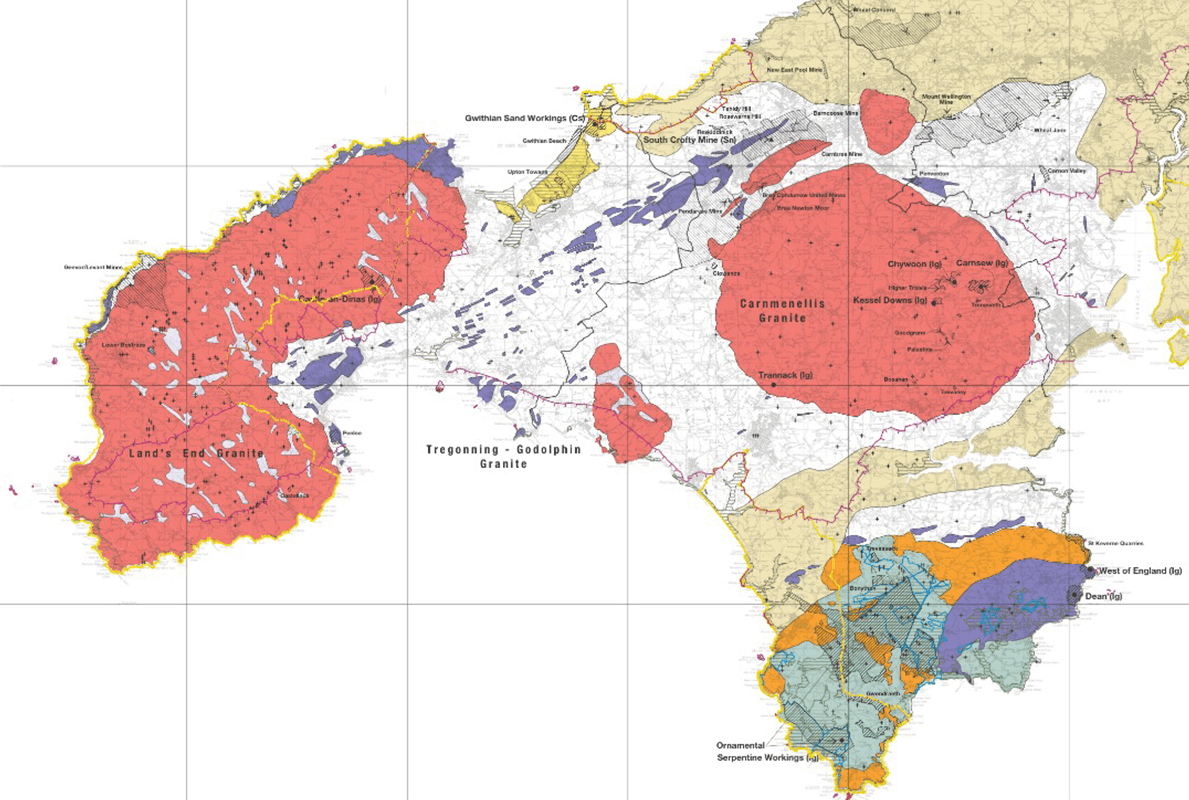
Here’s a map of the “areas around Camborne, Redruth and St. Day” that Cornish Lithium are looking into:
A bullet point further down the announcement also reveals that:
The Company has also secured rights to geothermal energy contained in the hot spring brines. It is anticipated that this energy will be utilised to generate power to reduce processing costs, but also may be used for other industries in the region.
Now as Scott Mann pointed out yesterday, with the potential for tidal and wave power as well as geothermal energy generation the South West Peninsula is well suited for “24/7” renewable energy generation as well as the more familiar “intermittent” wind and solar photovoltaic electricity generation, so that aspect of the proposed project is also of great interest to us here at V2G UK. Getting back to the lithium bearing hot spring brines though, Cornish Lithium’s news release also points out that:
Cornish Lithium is an independent company that has been created to develop lithium in geothermal “hot spring brines” in Cornwall. The Company believes this could result in the creation of a new lithium production industry in Cornwall.
Cornish Lithium’s legal agreements encompass a large area centered around the area of Camborne, Redruth and St Day, but also cover other areas of Cornwall that the Company believes may be prospective for geothermal hot spring brines. Negotiations are ongoing with other owners of mineral rights within Cornwall.
The rapid growth in demand for lithium-ion batteries is now centre stage globally given the dramatic switch towards electric cars. Most major vehicle manufacturers have outlined an electric car development programme with some manufacturers expecting 25 per cent of their sales to be electric vehicles by 2025. It is considered vital that new sources of lithium are developed, particularly in Europe in order that European car manufacturers can gain secure access to the lithium required.
The UK Government has defined lithium as a metal of strategic importance to the country.
The majority of lithium produced today comes from South America, Australia and China.
Cornish Lithium is an independent company that has been created to develop lithium in geothermal “hot spring brines” in Cornwall. The Company believes this could result in the creation of a new lithium production industry in Cornwall.
Cornish Lithium’s legal agreements encompass a large area centered around the area of Camborne, Redruth and St Day, but also cover other areas of Cornwall that the Company believes may be prospective for geothermal hot spring brines. Negotiations are ongoing with other owners of mineral rights within Cornwall.
You will note that at around 5:15 Cornish Lithium CEO Jeremy Wrathall says:
We’ll hopefully go into production, with a fair wind, maybe in the next 5 years or after 5 years. That’s the sort of timeframe we’re looking at.
Presumably within that timeframe we’ll also find out whether there will be another geothermal energy generation project to add to our map of geothermal energy generation projects in the United Kingdom!
The prospect of lithium being “mined” in Cornwall also raises the question of what might happen to the metal once it’s been extracted? Perhaps Tesla and SpaceX founder Elon Musk will use the proposed Spaceport Cornwall nearby to ship the raw material to Tesla’s “Gigafactory” in Nevada? More realistically, perhaps Cornwall’s very own Lithium ion battery factory might be developed alongside Cornish Lithium’s hot brine wells?
Finally, for the moment at least, here’s some further information on Cornwall’s long mining heritage:
Fresh from bemoaning the lack of grid-scale energy storage to support all the large scale solar PV parks currently being proposed here in not so sunny South West England, the latest edition of the IEEE Spectrum magazine landed on my doormat this morning. In all the circumstances it would have been very handy if it had arrived this time last week, since it contains all sorts of statistics and arguments derived therefrom that support my position on that locally contentious issue!
In an article entitled “A Skeptic Looks at Alternative Energy” Vaclav Smil, a distinguished professor in the department of environment and geography at the University of Manitoba, bemoans (amongst other things) solar PV subsidies here in Northern Europe:
In June 2004 the editor of an energy journal called to ask me to comment on a just-announced plan to build the world’s largest photovoltaic electric generating plant. Where would it be, I asked—Arizona? Spain? North Africa? No, it was to be spread among three locations in rural Bavaria, southeast of Nuremberg.
I said there must be some mistake. I grew up not far from that place, just across the border with the Czech Republic, and I will never forget those seemingly endless days of summer spent inside while it rained incessantly. Bavaria is like Seattle in the United States or Sichuan province in China. You don’t want to put a solar plant in Bavaria, but that is exactly where the Germans put it. It happened for the best reason there is in politics: money. Welcome to the world of new renewable energies, where the subsidies rule—and consumers pay.
After laying his cards on the table at the outset Vaclav then lays into a wide range of renewable energy subsidies, making only two exceptions:
Without these subsidies, renewable energy plants other than hydroelectric and geothermal ones can’t yet compete with conventional generators. There are several reasons, starting with relatively low capacity factors—the most electricity a plant can actually produce divided by what it would produce if it could be run full time. The capacity factor of a typical nuclear power plant is more than 90 percent; for a coal-fired generating plant it’s about 65 to 70 percent. A photovoltaic installation can get close to 20 percent—in sunny Spain—and a wind turbine, well placed on dry land, from 25 to 30 percent. Put it offshore and it may even reach 40 percent. To convert to either of the latter two technologies, you must also figure in the need to string entirely new transmission lines to places where sun and wind abound, as well as the need to manage a more variable system load, due to the intermittent nature of the power.
I couldn’t have put it better myself, and I couldn’t have fitted it all into 5 minutes last Monday either. If you have any interest in learning how to discern the difference between Green Energy and GreenWash I heartily recommend you read the article in full. Several times if necessary, until Vaclav’s message makes sense to you. To summarise, here’s his closing remark:
It is impossible to displace [the world’s fossil-fuel-based energy system] in a decade or two—or five, for that matter. Replacing it with an equally extensive and reliable alternative based on renewable energy flows is a task that will require decades of expensive commitment. It is the work of generations of engineers.
As if all that wasn’t enough, here’s a 45 minute video in which Bill Gates presents his views on energy policy in general, and Vaclav Smil in particular: