Hurricane Harvey Power Outages

Major Hurricane Harvey reached category 4 before landfall on the coast of Texas last night. Apart from numerous other forms of damage a large number of properties will lose their supply of electric power over the next few hours and days. In advance of Harvey’s arrival The Electric Reliability Council of Texas (ERCOT for short) issued a press release, which read as follows:

AUSTIN, TX, Aug. 25, 2017 – The Electric Reliability Council of Texas (ERCOT) has issued a weather-related watch in preparation for Hurricane Harvey, which is expected to make landfall late Friday night or early Saturday morning.

ERCOT anticipates the hurricane may cause damage to infrastructure from high-speed wind, along with significant flooding in the South, South Central and Coastal weather zones in the ERCOT region. This includes the cities of Houston, Corpus Christi, Brownsville, Austin and San Antonio. These conditions may cause a number of power outages throughout the ERCOT region.

The ERCOT System Operations team is working 24/7 at ERCOT’s System Control Center, which is built to withstand hurricane-force winds, to monitor the situation and protect overall system reliability. Extra engineering staff will be supporting their efforts throughout the weekend.

ERCOT also has been communicating with transmission and generation owners regarding hurricane preparations. Generation owners are implementing their own hurricane procedures to ensure the safety of their staff and equipment.

ERCOT remains focused on maintaining system reliability throughout the entire ERCOT region. At this time, ERCOT anticipates it will have sufficient generation available during the hurricane, while storm-related damage is expected to result in widespread power outages.

Please visit www.ercot.com/help/harvey for updates throughout the weekend. This site includes Frequently Asked Questions as well as helpful contact information.

Researchers from Michigan, Ohio State and Texas A & M Universities have created a model to predict power outages (as they’re referred to in the United States) resulting from Harvey’s passage. Here’s their current forecast:
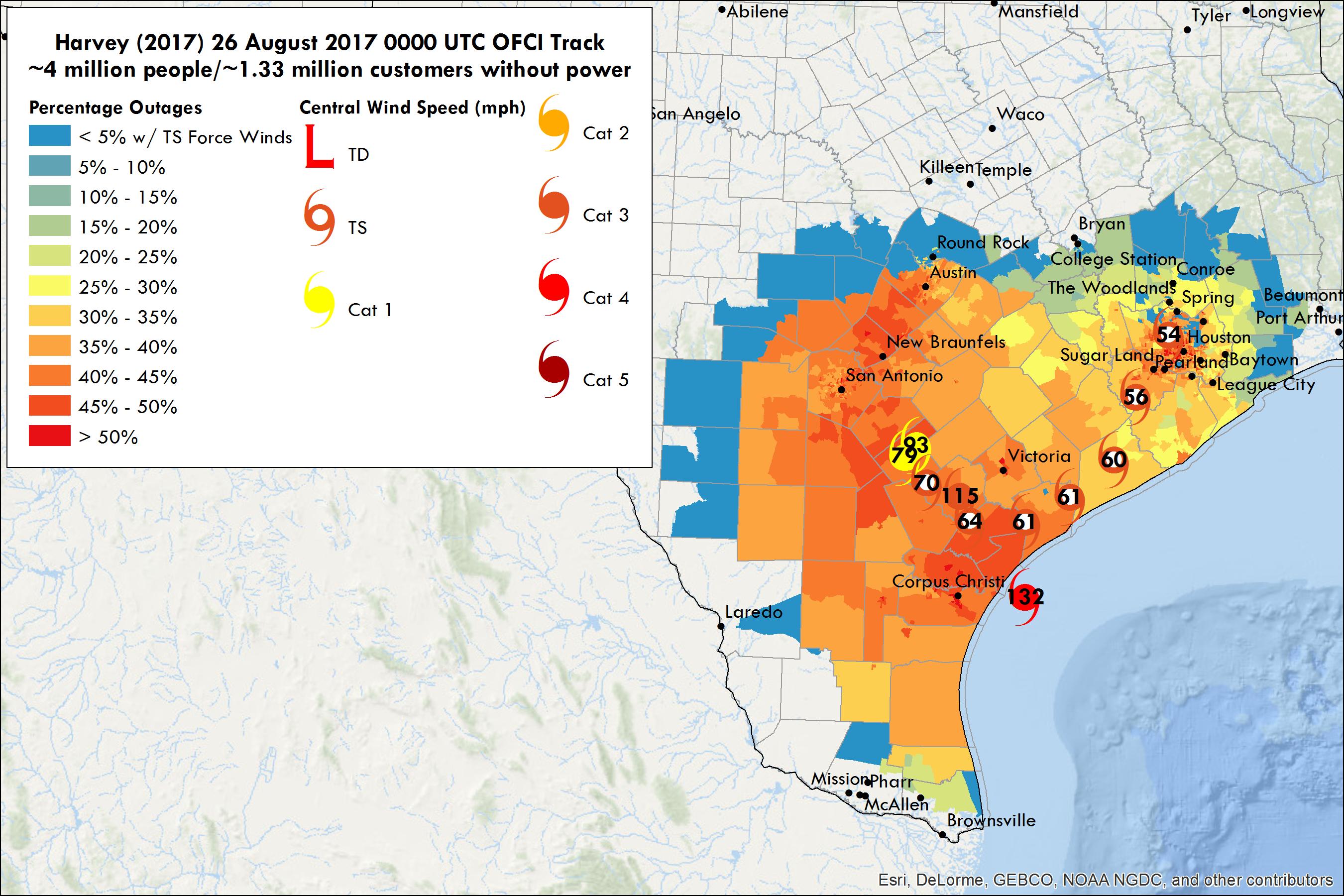
Currently over 200,000 properties in Texas are without electric power as a result of Harvey. That number will increase! Here’s some example outage maps at the moment (09:00 UTC):
 

[Edit – August 26th 12:00]


[Edit – August 26th 15:00]

ERCOT report via Twitter that:


[Edit – August 27th 12:00]

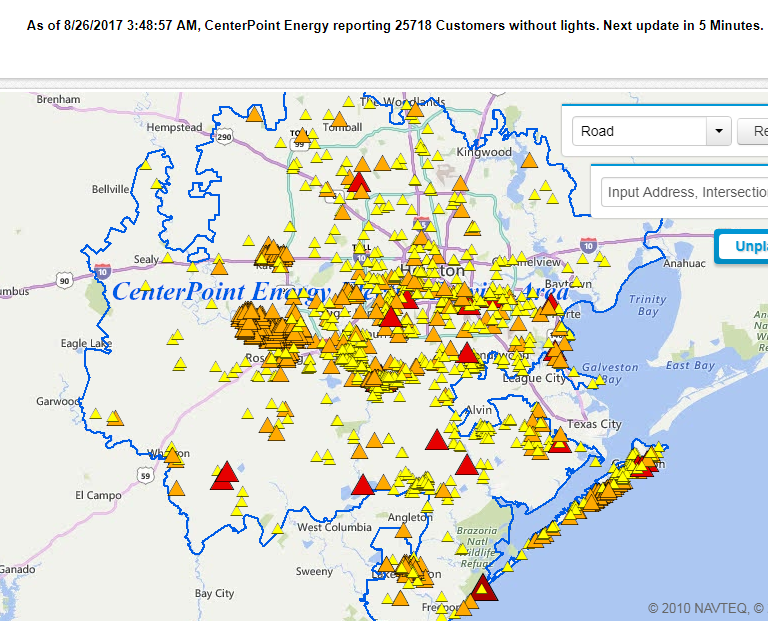
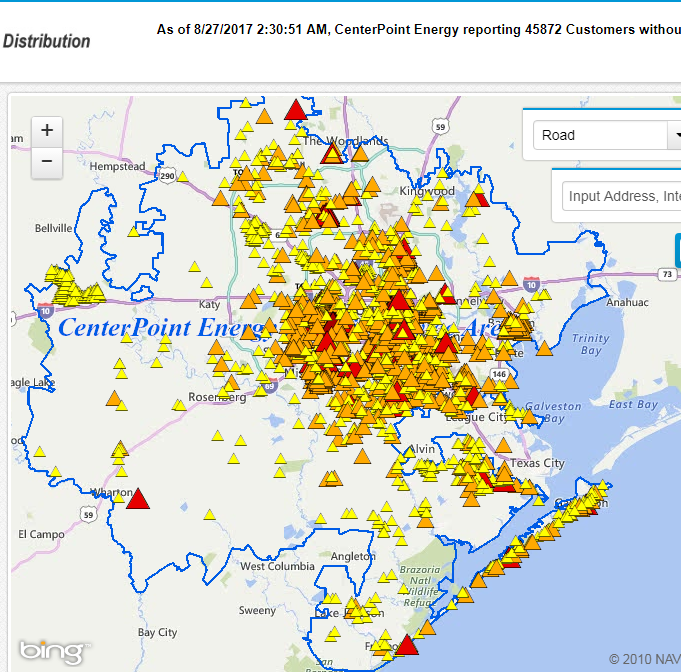
Power outages across Texas dropped below a quarter of a million overnight, but have now risen again to over 260,000. There has been a large increase in the region powered by CenterPoint Energy:
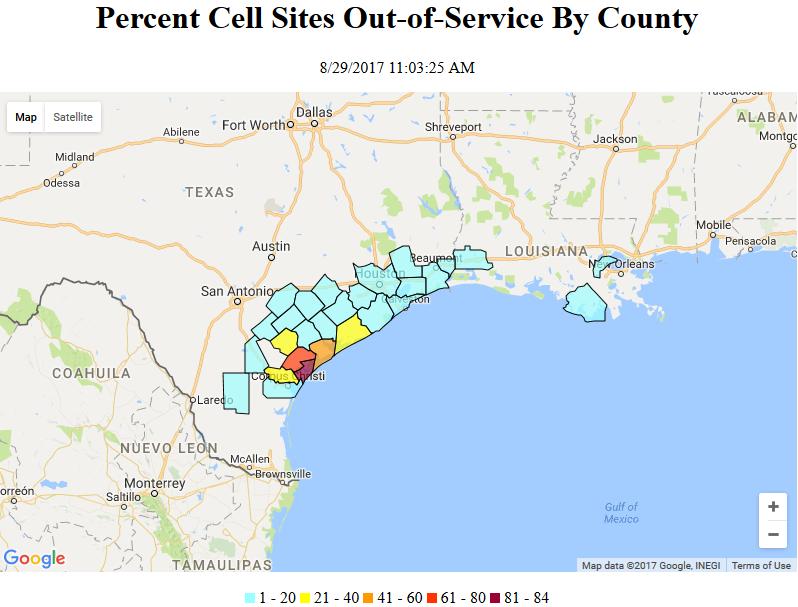
A problem that we’re all too familiar with here in South West England is that power outages can lead to communications outages. The United states’ Federal Communications Commission has issued a report on the effects of Hurricane Harvey on the cellphone infrastructure in Texas:

The following is a report on the status of communications services in geographic areas impacted by Hurricane Harvey as of August 26, 2017 at 10:30 a.m. EDT. This report incorporates network outage data submitted by communications providers to the Federal Communications Commission’s Disaster Information Reporting System (DIRS). DIRS currently covers areas of Texas and Louisiana. Note that the operational status of communications services during a disaster may evolve rapidly, and this report represents a snapshot in time.

While we don’t have reports for all counties yet, there are at least 149,909 subscribers out of service in the affected area. This includes users who get service from cable system or wireline providers. There are 5 switching centers out of service and 38 switching centers on back-up power.
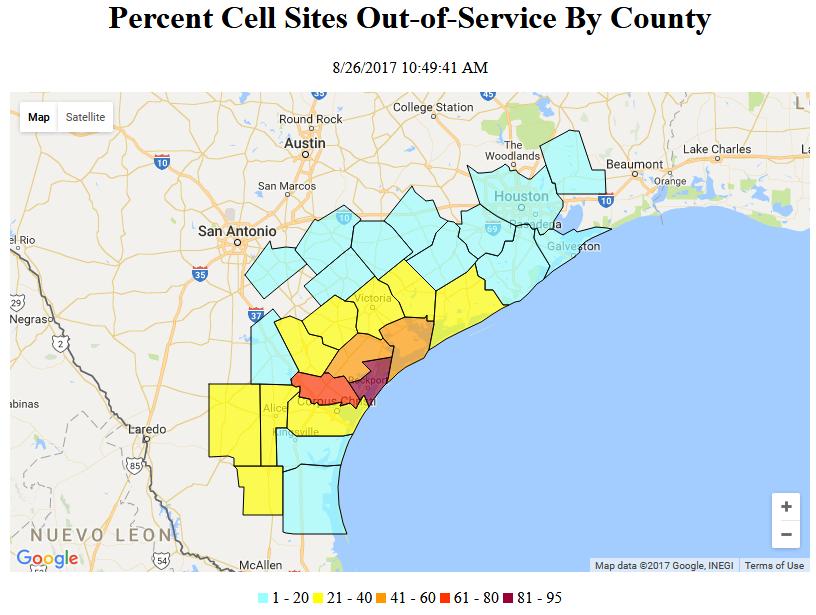
There are 4% of the cell sites down in the affected area. The counties with greater than 50% of cell sites out are Aransas, Refugio, and San Patricio in TX. There are no cell sites affected in LA.

The FCC also reports that:

The Public Safety and Homeland Security Bureau (PSHSB) learns the status of each Public Safety Answering Point (PSAP) through the filings of 911 Service Providers in the Disaster Information Reporting System (DIRS), through reporting done to the FCC’s Public Safety Support Center (PSSC), coordination with state 911 Administrators and, if necessary, individual PSAPs. There are a total of 9 PSAPs affected:

Portland Police Department, TX is down with no re-routes.
Calhoun County Sheriff, TX is up without Automatic Location Information (ALI).
Port Aransas Police Department, TX; Cameron Parish Sheriff’s Office, LA; Victoria Police Department, TX; Mathis Police Department, TX; Refugio County Sheriff’s Office, TX; Ingleside Police, TX; and Robstown Police Department, TX have either been re-routed to administrative lines or re-routed to another PSAP.
Cameron Parish Sheriff’s Office and Victoria Police Department have been re-routed with ALI, all other re-routes are without ALI.

There are 5 radio stations out of service: TX – WKNC, KKTX, KUNO, KKWV, and KAYK
There are no TV stations reported as being out of service.


[Edit – August 27th 22:30]

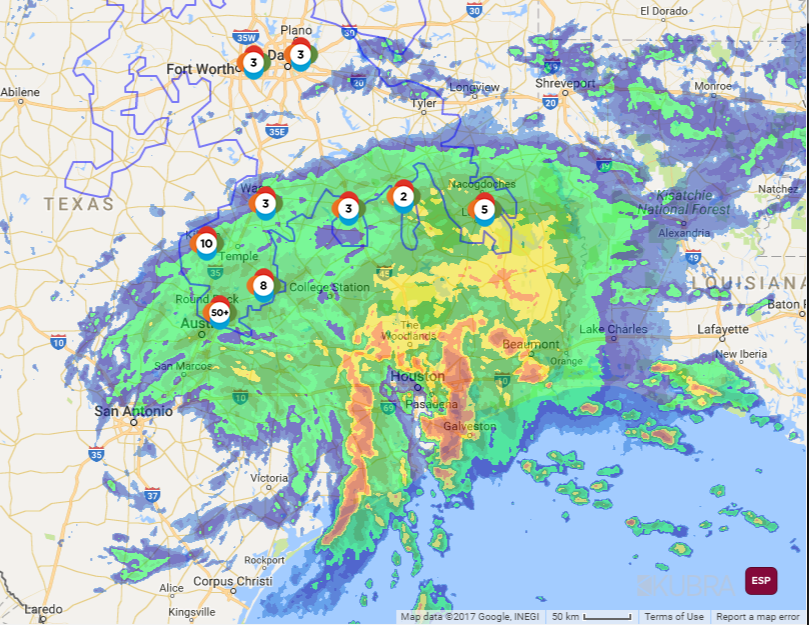
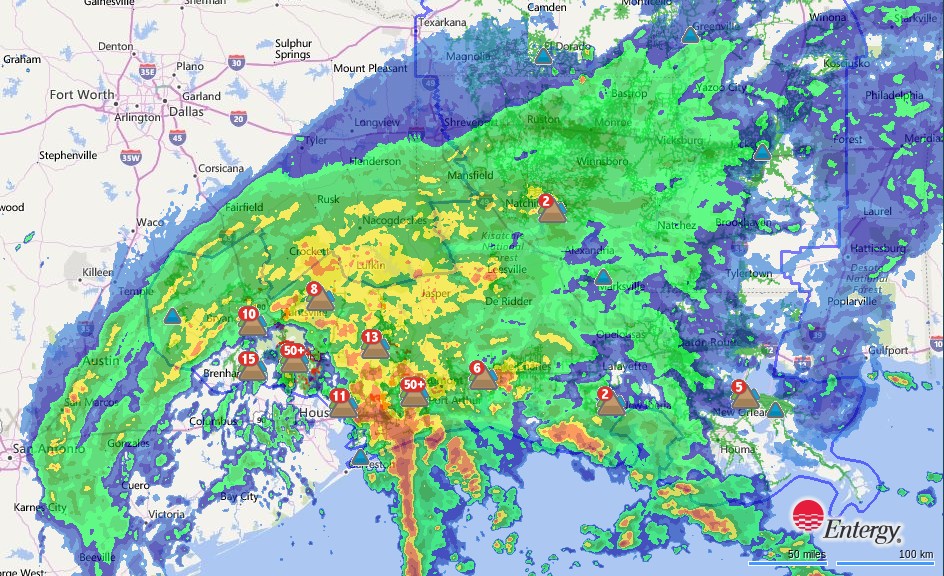
There are currently still over 300,000 power outages across Texas. This rainfall radar map shows that the Houston area is still enduring very high rates of precipitation:


[Edit – August 28th 09:30]

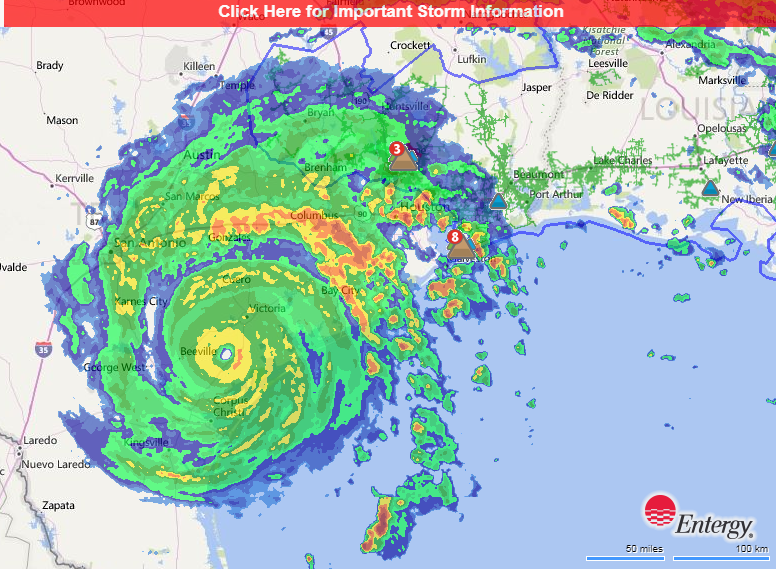
The number of reported outages has dropped overnight (UTC), but there are still over 250,000 “customers” without electric power in Texas, plus some more in Louisiana. Here’s the current Entergy Texas outage map as Harvey heads back towards the Gulf of Mexico:
The FCC reported yesterday that:

There are a total of 17 (up from 9 yesterday) PSAPs affected:

PSAP down with no re-route: Portland Police Department, TX.
PSAP up without Automatic Location Identification (ALI): Calhoun County Sheriff, TX.
PSAP re-routed without ALI: Aransas County SO, TX; Bee PD, TX; Beeville PD, TX; Kingsville PD, TX; Kleberg County SO, TX; Mathis PD, TX; Port Aransas PD, TX; Refugio County SO, TX; and Ingleside PD, TX.
PSAP re-routed with ALI: Aransas Pass PD, TX; Cameron Parish SO, LA; Richmond PD, TX; Robstown PD, TX; Victoria PD, TX; and Wilson County SO, TX.

There are 4.1% of the cell sites down in the affected area. The counties with greater than 50% of cell sites out are Aransas, Calhoun, Refugio, and San Patricio in TX. There are no cell sites affected in LA.


[Edit – August 28th 15:00]

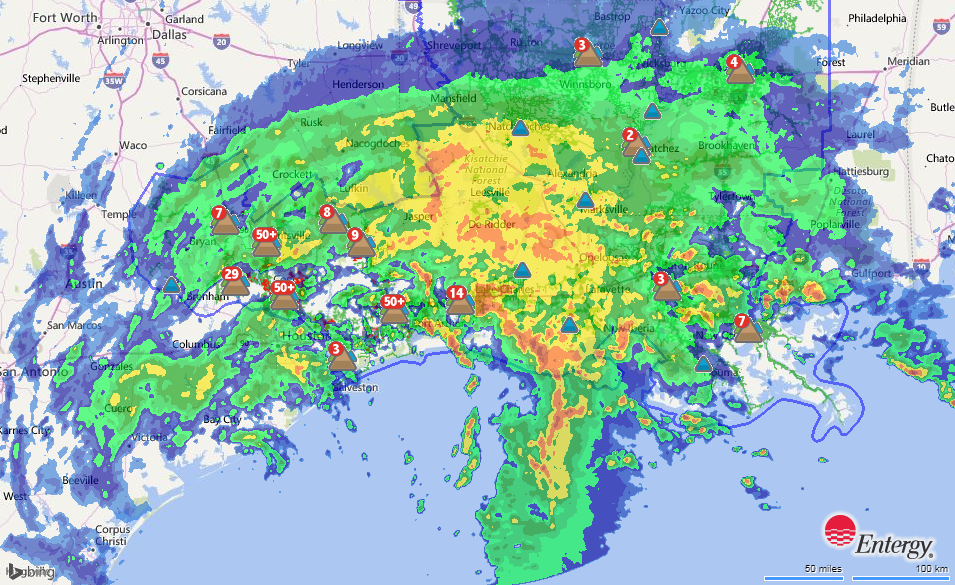
Reported outages are heading for 300,000 again whilst Texas wakes up to further flooding as Harvey heads back to the coast:
 

[Edit – August 29th 09:00]

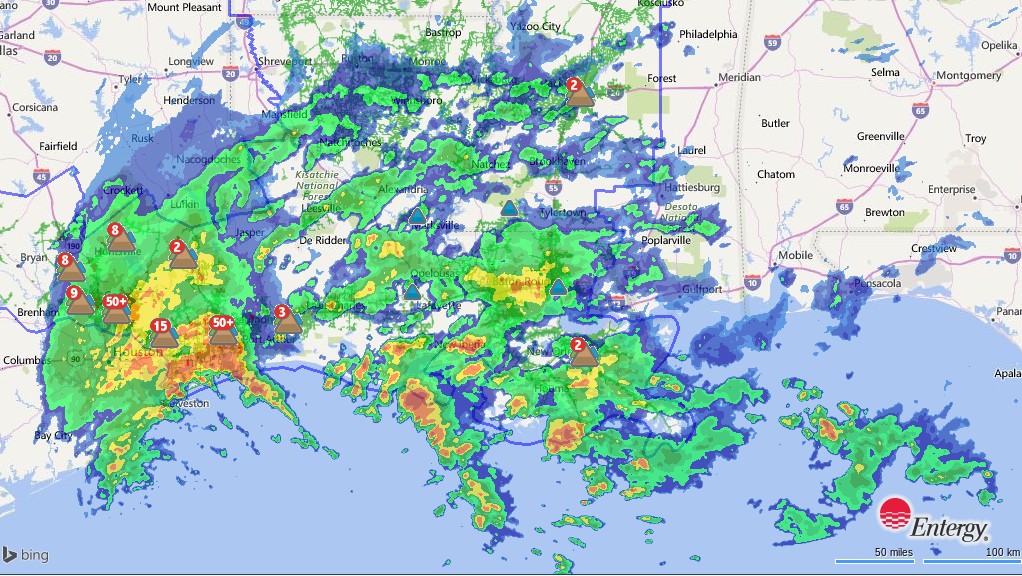
Reported outages have dropped somewhat overnight, as the centre of Tropical Storm Harvey is now over the Gulf of Mexico once again:
Yesterday evening local time ERCOT issued the following statement:

The ERCOT grid continues to be in stable condition following Hurricane Harvey. However, several transmission lines remain out of service, especially near Corpus Christi and Victoria where Hurricane Harvey made landfall.

Two major 345-kV transmission lines serving the Gulf Coast area are still out of service, along with many other high-voltage transmission lines. As of mid-day today, a little more than 6,700 MW of generation capacity, including a very small percentage of renewables, was off-line for reasons related to the storm.

Electricity demand in the days since landfall has been about 20,000 megawatts (MW) below typical August electricity use, peaking at less than 44,000 MW, due to a combination of structural damage along the coast and cooler temperatures in much of the region.

The FCC reported yesterday that:
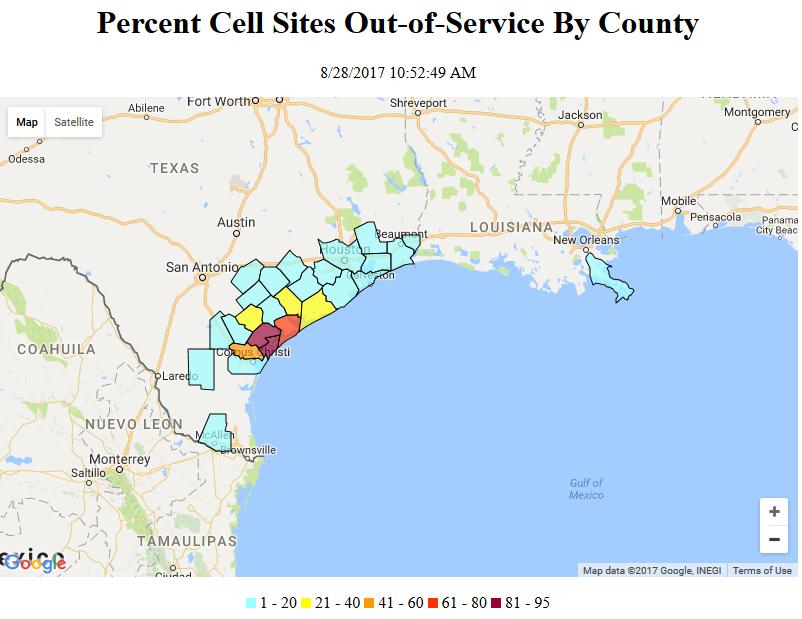
There are 4.7% of the cell sites down in the affected area, up from 4.1% yesterday. The counties with greater than 50% of cell sites out are Aransas, Calhoun, and Refugio in TX. Plaquemines is the only county in LA reporting any cell sites out.


[Edit – August 29th 12:00]

As a new day dawns in Texas reported outages are increasing once again. Over 270,000 in Texas plus ~5,000 so far in Lousiana:
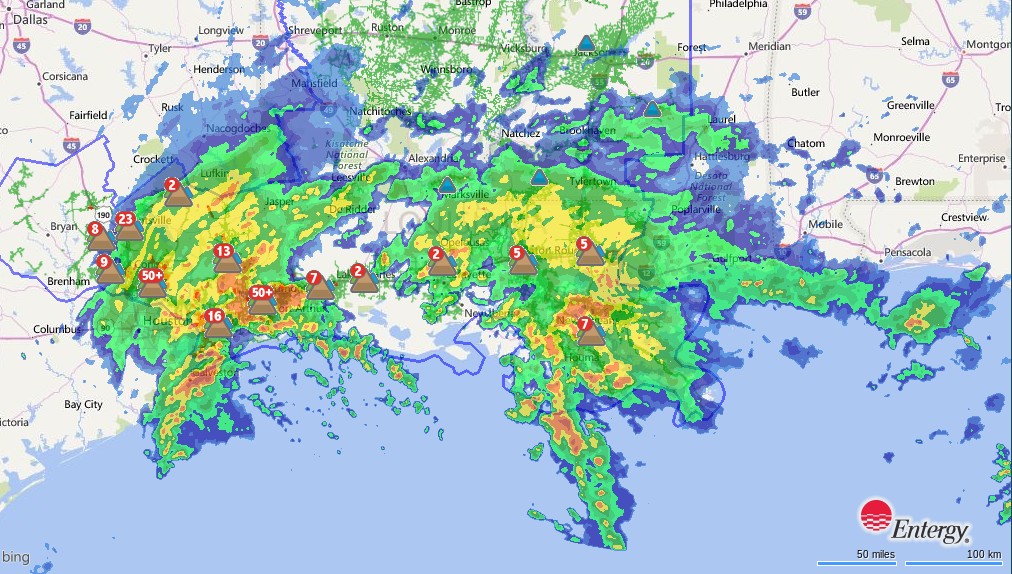
 

[Edit – August 30th 10:00]

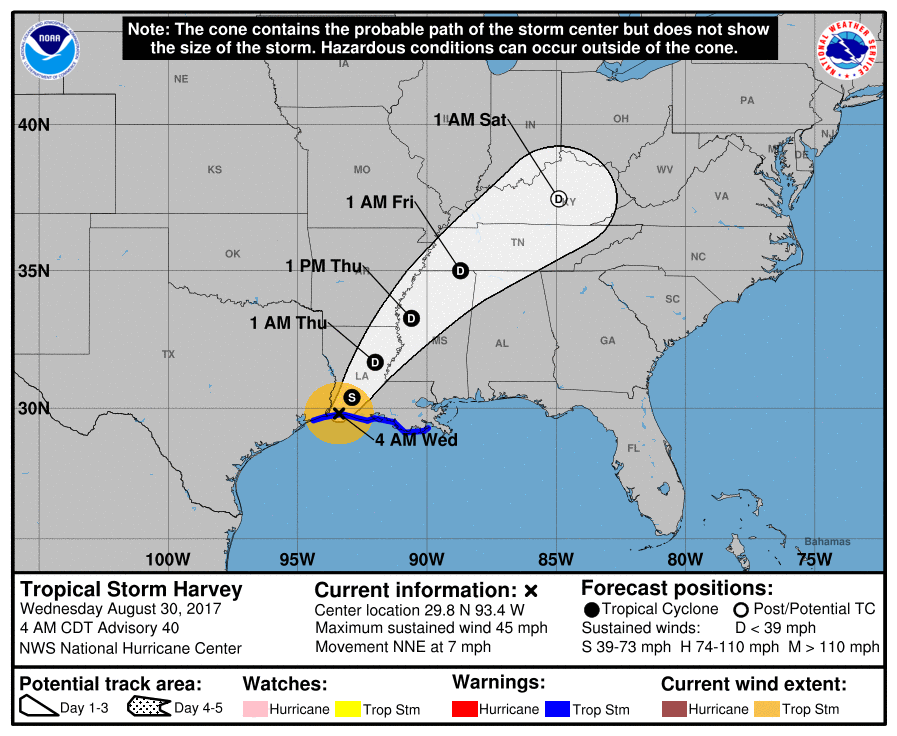
The latest forecast from the United States’ National Hurricane Center shows that at long last Harvey will move inland and dissipate:
Rainfall radar reveals that the rain has stopped falling over Houston:
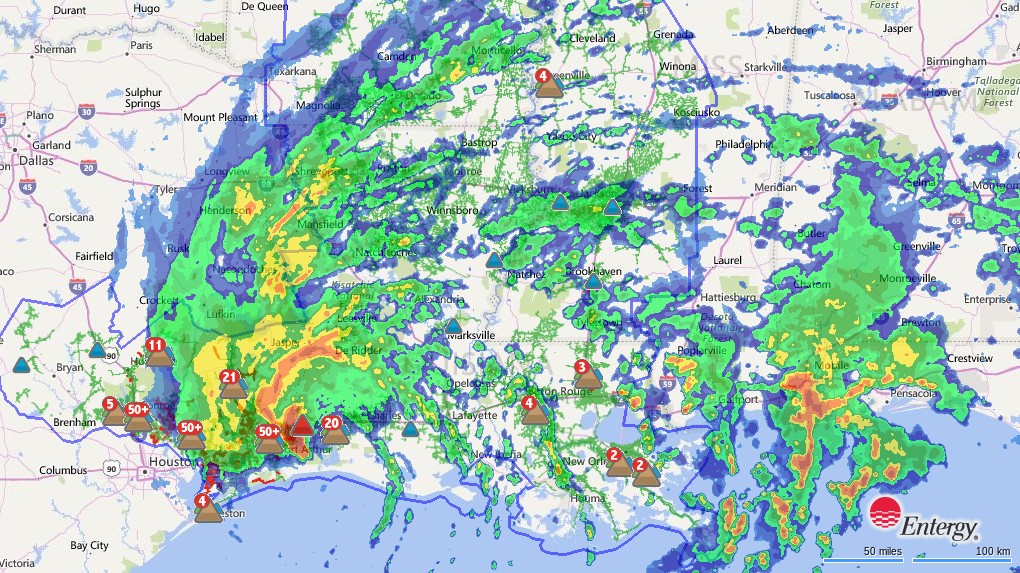
The power outages continue however. There’s still over a quarter of a million properties without power in Texas, with a few thousand more in both Louisiana and Mississippi. Whilst we wait to see when the number of outages starts to reduce significantly, here’s a rainfall radar animation of Harvey’s progress so far:

The FCC reported yesterday that:

There are 4.7% of the cell sites down in the affected area, the same as yesterday. The counties with greater than 50% of cell sites out are Aransas and Refugio in Texas. In Louisiana, Calcasieu, St. John the Baptist, and Terrebonne are the only parishes to report any cell site outages, with each having only one cell site out.


[Edit – August 30th 15:00]

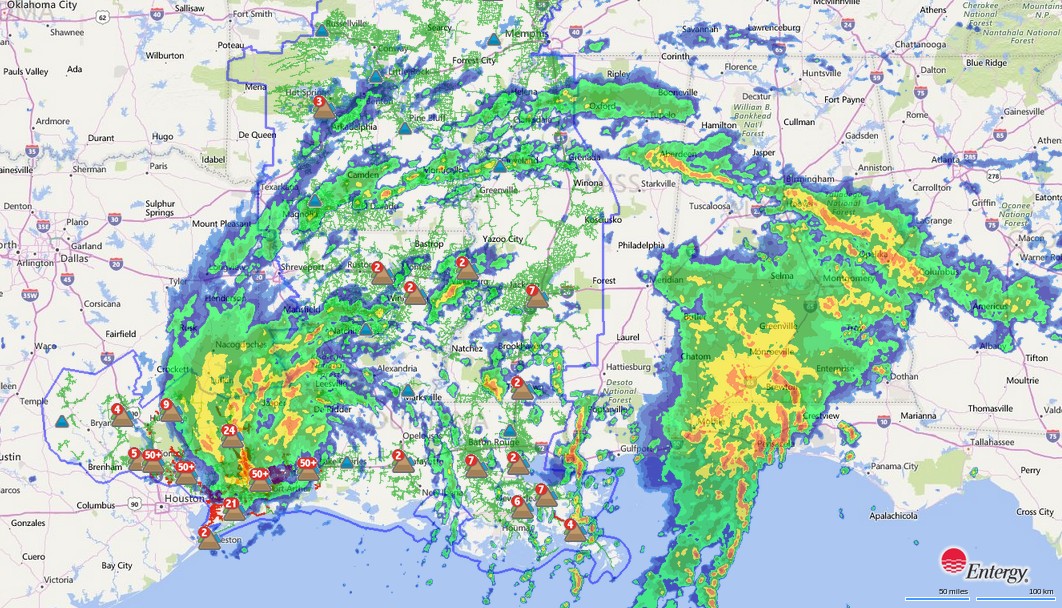
Power outages due to ex Hurricane Harvey are back up over 300,000:
Watch this space!

An Exeter Nissan e-NV200 Heads North

The United Kingdom Government have finally seen the light and have pledged to pump £20 million into vehicle-to-grid technology:

Up to £20 million is available from the Department for Business, Energy & Industrial Strategy – working with the Office for Low Emission Vehicles and Innovate UK – to fund projects that investigate new business models, consumer awareness and technologies that support interaction between electric vehicles and the grid.

So-called vehicle-to-grid technologies are expected to play a big part in making the UK’s electricity supply network smarter and in encouraging take-up.

Vehicles that can take electricity from the grid when demand is low and return it when demand is high could help to even out peaks and troughs and make the grid more efficient.

The UK government wants nearly all cars to be zero emission by 2050, and it sees a smarter and more flexible electricity system as a major benefit to consumers and a key to future growth.

This is of course very good news, apart from the time it has taken UK plc to get around to it! As a consequence of the announcement V2G UK booked ourselves in to give a two minute “elevator pitch” at a Knowledge Transfer Network V2G briefing event at the Energy Systems Catapult offices in Birmingham.

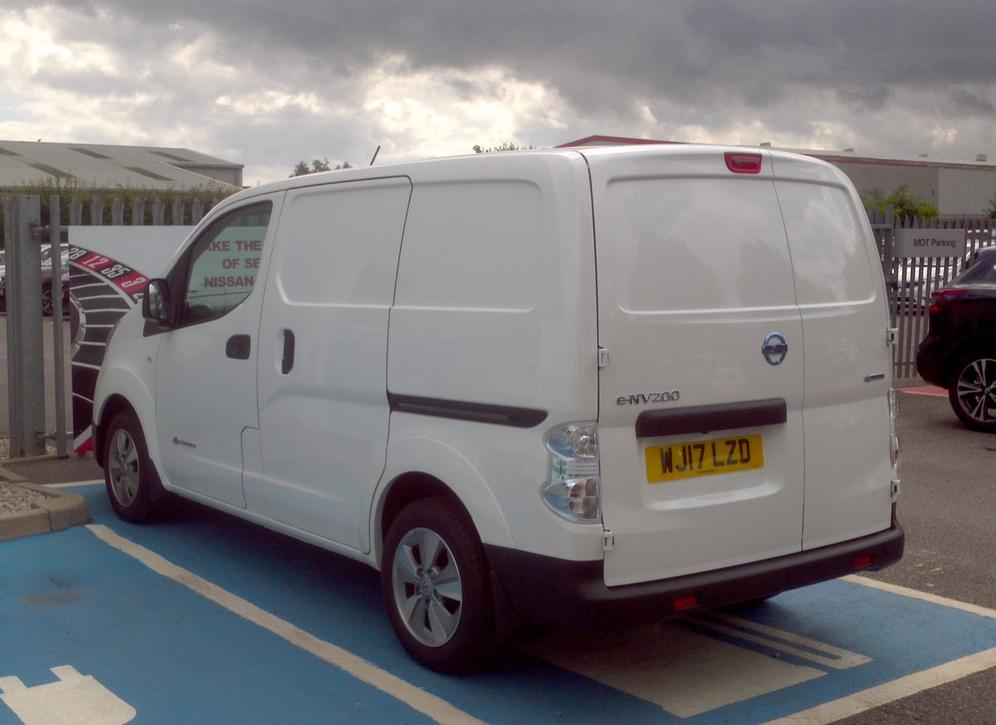
We decided we should travel in style, and Exeter Nissan kindly offered us an extended test drive in an almost brand new Nissan e-NV200 van! That’s much better for our purposes than a black stretch limo, which we will hopefully prove to you in due course. Here’s a photo of the Exeter Nissan team for posterity:

Exeter Nissan - Arguably the most enthusiastic and experienced Nissan team in the UK!

Arguably the most enthusiastic and experienced Nissan team in the UK!

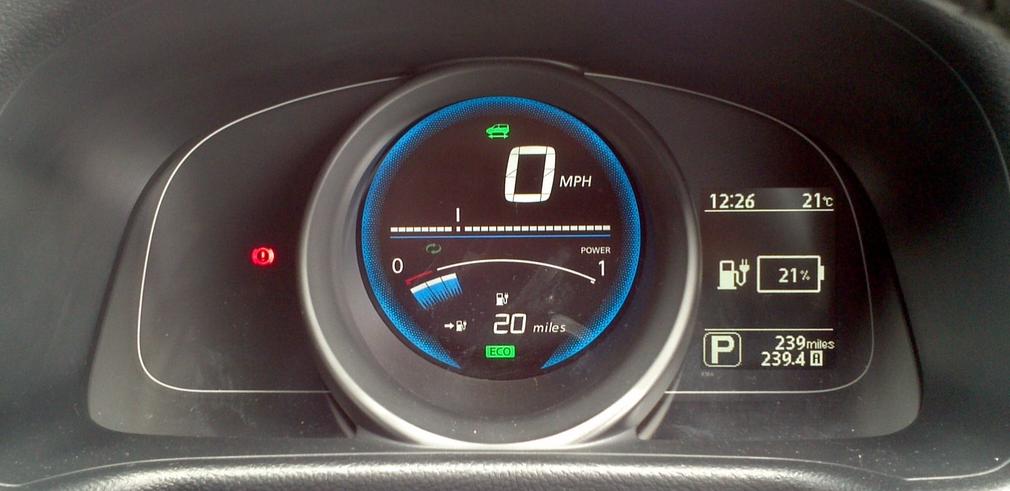
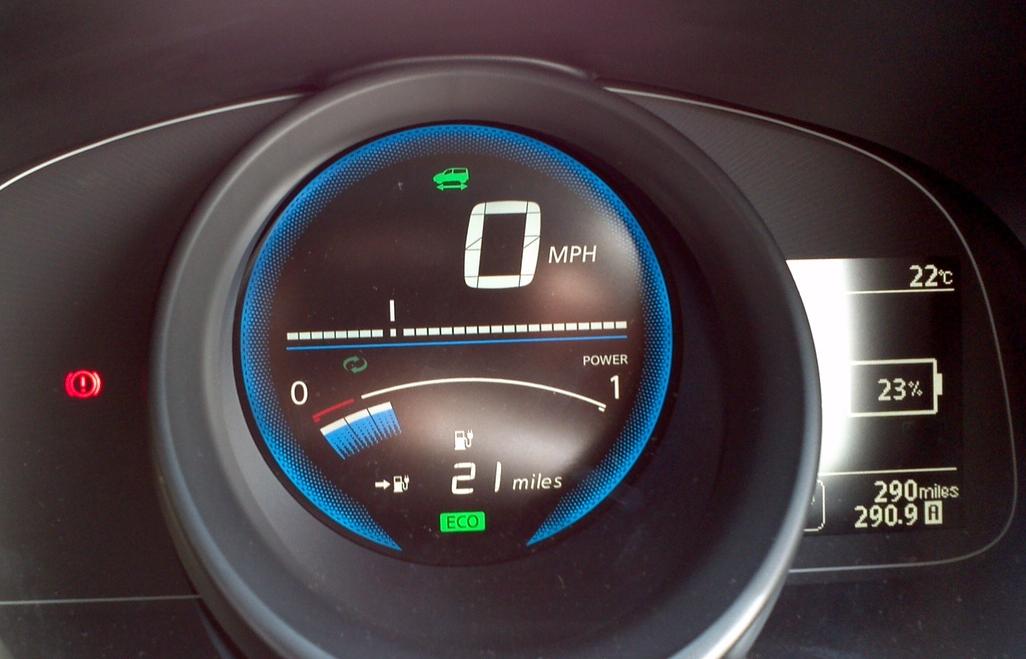
We picked up the e-NV200 from them almost fully charged, and here’s how it looked at the time:

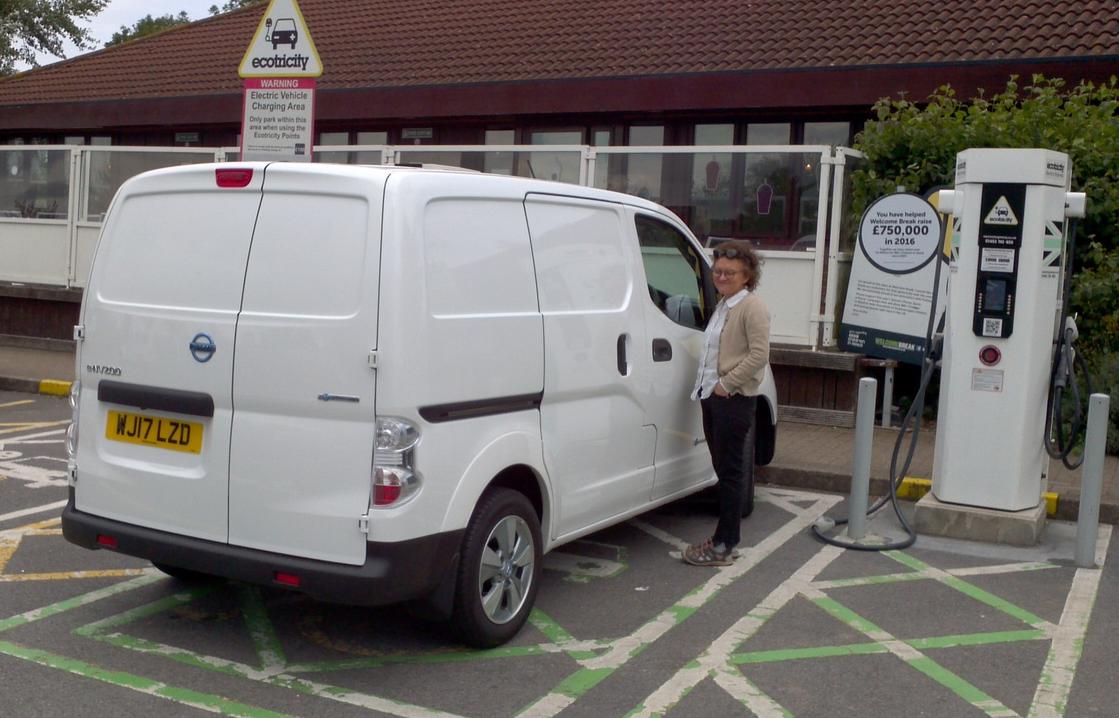
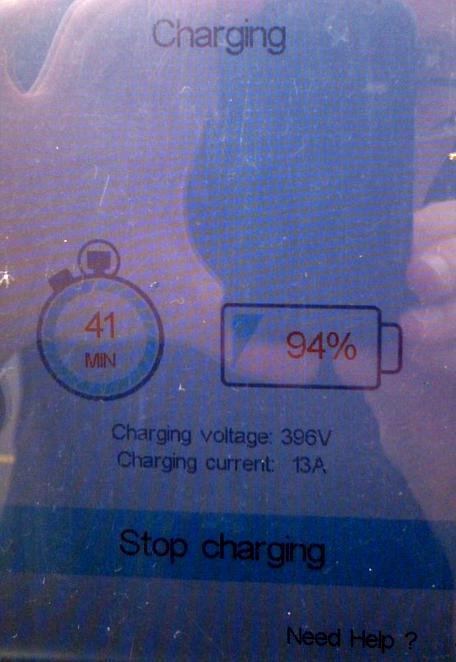
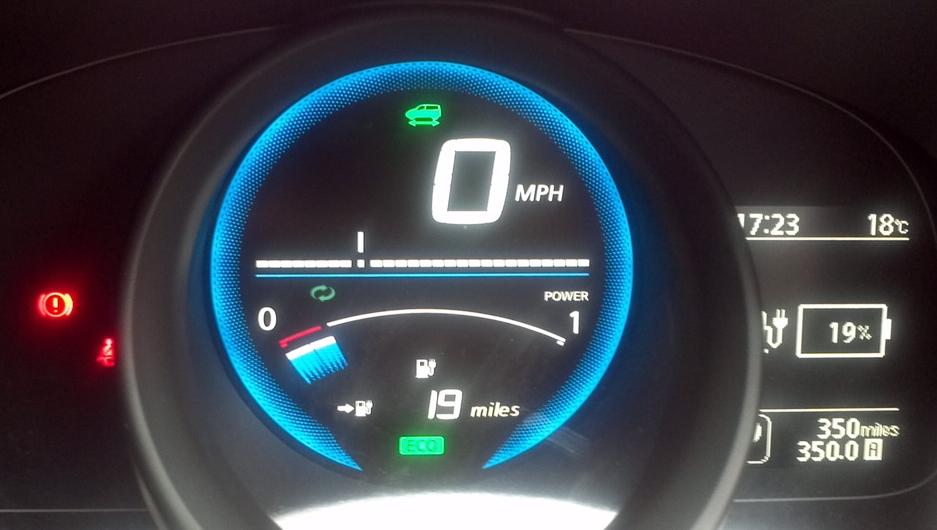
The weather wasn’t too bad, so we jumped straight in and drove the 56 and a bit miles up the M5 to Sedgemoor Services in “Eco” mode at a steady 60 mph or thereabouts. Now zooming up the motorway carrying an overnight bag and a couple of suits in the back isn’t a typical days work for a van, but with that proviso in mind here are some of the sights we saw on arrival at Sedgemoor:

The e-NV200 dashboard will be familiar to LEAF drivers, although there are some other differences. The “gear stick” is mounted below the dashboard, and the foot operated parking brake has morphed back into a conventional handbrake. In our case the 56 miles we’d travelled plus 20 left in “the tank” equates to a range of 76 miles by my reckoning, which is roughly what we achieved during the entire journey.

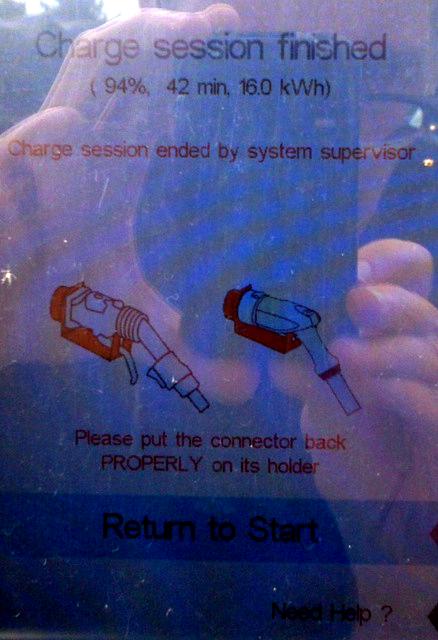
We’d used the old Ecotricity free “smart card” system on previous test drives, but this time we had to pay through the nose using their new smartphone app. That refused to install on my ancient Motorola Atrix, but we eventually got things working on Kasia’s more modern Sony Xperia. After a lengthy lunch break we returned to see this:

Stopping charging proved to be a non trivial procedure. Pressing the button on the charging station prompted Kasia to tap a button on her phone. That seemed to do the trick on the physical equipment but the virtual app insisted that charging hadn’t stopped yet.

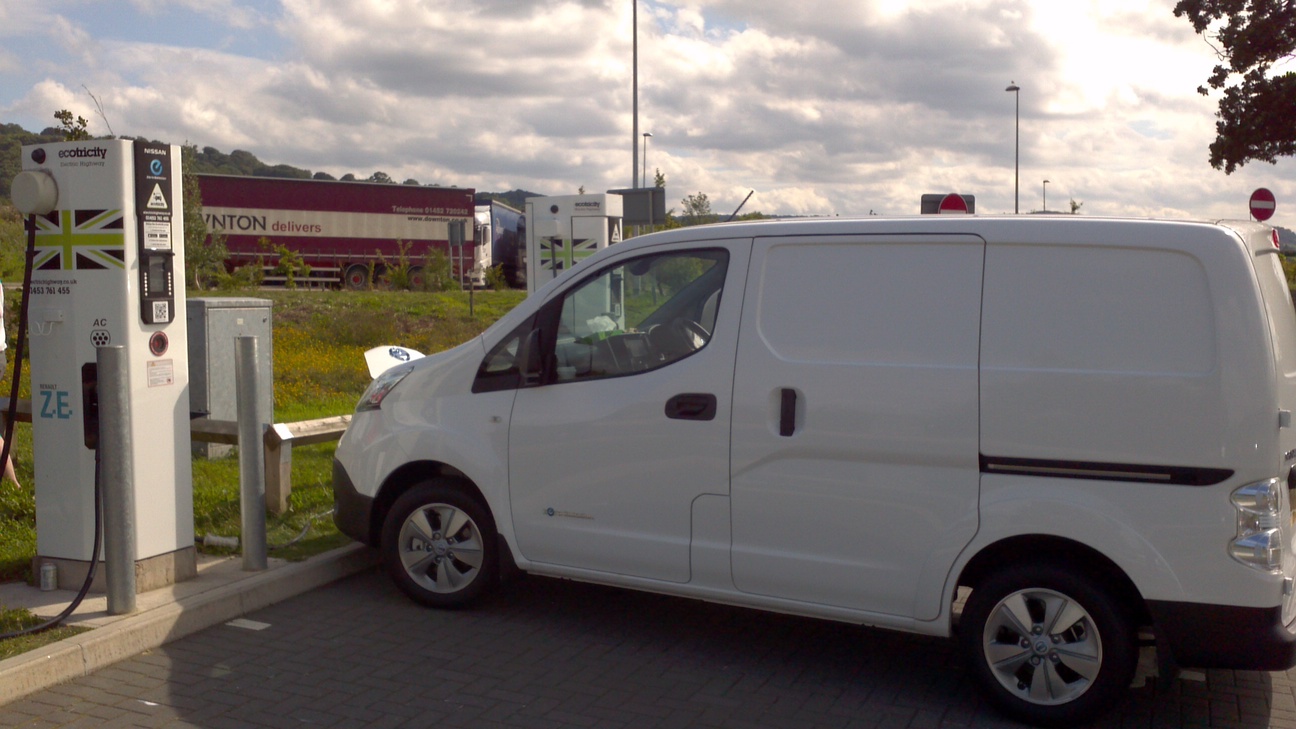
We eventually pressed on regardless to the shiny new Gloucester Services:

51.7 miles according to Google maps. 51 miles according to the e-NV200:

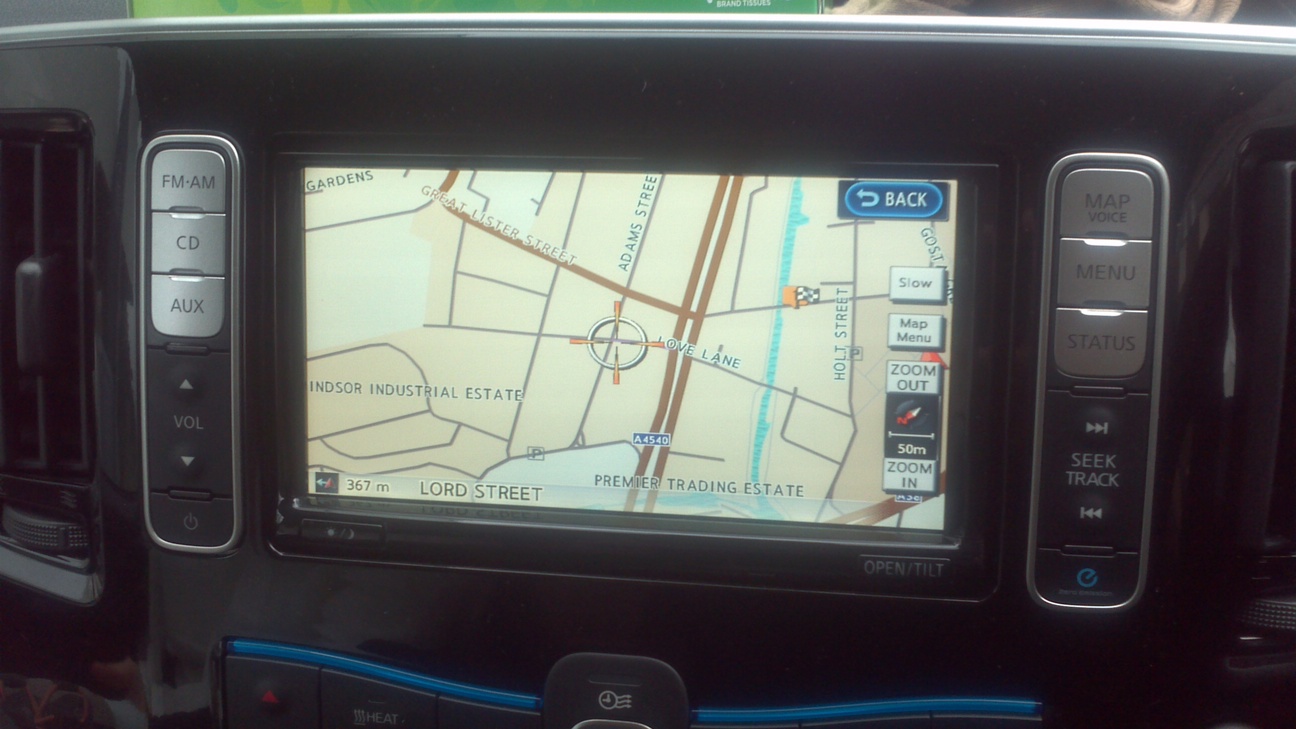
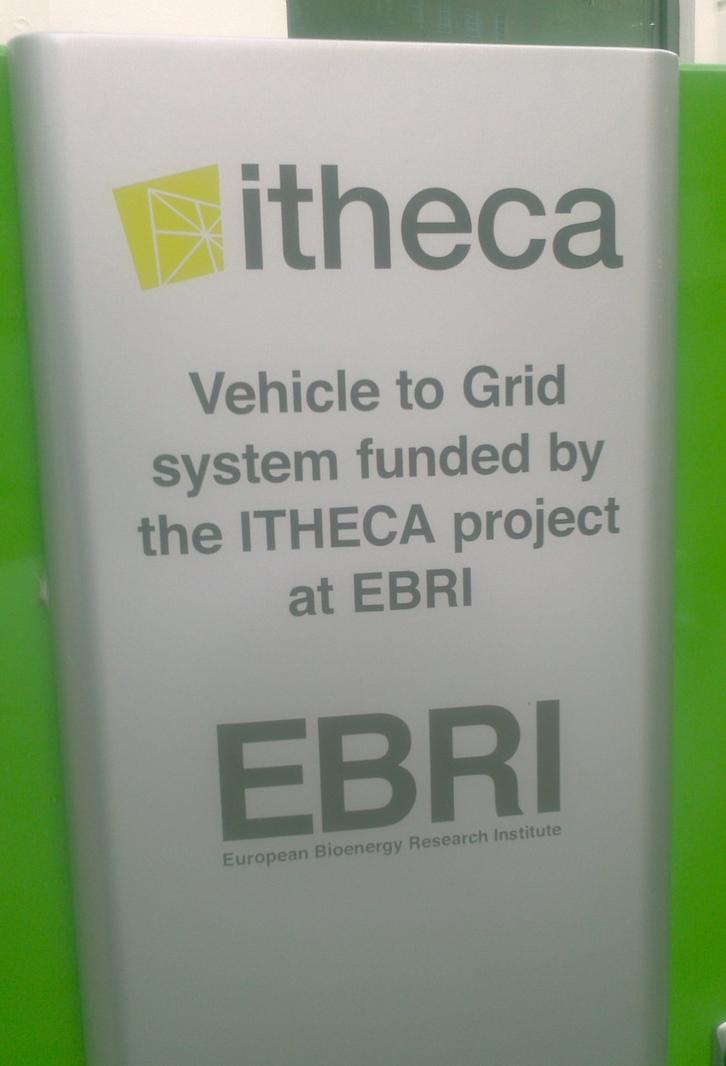
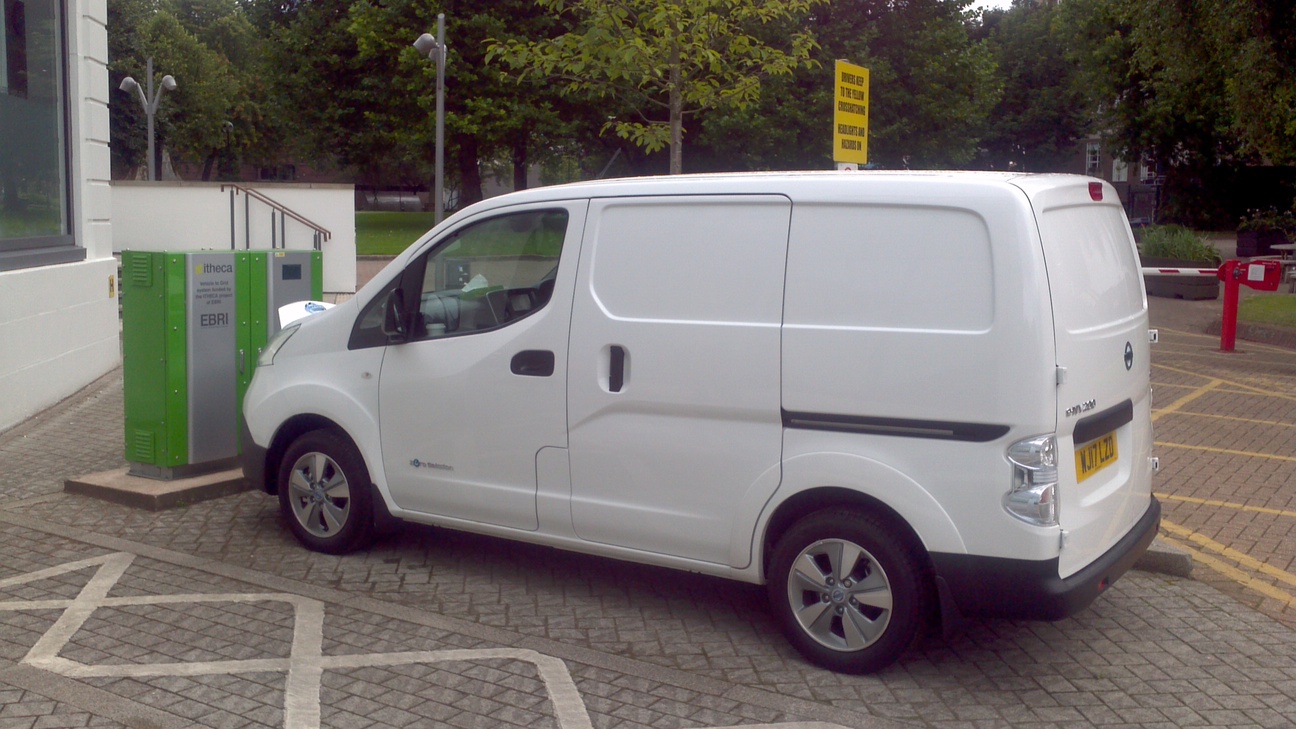
Kasia’s Ecotricity app was still insisting the charging session at Sedgemoor hadn’t finished yet! Power cycling her phone enabled us to get a new session started. After a slightly swifter coffee break this time we set off on the last leg to Birmingham with a 95% charge. That was when our troubles really began. The Nissan satellite navigation system kept insisting “you may be unable to reach your destination” even though there was apparently plenty of juice in the battery. It seems the M5 north of junction 5 was jammed solid. The sat nav eventually suggested an alternative route taking the A38 around Bromsgrove and then the M42 before heading towards Aston University in the centre of Birmingham. After several apologetic phone calls we eventually arrived at the European Bioenergy Research Institute well behind schedule:

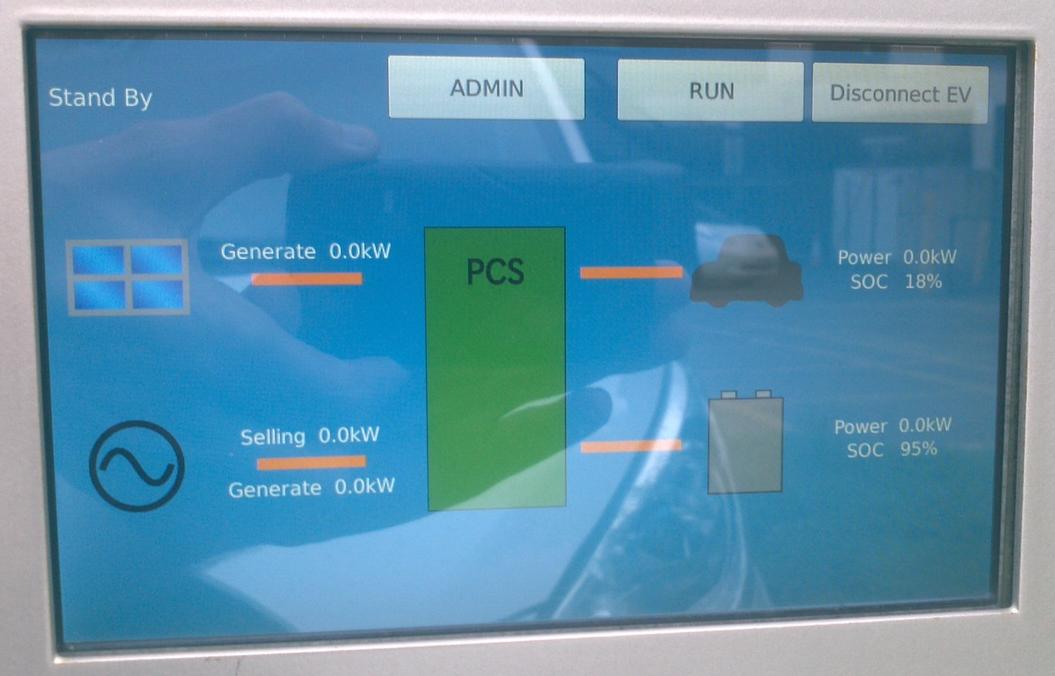
Thankfully in all the circumstances our e-NV200 started charging without problems on the ITHECA project‘s bright green bi-directional charger!

To be continued….

The New 2018 Nissan LEAF

The rumours have been flying around for months, but Nissan have just issued another “teasing” press release about the next generation LEAF. It makes no mention of new battery technology or increased range, but it does say this:

Packed with our most advanced technologies, the redesigned next-generation LEAF will amaze your senses and raise the bar for the electric vehicle market.

Being 100% electric and zero emissions, the new Nissan LEAF, an icon of Nissan Intelligent Mobility, offers a quiet and refreshing experience while driving. With Nissan Intelligent Mobility technologies, you are more confident with enhanced vision and can better sense what is around the car. Premium interiors designed to suit your taste offer a touch more comfort.

Nissan established itself as a pioneer in the EV movement by launching the LEAF, the world’s first mass-market electric vehicle.

The world premiere for the new Nissan LEAF will take place on September 6, 2017 in Japan and we will be bringing the unveil to you live online.

It also includes this image:

and comes complete with this video:

Nissan’s previous 2018 LEAF press release suggested improved aerodynamics would lead to increased range even in the absence of a novel battery pack:

The new Nissan LEAF will feature an improved aerodynamic design that makes it even more efficient, allowing drivers to travel farther on a single charge.

Aerodynamics is key to how efficiently an electric car moves. Less drag and better stability enable the vehicle to drive longer distances before having to recharge.

The redesigned next-generation Nissan LEAF is lower to the ground, helping it realize zero lift for better stability at high speeds. Other new design features significantly stabilize the car when hit by strong crosswinds.

Inspired by airplane wings, Nissan engineers recreated the ideal shape for the new LEAF, enabling a symmetric air flow that helps it slice through the air for a smoother, more efficient journey.

It also included this image:

There was also another associated video!

Before that there was the “e-Pedal” teaser:

Nissan announced today that the widely anticipated new Nissan LEAF will come with e-Pedal, a revolutionary technology that transforms the way we drive.

With the flip of a switch, the technology turns your accelerator into an e-Pedal, allowing drivers to accelerate, decelerate and stop using just the e-Pedal. e-Pedal technology is the world’s first one-pedal operation that allows drivers to bring the car to a complete stop even on hills, stay in position, and resume driving instantly.

Drivers can cover 90% of their driving needs with the e-Pedal, making the process of driving more exciting. In heavy traffic and during city commutes, drivers will greatly reduce the need to shift from one pedal to the other, making your drive simpler and more engaging.

The e-Pedal technology represents another key milestone in Nissan’s ongoing commitment to bring accessible, advanced driver assistance technologies to the mainstream. Set to make driving safer and more enjoyable, the development of these technologies is part of Nissan Intelligent Mobility, the company’s blueprint for transforming how cars are driven, powered and integrated into society.

Here’s the e-Pedal video:

Please note the extremely important footnote:

Use conventional brake pedal for aggressive braking situations.

Before you leave please make sure to also take a look at our previous article that includes video of the next generation LEAF’s autonomous driving capabilities.

Watch this space!

Energy Storage Growth Scenarios and Operating Modes

Western Power Distribution and Regen SW have just released a report on the results of their consultation concerning “Energy Storage Growth Scenarios and Operating Modes“. The entire report is worth a read from cover to cover, but here are a couple of extracts that immediately caught our eye here at V2G UK:

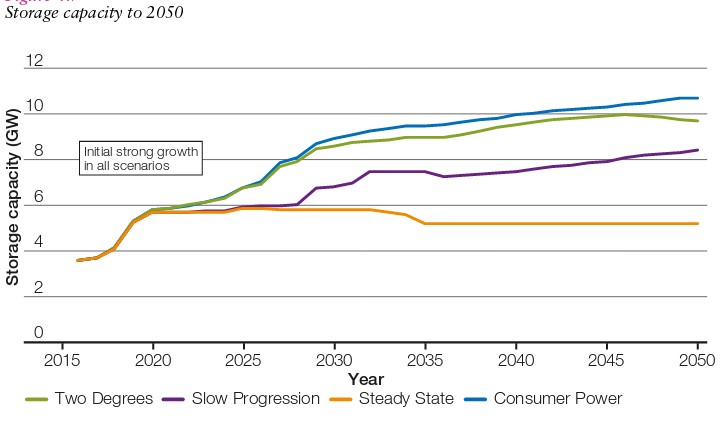
On 13th July 2017, National Grid published the latest version of their Future Energy Scenarios (FES) strategic document. This document considers and discusses the role of energy storage in the future in 4 key energy scenarios. In these scenarios, storage is referenced as a provider of flexibility, both for response and co-location with intermittent generation (both solar and wind) and highlights the expectation that energy storage will be a significant part of the ongoing energy transition towards a smarter and more distributed electricity system. National Grid forecast strong growth in energy storage (in all scenarios) over the next few years, such that a total of 6 GW is forecast to be connected to the UK electricity system by 2020. Beyond this,National Grid expectation for energy storage growth varies significantly across the scenarios proposed, with the highest two scenarios showing storage grow to 10 GW by 2050 (Consumer Power-10.7 GW and Two Degrees – 9.8 GW). The considerably lower level of storage growth (under the Steady Statescenario) shows 5.2 GW by 2050, due to low levels of available funding, coupled with a reduction in capacity from 2030 onwards, as a result of existing assets not being replaced when they reach end of life.

There is also this V2G specific section:

A number of market analyst’s reports have projected energy storage growth scenarios, these include National Grid Future Energy Scenarios (see Fig.4), Committee on Climate Change, Carbon Trust and UK Government.As a starting point for WPD’s modelling, we are proposing to take a:

•High growth scenario of 10-12 GW and 24-44 GWh of energy storage capacity installed across GB by 2030.
•Lower growth scenario of 4-5 GW and 6-15 GWh across GB by 2030.

Note: these figures include 2.7GW of existing pumped hydro storage.

The introduction of significant number of electric vehicles under “Vehicle-to-Grid” (V2G) arrangements could be one factor that results in storage deployments levels increasing above the values we proposed. However, other comments received also identified regulatory barriers as a key factor that could perhaps limit deployment to levels potentially even beneath the lower growth scenario proposed. The wide margin between the high and low growth scenarios presented was recognised as an accurate reflection of market uncertainty.

We couldn’t agree more. There is currently much “market uncertainty” concerning energy storage in general and V2G technology in particular. Removing the “regulatory barriers” to progress would be most welcome down here in North Cornwall!