Will There Be Blackouts in the UK This Winter?

According to an “exclusive” report in The Guardian:

Ministers are discussing launching a public information campaign to encourage households to reduce their energy use this winter as fears grow over winter blackouts.

Households could be asked to turn their thermostats down and use their dishwashers and washing machines during the night and at times when energy demand is lower, under plans being discussed between the business department, energy companies and the network operator National Grid.

No names are mentioned of course, but allegedly:

Sources close to the discussions said that government officials and industry executives were determined to avoid blackouts disrupting the supply of energy to Britons’ homes. A public information campaign could help ease pressure on energy supplies during the winter.
Ministers have so far resisted calls to tell consumers to cut their energy use, saying consumption of gas and electricity was a “decision for individuals”.

The article mentions the recent trial in Scotland run by Octopus Energy and SP Energy Networks, in which a financial incentive was offered to domestic consumers to shift the timing of their electricity demand.

Over 2,500 Octopus Energy customers across Dumfries and Galloway participated in the six-week trial*. Directed to power up their usage when green energy supply was highest, households used 20MWh more energy across the six two-hour trial windows.
Households who increased their usage by more than 10% were credited back all the energy they had used during the two-hour timeframe. Those who used more than 100% extra were credited double the amount they had used. Participating customers were rewarded with an average of £5 of free energy, with some saving up to £73.

According to The Guardian once again:

National Grid will lay out its outlook for winter energy supplies on Thursday, giving the first comprehensive assessment of the risk of blackouts this winter.

The eagerly awaited document should show how resilient Britain’s energy supplies are over the coming months. An early view, published in August, showed the UK should be able to meet its energy demand in the coming months. However, since then Norway has indicated it may prioritise supplying its domestic market over exporting power.

Here’s how things stacked up for the National Grid in August:
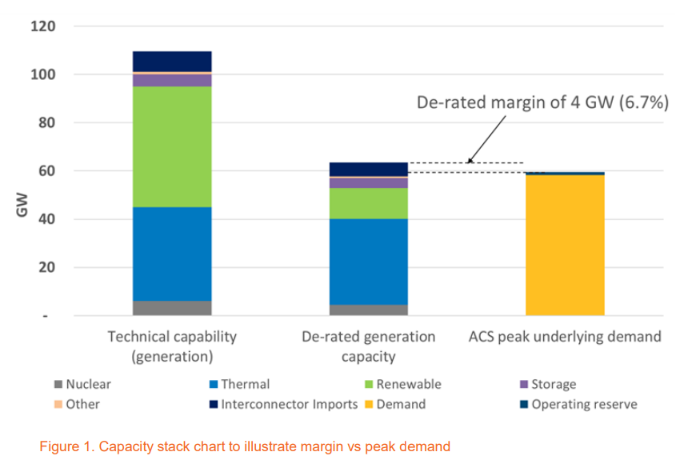
We eagerly await any changes revealed in tomorrow’s report!

[Edit – October 6th]

The National Grid Electricity System Operator has now published its “Winter Outlook Report” for 2022/23. Here is the executive summary in full:

Our first illustrative scenario examines what would happen if there were no electricity imports from continental Europe . In this scenario we would deploy our mitigation strategies – dispatching the retained coal units and our Demand Flexibility Service. By securing 4GW through these actions, we would maintain adequate margins and mitigate impacts on customers.

Our Demand Flexibility Service is new and innovative, and we have worked with suppliers, aggregators, industry, Ofgem and BEIS on the design to ensure it is ready for the winter and capable of delivering the required level of participation and response (2 GW+). It will launch on 1 November, and we are encouraging suppliers and aggregators to work with their customers to ensure the highest levels of engagement and participation. We see particular potential from commercial organisations who can shift their load from peak hours and have had positive feedback from British companies on this.

Without the Demand Flexibility Service, we would expect to see a reduction in margins. In this scenario on days when it was cold (therefore likely high demand), with low levels of wind (reduced available generation), there is the potential to need to interrupt supply to some customers for limited periods of time in a managed and controlled manner. However, we expect the mitigations outlined above to be effective.

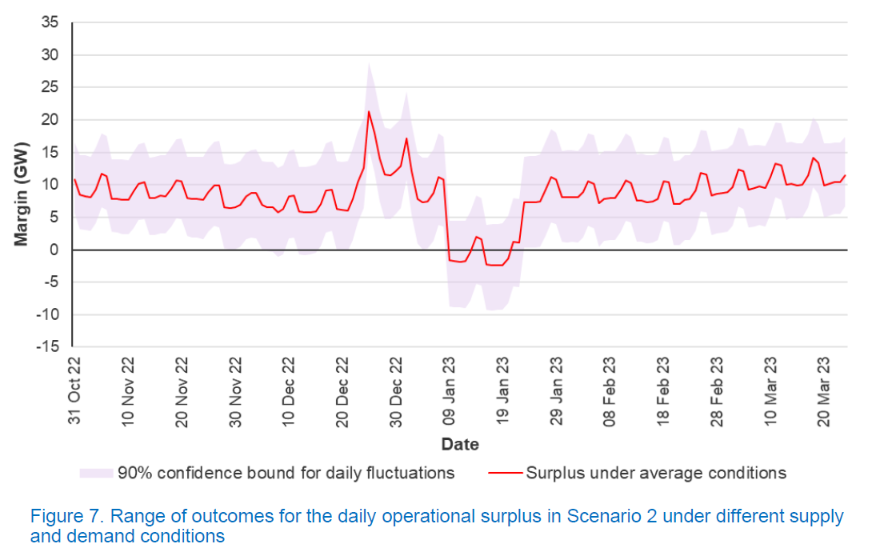
A second, more extreme scenario, looks at a hypothetical escalation of the energy crisis in Europe such that there is insufficient gas supply available in Great Britain (in addition to no electricity available to import from continental Europe as per above scenario). In the unlikely event that escalation of the situation in Europe means that insufficient gas supply were to be available in Great Britain this would further erode electricity supply margins6 potentially leading to interruptions to customers for periods. All possible mitigating strategies, including our new measures, would be deployed to minimise the disruption.

Overall, this is likely to be a challenging winter for energy supply throughout Europe. We have taken extensive measures to try to mitigate the impacts for British consumers and expect that, under our base case, margins will be adequate. Nevertheless, there remain scenarios, driven principally by factors outside of Great Britain which could impact upon British electricity supplies. Plans are in place to ensure the impact is minimised and the overall security and integrity of Britain’s energy systems are protected.

Here too is the updated version of the “base case” supply margin chart shown above:

The chart is accompanied by these two provisos, amongst others:

Our base case assumes electricity imports from Europe are available at times when we need them to meet demand, delivering in line with their Capacity Market agreements, and that there is no disruption to gas supplies.

Our base case does not assume any material reduction of consumer demand due to high energy prices. It does not include any of our mitigation measures such as coal contracts or the Demand Flexibility Service as we would not expect to deploy them here.

The winter outlook also considers “Scenario 1” in which there are “reduced electricity imports from Europe”:
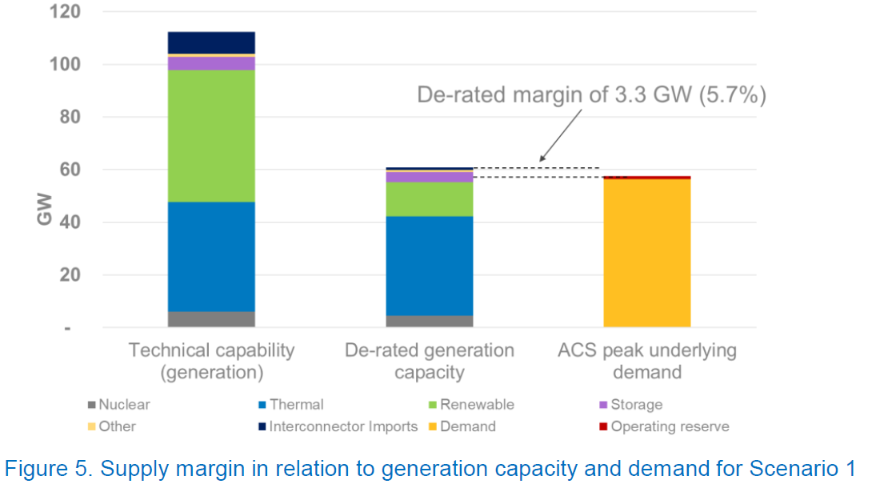
The bar chart is accompanied by a graph of “operational surplus”:
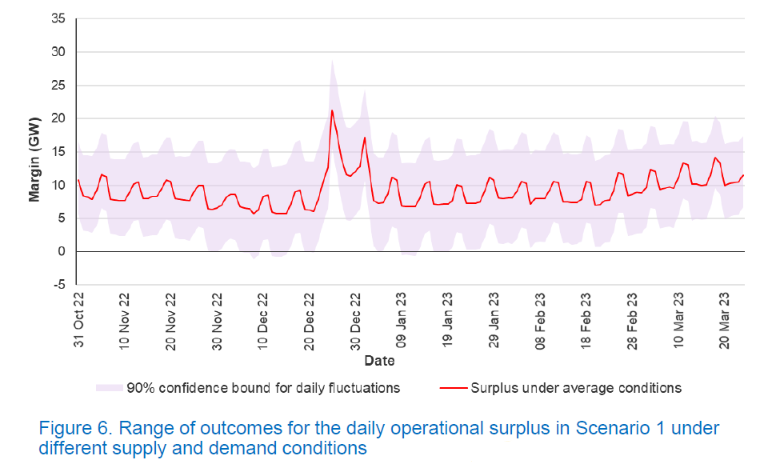
That shows National Grid’s “90% confidence” that the surplus will not turn negative over the winter. However now let’s take a look at “Scenario 2” in which there is in addition “insufficient gas supply in Great Britain”:
Note that according to Ofgem a few days ago:

Due to the war in Ukraine and gas shortages in Europe, there is a significant risk that gas shortages could occur during the winter 2022/23 in Great Britain. As a result, there is a possibility that GB could enter into a Gas Supply Emergency.

Perhaps it would be prudent at this juncture for us all to cross our fingers and hope that the gas keeps arriving at Great British shores over the coming months, whether via pipeline or LNG tankers?

[Edit – October 7th]

The Energy Networks Association has published an article entitled “How planned emergency power cuts would work if they are needed this winter“. They state, in part, that:

Though no power cuts are currently planned, in their winter outlook National Grid ESO raised the possibility of the need for planned national power cuts, in order to manage the possibility of energy demand outstripping the supply available.

Firstly, it’s important to know that before any emergency planned power cut instruction is given, National Grid ESO takes several steps to protect customers. These include:

* Encouraging additional generation through the supply market.
* Asking heavy industrial users to limit their demand during peak periods.
* Reducing domestic power demand – this could include paying customers to change how and when they use appliances like washing machines and dishwashers or reducing voltage across the country by a small percentage, which would be undetectable.

Procedures for emergency planned power cuts like this have existed for decades and are simulated in emergency exercises by the energy sector each year ahead of the winter.

If needed, the emergency procedures are designed to minimise the impact on customers as far as possible, by limiting power cuts to shorter periods in order to manage overall electricity demand. However, while the winter is expected to be challenging, there is no guarantee emergency measures will be necessary.

If an emergency power cut is implemented, customers in certain parts of the country would typically be without power for around three hours per day during the emergency.

Distribution network operators, which run the local power networks, would be legally instructed by National Grid ESO, which controls the flow of energy around the country, to disconnect power supplies using established procedures. These procedures are set out by the government in a document known as the Electricity Supply Emergency Code, sometimes referred to as ESEC. The procedures ensure that power is shared fairly across all customers during a national energy emergency…

If emergency power cuts are needed customers will be able to find their rota and what it means for them at powercut105.com by entering their postcode. The rota will only be published once emergency power cuts have been approved to take place.

[Edit – October 17th]

In an article in today’s Financial Times, energy correspondent Nathalie Thomas writes that:

National Grid’s chief executive has warned British households to prepare for blackouts between 4pm and 7pm on “really, really cold” weekdays in January and February in the event of reduced gas imports from Europe.

John Pettigrew said the company would have to impose rolling power cuts on “those deepest darkest evenings in January and February” if generators failed to secure enough gas from the continent to meet demand, particularly if the country suffers a cold snap.

Pettigrew’s comments at the Financial Times’s Energy Transition Summit came after National Grid, which oversees Britain’s electricity and gas systems, this month took the unusual step of setting out various “unlikely” scenarios in which Britain might not have sufficient energy supplies this winter.

[Edit – November 4th]

National Grid ESO’s Director of Corporate Affairs, Jake Rigg explained their
Demand Flexibility Service on BBC Breakfast this morning. · According to a BBC article:

Households will be offered discounts on their electricity bills if they cut peak-time use on a handful of days over the winter, as part of National Grid’s efforts to avoid blackouts.

The network operator has announced details of the scheme, which it said could save households up to £100.

There will be 12 “test” days initially, designed to see how customers respond, between November and March.

But only homes with smart meters will be able to take part.

Only 14 million, less than half, of households in England, Scotland and Wales, where the scheme is being tested, have a smart electricity meter installed.

Customers taking part will be given 24 hours’ notice of a “test” day where they will be asked to reduce their peak-time electricity use if they can during a one-hour period identified by National Grid, likely to be between 16:00 and 19:00.

That could include delaying use of a tumble-dryer or washing machine, or cooking dinner in the microwave rather than the oven.

National Grid said it will pay energy suppliers, which will be required to sign up to the scheme to operate it for customers, £3 for every kilowatt-hour during the test periods.

Individual suppliers will decide how much customers will receive and whether the money is taken off bills, credited to accounts, or if there’s an option to withdraw the cash…

Watch this space!
Weather Forecasts to Expand National Grid Capacity?

In a press release yesterday National Grid Group PLC announced that:

National Grid Electricity Transmission (NGET) has partnered with the Met Office on an innovative weather data project to help expand capacity on the electricity transmission network for wind and solar power.

The partnership is aiming to explore the value that can be derived from utilising higher specification weather forecasts to boost capacity on the electricity overhead transmission power lines, allowing more renewable energy to flow.

Currently, the electricity transmission system is limited by the individual power rating or capacity of the circuits connecting everyone across the country and, with the growth in renewable electricity generation, power flows across the existing grid infrastructure are changing, particularly at peak periods.

Historically, standard assumptions made for weather conditions have been conservative, therefore assets have operated at ratings lower than the actual capacity. To expand capacity, the £545k project, funded through the Ofgem’s Network Innovation Allowance mechanism, looks to utilise significant advances in weather forecasting by assessing the feasibility of integrating a cloud-based weather forecasting service into NGETs present Dynamic line rating (DLR) calculation methodology.

Assessing the DLR and varying the capacity of an overhead transmission power line dynamically, depends on the conductor’s physical properties as well as environmental factors such as wind speed, wind direction, ambient temperature, solar radiation etc.  If the environmental conditions are favourable enough to cool the conductors sufficiently, more power can be pushed through the lines, relieving some of the network constraints – helping to meet the country’s energy needs.

Given that the United Kingdom’s energy needs are currently being met at great expense, let us all hope that every little helps.

Tesco and the rest of us!

National Grid Acquires Western Power

In a press release on March 18th National Grid announced:

National Grid plc today announces that it has agreed to acquire PPL WPD Investments Limited, the holding company of Western Power Distribution (WPD), the UK’s largest electricity distribution business, from PPL WPD Limited, a subsidiary of PPL Corporation for an equity value of £7.8 billion and National Grid has agreed to sell The Narragansett Electric Company (NECO) to PPL Energy Holdings, LLC, also a subsidiary of PPL, for an equity value of US$3.8 billion (£2.7 billion).

In addition, National Grid announces that it will commence a process later this year for the sale of a majority stake in National Grid Gas plc, the owner of the national gas transmission system.

As is the way with such things, this is not all signed, sealed and delivered just yet:

Completion of the WPD Acquisition, which will be funded by fully committed bridge facilities, is expected to occur within the next four months and completion of the NECO Sale is expected to occur before the end of the first quarter of 2022. National Grid expects to launch the sale process for NGG in the second half of this year and complete the sale approximately a year later.

The Chief Executive of National Grid, John Pettigrew , commented that:

Continue reading →

Octopus and Ohme Announce a Smart Cable

This is a piece of electric vehicle smart charging (V1G for short) news rather than directly related to vehicle-to-grid technology. It is extremely interesting nonetheless. In a press release this morning it was announced that:

Octopus Energy and Ohme are today announcing a partnership to offer Octopus Energy customers the chance to have smart charging at home – enabling them to charge any electric car when Octopus’s green electricity is cheapest.

By integrating with Agile Octopus, the UK’s only smart time-of-use tariff, the Ohme cable and app brings smart charging to any home.

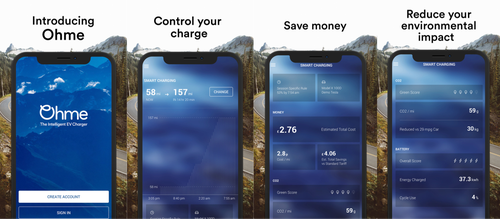
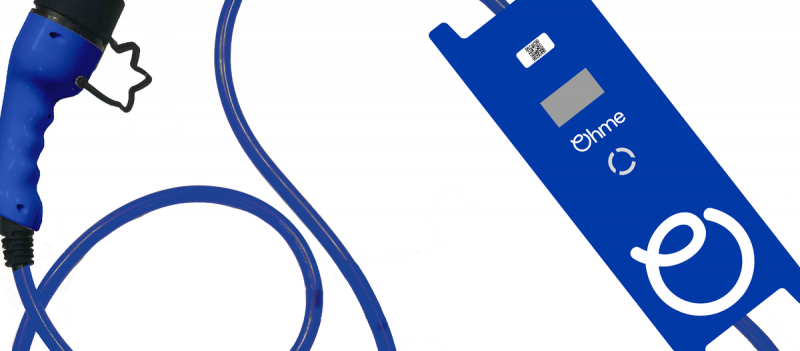
Here’s the image of Ohme’s new “smart cable” that accompanied the press release:

OHME_cable_launch

The press release continues:

Once the cable is connected, the driver can just open up the app and enter the amount they would like to charge their car and by when, and then let Ohme manage it for them. For example: “On weekdays, charge my car battery to 100% by 7am”. Ohme then uses the Octopus Agile API to automatically deliver the right amount of electricity when it is cheapest.

By optimising their charging in this smart way, Octopus Energy and Ohme estimate that customers using Ohme in parallel with the Agile Octopus tariff could save around £300 per year on their charging costs in comparison to charging on a typical industry standard variable tariff.

The cable will cost £399, but the first 1,000 Octopus Energy customers get a special launch price of £199.

The Ohme cable is available for pre-order on the Octopus Energy web site. Whilst we wait for them to start shipping the new product, here’s an image of the Ohme app in action:

OHME_app_launch

According to Ohme’s CEO, David Watson:

At Ohme we believe the future of transport is electric and that flexible home charging is the key to mass adoption. Ohme’s innovative smart charging cable is the first App-controlled, intelligent EV charger, that combined with Octopus’ smart energy tariffs, delivers real savings and environmental benefits. All you need to do is plug in and let Ohme do the rest.

I cannot help but think that the likes of Wallbox might well quibble with David’s “first app-controlled, intelligent EV charger” remark? The press release didn’t include a telephone number, but we’ll let you know Ohme’s thoughts on the matter when we manage to get hold of them.


[Edit – March 30th]

After desperately doing my due diligence I eventually managed to have a long chat with Ohme’s technical guru, Dan Hollingworth, yesterday evening. As I strongly suspected, the Ohme “smart cable” isn’t actually that smart, by V2G UK’s standards at least. It contains a microprocessor and a 4G modem, not unlike our sister company V2G EVSE’s “smart controller” except that it doesn’t optionally do WiFi, Bluetooth, 2.5 G, 3G, LTE-M and NB-IoT as well.

Ohme’s device doesn’t determine the electric vehicle (EV for short) battery pack’s state of charge by communicating with the EV through the cable. Instead it finds out that useful piece of information by using its 4G modem to communicate with assorted EV original equipment manufacturer’s (OEM for short) cloud platforms, which in turn communicate wirelessly with the EV the Ohme’s cable is plugged into using proprietary protocols.

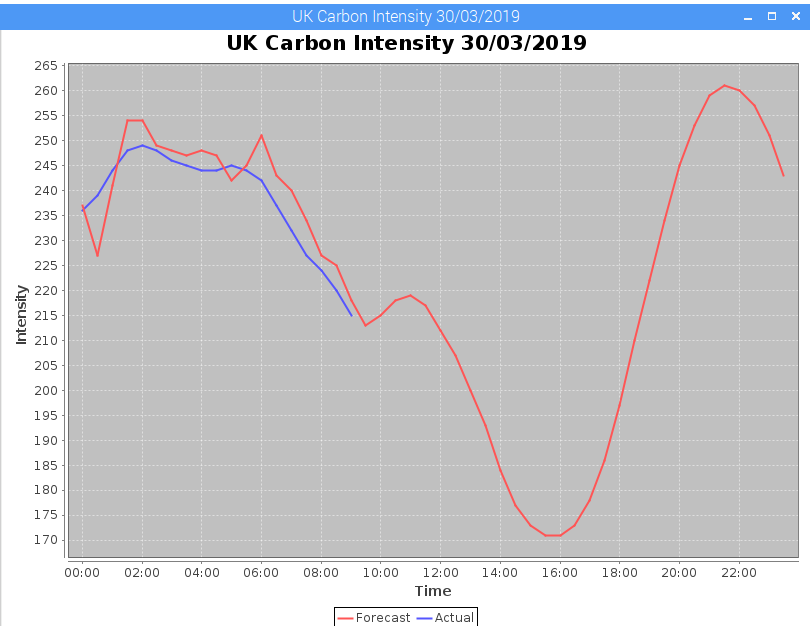
Ohme’s cloud platform is somewhat smarter since it communicates with National Grid’s Application Programming Interface (API for short) to forecast the “carbon intensity” of the UK Grid and thus determine the “greenness” of the electricity used to charge the EV to which the “smart cable” is attached. Here’s the current output of our open source example of how to go about doing that, generated by the V2G EVSE smart controller:

Screenshot from 2019-03-30 10-05-54

Ohme’s cloud platform also determines the price of electricity on Octopus Energy’s Agile or Go tariffs by communicating with the Octopus Energy API

Ohme’s smartphone application (app for short) allows the EV’s owner to instruct Ohme’s cloud based platform how much charge they’d like in their EV battery pack by when. On the basis of all the information Ohme’s cloud based platform has acquired it then uses version 1.6 of the Open Charge Point Protocol (OCPP for short) to instruct the cable when and how fast to charge the EV it’s connected to. In case it’s of interest here’s our open source smart charging station simulator, based on a mildly modified clone of Thomas Volden’s OCPP 1.6 library over on GitHub:

https://github.com/V2G-Ltd/OCPP-1.6-EVSE-Demo

Does that all make perfect sense now?

Nissan Announce 1000 V2G Installations in the UK

Since it mentions “1000 V2G installations” and comes with a nice picture of a 2018 LEAF plugged in to a V2G charging station Nissan’s announcement of its “e4Future” project’s successful entry in the recent Innovate UK V2G funding competition deserves an article of its very own:

2018-LEAF-V2G

Whilst it is certainly connected to the vehicle the charging station doesn’t seem to be connected to the grid! Regarding their successful bid Nissan say that:

Nissan and its partners welcome the announcement by Department for Business, Energy and Industrial Strategy minister Richard Harrington to award £9.8m for a Vehicle-to-Grid demonstrator project.

The project foundation is for a large-scale demonstrator targeting 1000 Vehicle-to-Grid (V2G) installations that will evaluate a commercial offer to electric vehicle fleet customers. The chargers will be controlled by an aggregator and data will be collected to understand the technical characteristics of vehicle to grid charging for both the vehicles and the electricity networks.

A consortium, led by Nissan, will bring expertise from across the whole Vehicle-to-Grid value chain: V2G infrastructure/aggregator provider Nuvve, the energy community represented by National Grid, two Distribution Network Operators (DNOs); UK Power Networks and Northern Powergrid, with varied grid infrastructure. The research and analysis activities will be supported by Newcastle University and Imperial College London.

Vehicle-to-Grid technology and this project will leverage Nissan’s brand commitment to Nissan Intelligent Mobility to transform the way people drive and live, creating a more exciting and sustainable future.

Once again V2G charging station manufacturers are conspicuous by their absence from the list of Nissan’s collaborators, and there is no label on the white charging station displayed above. Nissan also provide the following bullet points summarising the e4Future project:

  • In January 2018, OLEV and BEIS announced that 21 projects (8 feasibility studies, 5 collaborative research and development projects, and 8 real-world V2G trial projects) were to receive funding of £30m to develop the business proposition and core technology around V2G, and demonstrate those with large scale trials. The projects involve more than 50 industrial partners and research organisations from both the Energy and Automotive sector, marking the largest and most diverse activities on V2G in the world, and trialling more than 2700 vehicles across UK.
  • The V2G projects represent a significant step towards the transition to a low carbon transportation and a smart energy system. Allowing EVs to return energy to the Power Grid when parked and plugged for charging, will increase Grid resilience, allow for better exploitation of renewable sources and lower the cost of ownership for EV owners, leading to new business opportunities and clear advantages for EV users and energy consumers.

Amongst other things Nissan’s Managing Director of Nissan Energy at Nissan Europe, Francisco Carranza, said that:

Our EVs can be plugged into the grid and support the transmission and distribution companies in making the UK grid more sustainable and more stable. The increase of electric vehicles penetration, the introduction of more and more distributed generation and storage and the overall increase in renewable energy penetration should be done smartly.

To ensure Nissan plays a wider role in the advancement and protection of our cities, our electric V2G-ready vehicles will be used as clean mobile energy units.

Nissan has also reiterated its bold mission to offer customers free power for their EVs. V2G introduction will change the rules of the game and make energy cheaper for everyone.

The press release also contains a long list of quotes from Nissan’s collaborators on the project. Let’s take a look at this one from Myriam Neaimeh of Newcastle University:

The Government’s announcement will be a real game changer as we move towards decarbonising the grid.

This will be the first, large scale demonstration of vehicle to grid technology anywhere in the world and crucially, this project brings together all the key players for the first time – a giant of the automotive industry with energy providers, infrastructure experts and academics – so we can work together to really make this happen. It’s a really exciting time and fantastic that Newcastle University has been involved right from the beginning.

I still cannot help but wonder who will be manufacturing the all important V2G capable charging stations that will be installed as part of the e4Future project, and what de facto or international standards they will comply with?

National Grid Launches Carbon Intensity Data Feed

In a press release last week National Grid announced that:

The company today launches innovative new software that forecasts the carbon intensity of electricity generation up to two days ahead, helping people to understand and control their energy use.

National Grid is working with Environmental Defense Fund Europe and WWF to make the software openly available to the public. WWF has used the data as the basis of an online tool which points users to the best times to turn on or turn off home appliances to minimise carbon emissions, while Environmental Defense Fund Europe are working on policy implications of having this data available and widely understood. Shifting activities like dishwasher cycles or electric vehicle charges could help relieve pressure on the energy system, reduce the need to use back-up fossil fuel plants, and potentially reduce bills for households.

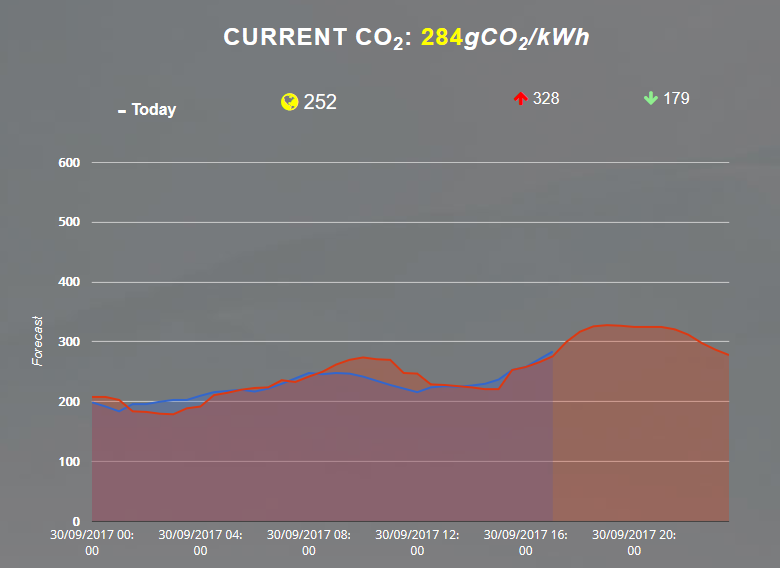
Here’s how National Grid’s visualisation of their carbon intensity data looks at the moment:

NGIntensity-20170930-1700

According to Duncan Burt, Director of the System Operator at National Grid:

We’re providing our forecast data in a format that allows technology companies to build innovative apps and software that could make a real difference to how and when people use energy. Clear and concise information that can tell you in advance when’s best to turn on the washing machine, load the dishwasher or charge your car for example, is a step in the right direction towards a low carbon future. This technology puts people at the heart of it, helping everyone to use power when it’s greenest, and likely, more cost efficient.

Simultaneously the WWF published a web page entitled “How do you make a green cup of tea” that presents the carbon intensity data in a “user friendly” fashion. According to the WWF:

Electricity is changing in the 21st century. Coal is being phased out and renewable energy sources like wind and solar now make up a quarter of our electricity.

This means that the greenness of our electricity now varies throughout the day. When it’s sunny and windy, we’ve got more green power. When it’s overcast and calm, we’ve got more fossil fuels online.

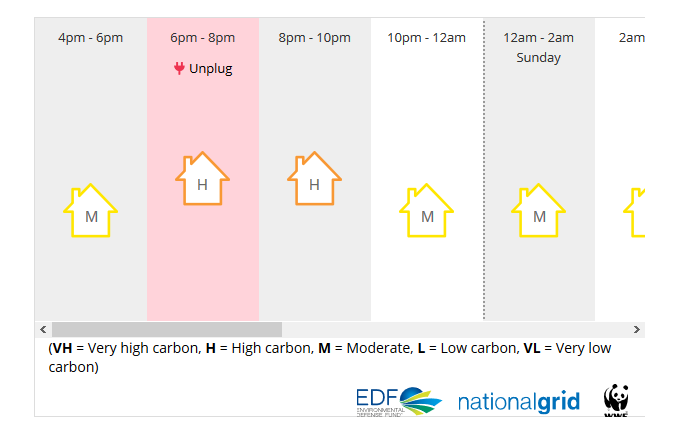
This new forecasting tool shows you what the greenest and dirtiest times of day will be up to two days ahead. This can help people plan their energy use, switching things on when energy is green and off when it’s not.

Being flexible with our energy use boosts our energy security and cuts carbon emissions by reducing the need for back-up fossil fuel generation. It could potentially save people money as well if they’re on time of use tariffs.

So if you want to make a green cup of tea, check out our forecast to find the greenest time of day to stick the kettle on.

Here’s how that forecast looks at the moment:

WWFIntensity-20170930-1700

Apart from the assorted press releases about the carbon intensity API there’s also a blog post from National Grid:

Working with WWF and Environmental Defense Fund Europe to finesse the science, we agreed to make the data that sits behind the forecast publicly available. The aim is to see tech developers creating consumer-friendly apps that can tell the public, in advance, when electricity generation is expected to be cleaner and greener, and more likely cost efficient.

The new software was a good idea hatched at a GB System Operator Hackathon and is yet another example of how our System Operator continues to be at the forefront of the energy revolution.

This new tool is a credit to the team in Wokingham – led by James Kelloway and his team members Alasdair Bruce and Lyndon Ruff, along with the sponsorship and guidance of Director of System Operations Duncan Burt and support from Corporate Affairs.

Not to be outdone the Met Office has also written another blog post on the topic:

Using hourly weather data from the Met Office and combining it with historical data from the grid, National Grid are able to forecast demand for electricity and also identify the contribution from renewable energy flowing into the grid. Using this information, they can forecast the carbon output of the grid over a 48-hour period, and identify the periods of lowest carbon output and highest carbon output. In other words, how green the grid will be during that period.

Using this information, the partners involved in the project hope that electricity consumers across Great Britain will be able to plan their electricity use around periods of high availability for renewable energy, reducing carbon output.

Patrick Sachon, Met Office Business Group Leader for Energy said: “The green energy forecast is a great example of innovative re-use of Met Office data. As a scientific organisation we encourage the re-use of our data, particularly if it can be applied to develop a deeper understanding of the interrelation between weather and something that is so integral to our everyday lives such energy.”

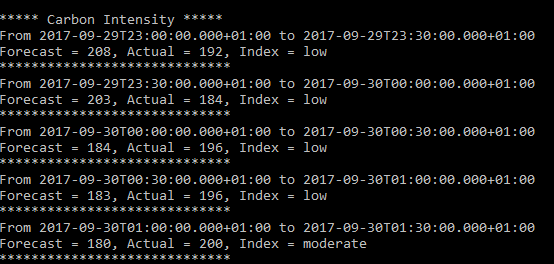
Down here at V2G UK we like to think of ourselves as an “innovative technology company” so we’ve already started using the new API. It’s very easy to use if you’ve ever written a JSON parser before, which fortunately we have. Here’s how the raw data for today looks as decoded by our trusty Raspberry Pi:

CarbonIntensity-20170930

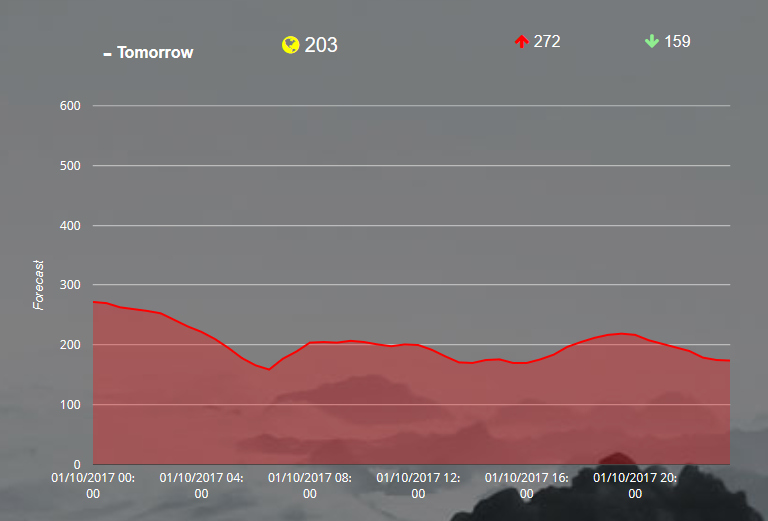
We haven’t persuaded our Pi to produce any pretty pictures as yet, so for now here’s National Grid’s forecast for tomorrow, which is forecast by the Met Office to be rather wet and windy:

NGIntensity-20170930+24h

Having slaved over a hot keyboard typing in this article I could really do with a nice hot cup of tea now, but it looks as though now is not a very good time. Wouldn’t it be a good idea if I could boil a kettle using electrical energy obtained from my very own battery instead of from the local grid? Another good idea would be if, much like the Met Office already do for the weather, National Grid could supply us with a carbon intensity forecast for Camelford as well as for the UK as a whole.

[Edit – October 1st]

Our experimental application is now producing simple graphs. If you’d like to experiment along similar lines we’ve uploaded our Java source code to GitHub. For further details see our new project page:

“National Grid Carbon Intensity API“

Energy Storage Growth Scenarios and Operating Modes

Western Power Distribution and Regen SW have just released a report on the results of their consultation concerning “Energy Storage Growth Scenarios and Operating Modes“. The entire report is worth a read from cover to cover, but here are a couple of extracts that immediately caught our eye here at V2G UK:

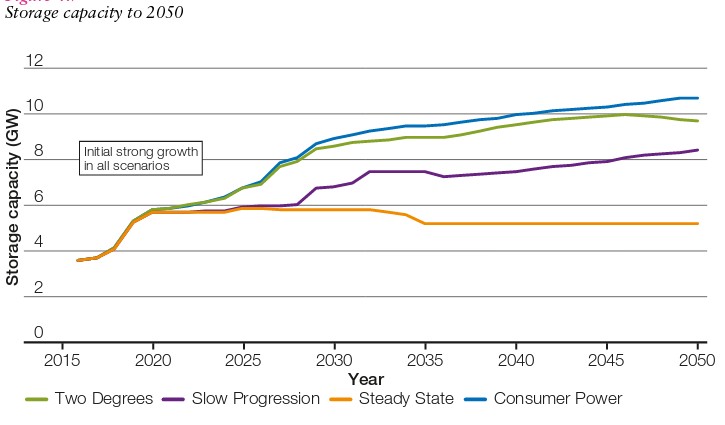
On 13th July 2017, National Grid published the latest version of their Future Energy Scenarios (FES) strategic document. This document considers and discusses the role of energy storage in the future in 4 key energy scenarios. In these scenarios, storage is referenced as a provider of flexibility, both for response and co-location with intermittent generation (both solar and wind) and highlights the expectation that energy storage will be a significant part of the ongoing energy transition towards a smarter and more distributed electricity system. National Grid forecast strong growth in energy storage (in all scenarios) over the next few years, such that a total of 6 GW is forecast to be connected to the UK electricity system by 2020. Beyond this,National Grid expectation for energy storage growth varies significantly across the scenarios proposed, with the highest two scenarios showing storage grow to 10 GW by 2050 (Consumer Power-10.7 GW and Two Degrees – 9.8 GW). The considerably lower level of storage growth (under the Steady Statescenario) shows 5.2 GW by 2050, due to low levels of available funding, coupled with a reduction in capacity from 2030 onwards, as a result of existing assets not being replaced when they reach end of life.

There is also this V2G specific section:

A number of market analyst’s reports have projected energy storage growth scenarios, these include National Grid Future Energy Scenarios (see Fig.4), Committee on Climate Change, Carbon Trust and UK Government.As a starting point for WPD’s modelling, we are proposing to take a:

•High growth scenario of 10-12 GW and 24-44 GWh of energy storage capacity installed across GB by 2030.
•Lower growth scenario of 4-5 GW and 6-15 GWh across GB by 2030.

Note: these figures include 2.7GW of existing pumped hydro storage.

The introduction of significant number of electric vehicles under “Vehicle-to-Grid” (V2G) arrangements could be one factor that results in storage deployments levels increasing above the values we proposed. However, other comments received also identified regulatory barriers as a key factor that could perhaps limit deployment to levels potentially even beneath the lower growth scenario proposed. The wide margin between the high and low growth scenarios presented was recognised as an accurate reflection of market uncertainty.

We couldn’t agree more. There is currently much “market uncertainty” concerning energy storage in general and V2G technology in particular. Removing the “regulatory barriers” to progress would be most welcome down here in North Cornwall!

Nissan, Enel and National Grid Announce UK V2G Trial

Things seem to be looking up for vehicle-to-grid technology here in the United Kingdom! In a press release Nissan have just announced that:

Automotive industry leader Nissan and multinational power company Enel, today confirmed plans to launch a major vehicle-to-grid (V2G) trial – the first ever carried out in the UK. The trial will work by installing and connecting one hundred V2G units at locations agreed by private and fleet owners of the Nissan LEAF and e-NV200 electric van. By giving Nissan electric vehicle owners the ability to plug their vehicles into the V2G system, owners will have the flexibility and power to sell stored energy from their vehicle battery back to the National Grid.

Technical details of the trial are however conspicuous only by their absence from the announcement. I for one would love to know exactly how “sell[ing] stored energy from [a] vehicle battery back to the National Grid” is going to work in practice. The press release continues:

Today’s announcement heralds an exciting era for energy management in the UK. Not only will Nissan electric vehicle owners be able to play an active role in grid stability, providing an alternate source of income, but it will revolutionise how energy is supplied to the grid. Once scaled up, the V2G technology can become a game-changer for owners of Nissan EV in the UK as they become fully fledged and active participants in the UK energy market.

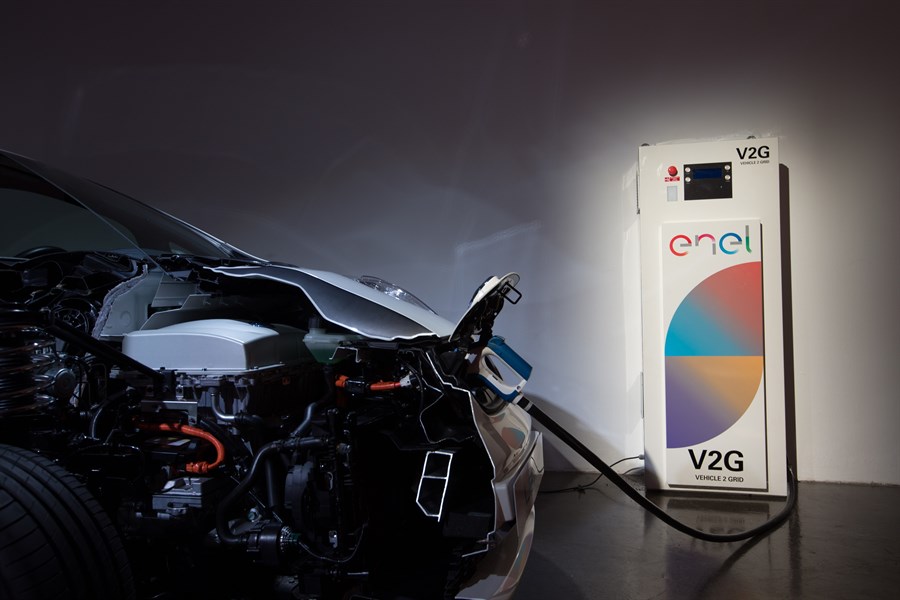
Personally I’d love to be the owner of an electric vehicle that is a “fully fledged and active participant in the UK energy market” but I don’t foresee that happening any time soon. I cannot help but wonder what Nissan UK and National Grid know that I don’t? Whilst I wait to find out the answer to that particular UK energy market conundrum, here’s a publicity picture of the associated hardware:

Perhaps the most pertinent comment in the announcement comes from Steven Holliday, the former CEO of National Grid plc, who points out that:

At National Grid we are constantly looking to the future to ensure we have the capacity to meet national energy demand – it’s our job to future proof the national transmission network.

The rapid uptake of Electric Vehicles is certainly positive yet could also be challenging if we don’t plan ahead to understand precisely what effect this new technology will have on the electricity system. Our Future Energy team predict that there could be up to 700,000 Electric Vehicles in 2020 requiring an extra 500MW of energy. That’s why we support innovative technologies and pioneering projects such as this one that have the potential to make a real difference to the way we manage energy supply and demand.

The press release concludes:

Today’s announcement follows the signing of a partnership agreement between Nissan and Enel in Paris in December 2015 during the 21st UN Conference on Climate Change (COP21) to trial V2G technology in Europe. A trial comprising 40 V2G units began in Denmark in January 2016.

I wonder if any Nissan LEAF owners are already active participants in the Danish energy market?

Energy and Climate Change Committee Criticise Capacity Market

The UK’s House of Commons Energy & Climate Change Select Committee issued a report today on the implementation of Electricity Market Reform which is highly critical of the new electricity capacity market. This may strike you (as it does me!) as a severe case of shutting the stable door after the horse has bolted, but nonetheless the executive summary puts it this way:

The Government’s flagship Electricity Market Reform was designed to drive investment in our energy infrastructure and manage the transition towards generating low-carbon, secure and cost-effective electricity. After years of planning, the Government has successfully put in place the necessary framework for the first Capacity Market and Contract-for-Difference (CfD) auctions under EMR, and DECC, National Grid and the Low Carbon Contracts Company have been helpful in preparing industry in the run-up to the auctions.

However, the speed at which participants have had to assimilate the complex policies have made it a challenging environment for smaller companies, and DECC is still failing to ensure that demand-side response (DSR) providers are given a level playing field in the Capacity Market. In order to avoid paying for more expensive generation capacity that may not be needed in the future, the Government should consider means to further support DSR in the Capacity market, for instance by increasing the contract length of DSR capacity agreements.

There also remain strong concerns around National Grid’s potential conflicts of interest as EMR Delivery Body, and it is important that clear steps are taken to ensure that it does not have an unfair commercial advantage in future Capacity Market auctions.

Speaking as one of those “smaller companies” it seems from our perspective that the playing field is indeed located on a rather steep slope! Tim Yeo, chairperson of the committee, said that:

Every consumer in the country is currently subsidising spare electricity generating capacity that may only be used for a few hours each year. But smart technology has now made it possible to reduce unnecessary electricity demand at peak times, thereby reducing the number of polluting power stations that need to be switched on. This could mean we can reduce the total electricity generating capacity that has to be maintained in future, bringing down costs for consumers while enabling us to reduce consumption of fossil fuels.

Yet this promising new demand-side response technology has been disadvantaged in the auctions under the Government’s Capacity Market – meaning costs and emissions could be higher than necessary. Only a fraction of the £1 billion pounds that will be spent keeping the lights on through the Capacity Market will actually provide new capacity and just 0.4% will go on demand-side response – with most of the rest going to existing fossil fuel power stations, paying some of them to stand idle for much of the year. Nearly a fifth of the capacity contracts already awarded are going to highly polluting coal power stations.

Which sums things up quite nicely for us. We would go even further than Tim Yeo. Not only should Demand Side Response be getting a better deal, so should distributed energy storage in general and V2x in particular. Tim does however also point out that:

The results of the first CfD auction for long term low-carbon contracts show that small companies or community energy projects are in danger of being shut out. The fact that the final strike prices were cheaper than the administrative price is a very positive result, but it casts further doubts over the value-for-money of the early contracts for renewables under the Levy Control Framework.

The committee’s concluding bullet points read as follows:

DECC’s upcoming review on EMR should focus hard on the issues voiced by stakeholders and raised in the Committee’s report. In particular, it should focus on:

  • The role of highly polluting coal and diesel fired power generation in the capacity market
  • How to facilitate cheaper and cleaner demand-side solutions to keep the lights on
  • How potential conflicts of interest with National Grid will be avoided or addressed
  • How engagement with small players can be improved

to which we would add one of our own:

How to design UK energy markets such that distributed storage and generation operate on a level playing field?