As regular readers here will realise we have a liking for running Linux on ARM processors. Hence we were delighted to recently receive our very own quad core Raspberry Pi 2 to experiment with. Here’s what it looks like:
However we’ve recently received even more interesting news, to us at least. In a press release earlier this week Red Hat announced that:
The Red Hat ARM Partner Early Access Program has expanded to include more than 35 member companies, ranging from silicon vendors and original equipment manufacturers (OEMs) to independent software vendors (ISVs).
According to Mike Werner, who is Senior Director of Global Technology Ecosystems at Red Hat:
Since its launch just over six months ago, the Red Hat ARM Partner Early Access Program has achieved two critical goals, driving significant interest and participation from both hardware vendors and independent software vendors as well as the successful completion of the hardware enablement phase. The program is a perfect example of how Red Hat, along with our vast network of partners and ISVs, drives standardization within specific technology segments, with the ultimate goal of delivery of fully tested and certified solutions to the marketplace.
whilst Kumar Sankaran, who is an associate vice president at Applied Micro, said that:
As the only silicon vendor shipping an enterprise-hardened, ARMv8-A Server-on-a-ChipTM solution and an initial participant of the Red Hat ARM Partner Early Access Program, we are pleased to continue our work with Red Hat. The program is strengthening the entire ARM 64-bit ecosystem while allowing OEM and end-user partners the opportunity to work with fully operational software and hardware. We have had a great working relationship with Red Hat dating back to our X-Gene launch in 2011 and we are excited to provide a serious alternative to incumbent solutions.
and Susan Blocher, who is Hewlett Packard’s vice president of Product Management and Business Development for their Moonshot server range, said that:
Today, customers are already leveraging the industry-leading HP Moonshot servers with 64-bit ARM technology to improve application performance, drive business innovation and deliver breakthrough datacenter economics. We are committed to working with partners in the Red Hat Partner Early Access Program to extend the ARM ecosystem and deliver enterprise-ready solutions to address customer challenges.
The practical benefits to all concerned are summed up by Red Hat as follows:
Launched in July 2014 with nine participants, the program aims to deliver, via collaboration, a singular operating platform capable of supporting multiple partner-initiated system designs based on the 64-bit ARMv8-A architecture. As a part of that commitment, program participants have successfully completed the hardware enablement phase by incorporating necessary architectural requirements into the latest version of the development software. Based on that, Red Hat ARM Partner Early Access Program participants are now expected to contribute system-specific software and drivers to an open source upstream Linux community for incorporation into future commercial offerings.
Bear in mind that it costs rather more than the $35 that a Raspberry Pi 2 will set you back, but here’s what an HP 64 bit ARM Moonshot server cartridge looks like:
Bear in mind also that whether you’re considering a Raspberry Pi, a Moonshot or a data centre packed full of ARMv8s, an ARM CPU delivers rather more bang per Watt than the average microprocessor.
According to Bloomberg the answer to the question posed in our title is a most definite yes! In a February 19th article Tim Higgins says that:
Apple Inc., which has been working secretly on a car, is pushing its team to begin production of an electric vehicle as early as 2020, people with knowledge of the matter said.
The timeframe — automakers typically spend five to seven years developing a car — underscores the project’s aggressive goals and could set the stage for a battle for customers with Tesla Motors Inc. and General Motors Co., both of which are targeting a 2017 release of an electric vehicle that can go more than 200 miles on a single charge and cost less than $40,000.
then adds that:
Apple representatives declined to comment for this story.
According to Bloomberg, however:
Apple began around June an “aggressive campaign to poach” employees from A123 Systems LLC, the Waltham, Massachusetts-based battery maker said in a lawsuit against Apple filed this month.
Apple hired five people from A123 and has tried to hire battery experts from LG Chem Ltd, Samsung Electronics Co., Panasonic Corp., Toshiba Corp. and Johnson Controls Inc., according to the lawsuit.
Bloomberg also talked to Tesla CEO Elon Musk, who told them:
That Apple was seeking to hire away his workers, offering $250,000 signing bonuses and 60 percent salary increases.
It seems as though when it comes to EVs, there’s never any smoke without fire?
APPLE’S ability to make desirable iGadgets designed for easy portability is beyond question. Reports emerged this week that it is planning to make a mobile device that will instead carry its users—an electric car. Apple’s plans are unclear and unconfirmed. By some accounts it has put a few hundred people to work developing cars to match Tesla, another Silicon Valley firm that makes fast and luxurious battery-powered saloons. Others reckon that it is working on a self-driving car.
Plenty of other tech firms are turning their attention to cars. In February Uber, a firm that provides taxis through a smartphone app, said it would set up a laboratory in Pittsburgh to develop self-driving taxis. Sony recently put money into ZMP, a self-driving car startup; Google has been working for years on driverless cars.
The Economist doesn’t sound optimistic about the future for the alleged Apple EV:
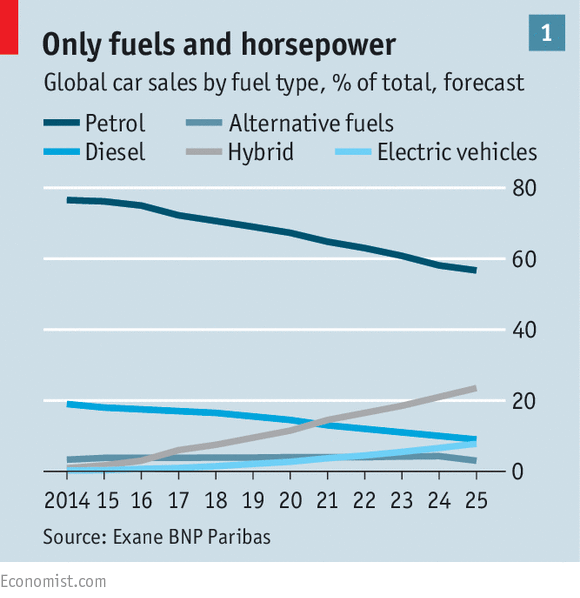
The likes of Apple may not know much about pistons and gearboxes, but the big challenge for electric cars is batteries. Battery-powered cars have many advantages: refuelling at home, cheap running costs and no tailpipe emissions. But the market for pure electric vehicles is tiny:
Expensive batteries make for costly cars, and limited range and a lack of recharging infrastructure have put off most drivers. Nissan’s Leaf, the world’s best-selling electric car, attracted only 40,000 buyers last year compared with the 250,000 the company once hoped to shift. Tesla aspires to enter the mass market but so far it has dealt with the battery problem by putting lots of them in a big, expensive car, thereby limiting it to a luxury niche. The plunging oil price dents the prospects for electrification still further.
and concludes:
Tech firms may be better off working with carmakers, to develop the software that will provide the brains of the self-driving car, and to improve the range and battery costs of the electric car. In the motor industry, supplying the key parts is generally more profitable than putting the cars together, even if you do not get your company’s badge on the bonnet. In the future cars will be different but the brands will probably be much the same.
In a highly unusual move the Prime Minister, Deputy Prime Minister and the Leader of the Opposition have agreed to work together across party lines to tackle climate change.
The agreement follows the launch of The Climate Coalition’s SHOW THE LOVE campaign which has reached millions across the UK, thousands of whom are wearing green hearts and telling the world what they love that could be lost to climate change.
The Green Alliance kindly provide video evidence that the signing of the agreement is not in actual fact merely a cruel hoax:
The agreement itself states that:
Climate change is one of the most serious threats facing the world today. It is not just a threat to the environment, but also to our national and global security, to poverty eradication and economic prosperity.
Acting on climate change is also an opportunity for the UK to grow a stronger economy, which is more efficient and more resilient to the risks ahead. It is in our national interest to act and ensure others act with us.
2015 offers a unique opportunity to accelerate that opportunity, with countries pledging their contributions to action before the world comes together at Paris at the end of the year to reach an agreement on tackling climate change. It is vital that this agreement is a success, and the UK will play its part in ensuring an ambitious outcome.
That is why we pledge:
To seek a fair, strong, legally binding, global climate deal which limits temperature rises to below 2°C.
To work together, across party lines, to agree [UK] carbon budgets”, which are required by law but which caused serious cabinet clashes in 2011.
To accelerate the transition to a competitive, energy-efficient low-carbon economy and to end the use of unabated coal for power generation.
Whilst that is of course all fine and dandy, the $64 gazillion question is in fact:
What will it actually take to limit temperature rises to below 2°C in practice in the real world?
The press release is accompanied by statements from a long list of the great and the good such as Al Gore, ex Vice-President of the United States of America, who gushes:
This agreement represents inspiring leadership and true statesmanship by all three men. The political courage it represents on all sides is exactly what our world most needs in order to solve the climate crisis. Thank you! Thank you! And thank you!
which doesn’t answer that question. Then there’s Lord Nicholas Stern, Co-Chair of the Global Commission on the Economy and Climate, Chair of the Grantham Research Institute on Climate Change and the Environment at London School of Economics and Political Science, and President of the British Academy, who points out that:
I am glad to see the leaders of the three main Westminster parties giving their support to strong international and domestic action on climate change. The next UK Government will need to ensure a step change in the pace of the transition to a low-carbon economy in order to meet the statutory carbon budgets and to decarbonise the power sector by 2030.
A key part will be to end emissions from coal, which are twice those from natural gas per unit of electricity generated. The Coalition Government has already introduced regulations to prevent the construction of any new coal-fired power stations unless they are equipped with carbon capture and storage technology. We now need to bring a speedy end to coal-burning by existing power stations which release carbon dioxide and other pollutants into the atmosphere.
The transition to a low-carbon economy and investment in our cities and transport to make them more efficient, less congested and cleaner has great potential to drive a dynamic, more attractive and sustainable growth story for the UK, and indeed help the UK with design and technology it can take to the world. I hope that the leaders will embody their commitment to a low-carbon economy in overseas aid to help poor countries to overcome poverty and make their transition to low-carbon growth and to become more resilient to those impacts of climate change that cannot now be avoided.
That’s a bit closer to the mark, but no mention is made of Lord Stern’s previous statement that:
Climate change is the greatest market failure the world has ever seen.
However the most surprising thing, to your humble scribe at least, is that nowhere in amongst the gigatonnes of publicity have I been able to spot the name of Kevin Anderson, who is professor of energy and climate change in the School of Mechanical, Aeronautical and Civil Engineering at the University of Manchester. Last October he wrote an “Open Letter to the Prime Minister and Secretary of State at the Department of Energy & Climate Change“. Kevin’s letter includes lots of references and starts by saying:
The letter summarises why the IPCC’s carbon budgets for a “likely” chance of not exceeding the international community’s 2°C commitment, requires the EU to reduce the emissions from its energy system by 80% by 2030, with complete decarbonisation just a few years later.
and concludes that:
I understand the enormous political difficulties for European heads of state in developing a transparent and evidence-based mitigation agenda. However, the reasons for today’s climate dilemma reside in our prolonged abject failure to set in train an effective programme of mitigation. A quarter of a century on from the IPCC’s first report, the carbon intensity of a typical EU citizen’s lifestyle remains unchanged. I urge you to resist the vested interests calling for continued inaction and instead drive for an ambitious policy framework “consistent with science” and developed on “the basis of equity”. Ultimately, this will be the legacy we bequeath to future generations.
Now as luck would have it I attended a seminar given by Prof. Anderson to a group of climate scientists (plus your current correspondent) at Exeter University just two days ago. As further luck would have it I discovered on entering the room that my trusty surf camera was nestled at the bottom of my backpack, and Kevin kindly gave me permission to turn it on. Here is a small portion of what it managed to record for posterity:
You will note that amongst many other things Kevin asks rhetorically at 1:10:
What about 2°C?
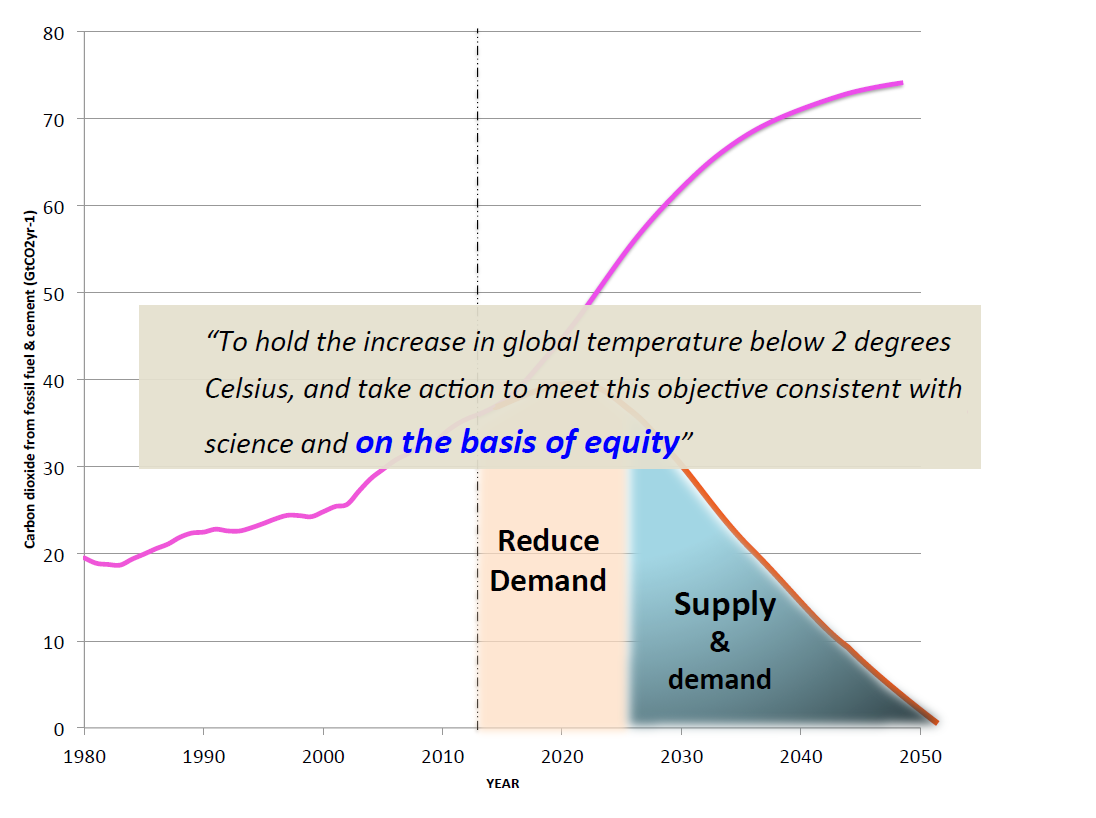
and summarises his “recipe for success” with this graphic graphic:
He goes on to say that:
We can’t do [2°C] with low carbon supply. We can’t make the changes quick enough. You have to do something with our demand for energy, and that is very, very unpopular amongst all of us, all of our colleagues, all the policy makers, so basically the whole world, all the high emitting parts of the world, which is only a small proportion, none of us like this at all, and that’s why we don’t really like the science.
Which is one of the reasons I feel compelled to ask myself at this juncture, and not for the first time:
Why is there no mention of Professor Anderson’s letter in any of the recent hullabaloo, and how on Earth do David, Nick, Ed M. and Ed D. propose to actually hit their so lovingly enunciated target, particularly given the UK’s currently sadly “constipated” energy policy?
A copy of Professor Anderson’s slides from his presentation can be downloaded from the seminar archive web page.
On Tuesday I attended a meeting organised by Exeter Community Energy. The theme for the evening was “UK Energy Policy and the role of community energy”, and the main speaker was Catherine Mitchell who is Professor of Energy Policy at Exeter University, and was a lead author in the Inter-Governmental Panel on Climate Change Working Group 3’s recent fifth assessment report. To summarise briefly, Catherine had many more good words to say about community energy than she did about Great British Energy Policy!
It quickly became apparent that Catherine felt that the change “from ‘dirty’ energy to sustainable energy” is happening much faster elsewhere in Europe, and further afield, than it is here in the UK. After taking a while to consider a suitable epithet she settled on “constipated” as the best descriptor of UK energy policy!
Energy is always political, and has become much more political under the coalition government. Rational evidence based decision making has stopped. The current focus is on nuclear power, with only lip service being paid to renewable generation, demand management, demand reduction and community energy generation.
What positive changes that are taking place are “moving in from Europe”. Catherine moved on to give an overview of the current state of play of electricity generation across Europe. Broadly demand in the 21st century has been constant, with a slight dip due to the recession in 2009. The renewables’ share of total generation has been increasing throughout that period, and the most recent figures show much more renewable capacity being constructed than fossil fuels or nuclear.
In the UK wholesale prices are the 3rd highest in Europe, and interconnections with other countries, which are “very helpful for renewables”, are lacking. Great Britain and Poland “are trying to water down” the EU 2030 framework for climate and energy policies. Conventional utilities are however “under threat” due to the low marginal costs of renewable energy sources, which undermines their business model. However in the UK “self reinforcing governance” makes it hard for new entrants to challenge the “Big 6”, who currently have 91% of the UK electricity market, and even more for energy overall. However “despite this, there are some changes”.
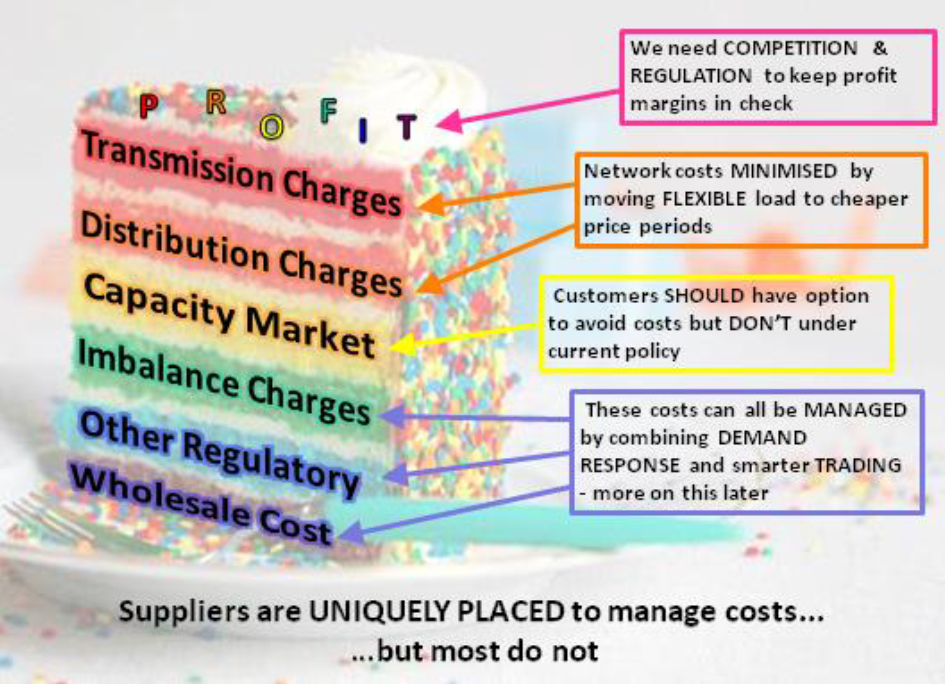
Community energy policy is “very inconsistent”, but there are new demand side entrants such as Tempus Energy, and new financial models from the likes of OVO Energy. Combined heat & power “is starting to come together”, but “the Big 6 don’t want to change. People need to start to do things differently”. Here’s how the UK energy cookie currently crumbles according to Tempus:
and here’s a video in which they explain how matters might be improved by using “a smarter approach for everybody”:
At that point the questions from the audience began. The one that most interested me concerned energy storage, and the possibility of getting paid for providing that useful service. According to Catherine “Norway is doing wonderful stuff, Germany has started, but there are no plans in Great Britain”. A member of the audience pointed out that the Renewable Energy Association had recently launched “UK Energy Storage” to lobby government, apparently:
The trade body for all storage technologies across the UK
I waved my hand in an endeavour to point out that the Electricity Storage Network has in fact been around for quite some time now, and say they are:
The industry association for the promotion of electrical energy storage.
However my turn to ask a question didn’t come around until right at the end of the evening. It seemed apparent that Catherine wasn’t very impressed by current UK energy markets, and I wondered:
Whether any future market based on “Anglo Saxon Capitalism” would be up to the job of solving the “energy/climate conundrum”?
Catherine assured me that she didn’t see capitalism going away for the foreseeable future. The slides from her presentation can be downloaded from the IGov web site.
Last year, in her role as an IPCC lead author, Catherine Mitchell also gave a presentation about UK energy policy at the Transformational Climate Science conference at Exeter University. Here it is:
Catherine also published an article on the IGov web site after that conference. For additional background information please also read:
We as individuals and communities in civil society have to do all we can to get our politicians, neighbours, businesses, energy suppliers and so on to take climate change seriously. Climate and energy policy must take note of the IPCC warning and act now.

 However we’ve recently received even more interesting news, to us at least. In a press release earlier this week Red Hat announced that: