The FCA/ENGIE V2G pilot project gets under way

We reported last September on the announcement of partnership between Fiat Chrysler and Italian utility Terna to develop “an experimental demonstration fleet of electric cars connected to the grid via a V2G infrastructure”. Now comes news via an FCA press release that:

FCA has selected ENGIE Eps as the technology partner for the project, to build that infrastructure.

In full compliance with the safety standards to contain the epidemic, work has therefore begun at the FCA plant in Mirafiori, Turin on the first phase of the Vehicle-to-Grid (V2G) pilot project. Once fully completed, it will be the largest plant of its kind in the world.

The initiative is aimed at two-way interaction between FCA full electric vehicles and the power grid. In addition to recharging the cars, the project will use their batteries to provide grid stabilization services.

The vehicle batteries are capable of storing energy and, using the V2G infrastructure, can return it to the grid when needs be. This represents an opportunity to optimize the operating costs of the cars – for the benefit of motorists – and a concrete possibility of contributing to a more sustainable electricity system.

The construction site for phase 1 of the project is now open at the Drosso logistics center, within the Mirafiori complex. The works cover an area of approximately 3,000 m2 with 450 m of trenches already excavated, ready to host over 10 km of the cables required to interconnect the electricity grid with 64 two-way fast charging points, with an output of up to 50 kW. The centralized infrastructure and advanced control system – providing Vehicle-to-Grid network services in addition to fast charging of electric vehicles – was designed, patented and constructed by ENGIE Eps.

Phase 1 of the project will see the installation of 32 V2G columns capable of connecting 64 electric vehicles and is scheduled for completion in July. By the end of 2021, the infrastructure will be extended to interconnect up to 700 electric vehicles, capable of providing ultrafast grid services to the transmission network operator, as well as recharging the vehicles themselves.

In its final configuration, the project will be capable of supplying up to 25 MW of regulatory capacity, making it the largest V2G facility ever built in the world. In addition, by aggregating with other FCA “assets” at Mirafiori – including 5 MW of solar panel capacity – this V2G infrastructure will become a true Virtual Power Plant, indeed the most innovative one in Italy. It will have the capability to provide a high level of resource optimization to the equivalent of 8,500 homes and a wide range of services to the network operator, including ultrafast frequency regulation.

This is all very interesting of course, not least because of ENGIE’s promised “ultrafast frequency regulation”. I’d love to know how that will be achieved, and also the type of V2G technology capable of delivering such an “ultrafast” response. AC or DC? CCS or CHAdeMO?

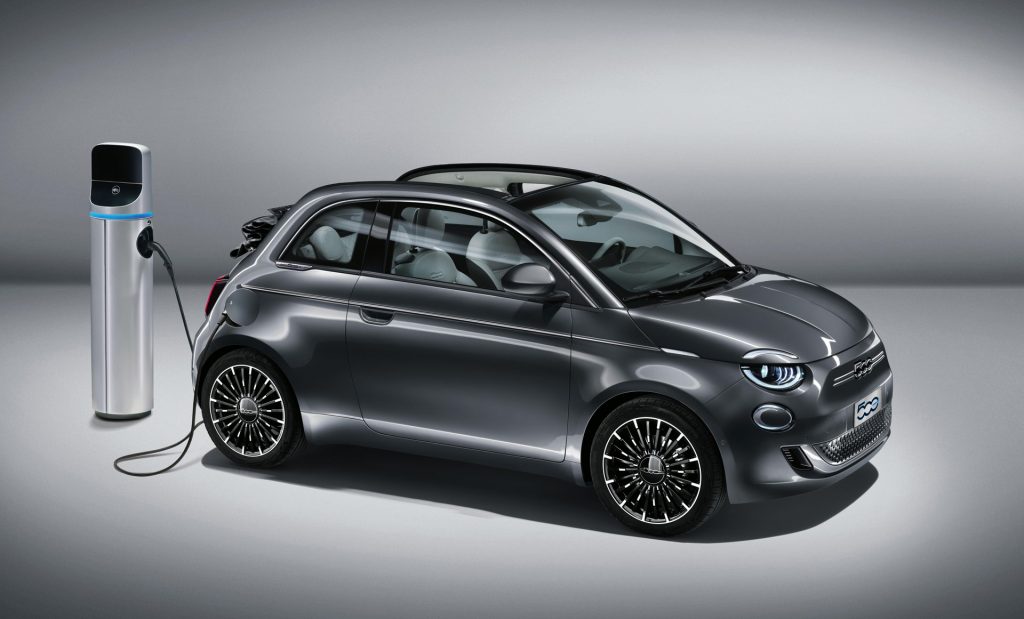
Time will tell, so watch this space! In the mean time here’s an artist’s impression of the 2021 model year Fiat 500 EV:
Is Tesla’s Model 3 Already V2G Capable?

According to Fred Lambert at Electrek:

Electrek has learned that Tesla has quietly made Model 3, and likely Model Y, ready for bidirectional charging, which should enable some game-changing features in the near future.

Since we were wildly speculating about such a thing only last month we did of course read further. After an explanation of the benefits of V2G technology Fred continued:

In a recent filing with the Texas electric utility commission in which Tesla was responding to questions about how electric utilities should approach electric vehicles, the automaker summarized its view of vehicle to grid technology:

“Vehicle to grid benefits can be recognized much more efficiently when EV deployment is at scale rather than in the early adopter phase. At the same time, any discussion regarding the capabilities of EV related technologies must recognize as a first principle that customer experience and willingness for participation is key. There certainly may be an opportunity for future projects and programs that focus on advanced technological integration, such as the eventual aggregation of EVs in the future to provide grid services in wholesale markets. In any setting, it is important to remember that EVs are modes of transportation first and foremost for customers. There is also an opportunity to evaluate stationary storage assets first to provide similar grid services capabilities from a wholesale electricity market perspective.”

While those comments are not too encouraging, they do note that there’s value in vehicle to grid once the EV fleet becomes large enough, which is starting to become the case…

Electrek has learned that Tesla has already prepared its onboard vehicle charger for bidirectional charging.

Marco Gaxiola, an electrical engineer who participated in a Model 3 teardown for a Tesla competitor, reverse engineered the electric car’s charger and found it to be ready for bidirectional charging.

He told Electrek:

“What I learned on reverse engineering the Model 3 charger, was that the design is fully bidirectional. This means power can be converted from AC to DC the same way as the previous example, but also power can flow in reverse direction, coming from the battery and ending up on the AC side. This is known as DC to AC inverter, and when this technology is present in a vehicle, it is known as V2G (Vehicle to Grid).”

The engineer added about the design of Tesla’s onboard charger:

“To complement this, the bidirectional design is replicated 3 times across the same PCB on the Model 3 charger. Another example of redundant design that assures a working process even if one of the circuits fails. Additionally, it is 3 phase design, so it can be used worldwide.”

Gaxiola believes that the vehicle to grid capacity in the Model 3 could be enabled through an over-the-air software update.

An intriguing “rumour”. How much store should we put in Marco’s reverse engineering efforts?

Time will tell, so please watch this space!

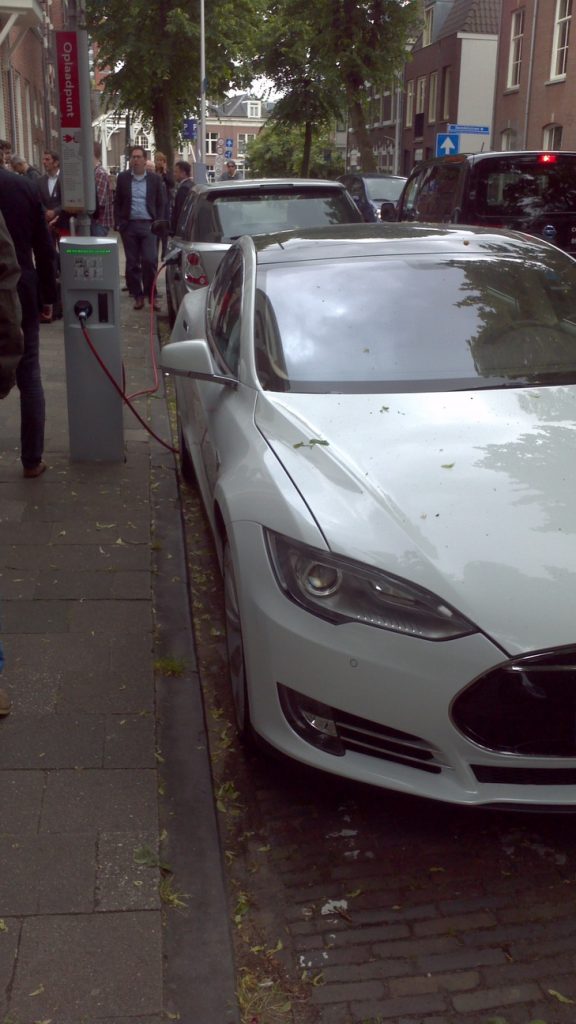
Meanwhile here’s a picture of a (sadly uni-directional) Tesla Model S connected to an AC V2G charging station in 2015:

Nissan Unveils e-NV200 Voltia

In a press release today Nissan announced that:


Nissan expands its electric e-NV200 line-up across Europe with the versatile e-NV200 XL Voltia.

The electric van for urban deliveries, the e-NV200 XL Voltia is a highly versatile conversion of the trusted electric Nissan e-NV200 van. The new model is already the zero-emissions vehicle of choice for major last-mile delivery suppliers across Europe.

The e-NV200 is cementing its reputation as the ideal vehicle for urban deliveries where operators and residents appreciate its near-silent and zero emission operation.

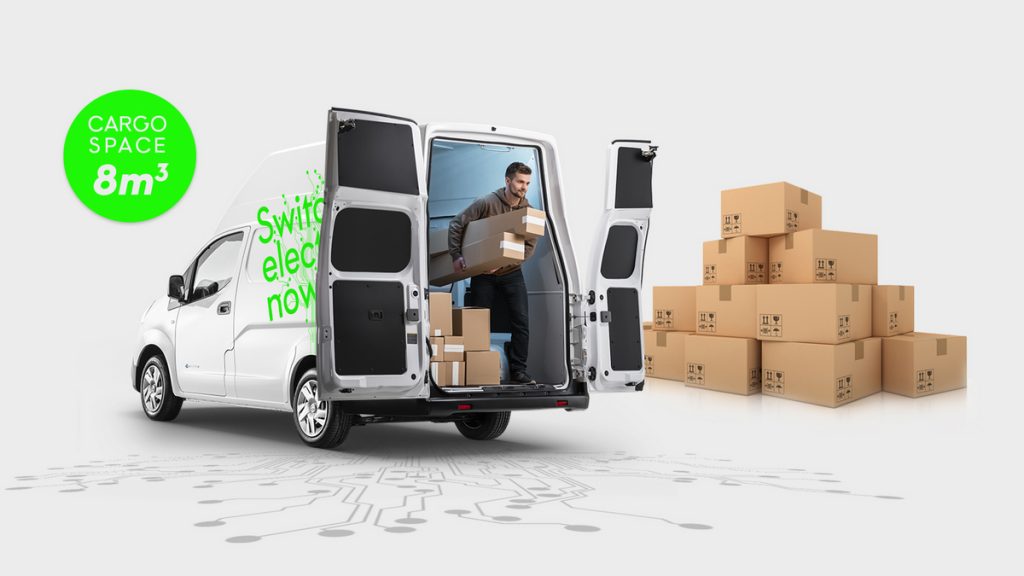
Broadening the diversity of the e-NV200 model family, the e-NV200 XL Voltia offers a compact body and sizeable cargo capacity. With a load space of 8 m³, the new model expands the standard e-NV200’s competitive load space by 90%. This allows businesses to complete fewer trips on each delivery round, allowing them to streamline operations and save time.

The newest member of the e-NV200 family is designed with versatility and practicality in mind. Combining an elongated load bay with an expansive roof space, the 8 m³ van allows drivers to load cargo easily, with standing room ensuring they remain comfortable on the job. The van is highly manoeuvrable on the road, too, with an optimised turning circle making it an ideal solution for urban roads.

The e-NV200 XL Voltia also benefits from technology inspired by the Nissan LEAF’s tried-and-tested powertrain. The model is equipped with Nissan’s highly capable 40kWh battery and an on-board CHAdeMO charger for rapid DC charging capability – making it the perfect solution for flexible urban delivery.

Alongside the efficient powertrain, intelligent energy management technology enhances the e-NV200 XL Voltia’s sustainability credentials even further. B mode optimises regenerative braking to recharge the battery on the move, whilst ECO mode manages power output to conserve battery capacity. When used together, both technologies maximise range to help drivers go longer on each delivery.

The Nissan e-NV200 has enjoyed widespread popularity since its launch in 2014, with 42,000 units produced– almost 10,000 sold across Europe in 2019 alone – supporting Nissan in its commitment to reduce urban emissions from commercial operations.

The e-NV200 XL Voltia will be made available in all European markets, with local pricing to be revealed upon launch.

The press release makes no mention of the inclusion of V2G technology in the Voltia, but since the van is based on the existing e-NV200 platform we assume the new vehicle is V2G capable. If we discover otherwise you will be the first to hear!