5 Spots Left on Octopus Powerloop V2G Trial

The introduction to a recent article on the Octopus Electric Vehicles blog about their Powerloop vehicle-to-grid trial reads as follows:

Powerloop is providing a crucial insight into the viability of Vehicle-to-Grid (V2G), as well as helping improve the customer experience for the installation of other smart technologies. The project is run by Octopus Electric Vehicles in partnership with UK Power Networks, Energy Saving Trust, ENGIE EV Solutions, Open Energi, Guidehouse and our sister company, Octopus Energy, Here, we discuss how Powerloop works, why V2G is so important, and how learnings from this project are helping UK Power Networks improve the broader smart technology onboarding process!

What is V2G?

Put simply, V2G enables an electric vehicle (EV) owner to be both the generator and the consumer of energy, using bi-directional charging technology to allow the user to charge and discharge their EV. This means that, unlike household appliances that can only receive energy, such as a kettle, the car’s battery becomes an energy asset that can transfer energy back to the grid.

However our readers located in UK Power Networks’ service area might be most interested in the following exciting information?

Powerloop is V2G in action, and is still open to new participants (just five spots remain!). Combining the Nissan LEAF with the Wallbox Quasar V2G charger, Powerloop is gathering real world data to help show how V2G can be a valuable asset to the UK’s energy network by helping flatten peak grid demand and making the most of renewable energy whilst using an EV.

By all means read the Octopus article in full, but if you want one of the last available chances to get a Wallbox Quasar on your own wall as part of the Powerloop V2G trial get in touch with Octopus PDQ!

Stellantis & Engie Announce V2G Joint Venture

Earlier this week Stellantis announced that:

In a major step as they move towards the completion of their Joint Venture as announced on 26 January 2021, Stellantis and Engie EPS today announce the composition of the Board of Directors and the corporate name of the new entity: Free2Move eSolutions.

Free2Move eSolutions has the ambition to support and ease the transition to electric mobility by offering innovative and tailor-made electric solutions for both private and business actors of the value chain.

Through a digital and seamless journey across all product lines, the scope of Free2Move eSolutions activities will range from charging infrastructures (installation, servicing and operations), public and home charging subscriptions with monthly fee, to battery lifecycle management and advanced energy services such as Vehicle-to-Grid (V2G) integration and energy management solutions to reduce the total cost of vehicle ownership.

The joint venture between Stellantis and Engie EPS will simplify the access to e-mobility and will complement Free2Move current portfolio, with a new set of offers 100% dedicated to electric mobility.

Free2Move (part of the Stellantis Group) is a mobility tech company, created in 2016, whose objective is to simplify and guarantee mobility for both private and business customers with solutions adapted to all needs, anywhere and anytime from 1 hour, 1 day, to 1 month or more, via a single platform. It also provides solutions supporting energy transition and fleet management for professionals.


Inauguration of the FCA/Terna/ENGIE V2G pilot project

We have been covering the joint Fiat Chrysler/Terna/ENGIE V2G project in Milan for the past year or so. Yesterday the first stage of the project was inaugurated during an on site press conference. According to the Terna press release:

Today at the headquarters of the Heritage Hub within FCA’s Mirafiori industrial district in Turin, FCA, Engie Eps and Terna presented the Vehicle-to-grid (V2G) electric-mobility pilot project, which will be the largest in the world once completed.

The V2G installation, located in the Drosso logistics area, was inaugurated during an international conference in the presence of the Minister of Economic Development, Stefano Patuanelli, the Mayor of Turin, Chiara Appendino and the President of the Piedmont region, Alberto Cirio, along with numerous other institutional guests and journalists from Italy and around the world, with a demonstration of its features and operating methods.

The V2G plant at Mirafiori is a project “100% made in Italy”. On the one hand, it is a significant opportunity for the Italian industrial system to take a leading role in the development of the future of sustainable mobility. On the other, it is the result of the joint effort of three companies that lead their sectors. In their use of such an innovative technology, their experiments are now beginning on a bidirectional charging solution that benefits from physical aggregation in a single point of interconnection with the power grid, capable of interacting with the other energy resources on site.

According to the Engie press release:

Continue reading →

The FCA/ENGIE V2G pilot project gets under way

We reported last September on the announcement of partnership between Fiat Chrysler and Italian utility Terna to develop “an experimental demonstration fleet of electric cars connected to the grid via a V2G infrastructure”. Now comes news via an FCA press release that:

FCA has selected ENGIE Eps as the technology partner for the project, to build that infrastructure.

In full compliance with the safety standards to contain the epidemic, work has therefore begun at the FCA plant in Mirafiori, Turin on the first phase of the Vehicle-to-Grid (V2G) pilot project. Once fully completed, it will be the largest plant of its kind in the world.

The initiative is aimed at two-way interaction between FCA full electric vehicles and the power grid. In addition to recharging the cars, the project will use their batteries to provide grid stabilization services.

The vehicle batteries are capable of storing energy and, using the V2G infrastructure, can return it to the grid when needs be. This represents an opportunity to optimize the operating costs of the cars – for the benefit of motorists – and a concrete possibility of contributing to a more sustainable electricity system.

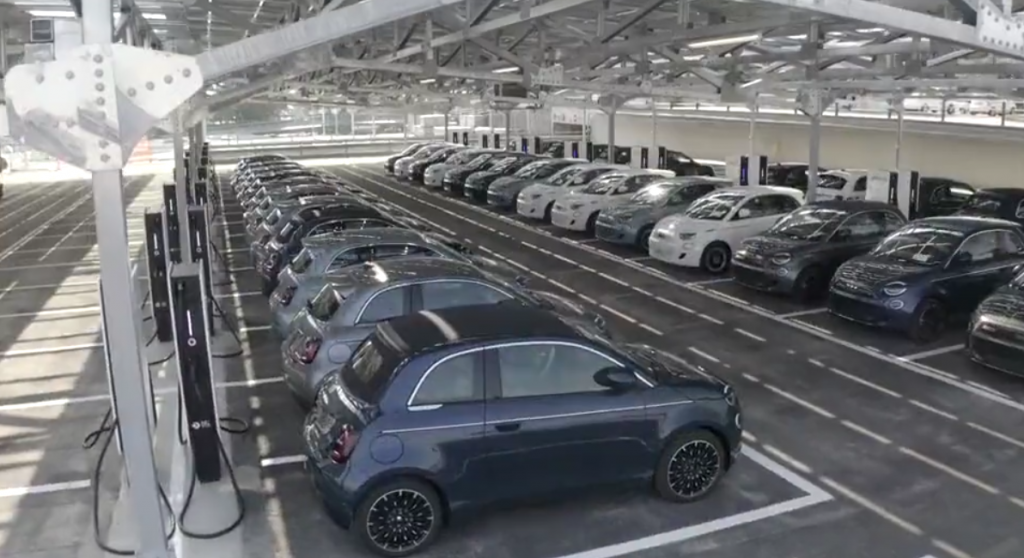
The construction site for phase 1 of the project is now open at the Drosso logistics center, within the Mirafiori complex. The works cover an area of approximately 3,000 m2 with 450 m of trenches already excavated, ready to host over 10 km of the cables required to interconnect the electricity grid with 64 two-way fast charging points, with an output of up to 50 kW. The centralized infrastructure and advanced control system – providing Vehicle-to-Grid network services in addition to fast charging of electric vehicles – was designed, patented and constructed by ENGIE Eps.

Phase 1 of the project will see the installation of 32 V2G columns capable of connecting 64 electric vehicles and is scheduled for completion in July. By the end of 2021, the infrastructure will be extended to interconnect up to 700 electric vehicles, capable of providing ultrafast grid services to the transmission network operator, as well as recharging the vehicles themselves.

In its final configuration, the project will be capable of supplying up to 25 MW of regulatory capacity, making it the largest V2G facility ever built in the world. In addition, by aggregating with other FCA “assets” at Mirafiori – including 5 MW of solar panel capacity – this V2G infrastructure will become a true Virtual Power Plant, indeed the most innovative one in Italy. It will have the capability to provide a high level of resource optimization to the equivalent of 8,500 homes and a wide range of services to the network operator, including ultrafast frequency regulation.

This is all very interesting of course, not least because of ENGIE’s promised “ultrafast frequency regulation”. I’d love to know how that will be achieved, and also the type of V2G technology capable of delivering such an “ultrafast” response. AC or DC? CCS or CHAdeMO?

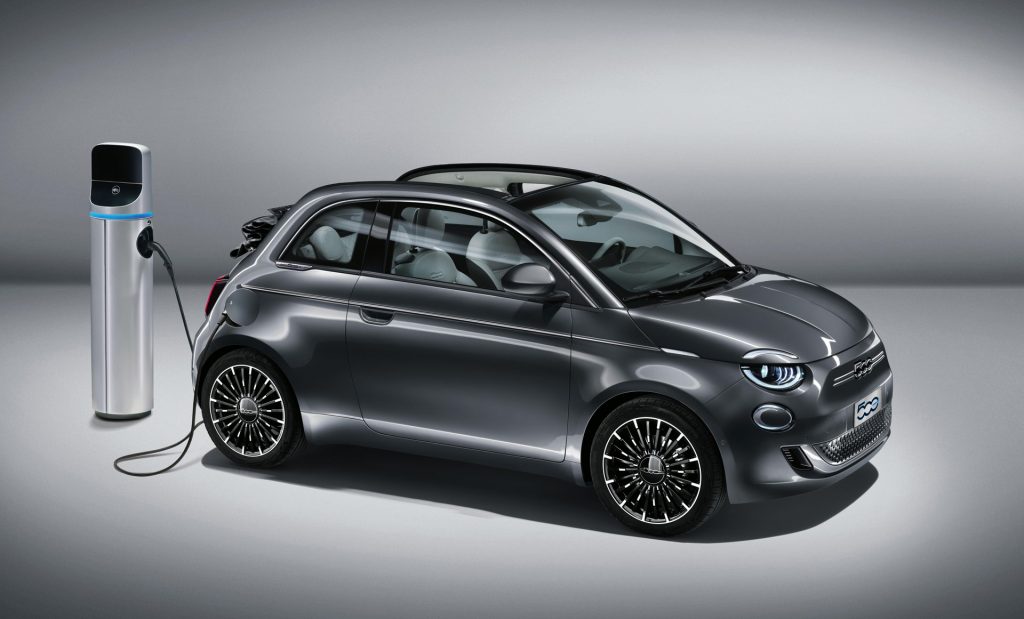
Time will tell, so watch this space! In the mean time here’s an artist’s impression of the 2021 model year Fiat 500 EV:

Is Hitachi’s V2G Charging Station Really “Unique”?

We pose that question because Mitsubishi Motors’ press release certainly makes it sound that way!

Hitachi Europe Ltd., Mitsubishi Motors and ENGIE have demonstrated a pioneering project to explore the potential for electric vehicles to act as a means of energy storage for an office building. For this demonstration, the consortium linked the first vehicle to everything (V2X) charger to ENGIE’s office building in Zaandam.

Hitachi’s innovative V2X Charger is the first recharger that cannot only recharge an electric car but can also discharge the energy back into the building/grid providing different flexibilities including kW, ΔkW, kWh and VAR. Moreover, it is possible to connect solar panels and external storage directly to the recharger, allowing a much more efficient electricity supply to buildings.

That all sounds as though Hitachi’s “innovative V2X Charger” is just the thing we need for our V2G “Living Lab” here in sunny South West England. Our “artist’s impression” of the concept is displayed above. As you can easily see it involves most of the buzz words from the press release, including V2H, V2G, Solar PV and “external storage”. It’s also 5 years old, which means we’ve done a lot of research into the necessary technology!

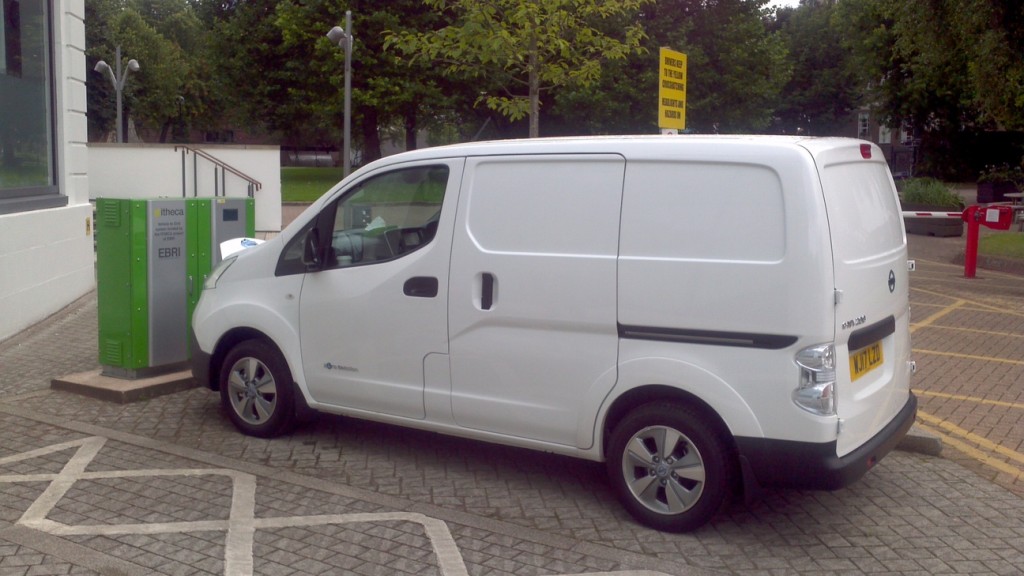
External storage and vehicle-to-building is obviously old hat. We’ve personally tested technology that does both those things at the University of Aston:
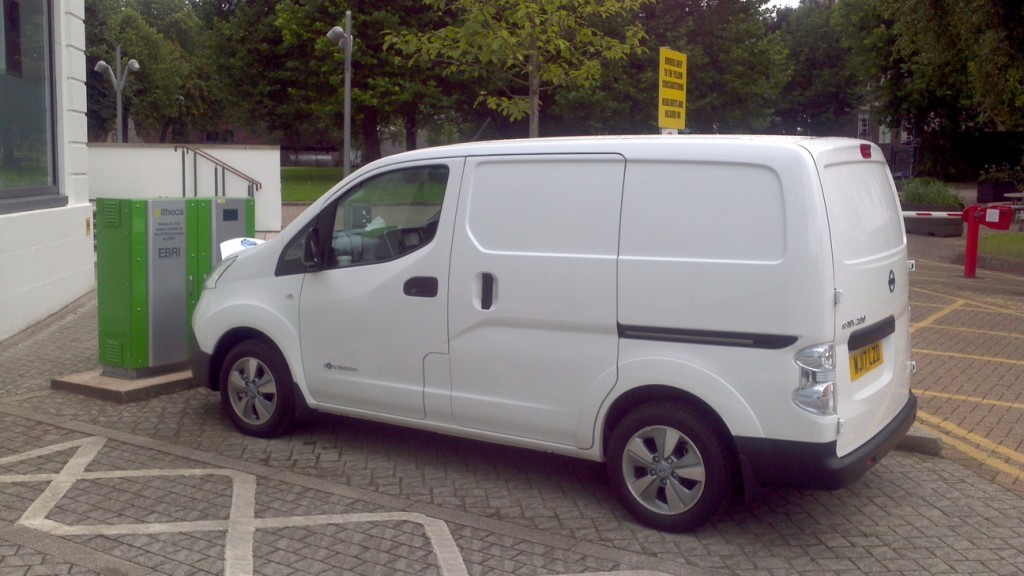
EBRI-eNV200

However the EBRI V2G pilot project didn’t incorporate “solar panels” so let’s take a look at another recent press release shall we? This one is from the Technical University of Delft in the Netherlands:

Electric vehicles and solar power systems are fundamentally direct current (DC) in nature, so conversion to AC leads to unnecessary conversion steps and losses. And two separate DC–AC inverters are required, increasing the cost and size of the power electronics.

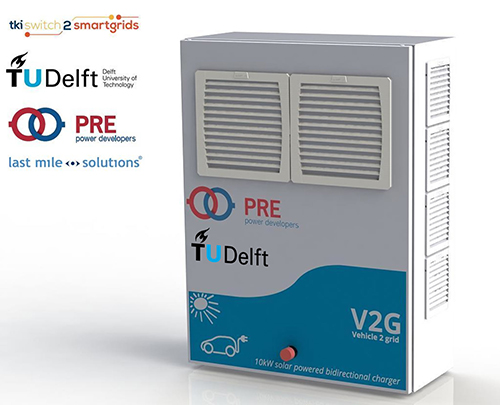
Why not use a single integrated converter that charges the electric vehicle from the solar power system on DC? That is what Mouli worked on during his PhD research. Based on Mouli’s doctoral research, TU Delft has developed a quick charger together with the Power Research Electronics and Last Mile Solutions companies which can charge cars directly with electricity from solar panels.

The TU Delft “quick charger” looks like this:
Gautham_Charger_500pix

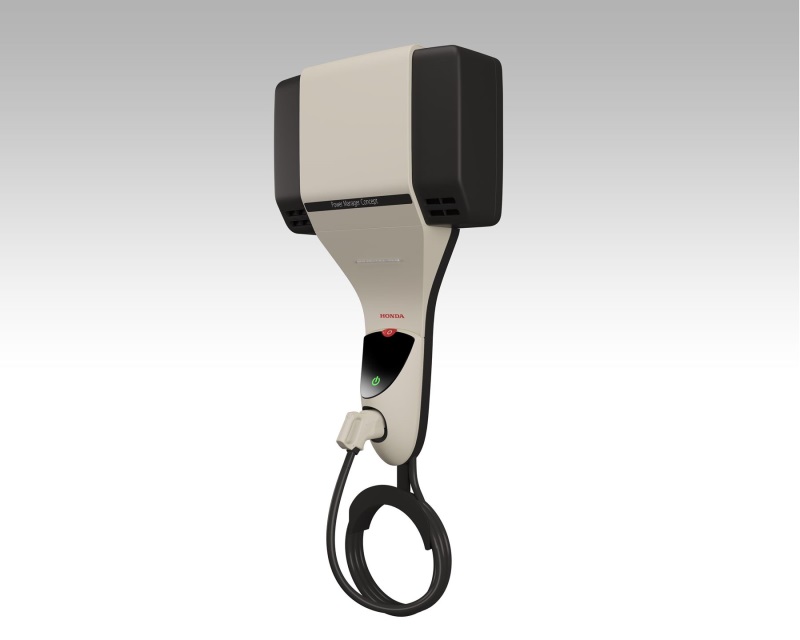
Delving further back into the mists of time last year we discussed Honda’s “Power Manager Concept” which looks like this:
honda-power-manager-800

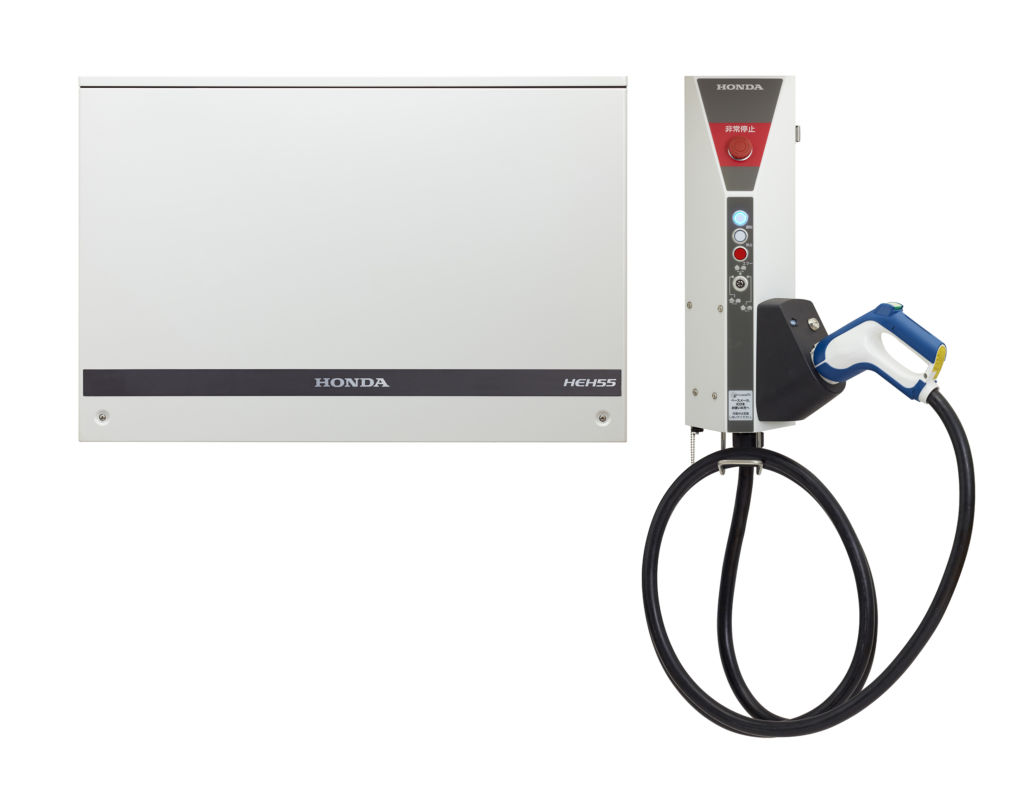
which is presumably based on their current Power Manager technology, which looks like this:
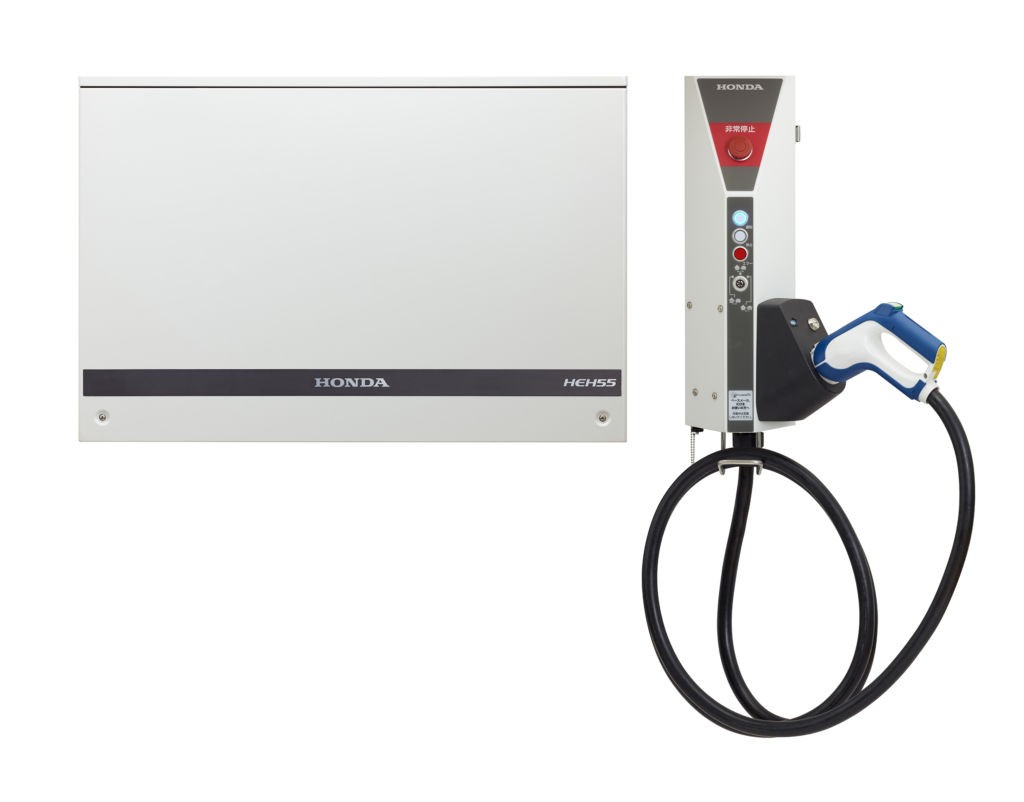
PowerManager-1024

According to Honda:

Power Manager Concept works by aggregating and distributing energy to and from the grid, solar panel-equipped homes or workplaces, and electric vehicles.

Electricity is received into the system from the grid or is generated by the solar panels and can be used to power and heat the building as well as to charge the EV. While the EV is plugged in, the energy can be stored and used at home or sold back to the grid, potentially generating value for EV owners.

Hitachi’s new offering evidently isn’t unique in that regard either then! Here’s their infographic of the ENGIE installation:

Hitachi-Mitsubishi

That makes it clear as a bell that they’re not doing pukka vehicle-to-grid yet either. Based on that image they also haven’t got any “static” battery storage installed at ENGIE yet.

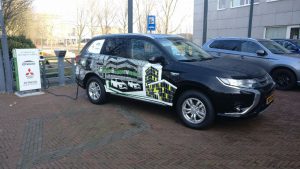
We reached out to Hitachi and Mitsubishi, and whilst both companies have been very helpful we still don’t have a photograph of the equipment installed at ENGIE to show you. Hitachi point out that “the PV/Battery inverter functionality is the unique aspect of our charger”, but it’s still not clear to us in what way Hitachi’s claim to offer “the first vehicle to everything (V2X) charger” is justified. That being the case we have a suggestion to make. Perhaps Hitachi could let us test one of their new units at our V2G Living Lab just outside Camelford in Cornwall. Then perhaps we could swiftly establish for ourselves the veracity of the claims of Mitsubishi Motors’ marketing department?


[Edit – April 4th]

Hitachi Europe have pointed me at this Dutch language press release from ENGIE which includes an image of their charging station in action:

ENGIE-Outlander-V2G