Hyundai Motor Group, South Korea’s top automaker, will stop developing new internal combustion engines in order to accelerate its transformation into an electric vehicle manufacturer.
Hyundai Motor Co., the group’s larger carmaker, closed its engine development division at its research and development center, according to industry sources on Dec. 23. The Namyang R&D Center in South Korea is the group’s brain with about 12,000 researchers.
“Now, it is inevitable to convert into electrification,” said the newly appointed R&D chief Park Chung-kook in an email to employees. “Our own engine development is a great achievement, but we must change the system to create future innovation based on the great asset from the past.”
The move came as the global automobile industry is moving towards EVs more rapidly than expected. An EV, which runs on an electric motor, does not need a powertrain, which includes an internal combustion engine and a transmission.
The engine development team was established in 1983 as the late Chung Ju-yung, Hyundai Group founder and grandfather of current Hyundai Motor Group Chairman Chung Euisun, ordered that the company make its own engine.
That’s a question I’ve been wondering about since UK retail electricity prices started rising and suppliers started going bust in droves. And I am not the only one. Here’s Enel CEO Francesco Starace speaking to CNBC back in the summer:
If you look at Europe this [electricity price spike] was quite easy to predict. 2021 is the first year in which the ETS (Emissions Trading Scheme) gets into this mechanism of cutting quotas as the slack shows up, and that’s working, and I think that is something that everyone was expecting to work and it’s doing the job. The question is whether this will become too much, or whether politicians will be able to understand that they have to be part of this game, and use fiscal levers to mitigate the impact on the most vulnerable customers.
No doubt there are also other factors at work, but one way and another we here in the United Kingdom seem be losing “this game” by many a mile at the moment.
Those “most vulnerable customers” are currently feeling the impact, as indeed are we when perusing our own electricity bills. I’ve been documenting that impact via videos of our own local friendly neighbourhood wind turbine at Upper Tremail when the wind is blowing, thanks to both Storm Arwen:
Here’s a recording of the recent, virtual Shared Transport Conference organised by Collaborative Mobility UK, which is timed to start with the keynote speech by Trudy Harrison, the current Under Secretary of State at the Department for Transport responsible for the decarbonisation of transport:
Trudy says a number of things of great interest to those of us that think that owning a car really should be a thing of the past for most residents of the United Kingdom. Take for example this from near the beginning:
We certainly need more voices such as [CoMoUK’s] so that we can design a transport system that is fit for the future and free of fossil fuels, which moves us away from the 20th century thinking centred around private vehicle ownership and towards greater flexibility, with personal choice and low carbon shared transport.
I think actually that the future is much closer than we may think. When you look at the progress that has been made in just a year, we’ve launched the Transport Decarbonisation plan, our Net Zero Strategy and of course we’ve hosted COP 26. And we’re trialling Future Transport Zones across the country, unleashing British innovation and transforming inner city journeys.
Fast forward to 5:05 and Trudy points out that:
According to Warwick Business School 78% of 18-24 year olds use a shared economy service, from Zipcar to Liftshare and Airbnb. These services are high convenience, and they can help people to manage the cost of travel flexibly, and in fact it’s becoming a lifestyle choice so transport must keep pace.
The Department for Transport’s “Decarbonising Transport” plan, published earlier this year, goes into much greater detail. For example the “Shared Mobility” section states that:
Shared mobility services can decarbonise and decongest our transport network, offer an alternative to traditional mass transit, and provide new forms of transport for the first and last mile connecting to public transport…
And outlines the following long list of “Commitments”:
We will take action to increase average road vehicle occupancy by 2030
We will publish guidance for local authorities on support for shared car ownership and shared occupancy schemes and services
We will support car clubs to go fully zero emission
We will consult on a Mobility as a Service Code of Practice
We will use national e-scooter trials to understand their environmental impact, safety, and mode shift potential to evaluate whether they should be legalised
We will reduce the barriers to data sharing across the transport sector
We have launched a new annual statistical release and guidance about transport’s impact on the environment and support its use by third parties
We will explore the introduction of a new sustainable travel reward scheme supported by businesses, community organisations and charities
We will support transport providers to develop communications campaigns that encourage mode-switch and sustainable transport behaviours
We will encourage and support UK businesses to lead the way in taking action to reduce emissions from their employees’ travel journeys through “Commute Zero”
We will identify specific opportunities for decarbonisation through innovation in rural areas in the upcoming Future of Transport: Rural Strategy
We will help build a skilled workforce for the future of transport
We at V2G UK cannot wait to see those commitments being put into practice. Especially the final two! As Trudy puts it at 9:00:
This is quite personal to me. These benefits should not be exclusive to city dwellers… I feel really strongly that this needs to be inclusive, and I also know that for many people in rural areas a car is a lifeline.
We have previously discussed the work of the Warwick Manufacturing Group on mitigating potential battery degradation by “intelligently managing V2G technology”. In a recent press release the EV-elocity project refers to a new WMG paper on that subject, reporting that:
A number of studies have identified the strategic importance of charging infrastructure to support the introduction of electrified vehicles (EVs) and to underpin consumer acceptance of the technology. For this reason, considerable research has been undertaken to evaluate the different facets of the technology, including the ability to charge at higher rates of electrical power, the introduction of smart charging (V1G) that allows dynamic management of the charging process in terms of both power and charge time and vehicle-to-grid (V2G) that enables bidirectional energy flow between the vehicle and the supply. In recent years, the term V2G has become more generalised to V2X, to acknowledge the variability in which the EV may be integrated, either to the grid or behind-the-meter, for example within a local electrical network, such as a building (V2B).
Irrespective of the exact nature of the integration method, understanding the impact of different strategies on battery degradation is a key requirement that may ultimately underpin consumer acceptance. Only a few studies have examined the potential impact of V2G operation on battery degradation. Often their assertion is that the increased charge-throughput will negatively impact battery life. These works often neglect that the battery will equally degrade through a process of calendar-ageing in which the retained capacity of the battery reduces as the battery is stored at no-load.
As highlighted in these results from the EV-elocity project, the nature of the degradation is highly complex with dependencies that crosscut: the state of charge (SOC) of the battery with respect to the optimal SOC storage condition and the duration of the parking interval. To further compound the challenge, experimental results shows that the optimal SOC point varies with battery life.
Transport electrification is a key enabler to reduce fossil fuel depletion and related carbon dioxide emissions. However, critical barriers exist in terms of battery costs and their expected life. Vehicle-to-grid technology can bring benefits to both the electrical power grid and electric vehicle owners, while its practical implementation faces challenges due to the concerns over accelerated battery degradation. This paper presents a comprehensive study on reduced Lithium-ion battery degradation through state-of-charge pre-conditioning strategies that allow an electric vehicle to participate in vehicle-to-grid operations during periods in which the vehicle is parked. Energy capacity reduction of the electric vehicle battery are predicted using semi-empirical ageing models, which have been built and validated to capture the degradation behaviours of the battery with respect to both calendar and cycling ageing. Five charging strategies for battery state-of-charge pre-conditioning have been developed to evaluate the ability to mitigate battery ageing before commencing vehicle-to-grid operations. Simulation studies on battery degradation utilizing such charging mechanisms under two different operational profiles have been undertaken.
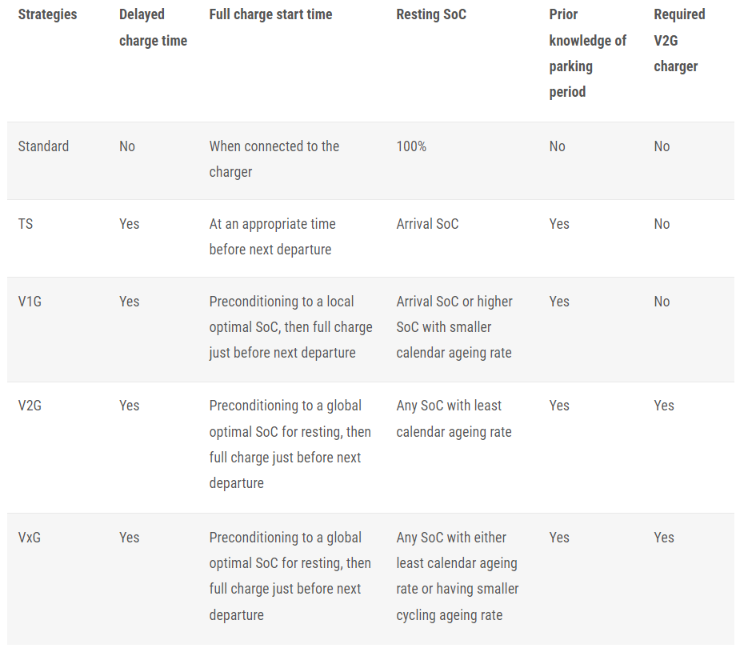
At this point you may be wondering exactly what the various charging mechanisms entail? Here’s a summary of the assorted strategies from the press release:
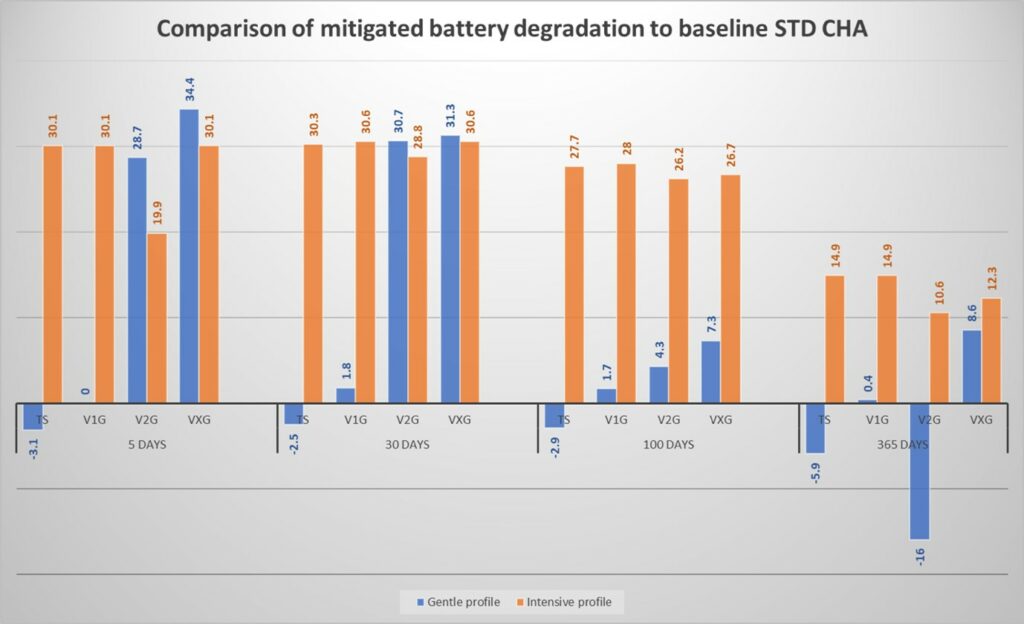
and here’s a summary of the results:
Going back to the abstract from the Bui et al. paper, the brief conclusions are that:
The analytical results show that the proposed charging strategies do not accelerate battery degradation and are capable of mitigating the total ageing process from 7.3 – 26.7% for the first 100 days of operational life and gradually vary to 8.6 – 12.3% for one-year continual operation compared to the reference standard charging approach.
To summarise, leaving your electric vehicle plugged in and “fully charged” is not good for the “state of health” of its traction battery. Here’s a video from Euan McTurk that delivers a similar message:
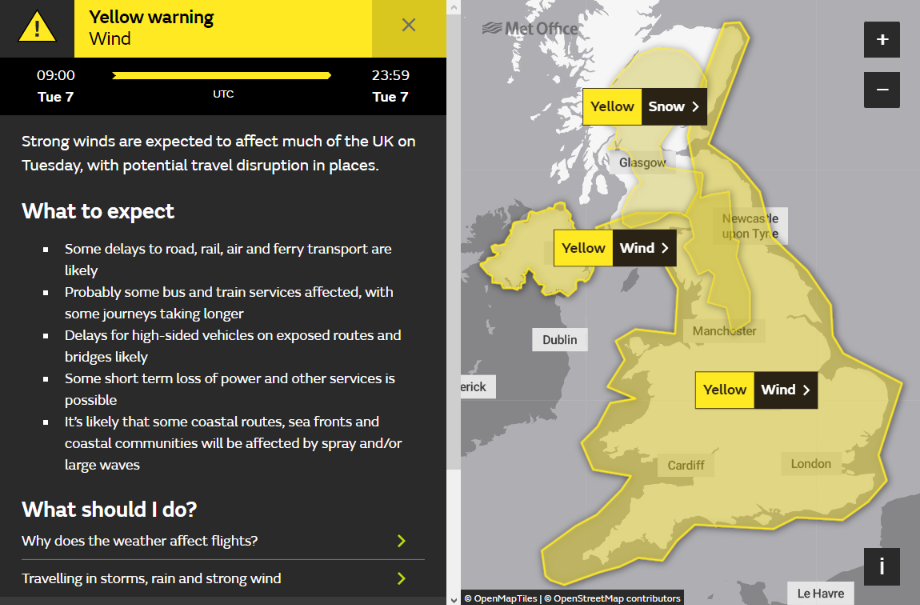
As we anticipated yesterday, Storm Barra has been officially named by Met Éireann even though the remaining power cuts due to Storm Arwen have yet to be repaired:
#StormBarra has been named by @MetEireann and is forecast to bring strong winds to much of the UK and snow to northern areas on Tuesday and into Wednesday
You could argue that Toyota’s recent launch of a 100% battery, non hybrid, electric vehicle was worthy of an article on this web site, but what with one thing and another we had more important things to write about. However that has now changed!
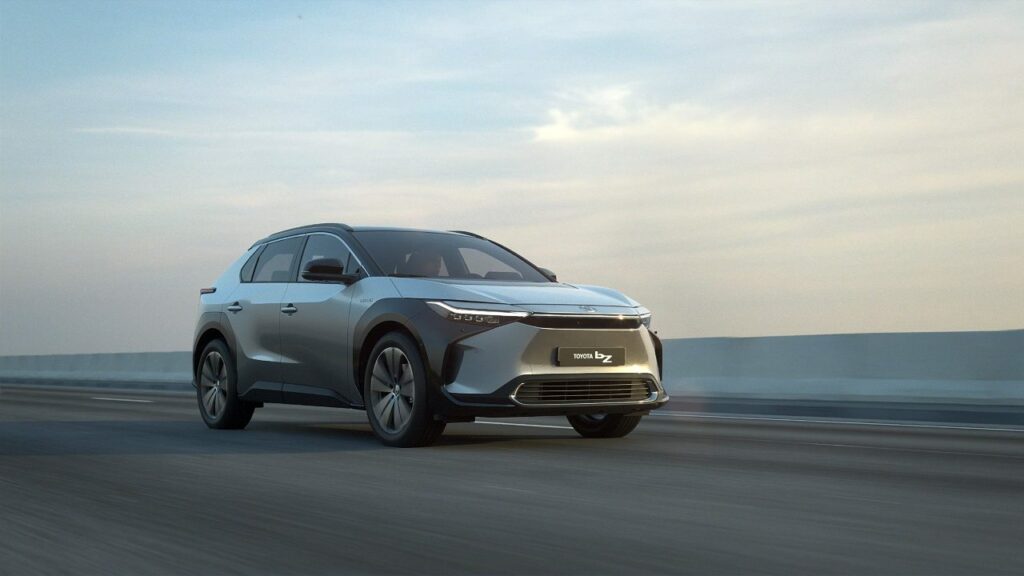
Today, Toyota presents the world premiere of the all-new bZ4X, the first model in a new series of bZ – beyond Zero – battery electric vehicles (BEVs).
Faithful in its design and technology to its concept predecessor, revealed earlier this year, the production-ready bZ4X is the first model to be developed by Toyota entirely as a BEV. It is also the first car to be built on the company’s new dedicated BEV platform. Based on e-TNGA philosophy, this has been co-developed by Subaru and Toyota.
Incorporating the battery unit as an integral part of the chassis, beneath the vehicle floor, it gives the fundamental benefits of a low centre of gravity, excellent front/rear weight balance and high body rigidity for high levels of safety and ride and handling quality…
With a fully charged battery, expected range is more than 280 miles (depending on version, exact data to be confirmed later). The bZ4X will also offer advanced technology features, including a solar panel roof to help charge the battery while driving or parked, and third generation Toyota Safety Sense with new and improved active safety and driver assistance systems.
The bZ4X will have its European premiere on 2 December; customers who want to be among the first to obtain the new model will be able to place a reservation via the Toyota.co.uk website from 15 December.
Toyota has drawn on almost 25 years’ experience in electrified vehicle battery technology to ensure the new lithium-ion unit in the bZ4X has world-leading quality, durability and reliability. Its confidence in the technology is reflected in an extended care programme that guarantees the battery will still operate to 70 per cent of its original capacity after up to 10 years of ownership or one million kilometres driven, subject to the customer taking their vehicle to an authorised Toyota service centre for an annual health check. To ensure this guarantee could be offered, Toyota developed the battery with a target of 90 per cent of capacity retained after 10 years/240,000 km.
This level of quality and performance is supported by multiple monitoring of the battery’s voltage, current and temperature, from individual cell level. If any abnormal heat generation is detected, controls are automatically triggered. Countermeasures have been put in place to mitigate any material degradation, and there are safeguards in the manufacturing process to prevent foreign matter from entering the battery. In a Toyota first, the battery is water-cooled.
All very interesting of course but still no mention of any mechanism for discharging the bZ4X’s water cooled battery to the outside world. Until now that is! Earlier today my attention was drawn to the Toyota Global bZ4X launch video:
https://youtu.be/d9qp2eoOWCk?t=230
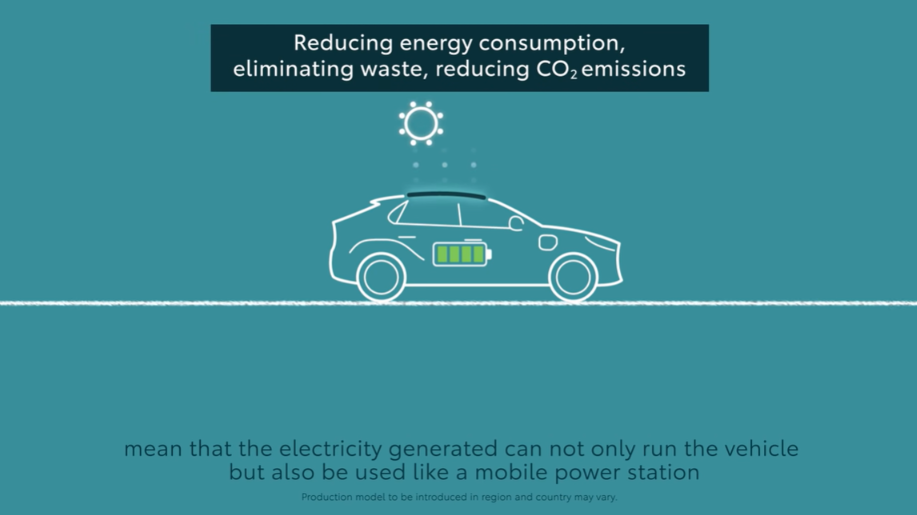
On board solar panels included with the bZ mean that the electricity generated can not only run the vehicle but also be used like a mobile power station in emergencies and in outdoor activities.
Which sounds an awful lot like V2L to me! Close inspection of the associated press release reveals the following information:
Roof solar panel (specially equipped vehicles)
Generates electricity equivalent to 1,800 km of driving distance per year (in-house estimate), contributing to superb cruising range. Can charge in parking lots where there are no charging stations, and solar power can be used to charge in disasters or other emergencies.
DC external power supply function (Japanese specifications)
Can connect to a power feeder to supply high-output electricity to homes and home appliances for outdoor activities, and during disasters and other emergencies.
When used with home solar power generation, solar power can supply electricity to the house in the daytime, surplus electricity can be used to recharge the vehicle via a power feeder, and electricity stored in the vehicle can be used to power the home at night.
The bZ4X is scheduled for launch in all regions from mid-2022.
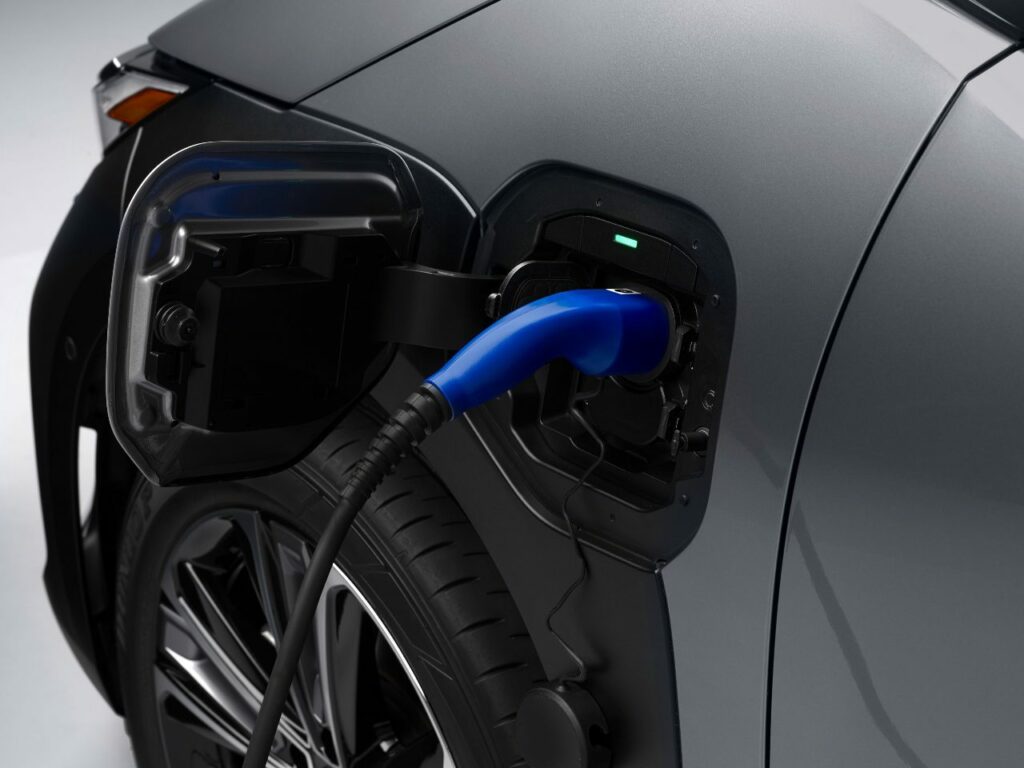
Which is extremely interesting, because unlike other V2L/V2H capable EVs that have been announced recently this one seems to claim that it offers a “high-output DC” rather than a “low-output AC” feed:
However be sure to read the (very) small print. Only in Japan by the sound of it.