As yet another named storm arrives on the coast of North Cornwall the UK Government has just published what they describe as an “interim report” into the events of last November when Storm Arwen struck more northern parts of the nation. As the news release puts it :
The review was launched last year by the Business and Energy Secretary Kwasi Kwarteng in the wake of one of the worst storms in decades, with Storm Arwen bringing significant and widespread severe weather to the UK and leaving just under 1 million households experiencing power cuts, 59,101 of whom were without power for over 48 hours and 3,032 for a week or more.Today’s Interim Report has identified early key findings and initial recommendations based on preliminary evidence including that call wait times for customers to speak to network operators were too high, and that some households, especially in rural areas, experienced unacceptably long power cuts.
Nearly 90% of those affected received compensation payments by 24 January, following the Business and Energy Secretary writing to network providers to ensure this was paid as soon as possible – with the timeliness of payments a key focus of the review.
As the government made clear at the time, it was completely unacceptable that thousands of homes were left without power for so long, which is why a specific review into how network operators responded to Storm Arwen was launched to identify lessons and recommendations for the management of future power disruption events.
Some of the key initial findings in the Interim Report include:
- recognising that wait times for some customers to contact their network operator were unacceptably high, and recommending that more needs to be done to manage both the method and content of customer communications effectively during severe events to allow customers to make informed decisions about their welfare
- identifying the unusual northerly wind as putting the network at more risk, recommending Network Operators and partners should better account for wind direction as well as speed and duration in their escalation thresholds
- acknowledging there were unacceptably long power cuts to some households, especially those in rural areas, and recommending enhancing strategies to reduce the length of time customers remain off supply following severe and widespread power disruption
- recommending that new processes should be established to ensure payment of compensation to affected customers occurs without delay
The review is in addition to the industry regulator Ofgem’s which is looking at how each individual network operator performed against the legal standards they are required to, such as whether network operators made sufficient investments in infrastructure in areas that experienced faults. Where operators did not meet these standards, Ofgem will consider if appropriate enforcement action needs to be taken against them.
Ofgem can impose financial penalties of up to 10% of a licensee’s turnover, make consumer redress orders and issue provisional/final orders, where appropriate, for breaches of relevant conditions and requirements under the Gas Act 1986 and the Electricity Act 1989.
A final report, detailing specific actions and delivery plans for their implementation, is due around the end of March 2022, when Ofgem will also publish findings from their review into the handling of the storm. In the meantime, the review will continue to work on the issues that have been identified, in order to learn lessons and develop recommendations for the prevention and management of storms.
A brief extract from the interim report itself discusses the primary causes of damage:
The impacts of Storm Arwen were felt across Great Britain’s electricity system, with 13 of the 14 network licence areas being affected, although to differing extents. The only network licence area not affected was UK Power Network’s London area.
In total, nearly 6,500 faults were recorded by the network operators, predominately to overhead line circuits. On the peak day of the storm, 27 November, Network Operators recorded 2,478 faults, 10 times more on average than a typical day. These faults on the electricity system resulted in just under 1 million customers being without electricity for between 3 minutes and 12 days. This equates to 3.2% of customers across Great Britain experiencing a power cut for more than three minutes as a result of Storm Arwen.
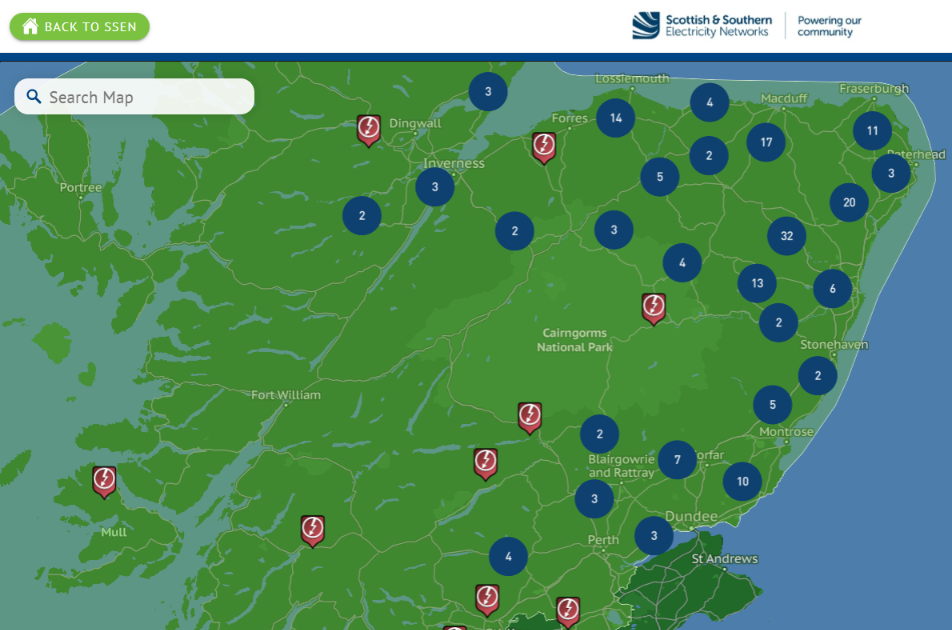
The damage inflicted by Storm Arwen on electricity networks was far more severe in some regions of Great Britain compared to others, with Scotland and Northern England, particularly along the Eastern Coast in regions such as Aberdeenshire, Northumberland and Yorkshire being the most affected.
The high number of fallen and broken trees was due to the high wind speeds from the north, which is not the prevailing wind direction for most of the UK. Trees grow to withstand winds coming from the prevailing direction, which in most cases is from the south-west. As a consequence, Storm Arwen brought down and uprooted/snapped more trees causing more faults on the electricity networks than similar wind speeds from the south-west would have done.
Storm Arwen caused relatively little damage to higher voltage lines, although this varied geographically, largely due to them being supported by more robust lattice towers, rather than wooden poles. The vast majority of faults occurred on the lower voltage lines. The main causes of failure were caused by:
- Trees falling directly onto the overhead lines/wooden poles.
- Flying debris bringing down/getting entangled in the overhead lines or on to equipment within the substations
- Strong winds snapping overhead lines or wooden poles that support them.
- Ice forming around the overhead lines causing them to break under the weight and additional resistance in the sustained high winds.
In some places underground cables are used in place of overhead lines. While more resilient to high winds, they pose other technical challenges, and the cost of undergrounding is between 2 and 20 times more expensive than overhead lines. The decision to invest in underground cables is driven by a balance of risk and costs that is regularly reviewed by operators and the regulator.