Will GB Energy be keen on V2G?

Just in case you missed the news, the Labour Party have been holding their annual conference this week. During his well received speech current Labour Party leader Keir Starmer had this to say:

We will set up Great British Energy in the first year of a Labour Government. A new company that takes advantage of the opportunities in clean British power. And because it is right for jobs. Because it is right for growth. Because it is right for energy independence from tyrants like Putin…

The exciting news about the potential “GB Energy” publicly-owned low carbon energy company seems to have been generally well received. For example the New Civil Engineer had this to say:

Labour leader Keir Starmer’s plan to create a publicly-owned renewable energy company is a positive step for the industry, according to Energy and Climate Intelligence Unit senior analyst Jess Ralston.

At the Labour Party conference, Starmer announced proposals to create the new company, named Great British Energy, if Labour wins the next general election.

The company would be similar to France’s EDF and aim to ensure an expansion in clean energy, focusing on offshore wind, onshore wind, nuclear, solar, hydrogen and tidal power.

Ralston told NCE that the clean power industry will be “boosted” by the plans.

“The devil will be in the detail but more broadly it does show that Labour clearly see clean power – whether it be nuclear or wind, solar and renewables – as the future of the energy system and putting government money behind it would help investors see the security there and help private investment be leveraged as well,” she said.

A few years ago, in the days when Jeremy Corbyn was Labour leader, John McDonnell had this to say concerning vehicle-to-grid technology:

Speaking on the Today programme, Shadow Chancellor John McDonnell announced that Labour will introduce 2.5 million interest free loans for the purchase of electric cars.

The loans of up to £33,000 will allow low to income households, those living in rural areas and independent contractors and SMEs middle to save on new electric cars. The government will cover the £1,500 cost of interest on a loan, with individuals saving up to £5,000 over time.
The scheme will ensure that access to the Electric Car Revolution is broadened beyond elites, as part of Labour’s vision of clean transport for everyone.

The interest-free loans will require participation in a mass trial of Vehicle-2-Grid technology which will allow the UK to transition to renewable energy.

This new technology will allow electric cars to store excess energy from the national grid, smoothing energy supply from renewable sources.
The scheme will boost the British automobile industry and support the UK’s transition away from petrol and diesel cars.

One cannot help but wonder what views the current Shadow Chancellor,
Rachel Reeves, holds on the three letter acronym most dear to our hearts here at V2G UK?

Ditto for the current Chancellor of the Great British Exchequer!

Watch this space!

An Open Letter to Trudy Harrison, Scott Mann et al.

Particularly given recent events in Ukraine and the publication of the IPCC’s AR6 WG2 report the urgency of this issue increases with every day that passes. Hence I reproduce below an email I sent to Trudy Harrison MP on December 17th 2021.

Below that is the only response I have received to date:

Electric Vehicles (Smart Charge Points) Regulations 2021

To: Trudy Harrison MP
Cc: Scott Mann MP

Hello Trudy,

I originally e-met Rachel Maclean via a Cicero Group webinar. Since you have now taken over her role it seemed appropriate to introduce myself to you, particularly in view of the Prime Minister’s recent announcement about electric vehicle charging points.

In particular I am the only UK representative on a wide range of “smart grid” and “EV charging” international (and hence British) standards setting committees. I also sit on the British Standards Institution’s L/13 “smart energy overview” committee as the UK’s leading expert on V2G technology.

If possible I would like to discuss some of the “interoperability standards” implications of the draft legislation associated with the Prime Minister’s statement with someone in Government. Who do you recommend?

Best wishes,

Jim Hunt
CEO
V2G EVSE Limited

=================================================================

Thank you for contacting me.  Please accept this as an acknowledgement of your email. You will receieve a response within 7 days.

Please note the following:

·  If you are a constituent please ensure that you have provided your full name and address, including postcode. There is a strict Parliamentary protocol that MPs only deal with matters raised by residents of their own constituency. 

· Where possible, all circular email campaigns will be responded to by letter and on my website – https://www.trudyharrison.co.uk/

· I may need to pass your details and email to any relevant authority deemed appropriate to help answer your query. If you do not wish this to happen you need to inform my office to this effect.

Thank you for taking the time to write to me.

=================================================================

UK Publishes Interim Report on Storm Arwen Review

As yet another named storm arrives on the coast of North Cornwall the UK Government has just published what they describe as an “interim report” into the events of last November when Storm Arwen struck more northern parts of the nation. As the news release puts it :


The review was launched last year by the Business and Energy Secretary Kwasi Kwarteng in the wake of one of the worst storms in decades, with Storm Arwen bringing significant and widespread severe weather to the UK and leaving just under 1 million households experiencing power cuts, 59,101 of whom were without power for over 48 hours and 3,032 for a week or more.

Today’s Interim Report has identified early key findings and initial recommendations based on preliminary evidence including that call wait times for customers to speak to network operators were too high, and that some households, especially in rural areas, experienced unacceptably long power cuts.

Nearly 90% of those affected received compensation payments by 24 January, following the Business and Energy Secretary writing to network providers to ensure this was paid as soon as possible – with the timeliness of payments a key focus of the review.

As the government made clear at the time, it was completely unacceptable that thousands of homes were left without power for so long, which is why a specific review into how network operators responded to Storm Arwen was launched to identify lessons and recommendations for the management of future power disruption events.

Some of the key initial findings in the Interim Report include:

  • recognising that wait times for some customers to contact their network operator were unacceptably high, and recommending that more needs to be done to manage both the method and content of customer communications effectively during severe events to allow customers to make informed decisions about their welfare
  • identifying the unusual northerly wind as putting the network at more risk, recommending Network Operators and partners should better account for wind direction as well as speed and duration in their escalation thresholds
  • acknowledging there were unacceptably long power cuts to some households, especially those in rural areas, and recommending enhancing strategies to reduce the length of time customers remain off supply following severe and widespread power disruption
  • recommending that new processes should be established to ensure payment of compensation to affected customers occurs without delay

The review is in addition to the industry regulator Ofgem’s which is looking at how each individual network operator performed against the legal standards they are required to, such as whether network operators made sufficient investments in infrastructure in areas that experienced faults. Where operators did not meet these standards, Ofgem will consider if appropriate enforcement action needs to be taken against them.

Ofgem can impose financial penalties of up to 10% of a licensee’s turnover, make consumer redress orders and issue provisional/final orders, where appropriate, for breaches of relevant conditions and requirements under the Gas Act 1986 and the Electricity Act 1989.

A final report, detailing specific actions and delivery plans for their implementation, is due around the end of March 2022, when Ofgem will also publish findings from their review into the handling of the storm. In the meantime, the review will continue to work on the issues that have been identified, in order to learn lessons and develop recommendations for the prevention and management of storms.

A brief extract from the interim report itself discusses the primary causes of damage:

The impacts of Storm Arwen were felt across Great Britain’s electricity system, with 13 of the 14 network licence areas being affected, although to differing extents. The only network licence area not affected was UK Power Network’s London area.

In total, nearly 6,500 faults were recorded by the network operators, predominately to overhead line circuits. On the peak day of the storm, 27 November, Network Operators recorded 2,478 faults, 10 times more on average than a typical day. These faults on the electricity system resulted in just under 1 million customers being without electricity for between 3 minutes and 12 days. This equates to 3.2% of customers across Great Britain experiencing a power cut for more than three minutes as a result of Storm Arwen.

The damage inflicted by Storm Arwen on electricity networks was far more severe in some regions of Great Britain compared to others, with Scotland and Northern England, particularly along the Eastern Coast in regions such as Aberdeenshire, Northumberland and Yorkshire being the most affected.

The high number of fallen and broken trees was due to the high wind speeds from the north, which is not the prevailing wind direction for most of the UK. Trees grow to withstand winds coming from the prevailing direction, which in most cases is from the south-west. As a consequence, Storm Arwen brought down and uprooted/snapped more trees causing more faults on the electricity networks than similar wind speeds from the south-west would have done.

Storm Arwen caused relatively little damage to higher voltage lines, although this varied geographically, largely due to them being supported by more robust lattice towers, rather than wooden poles. The vast majority of faults occurred on the lower voltage lines. The main causes of failure were caused by:

  • Trees falling directly onto the overhead lines/wooden poles.
  • Flying debris bringing down/getting entangled in the overhead lines or on to equipment within the substations
  • Strong winds snapping overhead lines or wooden poles that support them.
  • Ice forming around the overhead lines causing them to break under the weight and additional resistance in the sustained high winds.

In some places underground cables are used in place of overhead lines. While more resilient to high winds, they pose other technical challenges, and the cost of undergrounding is between 2 and 20 times more expensive than overhead lines. The decision to invest in underground cables is driven by a balance of risk and costs that is regularly reviewed by operators and the regulator.

Storm Arwen Blacks Out Scotland

The United Kingdom’s Meteorological Office has officially named the first severe storm of the winter of 2021/22:

As you can see from the forecast above, very strong winds are forecast to hit the north east coast of Scotland later today, which will inevitably lead to a large number of power cuts.

The UK Met Office has now also issued a red weather warning for Storm Arwen:

https://twitter.com/metoffice/status/1464187971230482443

[Edit – November 26th 22:00]

High winds speeds in Scotland have been expected, but the coast of South Devon has also been subject to gusts over 60 mph:

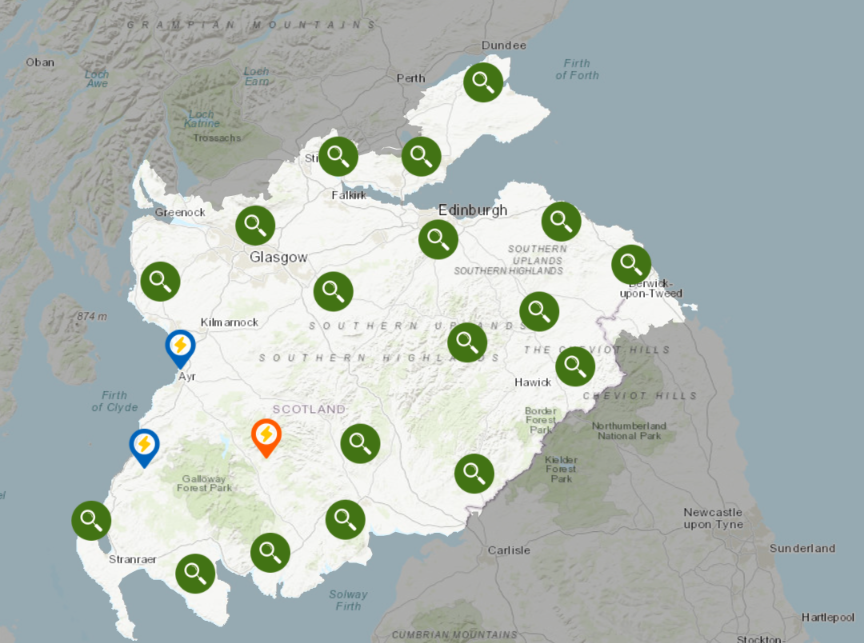
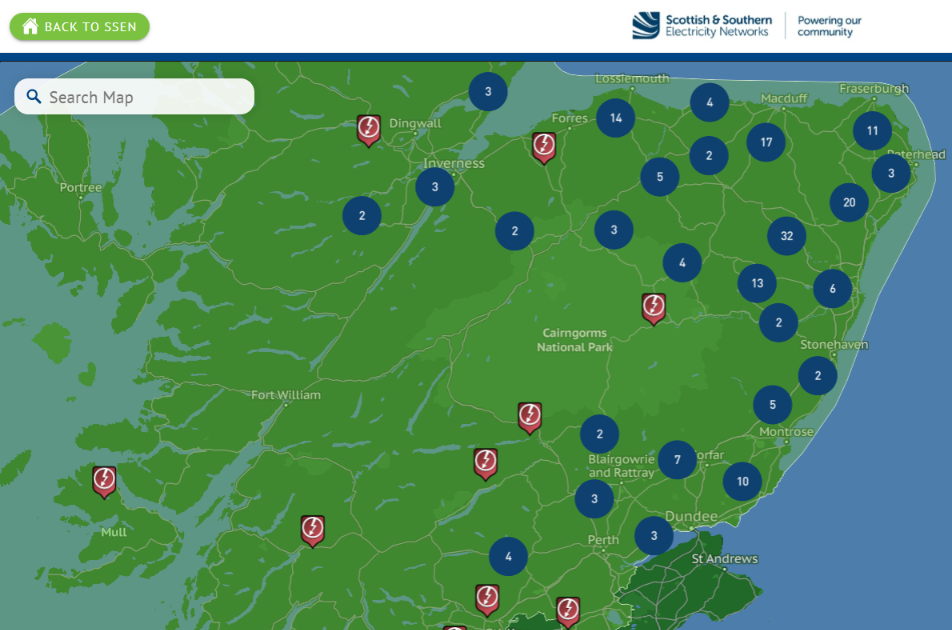
Here’s the latest power cut map for the north of Scotland from Scottish and Southern Electricity, showing a total of 201 “unplanned outages”:

and here is Scottish Power’s map for further south:

Continue reading →

Rolls-Royce SMR Seeks Regulatory Approval

In a press release yesterday Rolls Royce SMR Ltd. announced that:

Rolls-Royce SMR Ltd has submitted a 470MW Small Modular Reactor (SMR) design for entry to the UK’s Generic Design Assessment (GDA) regulatory process.

The first step is to secure clearance from the Department for Business Energy and Industrial Strategy (BEIS) through its initial screening process, which will confirm the Rolls-Royce SMR business is suitability qualified to enter the Office for Nuclear Regulation, Natural Resources Wales and Environment Agency’s combined GDA process.

This initial screening process reviews whether a company has the capability and capacity to successfully enter the UK GDA process. The Government evaluation process is expected to take up to four months before the regulators can begin their formal review process.

Continue reading →

Global Power System Transformation Consortium Announced

Imperial College announced in a news release yesterday that:

US and UK ministers launch a global effort – which features Imperial expertise – to speed up the energy transition.

An innovative public-private partnership to accelerate the clean energy transition by transforming our power systems has been formally launched, ahead of US President Joe Biden’s Earth Day climate summit.

The Global Power System Transformation Consortium (G-PST), which includes technical expertise from Imperial, was officially launched by the UK Secretary of State for Business, Energy and Industrial Strategy Kwasi Kwarteng and US Secretary of the Department of Energy Jennifer Granholm, alongside CEOs of power system operators and institutions from around the world.

G-PST aims to enable the integration of renewable energy sources into power systems at an unprecedented scope and scale, contributing to a 50 per cent reduction in emissions of all pollutants over the next ten years.

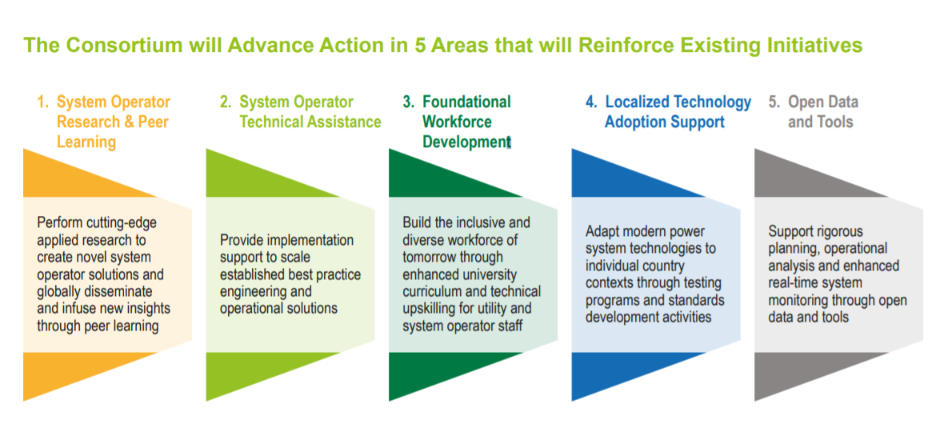
The Global PST Consortium Action Areas

Kwasi Kwarteng pointed out that:

Tackling climate change requires international cooperation and if we want to successfully achieve cost-efficient, green energy networks that work for everyone, we need to work together.

As a world leader in both technological innovation and the renewable energy market, I am delighted that the UK is co-hosting the launch of this new consortium, uniting the very best of business, research and academia to bring world-class renewable energy to the grid – key for economic growth, job creation, the climate and building back greener.

Unfortunately Kwasi didn’t go into detail about exactly how “building back greener” would “bring world-class renewable energy to the grid “, desirable as that undoubtedly is.

However some academics and engineers are members of the Global PST Consortium:

Continue reading →