Fully Charged Delivers Moving Pictures of the ARRIVAL e-Van

We previously got quite excited about the Great British ARRIVAL electric (not diesel!) van. At that time there were some snarky comments on social media to the effect that “The van never moves in that video”. Well now it most certainly does! Take a look at the latest episode of Robert Llewellyn’s Fully Charged:

Of course we eagerly awaited some mention of our favourite three letter acronym – “V2G”. Unlike the recent launch of the new Ariya eSUV from Nissan, we were not disappointed by this update on the progress at ARRIVAL. Notice that at 4:00 into the video Robert Llewellyn asks:

Are these vehicles, for instance, vehicle-to-grid capable. Bi-directional charging is possible?

to which Patrick Bion, ARRIVAL’s head of product replies:

Absolutely!

Which is very good to hear from our admittedly biased perspective. A bit later on, at
7:30, Robert says:

I can see they have rapid charging capabilities, they have CCS charge sockets.

and Patrick confirms:

Yeah, that’s right.

Putting those two snippets of information together and you get the magic words “V2G [over] CCS”!

Here’s our take on this convoluted story from our Twitter feed:

and here’s our (hopefully ARRIVAL compatible!) bi-directional charging station, which has been patiently waiting for an ARRIVAL van’s arrival in our more modest car park since this time last year:
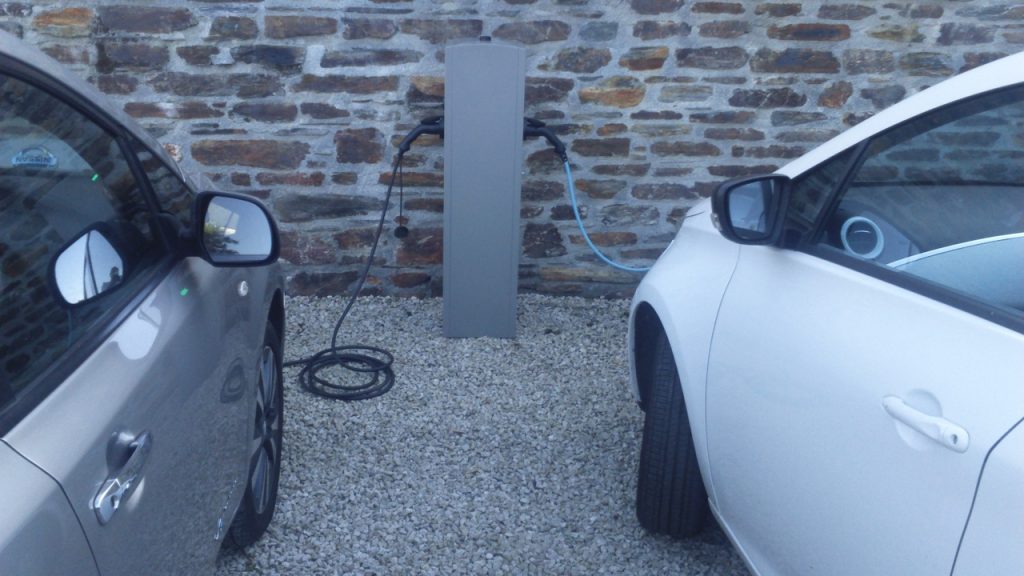
Here too is a video of our “soft launch” during the V2G panel session at the Fully Charged Live show at Silverstone in 2019:

Watch this space!

For another year? Or perhaps even until 2025 as officially pronounced by CharIN not so very long ago?
Audi & Hager Group Research V2H

Without even mentioning the term vehicle-to-grid Audi announced in a press release last week that:


Increasing network stability, lowering electricity costs, and contributing to climate protection – that is the vision that Audi and the Hager Group are pursuing. The incorporation of the electric car into the domestic grid is at the core of an innovative research project on bidirectional charging. This offers major advantages in combination with a photovoltaic system in particular. Excess PV electricity can be stored temporarily and output as needed.

Audi has committed to the objectives of the Paris Climate Agreement and is working on making its vehicle fleet CO2-neutral by 2050. In order to achieve this aim, the brand with the four rings is pursuing a broad electric offensive that involves launching around 20 fully electric models by 2025. And not only that: The electric car is to evolve into part of an increasingly broad mobility offer and become an element of the sustainable energy transition.

Electric cars as part of the energy transition

The press release does however mention a slightly less familiar three letter acronym:


The idea is as simple as it is genius: The high-voltage battery of the electric car not only is charged via the wall box at home but can also supply energy back to the house as a decentralized storage medium. If the customer has a photovoltaic system, the electric car serves as a temporary storage medium for the domestically generated eco-electricity. When the sun is no longer shining, the vehicle can supply the stored electricity back to the house. Bidirectional charging at home – also known as Vehicle to Home (V2H) – has great potential to reduce the home owner’s electricity costs and increase network stability. As a further expansion stage in combination with a home storage unit, it is possible to achieve near complete energy independence and increased security of supply in the event of a blackout. “Using the battery of electric vehicles to contribute to climate protection while lowering electricity costs at the same time is a vision that we have found fascinating since the very beginning. And we have found an ideal partner in Audi,” explains Ulrich Reiner, project manager at Hager Group.

We are very pleased to hear Audi state that “The idea is… genius “, since we put our “artist’s impression” of our “Static and Mobile Distributed Energy Storage” (SaMDES for short) concept in the banner at the top of every page on the V2G UK web site over 7 years ago!

Audi explain our V2H genius in greater detail in slightly stilted English as follows:

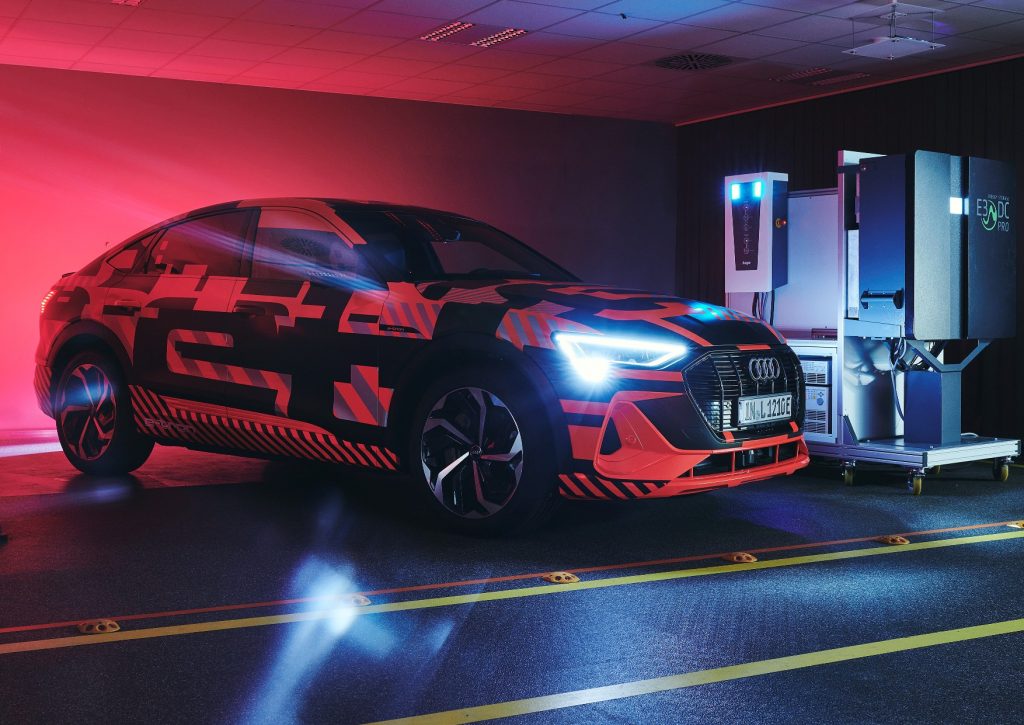
What sounds simple in theory requires a high level of technical intelligence and coordinated interaction between different technical components in terms of infrastructure and in the vehicle in practice. An Audi e-tron with near-series charging technology was used in the research project. In the test grid, the fully electric Audi model operated with a DC wall box, which enables a charging capacity of up to 12 kW, and a flexibly extendable home storage unit with a capacity of 9 kWh. While it could provide additional flexibility in possible series production, it is not a necessary requirement for bidirectional charging. Thanks to the DC voltage level in the overall grid, the connection between the PV system and the vehicle does not require an inverter and is thus a particularly efficient solution.

One thing Audi and Hager have done that we hadn’t quite managed to get around to just yet is to create a video that explains our SaMDES concept in an approachable way and set to music. Here it is:

Do you suppose that given all their resources Audi will eventually catch up with us?


Nissan Launches CHAdeMO-less Ariya eSUV

In a press release earlier this week Nissan announced that it had:

Revealed to the world the all-new Nissan Ariya electric coupé crossover, marking a new chapter for Nissan electric vehicles. The EV premiered globally through a virtual event hosted at the soon-to-open Nissan Pavilion in Yokohama.

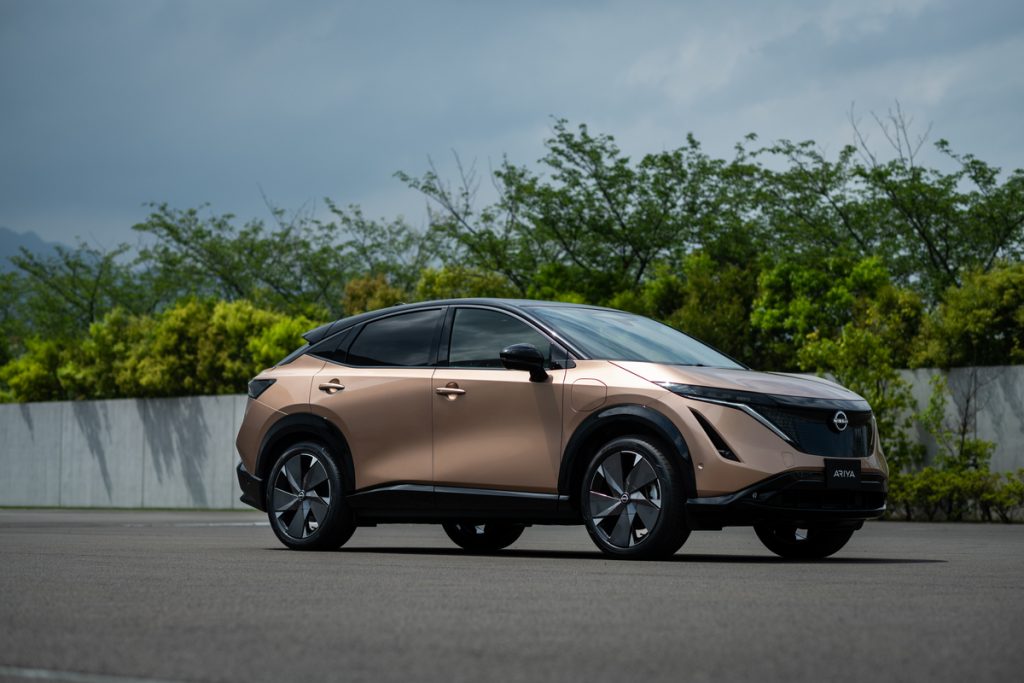
The Ariya – Nissan’s first all-electric coupé crossover– offers powerful acceleration and smooth, quiet operation, as well as an interior with a welcoming, luxurious lounge-like atmosphere. Its stress-free autonomous driving features, voice personal assistance and seamless connectivity heighten on-road confidence and provides a welcoming environment for the driver and passengers. And with an estimated range of up to 500 kilometers (based on WLTP combined cycle, subject to homologation), Ariya is the perfect partner for daily commutes and road trips alike.

The Nissan Ariya is heavily based on the similarly-named concept vehicle displayed at the 2019 Tokyo Motor Show and first hinted at with the IMx at the 2017 Tokyo Motor Show. It’s the first production model to represent Nissan’s new electrified brand identity, forging a path toward a new automotive era where electrification, optimized platform packaging and seamless vehicle AI technology will become standard.

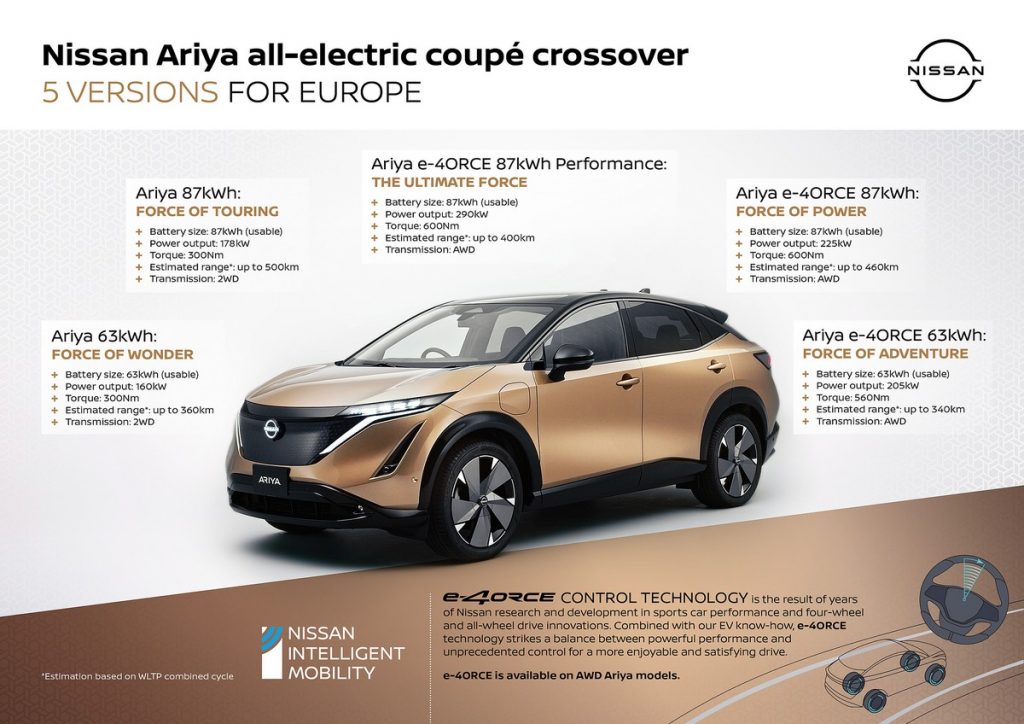
A bit of a change from the venerable LEAF then, with a dual motor 4 wheel drive option accompanying the “new electrified brand identity”, which does reduce the range somewhat:

As you can see from Nissan’s Ariya infographic, the LEAF’s dual AC/DC charging connector has moved from front and centre to the nearside front wing. Nissan haven’t provided an image of what’s hiding under the cover, but the press release does mention in passing that:

Continue reading →