
Volkswagen Announce V2H Trial For Their ID. Range of EVs

We got very excited here at V2G UK way back in February 2022 when Volkswagen announced in a press release that Markus Arand, head of brand and product communications at VW Commercial Vehicles, had said:

When you have solar panels on your home, for example, this car will be able to have a thing called bi-directional charging. You can give the energy from the ID. Buzz back to your home.

After a long wait VW have finally published a related press release. This one states that:

From now on, many models in the ID. Family now offer bidirectional charging with the “Vehicle to Home” function. With a home power station and the integrated Home Energy Management System (HEMS) from Volkswagen partner HagerEnergy GmbH, customers can cover as much of their household consumption as possible with their photovoltaic system. Both companies have launched a pilot project in Sweden in which an entire housing estate is being supplied with vehicles and the corresponding charging infrastructure.

Another pertinent piece of information is that:

Bidirectional charging is possible in all new models with the 77 kWh battery (net) and from ID. Software 3.5 or higher.

Note that the “small print” outlines a few constraints:

The discharging and bidirectional charging functions are no longer available once the intended operating time or energy quantity has been reached: Max energy quantities: Up to 10,000 kWh Discharging; Max operating hours: Up to 4,000 hours Discharging

Here’s an image from the press release showing an “artist’s impression” of a VW ID.5 discharging electricity generated from a rooftop solar PV installation back into a home as dusk falls:
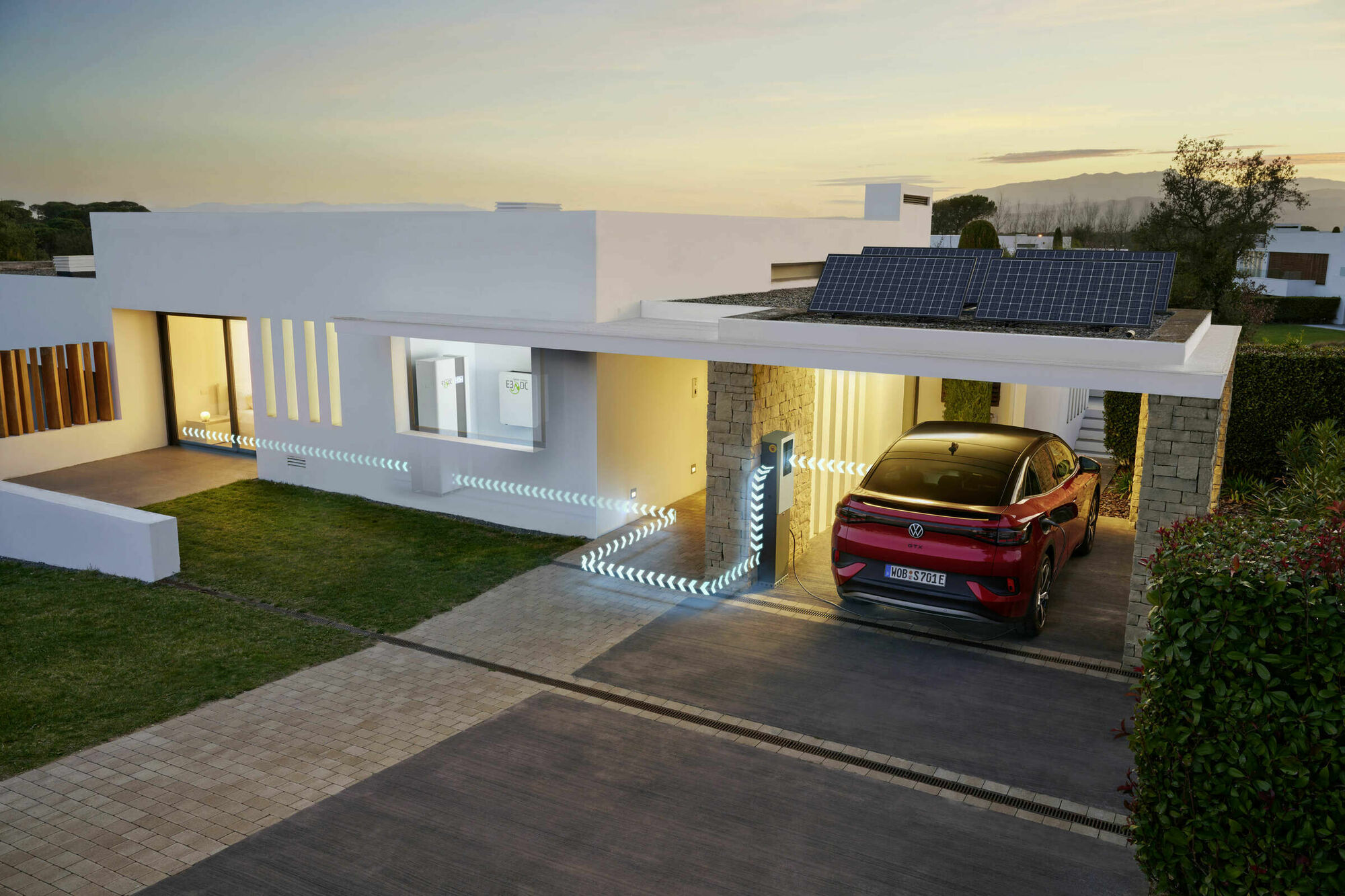
Compare and contrast the image with our own artist’s impression in the banner at the top of this article. It is now over 10 years old.

I cannot help but wonder when the first trial of Volkswagen’s exciting new V2H technology will ultimately start in a similarly equipped home here the United Kingdom, and when the current “constraints” might be raised or removed entirely?
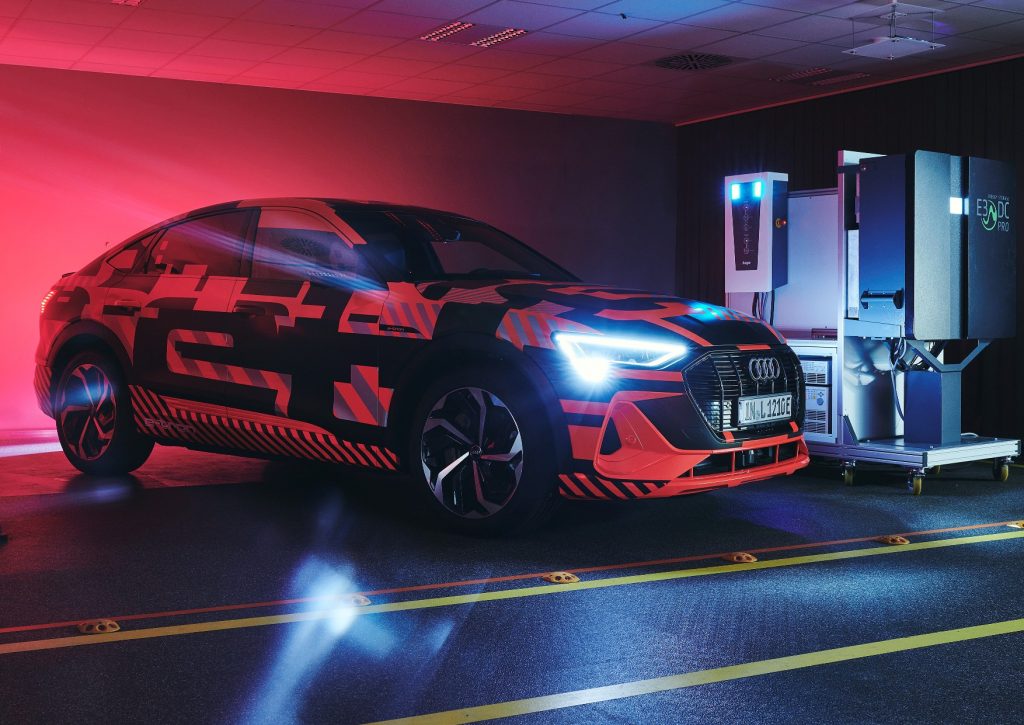
Audi & Hager Group Research V2H

Without even mentioning the term vehicle-to-grid Audi announced in a press release last week that:


Increasing network stability, lowering electricity costs, and contributing to climate protection – that is the vision that Audi and the Hager Group are pursuing. The incorporation of the electric car into the domestic grid is at the core of an innovative research project on bidirectional charging. This offers major advantages in combination with a photovoltaic system in particular. Excess PV electricity can be stored temporarily and output as needed.

Audi has committed to the objectives of the Paris Climate Agreement and is working on making its vehicle fleet CO2-neutral by 2050. In order to achieve this aim, the brand with the four rings is pursuing a broad electric offensive that involves launching around 20 fully electric models by 2025. And not only that: The electric car is to evolve into part of an increasingly broad mobility offer and become an element of the sustainable energy transition.

Electric cars as part of the energy transition

The press release does however mention a slightly less familiar three letter acronym:


The idea is as simple as it is genius: The high-voltage battery of the electric car not only is charged via the wall box at home but can also supply energy back to the house as a decentralized storage medium. If the customer has a photovoltaic system, the electric car serves as a temporary storage medium for the domestically generated eco-electricity. When the sun is no longer shining, the vehicle can supply the stored electricity back to the house. Bidirectional charging at home – also known as Vehicle to Home (V2H) – has great potential to reduce the home owner’s electricity costs and increase network stability. As a further expansion stage in combination with a home storage unit, it is possible to achieve near complete energy independence and increased security of supply in the event of a blackout. “Using the battery of electric vehicles to contribute to climate protection while lowering electricity costs at the same time is a vision that we have found fascinating since the very beginning. And we have found an ideal partner in Audi,” explains Ulrich Reiner, project manager at Hager Group.

We are very pleased to hear Audi state that “The idea is… genius “, since we put our “artist’s impression” of our “Static and Mobile Distributed Energy Storage” (SaMDES for short) concept in the banner at the top of every page on the V2G UK web site over 7 years ago!

Audi explain our V2H genius in greater detail in slightly stilted English as follows:

What sounds simple in theory requires a high level of technical intelligence and coordinated interaction between different technical components in terms of infrastructure and in the vehicle in practice. An Audi e-tron with near-series charging technology was used in the research project. In the test grid, the fully electric Audi model operated with a DC wall box, which enables a charging capacity of up to 12 kW, and a flexibly extendable home storage unit with a capacity of 9 kWh. While it could provide additional flexibility in possible series production, it is not a necessary requirement for bidirectional charging. Thanks to the DC voltage level in the overall grid, the connection between the PV system and the vehicle does not require an inverter and is thus a particularly efficient solution.

One thing Audi and Hager have done that we hadn’t quite managed to get around to just yet is to create a video that explains our SaMDES concept in an approachable way and set to music. Here it is:

Do you suppose that given all their resources Audi will eventually catch up with us?