Volkswagen’s V2G Vision

Back in March 2019 I was in Amsterdam to watch Volkswagen’s Martin Römheld give the final keynote speech at the rEVolution conference:

Amongst many other things he said that:

For VW I can tell you, and I think you can read that from the papers and the news currently they’re really doing a paradigm shift. The top management is really turning around the company big time.

and then went on to outline VW’s ID series of electric vehicles:
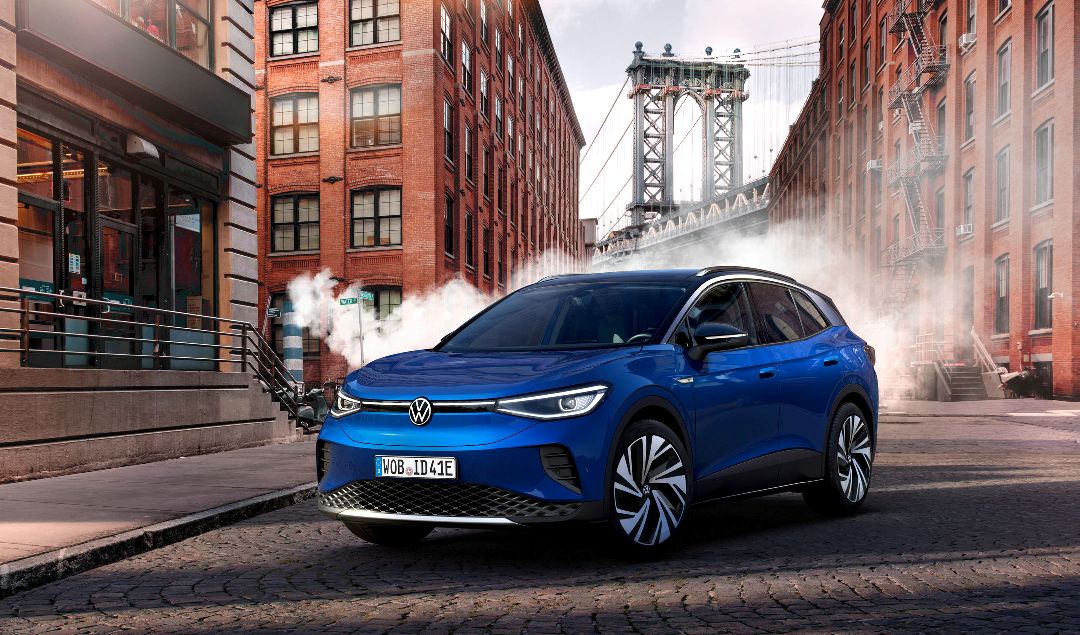
Volkswagen ID.4 1ST Max

At the rEVolution after party I asked Martin whether Volkswagen had any ambitions by way of bidirectional power transfer. He dropped a heavy hint, but I was of course sworn to secrecy. Now at long last VW Development Board Member Thomas Ulbrich has revealed much more about those ambitions in an interview with German newspaper Handelsblatt. I’ve been hoping for a definitive English language version to appear, but no such luck. Hence what follows is aided by Google Translate.

According to Handelsblatt:

In order for a fleet of millions of EVs to be used as a new, flexible energy storage facility, electric cars must also be able to return the electricity to the grid at any time – they must be designed to be “bidirectional”. The VW group will be the first major manufacturer to start doing so next year.

I assume Handelsblatt must actually mean “the first major German manufacturer”, since on this side of the North Sea Japanese EV OEM Nissan certainly count as “major”, and they’ve been offering V2G capable vehicles for quite some time! Moving on we are told:

From 2022 onwards, every electric car from the Volkswagen Group that is based on the MEB (“Modularer E-Antriebs-Baukasten” but “modular electrification kit” according to Google) electrical platform can not only be charged with electricity but also return it to the grid. In addition to VW, the MEB is also used by the sister brands Audi , Skoda and Seat-Cupra.

The first generation of MEB models that Volkswagen has been delivering since autumn last year is not yet designed to be bidirectional. These cars can only charge. Volkswagen will be able to retrofit V2G to those cars with comparatively few technical changes and additional software.

Production should begin in December, and the bidirectional electric cars will go on sale after the turn of the year. At least 300,000 vehicles are likely to be manufactured at the VW plant in Zwickau alone in 2022.

Nissan does then get a mention, albeit a rather Deutschland centric one:

Nissan’s e-models have been able to charge bidirectionally as a standard feature since 2013. “The fact that this ability has not yet been exploited is solely due to the lack of relevant functions in the current charging stations,” said a Nissan spokeswoman.

But if the European industry leader opts for bidirectionality, then many other competitors will have to follow suit for competitive reasons alone. “Volkswagen is setting things in motion”, says Stefan Bratzel, professor at the Center of Automotive Management (CAM) at the Bergisch Gladbach University of Applied Sciences.

Other automakers are likely to present similar offers for the foreseeable future. Hyundai from Korea has already made a corresponding announcement.

We have recently covered that Hyundai V2x announcement in detail, and I have to say that I very much look forward to a wide variety of VW’s competitors shipping hundreds of thousands of V2G enabled electric vehicles beginning in 2022 or shortly thereafter.

However there remains the issue of that unfortunate “lack of relevant functions in the current charging stations”. Currently installed V2G capable charging stations use the Japanese CHAdeMO system, and even Nissan’s new Ariya EV has dropped that way of doing things here in Europe. Hence I cannot help but wonder how hundreds of thousands of VW MEB/ID compatible bidirectional charging stations are suddenly going to spring up along the highways and byways of Europe. And the United Kingdom too of course.

In conclusion, here is an infographic from Volkswagen’s current Energy Storage FAQ:
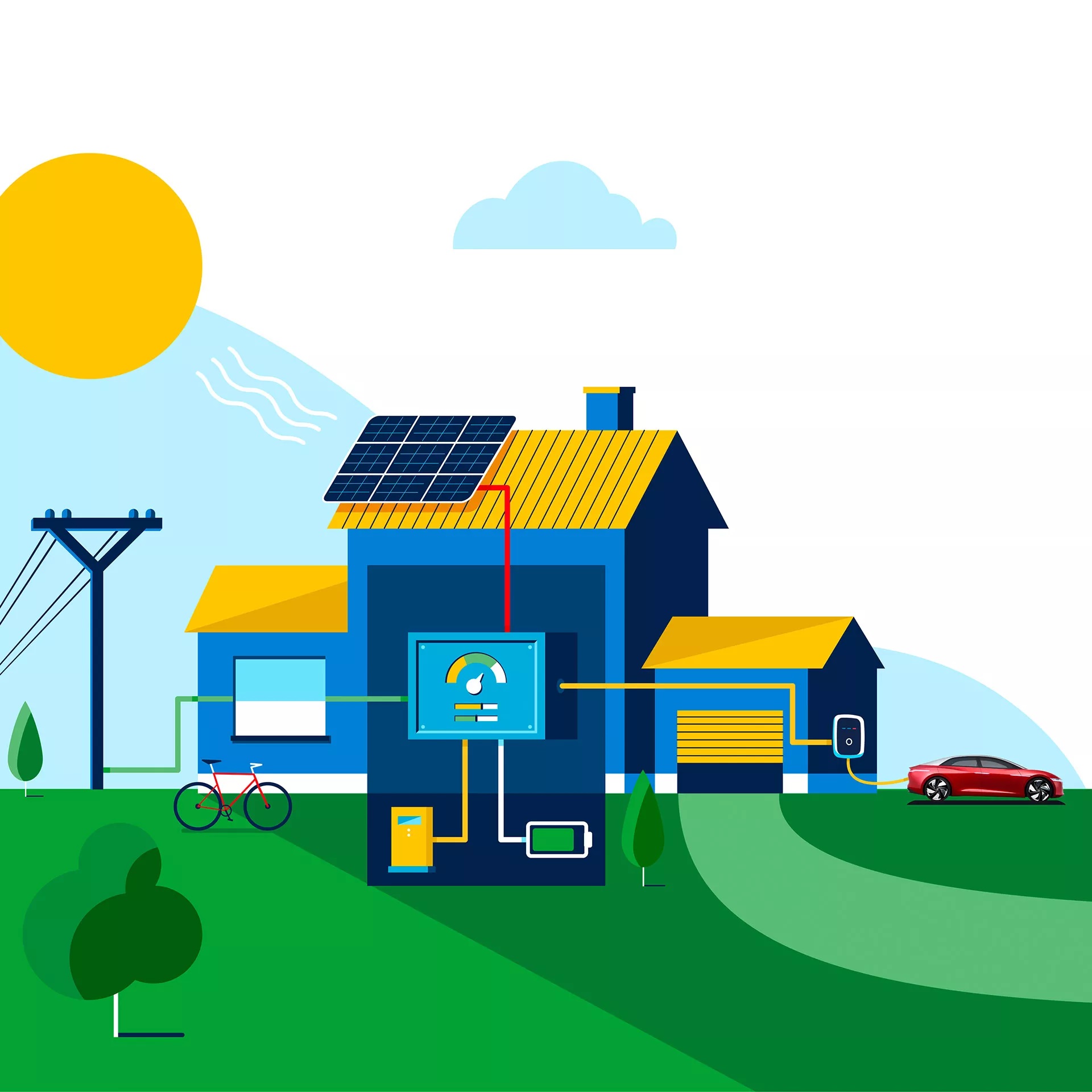
For some strange reason it bears a striking resemblance to our SaMDES banner at the top of this article. However in VW’s V2G vision the EV is outside the garage rather than inside!
The Future of Vehicle to Grid EV Charging?

Our title for today is shamelessly plagiarised from an article of the same name on the Electric Nation web site, which begins as follows:

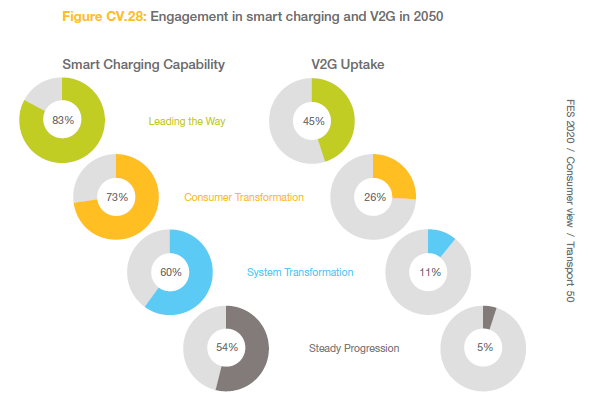
By 2050, up to 45% of households will actively provide Vehicle to Grid (V2G) services, according to National Grid’s Future Energy Scenarios, published in July 2020. But will the average Electric Vehicle (EV) driver be able to use V2G charging over the next few years?

A very good question and a very interesting infographic! The article continues:

The rapid growth in the numbers of electric vehicles on our roads will mean more demand on local electricity networks if EVs are all plugged in at the same time, such as during the peak between 5pm and 7pm in the evening. Smart charging, or ‘V1G’, which allows management of the time when EV charging occurs – as trialled by the original Electric Nation project – will help to avoid this situation.

V2G charging will be more effective than smart charging. This is due to the ability to link EVs together and put significant levels of energy back into the grid at peak times, like a huge decentralised power station. V2G will therefore help to reduce the grid’s need for additional energy generation, typically supplied by fossil fuels at peak times, as well as reducing demand on electricity networks, and allowing EV drivers to use greener and cheaper electricity.

So far so good, I agree entirely. However the next paragraph states:

Continue reading →

Audi & Hager Group Research V2H

Without even mentioning the term vehicle-to-grid Audi announced in a press release last week that:


Increasing network stability, lowering electricity costs, and contributing to climate protection – that is the vision that Audi and the Hager Group are pursuing. The incorporation of the electric car into the domestic grid is at the core of an innovative research project on bidirectional charging. This offers major advantages in combination with a photovoltaic system in particular. Excess PV electricity can be stored temporarily and output as needed.

Audi has committed to the objectives of the Paris Climate Agreement and is working on making its vehicle fleet CO2-neutral by 2050. In order to achieve this aim, the brand with the four rings is pursuing a broad electric offensive that involves launching around 20 fully electric models by 2025. And not only that: The electric car is to evolve into part of an increasingly broad mobility offer and become an element of the sustainable energy transition.

Electric cars as part of the energy transition

The press release does however mention a slightly less familiar three letter acronym:


The idea is as simple as it is genius: The high-voltage battery of the electric car not only is charged via the wall box at home but can also supply energy back to the house as a decentralized storage medium. If the customer has a photovoltaic system, the electric car serves as a temporary storage medium for the domestically generated eco-electricity. When the sun is no longer shining, the vehicle can supply the stored electricity back to the house. Bidirectional charging at home – also known as Vehicle to Home (V2H) – has great potential to reduce the home owner’s electricity costs and increase network stability. As a further expansion stage in combination with a home storage unit, it is possible to achieve near complete energy independence and increased security of supply in the event of a blackout. “Using the battery of electric vehicles to contribute to climate protection while lowering electricity costs at the same time is a vision that we have found fascinating since the very beginning. And we have found an ideal partner in Audi,” explains Ulrich Reiner, project manager at Hager Group.

We are very pleased to hear Audi state that “The idea is… genius “, since we put our “artist’s impression” of our “Static and Mobile Distributed Energy Storage” (SaMDES for short) concept in the banner at the top of every page on the V2G UK web site over 7 years ago!

Audi explain our V2H genius in greater detail in slightly stilted English as follows:

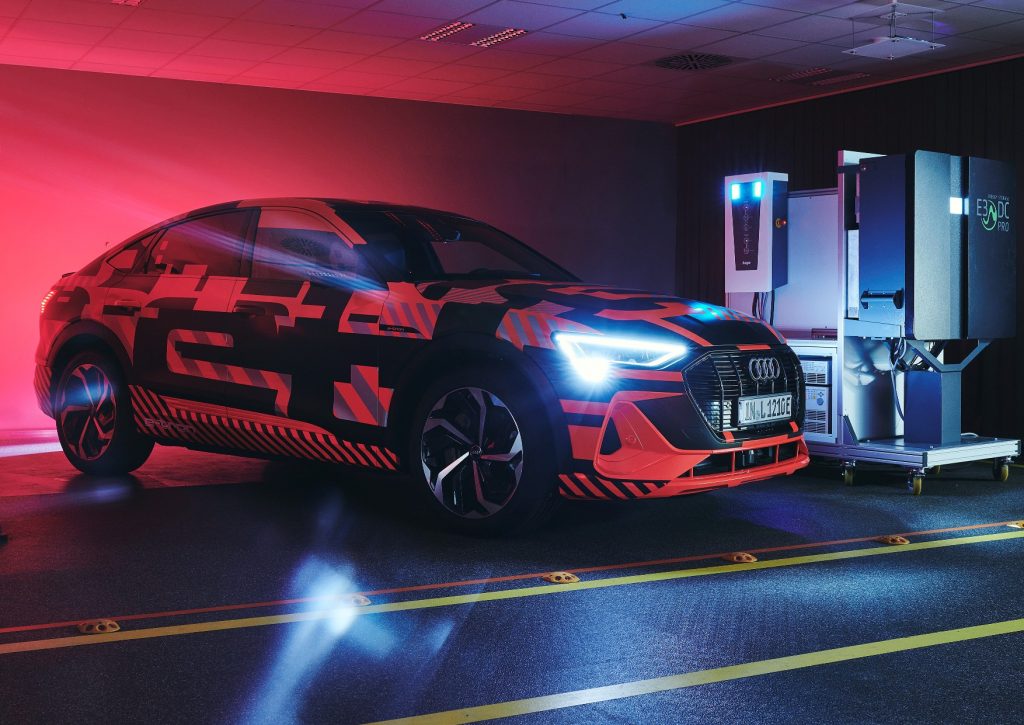
What sounds simple in theory requires a high level of technical intelligence and coordinated interaction between different technical components in terms of infrastructure and in the vehicle in practice. An Audi e-tron with near-series charging technology was used in the research project. In the test grid, the fully electric Audi model operated with a DC wall box, which enables a charging capacity of up to 12 kW, and a flexibly extendable home storage unit with a capacity of 9 kWh. While it could provide additional flexibility in possible series production, it is not a necessary requirement for bidirectional charging. Thanks to the DC voltage level in the overall grid, the connection between the PV system and the vehicle does not require an inverter and is thus a particularly efficient solution.

One thing Audi and Hager have done that we hadn’t quite managed to get around to just yet is to create a video that explains our SaMDES concept in an approachable way and set to music. Here it is:

Do you suppose that given all their resources Audi will eventually catch up with us?


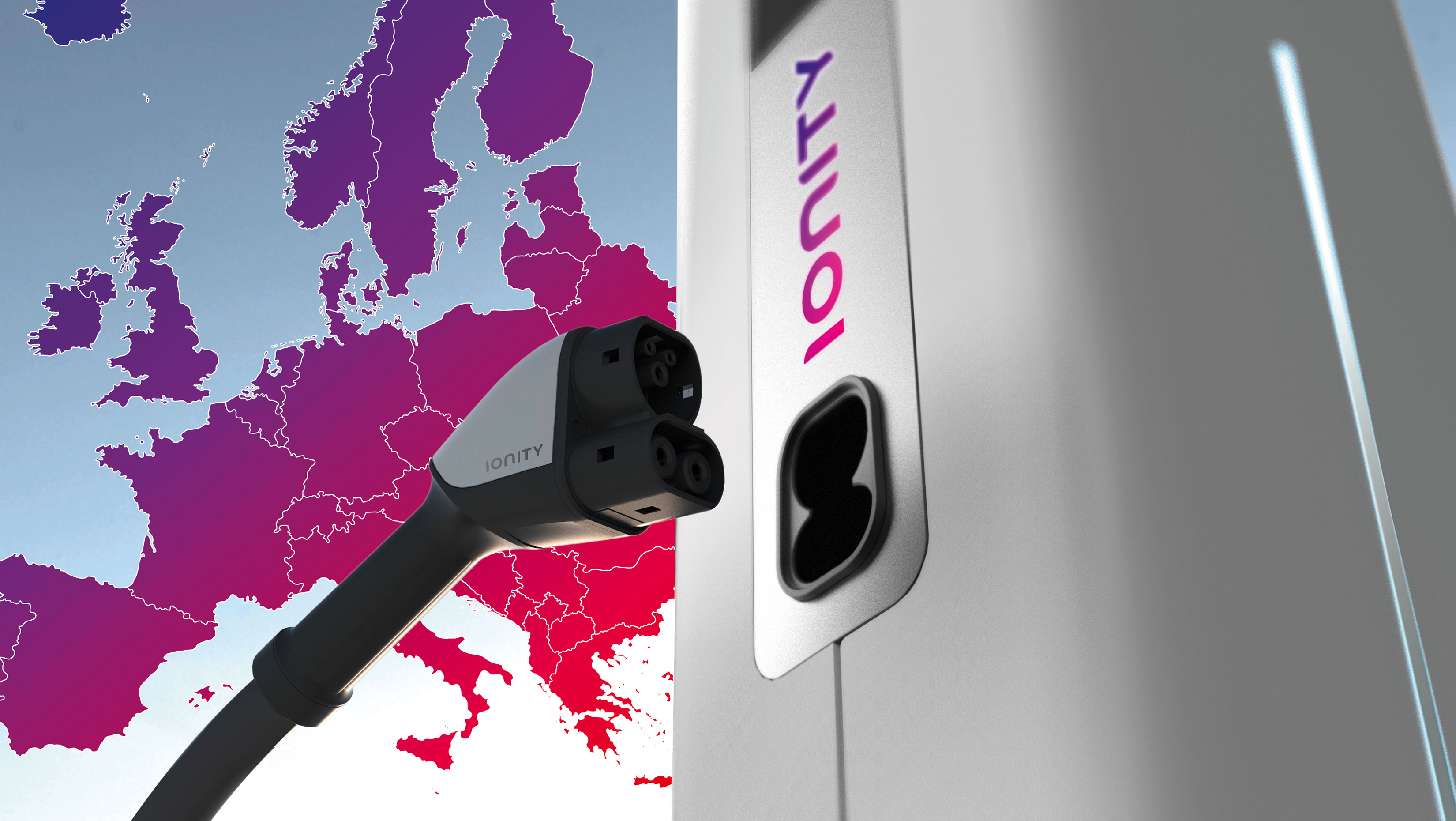
IONITY – A New Pan-European High-Power Charging Network

In a press release a couple of days ago it was announced that:

BMW Group, Daimler AG, Ford Motor Company and the Volkswagen Group with Audi and Porsche today announced joint venture IONITY that will develop and implement a High-Power Charging (HPC) network for electric vehicles across Europe. Launching approximately 400 HPC stations by 2020, IONITY will make long-distance journeys easier and marks an important step for electric vehicles.

Based in Munich, Germany, the joint venture is led by Chief Executive Officer Michael Hajesch and Chief Operating Officer Marcus Groll, with a growing team, set to number 50 by the start of 2018.

A total of 20 stations will be opened to the public this year, located on major roads in Germany, Norway and Austria, at intervals of 120 km, through partnerships with “Tank & Rast”, “CircleK” and “OMV. Through 2018, the network will expand to more than 100 stations, each one enabling multiple customers, driving different manufacturer cars, to charge their vehicles simultaneously.

588961_ionity_2017_porsche_ag

As that image implies:

With a capacity of up to 350 kW per charging point, the network will use the European charging standard Combined Charging System to significantly reduce charging times compared to existing systems. The brand-agnostic approach and Europe-wide distribution is expected to help make electrified vehicles more appealing.

Unfortunately, from our perspective at least, it seems as though “Europe-wide” doesn’t currently include the United Kingdom. What’s more the new joint venture isn’t worldwide “brand-agnostic” either. It seems unlikely that any Japanese EV OEMs will be joining the group any time soon. When it comes to rapid charging they currently prefer the CHAdeMO connector!