ISO Release the 15118-20 Amendment 1 Standard for AC V2G

It’s been a very long time coming, but the International Standards Organisation has finally published what is formally known as ISO 15118-20:2022/Amd 1:2026. According to the ISO web site the amendment adds the following improvements to the previously published 15118-20 standard:

AC DER service, MCS service, and improved security concept

If the acronyms above seem somewhat opaque and your internet address indicates that you are located in the United Kingdom you will see this not entirely helpful notice when you click the link above, :

Sadly the associated British standard is not yet available for purchase from the BSI web site! Instead we are told:

Approval start date: 17/04/2026

Publication start date: 06/08/2026

Fortunately in all the circumstances I don’t need to wait for the BSI to start selling the document, or pay ISO CHF 227 for the original 15118-20 standard plus another CHF 227 for the new amendment. As a member of the committee that developed the standards I already have PDF copies on my hard drive.

Quoting extracts from the brief sample of the amendment provided on the ISO web site:

3.73
megawatt charging system
MCS

charging system according to IEC61851-23-3

3.76
distributed energy resource
DER

source of electric power that is not directly connected to a bulk power system
EXAMPLE Generators and energy storage technologies capable of exporting active power to the electrical grid..

3.78
frequency droop curve

parameterized curve of the frequency-watt function

3.87
ride-through

ability to withstand voltage or frequency disturbances inside defined limits and to continue operating as specified

If you would like further insight into the implications of the above information, please do not hesitate to get in touch.

ISO 15118 Ready for California

The California Energy Commission (CEC for short) have recently undertaken a consultation on Assembly Bill 2127, which mandates a biennial assessment of electric vehicle charging infrastructure in California. Following that consultation they have now published a technical note which recommends the “Deployment of ISO 15118-Ready Chargers “. It states amongst other things that:

California Energy Commission (CEC) staff recommends that charging providers pursue widespread deployment of ISO 15118-ready chargers. CEC analysis indicates that ISO 15118-ready chargers are needed to support current and upcoming vehicle features, critical vehicle-grid integration capabilities, and an easier-than-gas user experience.

The technical note provides an “ISO 15118-Ready Hardware Definition” which states that:

Based on dozens of stakeholder conversations, CEC staff has identified the following capabilities needed to support ISO 15118 communication for chargers using the J1772 or CCS connector. An “ISO 15118-ready” charger is capable of, at minimum:

  1. Powerline carrier (PLC) based high-level communication as specified in ISO 15118-3.
  2. Secure management and storage of keys and certificates.
  3. Transport Layer Security (TLS) version 1.2; additional support for TLS 1.3 or subsequent versions is recommended to prepare for future updates to the ISO 15118 standard.
  4. Remotely receiving updates to activate or enable ISO 15118 use cases.
  5. Connecting to a backend network.
  6. Selecting the appropriate communication protocol used by the vehicle.

An ISO 15118-ready charger uses at least one J1772 or CCS connector; this includes multiple-connector DC chargers with at least one CCS connector. ISO 15118-ready chargers should have onboard hardware to support the above capabilities, although software implementation of specific ISO 15118 use cases is not included in the scope of this recommendation. For example, an ISO 15118-ready charger should have the onboard hardware needed for Plug and Charge, but might not yet have Plug and Charge software implemented.

ISO 15118-ready chargers should be capable of selecting the appropriate communication protocol used by the vehicle. AC chargers should support pulse-width modulation control as specified in J1772 and be capable of communicating using ISO 15118-2 and/or ISO 15118-20. DC chargers should support DIN 70121 and be capable of communicating using ISO 15118-2 and/or ISO 15118-20.

The CEC then mention an area dear to our heart here at V2G UK, bi-directional charging:

CEC staff estimates that the marginal hardware components needed for ISO 15118 readiness cost less than $6 per charger. Despite the growing number of electric vehicle models using ISO 15118 for Plug and Charge and grid-integration features, many existing chargers, particularly AC chargers, are not equipped to reciprocate such communication. To fully support these vehicle models and capabilities, CEC staff recommends widespread deployment of ISO 15118-ready chargers.

The capabilities of an ISO 15118-ready charger identified above outline a hardware baseline for chargers using the J1772 or CCS connector and do not discourage additional functionality. ISO 15118-ready chargers may optionally support bidirectional charging. ISO 15118-ready chargers do not affect the use of other communication pathways (such as vehicle telematics).

All in all it sounds as though smart charging stations destined for the Californian market will in future bear a close resemblance to their European equivalents, albeit with some differences. A 60 Hz supply for example, and a CCS1 DC plug rather than CCS2:

Image by Mliu92, CC BY-SA 4.0, https://commons.wikimedia.org/w/index.php?curid=108208696

There is however a fly in the ISO 15118 ointment:

CEC staff also plans to monitor related market indicators, such as PLC transceiver lead times.

V2H on the VW ID. Buzz Surf Bus!

In a press release earlier today VW announced that:

The world premiere of the ID. BUZZ concept car at the Detroit Motor Show in January 2017 triggered a sensational response around the globe. The positive feedback made only one decision possible: the concept car had to be transferred to full production. Five intensive years of development work followed. Now the time has come: the ID. Buzz – an electric motoring game-changer – is ready. Volkswagen is therefore activating the countdown for a double world premiere: on 9 March, the all-electric Bulli will be simultaneously taking off emission-free as the ID. Buzz (5-seater) and Buzz Cargo (van).

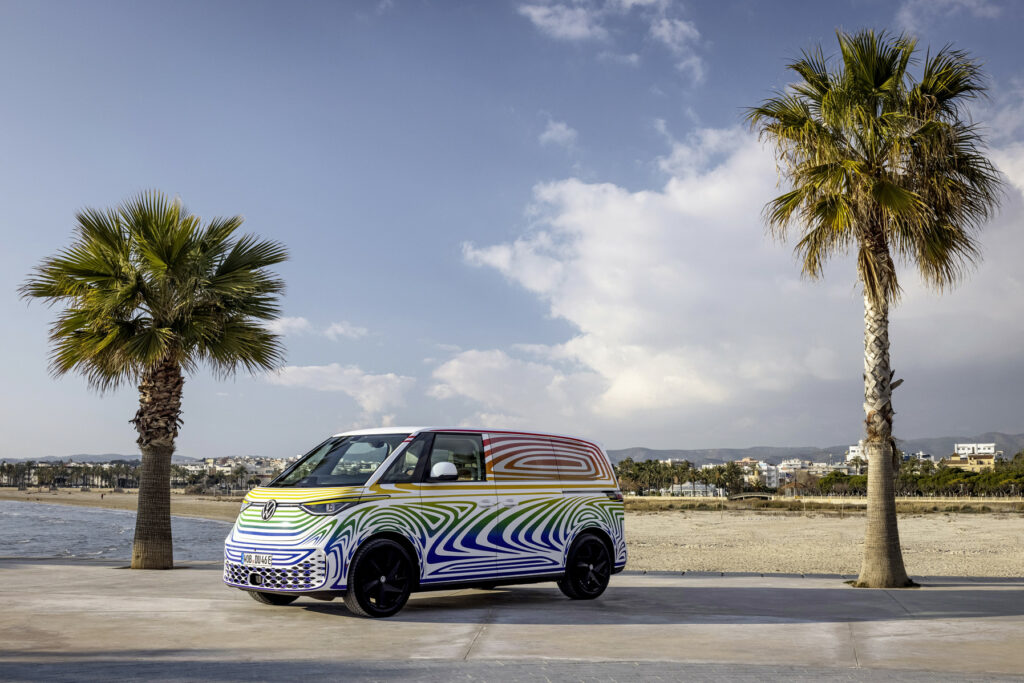
The ID. Buzz in Barcelona


The ID. Buzz looks like the iconic electric surf bus for the 2020s and beyond?

Not having had a chance to test drive the Buzz ourselves as yet, here for your delectation is Jonny Smith’s initial review on his Late Brake Show .

By all means rewind to the start and watch the entire video, but I’ve chosen to look first at the section captioned “Bi-directional charging”:

According to Markus Arand, head of brand and product communications at VW Commercial Vehicles:

When you have solar panels on your home, for example, this car will be able to have a thing called bi-directional charging. You can give the energy from the ID. Buzz back to your home. This is the combination we are talking about.

The other technical innovation of particular interest to yours truly, since I sit on the international standards committee that developed it, is that the ID. Buzz evidently supports the ISO 15118-20 communications protocol between the EV and the charging station. The resulting ability to “Plug & Charge” without messing around with plastic cards or dodgy apps is mentioned at 25:46 in Jonny’s video.

The Buzz “data sheet” doesn’t mention its vehicle-to-home capability, but does include the following information:

Important dates

• World premiere: 9 March 2022

• Start of production ID. Buzz Cargo: first half of 2022

• Start of production ID. Buzz: first half of 2022

• Market launch in Europe: autumn 2022

Here at V2G UK we await more technical details about the Buzz’s V2H capabilities with barely bated breath! A test drive to the seaside would also be much appreciated. And also a bit of vehicle-to-home interoperability testing in our suitably equipped car park:

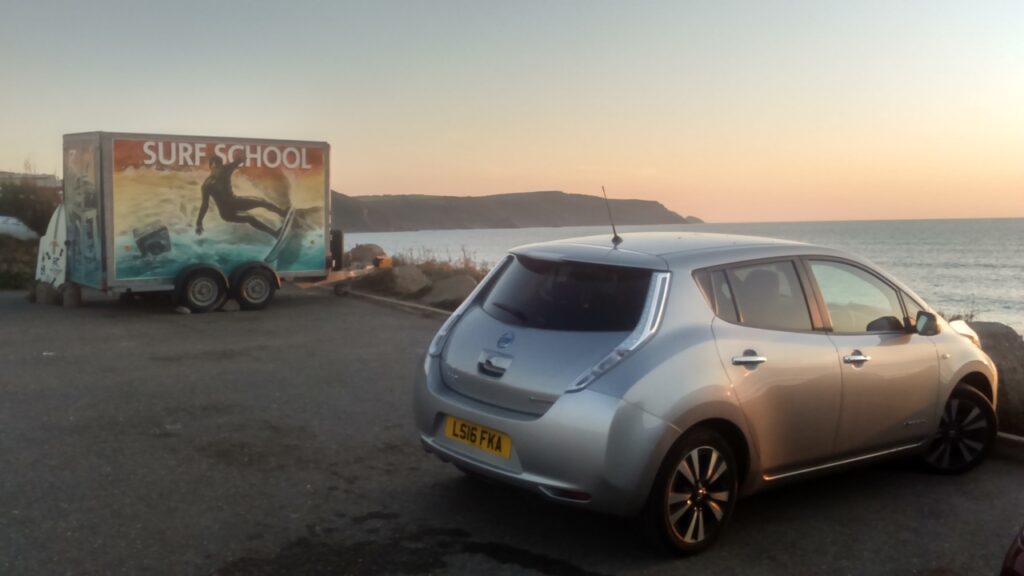
Lisa our Nissan LEAF also cannot wait to meet Buzz. She gets very lonely at times:


The Future of Vehicle to Grid EV Charging?

Our title for today is shamelessly plagiarised from an article of the same name on the Electric Nation web site, which begins as follows:

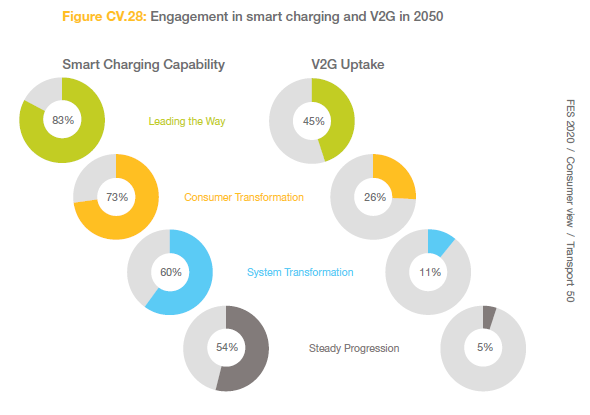
By 2050, up to 45% of households will actively provide Vehicle to Grid (V2G) services, according to National Grid’s Future Energy Scenarios, published in July 2020. But will the average Electric Vehicle (EV) driver be able to use V2G charging over the next few years?

A very good question and a very interesting infographic! The article continues:

The rapid growth in the numbers of electric vehicles on our roads will mean more demand on local electricity networks if EVs are all plugged in at the same time, such as during the peak between 5pm and 7pm in the evening. Smart charging, or ‘V1G’, which allows management of the time when EV charging occurs – as trialled by the original Electric Nation project – will help to avoid this situation.

V2G charging will be more effective than smart charging. This is due to the ability to link EVs together and put significant levels of energy back into the grid at peak times, like a huge decentralised power station. V2G will therefore help to reduce the grid’s need for additional energy generation, typically supplied by fossil fuels at peak times, as well as reducing demand on electricity networks, and allowing EV drivers to use greener and cheaper electricity.

So far so good, I agree entirely. However the next paragraph states:

Continue reading →

Last Call for IEC 63110 Use Case Submissions

Our regular reader(s) will be aware that quite some time ago I suggested that:

There’s a few more urgent things to be ticked off on the to do list. How about OCPP 2.0 or even fully fledged British and international standards for “smart charging”, V2B and ultimately pukka V2G protocols for starters?

I am happy to now be able to report that my wish has come true! An international standard is now being developed for electric vehicle supply equipment (EVSE for short) communications with the “back office”, including vehicle to grid (V2G for short) functionality. For my sins I now sit on IEC technical committee 69 joint working group 11 (TC69/JWG11 for short). According to the Wikipedia article on the subject, which I wrote:

IEC 63110 is an international standard defining a protocol for the management of electric vehicles charging and discharging infrastructures, which is currently under development. IEC 63110 is one of the International Electrotechnical Commission’s group of standards for electric road vehicles and electric industrial trucks.

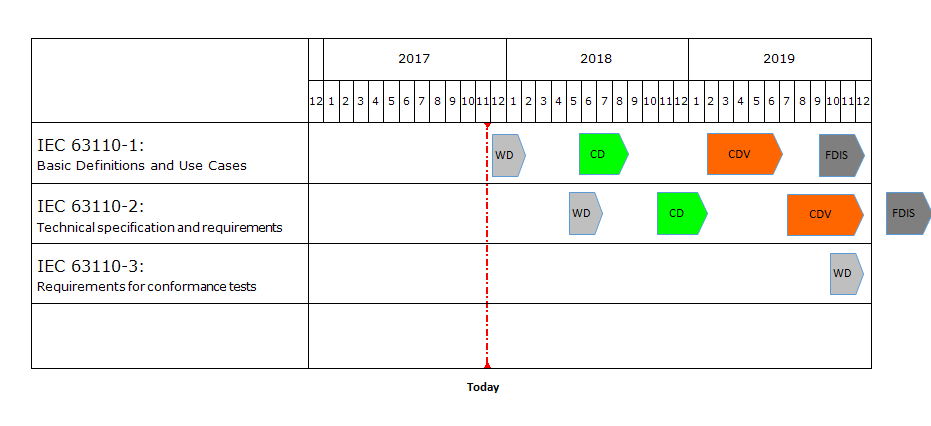
You will no doubt be delighted to discover that proceedings are still at a fairly early stage. Here’s the current IEC 63110 roadmap:

IEC-63110-2017-11-24

The top line indicates to the initiated that I am still able to point out that IEC TC69/JWG11 is currently seeking submissions for potential use cases to add to our initial list. The current deadline is December 6th. It is probably safe for you to assume that all the obvious stuff from the Open Charge Alliance’s Open Charge Point Protocol and ISO/IEC’s 15118 protocol is already included on our list.

However if you have a use case that isn’t in amongst the obvious stuff then please do not hesitate to get in touch!

Are you ready?

Europe’s PowerUp Project Releases V2G Conformance Testing Suite

Almost exactly a year since they first released their V2G interface specification the EU funded PowerUp project has now released a V2G interface conformance testing suite. According to the announcement on their web site:

The PowerUp project has published the TTCN-3 based implementation of the conformance test cases which it has developed for testing ISO/IEC 15118-2 protocol implementations, i.e. the V2G application protocol.

With this publication, a V2G standards compliance testing suite has been made available for the first time. The PowerUp team believes that this testing suite will prove to be valuable for the validation and maturing of V2G system implementations which incorporate the ISO/IEC 15118 standards.

Further extensions of this TTCN-3 suite, along with its incorporation into the ISO/IEC 15118-4 V2G testing standard are possible.

The conformance testing suite and associated documentation can be downloaded from the PowerUp web site.

Europe’s PowerUp Project Delivers V2G Interface Documentation

The EU funded PowerUp project has just released a set of documents, still labelled “Confidential”, but also “Final” and “Public”! According to the European Union’s web site:

PowerUp aims to develop the Vehicle-2-Grid (V2G) interface, involving a full development cycle of physical/link-layer specification, charging control protocol design, prototyping, conformance testing, field trials, and standardisation. Its results will ensure that FEVs smoothly integrate into emerging smart-grid networks. Thereby the efficiencies resulting from robust grid operation may be achieved; V2G capabilities will smoothen the daily fluctuation of electricity demand and will enable FEVs to act as emergency energy supplies. To achieve these desired results, it is essential that any electric vehicle type would be compatible with any European smart-grid network.


V2G technology will be developed in liaison with the ongoing ISO/IEC standardisation of the V2G interface, and it will extend existing smart-metering standards and ETSI ITS standards for vehicular communications. On the grid side, smart electric meters will be enhanced for V2G capability and V2G-specific demand-balancing control algorithms will be researched.

The documents delivered this week can be downloaded from the PowerUp home page.  To give you a feel of what is contained therein, here’s an extract from the introduction to deliverable 4.1:

The PowerUp project aims at developing and validating the V2G interface, so as to support nomadic electricity consumption by electric vehicles under any foreseen arrangement of the billing architecture or value chains. The PowerUp use cases, which can be handled by the envisaged architecture, are stated below:


A) Basic V2G set up (commercial heavy vehicle)
B) Basic V2G setup (passenger car) in semiprivate area
C) Power delivery re-negotiation
D) Grid-controlled scheduling and re-scheduling of charging
E) Power failure handling
F) User initiated re-scheduling
G) High speed data exchange with the EV over PLC
H) Vehicle to grid transfer of energy

According to the rather sparse “Events” section of the PowerUp  web site:

Our up-to-date V2G interface prototypes will be demonstrated at the EC stand and at the Denso stand at the 2012 ITS World Congress in Vienna.

The Intelligent Transport Systems World Congress takes place between October 22nd and 26th at the Messezentrum Wien in Vienna. Perhaps we’ll see you there?