
Merging/Migrating OCPP to IEC 63110

Today’s article is another in our occasional series endeavouring to explain the arcane world of international standards. Hence it is more technical than is usual here on the V2G UK blog, but it is possibly even more relevant than the latest V2x announcements from assorted electric vehicle manufacturers.

This morning I attended the first meeting of an IEC Technical Committee 69 Joint Working Group 11 task force set up to develop an “information document” aiming to provide helpful advice to EV charging station manufacturers as they develop future “smart grid” enabled products. This document will be more like the British Standards Institution’s recently released PAS 1878 “specification” than a full blown international standard, albeit hopefully nowhere near as long!

By way of an example of the sort of things that were discussed in the meeting here is an infographic from PAS 1878 which hopefully illustrates the extensive overlap between the BSI’s concept of a future “smart home” and the related concepts emerging from the work of the European CENELEC Technical Committee 205 and other standards development committees:
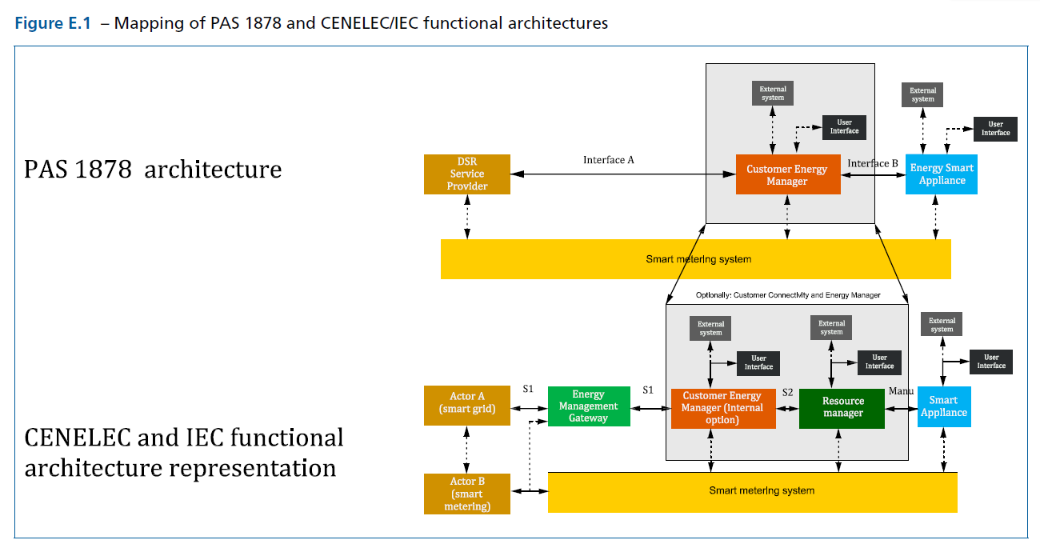
BSI PAS 1878 figure E.1.
PAS 1878 figure E.1. (Click to enlarge)

As annex E from the PAS explains:

This annex provides information on the relationship between the functional architecture described in this PAS and an amalgamation of the “smart grid” functional architecture included in several CENELEC and IEC standards. The representations in the CENELEC and IEC documents, whilst broadly similar, do differ slightly, hence the need for an amalgamated representation. The two architectures and how they are mapped are shown in Figure E.1. The CENELEC/IEC architecture is configured assuming that the CEM is internal to the consumer premises. As this is a functional architecture, a configuration with the CEM external to the consumer premises (e.g. in the cloud) is also permissible.

Figure E.1. shows the relationship between the PAS 1878 functional architecture and an amalgamated representation of the smart grid flexibility functional architecture depicted in several CENELEC and IEC standards, including BS EN 50491-12-1:2018, BS EN 50631-1:2017, PD IEC/TR 62746-2:2015, and prEN50491-12-2.

Expect to hear much more over the coming months and years about such esoteric things as the “Customer Energy Manager”, the “Resource Manager”, assorted “Demand Side Response Service Providers” and any number of other novel terms and acronyms. The diagram above is generic, but for the EV charging use case note that the charging station is equivalent to the “Smart Appliance” and the OCPP and/or IEC 63110 protocols are equivalent to “Interface B” in the top half of the diagram or the “Manufacturer protocol” in the lower half.

Hopefully that’s all crystal clear by now? If not hopefully it will become so by the time the newly constituted IEC task force has completed it’s work and you have read the resulting guidance document!
IEC 63110-1 Committee Draft for Vote Draws Near

Please read on to discover the latest news from the smoke filled back offices of the International Electrotechnical Commission’s (IEC for short) electric vehicle standards development committees.

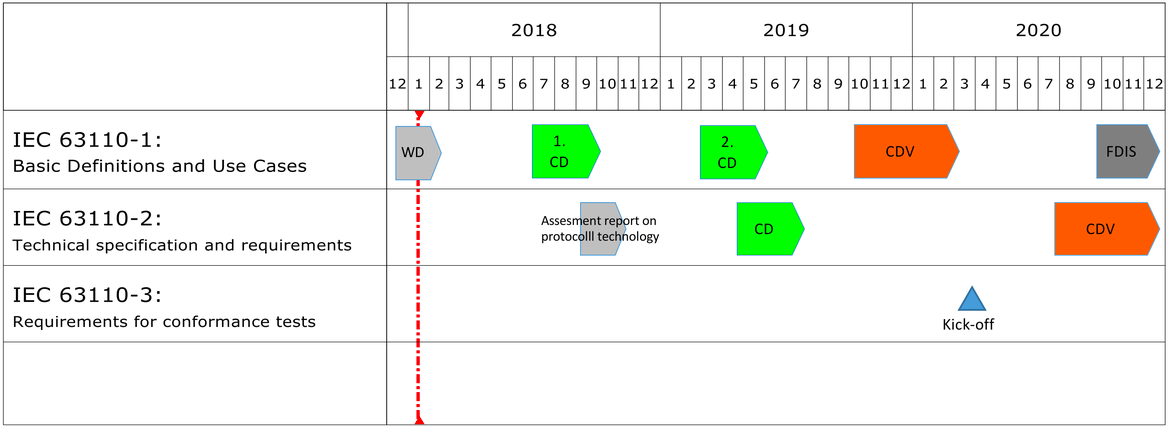
Here once again is the roadmap for the development of the IEC 63110 international standard defining a protocol for the management of electric vehicles charging and discharging infrastructures:

2018-01-IEC-63110-Roadmap

Part 1 of the standard (IEC 63110-1 for short) concerns itself with potential EV charging and discharging use cases. As we have previously mentioned the committee produced a draft document for comment many months ago. The original draft has now been modified to incorporate the suggestions contained in several hundred comments received from around the world. A grand total of zero of those comments emanated from the United Kingdom. The committee is issuing one final call for informal suggestions for further vehicle-to-grid use cases before their next face to face meeting which will be held in Seoul, South Korea starting on June 18th 2019. At that meeting the Committee Draft for Vote (CDV) document for 63110-1 will be finalised, following which the assorted national committees that make up the IEC will vote on the committee’s proposals.

Meanwhile the IEC 63110 part 2 (IEC 63110-2) task force looking into possible options for “message encoding and transmission technology” to be included in the standard are also currently completing their work. It was agreed on the IEC Technical Committee 69 Joint Working Group 11 (TC 69/JWG 11 PT1 and PT2 web conference calls earlier this week that the Seoul meeting should be extended by a day in order to finalise this aspect of part 2 of the standard. By way of example, version 2 of the Open Charge Point Protocol (OCPP 2.0) specifies using JSON encoding over RFC 6455 WebSockets transport, but the task force have been considering a wide range of other possibilities.

Should you have any thoughts on these thorny eMobility topics then please do not hesitate to get in touch at your earliest convenience. After the TC 69/JWG 11 meeting in Seoul these matters will be starting to be set in stone (SSS for short).

IEC 63110 Project Team 2 Kicks Off

In our continuing endeavour to explain the arcane workings of the International Electrotechnical Commission’s (IEC for short) electric vehicle standards development committees we have some exciting news to report!

As predicted last November:

2018-01-IEC-63110-Roadmap

it was agreed at the IEC Technical Committee 69 Joint Working Group 11 (TC 69/JWG 11 for short) meeting in Toronto last week that work on the IEC 63110 part 2 standard (IEC 63110-2 for short) should begin by setting up a task force (TF for short) to “evaluate possible options for message encoding and transmission technology”. We swiftly volunteered for the new task force, not least because our V2G EVSE subsidiary is already evaluating precisely that for the United Kingdom’s Department for Transport (DfT for short).

In actual fact the Project Team 1 (PT1 for short) schedule has slipped a bit, so if you still have any out of the ordinary new “protocol for the management of electric vehicles charging and discharging infrastructures” use cases to bring to our attention there is still time before the Committee Draft (CD for short) stage of the IEC process is reached. In addition if you have any suggestions for “message encoding and transmission technologies” above and/or beyond the industry standard TCP/IP over cellular comms please do not hesitate to get in touch.

Lastly, but certainly not least, the existing IEC 63110 Security Task Force is still seeking input from suitably qualified experts in that particularly important domain.

Last Call for IEC 63110 Use Case Submissions

Our regular reader(s) will be aware that quite some time ago I suggested that:

There’s a few more urgent things to be ticked off on the to do list. How about OCPP 2.0 or even fully fledged British and international standards for “smart charging”, V2B and ultimately pukka V2G protocols for starters?

I am happy to now be able to report that my wish has come true! An international standard is now being developed for electric vehicle supply equipment (EVSE for short) communications with the “back office”, including vehicle to grid (V2G for short) functionality. For my sins I now sit on IEC technical committee 69 joint working group 11 (TC69/JWG11 for short). According to the Wikipedia article on the subject, which I wrote:

IEC 63110 is an international standard defining a protocol for the management of electric vehicles charging and discharging infrastructures, which is currently under development. IEC 63110 is one of the International Electrotechnical Commission’s group of standards for electric road vehicles and electric industrial trucks.

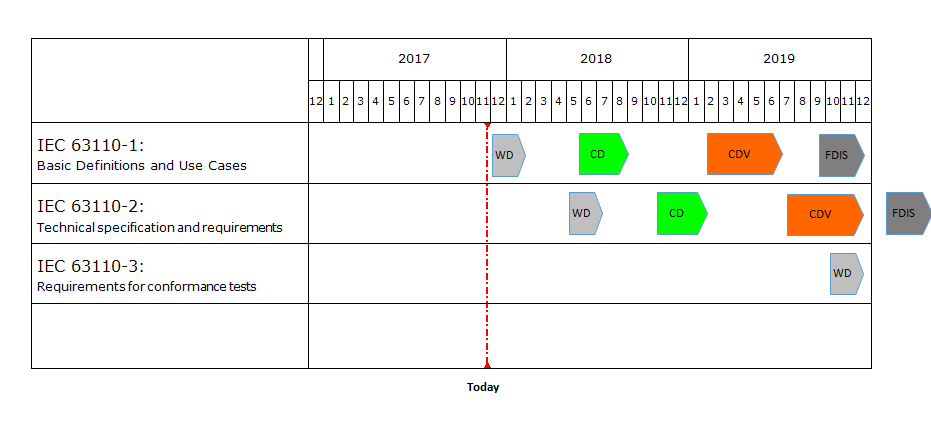
You will no doubt be delighted to discover that proceedings are still at a fairly early stage. Here’s the current IEC 63110 roadmap:

IEC-63110-2017-11-24

The top line indicates to the initiated that I am still able to point out that IEC TC69/JWG11 is currently seeking submissions for potential use cases to add to our initial list. The current deadline is December 6th. It is probably safe for you to assume that all the obvious stuff from the Open Charge Alliance’s Open Charge Point Protocol and ISO/IEC’s 15118 protocol is already included on our list.

However if you have a use case that isn’t in amongst the obvious stuff then please do not hesitate to get in touch!

Are you ready?