BSI Requests Comments on a New Draft of PAS 1878

Regular readers may recall that in 2021 the British Standards Institution published the first edition of their Publicly Available Specification 1878 on the subject of “Energy smart appliances”? You may also recall that I wrote at the time:

A “smart” EV charging station is a special case of an interoperable Energy Smart Appliance.

The BSI has recently published a draft version of a new edition of the PAS 1878 specification, and is inviting comments from interested parties. Note that the deadline for submitting any such comments is July 9th 2025.

The BSI’s request for comments points out that:

This PAS specifies the following aspects of a system for the delivery of certain demand side response (DSR) services for domestic and small business premises…

This PAS is intended to be used by manufacturers of ESAs and CEMs.

NOTE 1 – Other audiences that might have an interest in this PAS are maintainers of ESAs, manufacturers and maintainers of interfacing products, software developers and service providers.

The introduction to the new draft includes the following information:

This is a full revision of the document, and introduces the following principal changes:

  • defined system architecture for both on-premises and hybrid cloud/on-premises implementations of ESAs and CEMs, and both 1-to-1 and 1-to-many CEM to ESA connections;
  • minimum requirements for secure communication between CEMs, ESAs and DSRSPs;
  • detailed sequence of DSR-based activities from consumer registration to decommissioning;
  • a move from OpenADR 2.0b to OpenADR 3.0 as the minimum application layer protocol to be supported by Interface A (between DSRSP-CEM);
  • the optional provision of flexibility performance requests from the DSRSP to enable ESAs to calculate relevant flexibility offers more easily;
  • updated compatibility with GB smart metering and a wide range of smart appliances – including EV charge points and battery storage;
  • new provisions for Open ADR 3 as the Interface A

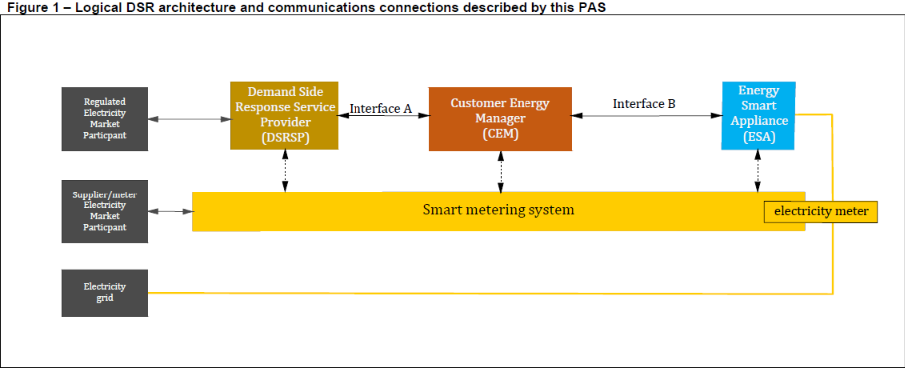
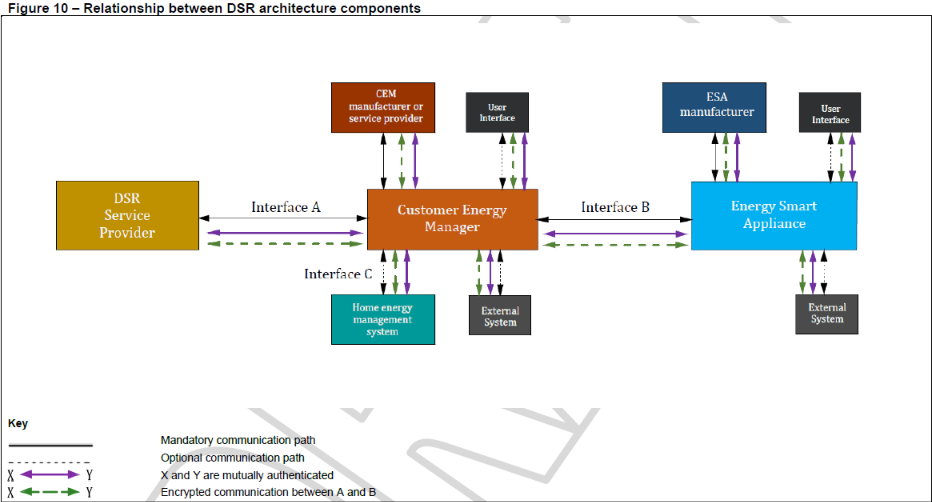
By way of a brief introduction to some of the assorted acronyms mentioned above, here is figure 1 from the draft PAS:
Clause 8 of the draft PAS includes these specific requirements regarding electric vehicle charging:

The smart EV chargepoint ESA shall be capable of reporting forecast power profiles based on operating capabilities, consumer preferences, including expected departure/arrival schedule and journey distance/ duration/characteristics, and external information, including estimates of EV battery capacity, EV state of charge (or state of charge if available via the charger – e.g. V2G, or accessible via the vehicle telematics) and EV physical operating limits. If a smart EV chargepoint supports V2G functionality and has been configured to present itself to the DSRSP as an ESA, it shall meet the information and messaging requirements specified in Clause 5 and Clause 6.

NOTE Smart EV chargepoints are not required to support V2G functionality.

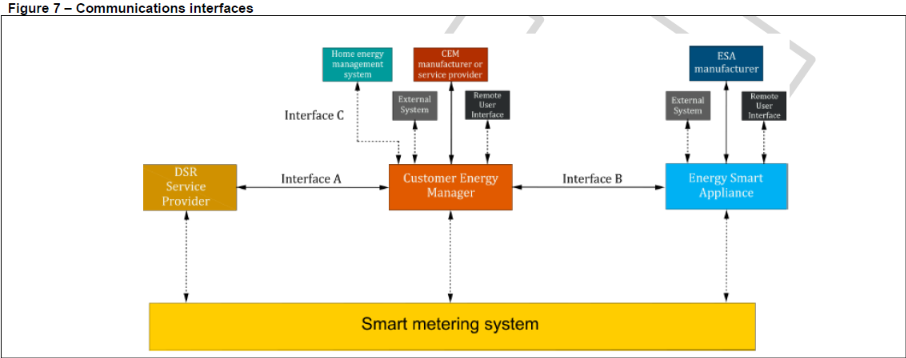
Clause 5 is entitled “Communications and messaging” and includes this diagram:
Clause 6 is entitled “Cyber security” and includes this diagram:
If you have any questions please do not hesitate to ask using the space provided for that purpose below.
The Electric Vehicles (Smart Charge Points) Regulations 2021

I’ve spent a busy few days covering the power cuts caused across the UK by Storm Arwen. Before she arrived on the scene I intended to go into more detail about Boris Johnson’s announcement last week about “New laws to supercharge the electric vehicle revolution”. Finally the time has come to look at some of those new laws in a bit more detail!

According to the preamble to “The Electric Vehicles (Smart Charge Points) Regulations 2021“, currently merely a “Draft Statutory Instrument”:

The Secretary of State, in exercise of the powers conferred by sections 15, 16, 17 and 18 of the Automated and Electric Vehicles Act 2018(1) (“the 2018 Act”), makes the following Regulations.

In accordance with section 18(4) of the 2018 Act, a draft of this instrument has been laid before Parliament and approved by a resolution of each House of Parliament.

The Secretary of State has consulted such persons as the Secretary of State considered appropriate in accordance with section 18(3) of the 2018 Act before making these Regulations.

PART 1
Introduction

Citation, commencement and extent
1.—(1) These Regulations may be cited as the Electric Vehicles (Smart Charge Points) Regulations 2021 and come into force on 30th June 2022.
(2) These Regulations extend to England and Wales and Scotland.

To summarise, if duly enacted by Parliament the following interesting extracts from the bill will come into force on 30th June 2022. Which is approximately 7 months from now:

Continue reading →

Sono Announce AC V2G Wallbox

On a press release a couple of days ago Sono Motors announced that:

Mobility provider Sono Motors is fulfilling the Community’s desire for an affordable wall charging station, suitable for home charging, vehicle-to-grid (V2G) and vehicle-to-home (V2H) with the first bidirectional AC wallbox on the market. This brings the company a significant step closer to its vision of a world without fossil fuels. The wallbox enables the Sion to be used as a mobile power plant and also to feed stored electricity either back into their house or into the grid itself. Homeowners with photovoltaic systems especially save a large amount of money as they are able to use more of their own electricity without having to buy an expensive home storage system. The Sono wallbox charges and discharges the Sion with up to 11 kW via the integrated Type 2 charging cable, and will save up to 70% of costs incurred by DC bidirectional wallboxes available to date. It is already possible to reserve the new wallbox free of charge, delivery is expected to take place with the Sion start of production in 2023.

This is of course very exciting news, and Sono also address a question that we have been pondering for many years, and which we discussed in detail more recently with the British Standard Institution’s launch of its PAS 1878 specification for home energy management systems:

A home energy management system (HEMS) controls when the Sion is charged and discharged: the wallbox communicates with the HEMS via various protocols such as EEBUS, Modbus or OCPP. A recommendation as to which HEMS are compatible with the Sono wallbox will be available shortly after its sales launch. The Sono app and Sono infotainment can also be used to set the level of the vehicle’s battery at which discharging can be terminated. This ensures that it always has enough range to cover any mobility needs.

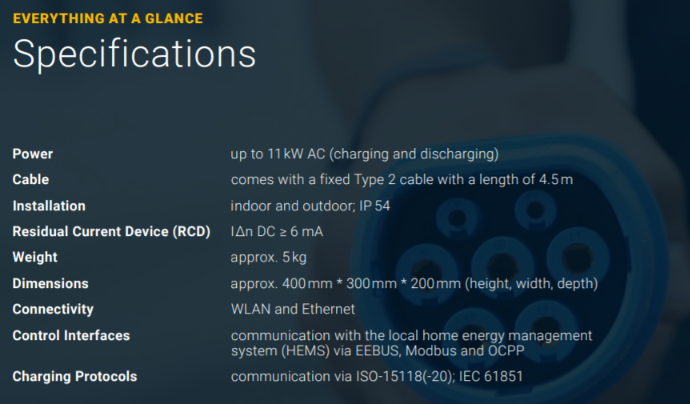
The specification for the Sono bidirectional wallbox looks like this:

That all looks very good, but there are a couple of flies in Sono’s ointment. Their wallbox won’t be available until 2023, and there appear to be no plans to release it in the United Kingdom.

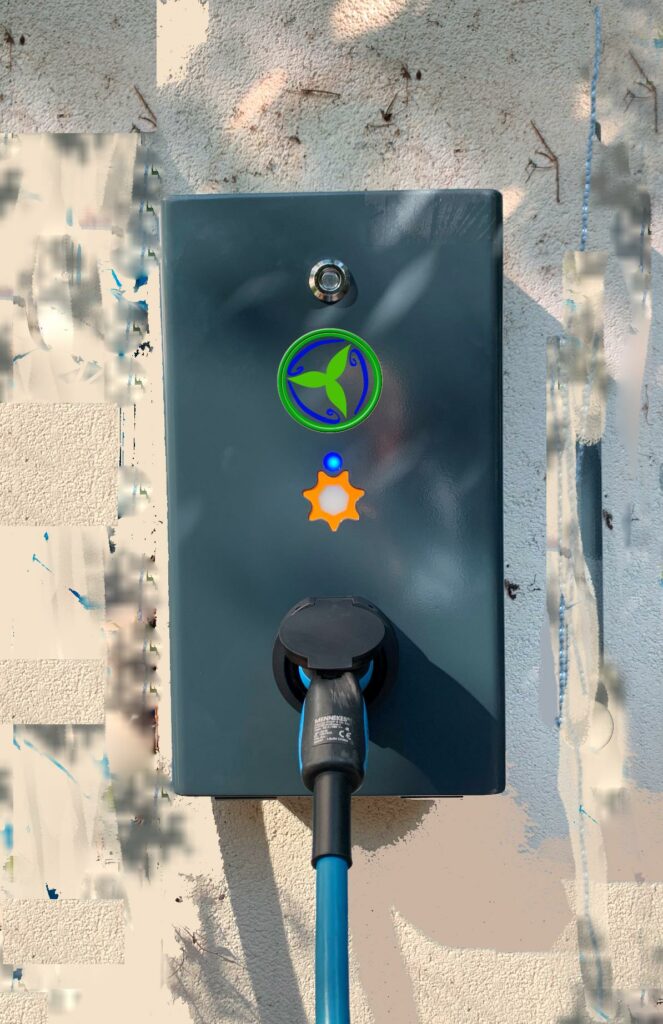
What’s more Sono’s copywriter needs a slight slap on the wrist. Here’s a picture of a 22 kW 3 phase bidirectional AC wallbox that has been available off the shelf for over a year!

Here’s Sono’s video explaining the benefits of their forthcoming, albeit less powerful, piece of equipment:

Perhaps Tillman would be good enough to appear in another Sion Motors video with more accurate commentary in the not too distant future?

Finally, for the moment at least, here once again is a dual 22 kW bidirectional AC charging pillar that has been installed in our car park for over two years:

Merging/Migrating OCPP to IEC 63110

Today’s article is another in our occasional series endeavouring to explain the arcane world of international standards. Hence it is more technical than is usual here on the V2G UK blog, but it is possibly even more relevant than the latest V2x announcements from assorted electric vehicle manufacturers.

This morning I attended the first meeting of an IEC Technical Committee 69 Joint Working Group 11 task force set up to develop an “information document” aiming to provide helpful advice to EV charging station manufacturers as they develop future “smart grid” enabled products. This document will be more like the British Standards Institution’s recently released PAS 1878 “specification” than a full blown international standard, albeit hopefully nowhere near as long!

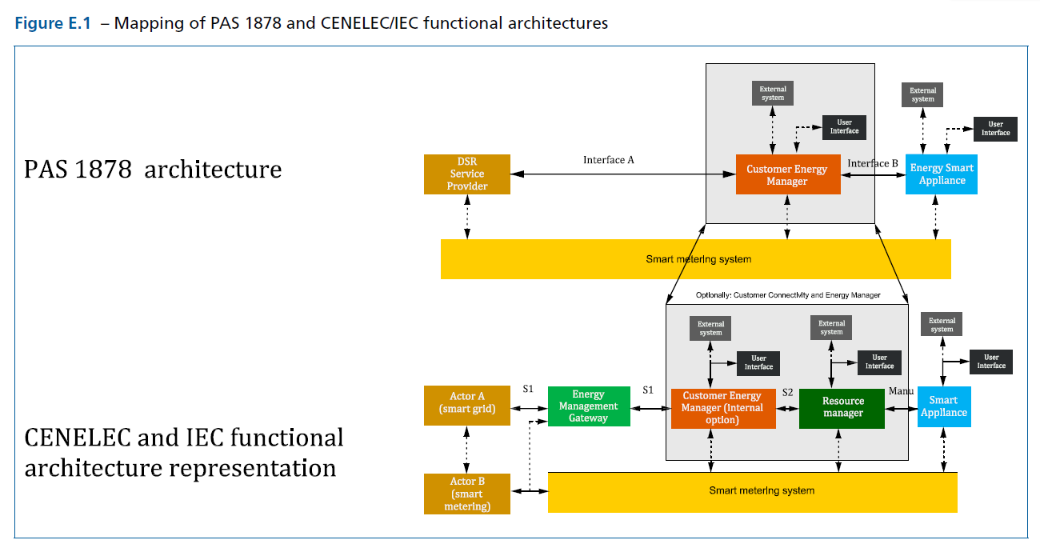
By way of an example of the sort of things that were discussed in the meeting here is an infographic from PAS 1878 which hopefully illustrates the extensive overlap between the BSI’s concept of a future “smart home” and the related concepts emerging from the work of the European CENELEC Technical Committee 205 and other standards development committees:

BSI PAS 1878 figure E.1.
PAS 1878 figure E.1. (Click to enlarge)

As annex E from the PAS explains:

This annex provides information on the relationship between the functional architecture described in this PAS and an amalgamation of the “smart grid” functional architecture included in several CENELEC and IEC standards. The representations in the CENELEC and IEC documents, whilst broadly similar, do differ slightly, hence the need for an amalgamated representation. The two architectures and how they are mapped are shown in Figure E.1. The CENELEC/IEC architecture is configured assuming that the CEM is internal to the consumer premises. As this is a functional architecture, a configuration with the CEM external to the consumer premises (e.g. in the cloud) is also permissible.

Figure E.1. shows the relationship between the PAS 1878 functional architecture and an amalgamated representation of the smart grid flexibility functional architecture depicted in several CENELEC and IEC standards, including BS EN 50491-12-1:2018, BS EN 50631-1:2017, PD IEC/TR 62746-2:2015, and prEN50491-12-2.

Expect to hear much more over the coming months and years about such esoteric things as the “Customer Energy Manager”, the “Resource Manager”, assorted “Demand Side Response Service Providers” and any number of other novel terms and acronyms. The diagram above is generic, but for the EV charging use case note that the charging station is equivalent to the “Smart Appliance” and the OCPP and/or IEC 63110 protocols are equivalent to “Interface B” in the top half of the diagram or the “Manufacturer protocol” in the lower half.

Hopefully that’s all crystal clear by now? If not hopefully it will become so by the time the newly constituted IEC task force has completed it’s work and you have read the resulting guidance document!

Electric Vehicles as “Energy Smart Appliances”

The British Standards Institution has just published a new “specification”, and unlike most BSI “standards” this one is free to download, as long as you don’t mind parting with an email address. As the download page puts it:

BSI is working with the UK Government to encourage the uptake of safe, secure and interoperable Energy Smart Appliances (ESAs). These are needed for the active management of demand on the electricity network, known as Demand Side Response (DSR). PAS 1878 is a critical component in this because it details the requirements and criteria necessary to make an energy smart appliance compatible with DSR activities.

At this point you may have a couple of question, such as “What on Earth is a PAS?”. The BSI have a ready answer for that question:

A PAS (Publicly Available Specification) is a fast-track standardization document – the result of an expert consulting service from BSI. It defines good practice for a product, service or process. It’s a powerful way to establish the integrity of an innovation or approach.

The next obvious question is “What has this got to do with electric vehicles and/or vehicle-to-grid technology?”. The answer to which is that a “smart” EV charging station is a special case of an interoperable Energy Smart Appliance. As the foreword to PAS 1878 states:

Continue reading →