Last week there was a significant “Energy Technology” announcement in Manchester. This article was supposed to be written/published last weekend, but Storm Darragh and our subsequent 20 hour power cut proved more than capable of disrupting the carefully laid plans of both mice and men!
Hastily returning to a rather damp Manchester on December 5th, here is a recording of the meat of the initial presentation by Devrim Celal, Chief Marketing and Flexibility Officer of KrakenFlex Limited, speaking at the launch of the “Mercury Consortium” at the “UK’s first energy tech superhub”:
Devrim’s presentation was followed by a panel session with representatives of four “manufacturers”, which we will cover at a future date. After a “networking break” there was another panel session with speakers from four “utilities”, introduced by Arshad Mansoor who is President and CEO of the Electric Power Research Institute. Here’s what Arshad had to say:
How do you catch a cloud and pin it down? How do you find a word that means Flexibility?
We’ll get back to answering that question in due course. First some exciting news.
On November 22nd I attended the kick off meeting of a new International Electrotechnical Commission “smart grid” committee. This one is catchily entitled the “System Committee Smart Energy ad hoc Group 11 on Energy flexibility and residential DSR: common ground”, or “SyC SE ahG 11” for short.
If you follow the link just above you will discover that ahG 11’s mission is:
To consider the implementation of international residential flexibility system standards, their compatibility with national requirements, and propose best practice:
* To ensure the compatibility of end-to-end system solutions at international level,
* To identify emerging challenges related to the uptake of residential DSR,
* To consider terminology alignment, and
* To develop an accelerated report containing requirements for residential flexibility. This would give recommendations for alignment of existing national publications and flexibility projects under development with international standards. It would also identify, if relevant, the need for further standardization
Amongst other questions discussed at the kick off meeting was “How do you define the term ‘flexibility'”. Your mileage may vary of course, but since I spent 5 years of my life meeting 2 or 3 times per week on the committee developing the IEC 63110-1 document I will quote from the Committee Draft for Vote (CDV for short) of that international standard:
General concept of elasticity of resource use, (demand, storage, generation) modification of consumption and/or generation of energy/power, on an individual or aggregated level, in 371 reaction to an external signal (price signal or request) in order to provide a service within the energy system
Elasticity of resource use (demand, storage, generation), modification of consumption and/or generation of energy/power, on an individual or aggregated level, in reaction to an external signal (price signal or request) in order to provide a service within the energy system.
If you have strong objections to that definition please do not hesitate to join ahG 11, or failing that to send your preferred term of words to me so that I can bring it to the committee’s attention.
My other main action item before the next meeting in the New Year is to generate a list of existing standards, regulations etc. relevant to my particular area of expertise, which is bi-directional power transfer during electric vehicle (dis)charging (BPT for short). More commonly referred to as V2x. Since ahG 11’s term of reference includes the word “residential” this suggests an emphasis on vehicle-to-home technology (V2H for short) . However, homes are of course connected to the local electricity distribution grid, and are not forbidden from feeding electrical energy back into the grid as long as all the associated rules and regulations are adhered to.
Please let me or any other member of the committee know of any “standards” within your own area of expertise that may be relevant to “residential demand side response” (using the UK’s non standard nomenclature!), whether they be international, national, “industry de facto” or even the learnings from relevant “pilot projects”.
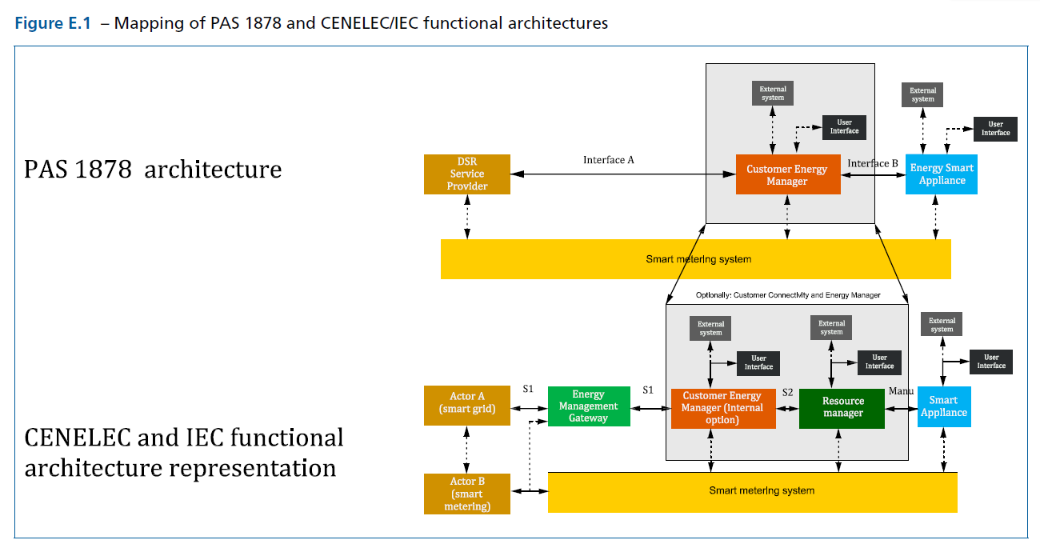
Please feel free to suggest candidates for “standards” for communicating across any of the arrowed lines in the diagram, and alternative diagrams for that matter!
Today’s article is another in our occasional series endeavouring to explain the arcane world of international standards. Hence it is more technical than is usual here on the V2G UK blog, but it is possibly even more relevant than the latest V2x announcements from assorted electric vehicle manufacturers.
This morning I attended the first meeting of an IEC Technical Committee 69 Joint Working Group 11 task force set up to develop an “information document” aiming to provide helpful advice to EV charging station manufacturers as they develop future “smart grid” enabled products. This document will be more like the British Standards Institution’s recently released PAS 1878 “specification” than a full blown international standard, albeit hopefully nowhere near as long!
By way of an example of the sort of things that were discussed in the meeting here is an infographic from PAS 1878 which hopefully illustrates the extensive overlap between the BSI’s concept of a future “smart home” and the related concepts emerging from the work of the European CENELEC Technical Committee 205 and other standards development committees:
PAS 1878 figure E.1. (Click to enlarge)
As annex E from the PAS explains:
This annex provides information on the relationship between the functional architecture described in this PAS and an amalgamation of the “smart grid” functional architecture included in several CENELEC and IEC standards. The representations in the CENELEC and IEC documents, whilst broadly similar, do differ slightly, hence the need for an amalgamated representation. The two architectures and how they are mapped are shown in Figure E.1. The CENELEC/IEC architecture is configured assuming that the CEM is internal to the consumer premises. As this is a functional architecture, a configuration with the CEM external to the consumer premises (e.g. in the cloud) is also permissible.
Figure E.1. shows the relationship between the PAS 1878 functional architecture and an amalgamated representation of the smart grid flexibility functional architecture depicted in several CENELEC and IEC standards, including BS EN 50491-12-1:2018, BS EN 50631-1:2017, PD IEC/TR 62746-2:2015, and prEN50491-12-2.
Expect to hear much more over the coming months and years about such esoteric things as the “Customer Energy Manager”, the “Resource Manager”, assorted “Demand Side Response Service Providers” and any number of other novel terms and acronyms. The diagram above is generic, but for the EV charging use case note that the charging station is equivalent to the “Smart Appliance” and the OCPP and/or IEC 63110 protocols are equivalent to “Interface B” in the top half of the diagram or the “Manufacturer protocol” in the lower half.
Hopefully that’s all crystal clear by now? If not hopefully it will become so by the time the newly constituted IEC task force has completed it’s work and you have read the resulting guidance document!
In a press release yesterday the CHAdeMO Association made a most interesting announcement. Here is what they said:
CHAdeMO Association announced today their decision to jointly develop the next generation Ultra-Fast charging standard with China Electricity Council (hereafter CEC), China’s official association of utilities in charge of their national regulations and standards related to electricity. Two entities will sign a Memorandum of Understanding on August 28th in Beijing, China, to kick-start their collaboration.
CHAdeMO signs an MoU with China Electricity Council (CEC) for co-development of next generation ultra-fast EV charging standard
New ultra-fast charging standard will ensure backward compatibility with both current CHAdeMO and GB/T standards, in order not to penalize current EV users
Both Japanese and Chinese governments support this industry initiative, which is expected to lead the way towards a single harmonised future standard
CHAdeMO protocol, a Direct Current fast charging standard recognised by the IEC* and the most popular international standard with over 18,500 charging points covering the EV market worldwide, set its specification at 500V and 125A when it was initially defined in 2009. After updates in 2017 and 2018, its current specification goes up to 1000V and 400A to cater to the market demand.
CEC, a Government approved association in charge of starndardisation of EV charging equipment. is evaluating high-power charging technologies and promoting demo projects and pilot studies for the creation of a new, Ultra-Fast charging standard to prepare for the expected market needs in the future. CHAdeMO Association and CEC reached an agreement to jointly proceed with such development.
This joint development should lead to a next-generation Ultra-Fast charging technology that is safe and versatile. As the new Ultra-Fast charging standard aims to ensure interoperability with existing CHAdeMO and GB/T fast charging standards, it is also expected that the new standard will be adopted not only in Japan and China but also in many other EV markets worldwide, and to contribute to the further roll-out of EV charging network.
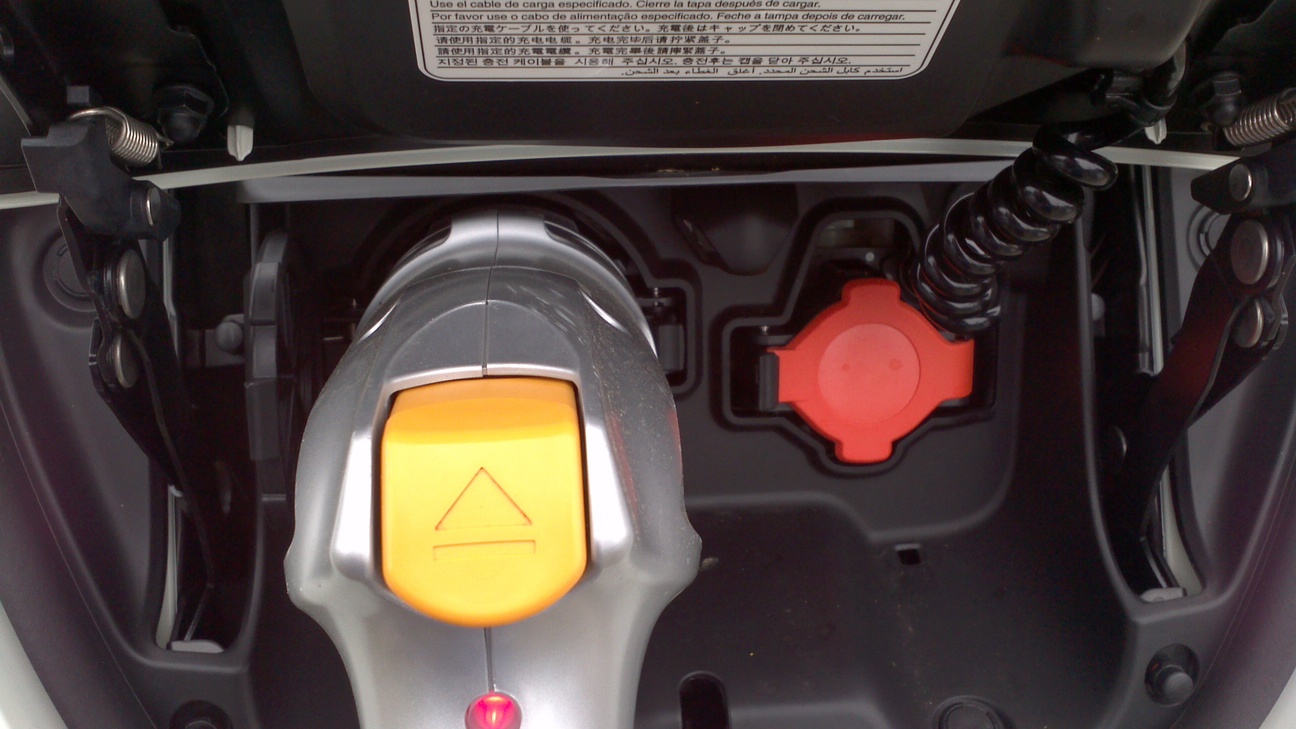
That potentially makes life easier for those of us beavering away behind the scenes developing international standards for electric vehicle charging. Here’s what the current “rapid charging” 50 kW CHAdeMO connector looks like in action:
From a slightly different perspective, CHAdeMO’s Secretary General Dave Yoshida said:
We are pleased to work together with CEC to develop an ultra-fast charging standard to prepare for the future charging needs, while ensuring safety and interoperability, which is a core value of CHAdeMO protocol. We believe the outcome of this joint development will pave the way towards a single harmonised standard in the future.
The members of CharIN group who are developing the competing Combined Charging System “standard” might well quibble over Dave’s “single harmonised standard” remark, since their stated mission is:
Establishing the Combined Charging System (CCS) as the global standard for charging battery powered electric vehicles.
The CHAdeMO Association press release continues:
This joint development falls into one of the strategic categories defined as “Enhancing international harmonisation in vehicle electrification policies” in the Japanese government’s New Strategy for the automobile industry, which was recently announced by the Ministry of Economy, Trade and Industry, and will be strongly supported by both the Japanese and Chinese governments.
The Memorandum of Understanding aims to kick-start harmonisation for the next-generation international charging standard, for accelerating further deployment of electrified vehicles in wider vehicle categories, by starting the joint development activities based on the cutting-edge technologies foreseeable in the near term as an initial step.
As an apparent afterthought they finally point out that:
*IEC: International Electrotechnical Commission
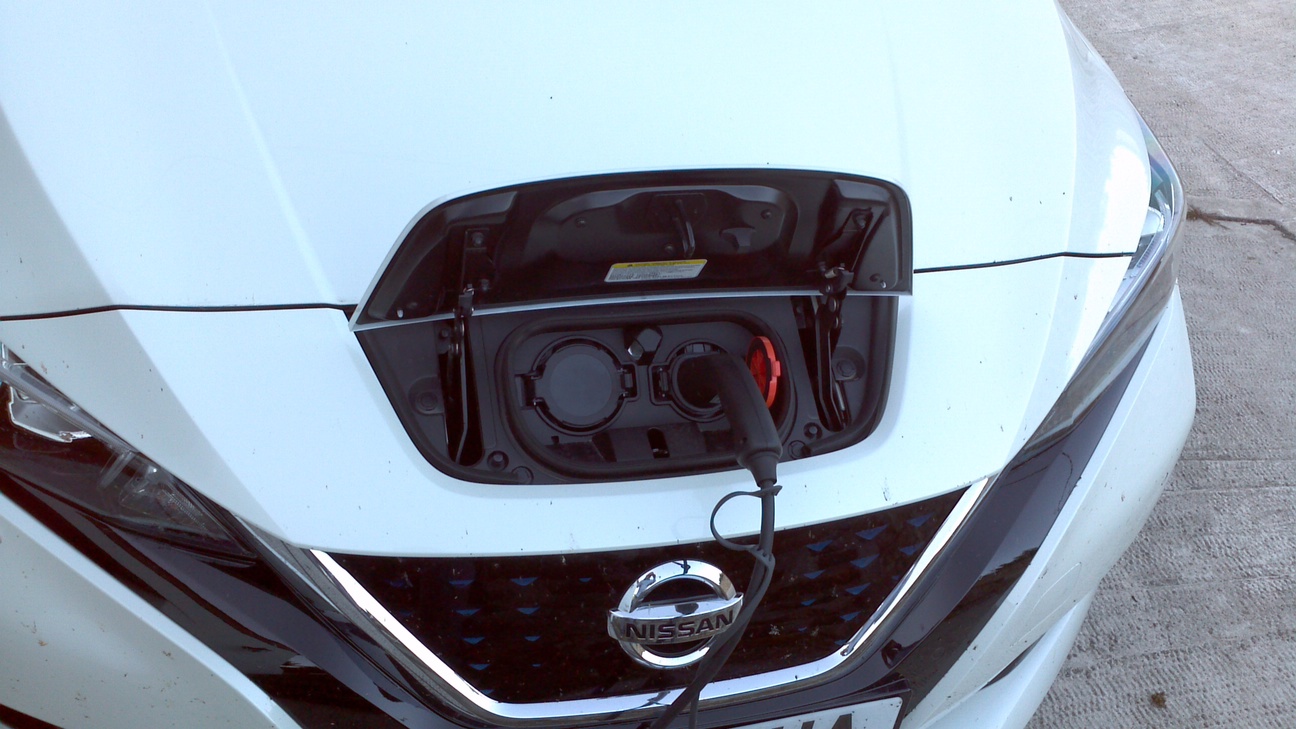
As an afterthought from us here at V2G UK in Cornwall’s (Silic)Inny Valley, here’s a 2018 Nissan LEAF charging from a standard UK 3 pin socket in our courtyard:
Perhaps the CHAdeMO Association and/or the CEC could lend us a suitably “ultra-fast charging standard” equipped vehicle for future such tests?
Our regular reader(s) will be aware that quite some time ago I suggested that:
There’s a few more urgent things to be ticked off on the to do list. How about OCPP 2.0 or even fully fledged British and international standards for “smart charging”, V2B and ultimately pukka V2G protocols for starters?
I am happy to now be able to report that my wish has come true! An international standard is now being developed for electric vehicle supply equipment (EVSE for short) communications with the “back office”, including vehicle to grid (V2G for short) functionality. For my sins I now sit on IEC technical committee 69 joint working group 11 (TC69/JWG11 for short). According to the Wikipedia article on the subject, which I wrote:
IEC 63110 is an international standard defining a protocol for the management of electric vehicles charging and discharging infrastructures, which is currently under development. IEC 63110 is one of the International Electrotechnical Commission’s group of standards for electric road vehicles and electric industrial trucks.
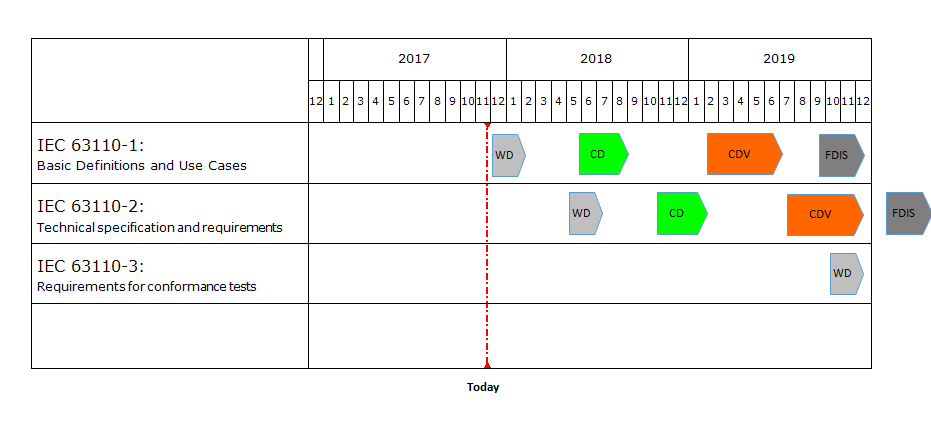
You will no doubt be delighted to discover that proceedings are still at a fairly early stage. Here’s the current IEC 63110 roadmap:
The top line indicates to the initiated that I am still able to point out that IEC TC69/JWG11 is currently seeking submissions for potential use cases to add to our initial list. The current deadline is December 6th. It is probably safe for you to assume that all the obvious stuff from the Open Charge Alliance’s Open Charge Point Protocol and ISO/IEC’s 15118 protocol is already included on our list.
However if you have a use case that isn’t in amongst the obvious stuff then please do not hesitate to get in touch!
The PowerUp project has published the TTCN-3 based implementation of the conformance test cases which it has developed for testing ISO/IEC 15118-2 protocol implementations, i.e. the V2G application protocol.
With this publication, a V2G standards compliance testing suite has been made available for the first time. The PowerUp team believes that this testing suite will prove to be valuable for the validation and maturing of V2G system implementations which incorporate the ISO/IEC 15118 standards.
Further extensions of this TTCN-3 suite, along with its incorporation into the ISO/IEC 15118-4 V2G testing standard are possible.
The conformance testing suite and associated documentation can be downloaded from the PowerUp web site.
PowerUp aims to develop the Vehicle-2-Grid (V2G) interface, involving a full development cycle of physical/link-layer specification, charging control protocol design, prototyping, conformance testing, field trials, and standardisation. Its results will ensure that FEVs smoothly integrate into emerging smart-grid networks. Thereby the efficiencies resulting from robust grid operation may be achieved; V2G capabilities will smoothen the daily fluctuation of electricity demand and will enable FEVs to act as emergency energy supplies. To achieve these desired results, it is essential that any electric vehicle type would be compatible with any European smart-grid network.
V2G technology will be developed in liaison with the ongoing ISO/IEC standardisation of the V2G interface, and it will extend existing smart-metering standards and ETSI ITS standards for vehicular communications. On the grid side, smart electric meters will be enhanced for V2G capability and V2G-specific demand-balancing control algorithms will be researched.
The documents delivered this week can be downloaded from the PowerUp home page. To give you a feel of what is contained therein, here’s an extract from the introduction to deliverable 4.1:
The PowerUp project aims at developing and validating the V2G interface, so as to support nomadic electricity consumption by electric vehicles under any foreseen arrangement of the billing architecture or value chains. The PowerUp use cases, which can be handled by the envisaged architecture, are stated below:
A) Basic V2G set up (commercial heavy vehicle)
B) Basic V2G setup (passenger car) in semiprivate area
C) Power delivery re-negotiation
D) Grid-controlled scheduling and re-scheduling of charging
E) Power failure handling
F) User initiated re-scheduling
G) High speed data exchange with the EV over PLC
H) Vehicle to grid transfer of energy
According to the rather sparse “Events” section of the PowerUp web site:
Our up-to-date V2G interface prototypes will be demonstrated at the EC stand and at the Denso stand at the 2012 ITS World Congress in Vienna.