Will There Be Blackouts in the UK This Winter?

According to an “exclusive” report in The Guardian:

Ministers are discussing launching a public information campaign to encourage households to reduce their energy use this winter as fears grow over winter blackouts.

Households could be asked to turn their thermostats down and use their dishwashers and washing machines during the night and at times when energy demand is lower, under plans being discussed between the business department, energy companies and the network operator National Grid.

No names are mentioned of course, but allegedly:

Sources close to the discussions said that government officials and industry executives were determined to avoid blackouts disrupting the supply of energy to Britons’ homes. A public information campaign could help ease pressure on energy supplies during the winter.
Ministers have so far resisted calls to tell consumers to cut their energy use, saying consumption of gas and electricity was a “decision for individuals”.

The article mentions the recent trial in Scotland run by Octopus Energy and SP Energy Networks, in which a financial incentive was offered to domestic consumers to shift the timing of their electricity demand.

Over 2,500 Octopus Energy customers across Dumfries and Galloway participated in the six-week trial*. Directed to power up their usage when green energy supply was highest, households used 20MWh more energy across the six two-hour trial windows.
Households who increased their usage by more than 10% were credited back all the energy they had used during the two-hour timeframe. Those who used more than 100% extra were credited double the amount they had used. Participating customers were rewarded with an average of £5 of free energy, with some saving up to £73.

According to The Guardian once again:

National Grid will lay out its outlook for winter energy supplies on Thursday, giving the first comprehensive assessment of the risk of blackouts this winter.

The eagerly awaited document should show how resilient Britain’s energy supplies are over the coming months. An early view, published in August, showed the UK should be able to meet its energy demand in the coming months. However, since then Norway has indicated it may prioritise supplying its domestic market over exporting power.

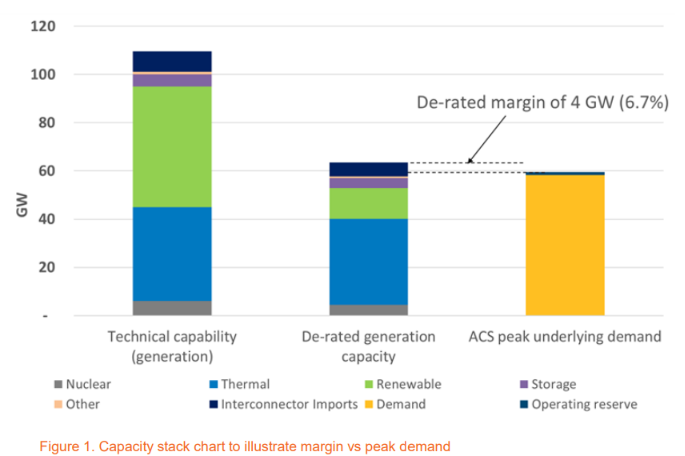
Here’s how things stacked up for the National Grid in August:
We eagerly await any changes revealed in tomorrow’s report!

[Edit – October 6th]

The National Grid Electricity System Operator has now published its “Winter Outlook Report” for 2022/23. Here is the executive summary in full:

Our first illustrative scenario examines what would happen if there were no electricity imports from continental Europe . In this scenario we would deploy our mitigation strategies – dispatching the retained coal units and our Demand Flexibility Service. By securing 4GW through these actions, we would maintain adequate margins and mitigate impacts on customers.

Our Demand Flexibility Service is new and innovative, and we have worked with suppliers, aggregators, industry, Ofgem and BEIS on the design to ensure it is ready for the winter and capable of delivering the required level of participation and response (2 GW+). It will launch on 1 November, and we are encouraging suppliers and aggregators to work with their customers to ensure the highest levels of engagement and participation. We see particular potential from commercial organisations who can shift their load from peak hours and have had positive feedback from British companies on this.

Without the Demand Flexibility Service, we would expect to see a reduction in margins. In this scenario on days when it was cold (therefore likely high demand), with low levels of wind (reduced available generation), there is the potential to need to interrupt supply to some customers for limited periods of time in a managed and controlled manner. However, we expect the mitigations outlined above to be effective.

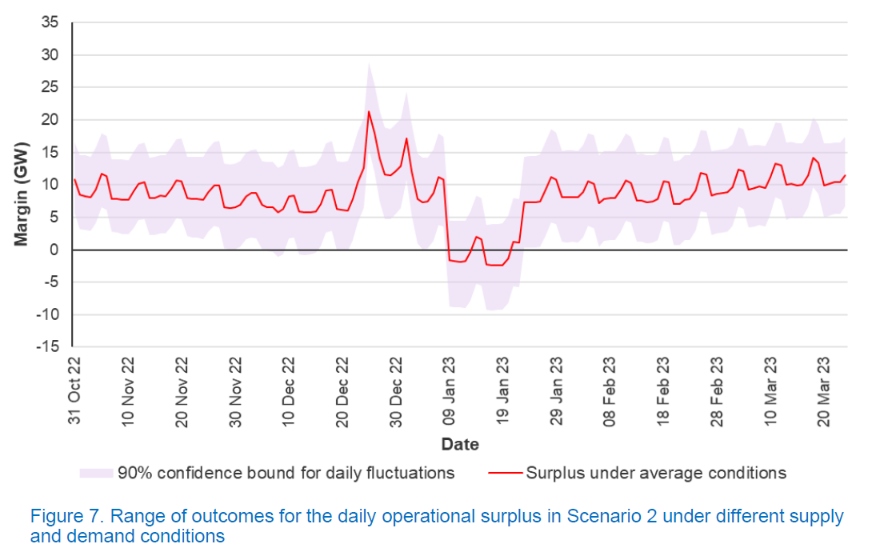
A second, more extreme scenario, looks at a hypothetical escalation of the energy crisis in Europe such that there is insufficient gas supply available in Great Britain (in addition to no electricity available to import from continental Europe as per above scenario). In the unlikely event that escalation of the situation in Europe means that insufficient gas supply were to be available in Great Britain this would further erode electricity supply margins6 potentially leading to interruptions to customers for periods. All possible mitigating strategies, including our new measures, would be deployed to minimise the disruption.

Overall, this is likely to be a challenging winter for energy supply throughout Europe. We have taken extensive measures to try to mitigate the impacts for British consumers and expect that, under our base case, margins will be adequate. Nevertheless, there remain scenarios, driven principally by factors outside of Great Britain which could impact upon British electricity supplies. Plans are in place to ensure the impact is minimised and the overall security and integrity of Britain’s energy systems are protected.

Here too is the updated version of the “base case” supply margin chart shown above:

The chart is accompanied by these two provisos, amongst others:

Our base case assumes electricity imports from Europe are available at times when we need them to meet demand, delivering in line with their Capacity Market agreements, and that there is no disruption to gas supplies.

Our base case does not assume any material reduction of consumer demand due to high energy prices. It does not include any of our mitigation measures such as coal contracts or the Demand Flexibility Service as we would not expect to deploy them here.

The winter outlook also considers “Scenario 1” in which there are “reduced electricity imports from Europe”:
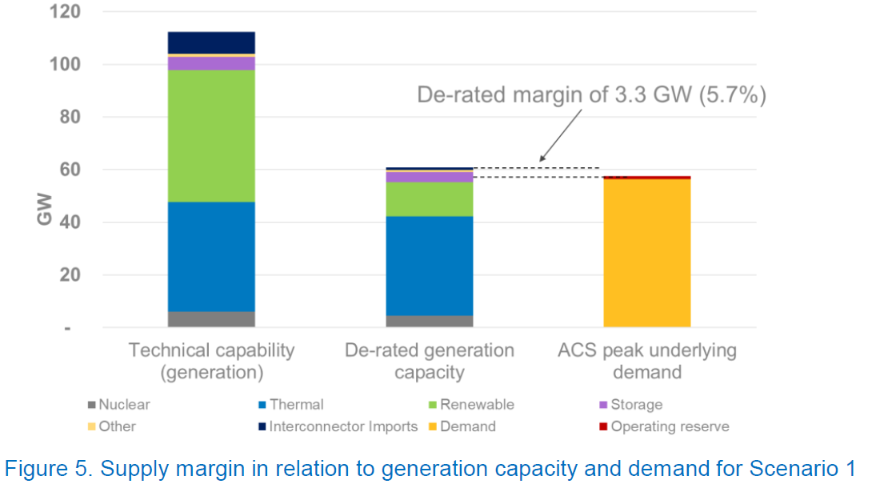
The bar chart is accompanied by a graph of “operational surplus”:
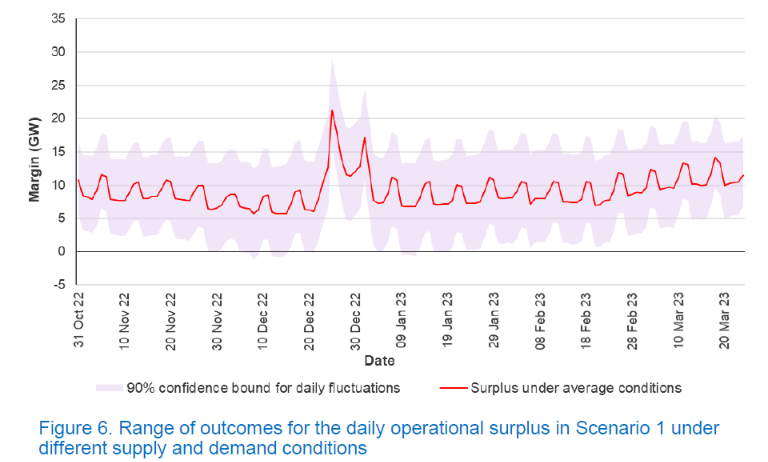
That shows National Grid’s “90% confidence” that the surplus will not turn negative over the winter. However now let’s take a look at “Scenario 2” in which there is in addition “insufficient gas supply in Great Britain”:
Note that according to Ofgem a few days ago:

Due to the war in Ukraine and gas shortages in Europe, there is a significant risk that gas shortages could occur during the winter 2022/23 in Great Britain. As a result, there is a possibility that GB could enter into a Gas Supply Emergency.

Perhaps it would be prudent at this juncture for us all to cross our fingers and hope that the gas keeps arriving at Great British shores over the coming months, whether via pipeline or LNG tankers?

[Edit – October 7th]

The Energy Networks Association has published an article entitled “How planned emergency power cuts would work if they are needed this winter“. They state, in part, that:

Though no power cuts are currently planned, in their winter outlook National Grid ESO raised the possibility of the need for planned national power cuts, in order to manage the possibility of energy demand outstripping the supply available.

Firstly, it’s important to know that before any emergency planned power cut instruction is given, National Grid ESO takes several steps to protect customers. These include:

* Encouraging additional generation through the supply market.
* Asking heavy industrial users to limit their demand during peak periods.
* Reducing domestic power demand – this could include paying customers to change how and when they use appliances like washing machines and dishwashers or reducing voltage across the country by a small percentage, which would be undetectable.

Procedures for emergency planned power cuts like this have existed for decades and are simulated in emergency exercises by the energy sector each year ahead of the winter.

If needed, the emergency procedures are designed to minimise the impact on customers as far as possible, by limiting power cuts to shorter periods in order to manage overall electricity demand. However, while the winter is expected to be challenging, there is no guarantee emergency measures will be necessary.

If an emergency power cut is implemented, customers in certain parts of the country would typically be without power for around three hours per day during the emergency.

Distribution network operators, which run the local power networks, would be legally instructed by National Grid ESO, which controls the flow of energy around the country, to disconnect power supplies using established procedures. These procedures are set out by the government in a document known as the Electricity Supply Emergency Code, sometimes referred to as ESEC. The procedures ensure that power is shared fairly across all customers during a national energy emergency…

If emergency power cuts are needed customers will be able to find their rota and what it means for them at powercut105.com by entering their postcode. The rota will only be published once emergency power cuts have been approved to take place.

[Edit – October 17th]

In an article in today’s Financial Times, energy correspondent Nathalie Thomas writes that:

National Grid’s chief executive has warned British households to prepare for blackouts between 4pm and 7pm on “really, really cold” weekdays in January and February in the event of reduced gas imports from Europe.

John Pettigrew said the company would have to impose rolling power cuts on “those deepest darkest evenings in January and February” if generators failed to secure enough gas from the continent to meet demand, particularly if the country suffers a cold snap.

Pettigrew’s comments at the Financial Times’s Energy Transition Summit came after National Grid, which oversees Britain’s electricity and gas systems, this month took the unusual step of setting out various “unlikely” scenarios in which Britain might not have sufficient energy supplies this winter.

[Edit – November 4th]

National Grid ESO’s Director of Corporate Affairs, Jake Rigg explained their
Demand Flexibility Service on BBC Breakfast this morning. · According to a BBC article:

Households will be offered discounts on their electricity bills if they cut peak-time use on a handful of days over the winter, as part of National Grid’s efforts to avoid blackouts.

The network operator has announced details of the scheme, which it said could save households up to £100.

There will be 12 “test” days initially, designed to see how customers respond, between November and March.

But only homes with smart meters will be able to take part.

Only 14 million, less than half, of households in England, Scotland and Wales, where the scheme is being tested, have a smart electricity meter installed.

Customers taking part will be given 24 hours’ notice of a “test” day where they will be asked to reduce their peak-time electricity use if they can during a one-hour period identified by National Grid, likely to be between 16:00 and 19:00.

That could include delaying use of a tumble-dryer or washing machine, or cooking dinner in the microwave rather than the oven.

National Grid said it will pay energy suppliers, which will be required to sign up to the scheme to operate it for customers, £3 for every kilowatt-hour during the test periods.

Individual suppliers will decide how much customers will receive and whether the money is taken off bills, credited to accounts, or if there’s an option to withdraw the cash…

Watch this space!
Electric Vehicles as “Energy Smart Appliances”

The British Standards Institution has just published a new “specification”, and unlike most BSI “standards” this one is free to download, as long as you don’t mind parting with an email address. As the download page puts it:

BSI is working with the UK Government to encourage the uptake of safe, secure and interoperable Energy Smart Appliances (ESAs). These are needed for the active management of demand on the electricity network, known as Demand Side Response (DSR). PAS 1878 is a critical component in this because it details the requirements and criteria necessary to make an energy smart appliance compatible with DSR activities.

At this point you may have a couple of question, such as “What on Earth is a PAS?”. The BSI have a ready answer for that question:

A PAS (Publicly Available Specification) is a fast-track standardization document – the result of an expert consulting service from BSI. It defines good practice for a product, service or process. It’s a powerful way to establish the integrity of an innovation or approach.

The next obvious question is “What has this got to do with electric vehicles and/or vehicle-to-grid technology?”. The answer to which is that a “smart” EV charging station is a special case of an interoperable Energy Smart Appliance. As the foreword to PAS 1878 states:

Continue reading →

Sero Group Announce “UK’s largest domestic DSR trial”

In a press release on Tuesday the Sero Group announced that:

FLATLINE, an industry led research project aiming to demonstrate the viability of a demand-side approach to energy management at domestic level, has reached a major milestone as residents move into three pilot homes at The Mill site in Cardiff.

Backed by the Department of Business, Energy & Industrial Strategy, the ‘Fixed Level Affordable Tariffs Led by Intelligently Networked Energy’ (FLATLINE) project aims to significantly reduce residents’ energy bills, using a combination of domestic Demand Side Response and demand shifting for both heat and electricity.

The specially built pilot homes at The Mill development site in Cardiff will be closely followed by a further 46 homes at a separate site, Parc Eirin in Tonyrefail – which will see first residents move in this autumn as the first phase of the 225 new home scheme is complete.

According to the “Zero Carbon Lifestyle” section of the Sero Homes web site:

Every Sero Home is built ready for future generations, and that includes the future of travel.

Our homes are built with three phase electricity – the “broadband” of power – and electric vehicle (EV) fast charging points. You can recharge your car at a Sero Home in less than four hours, compared to around twelve hours in a traditional home (or about three days on a 13amp plug).

Sero Homes’ class-leading recharging times are only useful if you can afford the car in the first place. To tackle this, on most of our sites we offer our residents an option to take an EV lease with inclusive miles bundled in.

It’s probably no coincidence that today Robert Llewellyn announced a new edition of his Fully Charged Show. An introduction to the “Affordable Eco Housing” at The Mill and Parc Eirin:

Continue reading →

National Grid Launches Carbon Intensity Data Feed

In a press release last week National Grid announced that:

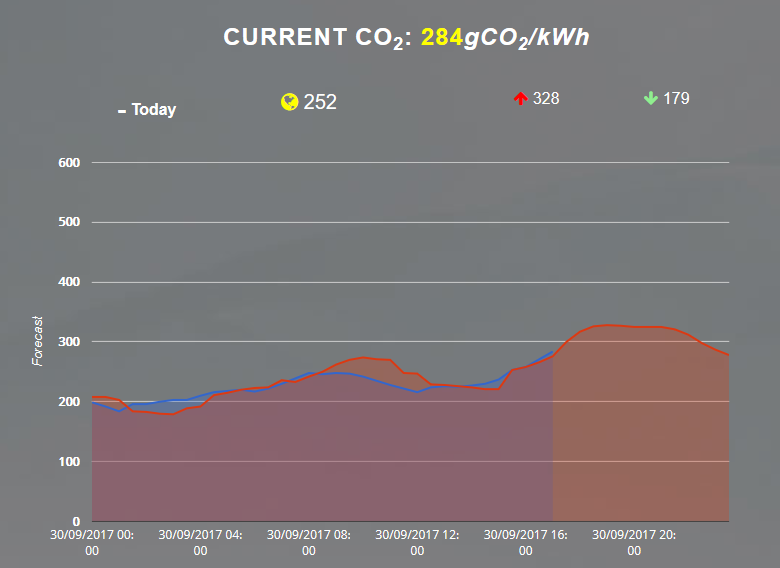
The company today launches innovative new software that forecasts the carbon intensity of electricity generation up to two days ahead, helping people to understand and control their energy use.

National Grid is working with Environmental Defense Fund Europe and WWF to make the software openly available to the public. WWF has used the data as the basis of an online tool which points users to the best times to turn on or turn off home appliances to minimise carbon emissions, while Environmental Defense Fund Europe are working on policy implications of having this data available and widely understood. Shifting activities like dishwasher cycles or electric vehicle charges could help relieve pressure on the energy system, reduce the need to use back-up fossil fuel plants, and potentially reduce bills for households.

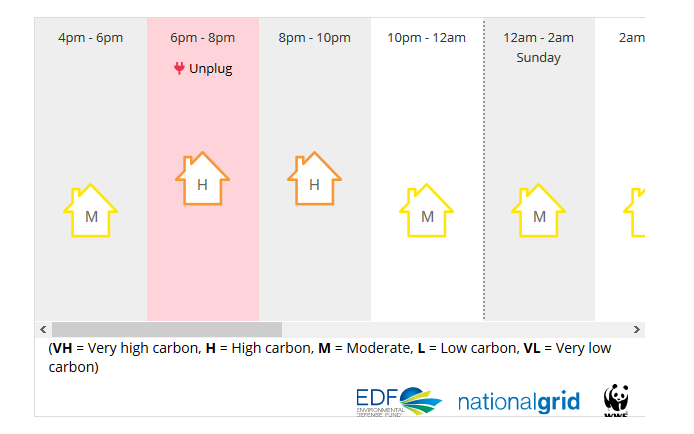
Here’s how National Grid’s visualisation of their carbon intensity data looks at the moment:

NGIntensity-20170930-1700

According to Duncan Burt, Director of the System Operator at National Grid:

We’re providing our forecast data in a format that allows technology companies to build innovative apps and software that could make a real difference to how and when people use energy. Clear and concise information that can tell you in advance when’s best to turn on the washing machine, load the dishwasher or charge your car for example, is a step in the right direction towards a low carbon future. This technology puts people at the heart of it, helping everyone to use power when it’s greenest, and likely, more cost efficient.

Simultaneously the WWF published a web page entitled “How do you make a green cup of tea” that presents the carbon intensity data in a “user friendly” fashion. According to the WWF:

Electricity is changing in the 21st century. Coal is being phased out and renewable energy sources like wind and solar now make up a quarter of our electricity.

This means that the greenness of our electricity now varies throughout the day. When it’s sunny and windy, we’ve got more green power. When it’s overcast and calm, we’ve got more fossil fuels online.

This new forecasting tool shows you what the greenest and dirtiest times of day will be up to two days ahead. This can help people plan their energy use, switching things on when energy is green and off when it’s not.

Being flexible with our energy use boosts our energy security and cuts carbon emissions by reducing the need for back-up fossil fuel generation. It could potentially save people money as well if they’re on time of use tariffs.

So if you want to make a green cup of tea, check out our forecast to find the greenest time of day to stick the kettle on.

Here’s how that forecast looks at the moment:

WWFIntensity-20170930-1700

Apart from the assorted press releases about the carbon intensity API there’s also a blog post from National Grid:

Working with WWF and Environmental Defense Fund Europe to finesse the science, we agreed to make the data that sits behind the forecast publicly available. The aim is to see tech developers creating consumer-friendly apps that can tell the public, in advance, when electricity generation is expected to be cleaner and greener, and more likely cost efficient.

The new software was a good idea hatched at a GB System Operator Hackathon and is yet another example of how our System Operator continues to be at the forefront of the energy revolution.

This new tool is a credit to the team in Wokingham – led by James Kelloway and his team members Alasdair Bruce and Lyndon Ruff, along with the sponsorship and guidance of Director of System Operations Duncan Burt and support from Corporate Affairs.

Not to be outdone the Met Office has also written another blog post on the topic:

Using hourly weather data from the Met Office and combining it with historical data from the grid, National Grid are able to forecast demand for electricity and also identify the contribution from renewable energy flowing into the grid. Using this information, they can forecast the carbon output of the grid over a 48-hour period, and identify the periods of lowest carbon output and highest carbon output. In other words, how green the grid will be during that period.

Using this information, the partners involved in the project hope that electricity consumers across Great Britain will be able to plan their electricity use around periods of high availability for renewable energy, reducing carbon output.

Patrick Sachon, Met Office Business Group Leader for Energy said: “The green energy forecast is a great example of innovative re-use of Met Office data. As a scientific organisation we encourage the re-use of our data, particularly if it can be applied to develop a deeper understanding of the interrelation between weather and something that is so integral to our everyday lives such energy.”

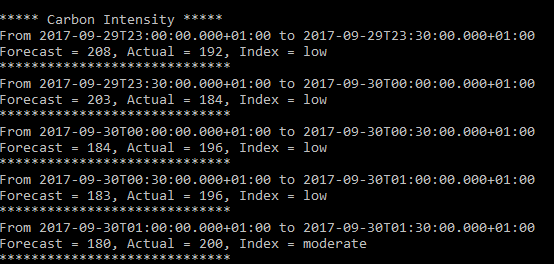
Down here at V2G UK we like to think of ourselves as an “innovative technology company” so we’ve already started using the new API. It’s very easy to use if you’ve ever written a JSON parser before, which fortunately we have. Here’s how the raw data for today looks as decoded by our trusty Raspberry Pi:

CarbonIntensity-20170930

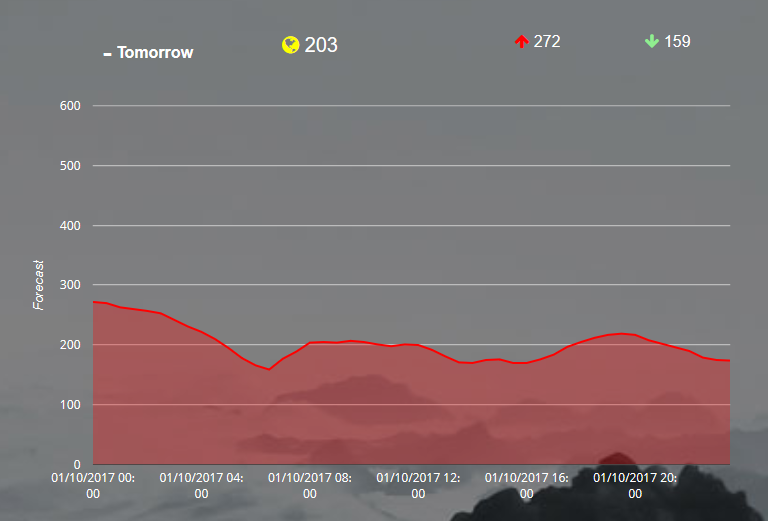
We haven’t persuaded our Pi to produce any pretty pictures as yet, so for now here’s National Grid’s forecast for tomorrow, which is forecast by the Met Office to be rather wet and windy:

NGIntensity-20170930+24h

Having slaved over a hot keyboard typing in this article I could really do with a nice hot cup of tea now, but it looks as though now is not a very good time. Wouldn’t it be a good idea if I could boil a kettle using electrical energy obtained from my very own battery instead of from the local grid? Another good idea would be if, much like the Met Office already do for the weather, National Grid could supply us with a carbon intensity forecast for Camelford as well as for the UK as a whole.

[Edit – October 1st]

Our experimental application is now producing simple graphs. If you’d like to experiment along similar lines we’ve uploaded our Java source code to GitHub. For further details see our new project page:

“National Grid Carbon Intensity API“

Tesla Energy Launches the Powerwall

In a much anticipated announcement last week Elon Musk told the world that Tesla Motors now had a sister business entitled “Tesla Energy” which would start delivering a new product called the Powerwall later this year. Here’s a video of Mr. Musk’s presentation:

Note that at around 2 minutes 25 seconds Elon points out that:

We have this handy fusion reactor in the sky called the Sun. You don’t have to do anything, it just works. It shows up every day and produces ridiculous amounts of power. Now a lot of people aren’t clear on how much surface area is needed to generate enough power to completely get the United States off of fossil fuels….

It’s really not much, and most of that area is going to be on rooftops. You won’t need to disturb land. You won’t need to find new areas. It’s mostly going to be on the roofs of existing homes and buildings.

Now the obvious problem with solar power is that the sun does not shine at night. This problem needs to be solved! we need to store the energy that is generated during the day so that we can use it at night.

I recommend watching the whole show, but if you’re the impatient sort then skip to 11 minutes 40 seconds and listen to this bit:

What about something that scales to much, much larger levels? For that we have something else. We have the Powerpack. The Tesla Powerpack is designed to scale infinitely. You can literally make this into a GWh solution. We already have one utility that wants to do a 250 MWh installation.

According to the Tesla Energy launch press pack:

Tesla is not just an automotive company, it’s an energy innovation company. Tesla Energy is a critical step in this mission to enable zero emission power generation.

With Tesla Energy, Tesla is amplifying its efforts to accelerate the move away from fossil fuels to a sustainable energy future with Tesla batteries, enabling homes, business, and utilities to store sustainable and renewable energy to manage power demand, provide backup power and increase grid resilience.

Tesla is already working with utilities and other renewable power partners around the world to deploy storage on the grid to improve resiliency and cleanliness of the grid as a whole.

Here’s a picture of the combination of Tesla’s two businesses:

Tesla Energy reveals a Model S in close proximity to a Powerwall

Tesla Energy reveals a Model S in close proximity to a Powerwall

and here’s their description of the Powerwall:

Tesla Powerwall is a rechargeable lithium-ion battery designed to store energy at a residential level for load shifting, backup power and self-consumption of solar power generation. Powerwall consists of Tesla’s lithium-ion battery pack, liquid thermal control system and software that receives dispatch commands from a solar inverter. The unit mounts seamlessly on a wall and is integrated with the local grid to harness excess power and give customers the flexibility to draw energy from their own reserve.

The battery can provide a number of different benefits to the customer including:

  • Load shifting – The battery can provide financial savings to its owner by charging during low rate periods when demand for electricity is lower and discharging during more expensive rate periods when electricity demand is higher
  • Increasing self-consumption of solar power generation – The battery can store surplus solar energy not used at the time it is generated and use that energy later when the sun is not shining
  • Back-up power – Assures power in the event of an outage

Powerwall increases the capacity for a household’s solar consumption, while also offering backup functionality during grid outages.

Powerwall is available in 10kWh, optimized for backup applications or 7kWh optimized for daily use applications. Both can be connected with solar or grid and both can provide backup power. The 10kWh Powerwall is optimized to provide backup when the grid goes down, providing power for your home when you need it most. When paired with solar power, the 7kWh Powerwall can be used in daily cycling to extend the environmental and cost benefits of solar into the night when sunlight is unavailable.

Since we are big fans of distributed energy storage here at V2G UK this is all music to our ears, but some things are strangely lacking from Tesla’s publicity.  Apparently:

Tesla’s selling price to installers is $3500 for 10kWh and $3000 for 7kWh. (Price excludes inverter and installation.) Deliveries begin in late Summer.

It looks as though inverters to attach to Powerwalls will be supplied by third parties and the pretty picture above notwithstanding connecting a Tesla Model S to one or more Powerwalls and thence to the local electricity distribution grid is a problem that has yet to be addressed by Tesla themselves.

There have been some associated press releases, such as this one from SolarEdge:

SolarEdge Technologies, Inc., a global leader in PV inverters, power optimizers, and module-level monitoring services, announced its collaboration with Tesla Motors to provide an inverter solution that will allow for grid and photovoltaic integration with Tesla’s home battery solution, the Powerwall.

The joint development by SolarEdge and Tesla builds on SolarEdge’s DC optimized inverter solution and Tesla’s automotive-grade energy storage technology to enable more cost-effective residential solar generation, storage, and consumption for the global market.

Designed to manage both functions with just one SolarEdge DC optimized inverter, the solution will allow for outdoor installation and will include remote monitoring and troubleshooting to keep operations and maintenance costs low. The solution will also support upgrading existing SolarEdge systems with the storage solution.

The SolarEdge solution is expected to be available by the end of 2015.

Once again, however, whilst the phrase “grid integration” is mentioned “vehicle to grid” is not. I cannot help but wonder when (and how) it will become possible for a Model S to earn its proud owner a modest income by feeding some of the energy stored in its battery pack back into the local grid at its times of greatest need.