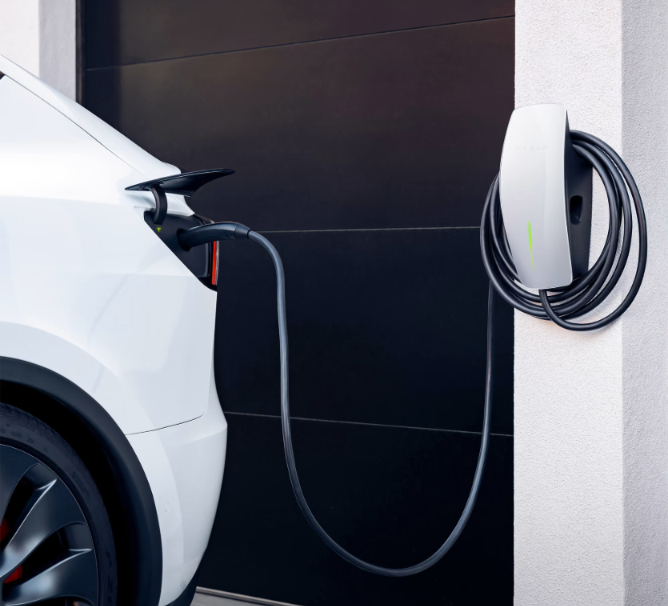
A new page has recently appeared on the Tesla web site, entitled “What is Powershare Grid Support“. In answer to that question Tesla state that:
With Powershare, your Cybertruck can support the electric grid when needed and earn you money. In participating regions listed below, Powershare Grid Support allows your vehicle to send energy back to the grid during high-demand energy events. For each event where you send energy to the grid, you’ll receive credit on your energy bill while helping your community’s energy resilience.
Given my evident enthusiasm for all things V2x, regular readers may be wondering why I have been more hesitant than most commentators to unequivocally applaud Greg Jackson’s announcement of Octopus Energy’s “Power Pack” retail vehicle-to-grid offer last week? £299 per month which covers all your electric mobility needs including “fuel”. What’s not to like? Surely it’s “a compelling consumer offer”, as I myself put it!
As already hinted at in my introductory article linked to above, perhaps it’s not quite so attractive if you are in fact a “prosumer”, with a few solar PV panels already installed on your very own roof? Here are some other recent items of news to ponder too. In these troubled times hackers are hard at work around the world. There was initial speculation that the recent Spanish “blackout” was a cyber attack. However, according to the BBC on April 29th:
The Spanish grid operator has ruled out a cyber attack as the cause of a massive power cut that crippled Spain, Portugal and parts of France on Monday.
Red Eléctrica’s operations director Eduardo Prieto said preliminary findings suggest “there was no kind of interference in the control systems” to imply an attack, echoing Portuguese Prime Minister Luís Montenegro the day before.
But the exact reason behind the cut is still unclear.
In January 2025, we participated in Pwn2Own Automotive with multiple targets. One of them was the Tesla Wall Connector — the home charger for electric vehicles (including non-Tesla ones)…
This article explains how we studied the device, how we built a Tesla car simulator to communicate with the charger, and how we exploited this logic bug during the competition.
The “hackers” of the Tesla wallbox wore “white hats”, but what might have happened if they had been wearing “black hats” instead? While you ponder your answer to that question, you may find it reassuring that the United Kingdom’s National Cyber Security Centre has been worrying about it for quite some time. According to the NCSC’s web site their mission is:
Making the UK the safest place to live and work online.
We support the most critical organisations in the UK, the wider public sector, industry, SMEs as well as the general public. When incidents do occur, we provide effective incident response to minimise harm to the UK, help with recovery, and learn lessons for the future.
The first example use case for their efforts reads:
Defending the digital infrastructure on which a sustainable world depends.
For example, by helping to protect a flexible energy system from cyber threats.
Image courtesy of ImageFX
In November 2023 the NCSC published a blog post that began as follows:
In 2020, the NCSC published a white paper on Preparing for Quantum-Safe Cryptography. This paper explained the threat that a possible future quantum computer – one much larger, and much more capable, than any that exist today – would pose to a large class of widely deployed cryptography. That cryptography is known as public-key cryptography (PKC). PKC is the enabling technology for secure communication at scale, on the internet and many other networks.
The same white paper also explains why NCSC’s recommended mitigation of the quantum computing threat is quantum-safe cryptography, or post-quantum cryptography (PQC). PQC is cryptography that is resistant to attack by quantum computers, and also to today’s digital, or classical, computers. Furthermore, PQC offers broadly equivalent functionality to the quantum-vulnerable PKC currently in use, and can be deployed in many of today’s devices (including PCs, smartphones etc.) with a software update.
This seems like a simple solution to the threat from a potentially disruptive technology. And conceptually, it is – but the migration to PQC is a very complicated undertaking. This blog explains why.
Do you suppose that Greg and/or the Octopus Power Pack team have read it?
After maintaining an anti V2x stance for many years Tesla have finally accepted the inevitable! On the new Powershare page on the Tesla web site they say that:
Tesla vehicles* equipped with Powershare technology have onboard electronics that unlock your battery’s ability to provide power whenever you need it, wherever you are. Whether you need to power a construction site, pre-game tailgate, another electric vehicle or even your home during an outage, your Tesla vehicle with Powershare has you covered.
That sounds awfully exciting, but following the asterisk to the small print at the bottom of the page reveals that:
Tesla Powershare is currently available for Cybertruck only.
Without actually mentioning vehicle-to-load or vehicle-to-home Tesla suggest some use cases for the newly unlocked power:
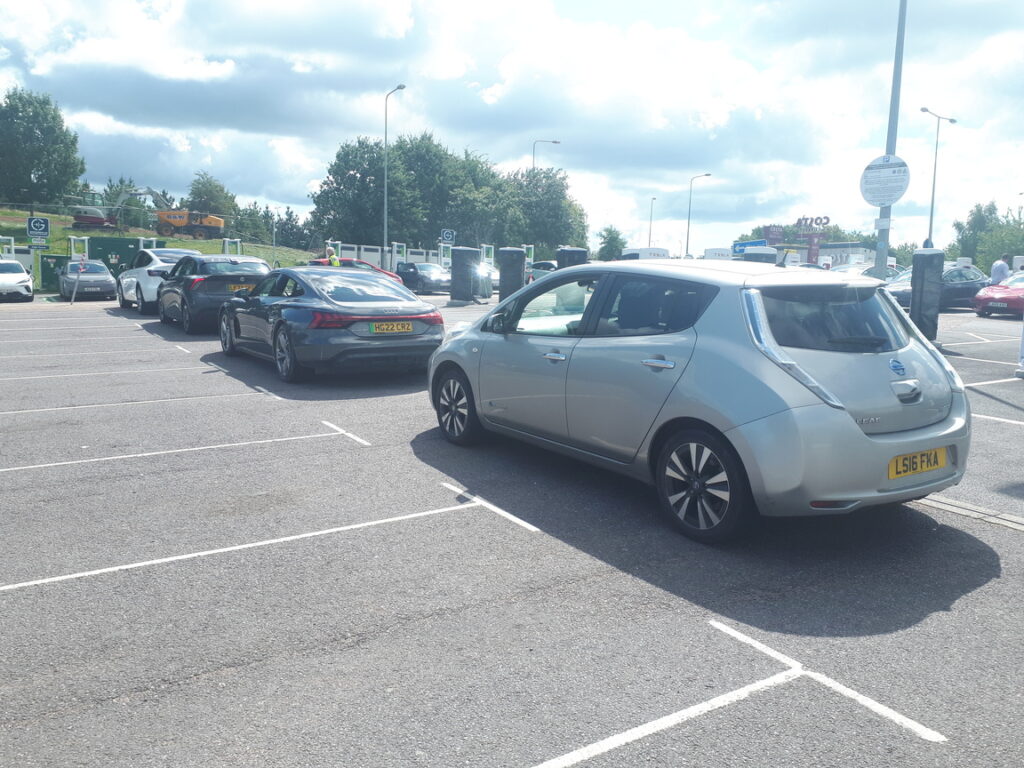
Lisa, our ageing experimental Nissan LEAF, was conveying us towards a visit to the seaside in Exmouth when she popped into Exeter Services for a quick “splash and dash” charging session. Sadly it was not to be:
There’s nothing quick or dashing about waiting in the queue for a vacant Gridserve CHAdeMO charging connector. Especially when there’s a Tesla at the head of that queue, and there seems to be a vacancy in the adjacent serried ranks of Tesla superchargers:
Back in March General Motors announced a vehicle-to-home pilot project in partnership with Pacific Gas and Electric. According to Mary Barra:
Bi-directional charging will help when there’s a power outage or additional demand, to really help supply energy and keep everybody having the energy they need to live their lives.
Now the next phase of General Motors’ master plan to beat Tesla at the energy game has been announced, in a press release yesterday:
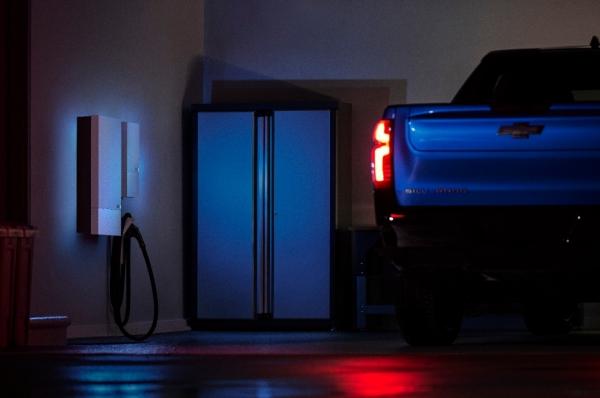
The introduction of Ultium Home and Ultium Commercial, which in combination with the existing Ultium Charge 360, create a holistic ecosystem of energy management products and services that will be housed under a new business unit called GM Energy.
GM Energy’s connected product and service offerings are designed to offer cohesive energy management for home, commercial and EV customers, with solutions ranging from bi-directional charging, vehicle-to-home (V2H) and vehicle-to-grid (V2G) applications, to stationary storage, solar products, software applications, cloud management tools, microgrid solutions, hydrogen fuel cells and more. GM Energy’s services will also enable the sale of energy from EV and stationary storage batteries back to utilities during peak, high energy consumption periods, unlocking even more potential value for customers and increasing resiliency for the electrical grid.
Several large-scale companies across the U.S. have already agreed to work with GM Energy to provide energy solutions to customers and receive product or service offerings.
Among them is an agreement with SunPower, one of the nation’s leading solar technology and energy services providers. Together, the two companies will develop and offer customers a home energy system which will consist of integrated EV and battery solutions, solar panels and home energy storage. A primary feature of the home energy system is expected to enable drivers to deliver power to their homes with the battery in their compatible electric vehicle, designed to give them the ability to power their home’s necessities in a blackout or draw from stored energy during peak rate times. SunPower will also become a preferred installer for the home energy system and offer customers the opportunity to add solar to their home. The home energy system will be available alongside the retail launch of the 2024 Chevrolet Silverado EV, expected to begin production in fall 2023.
Tesla have of course yet to announce any plans for “the sale of energy from EV batteries”, but Tesla Energy predates GM Energy by several years. Will General Motors be able to catch up and overtake Tesla? Perhaps V2x technology will give GM an edge? Alternatively perhaps Tesla will also be offering V2x on their EVs by the time the 2024 Chevrolet Silverado EV starts production?
Particularly given recent events in Ukraine and the publication of the IPCC’s AR6 WG2 report the urgency of this issue increases with every day that passes. Hence I reproduce below an email I sent to Trudy Harrison MP on December 17th 2021.
Below that is the only response I have received to date:
Electric Vehicles (Smart Charge Points) Regulations 2021
To: Trudy Harrison MP Cc: Scott Mann MP
Hello Trudy,
I originally e-met Rachel Maclean via a Cicero Group webinar. Since you have now taken over her role it seemed appropriate to introduce myself to you, particularly in view of the Prime Minister’s recent announcement about electric vehicle charging points.
In particular I am the only UK representative on a wide range of “smart grid” and “EV charging” international (and hence British) standards setting committees. I also sit on the British Standards Institution’s L/13 “smart energy overview” committee as the UK’s leading expert on V2G technology.
If possible I would like to discuss some of the “interoperability standards” implications of the draft legislation associated with the Prime Minister’s statement with someone in Government. Who do you recommend?
Thank you for contacting me. Please accept this as an acknowledgement of your email. You will receieve a response within 7 days.
Please note the following:
· If you are a constituent please ensure that you have provided your full name and address, including postcode. There is a strict Parliamentary protocol that MPs only deal with matters raised by residents of their own constituency.
· Where possible, all circular email campaigns will be responded to by letter and on my website – https://www.trudyharrison.co.uk/
· I may need to pass your details and email to any relevant authority deemed appropriate to help answer your query. If you do not wish this to happen you need to inform my office to this effect.
I remotely attended several sessions at the recently completed COP26 conference in Glasgow, but what with one thing and another I missed out on attending this one as it happened:
As you can already see it was organised by Scottish and Southern Electricity Networks (SSEN for short) and was hosted by Laura Sandys. Note in particular the part at 6:30 where Professor Malcolm McCulloch of Oxford University says that:
So the challenge is to say “How do we allow that potential problem and risk, how do we turn that around to be something that’s really a friend and an aid to the system?”
And the one thing that worries me right at the moment is that we’re seeing a huge uptake in electric vehicles over the last while, I mean it’s kind of fascinating that at the beginning of this year the most popular vehicle being sold was the Ford Focus, last three months it’s been the Tesla Model 3! That kinds of tells you what the change in our dynamics is looking at.
At the moment we’re missing a trick because most of the vehicles being sold except for a few Nissan’s and a few others don’t have vehicle-to-grid. In other words the power flows in only one direction, so all that huge amount of storage capacity that’s available on the grid, we’re talking about by the time we get to 2030 there’s enough energy in the batteries of our electric vehicles to power the UK for two days. That’s a tremendous amount of energy that’s sitting there, but if we don’t install V2G soon, really soon, that boat is going to pass and we’re going to have real trouble in trying to, or much more costly ways of doing that.
Needless to say we broadly agree with Malcolm’s analysis, and the conversation in Glasgow continued. Please watch the whole 30+ minutes, but now there is further news. The Local Energy Oxfordshire project (LEO for short) has just released a white paper authored by Origami Energy and the Low Carbon Hub catchily entitled “Vision on the inclusion of small (under 7kW) flexibility from the grid edge and its role in Future Energy System“. Please also read it from cover to cover, and note that it briefly (and belatedly!) mentions that:
In 2021, British Standards Institute as part of [its] Smart Energy Appliance programme published two standards designed to support [a] testing and certification programme to motivate greater potential for demand response from [the] residential sector.
Note also LEO’s recommendations:
Grid-edge flexibility has great potential to be the enabler of Net Zero as outlined by the “Leading the Way” FES scenario. However, t he two biggest challenges facing the inclusion of small flexibility from the grid edge into delivering Net Zero are societal participation and commercial environment. A common pillar to both challenges is the value of flexibility which only partially reflects the benefits delivered through the flexibility markets. Today, each flexibility market is monopsonistic (market dominated by one buyer), segregated and short-term (there is a lack of long term stability in the regulatory landscape). There is a need to standardise products and services across all flexibility markets to encourage greater transparency and involvement of flexibility as these flexibility markets grow.
To support the inclusion of grid-edge flexibility, the proposed recommendations include:
• To tailor the legislation and regulation to support the development of local communities who act collectively to manage their LCTs and interact with the flexibility markets and other users of the system at a single node (e.g. enabled by an iDNO) or multiple nodes.
• Create a new energy and carbon marketplace to encourage wider deployment of Smart Local Energy Systems where local generation and demand flexibility is recognised as being critical for a healthy and affluent society. The Flexible Services players are seen to add significant benefit to the local society and also provide support to the National scale economy.
• Align the energy policy, welfare policy and housing policy to deliver long-term strategy for Net Zero and beyond ensuring balanced distribution of costs and benefits associated with grid-edge flexibility and cost of energy.
Australian Energy Regulator (AER) has filed a lawsuit against Neoen SA (NEOEN.PA), saying the French firm’s Tesla “Big Battery” in South Australia did not provide backup power during four months in 2019 for which it had received payment.
Neoen said it was disappointed with AER’s decision. It did not comment on the actual allegations.
On-demand power from storage is critical for preventing blackouts in Australia which is increasingly dependent on wind and solar farms from which energy is not always available.
Neoen’s Hornsdale Power Reserve was the world’s biggest battery when it was switched on in 2017, built after Tesla Inc (TSLA.O) Chief Executive Elon Musk said his firm could prevent blackouts in South Australia with its “Megapack” batteries….
AER said Hornsdale Power Reserve had offered to provide market services and was called on by the Australian Energy Market Operator to dispatch power in July to November 2019 during frequency disturbances – or power drops on the network – but that the energy was not supplied as needed.
“It is vital that generators do what they say they can do if we’re going to keep the lights on through the market’s transition to variable renewable generation,” said AER Chair Clare Savage.
The regulator is seeking fines and court costs for a “significant number of breaches” over the four-month period. Each breach of national electricity market rules carries a maximum penalty of A$100,000…
The AER action comes as Neoen faces potential delays with what will be its biggest battery in Australia, the 450 megawatt hour Victoria Big Battery, following a fire in one of its Tesla Megapacks.
Electrek has learned that Tesla has quietly made Model 3, and likely Model Y, ready for bidirectional charging, which should enable some game-changing features in the near future.
Since we were wildly speculating about such a thing only last month we did of course read further. After an explanation of the benefits of V2G technology Fred continued:
In a recent filing with the Texas electric utility commission in which Tesla was responding to questions about how electric utilities should approach electric vehicles, the automaker summarized its view of vehicle to grid technology:
“Vehicle to grid benefits can be recognized much more efficiently when EV deployment is at scale rather than in the early adopter phase. At the same time, any discussion regarding the capabilities of EV related technologies must recognize as a first principle that customer experience and willingness for participation is key. There certainly may be an opportunity for future projects and programs that focus on advanced technological integration, such as the eventual aggregation of EVs in the future to provide grid services in wholesale markets. In any setting, it is important to remember that EVs are modes of transportation first and foremost for customers. There is also an opportunity to evaluate stationary storage assets first to provide similar grid services capabilities from a wholesale electricity market perspective.”
While those comments are not too encouraging, they do note that there’s value in vehicle to grid once the EV fleet becomes large enough, which is starting to become the case…
Electrek has learned that Tesla has already prepared its onboard vehicle charger for bidirectional charging.
Marco Gaxiola, an electrical engineer who participated in a Model 3 teardown for a Tesla competitor, reverse engineered the electric car’s charger and found it to be ready for bidirectional charging.
He told Electrek:
“What I learned on reverse engineering the Model 3 charger, was that the design is fully bidirectional. This means power can be converted from AC to DC the same way as the previous example, but also power can flow in reverse direction, coming from the battery and ending up on the AC side. This is known as DC to AC inverter, and when this technology is present in a vehicle, it is known as V2G (Vehicle to Grid).”
The engineer added about the design of Tesla’s onboard charger:
“To complement this, the bidirectional design is replicated 3 times across the same PCB on the Model 3 charger. Another example of redundant design that assures a working process even if one of the circuits fails. Additionally, it is 3 phase design, so it can be used worldwide.”
Gaxiola believes that the vehicle to grid capacity in the Model 3 could be enabled through an over-the-air software update.
An intriguing “rumour”. How much store should we put in Marco’s reverse engineering efforts?
Time will tell, so please watch this space!
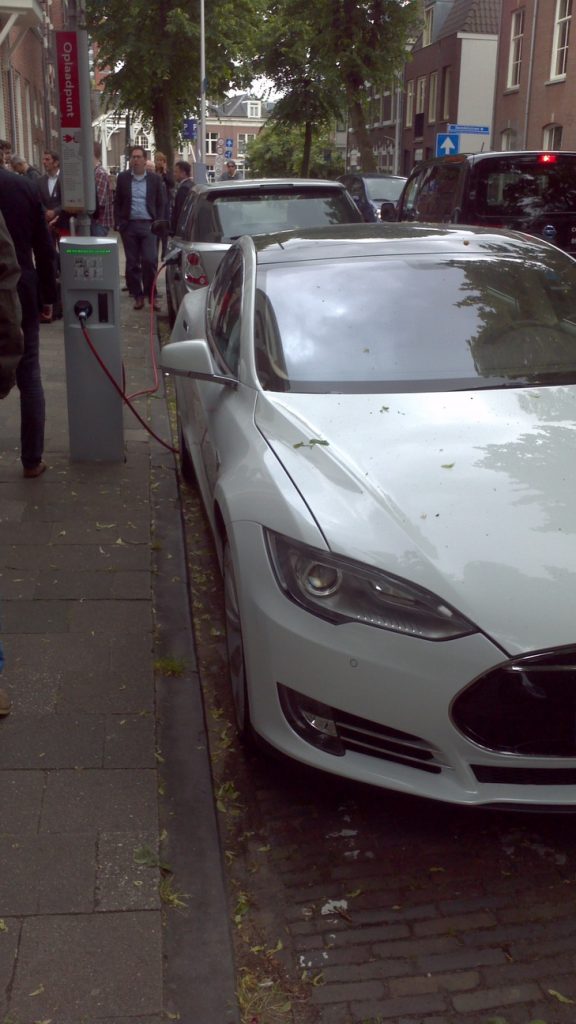
Meanwhile here’s a picture of a (sadly uni-directional) Tesla Model S connected to an AC V2G charging station in 2015:
We have previously commented on Tesla’s microgrid patent applications, and in related news we now bring you news of Tesla’s application for a UK power generation licence.
According to an article in today’s online edition of the energyst magazine:
Tesla Motors has applied for a UK power generation licence.
The company’s application, signed off by Tesla energy products sales director, Evan Rice, was published by energy regulator Ofgem.
The move suggests Tesla may be planning to build large-scale battery storage projects in the UK, as it has done in countries such as Australia, where it constructed a 100MW scheme in less than 100 days in late 2016.
However, it may mark Tesla’s first UK move into aggregation, as it eyes the virtual power plant (VPP) market.
The company’s ‘autobidder’ platform aims to make money from distributed batteries via real time trading and optimisation.
As well as its electric car business, Tesla also supplies battery storage for homes and businesses, plus solar roof tiles. The autobidder platform aims to harness everything from behind the meter home batteries to utility scale assets, bidding in flexibility to all available markets.
Tesla’s application to Ofgem reads as follows:
Tesla Motors Limited… hereby gives notice that it has made an application to the Gas and Electricity Markets Authority… for an electricity generation licence under section 6(1)(a) of the Electricity Act 1989 authorising it to generate electricity in the area specified in Schedule 1 for the purpose of giving a supply to any premises or enabling a supply to be so given.
SCHEDULE 1
SPECIFIED AREA
Great Britain, the territorial sea adjacent to Great Britain or in a Renewable Energy Zone.
where: Renewable Energy Zone has the meaning given by section 84(4) of the Energy Act 2004.
Our first thought regarding this interesting news here at V2G UK?