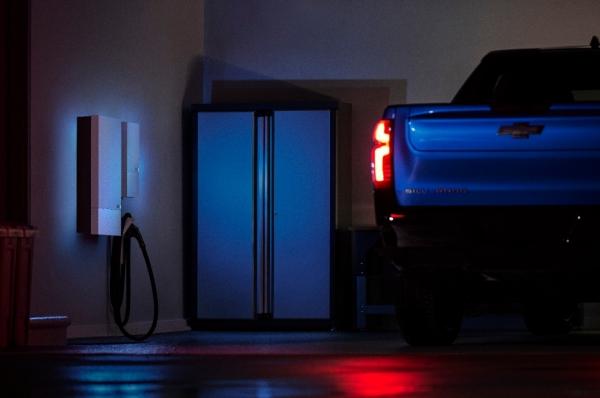
GM to make V2H technology available across Ultium-based EVs by model year 2026

According to a General Motors press release earlier this week:

GM will expand vehicle-to-home (V2H) bidirectional charging technology across its retail portfolio of Ultium-based electric vehicles by model year 2026. The first vehicles to receive the technology include the previously announced 2024 Chevrolet Silverado EV RST, followed by the 2024 GMC Sierra EV Denali Edition 1, 2024 Chevrolet Blazer EV, 2024 Chevrolet Equinox EV, 2024 Cadillac LYRIQ and the upcoming Cadillac ESCALADE IQ, which will be revealed on Aug. 9.

Building on the company’s plan to deliver a growing suite of energy management products and services through GM Energy, V2H unlocks additional value for EV drivers, who will be able to transfer energy from their vehicles to a properly equipped home when desired. The technology allows consumers to store and transfer energy to help offset electricity needs during peak demand days and mitigate the impact of power outages, making the transition to an all-electric future even more compelling.

According to the subsequent ESCALADE IQ press release:

Continue reading →

General Motors Announces “Energy Ecosystem”

Back in March General Motors announced a vehicle-to-home pilot project in partnership with Pacific Gas and Electric. According to Mary Barra:

Bi-directional charging will help when there’s a power outage or additional demand, to really help supply energy and keep everybody having the energy they need to live their lives.

Now the next phase of General Motors’ master plan to beat Tesla at the energy game has been announced, in a press release yesterday:

The introduction of Ultium Home and Ultium Commercial, which in combination with the existing Ultium Charge 360, create a holistic ecosystem of energy management products and services that will be housed under a new business unit called GM Energy.

GM Energy’s connected product and service offerings are designed to offer cohesive energy management for home, commercial and EV customers, with solutions ranging from bi-directional charging, vehicle-to-home (V2H) and vehicle-to-grid (V2G) applications, to stationary storage, solar products, software applications, cloud management tools, microgrid solutions, hydrogen fuel cells and more. GM Energy’s services will also enable the sale of energy from EV and stationary storage batteries back to utilities during peak, high energy consumption periods, unlocking even more potential value for customers and increasing resiliency for the electrical grid.

Several large-scale companies across the U.S. have already agreed to work with GM Energy to provide energy solutions to customers and receive product or service offerings.

Among them is an agreement with SunPower, one of the nation’s leading solar technology and energy services providers. Together, the two companies will develop and offer customers a home energy system which will consist of integrated EV and battery solutions, solar panels and home energy storage. A primary feature of the home energy system is expected to enable drivers to deliver power to their homes with the battery in their compatible electric vehicle, designed to give them the ability to power their home’s necessities in a blackout or draw from stored energy during peak rate times. SunPower will also become a preferred installer for the home energy system and offer customers the opportunity to add solar to their home. The home energy system will be available alongside the retail launch of the 2024 Chevrolet Silverado EV, expected to begin production in fall 2023.

Tesla have of course yet to announce any plans for “the sale of energy from EV batteries”, but Tesla Energy predates GM Energy by several years. Will General Motors be able to catch up and overtake Tesla? Perhaps V2x technology will give GM an edge? Alternatively perhaps Tesla will also be offering V2x on their EVs by the time the 2024 Chevrolet Silverado EV starts production?

Watch this space!

General Motors Announce V2H Pilot Project

A number of commenters on Twitter are getting very excited about an announcement from General Motors earlier today. Here’s GM’s Mary Barra and PG&E’s Patti Poppe talking with Phil LeBeau on CNBC’s “Squawk Box”:

As Mary says to Phil:

Bi-directional charging will help when there’s a power outage or additional demand, to really help supply energy and keep everybody having the energy they need to live their lives.

Phil suggests:

What you guys are talking about doing is making smart vehicles and a smart grid, where the communication happens and I don’t need to be involved. Correct?

Patti responds:

Automatically! There’s like this value stack for electric vehicles that I don’t think people fully appreciate yet. The first is obviously decarbonising transportation, number one and everybody gets that. And it’s a great driving experience. But then you stack on the resiliency play because of the effects of climate change, and then on a peak summer day imagine being able to leverage the fleet of electric vehicles. In California, in fact in my service area alone, one in five electric vehicles sold in America are in my service area, so we can really deploy them to power homes and to enable the grid.

In the accompanying press release General Motors reveal that:

Pacific Gas and Electric Company and General Motors today announced a breakthrough collaboration to pilot the use of GM electric vehicles as on-demand power sources for homes in PG&E’s service area.

PG&E and GM will test vehicles with cutting-edge bidirectional charging technology that can help safely power the essential needs of a properly equipped home. EVs play a critical role in achieving California’s goals for reducing greenhouse gas emissions and already provide customers with many benefits. Bidirectional charging capabilities add even further value by improving electric resiliency and reliability…

Skipping to the “How the pilot will work” section of the news release GM explain that:

PG&E and GM aim to test the pilot’s first vehicle-to-home capable EV and charger by summer 2022. The pilot will include the use of bidirectional hardware coupled with software-defined communications protocols that will enable power to flow from a charged EV into a customer’s home, automatically coordinating between the EV, home and PG&E’s electric supply. The pilot will include multiple GM EVs.

Following lab testing, PG&E and GM plan to test vehicle-to-home interconnection allowing a small subset of customers’ homes to safely receive power from the EV when power stops flowing from the electric grid. Through this field demonstration, PG&E and GM aim to develop a user-friendly vehicle-to-home customer experience for this new technology. Both teams are working quickly to scale the pilot with the goal of opening larger customer trials by the end of 2022.

It seems as though Mary, Patti, Phil et al. are blissfully unaware that pilot projects involving V2H/V2G and several hundred electric vehicles have been under way here in the United Kingdom since 2018.

We have even been running a “cutting-edge bidirectional charging technology” project in our very own car park here in wild and woolly South West England for the last couple of years:

For a more detailed overview of the UK pilot projects referred to above please download the presentation available at our sister web site:

“UK ‘Domestic’ V2G and DSR Trial Projects”

Is Apple Developing an Electric Vehicle?

According to Bloomberg the answer to the question posed in our title is a most definite yes! In a February 19th article Tim Higgins says that:

Apple Inc., which has been working secretly on a car, is pushing its team to begin production of an electric vehicle as early as 2020, people with knowledge of the matter said.

The timeframe — automakers typically spend five to seven years developing a car — underscores the project’s aggressive goals and could set the stage for a battle for customers with Tesla Motors Inc. and General Motors Co., both of which are targeting a 2017 release of an electric vehicle that can go more than 200 miles on a single charge and cost less than $40,000.

then adds that:

Apple representatives declined to comment for this story.

According to Bloomberg, however:

Apple began around June an “aggressive campaign to poach” employees from A123 Systems LLC, the Waltham, Massachusetts-based battery maker said in a lawsuit against Apple filed this month.

Apple hired five people from A123 and has tried to hire battery experts from LG Chem Ltd, Samsung Electronics Co., Panasonic Corp., Toshiba Corp. and Johnson Controls Inc., according to the lawsuit.

Bloomberg also talked to Tesla CEO Elon Musk, who told them:

That Apple was seeking to hire away his workers, offering $250,000 signing bonuses and 60 percent salary increases.

It seems as though when it comes to EVs, there’s never any smoke without fire?

[Edit – Saturday February 21st 2015]

This morning’s edition of The Economist includes an article on the Apple EV rumours:

APPLE’S ability to make desirable iGadgets designed for easy portability is beyond question. Reports emerged this week that it is planning to make a mobile device that will instead carry its users—an electric car. Apple’s plans are unclear and unconfirmed. By some accounts it has put a few hundred people to work developing cars to match Tesla, another Silicon Valley firm that makes fast and luxurious battery-powered saloons. Others reckon that it is working on a self-driving car.

Plenty of other tech firms are turning their attention to cars. In February Uber, a firm that provides taxis through a smartphone app, said it would set up a laboratory in Pittsburgh to develop self-driving taxis. Sony recently put money into ZMP, a self-driving car startup; Google has been working for years on driverless cars.

The Economist doesn’t sound optimistic about the future for the alleged Apple EV:

The likes of Apple may not know much about pistons and gearboxes, but the big challenge for electric cars is batteries. Battery-powered cars have many advantages: refuelling at home, cheap running costs and no tailpipe emissions. But the market for pure electric vehicles is tiny:
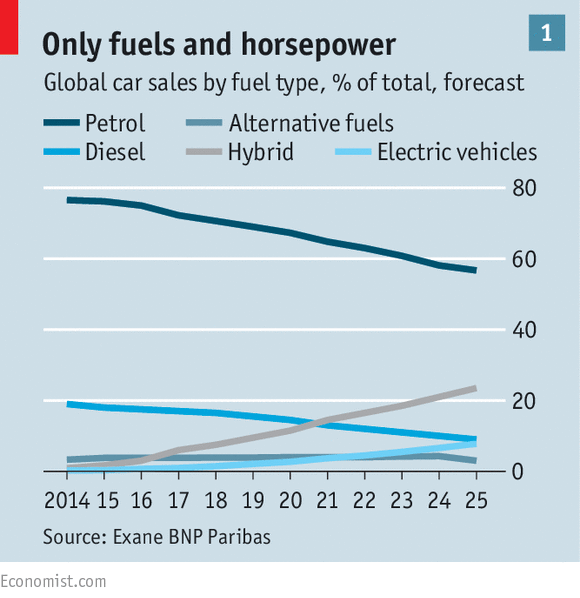
Expensive batteries make for costly cars, and limited range and a lack of recharging infrastructure have put off most drivers. Nissan’s Leaf, the world’s best-selling electric car, attracted only 40,000 buyers last year compared with the 250,000 the company once hoped to shift. Tesla aspires to enter the mass market but so far it has dealt with the battery problem by putting lots of them in a big, expensive car, thereby limiting it to a luxury niche. The plunging oil price dents the prospects for electrification still further.

and concludes:

Tech firms may be better off working with carmakers, to develop the software that will provide the brains of the self-driving car, and to improve the range and battery costs of the electric car. In the motor industry, supplying the key parts is generally more profitable than putting the cars together, even if you do not get your company’s badge on the bonnet. In the future cars will be different but the brands will probably be much the same.