
Is Apple Developing an Electric Vehicle?

According to Bloomberg the answer to the question posed in our title is a most definite yes! In a February 19th article Tim Higgins says that:

Apple Inc., which has been working secretly on a car, is pushing its team to begin production of an electric vehicle as early as 2020, people with knowledge of the matter said.

The timeframe — automakers typically spend five to seven years developing a car — underscores the project’s aggressive goals and could set the stage for a battle for customers with Tesla Motors Inc. and General Motors Co., both of which are targeting a 2017 release of an electric vehicle that can go more than 200 miles on a single charge and cost less than $40,000.

then adds that:

Apple representatives declined to comment for this story.

According to Bloomberg, however:

Apple began around June an “aggressive campaign to poach” employees from A123 Systems LLC, the Waltham, Massachusetts-based battery maker said in a lawsuit against Apple filed this month.

Apple hired five people from A123 and has tried to hire battery experts from LG Chem Ltd, Samsung Electronics Co., Panasonic Corp., Toshiba Corp. and Johnson Controls Inc., according to the lawsuit.

Bloomberg also talked to Tesla CEO Elon Musk, who told them:

That Apple was seeking to hire away his workers, offering $250,000 signing bonuses and 60 percent salary increases.

It seems as though when it comes to EVs, there’s never any smoke without fire?

[Edit – Saturday February 21st 2015]

This morning’s edition of The Economist includes an article on the Apple EV rumours:

APPLE’S ability to make desirable iGadgets designed for easy portability is beyond question. Reports emerged this week that it is planning to make a mobile device that will instead carry its users—an electric car. Apple’s plans are unclear and unconfirmed. By some accounts it has put a few hundred people to work developing cars to match Tesla, another Silicon Valley firm that makes fast and luxurious battery-powered saloons. Others reckon that it is working on a self-driving car.

Plenty of other tech firms are turning their attention to cars. In February Uber, a firm that provides taxis through a smartphone app, said it would set up a laboratory in Pittsburgh to develop self-driving taxis. Sony recently put money into ZMP, a self-driving car startup; Google has been working for years on driverless cars.

The Economist doesn’t sound optimistic about the future for the alleged Apple EV:

The likes of Apple may not know much about pistons and gearboxes, but the big challenge for electric cars is batteries. Battery-powered cars have many advantages: refuelling at home, cheap running costs and no tailpipe emissions. But the market for pure electric vehicles is tiny:

Expensive batteries make for costly cars, and limited range and a lack of recharging infrastructure have put off most drivers. Nissan’s Leaf, the world’s best-selling electric car, attracted only 40,000 buyers last year compared with the 250,000 the company once hoped to shift. Tesla aspires to enter the mass market but so far it has dealt with the battery problem by putting lots of them in a big, expensive car, thereby limiting it to a luxury niche. The plunging oil price dents the prospects for electrification still further.
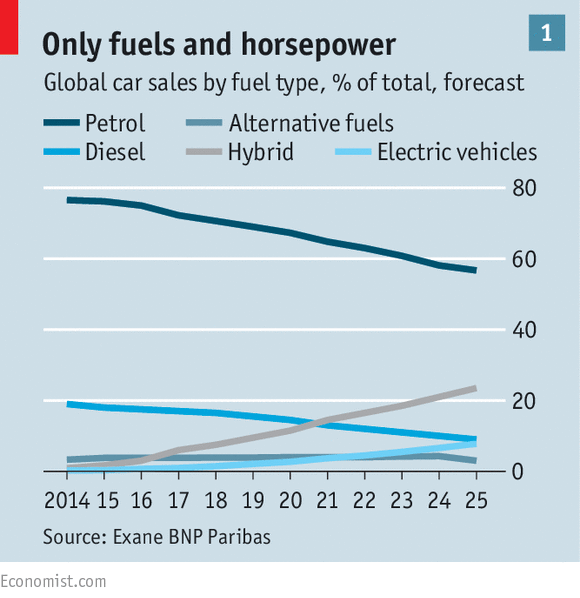
and concludes:

Tech firms may be better off working with carmakers, to develop the software that will provide the brains of the self-driving car, and to improve the range and battery costs of the electric car. In the motor industry, supplying the key parts is generally more profitable than putting the cars together, even if you do not get your company’s badge on the bonnet. In the future cars will be different but the brands will probably be much the same.


Bankrupt Battery Maker A123 Sold In Bits

On October 16th US lithium ion battery manufacturer A123 Systems announced that it had:

Entered into an asset purchase agreement with Johnson Controls, Inc., which plans to acquire A123’s automotive business assets, including all of its automotive technology, products and customer contracts, its facilities in Livonia and Romulus, Mich., its cathode powder manufacturing facilities in China, and A123’s equity interest in Shanghai Advanced Traction Battery Systems Co., Alpha’s joint venture with Shanghai Automotive. The asset purchase agreement also includes provisions through which Johnson Controls intends to license back to A123 certain technology for its grid, commercial and government businesses. A123 also continues to engage in active discussions regarding strategic alternatives for its grid, commercial, government and other operations, and has received several indications of interest for these businesses.

To facilitate the transaction process, A123 and all of its U.S. subsidiaries have filed voluntary petitions for reorganization under Chapter 11 of the U.S. Bankruptcy Code in the U.S. Bankruptcy Court for the District of Delaware. A123’s non-U.S. subsidiaries were not included in the filing.

Whilst A123 were working their way through Chapter 11, they did manage to find the time to make “the business case for grid energy storage” in Energy World magazine, concluding that:

Utilities and power producers all over the world continue to deploy systems that demonstrate the versatility, reliability and efficiency of energy storage. The applications that advanced energy storage technology can provide combining multiple functions, can create multiple revenue streams and further enhance the economic benefits of energy storage as an integral grid asset.

Matters have moved on since then however, and A123’s own revenue streams seem to have proved sadly inadequate. In a new press release A123 now say that:

It has reached agreement on the terms of an asset purchase agreement with Wanxiang America Corporation (“Wanxiang”) through which Wanxiang would acquire substantially all of A123’s assets for $256.6 million. The agreement was reached following an auction conducted under the supervision of the United States Bankruptcy Court for the District of Delaware (the “Court”). A hearing at which A123 and Wanxiang will seek the required Court approval of the sale is scheduled for Tuesday, December 11, 2012.

Excluded from the asset purchase agreement with Wanxiang is A123’s Ann Arbor, Michigan based government business, including all U.S. military contracts, which would be acquired for $2.25 million by Navitas Systems, a Woodridge, Illinois based provider of energy-enabled system solutions and energy storage products for commercial, industrial and government agency customers.

According to Pin Ni, the president of Wanxiang America:

We believe that A123’s industry-leading technology for vehicle electrification, grid energy storage and other industries complements Wanxiang’s strong R&D and manufacturing capabilities, so we think adding A123 to our portfolio of businesses strongly aligns with our strategy of investing in the automotive and cleantech industries in the U.S. We plan to build on the engineering and manufacturing capabilities that A123 has established in the U.S. and we are committed to making the long-term investments necessary for A123 to be successful.

Pin Ni may have to put the champagne on ice for while though, since the deal isn’t all signed and sealed just yet however:

The completion of the sale to Wanxiang is subject to certain closing conditions, including approval from the Court as well as from the Committee for Foreign Investment in the United States (CIFIUS). Because the total purchase price for A123’s assets would be less than the total amount owed to creditors, the Company does not anticipate any recoveries for its current shareholders and believes its stock to have no value.

This doesn’t sound like wonderful news for the hard pressed U.S. taxpayer either. A123 don’t refer to this aspect of things, but according to Reuters:

The U.S. Energy Department will not give A123 Systems Inc. the balance of a $249 million grant. Republicans lawmakers, meanwhile, renewed criticisms that the White House’s clean energy grant to the maker of lithium ion batteries for electric cars had wasted taxpayer money. The company had received about $133 million of its $249 million grant when it filed for bankruptcy protection in October.

Pin Ni, president of Wanxiang America, said his company would respect the decisions made by the DOE.

A123 declined to comment.