There have recently been a series of press releases from Nissan UK about their forthcoming range of electrically powered vehicles. At the end of May Nissan UK announced the electric MICRA. Yesterday they launched what was described as “The all-new LEAF“:
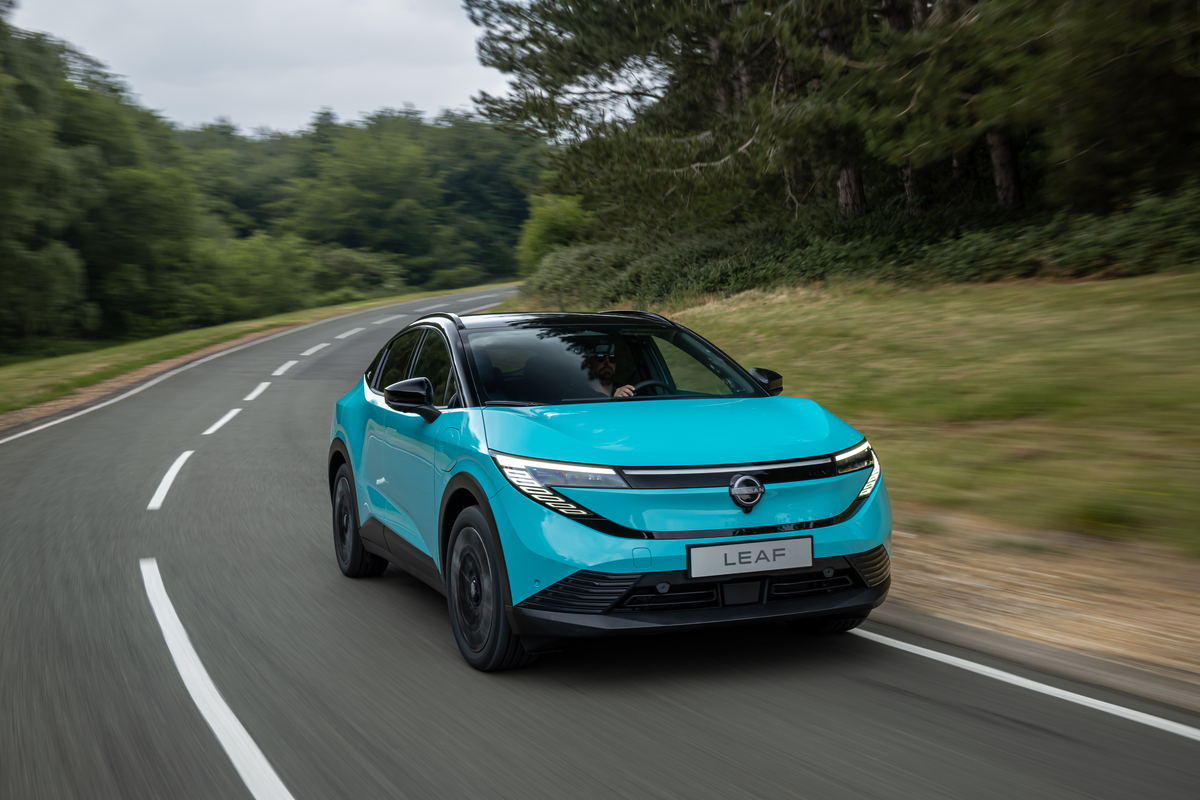
Today marks the debut of the all-new version of the Nissan LEAF – a British-built electric car icon.
The all-new Nissan LEAF is the next step in Nissan’s EV journey, building on its legacy as the world’s first mass-market electric car
The sleek, aerodynamic, and spacious crossover design comes with two battery options for an impressive range of up to 375 miles (WLTP), ensuring confident driving for everyday and long-distance trips
Delivers a fully connected mobility experience with Google built-in, dual 14.3” screens, and advanced driver assistance technologies
Built in Sunderland, UK, as part of Nissan’s EV36Zero initiative, supporting a sustainable electric future for Europe
This third generation of the pioneering LEAF continues to lead the charge in Nissan’s electrification strategy with a sleek design, significantly extended range, and intuitive technology that is seamlessly integrated for today’s connected driver.
Engineered to tackle key barriers to EV adoption, the all-new LEAF has a substantially increased maximum range of up to 375 miles on a single charge for a no-compromise driving experience. It also offers enhanced charging speeds (up to 260 miles of range in 30 minutes) and a suite of technologies that make both driving easier and EV ownership more rewarding.
Since its debut in 2010, the Nissan LEAF has sold close to 700,000 units worldwide, earning its place in history as the world’s first mass-market electric vehicle. Today, Nissan is ushering in a new chapter for this nameplate, re-designed and re-engineered to meet the needs of modern EV customers, while remaining true to its innovative roots…
Designed at Nissan’s Global Design Studio in Atsugi, Japan, the all-new LEAF introduces a stylish silhouette that reflects its dynamic character and aerodynamic efficiency. With a drag coefficient of just 0.25, its sleek design optimises airflow to enhance both performance and range. Flush door handles, a flowing roofline, full under floor cover, and sculpted surfaces create a modern profile, while its signature front and rear lighting delivers a distinct, high-tech identity on the road.
Pretty pictures and low drag coefficients are all very well, but “What about the all new LEAF’s V2x capabilities?” I hear you ask. Heading for the small print I learn that:
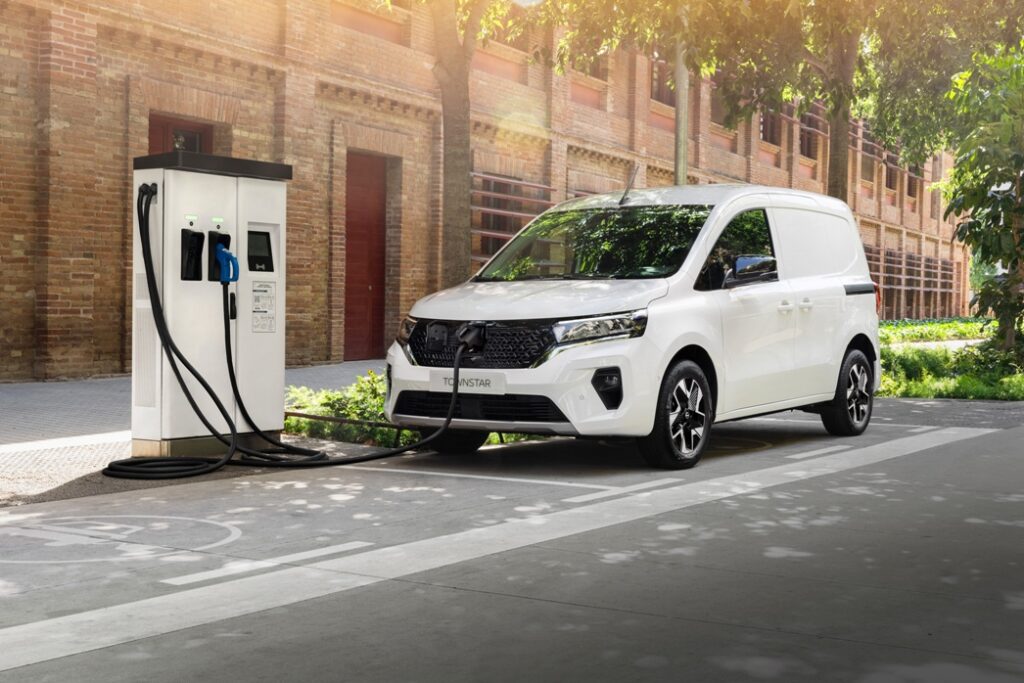
Commercial vehicle customers looking to future-proof their business operations and transition to zero emission motoring now have an exciting new option, following the launch of the electric Nissan Townstar van.
The Townstar EV builds on the success of the e-NV200, Nissan’s previous all-electric compact van and a former UK best-seller, which was designed with business owners’ needs in mind:
The electric Townstar was first announced in September 2021, but it seems that at long last it is possible to order one here in the United Kingdom:
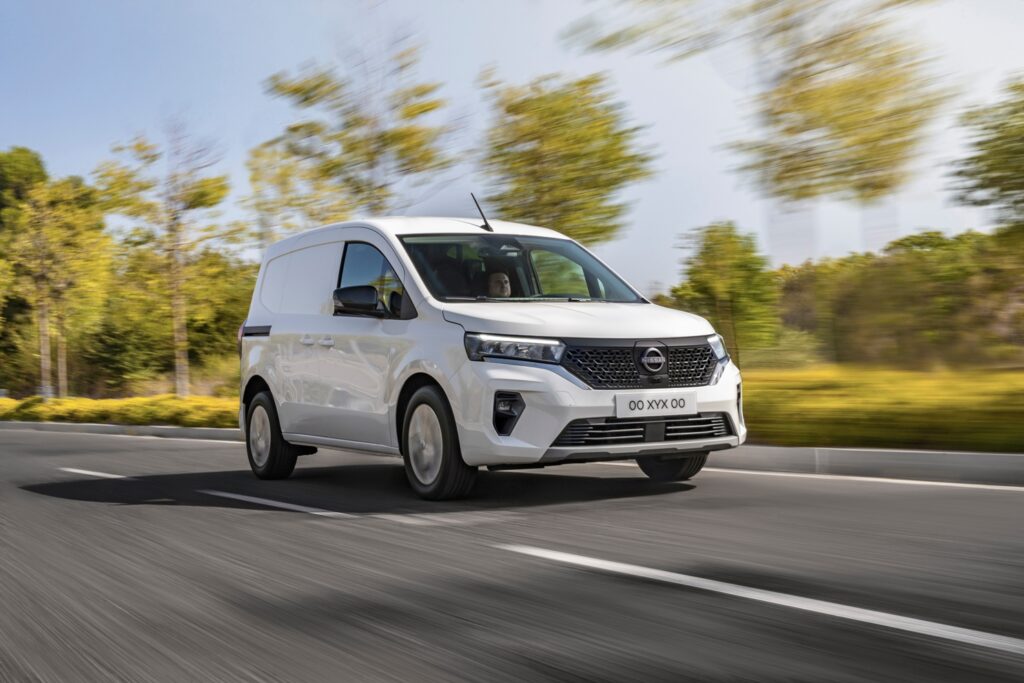
PARIS – Nissan reveals the next generation compact Light Commercial Vehicle (LCV), the all-new Townstar. With a fully electric powertrain in addition to a fuel-powered option, this new LCV range is primed to future-proof business operations and accelerate the transition towards electrification.
Demonstrating Nissan’s most technologically comprehensive LCV offering to date, the all-new Townstar brings a suite of 20+ technologies to the compact van offering, presenting a bold contender within the segment.
Building on the success of the Nissan e-NV200, a pioneer and leader in the electric LCV market, the fully electric version of the all-new Townstar is optimised to meet customer needs. With an enhanced 44kWh battery, advanced technology and low running costs the electric Townstar offers an efficient, sustainable mobility solution.
Here’s the Townstar launch video:
In view of the captions I cannot help but wonder when a right hand drive version will become available! In the meantime the press release tells us that:
The fully electric all-new Townstar will be equipped with a 44kWh battery and advanced technology. It will combine intelligent energy management and effective battery thermal cooling in one optimised package. The new van will replace the range offering of the e-NV200 and offer 245Nm of torque and 285km [range] (pending homologation)…
With a broad range of safety technologies and advanced driver assistance features such as Side Wind Assist and Trailer Sway Assist, the all-new Townstar provides a reassuring and confident experience behind the wheel. Intelligent Emergency Braking featuring Pedestrian and Cyclist Detection and Junction Assist, as well as Hands-Free Parking and Intelligent Cruise Control puts Townstar at the forefront of the category.
Nissan is integrating the Around View Monitor (AVM) for the first time in the compact van segment, democratising this cutting-edge technology. Using a suite of cameras, the system displays a 360-degree overview of the area around the vehicle, providing drivers with full peace of mind when parking in the city.
Customers of the fully electric all-new Townstar will also enjoy the innovative ProPILOT advanced driver assistance system. Supporting motorists with highway driving, the feature allows the vehicle to automatically slow to a full stop and accelerate by following the vehicle ahead, as well as keeping it centred in the lane – even around a gentle curve.
Convenient connectivity features such as E-Call, Apple CarPlay/Android Auto, and wireless phone charging will be available across the range from launch, with further enhanced Connected Services available from the launch of the fully electric version.
These connected services will be presented via an 8-inch touchscreen, which is linked to a 10-inch digital combimeter in front of the driver in the fully electric all-new Townstar.A
Built on the Alliance CMF-C platform, the all-new Townstar has been built from the ground up with quality and functionality in mind. It will bear the new Nissan brand logo, making it the first European model to be produced with it and the latest to be introduced under the Nissan NEXT transformation plan, which prioritizes sustainable growth and profitability across the company’s global operations.
The all-new Townstar van version has been developed to perfectly meet the needs of customers like SMEs who are looking for versatility, convenience, space and cargo on top of a hands-free parking system for complex city parking.
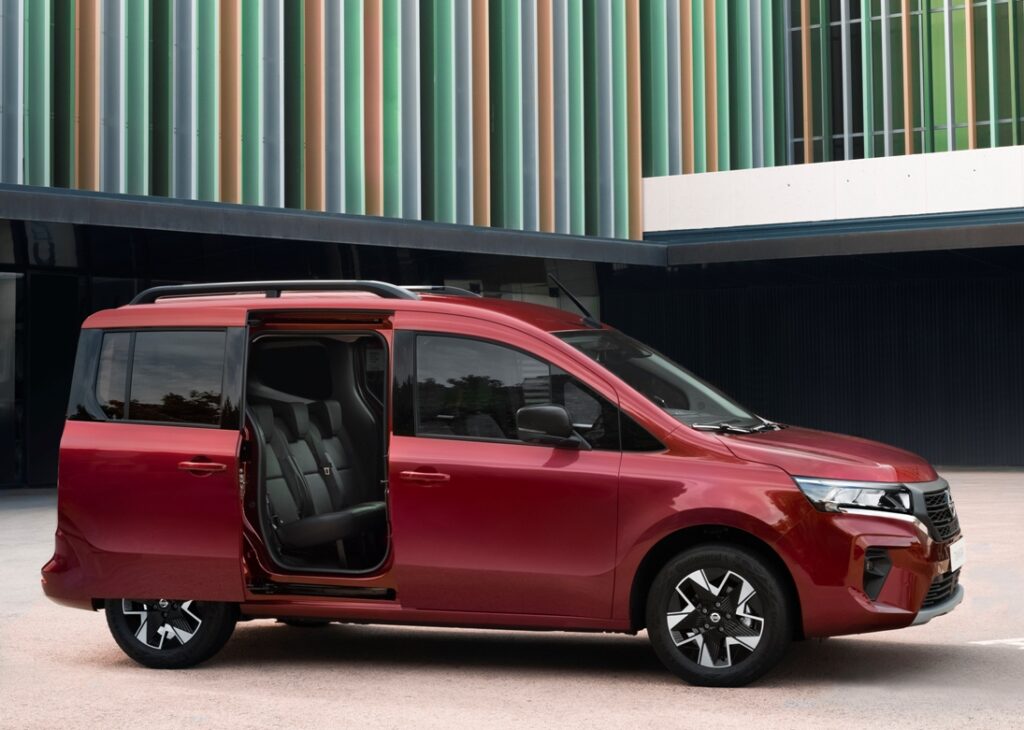
The combi version of the all-new Townstar will support families on the go with vast smart storage options that go up to 775 litres. From refined seat and door trims to a modern centre console and instrument panel finish, the all-new Townstar’s cabin welcomes customers with passenger-car-like comfort.
The fully electric all-new Townstar will reflect aesthetic cues of Ariya, including signature standard LED headlamps and an aerodynamic front shield integrating an intricate Kumiko pattern and a fresh V-motion design with daytime running lamps…
Featuring up to 3.9m3 of cargo space with a swivelling bulkhead, the new compact van can transport two Euro pallets and up to 800kg of cargo with ease, while the powerful powertrains allow the vehicle to offer a 1,500kg towing capacity, adapting to each businesses’ specific requirements.
The cargo area integrates large sliding doors on the side which facilitate unloading the van and the possibility to have 60/40 French doors with 180 degree opening or a tailgate at the rear. It also includes smart storage solutions and a dedicated space for on-board office tools.
Nissan presenta la nueva furgoneta Townstar: un cambio de juego dentro del mercado de Vehículos Comerciales Ligeros (LCV)
Unfortunately none of the above tells me what I really want to know, the ins and outs of (dis)charging the Townstar! Since there is no mention of it I can only assume that initial deliveries of the Townstar will not incorporate the vehicle-to-grid technology familiar from the e-NV200. However the Townstar specification sheet at the end of the press release does include some charging information:
Battery Capacity ( Usable )
44 kWh
Max. power
90kW (122HP)
Max. torque
245
Range estimation
Up to 285 (pending homologation)
Charging type AC
11 kw standard, or 22 kw optional
Charging type DC
75 DC in CCS
Charging time DC
0 to 80% 42 min
Battery cooling
Yes (with 22kW AC charger, or opt with 11kW)
If Nissan are working on incorporating V2G technology in the Townstar and/or the Ariya I wonder whether it will be AC or DC?
Last, but not necessarily least, here is a picture of the ICE Combi version of the Nissan Townstar:
Now I cannot help but wonder when we will be able to test drive one here in soggy South West England.
Our title for today is shamelessly plagiarised from an article of the same name on the Electric Nation web site, which begins as follows:
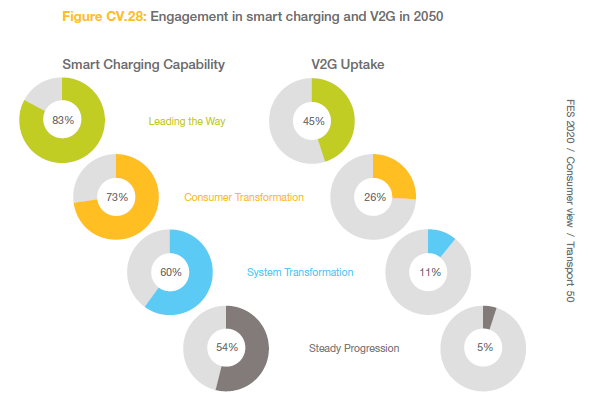
By 2050, up to 45% of households will actively provide Vehicle to Grid (V2G) services, according to National Grid’s Future Energy Scenarios, published in July 2020. But will the average Electric Vehicle (EV) driver be able to use V2G charging over the next few years?
A very good question and a very interesting infographic! The article continues:
The rapid growth in the numbers of electric vehicles on our roads will mean more demand on local electricity networks if EVs are all plugged in at the same time, such as during the peak between 5pm and 7pm in the evening. Smart charging, or ‘V1G’, which allows management of the time when EV charging occurs – as trialled by the original Electric Nation project – will help to avoid this situation.
V2G charging will be more effective than smart charging. This is due to the ability to link EVs together and put significant levels of energy back into the grid at peak times, like a huge decentralised power station. V2G will therefore help to reduce the grid’s need for additional energy generation, typically supplied by fossil fuels at peak times, as well as reducing demand on electricity networks, and allowing EV drivers to use greener and cheaper electricity.
So far so good, I agree entirely. However the next paragraph states:
In a press release earlier this week Nissan announced that it had:
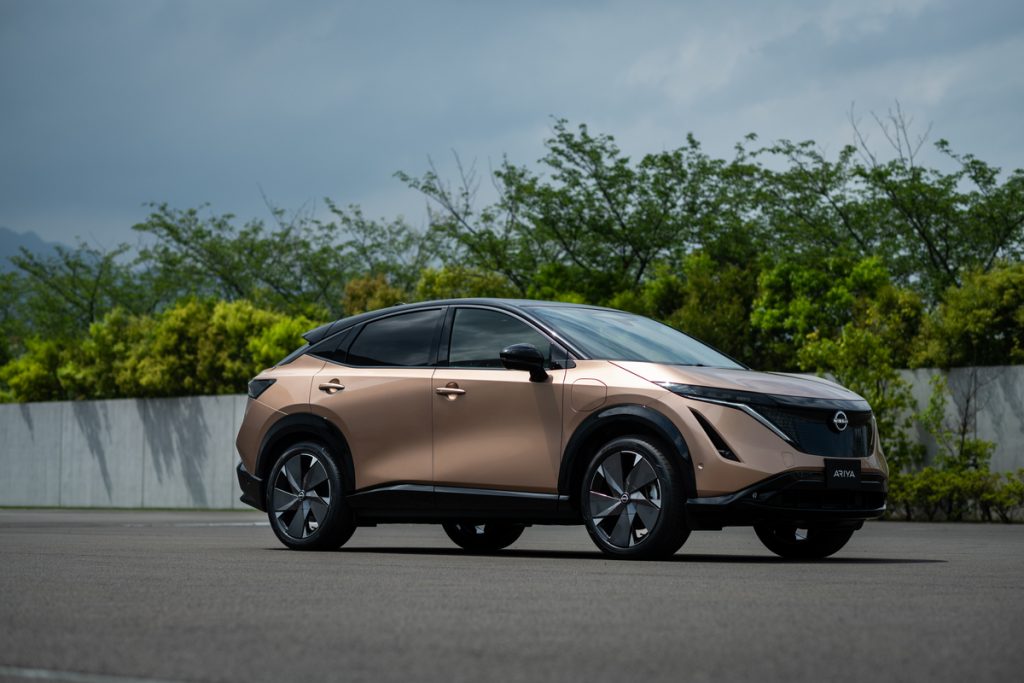
Revealed to the world the all-new Nissan Ariya electric coupé crossover, marking a new chapter for Nissan electric vehicles. The EV premiered globally through a virtual event hosted at the soon-to-open Nissan Pavilion in Yokohama.
The Ariya – Nissan’s first all-electric coupé crossover– offers powerful acceleration and smooth, quiet operation, as well as an interior with a welcoming, luxurious lounge-like atmosphere. Its stress-free autonomous driving features, voice personal assistance and seamless connectivity heighten on-road confidence and provides a welcoming environment for the driver and passengers. And with an estimated range of up to 500 kilometers (based on WLTP combined cycle, subject to homologation), Ariya is the perfect partner for daily commutes and road trips alike.
The Nissan Ariya is heavily based on the similarly-named concept vehicle displayed at the 2019 Tokyo Motor Show and first hinted at with the IMx at the 2017 Tokyo Motor Show. It’s the first production model to represent Nissan’s new electrified brand identity, forging a path toward a new automotive era where electrification, optimized platform packaging and seamless vehicle AI technology will become standard.
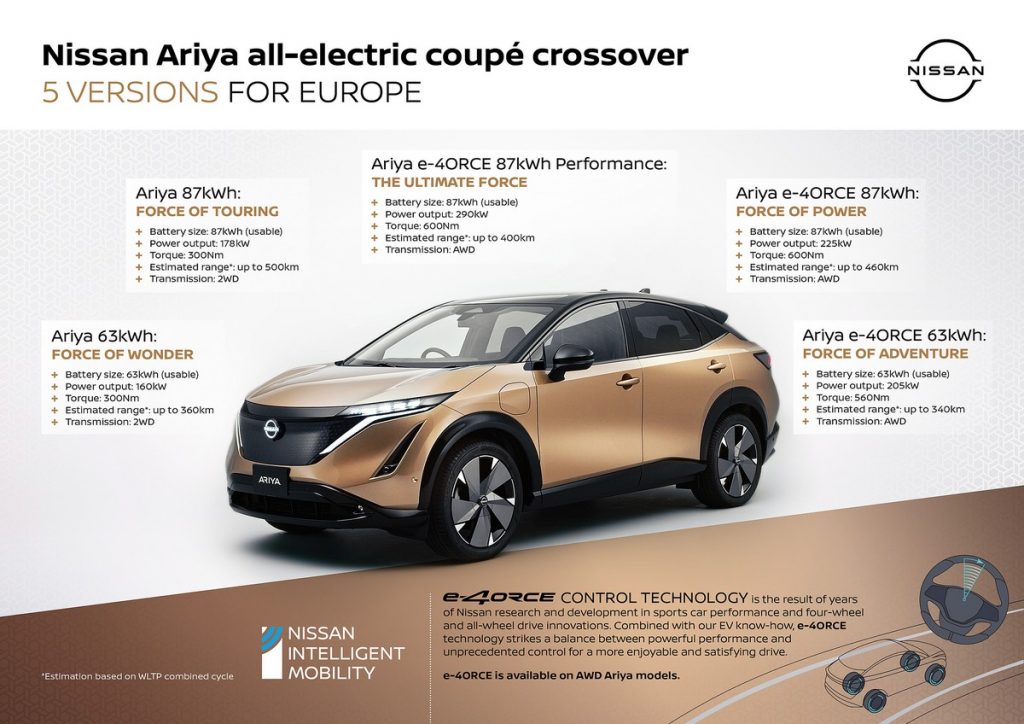
A bit of a change from the venerable LEAF then, with a dual motor 4 wheel drive option accompanying the “new electrified brand identity”, which does reduce the range somewhat:
As you can see from Nissan’s Ariya infographic, the LEAF’s dual AC/DC charging connector has moved from front and centre to the nearside front wing. Nissan haven’t provided an image of what’s hiding under the cover, but the press release does mention in passing that: