ISO Release the 15118-20 Amendment 1 Standard for AC V2G

It’s been a very long time coming, but the International Standards Organisation has finally published what is formally known as ISO 15118-20:2022/Amd 1:2026. According to the ISO web site the amendment adds the following improvements to the previously published 15118-20 standard:

AC DER service, MCS service, and improved security concept

If the acronyms above seem somewhat opaque and your internet address indicates that you are located in the United Kingdom you will see this not entirely helpful notice when you click the link above, :

Sadly the associated British standard is not yet available for purchase from the BSI web site! Instead we are told:

Approval start date: 17/04/2026

Publication start date: 06/08/2026

Fortunately in all the circumstances I don’t need to wait for the BSI to start selling the document, or pay ISO CHF 227 for the original 15118-20 standard plus another CHF 227 for the new amendment. As a member of the committee that developed the standards I already have PDF copies on my hard drive.

Quoting extracts from the brief sample of the amendment provided on the ISO web site:

3.73
megawatt charging system
MCS

charging system according to IEC61851-23-3

3.76
distributed energy resource
DER

source of electric power that is not directly connected to a bulk power system
EXAMPLE Generators and energy storage technologies capable of exporting active power to the electrical grid..

3.78
frequency droop curve

parameterized curve of the frequency-watt function

3.87
ride-through

ability to withstand voltage or frequency disturbances inside defined limits and to continue operating as specified

If you would like further insight into the implications of the above information, please do not hesitate to get in touch.

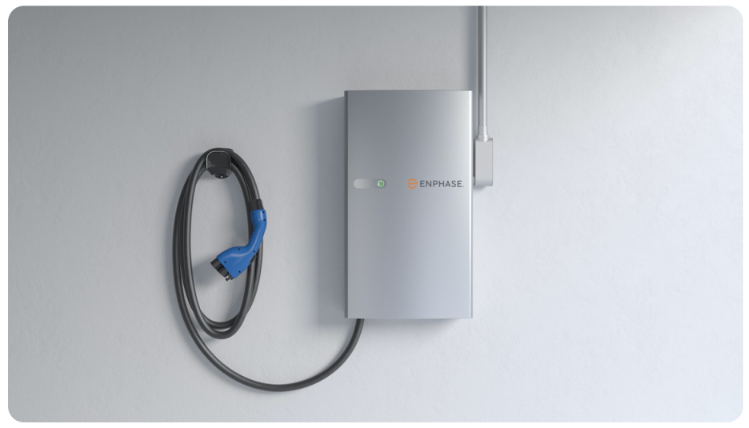
Enphase Announces V2G Charger

It has just been brought to my attention that at the beginning of this month Enphase Energy issued a press release announcing that:

Enphase Energy, Inc., a global energy technology company and the world’s leading supplier of microinverter-based solar and battery systems, announced today a successful demonstration of its bidirectional EV charger enabling vehicle-to-home (V2H) and vehicle-to-grid (V2G) functionality.

This product will leverage the power of grid-forming IQ8™ Microinverters and Ensemble™ energy management technology to seamlessly integrate into Enphase® home energy systems. In addition, Enphase’s bidirectional EV charger is expected to work with most EVs that support standards such as CCS (Combined Charging System) and CHAdeMO (a Japanese charging standard).

Here’s Enphase’s introductory V2G video:

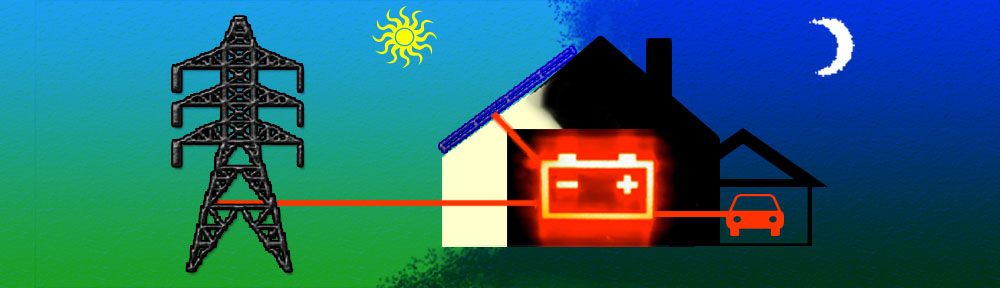
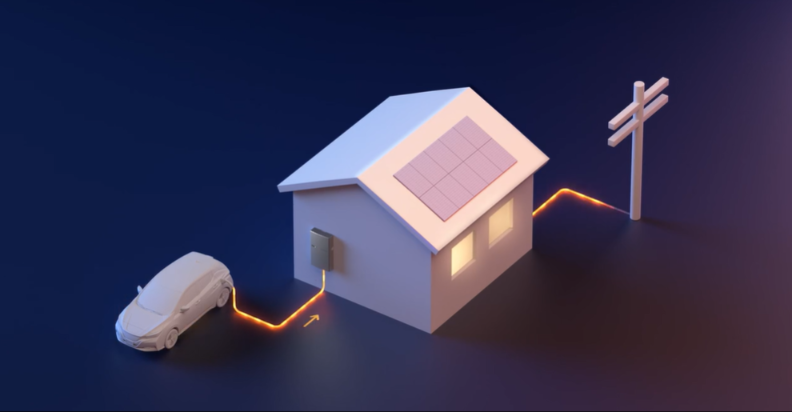
Here too is a still image from the video, which once again looks remarkably reminiscent of the decade old V2G UK banner at the top of this article!

The press release continues:

In addition to charging an EV, Enphase’s bidirectional charger will support the following functionality:

Vehicle-to-home (V2H) –enables the EV battery to provide uninterrupted power to a home during a power outage.
Vehicle-to-grid (V2G) –allows the EV battery to share energy with the grid to help relieve the strain on electric utilities during times of peak energy demand.
Green charging –sends clean solar energy directly to the EV battery.

Raghu Belur, co-founder and chief products officer at Enphase Energy, said that:

The new bidirectional EV charger, along with Enphase’s solar and battery storage system, can be controlled from the Enphase App, empowering homeowners to make, use, save, and sell their own power. We are working with standards organizations, EV manufacturers, and regulators to bring this charger to market in 2024.”

Since I sit on numerous EV (dis)charging and energy management standard development committees it would be very interesting to discover precisely which “standards organizations, EV manufacturers, and regulators” Enphase is working with!

Mohammad Alkuran, Ph.D., senior director of systems engineering at Enphase Energy, added that:

“ The Enphase bidirectional EV charger is the next step on our roadmap to building a solar-powered, all-in-one home energy system that further unlocks electrification, resilience, savings, and control for homeowners. This product will be a game changer for homeowners who want maximum control over their energy usage.”

For those of us that are more technically inclined Enphase Energy has also published a white paper about their bidirectional EV charger. Here’s an extract:

The Enphase Bidirectional EV Charger is part of the Ensemble energy management technology, which is the heart of the Enphase® Energy System™. The Enphase Energy System is a complete solution that produces, stores, monitors, exports, controls, and analyzes the energy in your home.

To achieve this, Enphase Energy System brings solar, batteries, other energy resources like generators, fuel cells, connected appliances and software together in one complete package so that a homeowner can make, use, save, and sell their own power—all through the Enphase mobile app.

Enphase has pioneered power conversion devices called IQ8™ Microinverters. These microinverters are best-in class power electronics components that convert power and comply with standards like UL 1741 for grid reliability functions and IEEE 1547 for interconnection of distributed energy resources (DER). These microinverters can create their own grid, also known as microgrid. They can operate in on-grid mode (as grid-tied) and off-grid mode (creating a microgrid). Enphase microinverter technology is at the forefront of the grid interface for our solar microinverters, storage batteries, and EV chargers.

The Enphase Bidirectional EV Charger leverages Enphase’s IQ Microinverter technology and IQ™ Battery architecture. When the charger is used with a vehicle that supports bidirectional charging, it enables the transfer of power and communication between the Enphase Energy System and the EV. The combination of the EV and the bidirectional charger is similar to an Enphase IQ Battery and can be controlled in an equivalent fashion.

The use of the terms “grid-forming” and “microgrid” is of particular interest to yours truly, since not all V2x charging stations are so well endowed.

Roll on 2024!

UK Parliament Debates Energy Storage

It’s all go on the energy storage front in the UK. Yesterday not only was V2G mentioned in the mainstream media but it was also debated by a committee in the House of Commons. The summary of the Energy Bill [Lords] 2015-16 states that it is:

A Bill to make provision about the Oil and Gas Authority and its functions; to make provision about fees in respect of activities relating to oil, gas, carbon dioxide and pipelines; to make provision about wind power; and for connected purposes.

I presume energy storage must count as a “connected purpose”, since the proposed New Clause 14 which was under discussion yesterday, reads as follows:

Electricity storage

(1) Section 4 of the electricity Act 1989 is amended as follows.

(2) After subsection (1)(c) insert—

“(d) stores electricity for the purpose of giving a supply to any premises or enabling a supply to be so given,”

(3) At end of subsection (4) insert—

““Store” means the conversion of electricity into a form of energy which can be stored, the storing of the energy which has been so converted and the reconversion of the stored energy into electrical energy in devices with an individual capacity of more than 50MW.”

(4) Section 6 of the electricity Act 1989 is amended as follows.

(5) After subsection (1)(d) insert—

“(e) a licence authorising a person to store electricity for the purpose of giving a supply to any premises or enabling a supply to be so given (‘a storage licence’);”

(6) After subsection (2) insert—

“(2ZA) In addition to holding a storage licence, the same person may be a holder of—

(a) a distribution licence,

(b) a transmission licence, or

(c) a generation licence.

(2ZB) The Secretary of State may by order determine the circumstances under which a person may hold a storage licence in addition to a distribution licence, a transmission licence or a generation licence under subsection (2ZA).

Events in The House were recorded for posterity, and the debate about NC14 can be seen in this video:

In some of the edited highlights Dr. Alan Whitehead, who is Shadow Minister for Energy and Climate Change, pointed out that:

A number of the issues we have discussed in the Committee—intermittency of wind, base-load problems and a whole range of other issues—can begin to be addressed by battery storage of electricity.

For example, if a battery storage system is attached to a solar array, the life of that solar array can be extended far beyond the period during the day when the sun shines. Clearly, the power that comes from it can go right through the night. We are already seeing that effect, to a minor extent, with solar arrays on streetlights, but on a much larger scale it could revolutionise the way in which solar is used in future.

Battery storage can also be used in relation to wind. We have heard that wind, quite self-evidently, does not always blow, and sometimes when it does blow, it blows rather a lot. Ensuring that the capturing of that variability is smoothed out into a regular supply through the attachment of battery storage to the wind turbine is clearly a positive step forward as far as wind supply is concerned.

However Andrea Leadsom, who is The Minister of State at the Department of Energy and Climate Change ultimately responded by saying:

On this last new clause, I am as keen as mustard on electricity storage; it has a vital contribution to make to dealing with intermittency and I wish we were five years ahead—it will be interesting to see how much we have managed to achieve in creating this new ability to store intermittent generation.

New clause 14 would create a new licence category for electricity storage operators and allow other licence holders, such as generators and transmission and distribution network operators, to hold an electricity storage licence. The creation of a separate electricity storage licence is an option that is being considered by my Department and one of a number of issues for storage operators to be included in a call for evidence in the spring. This will enable us to test it against other options, which may be less regulatory and burdensome, more targeted and, importantly, faster to implement. So, much as I would love to say, on this very last new clause, that we agree with the hon. Gentleman, the problem is that licensing storage now would be premature. Indeed, the Electricity Storage Network, which is a key trade body for the storage industry, has criticised this new clause on the grounds that it

“pre-empts the current work by the Department” and

“may hinder, rather than help, the progress of well thought-out strategies to support … the storage industry.”

following which Dr. Whitehead withdrew his proposed amendment.

All of which does rather beg the question of what “well thought-out strategies to support the storage industry” here in the United Kingdom will eventually look like, and whether they will accommodate “EV owners”, “Communities” and/or “Aggregators” as well as Distribution Network Operators, Transmission System Operators and electricity generators, whether distributed or centralised.