In a press release earlier today ITM Power announced that:
The most ambitious hydrogen mobility initiatives in Europe have joined forces to support the introduction of hydrogen-fuelled transport
A large coalition of European partners has launched the Hydrogen Mobility Europe project (H2ME). H2ME is co-funded with €32 million from the Fuel Cells and Hydrogen Joint Undertaking (FCH JU). The project will support the deployment of Fuel Cell Electric Vehicles (FCEVs) and Hydrogen Refuelling Stations (HRS) across Europe.
ITM’s headline summed things up so perfectly that we’ve unashamedly plagiarised it! The Hydrogen Mobility Europe project web site still says “Full website launching soon” at the top, but does state that:
The project brings together Europe’s four most ambitious national initiatives on hydrogen mobility (in Germany, France, Scandinavia and the UK) and will:
- Place 200 fuel cell cars (from Daimler and Hyundai) and 125 fuel cell range-extended vans (Symbio FCell collaborating with Renault) in customer hands
- Deploy 29 state-of-the art-hydrogen stations
- Carry out a long-term evaluation campaign to demonstrate the readiness of the technology for a mass market
- Develop insights into the customer experience and practical challenges of rolling out the technology at a large scale, which can be used in optimising the technology during its commercial roll-out
It also includes a link to their own press release, which adds that:
H2ME is the largest European project of this nature and is based around an alliance of the four most ambitious hydrogen mobility initiatives in Europe: H2 MOBILITY Deutschland, Mobilité Hydrogène France, Scandinavian Hydrogen Highway Partnership and UK H2 Mobility.
These initiatives originally brought together the key stakeholders in the hydrogen sector (vehicle manufacturers, hydrogen refuelling station providers and Government representatives), to study and develop strategies to make hydrogen-fuelled transport a reality in the respective regions. These initiatives will now be working together to make hydrogen-fuelled transport a reality in Europe.
Under H2ME they will deploy 200 FCEVs, 125 fuel cell range-extended electric (FC RE-EVs) commercial vans and 29 new HRSs in 10 countries (Austria, Belgium, Denmark, France, Germany, Iceland, Netherlands, Norway, Sweden and the UK) by 2019. This plan ties in with existing national level initiatives for the roll-out of a large scale hydrogen refuelling infrastructure, aimed at enabling Europe wide emission-free driving. The consortium, led by Element Energy, includes global leaders in the hydrogen and fuel cell sector, from fuel cells and car manufacturers (Daimler, SymbioFCell, Hyundai, Honda, Intelligent Energy, Nissan) and infrastructure providers (Air Liquide, BOC, H2Logic, ITM Power, Linde, McPhy Energy, OMV, AREVA, EIFER, H2 MOBILITY Deutschland, HYOP, Icelandic New Energy, Communauté d’Agglomération Sarreguemines Confluences) to data monitoring and dissemination organisations (Cenex, WaterstofNet).
The original agreements for the project were signed in July this year and the project has already delivered the first vehicles to customers in France and Germany (Daimler, SymbioFCell).
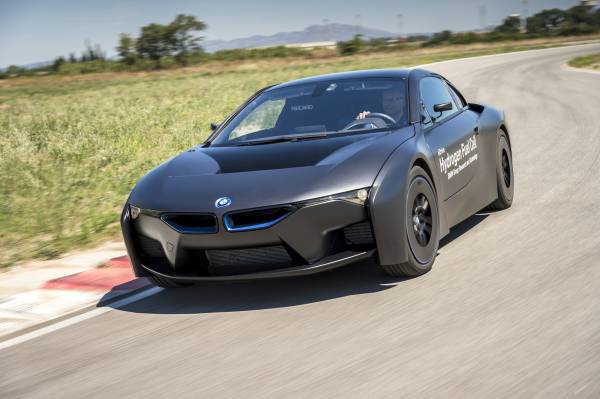
We have previously reported on BMW’s FCEV technology, developed in conjuction with Toyota, whose names are strangely absent from the above press releases. Perhaps that’s something to do with BMW’s use of “cryogenic pressure vessel technology”? Here’s BMW’s “CCH2 FCEV i8” prototype:
We wondered back in July about the:
Wait to discover how, where and when the hydrogen infrastructure BMW refer to materialises in Europe.
The H2ME project seems to be at least a partial answer to that question. In similar vein see also our report on the UK’s Riversimple open source hydrogen fuel cell vehicle. A much less extravagent beast than either BMW’s prototype FCEV i8, or the production Tesla Model S for that matter!