V2G at the 361 Energy Fair in Barnstaple

The 361 Energy Fair is back in Barnstaple on September 29th. The 2024 event starts at 10 AM in the Pannier Market with an introduction by Ian Roome, the newly elected Liberal Democrat MP for North Devon.

To give you a better idea of what to expect, here’s a video with extracts from previous 361 energy fairs:

For the first time this year’s fair includes a series of talks on a variety of topics. Our very own Jim Hunt will be giving a presentation on the topic of “An introduction to V2x, making greater use of EV batteries”, and the emphasis will be on vehicle-to-home and vehicle-to-building rather than fully fledged vehicle-to-grid.

Continue reading →

Hyundai Stops Internal Combustion Engine Development

According to the Korea Economic Daily:

Hyundai Motor Group, South Korea’s top automaker, will stop developing new internal combustion engines in order to accelerate its transformation into an electric vehicle manufacturer.

Hyundai Motor Co., the group’s larger carmaker, closed its engine development division at its research and development center, according to industry sources on Dec. 23. The Namyang R&D Center in South Korea is the group’s brain with about 12,000 researchers.

“Now, it is inevitable to convert into electrification,” said the newly appointed R&D chief Park Chung-kook in an email to employees. “Our own engine development is a great achievement, but we must change the system to create future innovation based on the great asset from the past.”

The move came as the global automobile industry is moving towards EVs more rapidly than expected. An EV, which runs on an electric motor, does not need a powertrain, which includes an internal combustion engine and a transmission.

The engine development team was established in 1983 as the late Chung Ju-yung, Hyundai Group founder and grandfather of current Hyundai Motor Group Chairman Chung Euisun, ordered that the company make its own engine.


EV OEMs Invest in Factorial Solid State Batteries

At the end of last month Factorial Energy issued a press release which announced that:

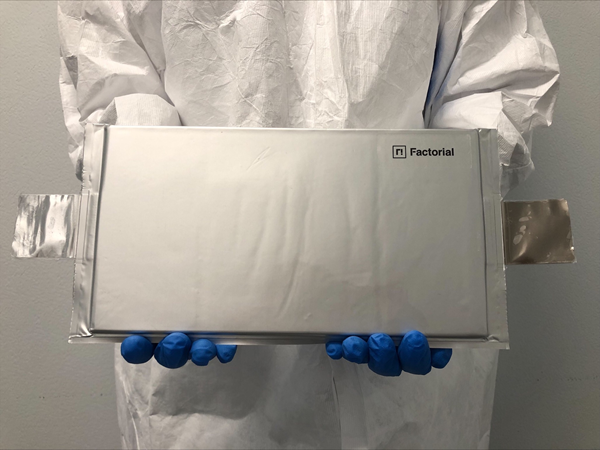
Factorial Energy, Hyundai Motor Company and Kia Corporation are partnering to test Factorial’s novel solid-state battery technology and its integration in Hyundai electric vehicles. Under the Joint Development Agreement, which includes a strategic investment, the companies will integrate Factorial technology at the cell, module, and system levels, perform vehicle-level integration, and co-develop specifications for manufacturing Factorial’s batteries. The announcement is Factorial’s first major strategic investment from a major automotive Original Equipment Manufacturer (OEM) group and deepens its existing research relationship with Hyundai.

Factorial has developed breakthrough solid-state technology that addresses key issues holding back widescale consumer adoption of electric vehicles: driving range, and safety.

Factorial’s advances are based on FEST™ (Factorial Electrolyte System Technology), which leverages a proprietary solid electrolyte material that enables safe and reliable cell performance with high-voltage and high-capacity electrodes and has been scaled in 40Ah cells that perform at room temperature. FEST™ is safer than conventional lithium-ion technology, extends driving range by 20 to 50 percent, and is drop-in compatible for easy integration into existing lithium-ion battery manufacturing infrastructure.

Earlier today Stellantis issued a press release which also announced an investment in Factorial Energy:

Stellantis N.V. and Factorial Energy announced today the signing of a joint development agreement to advance Factorial’s high-voltage traction solid-state battery technology. The agreement also includes a strategic investment from Stellantis.

“Our investment in Factorial and other highly recognised battery partners boosts the speed and agility needed to provide cutting-edge technology for our electric vehicle portfolio,” said Stellantis CEO Carlos Tavares. “Initiatives like these will yield a faster time to market and more cost-effective transition to solid-state technology.”

Factorial has developed breakthrough solid-state technology that addresses key issues holding back wide-scale consumer adoption of electric vehicles: driving range and safety.

“It is a great honor to partner with Stellantis, a leading global mobility player, which has some of the most iconic auto brands in the world,” said Siyu Huang, Co-founder and CEO of Factorial Energy. “It is an incredible opportunity for us to advance the adoption of our clean, efficient and safe solid-state battery technology to the mass market.”

Stellantis announced during its EV Day program in July 2021 its target of having the first competitive solid state battery technology introduced by 2026.

One cannot help but wonder how well this exciting new battery technology will handle the modest cycling requirements of V2G technology!

Hyundai Announce V2B Partnership with We Drive Solar

The press release is in Dutch, so I’m relying on Google Translate somewhat for this article! There is no explicit mention of V2x technology, but let’s read between the lines:

Hyundai and mobility provider We Drive Solar announced on April 13th a strategic partnership to provide housing projects with the energy system of the future.

I don’t know about you, but I’m getting a hint of vehicle-to-building already. Moving on:

Hyundai is well on its way to becoming a top 3 manufacturer of zero-emission vehicles worldwide, with a specific focus on 100% electric propulsion. By 2040, Hyundai aims to have its global car line-up fully electrified, aiming for a market share of 8 to 10 percent of the global EV market.

In addition to a leading role in electric driving, Hyundai also wants to accelerate the transition to sustainable mobility and optimally unburden customers with the help of innovative services, fully in line with the brand’s Progress for Humanity philosophy. In that context, Hyundai is expanding its e-mobility activities in the Netherlands significantly this year. Hyundai recently announced its partnership with Jedlix, the market leader in smart charging. Starting today, Hyundai is adding a new chapter in accelerating sustainable mobility by announcing its partnership with We Drive Solar.

Smart charging, sometimes referred to as V1G, is part of the equation but what about smart discharging? The press release continues:

Continue reading →

Fastned Electric Vehicle Charging Profiles

In the wake of the BBC’s “RapidGate” article last weekend I find myself debating the pros and cons of the 2018 model year Nissan LEAF that we road tested last week with a fan of the Hyundai Ioniq EV:

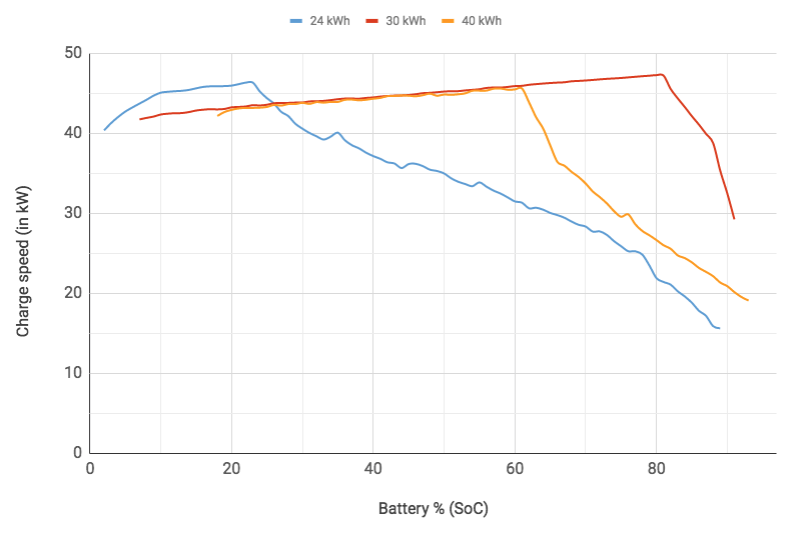
Dutch charging station operator Fastned helpfully provides some experimental evidence to inform the debate. Whilst they don’t publish data on the effects of successive rapid charging sessions on a long drive they do provide charging profiles for all three flavours of the Nissan LEAF:

Fastned Nissan Leaf GB

which does indeed show the latest LEAF fitted with a 40 kWh battery pack throttling the charging rate earlier than the preceding 30 kWh version. According to Fastned:

With a Nissan Leaf or e-NV200 (Evalia) you use the CHAdeMO plug. The charge speed is up to 50 kW at all of our chargers. In the charge curve below you can see the charge speed of the Nissan Leaf and e-NV200. On average both cars charge 100 km of range in 20 – 25 minutes. Charging behaviour largely depends on the battery size:

24 kWh edition: fast charging until 25%, charging will gradually go slower after this
30 kWh edition: fast charging until 80%, charging will go slower after this
40 kWh edition: fast charging until 60%, charging will go slower after this

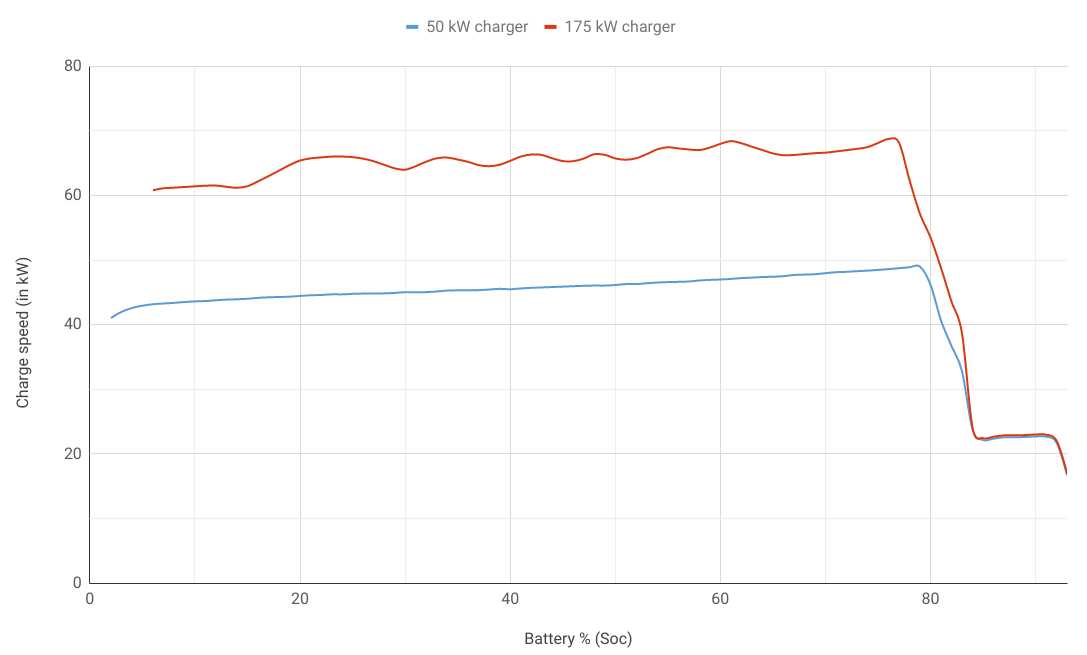
For comparison purposes here’s the equivalent graph for the Hyundai Ioniq:

Fastned Ioniq GB

According to Fastned once again:

If you have a Hyundai Ioniq, then you use the CCS plug. The charge speed is up to 70 kW at our next generation fast chargers and 50 kW at our other chargers. In the charge curve below you can see the charge speed of the Ioniq at both chargers. On average the Ioniq charges 100 km in 15 – 25 minutes. Above 75% the charge speed requested by the car will drop, and above 85% the charge speed is reduced to 22 kW.

Hydrogen Mobility Europe Launched with €32 Million Funding

In a press release earlier today ITM Power announced that:

The most ambitious hydrogen mobility initiatives in Europe have joined forces to support the introduction of hydrogen-fuelled transport

A large coalition of European partners has launched the Hydrogen Mobility Europe project (H2ME). H2ME is co-funded with €32 million from the Fuel Cells and Hydrogen Joint Undertaking (FCH JU). The project will support the deployment of Fuel Cell Electric Vehicles (FCEVs) and Hydrogen Refuelling Stations (HRS) across Europe.

ITM’s headline summed things up so perfectly that we’ve unashamedly plagiarised it! The Hydrogen Mobility Europe project web site still says “Full website launching soon” at the top, but does state that:

The project brings together Europe’s four most ambitious national initiatives on hydrogen mobility (in Germany, France, Scandinavia and the UK) and will:

  • Place 200 fuel cell cars (from Daimler and Hyundai) and 125 fuel cell range-extended vans (Symbio FCell collaborating with Renault) in customer hands
  • Deploy 29 state-of-the art-hydrogen stations
  • Carry out a long-term evaluation campaign to demonstrate the readiness of the technology for a mass market
  • Develop insights into the customer experience and practical challenges of rolling out the technology at a large scale, which can be used in optimising the technology during its commercial roll-out

It also includes a link to their own press release, which adds that:

H2ME is the largest European project of this nature and is based around an alliance of the four most ambitious hydrogen mobility initiatives in Europe: H2 MOBILITY Deutschland, Mobilité Hydrogène France, Scandinavian Hydrogen Highway Partnership and UK H2 Mobility.

These initiatives originally brought together the key stakeholders in the hydrogen sector (vehicle manufacturers, hydrogen refuelling station providers and Government representatives), to study and develop strategies to make hydrogen-fuelled transport a reality in the respective regions. These initiatives will now be working together to make hydrogen-fuelled transport a reality in Europe.

Under H2ME they will deploy 200 FCEVs, 125 fuel cell range-extended electric (FC RE-EVs) commercial vans and 29 new HRSs in 10 countries (Austria, Belgium, Denmark, France, Germany, Iceland, Netherlands, Norway, Sweden and the UK) by 2019. This plan ties in with existing national level initiatives for the roll-out of a large scale hydrogen refuelling infrastructure, aimed at enabling Europe wide emission-free driving. The consortium, led by Element Energy, includes global leaders in the hydrogen and fuel cell sector, from fuel cells and car manufacturers (Daimler, SymbioFCell, Hyundai, Honda, Intelligent Energy, Nissan) and infrastructure providers (Air Liquide, BOC, H2Logic, ITM Power, Linde, McPhy Energy, OMV, AREVA, EIFER, H2 MOBILITY Deutschland, HYOP, Icelandic New Energy, Communauté d’Agglomération Sarreguemines Confluences) to data monitoring and dissemination organisations (Cenex, WaterstofNet).

The original agreements for the project were signed in July this year and the project has already delivered the first vehicles to customers in France and Germany (Daimler, SymbioFCell).

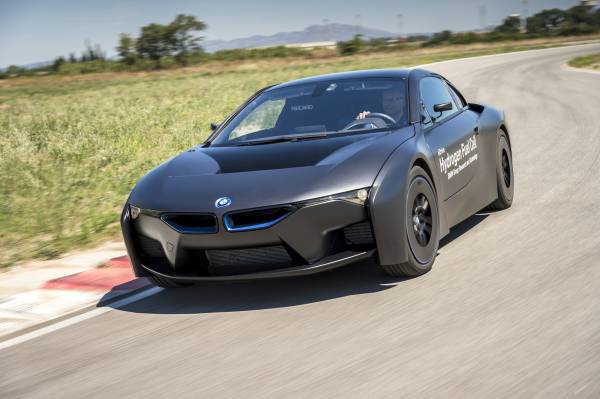
We have previously reported on BMW’s FCEV technology, developed in conjuction with Toyota, whose names are strangely absent from the above press releases. Perhaps that’s something to do with BMW’s use of “cryogenic pressure vessel technology”? Here’s BMW’s “CCH2 FCEV i8” prototype:
We wondered back in July about the:

Wait to discover how, where and when the hydrogen infrastructure BMW refer to materialises in Europe.

The H2ME project seems to be at least a partial answer to that question. In similar vein see also our report on the UK’s Riversimple open source hydrogen fuel cell vehicle. A much less extravagent beast than either BMW’s prototype FCEV i8, or the production Tesla Model S for that matter!