
Reduced Battery Degradation Using V2G

We have previously discussed the work of the Warwick Manufacturing Group on mitigating potential battery degradation by “intelligently managing V2G technology”. In a recent press release the EV-elocity project refers to a new WMG paper on that subject, reporting that:

A number of studies have identified the strategic importance of charging infrastructure to support the introduction of electrified vehicles (EVs) and to underpin consumer acceptance of the technology. For this reason, considerable research has been undertaken to evaluate the different facets of the technology, including the ability to charge at higher rates of electrical power, the introduction of smart charging (V1G) that allows dynamic management of the charging process in terms of both power and charge time and vehicle-to-grid (V2G) that enables bidirectional energy flow between the vehicle and the supply. In recent years, the term V2G has become more generalised to V2X, to acknowledge the variability in which the EV may be integrated, either to the grid or behind-the-meter, for example within a local electrical network, such as a building (V2B).

Irrespective of the exact nature of the integration method, understanding the impact of different strategies on battery degradation is a key requirement that may ultimately underpin consumer acceptance. Only a few studies have examined the potential impact of V2G operation on battery degradation. Often their assertion is that the increased charge-throughput will negatively impact battery life. These works often neglect that the battery will equally degrade through a process of calendar-ageing in which the retained capacity of the battery reduces as the battery is stored at no-load.

As highlighted in these results from the EV-elocity project, the nature of the degradation is highly complex with dependencies that crosscut: the state of charge (SOC) of the battery with respect to the optimal SOC storage condition and the duration of the parking interval. To further compound the challenge, experimental results shows that the optimal SOC point varies with battery life.

The paper referred to is open access and entitled “A Study of Reduced Battery Degradation Through State-of-Charge Pre-Conditioning for Vehicle-to-Grid Operations“. The abstract begins as follows:

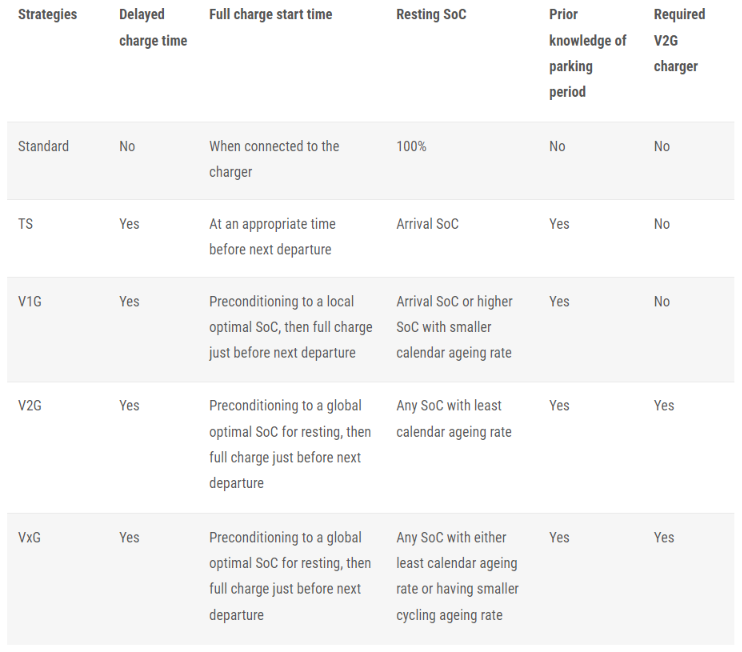
Transport electrification is a key enabler to reduce fossil fuel depletion and related carbon dioxide emissions. However, critical barriers exist in terms of battery costs and their expected life. Vehicle-to-grid technology can bring benefits to both the electrical power grid and electric vehicle owners, while its practical implementation faces challenges due to the concerns over accelerated battery degradation. This paper presents a comprehensive study on reduced Lithium-ion battery degradation through state-of-charge pre-conditioning strategies that allow an electric vehicle to participate in vehicle-to-grid operations during periods in which the vehicle is parked. Energy capacity reduction of the electric vehicle battery are predicted using semi-empirical ageing models, which have been built and validated to capture the degradation behaviours of the battery with respect to both calendar and cycling ageing. Five charging strategies for battery state-of-charge pre-conditioning have been developed to evaluate the ability to mitigate battery ageing before commencing vehicle-to-grid operations. Simulation studies on battery degradation utilizing such charging mechanisms under two different operational profiles have been undertaken.

At this point you may be wondering exactly what the various charging mechanisms entail? Here’s a summary of the assorted strategies from the press release:
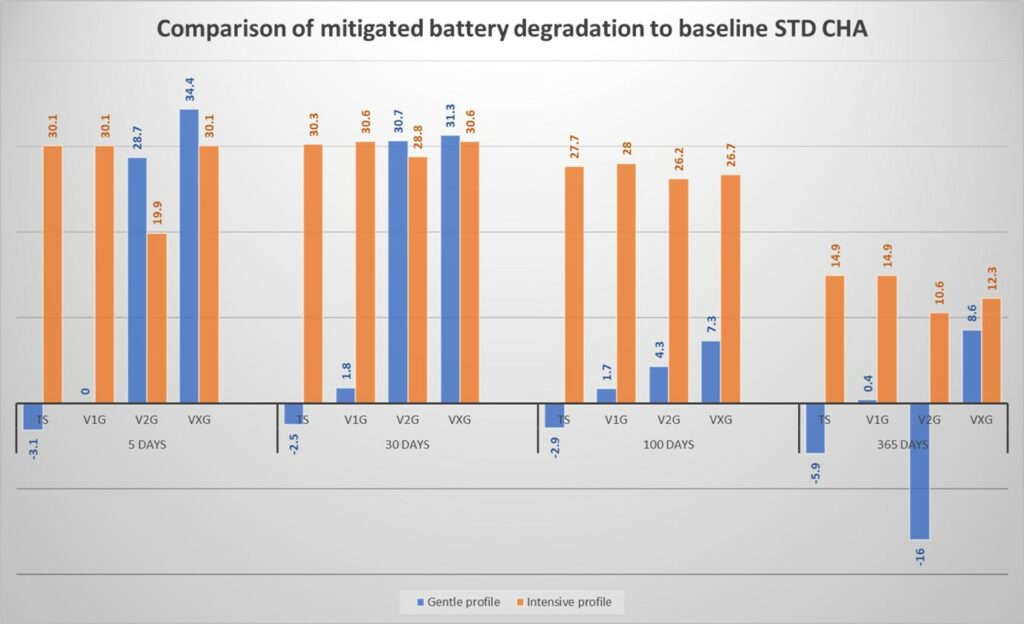
and here’s a summary of the results:
Going back to the abstract from the Bui et al. paper, the brief conclusions are that:

The analytical results show that the proposed charging strategies do not accelerate battery degradation and are capable of mitigating the total ageing process from 7.3 – 26.7% for the first 100 days of operational life and gradually vary to 8.6 – 12.3% for one-year continual operation compared to the reference standard charging approach.

To summarise, leaving your electric vehicle plugged in and “fully charged” is not good for the “state of health” of its traction battery. Here’s a video from Euan McTurk that delivers a similar message:
EV OEMs Invest in Factorial Solid State Batteries

At the end of last month Factorial Energy issued a press release which announced that:

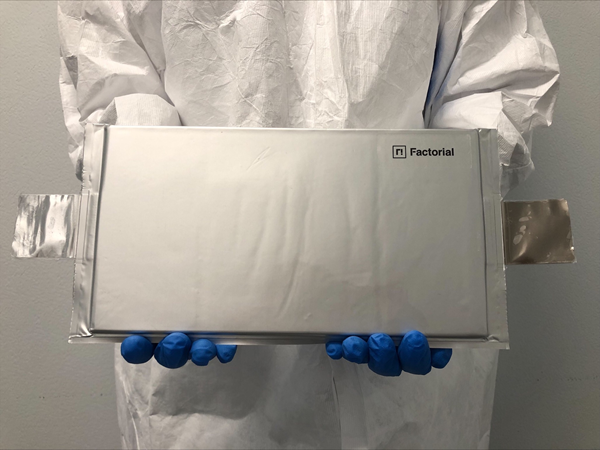
Factorial Energy, Hyundai Motor Company and Kia Corporation are partnering to test Factorial’s novel solid-state battery technology and its integration in Hyundai electric vehicles. Under the Joint Development Agreement, which includes a strategic investment, the companies will integrate Factorial technology at the cell, module, and system levels, perform vehicle-level integration, and co-develop specifications for manufacturing Factorial’s batteries. The announcement is Factorial’s first major strategic investment from a major automotive Original Equipment Manufacturer (OEM) group and deepens its existing research relationship with Hyundai.

Factorial has developed breakthrough solid-state technology that addresses key issues holding back widescale consumer adoption of electric vehicles: driving range, and safety.

Factorial’s advances are based on FEST™ (Factorial Electrolyte System Technology), which leverages a proprietary solid electrolyte material that enables safe and reliable cell performance with high-voltage and high-capacity electrodes and has been scaled in 40Ah cells that perform at room temperature. FEST™ is safer than conventional lithium-ion technology, extends driving range by 20 to 50 percent, and is drop-in compatible for easy integration into existing lithium-ion battery manufacturing infrastructure.

Earlier today Stellantis issued a press release which also announced an investment in Factorial Energy:

Stellantis N.V. and Factorial Energy announced today the signing of a joint development agreement to advance Factorial’s high-voltage traction solid-state battery technology. The agreement also includes a strategic investment from Stellantis.

“Our investment in Factorial and other highly recognised battery partners boosts the speed and agility needed to provide cutting-edge technology for our electric vehicle portfolio,” said Stellantis CEO Carlos Tavares. “Initiatives like these will yield a faster time to market and more cost-effective transition to solid-state technology.”

Factorial has developed breakthrough solid-state technology that addresses key issues holding back wide-scale consumer adoption of electric vehicles: driving range and safety.

“It is a great honor to partner with Stellantis, a leading global mobility player, which has some of the most iconic auto brands in the world,” said Siyu Huang, Co-founder and CEO of Factorial Energy. “It is an incredible opportunity for us to advance the adoption of our clean, efficient and safe solid-state battery technology to the mass market.”

Stellantis announced during its EV Day program in July 2021 its target of having the first competitive solid state battery technology introduced by 2026.

One cannot help but wonder how well this exciting new battery technology will handle the modest cycling requirements of V2G technology!

Have StoreDot Uncovered the Electric Vehicle Holy Grail?

Israeli company StoreDot announced last month:

A new round of financing of $18 million for its new Electric Vehicle business unit, bringing the total funding to-date to $66 million. Investors in this round include mostly existing investors such as Norma Investments Limited, representing Roman Abramovich and Samsung Ventures. Other existing investors also include Singulariteam.

This round of funding is centered on the development and commercialization of the EV business unit. One of the company’s immediate goals is to build the first ever instantly-charging car prototype. Additionally, this funding will allow new hiring and additional labs for the new business unit.

In the associated “FlashBattery” section of their web site they point out that:

StoreDot is developing a new type of electric-car battery consisting of specially synthesized organic compounds – the same innovative materials used in its FlashBattery for mobile devices. While the charging experience is similar to fueling a gasoline car, EV FlashBattery cost of ownership is only half per mile compared to existing electric-vehicle batteries.

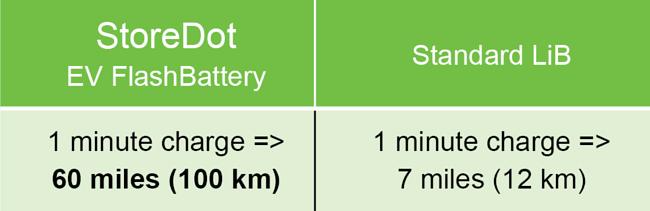
A significant and sustainable technological breakthrough, EV FlashBattery charges fully in 5 minutes, providing 300 miles (480 km) of driving distance. This fast charging technology shortens the amount of time drivers will have to wait in line to charge their cars, while also reducing the number of charging posts in each station, and considerably cutting the overall cost of owning an electric car.

EV FlashBattery’s remarkably fast charging rate is achieved due to StoreDot’s novel materials, comprising thousands of cells assembled and packed in a single battery module. When fully charged, the EV FlashBattery stores enough energy for a 300 mile (480 km) range on a 5 minute charge.

Allowing for less frequent battery replacement due to its increased number of cycles, EV FlashBattery results in a 50% cost reduction per mile over the electric vehicle’s lifetime, compared to existing battery technologies

As if all that isn’t exciting enough for you StoreDot point out in a related article that:

A country that is highly dependent on oil, China is responsible for nearly 25% of worldwide production [of emissions].

Following announcements by both the EU and the U.S. in the fall of 2014 to significantly slash GHG emissions by 2025, the Chinese government, too, pledged to reduce greenhouse emissions and to eliminate its reliance on imported oil by shifting away from conventional gasoline-powered vehicles and stimulating the use of renewable energy.

Despite government subsidies, demand for alternative-energy vehicles in China has been slow, and as of September 2014, the country had reached only 12% of its target for alternative-energy vehicles to be introduced by 2015.

This stems from several factors. First, as mentioned above, there are insufficient charging stations, which is holding back the adoption of EVs in the country.

Secondly, following the plunge in the price of crude oil in June 2014, gasoline prices have gradually gone down, leading to a decrease in the incentive to use EVs. This has led many EV owners in China to run their cars mostly on gasoline, which means that the electric capability is largely wasted, thus proving counterproductive regarding the environment.

A third factor is “range anxiety” – the driver’s fear of running out of power before reaching the nearest charging station – which is also an obstacle for electric-car adoption.

StoreDot FlashBattery technology addresses these issues by providing a driver experience similar to fuelling (without the fumes). Demand for EVs may increase substantially once the drivers are exposed to StoreDot’s 5-minute charging solution.

Given our own recent experiences of “EV range anxiety” we here at V2G UK cannot wait! The $64 gazillion question then is when will we ultimately be “exposed to StoreDot’s 5-minute charging solution”, or something similar from another company?