Riversimple Launch the Rasa Hydrogen FCEV

We’ve mentioned the Riversimple open source hydrogen fuel cell electric vehicle before, and we could not help but notice the countdown to the launch of their new “Rasa” model on their Twitter feed:

Today there’s an in depth article in the Financial Times about the Rasa and the reasoning behind it. Here’s the edited highlights:

Riversimple Movement is taking its hydrogen fuel-cell project — now 15 years in the making — to the next stage with the unveiling of its first production-ready, road-legal prototype and the start of a public trial.

In the autumn, about 20 people will have the chance to drive away a carbon-fibre Rasa, which may look slightly kooky with its rear-wheel spats and butterfly doors but packs four electric motors and can travel for 300 miles on a single fill-up.

“We’re not targeting the ecological market. We want it to look good,” says Hugo Spowers, who founded the company in 2001.

The Rasa was named for the blank-slate approach the company says it is taking to carmaking. Parts are chosen not on the basis of how cheap, light or powerful they are but how they will affect the business model.

“One investor told me this was the first time he’d seen a car built for a business model rather than the other way round,” says Mr Spowers.

Please read the FT article in full, but also take a look at what Riversimple themselves have to say. According to “Technology behind the car” section of their web site:

Every aspect of the hydrogen Mark ll Alpha has been created and interrogated for simplicity, efficiency, lightness, strength, affordability, safety and sustainability.

This first car is a two seater ‘network electric’ car, powered by a hydrogen fuel cell. The chassis is a carbon fibre monocoque made from very lightweight but extremely stiff carbon fibre composites. The monocoque chassis weighs less than 40kg.

Our car is very light – we have a target weight of 520 kg. It embodies various key features:

  • Four electric motors, one in each wheel
  • Motors as brakes – recovering over 50% of kinetic energy when braking
  • Super-capacitors to store this energy and provide most of the power for acceleration
  • A low powered hydrogen fuel cell ( 8.5 kW)
  • A body made of lightweight composites

It’s the synthesis of all these technologies that delivers the groundbreaking efficiency and range, many times better than inserting fuel cells into conventional, heavy, vehicles. The production prototype should do c.250 mpg (equivalent), with a range of 300 miles. Emissions are zero at tailpipe and c.40gCO2/km Well-to-Wheel – even if the hydrogen comes from natural gas.

We’ll keep you posted as the Rasa launch countdown continues. According to Twitter:

Here’s a teaser video to whet the appetite for the big reveal on 17 Feb – 5days to go!

[Edit – February 17th 2016]

The Riversimple Rasa has been unveiled today:
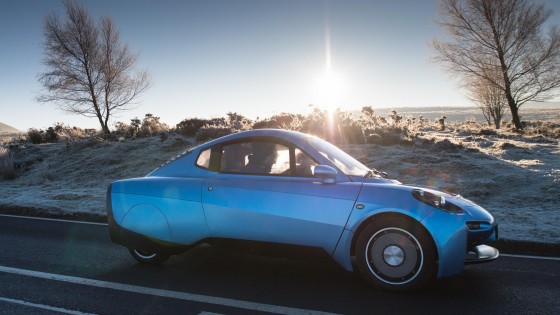
According to the Riversimple blog:

The new car reflects a simple idea that was first mooted in the 4th century BC by the great philosopher and scientist, Aristotle. It is the idea that something new begins, not with predetermined structure and characteristics, but with a blank slate – tabula rasa – moment of potential.

We set out with a blank slate, to design a car for the world in which we now live, shaped by the best technology available to us and answerable to our most pressing concerns. We set out to build a local car that will take people on their local journeys, in the way that they wish to travel, at a cost that is affordable – and without leaving a heavy footprint of air pollution and environmental degradation. To do this we selected a still evolving, but incredibly promising and safe technology. This is hydrogen fuel cell technology.

Here’s another video, this time revealing the Rasa in all its low drag glory:

I did enquire on Twitter where the nearest suitable filling station for a Rasa might ultimately be. I haven’t received an answer yet, but if it isn’t “Exeter” then I rather hope it will be “Plymouth”. According to the SWARM Project web site:

This project will establish a demonstration fleet of small passenger vehicles that builds on and expands existing hydrogen refuelling infrastructure. Three European regions will be participating in this effort: the UK (the Midlands and Plymouth), the Brussels area and Wallonia, and the Weser-Ems region in NorthWest Germany. Each of these regions will deploy a new hydrogen refuelling site to close the gaps in a continuous ‘hydrogen highways’ that leads from Scotland via the Midlands to London, connecting to Brussels and on to Cologne and Hamburg/Scandinavia/Berlin via Bremen.

The vehicles employed are low-cost, high fuel-efficiency, hybridised, light-weight passenger cars specifically designed for city and regional transport. These vehicles provide a complementary pathway to commercialisation to the large Original Equipment Manufacturer (OEM) of hydrogen fuel cell options, by allowing near-term rollout on a commercial basis to a wide range of users – in parallel with the planned rollouts for large OEM vehicles from 2015. Their deployment regions will gain the infrastructure, public exposure and technological understanding to act as seed locations for future large scale OEM vehicle rollout.

You will note that Riversimple are a member of the SWARM project consortium.
Hydrogen Mobility Europe Launched with €32 Million Funding

In a press release earlier today ITM Power announced that:

The most ambitious hydrogen mobility initiatives in Europe have joined forces to support the introduction of hydrogen-fuelled transport

A large coalition of European partners has launched the Hydrogen Mobility Europe project (H2ME). H2ME is co-funded with €32 million from the Fuel Cells and Hydrogen Joint Undertaking (FCH JU). The project will support the deployment of Fuel Cell Electric Vehicles (FCEVs) and Hydrogen Refuelling Stations (HRS) across Europe.

ITM’s headline summed things up so perfectly that we’ve unashamedly plagiarised it! The Hydrogen Mobility Europe project web site still says “Full website launching soon” at the top, but does state that:

The project brings together Europe’s four most ambitious national initiatives on hydrogen mobility (in Germany, France, Scandinavia and the UK) and will:

  • Place 200 fuel cell cars (from Daimler and Hyundai) and 125 fuel cell range-extended vans (Symbio FCell collaborating with Renault) in customer hands
  • Deploy 29 state-of-the art-hydrogen stations
  • Carry out a long-term evaluation campaign to demonstrate the readiness of the technology for a mass market
  • Develop insights into the customer experience and practical challenges of rolling out the technology at a large scale, which can be used in optimising the technology during its commercial roll-out

It also includes a link to their own press release, which adds that:

H2ME is the largest European project of this nature and is based around an alliance of the four most ambitious hydrogen mobility initiatives in Europe: H2 MOBILITY Deutschland, Mobilité Hydrogène France, Scandinavian Hydrogen Highway Partnership and UK H2 Mobility.

These initiatives originally brought together the key stakeholders in the hydrogen sector (vehicle manufacturers, hydrogen refuelling station providers and Government representatives), to study and develop strategies to make hydrogen-fuelled transport a reality in the respective regions. These initiatives will now be working together to make hydrogen-fuelled transport a reality in Europe.

Under H2ME they will deploy 200 FCEVs, 125 fuel cell range-extended electric (FC RE-EVs) commercial vans and 29 new HRSs in 10 countries (Austria, Belgium, Denmark, France, Germany, Iceland, Netherlands, Norway, Sweden and the UK) by 2019. This plan ties in with existing national level initiatives for the roll-out of a large scale hydrogen refuelling infrastructure, aimed at enabling Europe wide emission-free driving. The consortium, led by Element Energy, includes global leaders in the hydrogen and fuel cell sector, from fuel cells and car manufacturers (Daimler, SymbioFCell, Hyundai, Honda, Intelligent Energy, Nissan) and infrastructure providers (Air Liquide, BOC, H2Logic, ITM Power, Linde, McPhy Energy, OMV, AREVA, EIFER, H2 MOBILITY Deutschland, HYOP, Icelandic New Energy, Communauté d’Agglomération Sarreguemines Confluences) to data monitoring and dissemination organisations (Cenex, WaterstofNet).

The original agreements for the project were signed in July this year and the project has already delivered the first vehicles to customers in France and Germany (Daimler, SymbioFCell).

We have previously reported on BMW’s FCEV technology, developed in conjuction with Toyota, whose names are strangely absent from the above press releases. Perhaps that’s something to do with BMW’s use of “cryogenic pressure vessel technology”? Here’s BMW’s “CCH2 FCEV i8” prototype:

We wondered back in July about the:

Wait to discover how, where and when the hydrogen infrastructure BMW refer to materialises in Europe.

The H2ME project seems to be at least a partial answer to that question. In similar vein see also our report on the UK’s Riversimple open source hydrogen fuel cell vehicle. A much less extravagent beast than either BMW’s prototype FCEV i8, or the production Tesla Model S for that matter!

Hydrogen Fuel Cell Drive System is the Future of BMW eDrive technology?

In a press release about their 2015 Innovation Days the BMW Group have revealed that:

The strategic collaboration between the BMW Group and the Toyota Motor Company agreed at the beginning of 2013 has provided fresh momentum for the development of FCEV drive technology. The aim of the collaboration is to have an initial group of approved components ready by 2020. The successful introduction of FCEVs is dependent on the development of a hydrogen infrastructure in the markets concerned.

The two collaboration partners are supporting this process through jointly created technological standards which make fuel cell-powered vehicles easier to use and help to increase their reach and numbers.

Whilst we wait to discover how, where and when the hydrogen infrastructure BMW refer to materialises in Europe they go on to state that:

The hydrogen Fuel Cell Electric Vehicle (FCEV) represents a pioneering concept focusing on locally emission-free mobility combined with hallmark BMW dynamics and a high level of energy efficiency. The hydrogen fuel cell drive system combines the benefits of BMW eDrive technology with a host of qualities familiar from conventional combustion engines:

  • All-electric, locally emission-free driving.
  • BMW eDrive electric motor generates instantaneous power delivery and impressive dynamics.
  • Power electronics, high-voltage battery and intelligent energy management based on the BMW Group’s eDrive technology.
  • Long-distance capability with an operating range of more than 500 kilometres (300 miles) thanks to the high energy density of the hydrogen carried on board.
  • Fast and convenient refuelling in under five minutes.

Fuel cell technology therefore makes an ideal addition to both the BMW i models and, in the future, the series-produced models from the BMW brand fitted with tried-and-tested eDrive technology. It converts the gaseous hydrogen contained in the storage tank into electric power and water vapour. The vehicle’s high-voltage battery serves as an energy storage unit and can therefore be considerably smaller – with a net capacity of around one kilowatt hour – than in battery-electric concepts. Storing hydrogen in a cryogenic pressure vessel can, depending on the type of vehicle, allow an operating range comparable with that of conventional vehicles powered by combustion engines. Filling up the hydrogen storage tank takes a similar amount of time as refuelling a petrol or diesel tank.

This seems to suggest that in the not too distant future we can expect to see a version of the BMW i3 with a much smaller traction battery plus a hydrogen fuel cell instead of the existing range extender, together with a similarly equipped although presumably more powerful version of the i8!

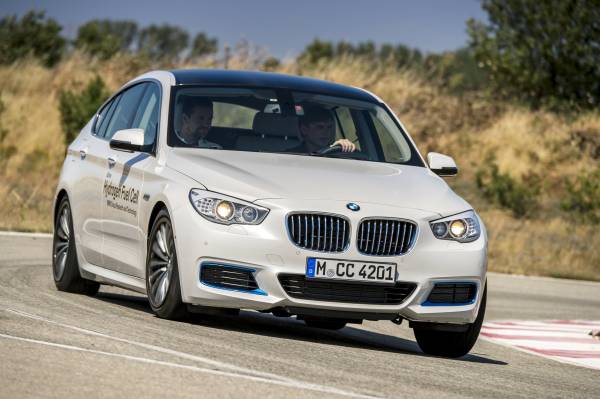
By way of a hint about what to expect the press release includes pictures such as this:

plus a video:

which according to BMW show:

The demonstration vehicle, based on a BMW 5 Series Gran Turismo, [which] reveals a take on this form of propulsion in keeping with the brand’s profile and character. It combines locally emission-free mobility with sporting dynamics, excellent ride comfort and long-distance capability. Its key features are as follows:

  • Electric motor developing 180 kW/245 hp, power electronics and high-voltage battery for interim energy storage; developed as a variant of BMW eDrive technology for BMW i cars and BMW brand plug-in hybrid models.
  • Hydrogen storage in the form of a tunnel tank between the front and rear axle; industry standard 700 bar CGH2 vessel technology and cryogenic pressure vessel technology (CCH2) patented by the BMW Group for storing gaseous hydrogen at low temperature and 350 bar pressure; operating range: over 500 kilometres (more than 300 miles).
  • Fuel cells, housing and ancillary systems: initial results from the collaboration between the BMW Group and the Toyota Motor Corporation on Fuel Cell Electric Vehicle (FCEV) technology.

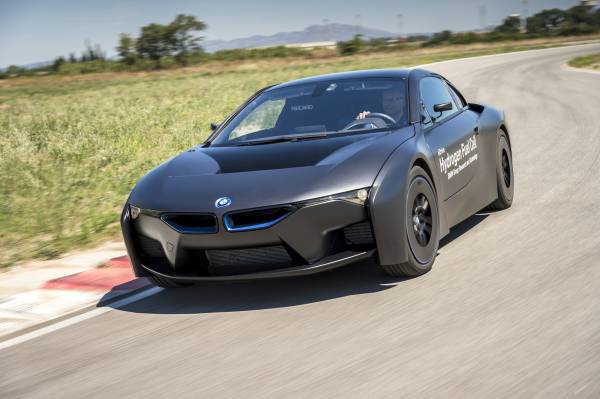
In the press kit BMW also reveal another vehicle emblazoned with the “Hydrogen Fuel Cell” logo:

According to Autocar the car:

Has been used as a rolling test bed for the German company’s hydrogen fuel cell technology, which is planned to head into large-scale production by 2020, according to the head of BMW’s vast research and development operations, Klaus Fröhlich.

Based around the contemporary new i8, the sleek two-door coupé relies on carbonfibre construction to keep its weight down and also features an aerodynamic package honed at BMW’s wind tunnel in Munich. The BMW research vehicle, which was constructed back in 2012 and remains unnamed, sites its fuel stack at the rear in the position usually taken up by the i8’s compact turbocharged 1.5-litre three-cylinder petrol engine.

Energy for the fuel stack is provided by cryogenically stowed hydrogen contained in a cylindrical tank mounted down the centre line of the car’s platform and oxygen provided by cooling air. The fuel stack subsequently provides electricity to run a rear-mounted electric motor, with the only emissions being water.

Here’s a video of the vehicle in action:

Evidently all sorts of exciting stuff is already well on the way to production. Now all we need, as so often seems to be the case these days, is the associated infrastructure!