Riversimple Launch the Rasa Hydrogen FCEV

We’ve mentioned the Riversimple open source hydrogen fuel cell electric vehicle before, and we could not help but notice the countdown to the launch of their new “Rasa” model on their Twitter feed:

Today there’s an in depth article in the Financial Times about the Rasa and the reasoning behind it. Here’s the edited highlights:

Riversimple Movement is taking its hydrogen fuel-cell project — now 15 years in the making — to the next stage with the unveiling of its first production-ready, road-legal prototype and the start of a public trial.

In the autumn, about 20 people will have the chance to drive away a carbon-fibre Rasa, which may look slightly kooky with its rear-wheel spats and butterfly doors but packs four electric motors and can travel for 300 miles on a single fill-up.

“We’re not targeting the ecological market. We want it to look good,” says Hugo Spowers, who founded the company in 2001.

The Rasa was named for the blank-slate approach the company says it is taking to carmaking. Parts are chosen not on the basis of how cheap, light or powerful they are but how they will affect the business model.

“One investor told me this was the first time he’d seen a car built for a business model rather than the other way round,” says Mr Spowers.

Please read the FT article in full, but also take a look at what Riversimple themselves have to say. According to “Technology behind the car” section of their web site:

Every aspect of the hydrogen Mark ll Alpha has been created and interrogated for simplicity, efficiency, lightness, strength, affordability, safety and sustainability.

This first car is a two seater ‘network electric’ car, powered by a hydrogen fuel cell. The chassis is a carbon fibre monocoque made from very lightweight but extremely stiff carbon fibre composites. The monocoque chassis weighs less than 40kg.

Our car is very light – we have a target weight of 520 kg. It embodies various key features:

  • Four electric motors, one in each wheel
  • Motors as brakes – recovering over 50% of kinetic energy when braking
  • Super-capacitors to store this energy and provide most of the power for acceleration
  • A low powered hydrogen fuel cell ( 8.5 kW)
  • A body made of lightweight composites

It’s the synthesis of all these technologies that delivers the groundbreaking efficiency and range, many times better than inserting fuel cells into conventional, heavy, vehicles. The production prototype should do c.250 mpg (equivalent), with a range of 300 miles. Emissions are zero at tailpipe and c.40gCO2/km Well-to-Wheel – even if the hydrogen comes from natural gas.

We’ll keep you posted as the Rasa launch countdown continues. According to Twitter:

Here’s a teaser video to whet the appetite for the big reveal on 17 Feb – 5days to go!

[Edit – February 17th 2016]

The Riversimple Rasa has been unveiled today:
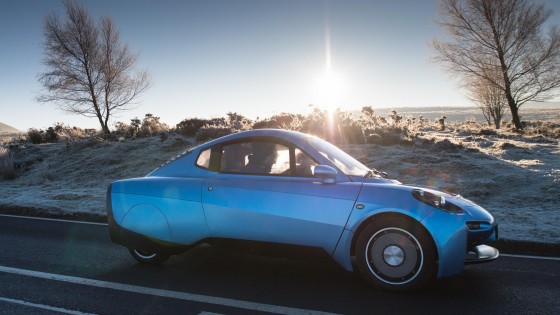
According to the Riversimple blog:

The new car reflects a simple idea that was first mooted in the 4th century BC by the great philosopher and scientist, Aristotle. It is the idea that something new begins, not with predetermined structure and characteristics, but with a blank slate – tabula rasa – moment of potential.

We set out with a blank slate, to design a car for the world in which we now live, shaped by the best technology available to us and answerable to our most pressing concerns. We set out to build a local car that will take people on their local journeys, in the way that they wish to travel, at a cost that is affordable – and without leaving a heavy footprint of air pollution and environmental degradation. To do this we selected a still evolving, but incredibly promising and safe technology. This is hydrogen fuel cell technology.

Here’s another video, this time revealing the Rasa in all its low drag glory:

I did enquire on Twitter where the nearest suitable filling station for a Rasa might ultimately be. I haven’t received an answer yet, but if it isn’t “Exeter” then I rather hope it will be “Plymouth”. According to the SWARM Project web site:

This project will establish a demonstration fleet of small passenger vehicles that builds on and expands existing hydrogen refuelling infrastructure. Three European regions will be participating in this effort: the UK (the Midlands and Plymouth), the Brussels area and Wallonia, and the Weser-Ems region in NorthWest Germany. Each of these regions will deploy a new hydrogen refuelling site to close the gaps in a continuous ‘hydrogen highways’ that leads from Scotland via the Midlands to London, connecting to Brussels and on to Cologne and Hamburg/Scandinavia/Berlin via Bremen.

The vehicles employed are low-cost, high fuel-efficiency, hybridised, light-weight passenger cars specifically designed for city and regional transport. These vehicles provide a complementary pathway to commercialisation to the large Original Equipment Manufacturer (OEM) of hydrogen fuel cell options, by allowing near-term rollout on a commercial basis to a wide range of users – in parallel with the planned rollouts for large OEM vehicles from 2015. Their deployment regions will gain the infrastructure, public exposure and technological understanding to act as seed locations for future large scale OEM vehicle rollout.

You will note that Riversimple are a member of the SWARM project consortium.

Has the Door Opened to a Very Different Car Industry?

On September 18th 2015 the United States Environmental Protection Agency issued a press release in which they stated that:

Today, EPA is issuing a notice of violation (NOV) of the Clean Air Act (CAA) to Volkswagen AG, Audi AG, and Volkswagen Group of America, Inc. (collectively referred to as Volkswagen). The NOV alleges that four-cylinder Volkswagen and Audi diesel cars from model years 2009-2015 include software that circumvents EPA emissions standards for certain air pollutants. California is separately issuing an In-Use Compliance letter to Volkswagen, and EPA and the California Air Resources Board (CARB) have both initiated investigations based on Volkswagen’s alleged actions.

“Using a defeat device in cars to evade clean air standards is illegal and a threat to public health,” said Cynthia Giles, Assistant Administrator for the Office of Enforcement and Compliance Assurance. “Working closely with the California Air Resources Board, EPA is committed to making sure that all automakers play by the same rules. EPA will continue to investigate these very serious matters.”

“Working with US EPA we are taking this important step to protect public health thanks to the dogged investigations by our laboratory scientists and staff,” said Air Resources Board Executive Officer Richard Corey. “Our goal now is to ensure that the affected cars are brought into compliance, to dig more deeply into the extent and implications of Volkswagen’s efforts to cheat on clean air rules, and to take appropriate further action.”

Here’s a video from The Financial Times which explains some more of the background to the story:

Four days previously Transport & Environment, who say they are “Europe’s leading NGO campaigning for cleaner transport” had issued a press release and an associated report in which they stated that:

Urban air in much of Europe is not fit to breathe, and vehicles, especially diesel cars, are the principal cause. High levels of particles, nitrogen oxides and unburned fuel create a cocktail of harmful pollution that is breathed by almost every urban European citizen. The effects are half a million premature deaths each year; a quarter of a million hospital admissions; and 100 million lost working days cumulatively costing over €900 billion. The crisis is taking place despite extensive EU laws that limit ambient air-pollution levels, total national emissions, and emissions from major sources including vehicles. The Commission has acted against 18 EU member states for breaching pollution levels but progress to tackle the problem is glacial. EU limits for air pollution are projected to be breached for at least another 15 years and levels will remain above World Health Organisation no-effect guidelines.

Following worldwide media coverage of the “VWGate” scandal, and in partial answer to the question posed in our title, The Economist certainly seems to think so. In an article in this weekend’s edition they say that:

The German carmaker’s… use of hidden software to deceive American regulators measuring emissions from diesel-engined cars has plunged VW into crisis. And as the scandal provokes further investigations it seems likely to throw into question a wider range of claims about emissions and fuel efficiency. It could thus be a blow to much of the industry—one that might be large enough to reshape it.

As well as being a threat to Germany’s export earnings, the scandal also menaces the brainchild of one of its most eminent engineers, Rudolf Diesel—at least as far as its future in cars is concerned. Diesel engines use fuel more efficiently than engines with spark plugs, and better efficiency reduces both drivers’ expenses and carbon-dioxide emissions. Those advantages have endeared diesel engines to thrifty Europeans with green governments; none too popular elsewhere in the world, they power half of Europe’s cars.

Unfortunately, the benefits come with costs. Diesel cars’ efficiency comes from burning their fuel at a higher temperature, and that means they turn more of the nitrogen in the air they use for burning into various oxides of nitrogen, collectively known as NOx. This does not have global climate effects on the same scale as those of carbon dioxide, which is the most important long-lived greenhouse gas. But it has far worse local effects, generating smogs and damaging plants and lungs. To make matters worse, the catalytic technologies used to deal with the NOx emitted by petrol engines are not well suited for use with diesels, requiring engine makers to deploy more complex and expensive alternatives. That is not a big problem for large engines like those of trucks and ships. But it is for small engines like those of cars.

In an associated editorial The Economist goes on to point out that:

The German carmaker has admitted that it installed software on 11m of its diesel cars worldwide, which allowed them to pass America’s stringent NOx-emissions tests. But once the cars were out of the laboratory the software deactivated their emission controls, and they began to spew out fumes at up to 40 times the permitted level. The damage to VW itself is immense. But the events of this week will affect other carmakers, other countries and the future of diesel itself.

VW’s skulduggery raises the question of whether other carmakers have been up to similar tricks, either to meet Europe’s laxer standards on NOx emissions or its comparable ones on fuel economy—and hence on emissions of carbon dioxide. BMW and Mercedes, VW’s two main German peers, rushed to insist that they had not.

Even if other makers of diesel vehicles have not resorted to the same level of deception as VW, the scandal could mean that these cars struggle to meet standards applied rigorously to both types of emission. Some fear that this may be the “death of diesel”. So be it. There is still scope to improve the venerable petrol engine; and to switch to cleaner cars that run on methane, hydrogen and electricity, or are hybrids. A multi-billion-dollar race is already under way between these various technologies, with makers often betting on several of them as the way to meet emissions targets. If VW’s behaviour hastens diesel’s death, it may lead at last, after so many false starts, to the beginning of the electric-car age.

Focussing on events here in the UK, The Daily Telegraph reports that:

A team of British scientists repeatedly warned the Government that emissions of a deadly pollutant from diesel cars far exceeded official safety levels. The scientists measured emissions from tens of thousands of diesel engine cars as they drove past sensors on roads in tests carried out since 2011.

The studies, funded by the Department for Environment, Food and Rural Affairs (Defra), showed that on average diesel cars emitted four times the legal limit of dangerous NOx gases.

Their findings appear to have been ignored by successive governments which have continued to offer generous tax subsidies to encourage people to buy diesel cars, which now account for half of new cars sold in the UK.

The scientific studies of roadside emissions were carried out by a team from King’s College London and paid for by Defra. The studies showed that NOx emissions have not declined since 2006 despite increasingly stringent requirements from the European Union.

Dr David Carslaw, who led the research, said: “What our studies show is that when these vehicles are officially tested they pass the European emissions standards but when you test them on the road they on average are emitting four times more NOx pollutant.

“We expected to see really substantial reductions in NOx emissions but that has not happened. There is a huge gap between what the manufacturers report and what is actually happening.” He added: “It has been known for some time and Defra are certainly aware that concentrations [of NOx] have not decreased.”

Here’s The Telegraph’s video summary of events thus far:

They continue with a claim that:

Suggestions of collusion between governments and the motoring industry have been bolstered by an allegation from a former transport minister that David Cameron agreed to delay imposing a new emissions limit after a personal request by Angela Merkel, the German chancellor, to protect her country’s motor industry.

Norman Baker, a former Liberal Democrat MP and transport minister in the Coalition, made the claims in a new book.

“Angela Merkel rang the Prime Minister and asked him effectively to defer the arrangements that had been carefully negotiated. He agreed to that, idiotically, and got something inconsequential in return,” said Mr Baker.

Evidently it will be quite some time before all the ramifications of “VWGate” become clear. If things pan out the way The Economist are suggesting perhap the landscape of the European motor industry will look very different in a few years time? However in the short term we here at V2G UK cannot wait to discover what the likes of David Cameron, Angela Merkel, DEFRA and the DfT have to say about the matter tomorrow morning!