On the same day as the announcement by Octopus Energy & Ford about their “PowerDrive” V2G consumer offer in Germany, BMW and E.ON issued a similar press release. This time in optional English:
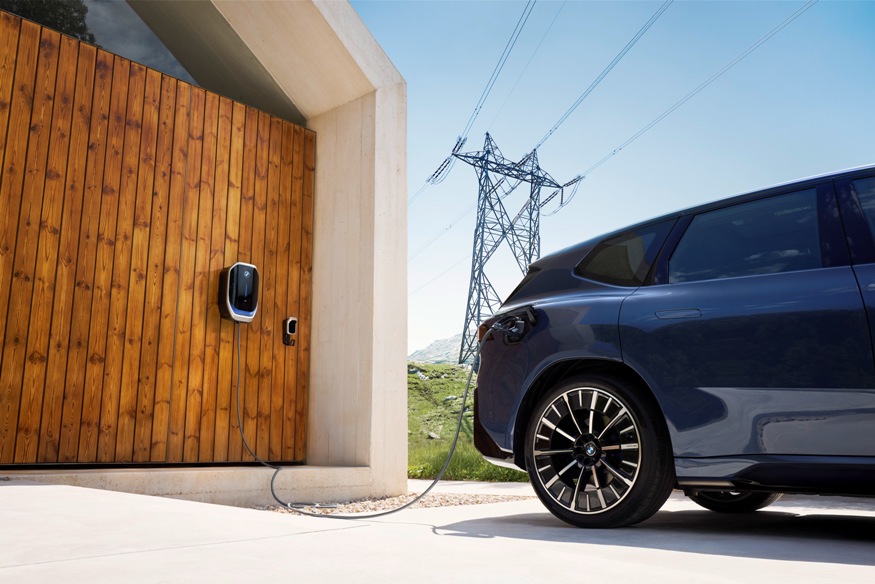
With the Neue Klasse, BMW is taking bidirectional charging to the next level, making Vehicle-to-Home (V2H), Vehicle-to-Load (V2L) and Vehicle-to-Grid (V2G) accessible to all customers. V2G is launching now: The BMW Group and E.ON are continuing their long-standing strategic partnership and are taking the next step following the successful announcement of Germany’s first commercial Vehicle‑to‑Grid offer at IAA Mobility in September 2025. As of today, private customers can order the complete product package, consisting of the BMW Wallbox Professional, the V2G electricity tariff from E.ON (E.ON ÖkoStrom Home & Drive V2G together with the E.ON V2G Plus feed-in contract), and – if not already installed – an intelligent metering system (smart meter).
In a press release a couple of days ago it was announced that:
BMW Group, Daimler AG, Ford Motor Company and the Volkswagen Group with Audi and Porsche today announced joint venture IONITY that will develop and implement a High-Power Charging (HPC) network for electric vehicles across Europe. Launching approximately 400 HPC stations by 2020, IONITY will make long-distance journeys easier and marks an important step for electric vehicles.
Based in Munich, Germany, the joint venture is led by Chief Executive Officer Michael Hajesch and Chief Operating Officer Marcus Groll, with a growing team, set to number 50 by the start of 2018.
A total of 20 stations will be opened to the public this year, located on major roads in Germany, Norway and Austria, at intervals of 120 km, through partnerships with “Tank & Rast”, “CircleK” and “OMV. Through 2018, the network will expand to more than 100 stations, each one enabling multiple customers, driving different manufacturer cars, to charge their vehicles simultaneously.
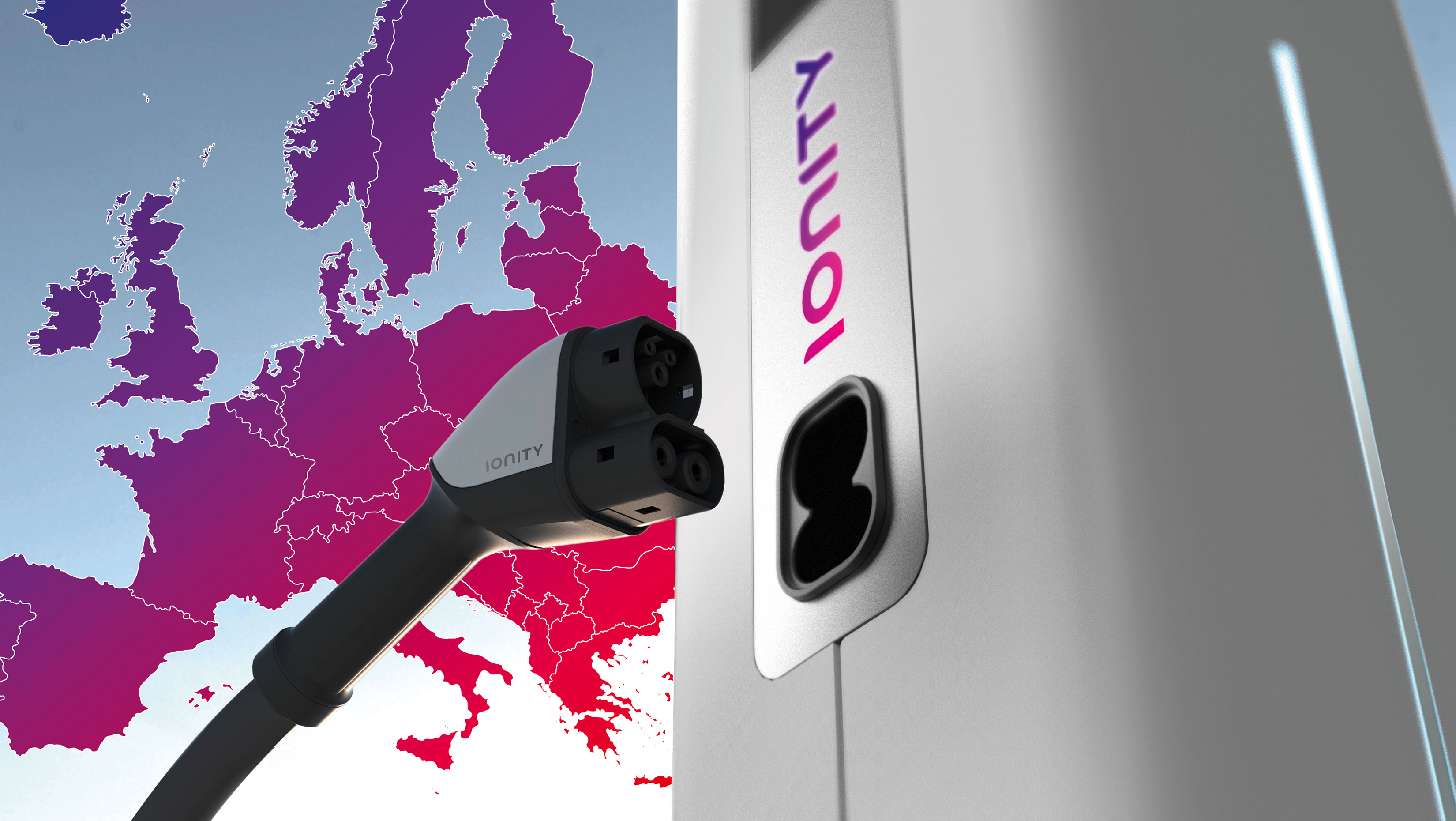
As that image implies:
With a capacity of up to 350 kW per charging point, the network will use the European charging standard Combined Charging System to significantly reduce charging times compared to existing systems. The brand-agnostic approach and Europe-wide distribution is expected to help make electrified vehicles more appealing.
Unfortunately, from our perspective at least, it seems as though “Europe-wide” doesn’t currently include the United Kingdom. What’s more the new joint venture isn’t worldwide “brand-agnostic” either. It seems unlikely that any Japanese EV OEMs will be joining the group any time soon. When it comes to rapid charging they currently prefer the CHAdeMO connector!
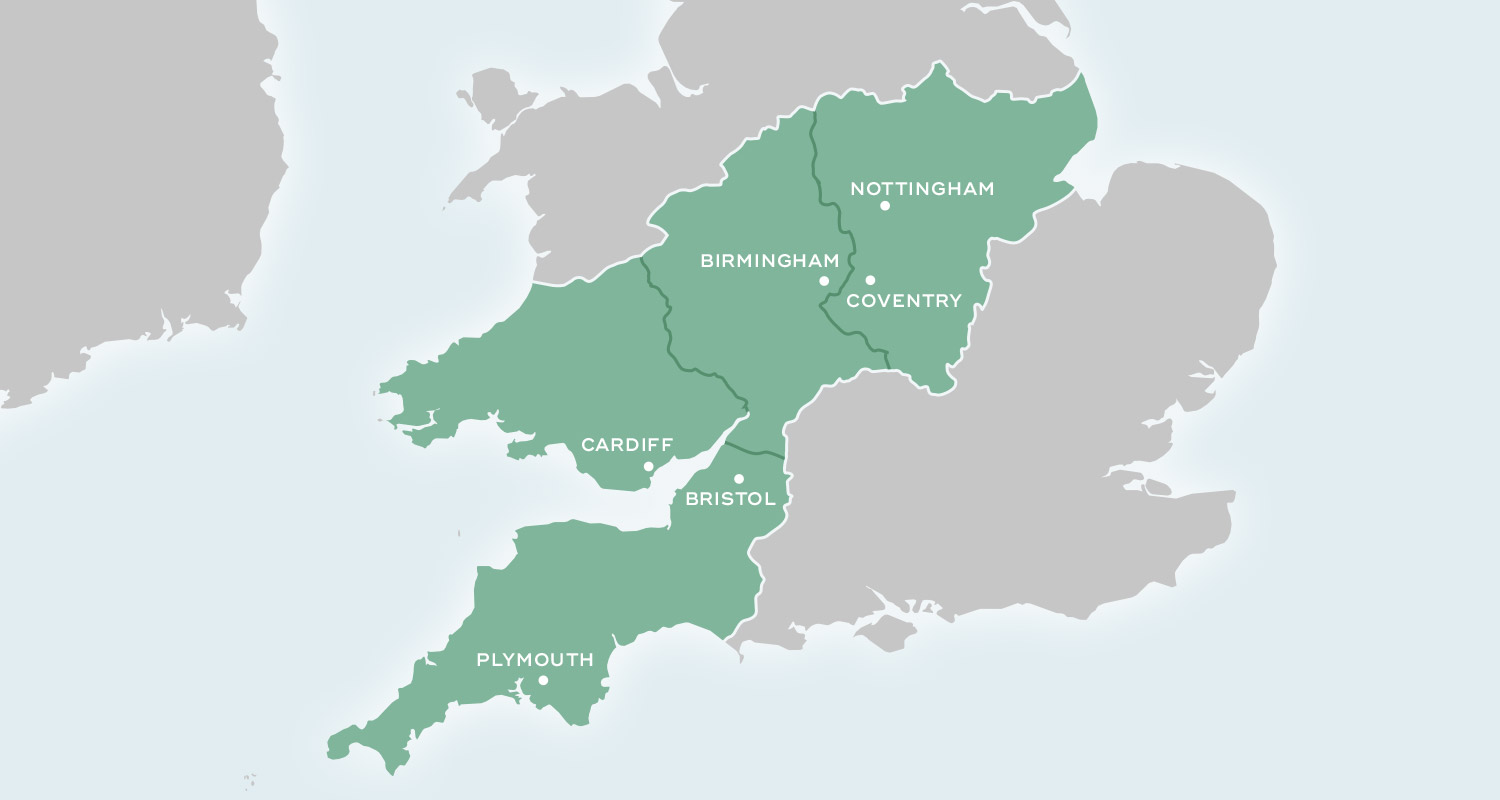
Electric Nation is an OFGEM funded electric vehicle “smart charging” trial project which:
Aims to provide local electricity network operators with the tools to be able to ensure that their networks can cope with [the] massive new challenge [of local electricity networks becoming overloaded], whilst avoiding replacing cables and substations.
The always entertaining Bobby Llewellyn explains the problem with a little help from Roger Hey, Future Networks Manager of Western Power Distribution:
As Roger puts it:
The more cars that you put in a single area, the more stress that you’re going to put on. The network was never really designed to have so many things all in one place. It was designed for powering people’s homes, for cooking. It wasn’t originally designed for transportation fuel as well!
Carl Sanderson of BMW UK adds:
What happens when, let’s say, 25% of the motoring public are plugging in their car at a similar time? Are we going to see massive blackouts? Are the lights going to go out? I think it’s a key point that needs addressing.
Andy Eastlake of the Low Carbon Vehicle Partnership suggests a solution:
One of the challenges is energy storage, and if we’re putting a huge energy storage capability into the cars can we use that to balance the grid?
To which Bobby responds:
So what you’re talking about then is very much vehicle-to-grid, [energy] going both ways, communicating smartly, the whole development of that technology?
Andy outlines the case for “smart charging” instead of full blown V2G, but adds:
There’s a problem with electricity tariffs. We’re not allowed to have lots and lots of electricity tariffs because the perception was the market will be too complex, so that’s one of the things holding back electricity supply companies in delivering creative tariffs.
Ben Godfrey, also from WPD, tells Bobby something he didn’t already know:
Effectively for every EV we connect to the network, it’s adding an extra house.
and points out that:
The interesting thing about vehicles as well is that they follow where people go. People move from town centres in the day, which is where we have the big load, to domestic places in the evening which also mirrors the load on the electricity network. If we could use the storage built into the vehicles to move that power from cities out into domestic areas then that would replace the need for us to put in extra cables which is going to cause disruption to the network.
If we can harness vehicle-to-grid then that can save us from building any extra cables, digging up roads and causing lots of disruption.
Bobby adds:
And potentially from building new power stations. You could time shift that power to a certain extent.
All in all a remarkable good advertisement for full blown V2G at the launch of a “smart charging” trial! First things first though. Is your home currently connected to Western Power Distribution’s network?
If so and if you have or are getting an electric vehicle and if you haven’t yet taken advantage of the UK Government’s home charger grant you may well be interested in finding out more about the Electric Nation trial:
Electric Nation is seeking to recruit over 500 electric vehicle (EV) owners (including pure electric and plug-in hybrids) to take part in the largest trial of its kind. Participants will charge their cars at home using a smart charger which can manage when and how their vehicle battery charges. The findings of the trial will help electricity network operators to manage the effect of the additional load caused by charging EVs on the local electricity network. This is essential for the security of electricity networks in the future and the decarbonisation of the transport sector which is responsible for approximately 21% of the UK’s greenhouse gas emissions.
In a press release a couple of days ago BMW announce a new “go further” version of their i3 model – “The world’s first premium car designed from the ground up to be powered by an electric drive system.”.
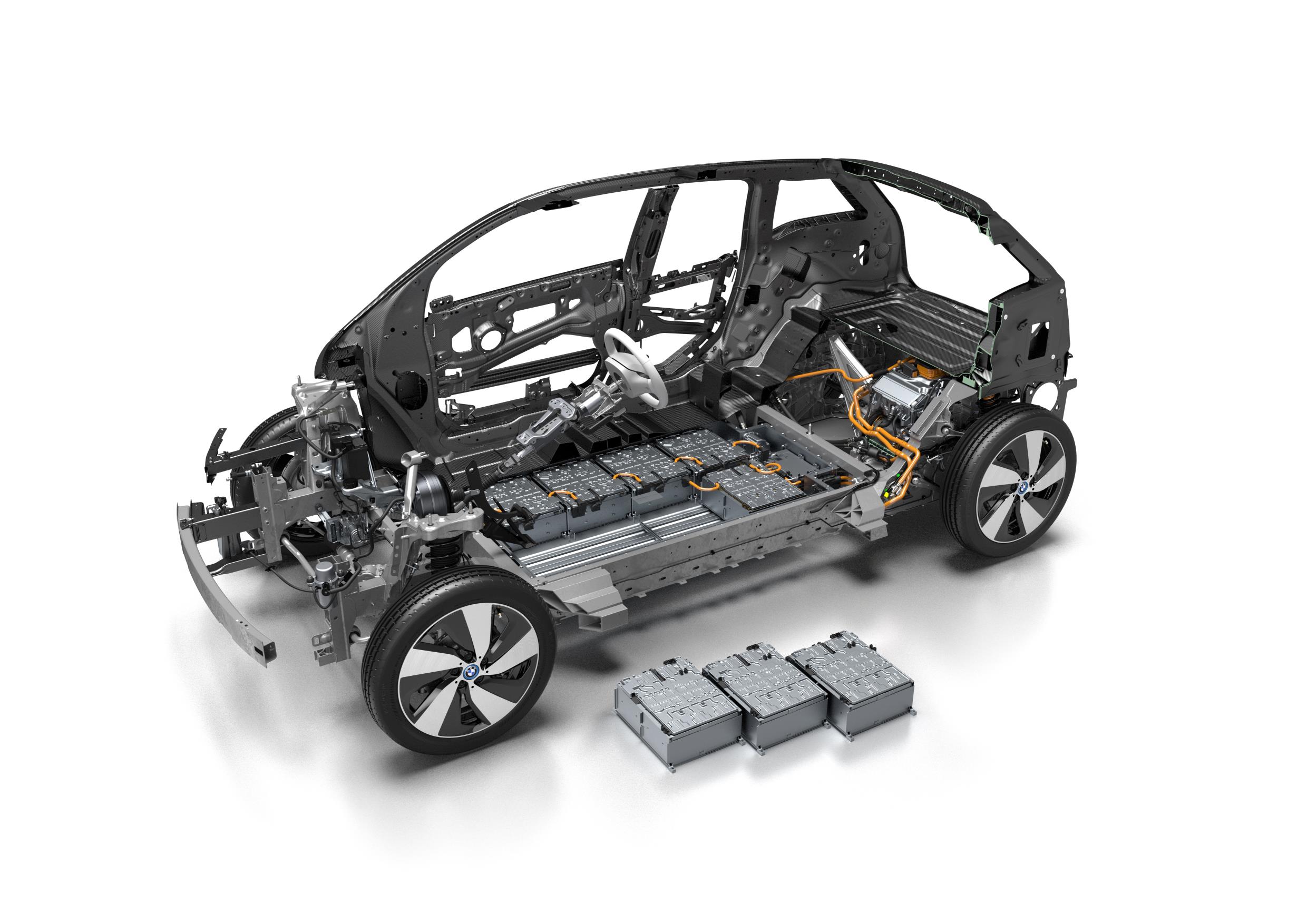
The BMW i3 94Ah replaces the current 60Ah model and has a capacity of 33kWh thanks to the higher storage density of the lithium ion cells. The battery dimensions remain unchanged with more than a 50 per cent range increase in the standard NEDC cycle. This equals a range of 195 miles in everyday driving. The motor propels the BMW i3 from zero to 62mph in just 7.3 seconds (BEV) making the BMW i3 both the sportiest and most efficient electric vehicle in its segment.
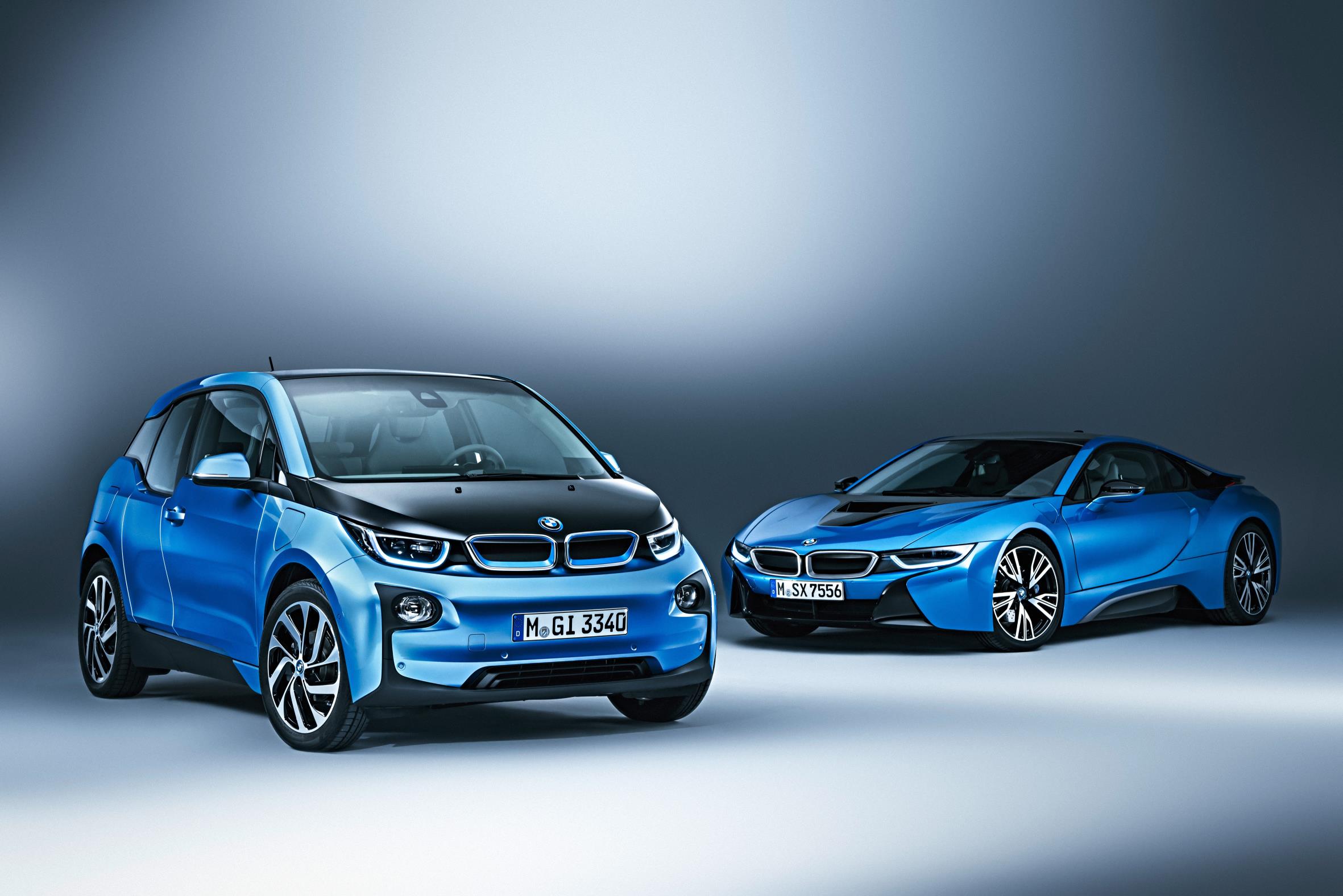
Here’s a picture of the new i3, with a gratuitous i8 sports car in the background for good measure!
BMW continue:
The high-voltage battery in the BMW i3 consists of eight modules (each with 12 individual cells), and its capacity has increased significantly without any changes in structure or exterior dimensions. By optimising the cell-internal packages with more electrolyte and adapting the active material, BMW has succeeded in increasing cell capacity to 94Ah and overall battery energy to 33kWh.
The range of the new BMW i3 94Ah (BEV) in everyday use, on a full battery charge with the air conditioning or the heating on has been significantly increased to 195 miles. This is achieved with no subjective loss of driving performance and agility. BMW i models strike the ideal balance between efficiency, performance and range. From standstill to country-road speeds, the BMW i3 94Ah is on par with sporty, conventionally combustion engine powered cars.
The lithium-ion cells used in the battery are particularly notable for their high energy density and impressive cycle life: they are designed to perform their energy storage function over the vehicle’s entire lifespan.
The coolant of the air conditioning system is responsible for cooling the high-voltage battery very effectively. An optional heating system can also be used to heat the battery to ensure the optimum operating temperature of 20°C before starting off. The battery has been designed to last for the car’s entire service life. Customers receive an 8-year or 100,000 mile warranty on the battery.
A couple of other significant things to note about the new range are that:
The emissions of the BMW i3 94Ah with Range Extender amounts to 12g/km, a 1g/km reduction in comparison to the previous model while the exclusively electrically powered BMW i3 produces zero emissions locally, plus
DC Rapid Charge now available as standard.
The new models will be available from July, in Protonic Blue with Frozen Grey metallic highlights:
Previously, this paintwork was reserved for the BMW i8 hybrid sports car!
The most ambitious hydrogen mobility initiatives in Europe have joined forces to support the introduction of hydrogen-fuelled transport
A large coalition of European partners has launched the Hydrogen Mobility Europe project (H2ME). H2ME is co-funded with €32 million from the Fuel Cells and Hydrogen Joint Undertaking (FCH JU). The project will support the deployment of Fuel Cell Electric Vehicles (FCEVs) and Hydrogen Refuelling Stations (HRS) across Europe.
ITM’s headline summed things up so perfectly that we’ve unashamedly plagiarised it! The Hydrogen Mobility Europe project web site still says “Full website launching soon” at the top, but does state that:
The project brings together Europe’s four most ambitious national initiatives on hydrogen mobility (in Germany, France, Scandinavia and the UK) and will:
Place 200 fuel cell cars (from Daimler and Hyundai) and 125 fuel cell range-extended vans (Symbio FCell collaborating with Renault) in customer hands
Deploy 29 state-of-the art-hydrogen stations
Carry out a long-term evaluation campaign to demonstrate the readiness of the technology for a mass market
Develop insights into the customer experience and practical challenges of rolling out the technology at a large scale, which can be used in optimising the technology during its commercial roll-out
It also includes a link to their own press release, which adds that:
These initiatives originally brought together the key stakeholders in the hydrogen sector (vehicle manufacturers, hydrogen refuelling station providers and Government representatives), to study and develop strategies to make hydrogen-fuelled transport a reality in the respective regions. These initiatives will now be working together to make hydrogen-fuelled transport a reality in Europe.
Under H2ME they will deploy 200 FCEVs, 125 fuel cell range-extended electric (FC RE-EVs) commercial vans and 29 new HRSs in 10 countries (Austria, Belgium, Denmark, France, Germany, Iceland, Netherlands, Norway, Sweden and the UK) by 2019. This plan ties in with existing national level initiatives for the roll-out of a large scale hydrogen refuelling infrastructure, aimed at enabling Europe wide emission-free driving. The consortium, led by Element Energy, includes global leaders in the hydrogen and fuel cell sector, from fuel cells and car manufacturers (Daimler, SymbioFCell, Hyundai, Honda, Intelligent Energy, Nissan) and infrastructure providers (Air Liquide, BOC, H2Logic, ITM Power, Linde, McPhy Energy, OMV, AREVA, EIFER, H2 MOBILITY Deutschland, HYOP, Icelandic New Energy, Communauté d’Agglomération Sarreguemines Confluences) to data monitoring and dissemination organisations (Cenex, WaterstofNet).
The original agreements for the project were signed in July this year and the project has already delivered the first vehicles to customers in France and Germany (Daimler, SymbioFCell).
We have previously reported on BMW’s FCEV technology, developed in conjuction with Toyota, whose names are strangely absent from the above press releases. Perhaps that’s something to do with BMW’s use of “cryogenic pressure vessel technology”? Here’s BMW’s “CCH2 FCEV i8” prototype:
We wondered back in July about the:
Wait to discover how, where and when the hydrogen infrastructure BMW refer to materialises in Europe.
The H2ME project seems to be at least a partial answer to that question. In similar vein see also our report on the UK’s Riversimple open source hydrogen fuel cell vehicle. A much less extravagent beast than either BMW’s prototype FCEV i8, or the production Tesla Model S for that matter!
In a press release about their 2015 Innovation Days the BMW Group have revealed that:
The strategic collaboration between the BMW Group and the Toyota Motor Company agreed at the beginning of 2013 has provided fresh momentum for the development of FCEV drive technology. The aim of the collaboration is to have an initial group of approved components ready by 2020. The successful introduction of FCEVs is dependent on the development of a hydrogen infrastructure in the markets concerned.
The two collaboration partners are supporting this process through jointly created technological standards which make fuel cell-powered vehicles easier to use and help to increase their reach and numbers.
Whilst we wait to discover how, where and when the hydrogen infrastructure BMW refer to materialises in Europe they go on to state that:
The hydrogen Fuel Cell Electric Vehicle (FCEV) represents a pioneering concept focusing on locally emission-free mobility combined with hallmark BMW dynamics and a high level of energy efficiency. The hydrogen fuel cell drive system combines the benefits of BMW eDrive technology with a host of qualities familiar from conventional combustion engines:
All-electric, locally emission-free driving.
BMW eDrive electric motor generates instantaneous power delivery and impressive dynamics.
Power electronics, high-voltage battery and intelligent energy management based on the BMW Group’s eDrive technology.
Long-distance capability with an operating range of more than 500 kilometres (300 miles) thanks to the high energy density of the hydrogen carried on board.
Fast and convenient refuelling in under five minutes.
Fuel cell technology therefore makes an ideal addition to both the BMW i models and, in the future, the series-produced models from the BMW brand fitted with tried-and-tested eDrive technology. It converts the gaseous hydrogen contained in the storage tank into electric power and water vapour. The vehicle’s high-voltage battery serves as an energy storage unit and can therefore be considerably smaller – with a net capacity of around one kilowatt hour – than in battery-electric concepts. Storing hydrogen in a cryogenic pressure vessel can, depending on the type of vehicle, allow an operating range comparable with that of conventional vehicles powered by combustion engines. Filling up the hydrogen storage tank takes a similar amount of time as refuelling a petrol or diesel tank.
This seems to suggest that in the not too distant future we can expect to see a version of the BMW i3 with a much smaller traction battery plus a hydrogen fuel cell instead of the existing range extender, together with a similarly equipped although presumably more powerful version of the i8!
By way of a hint about what to expect the press release includes pictures such as this:
plus a video:
which according to BMW show:
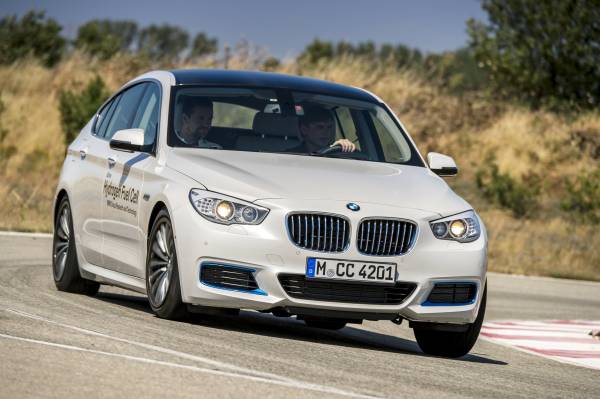
The demonstration vehicle, based on a BMW 5 Series Gran Turismo, [which] reveals a take on this form of propulsion in keeping with the brand’s profile and character. It combines locally emission-free mobility with sporting dynamics, excellent ride comfort and long-distance capability. Its key features are as follows:
Electric motor developing 180 kW/245 hp, power electronics and high-voltage battery for interim energy storage; developed as a variant of BMW eDrive technology for BMW i cars and BMW brand plug-in hybrid models.
Hydrogen storage in the form of a tunnel tank between the front and rear axle; industry standard 700 bar CGH2 vessel technology and cryogenic pressure vessel technology (CCH2) patented by the BMW Group for storing gaseous hydrogen at low temperature and 350 bar pressure; operating range: over 500 kilometres (more than 300 miles).
Fuel cells, housing and ancillary systems: initial results from the collaboration between the BMW Group and the Toyota Motor Corporation on Fuel Cell Electric Vehicle (FCEV) technology.
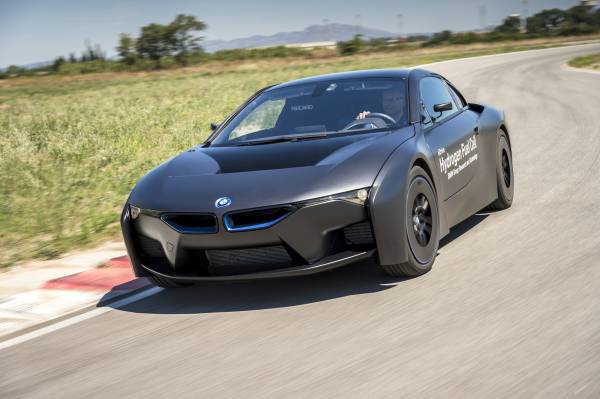
In the press kit BMW also reveal another vehicle emblazoned with the “Hydrogen Fuel Cell” logo:
Has been used as a rolling test bed for the German company’s hydrogen fuel cell technology, which is planned to head into large-scale production by 2020, according to the head of BMW’s vast research and development operations, Klaus Fröhlich.
Based around the contemporary new i8, the sleek two-door coupé relies on carbonfibre construction to keep its weight down and also features an aerodynamic package honed at BMW’s wind tunnel in Munich. The BMW research vehicle, which was constructed back in 2012 and remains unnamed, sites its fuel stack at the rear in the position usually taken up by the i8’s compact turbocharged 1.5-litre three-cylinder petrol engine.
Energy for the fuel stack is provided by cryogenically stowed hydrogen contained in a cylindrical tank mounted down the centre line of the car’s platform and oxygen provided by cooling air. The fuel stack subsequently provides electricity to run a rear-mounted electric motor, with the only emissions being water.
Here’s a video of the vehicle in action:
Evidently all sorts of exciting stuff is already well on the way to production. Now all we need, as so often seems to be the case these days, is the associated infrastructure!
In the first of my reports from the Regen SW “Community Energy Markets” conference in Bristol last Thursday I’ll be highlighting references in several of the presentations to what I like to call “Distributed Energy Storage“, which encompasses a whole lot more than just the battery packs in electric vehicles.
The first person to mention the subject was Jeff Hardy, who is Head of Future Consumers & Sustainability at Ofgem. His presentation was on the topic of “Non-traditional business models: Supporting transformative change in the energy market” which deserves an article all of its own in due course. However whilst discussing “rapid technological innovation” Jeff pointed out that “battery storage is the current flavour of the month”. After that Sonya Bedford, Head of Renewable Energy at Stephens Scown solicitors, also hinted at the subject in her talk about “Local supply models” in which she mentioned “Demand Side Response” and “Local Balancing Units”.
At the conclusion of the morning session Merlin Hyman, chief executive of Regen SW and our host for the day, asked if there were any questions from the floor. Nobody else seemed very keen to put their hand up, so I waved my arm in the air and was duly invited to stand up, state my name and affiliation, and then pose the panel a question. In the event I actually asked two. The first was to enquire if anybody else present was interested in international smart grid standards apart from me, since the LBUs that Sonya had mentioned seemed to me to come within the remit of the IEC 62325 standard working group which I am part of. Then I asked the panel whether the battery packs in electric vehicles were anywhere near being “flavour of next month” in the UK as yet.
Nobody responded to my first question, but Merlin framed my second question to the panel in terms of the recent “Powerwall” announcement from Tesla Energy. I was both pleased and somewhat surprised when Jeff pointed out that V2G was indeed on his radar screen, since he is “fascinated by EVs” and the “traditional battery worries have been overcome by technology”. Sonya was then good enough to mention that I had said much the same thing at the AGM of Exeter Community Energy earlier in the week.
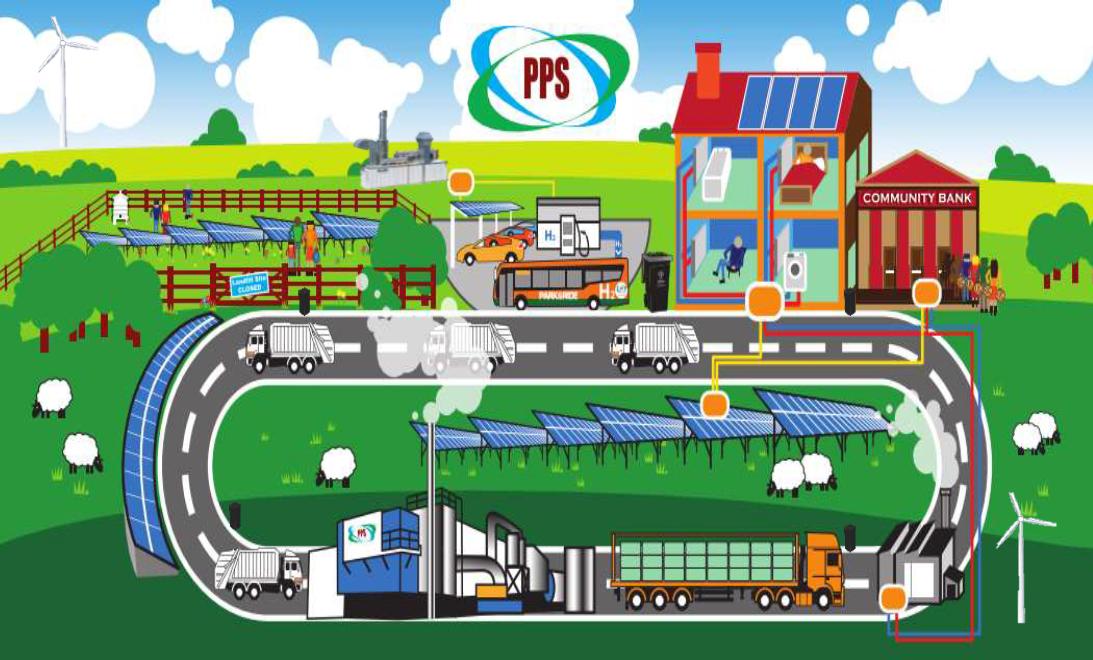
After lunch James Owen, commercial director of Public Power Solutions, started off by giving us a history lesson about local electricity generation in the UK. Then he went on to discuss the benefits of “Local Balancing Units”, “street level storage solutions” and “a true local smart micro-grid” amongst other things, using both Swindon and the Danish island of Bornholm as examples. James freely admitted to having pinched an infographic of Bornholm, so I’ve taken the liberty of pinching one of his! Here is PPS’s template for a future Bristol, or Bornholm, or the Isle of Wight, or anywhere else in Europe for that matter.
See if you can spot the difference between this version and the one on the PPS web site. It seems those recent additions are Tesla Powerpacks, and in my own vision of a future sunny Southwest England the cars under the solar PV canopy at the park and ride would be connected to similar “black boxes” that incorporate V2G functionality.
Having finally got the preface out of the way, I’d like at long last to mention some alternative battery filled “black boxes” from suppliers other than Tesla Energy. For “grid scale” battery storage you can repurpose EV battery packs like Sumitomo, or use batteries designed for the task from the likes of Saft.
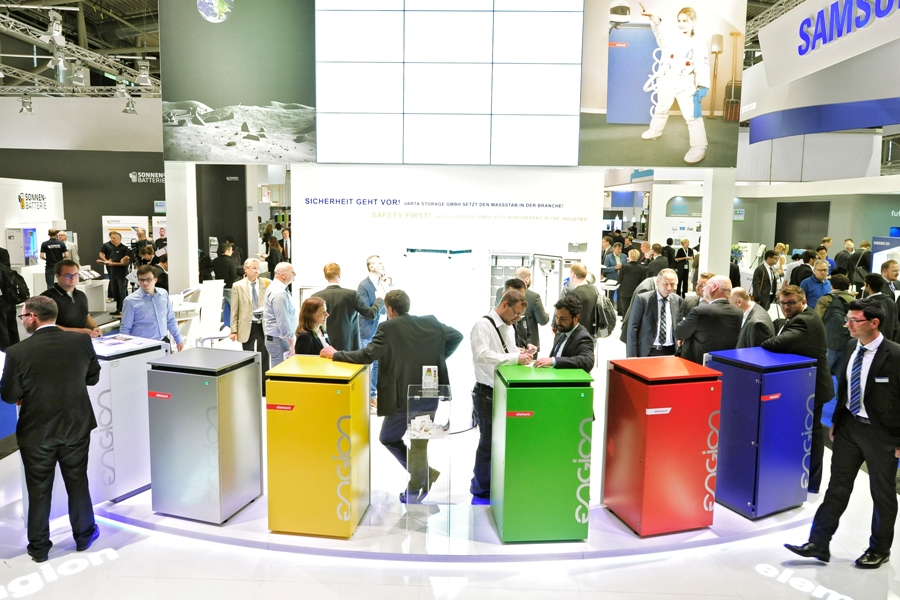
Moving down to the domestic scale I note that for some strange reason the solar PV equipped dwelling in a future Bristol/Bornholm lacks a V2x equipped garage similar to the one shown in the V2G banner at the top of this article. Moving indoors Moixa’s Maslow predates the Powerwall by a long way, and is designed to power a DC circuit for LED lighting, computers etc. Quite possibly prompted by Elon Musk‘s recent announcement, Samsung have also launched a domestic version of their modular Energy Storage System (or ESS for short). Stefan Quandt (of BMW fame) has launched the SolarWatt MyReserve, which has already won an award at the recent ees Europe exhibition over in Germany. Varta also launched their Engion Element “storage for beginners” at ees Europe. Here’s how they looked at the show:
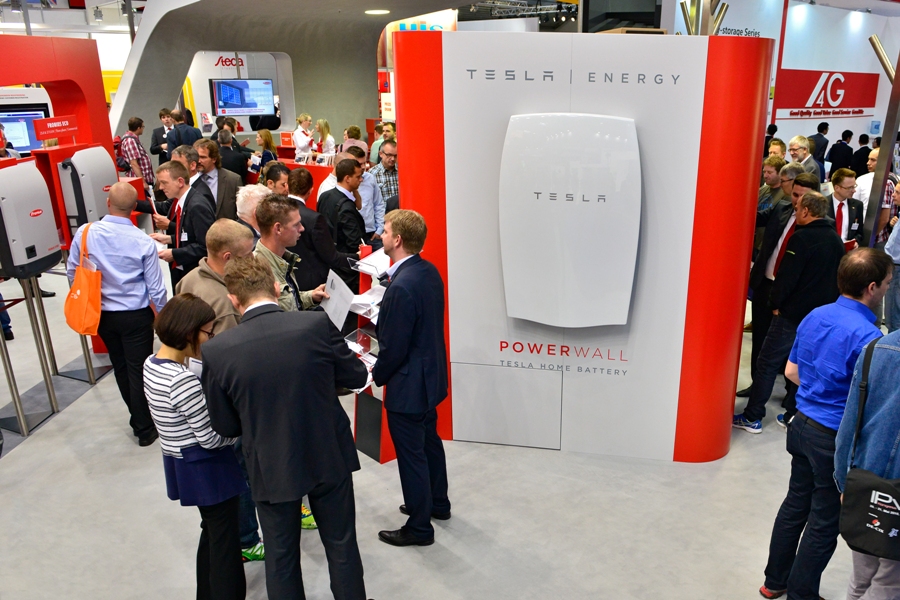
and just in case you haven’t yet tasted the flavour of the month, here’s a Tesla Powerwall for your delectation:
As you’ve probably gathered by now I have a lot more to say about all of this and more, including covering Anthony Price of Swanbarton’s talk dedicated to “Local balancing using storage”. However for the moment at least I cannot help but wonder what Ofgem make of all this “rapid technological innovation”, not to mention the potential associated “non-traditional business models” and last but by no means least, international smart grid standards!
Earlier this year we reported that the University of Delaware were running a pilot project in which a fleet of BMW Minis were actually earning money by providing a useful service to PJM Interconnection‘s electricity grid over the pond in North America.
Now comes news that Honda are taking part in the self same project. According to their press release:
Honda has joined a demonstration project for experimental vehicle-to-grid (V2G) technology aimed at providing a potentially valuable energy storage resource to the nation’s electrical grid while providing for more cost-effective ownership of plug-in electric vehicles.
The Honda technology builds off of the research conducted by the University of Delaware and now supported by NRG Energy, Inc. NRG and the University of Delaware, through their eV2g joint venture, came online early in 2013 with the world’s first revenue-generating vehicle-to-grid project, demonstrating the controls, regulatory requirements, and market participation rules for selling energy storage from vehicles into the PJM Interconnection Regulation Market. Honda is supplying an Accord Plug-In Hybrid with added V2G capabilities to the University’s Science, Technology and Advanced Research (STAR) Campus to jointly investigate the potential of this technology to benefit the electrical grid, vehicle owners and society.
There were of course also a number of quotes from senior managers of the companies involved. Steven Center, vice president of the Environmental Business Development Office of American Honda Motor Co., Inc said that:
This technology has the potential to support both a cleaner and more efficient power grid and a more positive ownership experience for EV customers. With V2G technology, a network of PEVs becomes essentially a distributed energy storage system. It makes for an even stronger value equation for plug-in vehicles, with benefits for both the community and the vehicle user.
Willett Kempton, professor in the College of Earth, Ocean, and Environment and Research Director of the University of Delaware’s Center for Carbon-Free Power Integration said that:
The participation of global automakers like Honda will help demonstrate and refine the technology. The University of Delaware has been developing the technology so that vehicle batteries can be used not only for mobility but also for grid services. It is a big step toward a future with widespread availability of the technology to have Honda join our demonstration with their V2G-capable car.
Finally Denise Wilson, NRG Executive Vice President and President, New Businesses said that:
As the U.S. adds more intermittent resources to the grid, finding a lower cost energy storage technology that also benefits electric vehicle drivers is a great opportunity. We see this demonstration by Honda as an important step in the development of vehicle to grid technology.
Much the same sort of sentiments apply here in the UK as we too “add more intermittent resources to the grid”. However I could not help but notice that once again nobody mentioned international standards!
Vehicle to grid technology is making money at last, and it’s mainstream news too. In a press release earlier today NRG Energy said that:
Joined by government and industry leaders, the University of Delaware and NRG Energy are celebrating an important milestone for its eV2g project today: becoming an official resource of PJM Interconnection and proving for the first time that electric vehicle-to-grid technology can sell electricity from electric vehicles (EVs) to the power grid.
Cameras were on hand to record those celebrations, and here is the resulting video:
According to NRG’s press release, Delaware Governor Jack Markell said that:
Moving innovative ideas out of the classroom and into the marketplace is critical to growing our economy. The partnership between NRG and University of Delaware perfectly illustrates the potential for research institutions to spur economic development
whilst NRG Executive Vice President Denise Wilson said that:
This demonstrates that EVs can provide both mobility and stationary power while helping making the grid more resilient and ultimately generating revenue for electric vehicle owners.
and University of Delaware President Patrick Harker said that:
I thank all of the industry and policy leaders who have come together around a project that incorporates clean transportation, stable energy and profitable sustainability. And I thank Prof. Willett Kempton and his fellow scientists for leading the way. It might be a few more years before a grid-integrated vehicle sits in every American driveway, but I’m excited to continue the journey.
Personally I suspect it might be a few more years before a grid-integrated vehicle sits in any American driveway, let alone in any British driveway. One of the reasons I say that is covered next in the press release. NRG briefly mention the raison d’être of V2G:
For grid operators, the technology serves as an innovative new approach to energy storage. It has the potential to balance the power provided by intermittent renewable resources such as wind and solar. Energy storage, such as large-scale batteries or those in a fleet of vehicles, can take the wind’s power generated at night and store it to use when demand is higher.
Whilst that potential may well exist, here’s the rub when it comes to reality. Michael J. Kormos, who is senior vice president of operations at PJM pointed out that:
PJM changed rules for participation in the regulation service market to decrease the minimum amount of power needed to participate and we implemented new rules that recognize and compensate faster, more accurately responding resources, such as batteries. We knew that by doing so would attract innovation and would find potential for energy storage or other technologies. We’re glad to be a part of this project and hope that this inspires continued innovation among our partners and others in the industry.
How many other “grid operators” like PJM, whether in the United States or over here in Europe, are going to be willing to change their rules and lower their thresholds for entry into wholesale electricity markets to include an EV sat in a driveway overnight, or even a fleet of 15 Mini EVs as in this project? If the answer turns out to be “none”, then who’s going to do the necessary aggregation and sit in the middle between the EVs in every driveway and the PJM’s of this world?
Be all that as it may, and no doubt having read the same press release as me, the New York Times put a slightly different spin on the story. They point out that:
The scale of this project, using 15 two-passenger Mini E models, donated by BMW, is indeed minuscule compared with the task of keeping the grid system that serves two-thirds of North America in balance, making sure that supply matches demand as precisely as possible.
The Delaware idea is tiny but promising. If we can get our electric vehicles to do more than just be electric vehicles, it will be very well received.
It would certainly be well received by your humble author, although at this juncture in history I cannot help but wonder which of all the currently competing international standards will ultimately ensure that all the electrical, mechanical and financial components of a future smart grid, produced by a plethora of international vendors, will all happily co-exist. There are still a long list of hurdles to be jumped before the realisation of Professor Kempton’s vision of:
[Seeing] the electric car and the wind machine as complementary tools for a low-carbon energy system.
is turned into electrical, mechanical and financial reality.