Scotland Announces New Energy Strategy

Hot on the heels of the UK Government’s new Clean Growth Strategy and Industrial Strategy the Scottish Government announced today its first ever Energy Strategy! Needless to say the first thing we did was to scan the document for any mention of the phrase “electric vehicle”, and sure enough EVs get a mention in Paul Wheelhouse’s ministerial statement:

We are well on the road to fully decarbonising our electricity system in Scotland. The challenge facing us now is to ensure a similar decarbonisation of our energy requirements for sustainable transport – and to deliver a well-balanced system capable of providing secure and affordable energy to meet Scotland’s needs.

Scotland is taking a leading role in promoting electric and other low-emission vehicles – with an ambition to phase out the need for new petrol and diesel cars and vans by 2032. This is as much an energy system ambition as a transport one. We will need to develop and manage the necessary charging and other network infrastructure, while building awareness and confidence on the part of consumers. The challenges here are more than matched by the economic opportunity and environmental benefits which success will bring.

Yes Minister! Precisely so.

Scottish_Energy_Strategy_2017-12-20

Moving on to the body of the document we are informed that:

More of us are turning to electric vehicles (EVs). At the end of June 2016, there were 3,575 electric cars and vans licensed in Scotland (eligible for the UK Government’s plug-in car and van grant schemes), compared to 2,050 at the end of June 2015. 78 More EVs were sold in Scotland in 2015 than the previous four years combined, with 2016 sales expected to have risen further. Our ChargePlace Scotland network has expanded to over 600 publicly available EV charging points, equating to over 1,200 charging bays. This includes over 150 ‘rapid’ charging points, one of the most comprehensive networks in Europe.

Searching further for any mention of static and/or mobile storage technology we learn that:

Combining storage with wind and solar assets presents a valuable solution for the energy system as a whole, offering the potential for demand to be managed locally. This kind of flexibility and control will be important as electric vehicles become an integral part of the transport system.

not to mention:

More ULEVs will mean higher electricity demand, creating particular pressures for local distribution networks as drivers look to connect and charge their vehicles. We are already discussing these issues with Scotland’s grid operators, and starting to consider different options and approaches.

There will be big challenges here – but opportunities too, for example, in developing solutions such as smart chargers, and interfaces which can manage and reduce pressure on electricity networks. The development and use of innovative software can reduce the need for investment in more expensive and disruptive “hardware”, in the form of grid upgrades. There is a big innovation opportunity here for Scottish businesses, and a chance to develop and export the necessary technology and solutions. Initiatives such as the “My Electric Avenue” project have already looked at some of these issues, and others are underway. A report by Transport Scotland and Urban Foresight published in 2016 concluded that large numbers of EVs across Scotland can help support ‘whole-system’ energy solutions by:

  • providing significant and distributed energy storage capacity, able to absorb intermittent loads from renewable generation;
  • helping to integrate more micro-generation;
  • increasing overall energy efficiency; and
  • potentially providing a source of grid power input when required.

which is vehicle-to-grid technology in all but name!

Finally, for the moment at least, here’s video of the proceedings in the Scottish Parliament earlier today:

We’ve set it to start where the Ministerial Statement mentions:

New commitments on electric and other low emission vehicles, and our intention to support up to £60 million of new innovation funding under the Low Carbon Innovation Fund, setting Scotland apart as a country at the vanguard of the global move to low carbon energy systems.

Building a Britain Fit for the Future?

The UK’s new “Industrial Strategy” was published last week. The last time we had a good look at UK plc’s strategy was three years ago, when we concluded that “it rather sounds as though ‘Storage to Grid’ (or S2G for short) is a more likely prospect here in the United Kingdom than fully fledged V2G”. So how about this year?

The foreword by Greg Clark, Secretary of State for Business,Energy and Industrial Strategy (or BEIS for short), states that:

This Industrial Strategy deliberately strengthens the five foundations of productivity: innovation, people, infrastructure, places and the business environment.

At the very least “innovation” and “infrastructure” sound like the sort of things we get up to here at V2G UK. Here’s how Gov.UK visualises our future infrastructure:

655638110

Moving on, Greg continues:

As well as setting a path to improved productivity, our Industrial Strategy sets out four areas where Britain can lead the global technological revolution. These four Grand Challenges – in artificial intelligence and big data; clean growth; the future of mobility; and meeting the needs of an ageing society – have been identified on the advice of the our leading scientists and technologists. They will be supported by investment from the Industrial Strategy Challenge Fund and matched by commercial investment.

There’s a video explaining the ISCF:

There’s even a video summarising each of the Grand Challenges. Electric vehicles get a mention in the one about mobility:

https://youtu.be/wlqQRp5vhOU

We’ve previously touched on the Government’s new “clean growth” strategy on the V2G blog, and obviously we’re inordinately interested in the “future of mobility”, so there really should be something of interest to us in the 131 page white paper. Let’s delve a little deeper shall we? Under the “infrastructure” heading we’re told that:

Our approach is to undertake a comprehensive package of measures to promote the uptake of zero emission vehicles. We have announced a further £100m for the plug-in car grant to incentivise the purchase of battery electric vehicles, and we are committing to 25 per cent of the cars in central government department fleets being electric by 2022. We are announcing an additional £200m of public investment, to be matched by private investment, to create a new £400m Charging Infrastructure Investment Fund, and we will regulate to support further expansion of the charging infrastructure network.

That certainly sounds like very good news for our Camelford electric car club project! What’s more:

After the Grenfell Review, we will update building regulations to mandate that all new residential developments must contain the enabling cabling for charge-points in the homes. We will also provide £40m to support new technologies for on-street and wireless charging.

All of which sounds like very good news for our SaMDES project which envisages installing static battery storage and V2G charging stations in homes and small businesses across the South West of England. The news gets even better! A little further on we discover:

The zero emission road transport strategy, to be published in the coming months, and work on the options for the long-term decarbonisation of heating will build on this. They will support the growth of markets for technologies that create synergies between systems, such as energy storage, smart meters, vehicle-to-grid charging and heat networks.

Will the sweet music to our ears never stop? Not for the moment at least. Next we discover that:

We are determined to tackle air pollution and support affected areas, given the significant negative impact it has on public health, the economy and the environment. We will provide £220m for a new Clean Air Fund that will allow local authorities in England with the most challenging pollution problems to help individuals and businesses adapt as measures to improve air quality are implemented. This new fund is in addition to the £255m provided to implement the Air Quality plan earlier this year.

That sounds like more potential assistance for Camelford due to the town’s Air Quality Management Area status. Moving on once more, regular readers will be aware that we are proponents of energy efficiency. “Negawatts not Megawatts!” we cried when the predecessor to BEIS pulled the plug on zero carbon homes a couple of years ago. Will they make amends now? Unfortunately not really. There are a couple of sentences to the effect that:

In the more immediate term, energy efficiency and reforms to the retail energy market will provide the opportunity to lower bills. Up to £6bn could be saved in 2030 through investment in cost effective energy saving technologies in the industrial and commercial sector.

We will encourage greater investment in energy efficiency measures and technologies, including by developing a new scheme to support investment in industrial energy efficiency, to help large businesses install measures that will cut their energy use and bills, as we as improve their productivity.

Plus there’s:

We want to support greater collaboration between councils, a more strategic approach to planning housing and infrastructure, more innovation and high quality design in new homes and creating the right conditions for new private investment.

From where I’m sat I’m afraid that’s not a patch on “the proposed 2016 increase in on-site energy efficiency standards” that bit the dust in 2015. The white paper contains some great news if you’re into decarbonising transport, as we most certainly are. However unfortunately reducing the energy wasted by the UK’s poorly insulated housing stock, both old and new, still seems to be very much on UK plc’s back burner.

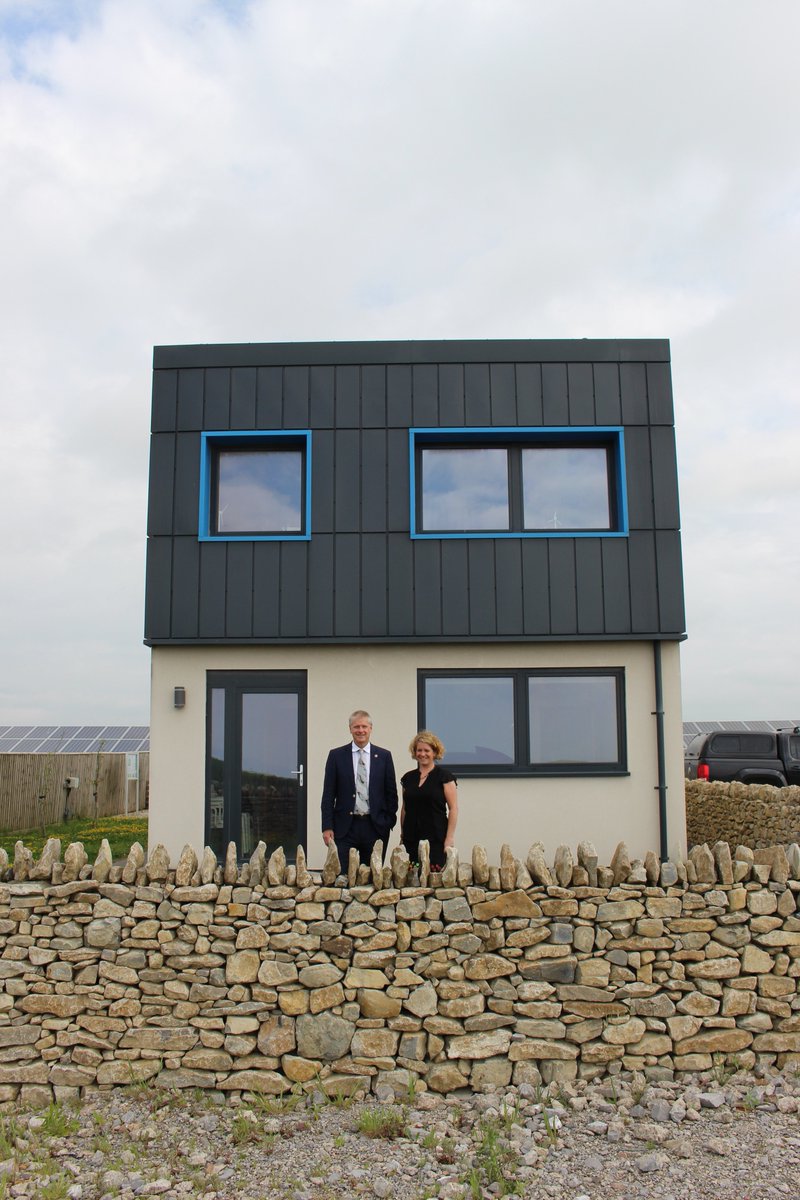
It seems as though we still have a long wait in store before homes like this will be constructed as a matter of urgency:

SOLCERHouse

Consumer Attitudes to Smart Meters

According to a press release from Smart Energy GB:

Consumers who have upgraded to a smart meter as part of Britain’s national rollout are continuing to demonstrate high satisfaction with their new technology, and greater control over their energy bills.

Smart Energy GB, the national campaign for Britain’s smart meter rollout, today publishes the third Smart energy outlook, the largest independent barometer of national public opinion on energy and smart meters. The research surveys more than 10,000 people around the country.

The bullet point from the “Smart Energy Outlook” report are:

  • More than half (52 per cent) of people with smart meters say their new meter is helping them save money
  • Eight in ten (80 per cent) people with smart meters have taken at least one step to reduce how much energy they use
  • Eight in ten (79 per cent) people with smart meters would recommend them to others
  • 85 per cent of those with smart meters say they have a better understanding of what they are spending on energy
  • People with smart meters are more confident in the accuracy of their bills (81 per cent) when compared to those with traditional meters (64 per cent)
  • Three quarters of people with smart meters (75 per cent) say that they understand their energy bills, while just 61 per cent of people using traditional meters said the same
  • Nearly three quarters (72 per cent) of people with smart meters say that they have the information they need to choose the right energy tariff, far higher than those with traditional meters (57 per cent)

Just in case you are now wondering “How do smart meters work?” here’s a video explanation from Smart Energy GB:

I wonder how many of the people surveyed by Populus would be interested in having an electric vehicle capable of powering their home, together with a smart meter and a “Smart Grid” that allowed them to optimise the charging and discharging of their EV’s batteries to their own financial advantage?

In partial answer to that supplementary question, here is our report on consumer attitudes to “Smart Charging” of electric vehicles

Solar PV Powered Public V2G Charging Launched in Utrecht

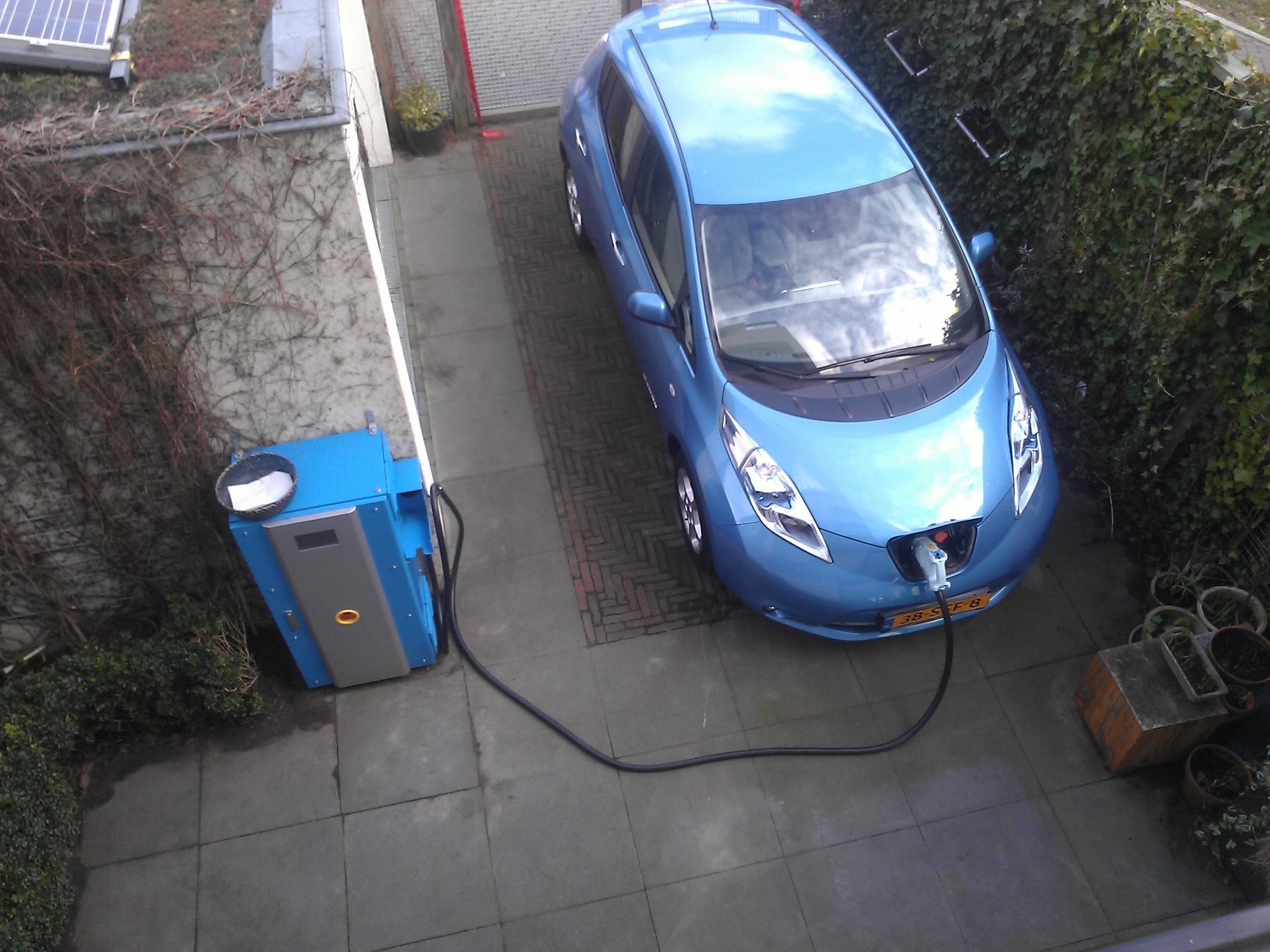
Earlier this week I attended a vehicle-to-grid workshop organised by Nissan Europe. This one was held in Utrecht in The Netherlands, where I discovered that the workshop coincided with the announcement of a new partnership between the City of Utrecht and a number of Dutch companies to ultimately deliver 120 “smart charging stations” across Utrecht. There’ll be more from me on the workshop itself in due course, but for now let’s take a close look at the world’s first publicly available solar powered V2G capable AC electric vehicle charging station:

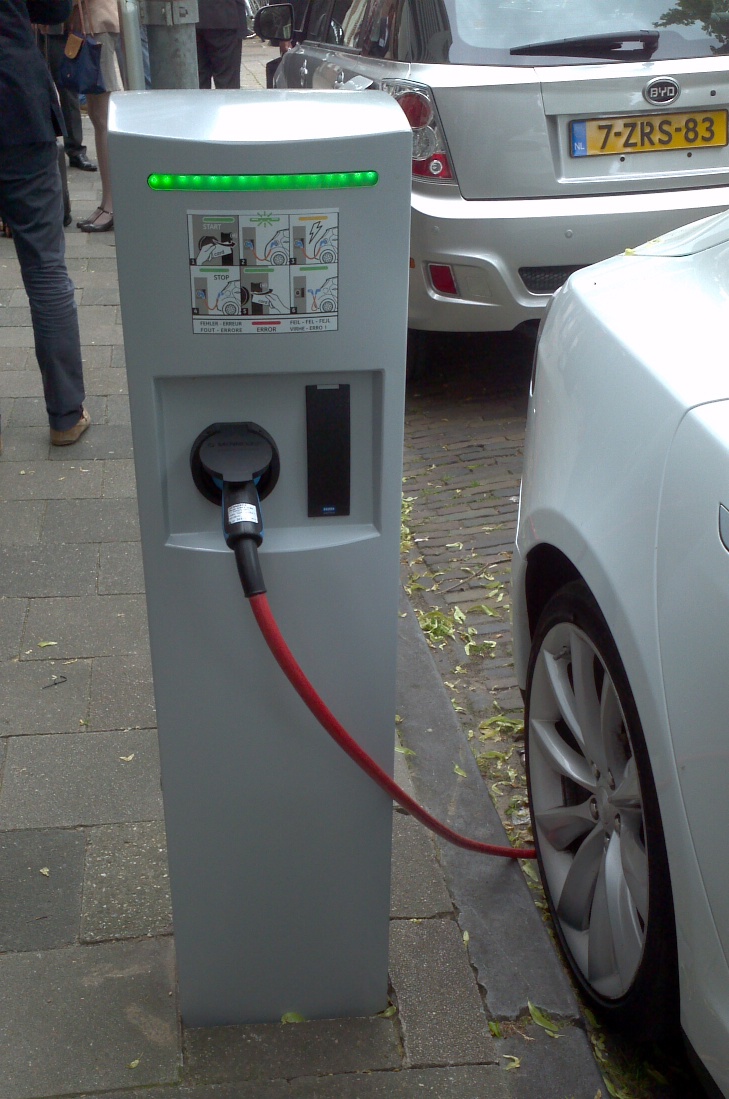
The charging station itself is a GE DuraStation with added bi-directional capability. Sadly my wish of a few weeks ago has not yet come true, and the Tesla model S you can see in the foreground is still only capable of being charged by the DuraStation, which is IEC 61851/62196 mode 3 compliant. However the BYD e6 visible in the background IS able to discharge its batteries back to the local distribution grid.

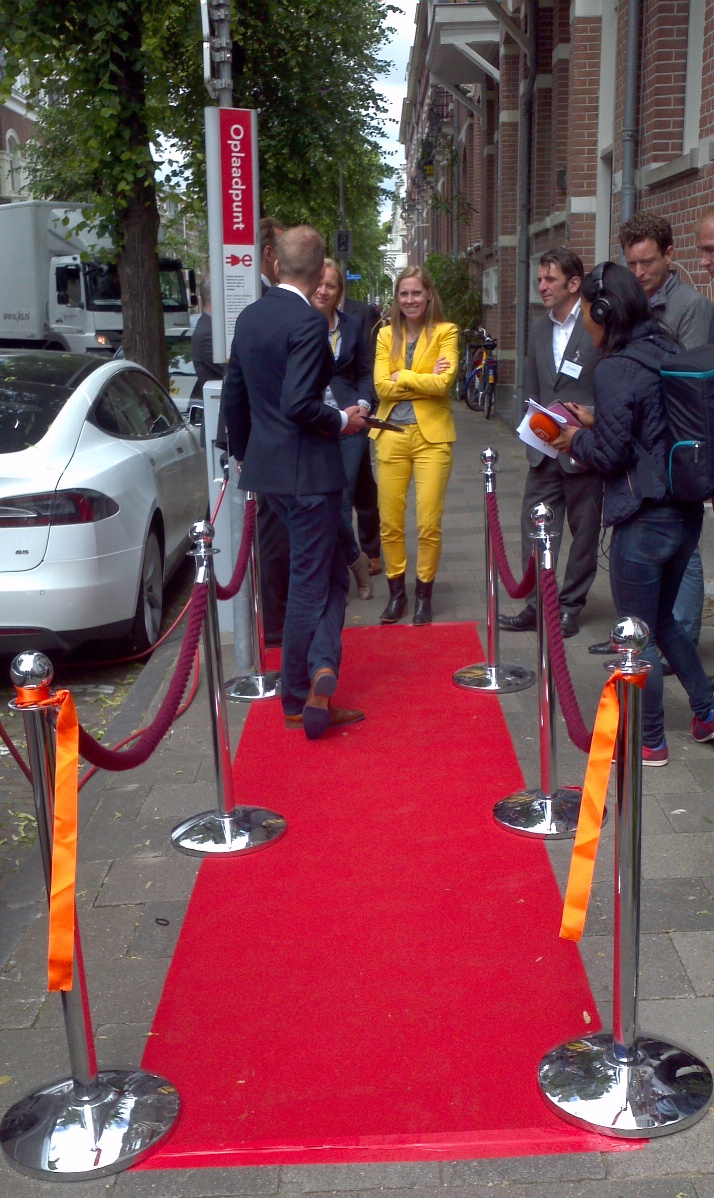
This particular charger is situated outside the offices of LomboXnet, and hence integrated with the CHAdeMO compliant V2G system we reported on back in March, which stores the excess energy generated by the Solar PV installation at a nearby primary school. Here’s another angle on the event, showing Councillor Lot van Hooijdonk shortly after she cut the ribbon to officially open the charging station:

Another part of my wish from last month has also yet to come true. In Utrecht as in the United Kingdom, and despite the red carpet, whether you own an electric vehicle manufactured by Nissan, BYD or Tesla, and whether it prefers to be charged via CHAdeMO, IEC 62196 or a Supercharger, you still won’t get paid for allowing your battery pack to be used to provide an extremely useful service to the local distribution grid. However, perhaps mighty oaks from little acorns do eventually grow?

Whilst we wait to discover if/when/how that happens, here’s the video that Robin Berg of LomboXnet showed the attendees of the 3rd Nissan V2G workshop:

Renault-Nissan to Provide 200 Electric Vehicles for UN COP21 Paris Climate Conference

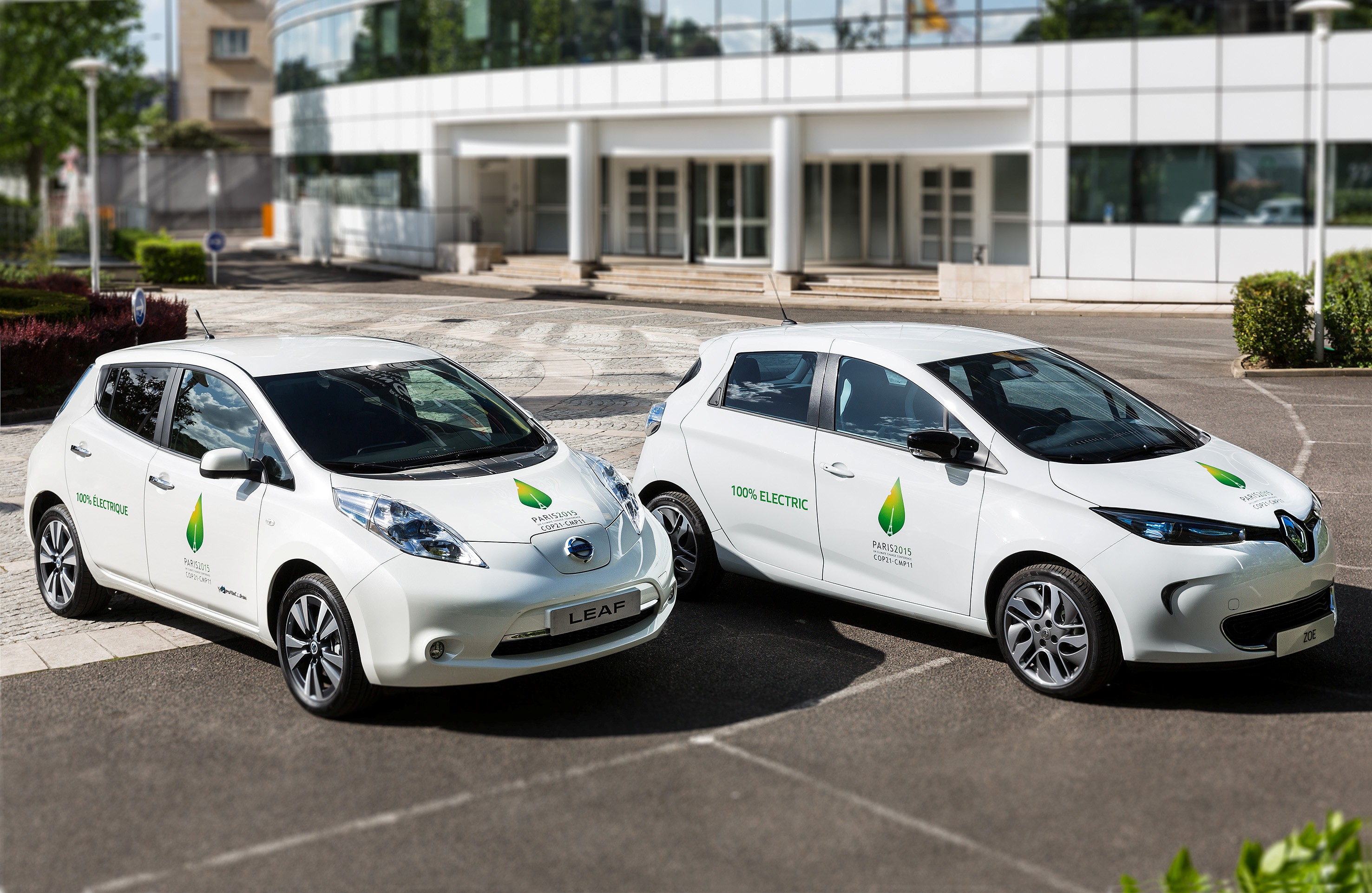
The Renault-Nissan Alliance announced today that they will provide a fleet of 200 all-electric vehicles as the official passenger-car provider for the United Nation’s COP21 climate conference in Paris later this year. The fleet of vehicles will include Renault’s ZOE and Kangoo Z.E. and Nissan’s LEAF and e-NV200. Here’s what a small part of it looks like:


According to the Alliance press release:

The partnership agreement was signed today between the Renault-Nissan Alliance and the General Secretary in charge of the preparation and organization of the 21st annual Conference of Parties (better known as COP21). The fully electric car fleet will shuttle delegates during the event from Nov. 30 to Dec. 11.

More than 20,000 U.N. participants from 195 countries are expected to attend the annual climate summit. It will be the first time the U.N. will use a zero-emission fleet for its entire passenger car shuttle at a COP event.

Laurent Fabius, the French Minister of Foreign Affairs and International Development and President of COP21, said that:

We are delighted to announce that the Renault-Nissan Alliance is an official partner of COP21 in Paris. Thanks to the Alliance’s fleet of 100% electric vehicles, it will contribute to our goal of achieving a carbon neutral event. The technology of electric vehicles helps reduce greenhouse gases in the transportation sector efficiently.

whilst Carlos Ghosn, Chairman and CEO of the Renault-Nissan Alliance, said that:

Electric vehicle technology is an efficient solution for a practical and affordable mode of transportation. This solution has a positive impact on the climate and air quality in our cities. It’s time to accelerate the shift to zero-emission mobility by working together with all parties concerned.

At this point in time I cannot help but wonder what Amber Rudd and her new team at DECC will make of being ferried around Paris in 100% electric vehicles later this year? Maybe they’ll be so impressed that they will follow the lead of Paris and:

Set up network[s] of more than 50 quick and standard charging stations powered by 100% renewable energy in strategic locations. The quick charging stations will be able to charge the EVs from 0 to 80% capacity in about 30 minutes.

Utrecht Gets V2G Based Energy Storage

In a ceremony at the Parkschool in the Lombok district of Utrecht on March 4th deputy Remco van Lunteren, officially opened the first Vehicle to Grid (V2G) energy storage system in Europe. The event was recorded for posterity:


The solar energy storage system supplied by Nissan charges electric cars but can also discharge their batteries in order to power houses. It helps to provide a higher return on solar power, reduces peak current on the grid and helps promote electric vehicles.  The opening of the V2G system is a sequel to the opening by Councillor Lot van Hooijdonk of a smart charging station from General Electric in Lombok on December 2nd 2014. The first charging station was unique because it had some built-in intelligence, and the V2G system adds an energy storage capability to it. Together, these are the first building blocks of Lombok’s Smart Solar Charging pilot project.

As the “Storage4all” project page puts it:

To create a truly smart grid using renewable energy, it is necessary to find a solution to the existing time differentials between generation and demand. The storage of energy is one way of achieving that.

Electric cars have a large storage capacity and are a major consumer of  future electric power generation. By making use of the storage facility of electric cars the “Smart Grid” can be made more sustainable.

In order to utilize the battery of an electric car for energy storage, it is necessary for the car batteries to be able to be discharged. In many cases this is not possible and the majority of EVs have internal protection against this. Only the Nissan LEAF currently has this possibility because of the Japanese market demand for storage (to protect against disruptions and power failures caused by earthquakes). The pilot project therefore initiated discussions with Nissan Europe and the provider of such a bi-directional charging system to achieve this in ​​Lombok.

Simulations show that there is much potential for storage of renewable energy in Smart Grids. Economically, it is not yet possible under current market conditions. The pilot project has ensured international recognition for this initiative, the development of the first European bi-directional charging station and a possible big roll out of them in Utrecht in the coming years.

Unfortunately market conditions here in the UK are currently also not economically favourable to this type of initiative.

Tesla Electric Vehicles Now “Open Source”

In a blog post yesterday Tesla CEO Elon Musk announced that:

Yesterday, there was a wall of Tesla patents in the lobby of our Palo Alto headquarters. That is no longer the case. They have been removed, in the spirit of the open source movement, for the advancement of electric vehicle technology.

Tesla Motors was created to accelerate the advent of sustainable transport. If we clear a path to the creation of compelling electric vehicles, but then lay intellectual property landmines behind us to inhibit others, we are acting in a manner contrary to that goal. Tesla will not initiate patent lawsuits against anyone who, in good faith, wants to use our technology.

When I started out with my first company, Zip2, I thought patents were a good thing and worked hard to obtain them. And maybe they were good long ago, but too often these days they serve merely to stifle progress, entrench the positions of giant corporations and enrich those in the legal profession, rather than the actual inventors. After Zip2, when I realized that receiving a patent really just meant that you bought a lottery ticket to a lawsuit, I avoided them whenever possible.

Mr. Musk’s blog post doesn’t define “good faith” precisely, but he goes on to say that:

At Tesla, however, we felt compelled to create patents out of concern that the big car companies would copy our technology and then use their massive manufacturing, sales and marketing power to overwhelm Tesla. We couldn’t have been more wrong. The unfortunate reality is the opposite: electric car programs (or programs for any vehicle that doesn’t burn hydrocarbons) at the major manufacturers are small to non-existent, constituting an average of far less than 1% of their total vehicle sales.

At best, the large automakers are producing electric cars with limited range in limited volume. Some produce no zero emission cars at all.

Given that annual new vehicle production is approaching 100 million per year and the global fleet is approximately 2 billion cars, it is impossible for Tesla to build electric cars fast enough to address the carbon crisis. By the same token, it means the market is enormous. Our true competition is not the small trickle of non-Tesla electric cars being produced, but rather the enormous flood of gasoline cars pouring out of the world’s factories every day.

We believe that Tesla, other companies making electric cars, and the world would all benefit from a common, rapidly-evolving technology platform.

Technology leadership is not defined by patents, which history has repeatedly shown to be small protection indeed against a determined competitor, but rather by the ability of a company to attract and motivate the world’s most talented engineers. We believe that applying the open source philosophy to our patents will strengthen rather than diminish Tesla’s position in this regard.

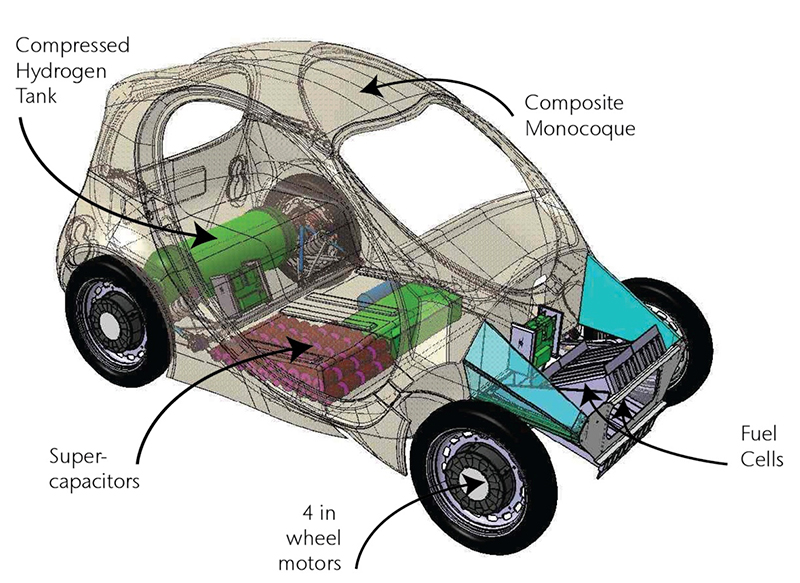
Teslas are by no means the first Open Source Electric Vehicles (or OSEVs for short). Here in the UK Riversimple open sourced their hydrogen fuel cell powered vehicle many moons ago. Here’s what their conception looks like:

Tesla certainly isn’t that sort of OSEV company. Where are the CAD models for example? Nonetheless maybe a few enterprising entrepreneurs can now combine the best of both worlds and start making some real inroads into “the enormous flood of gasoline cars pouring out of the world’s factories every day”?

Here’s what the two vehicles look like in action, emphasising the differences between the two companies’ approach to the technology:


Please also note that the Tesla Model S is now available “with the steering wheel on the right side of the car”!

Sinopoly to Invest $42 Million in Smith Electric Vehicles

Smith Electric Vehicles also have a factory here in the UK, but they stopped production at their U.S. factory near Kansas City airport late in 2013. Now they have announced that they have:

Secured a $42 million commitment from Sinopoly Battery Limited, a worldwide leader in the research, development, production, distribution and sale of Lithium-ion batteries and related EV products. The first $2 million in funding closed today, and the remainder will be invested in two tranches pending milestones to be achieved by both companies in the coming months.

The $42M investment will position Sinopoly as a strategic shareholder in Smith Electric. Under the agreement, Sinopoly will become Smith Electric’s exclusive supplier for batteries in vehicle applications that are compatible with Smith Electric’s platforms and customer requirements. Sinopoly will also become a preferred supplier for certain electric vehicle components that can be manufactured in its Hangzhou facility.

Bryan Hansel, chief executive officer of Smith Electric Vehicles, said that:

Demand for all-electric commercial vehicles is rapidly increasing in China, and Sinopoly’s investment in Smith Electric highlights the important role we will play in the global marketplace,” said Bryan Hansel, chief executive officer of Smith Electric Vehicles. This investment provides both companies with the opportunity to leverage the synergies between our operations while Smith maintains the financial and operational flexibility to scale manufacturing, transition and strengthen our supply chain, and move toward company profitability.

whilst Mr. Cao Zhong, the chairman and executive director of Sinopoly Battery Limited, said that:

Smith is an internationally renowned supplier of EVs. Sinopoly’s investment in Smith represents an important and strategic advance step in establishing Sinopoly as a significant integrated player in the EV industry. The combined expertise of Smith and Sinopoly, which will adopt the name of FDG Electric Vehicles Limited shortly, along with the macro-subsidy policy for alternative energy vehicles, uniquely positions us to capitalize on the rapidly growing commercial EV market in China and the U.S.

Smith (or should that now be FDG?) chairman of the board Charles Gassenheimer hinted at a future IPO, saying that:

Sinopoly’s investment in Smith Electric Vehicles marks an important milestone in recapitalizing and restructuring the company in preparation for the public market. This agreement underscores Sinopoly’s institutional understanding of the global electric vehicle industry and the company’s commitment to working with Smith Electric to create a major player in the market.

Western Power Distribution will be one of many UK companies breathing a sigh of relief that Sinopoly have breathed new life into their favourite supplier of electric commercial vehicles. Perhaps the U.S. Department of Defense will do likewise?

A Smith Electric Vehicles Newton stake bed truck

A Smith Electric Vehicles Newton stake bed truck

The Great Dunchideock Blackout Saga

We recently suffered a power outage, or power cut as we prefer to call such things here in the UK. This wasn’t any old power outage either. Let me explain.

The lights went out at 17:44 on Friday April 11th 2014. I hurriedly powered down everything in the lab and office except my laptop and our broadband router, which was by then being powered from the battery in an uninterruptible power supply. When the lights hadn’t come back on a few minutes later I telephoned our local Distribution Network Operator (DNO for short), Western Power Distribution, to enquire what the problem was, and when it might be fixed. WPD’s automated system suggested that our power should be restored by about 21:00 that evening.

9 o’clock came and went, by which time the batteries in my laptop and UPS were flat. I called WPD again, to be informed that the latest estimate for the time at which I would be able to get connected to the internet once again would be 01:00 on Saturday morning. I figured I’d allow WPD a bit of leeway, and eventually went to bed having set the alarm on my smartphone for 02:00. The alarm went off, but the lights still hadn’t come back on.  I phoned Western Power again to be informed that things should be back to normal in an hour or so. Bleary eyed I returned to bed.

When I arose next morning I wasn’t in need of any lights, but my router and laptop were working once again. There was, however, the continuous drone of an engine audible not too far away so I set out to investigate by following the sound, and here is what I discovered:
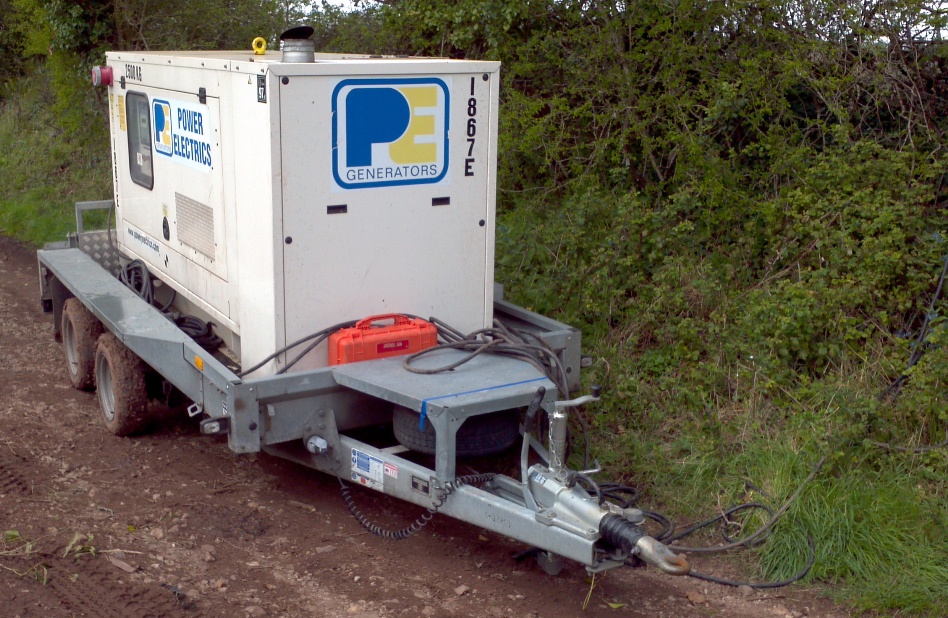
Generator on the track to Haldon Belvedere on April 12th 2014

Diesel generator on the track to Haldon Belvedere on April 12th 2014

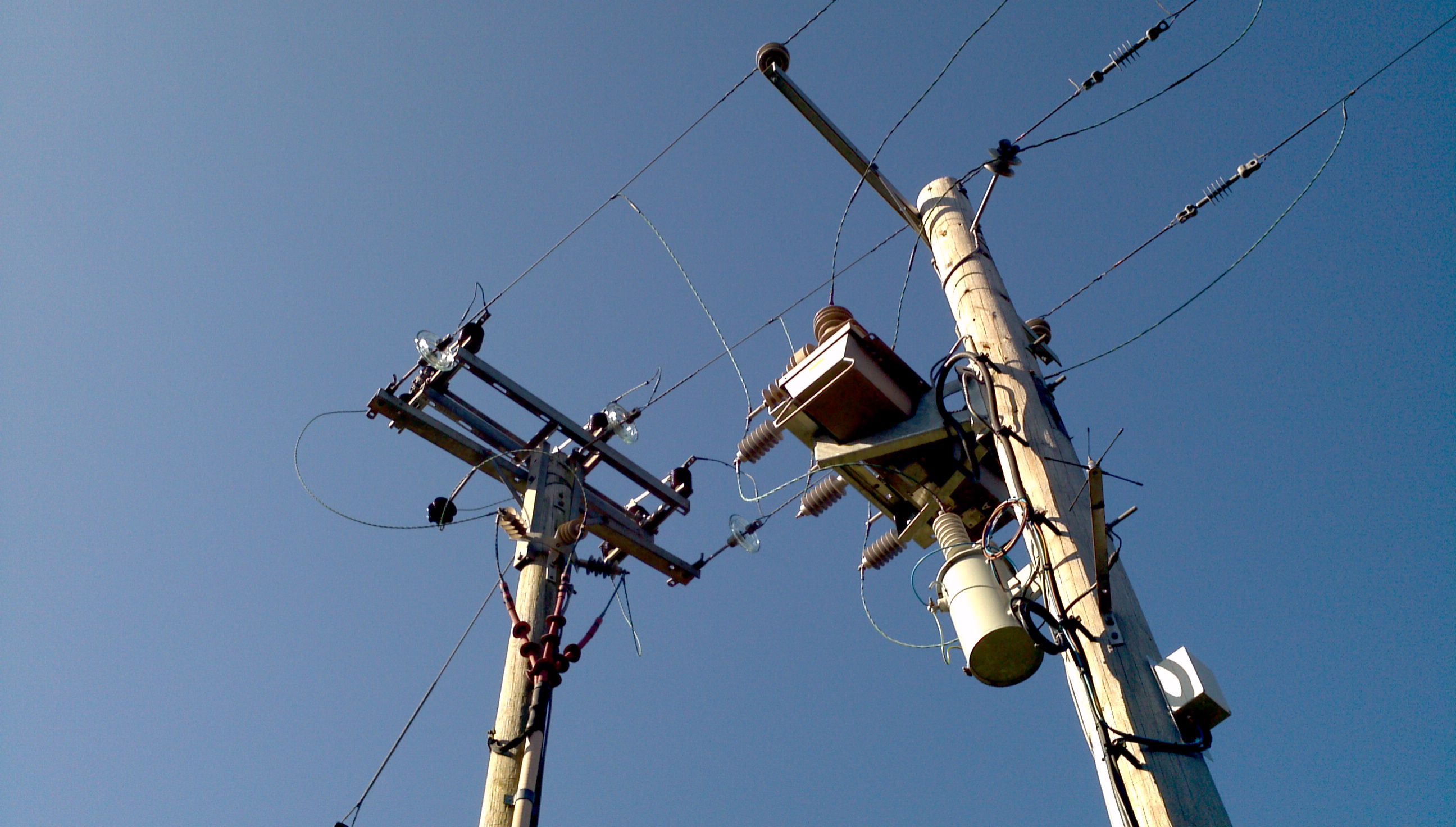
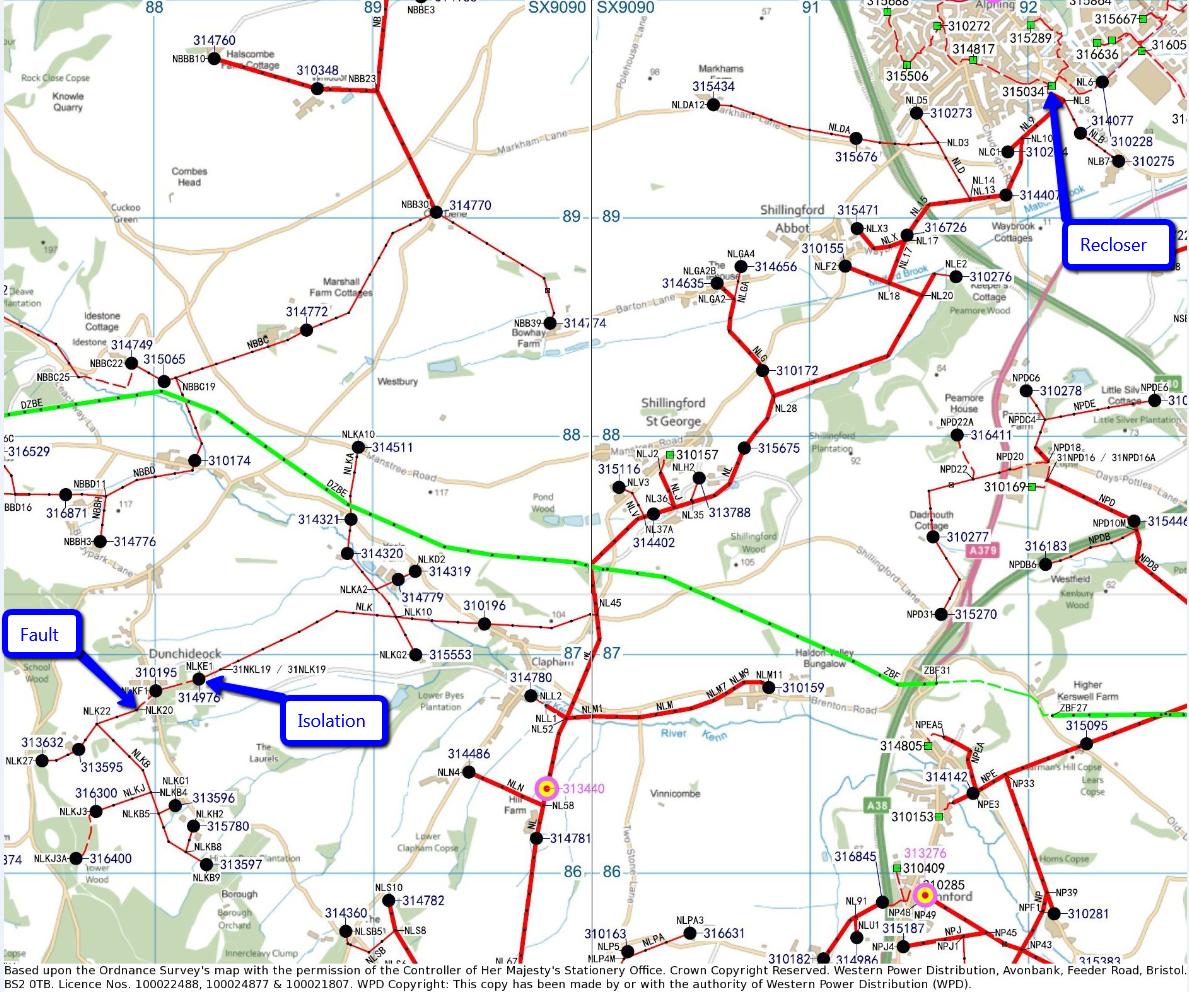
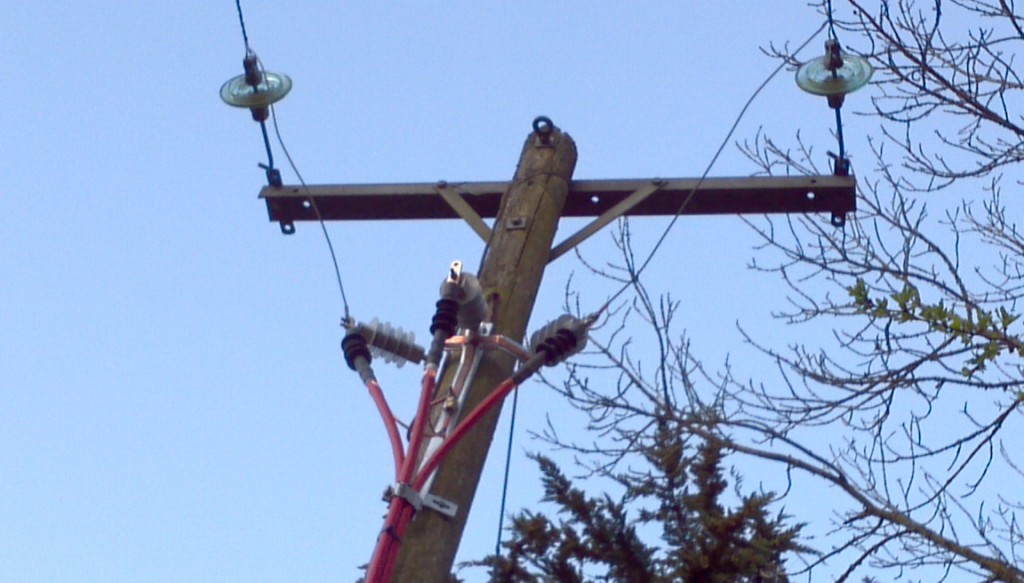
Another call to Western Power Distribution elicited some further information. I managed to speak to WPD’s standby manager for the day, who explained what had happened the previous evening. Initally over 300 properties had been without electricity following the operation of an automatic circuit recloser mounted on pole NLT1M in Alphington, as shown at the top right of the map of WPD’s network below (click the image for a larger version), and in this photo I took subsequently:
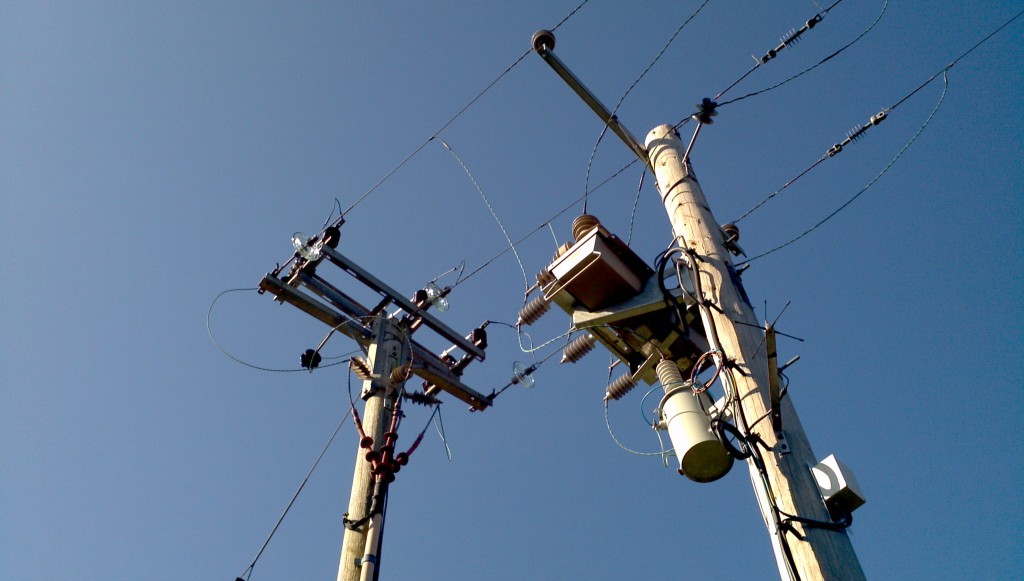
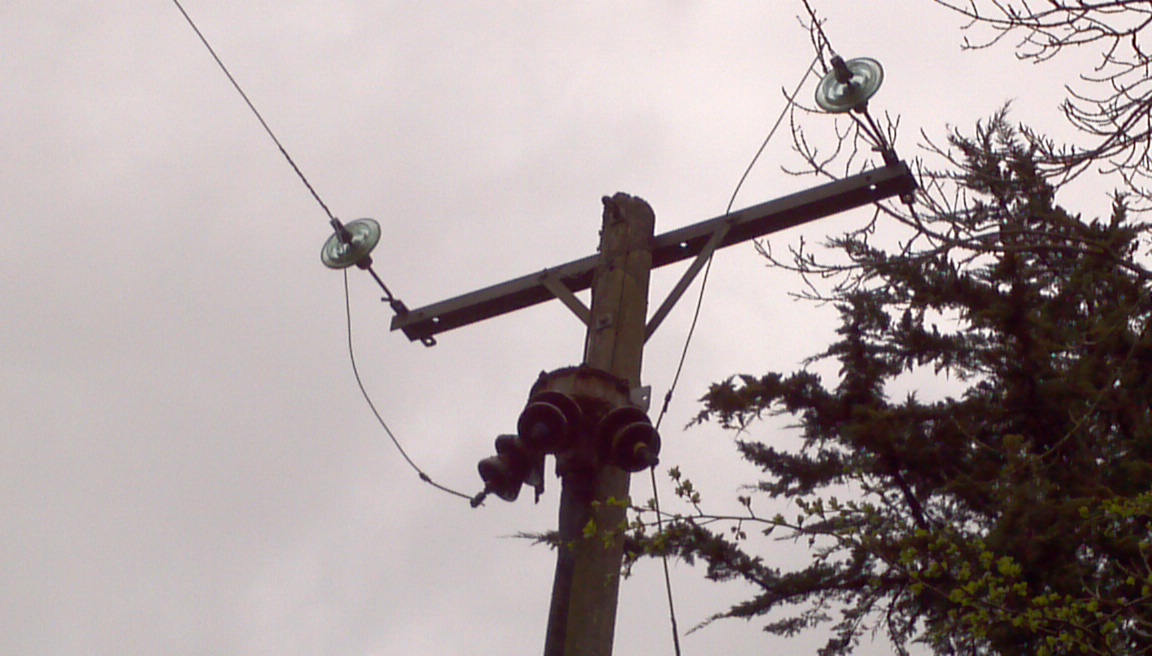
Schneider pole mounted recloser and air break isolator in Alphington

Schneider U-Series pole mounted recloser and an air break isolator in Alphington
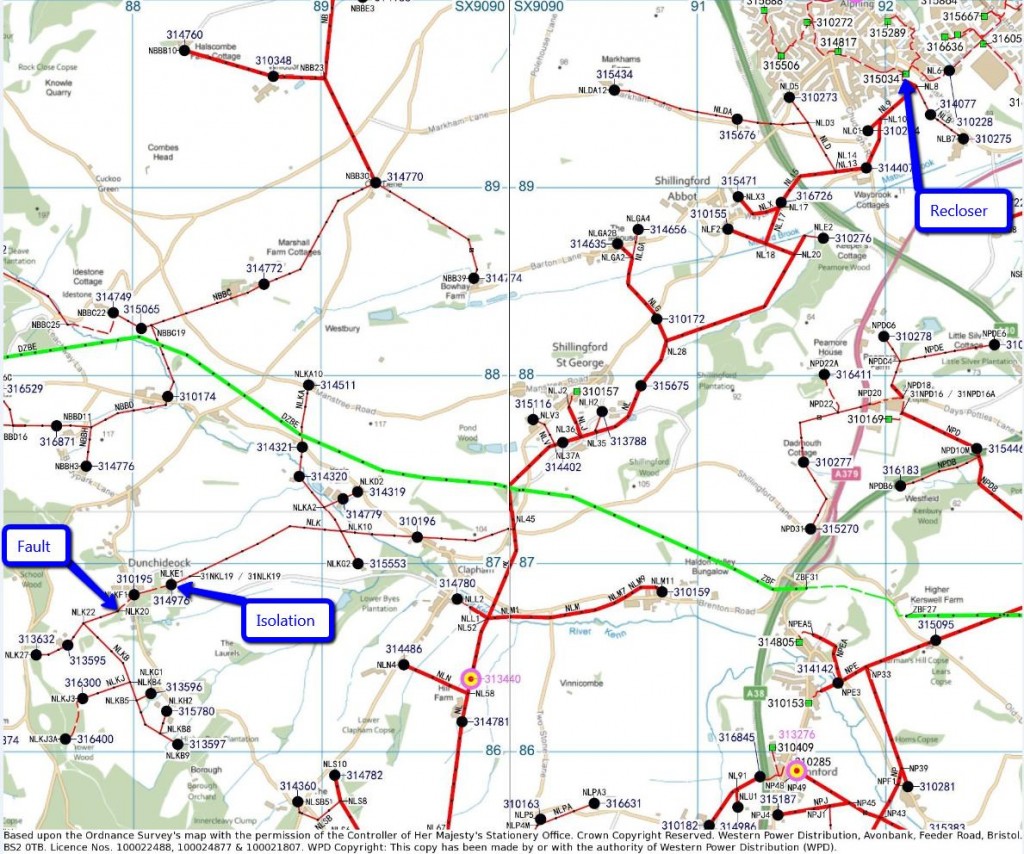
WPD map of 11 kV and 33 kV cables Southwest of Exeter

WPD map of 11 kV (red) and 33 kV (green) cables south west of Exeter

At that point everything powered via the 11 kV 3 phase (thick red) cables running from top right to bottom left of WPD’s map was without electricity. By around 21:00 the problem had been isolated to somewhere in the bottom left corner of the map, and power now reached as far as pole NLK19, near the north east corner of The Lord Haldon Hotel car park.
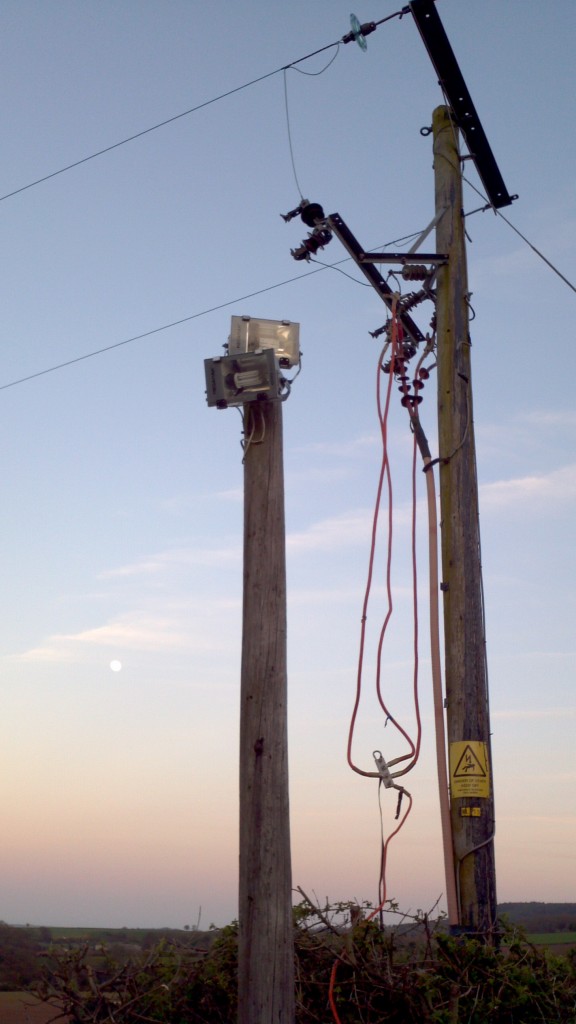
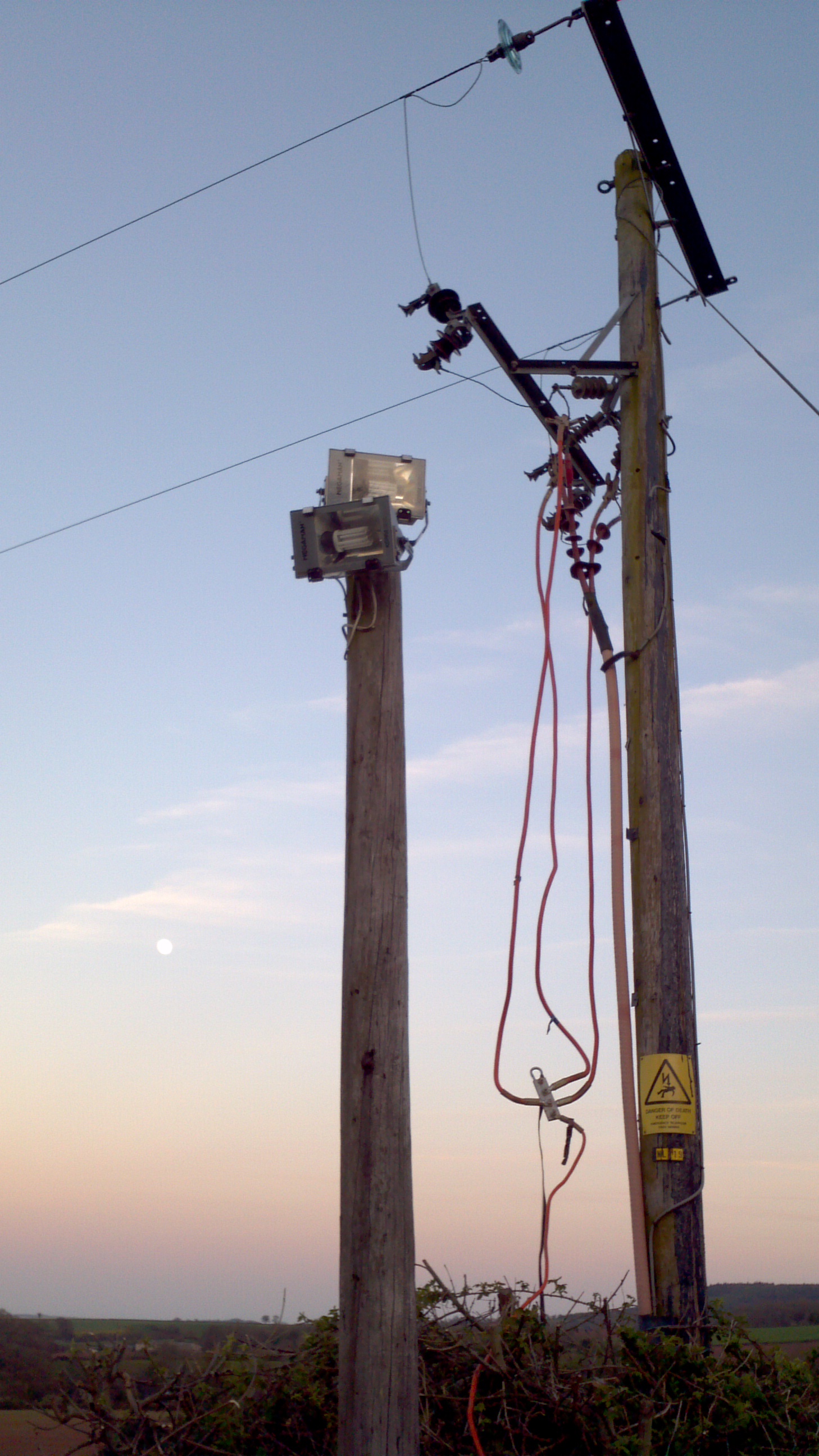
Pole 31NLK19, whilst The Lord Haldon Hotel and The Haldon Belvedere were running from WPD generators

Pole 31NLK19, draped with extra cables, whilst The Lord Haldon Hotel and The Haldon Belvedere were running from WPD generators

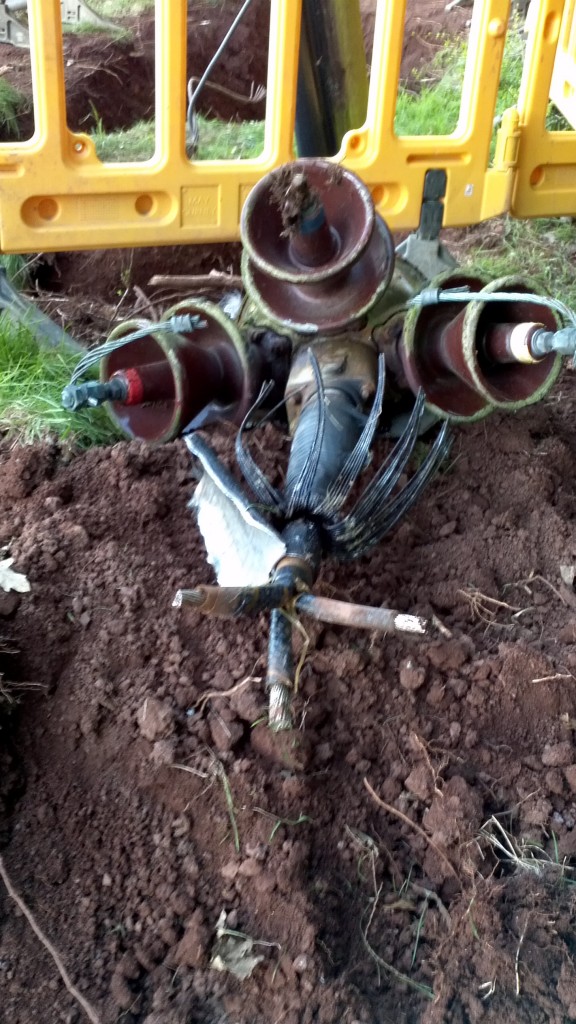
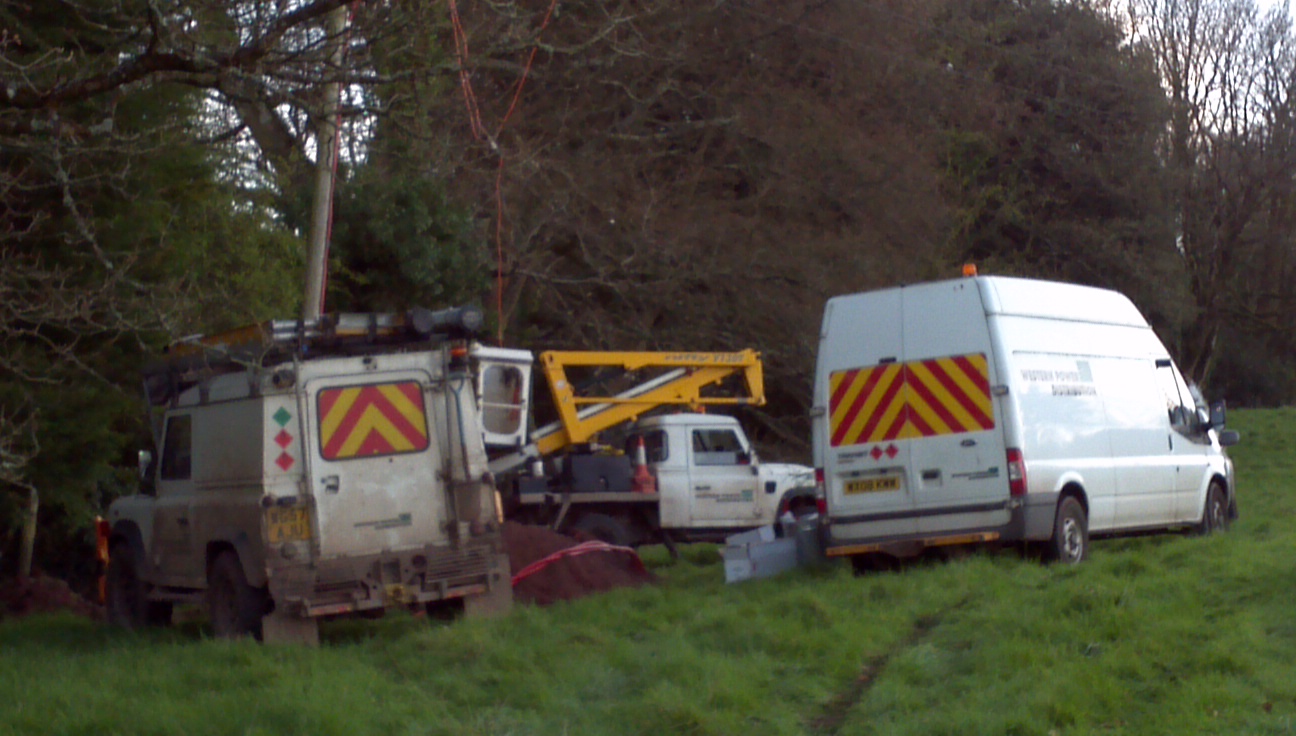
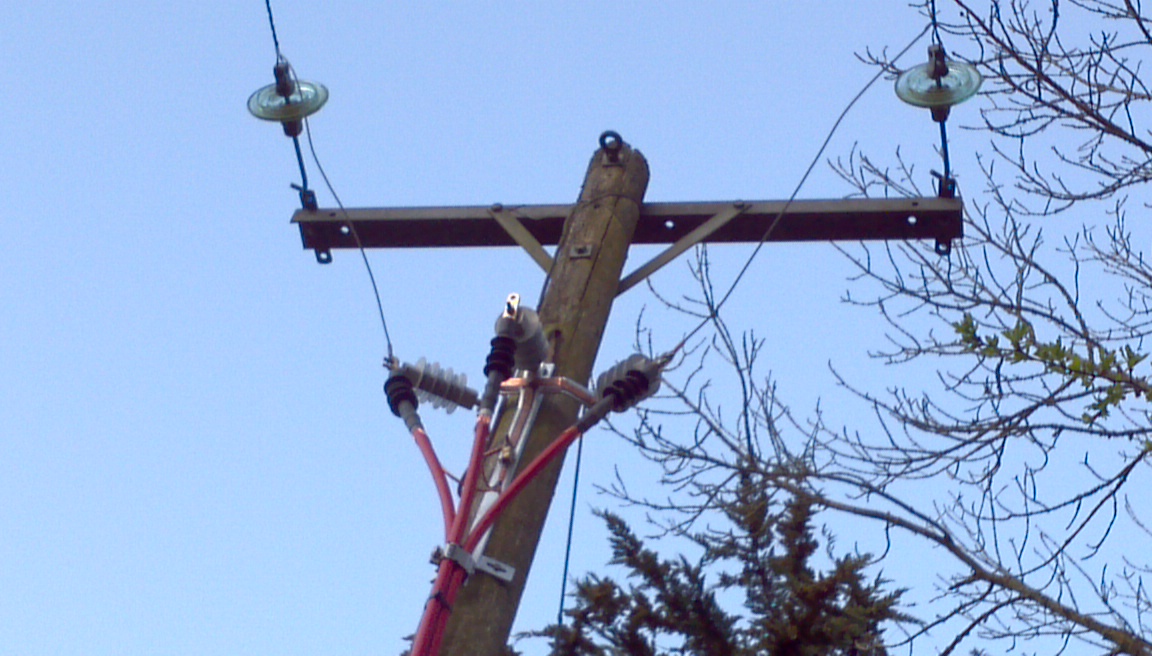
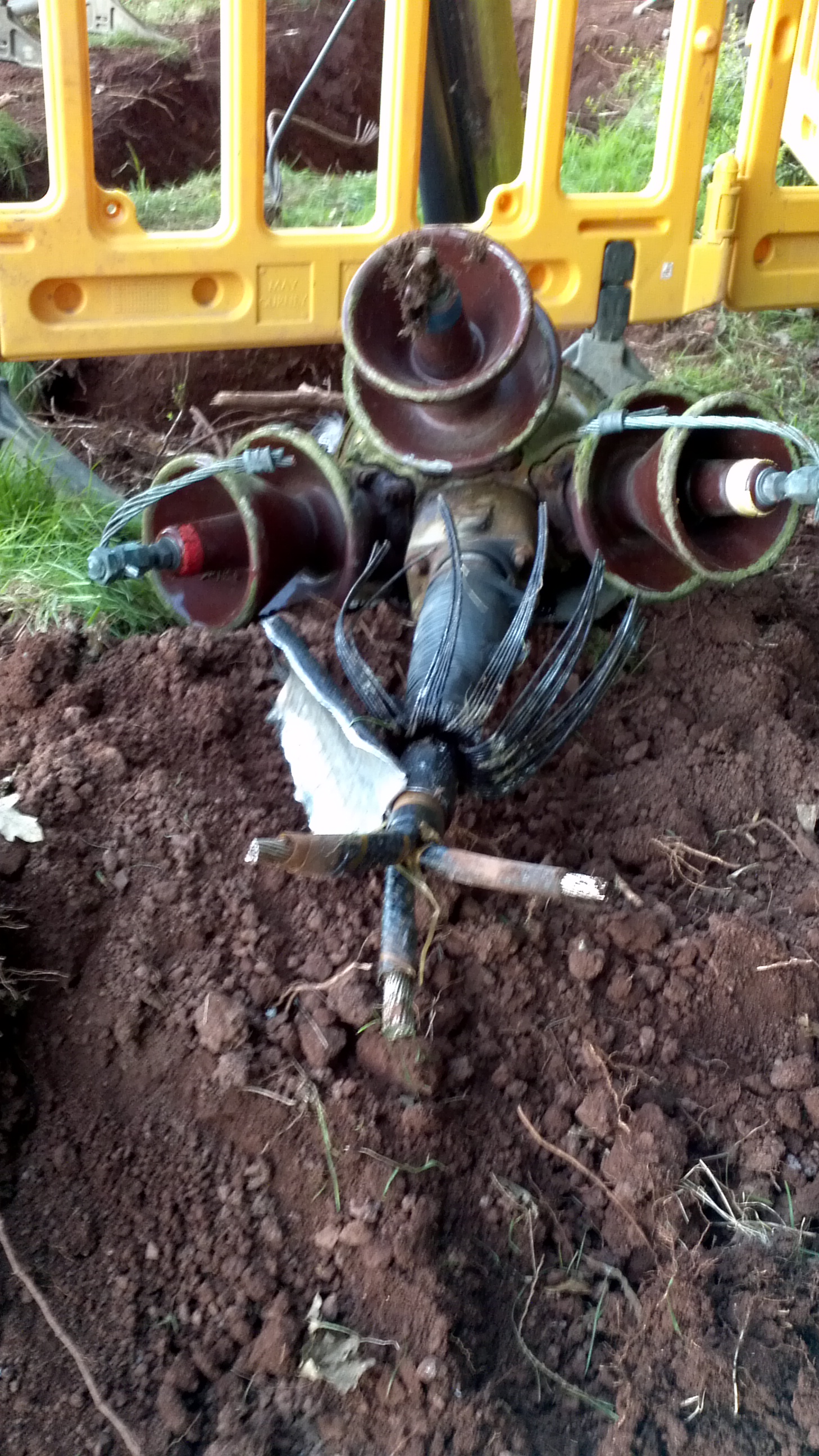
Unfortunately the hotel itself, which had a wedding reception booked that night, and everyone else in our corner of the village of Dunchideock and Haldon Hill were still without power, and WPD still didn’t know where the fault was. I am assured by a local resident that once it had got dark his wife noticed some arcing at the top of an electricity pole in a field behind his house, so he drove to the hotel car park and informed the WPD engineers gathered there about her discovery. The problem ultimately proved to be a faulty pole top cable termination, shown below in situ together with some inquisitive lambs:
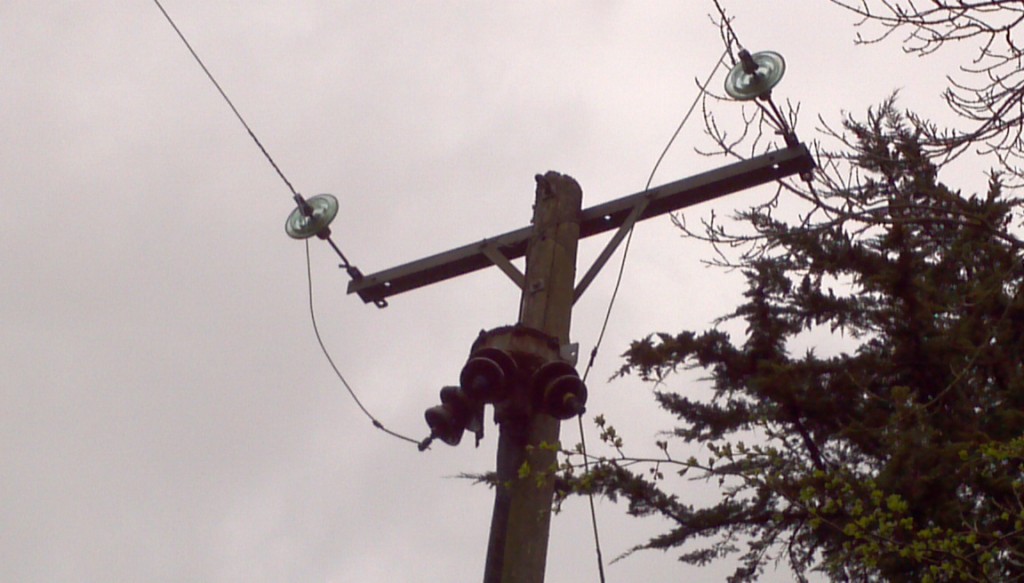
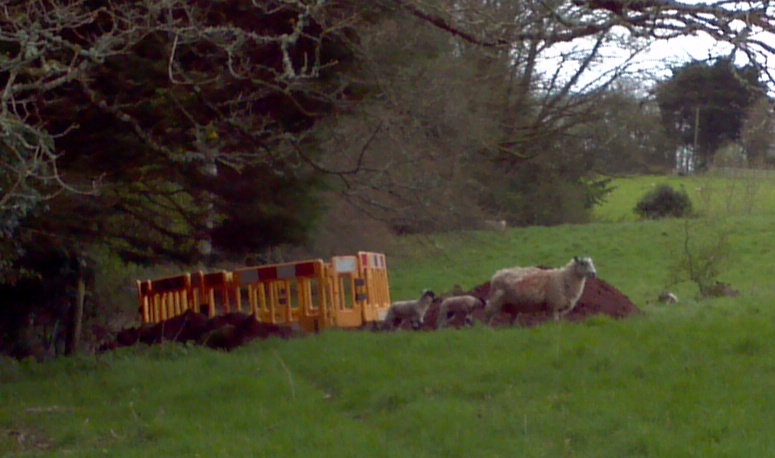
A 48 year old cable termination at the top of pole NLK20

Youthful interest is shown in a big hole in the ground

Some youthful interest is shown in a big hole in the ground

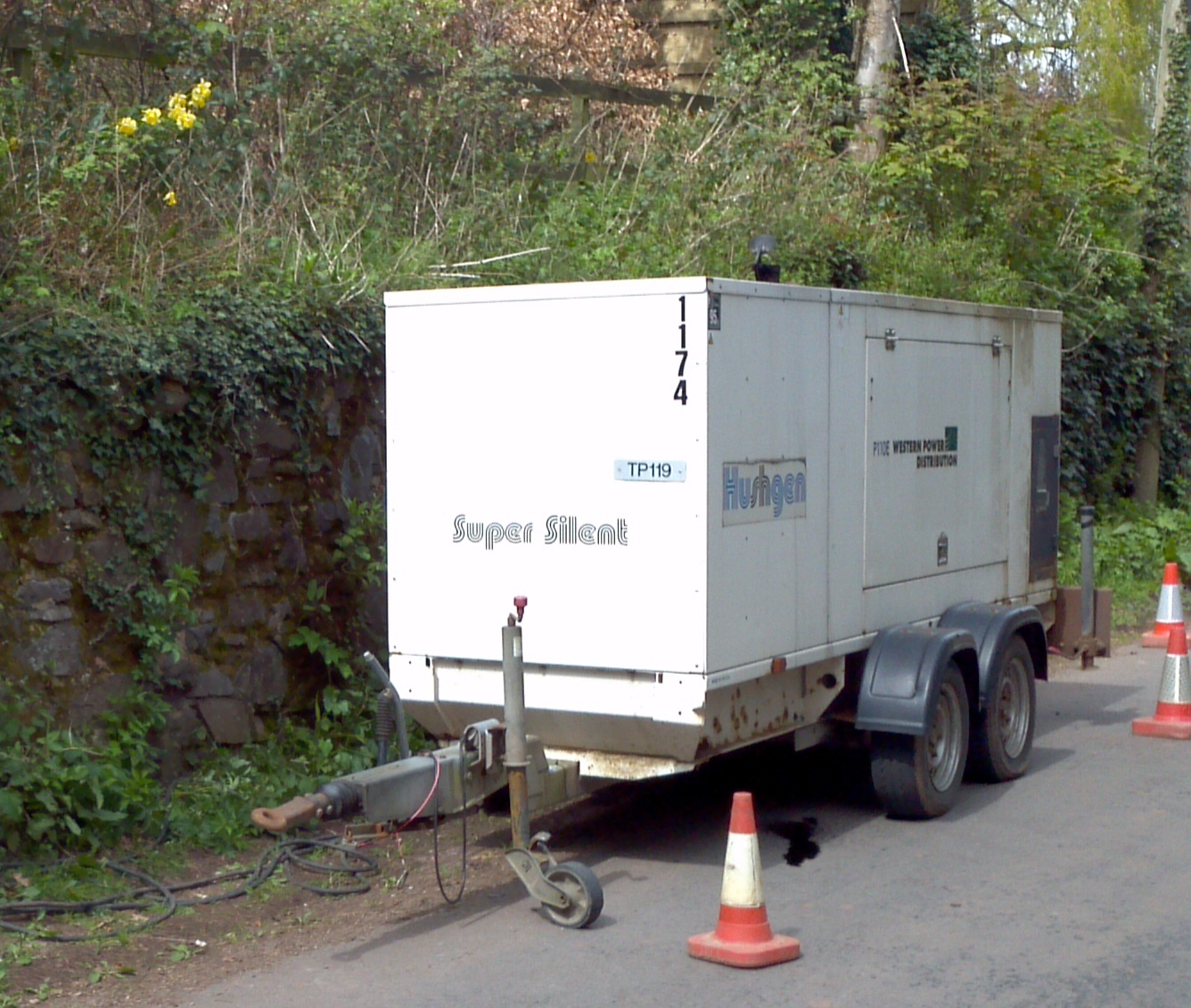
By the time the likelihood that this was indeed the ultimate cause of the problem had been established time was pressing. According to WPD they have a self imposed 12 hour time limit on turning the power back on after any interruption in supply, and there was no way this problem would be fixed within that timeframe. That being the case some generators would be required, which presented WPD with another big headache. It seems there had been some other problems in Devon on the same day, and there weren’t enough generators in Exeter to go around, so WPD brought some more in from Torbay. That still wasn’t adequate for the scale of the problem, so they brought some more in from Taunton. Even that wasn’t sufficient, so finally they had to hire a few more from Bristol, one of which was emitting the dulcet tones that greeted me on Saturday morning. Here’s one of WPD’s own generators, that was located a bit further up the road near the entrance to the hotel:
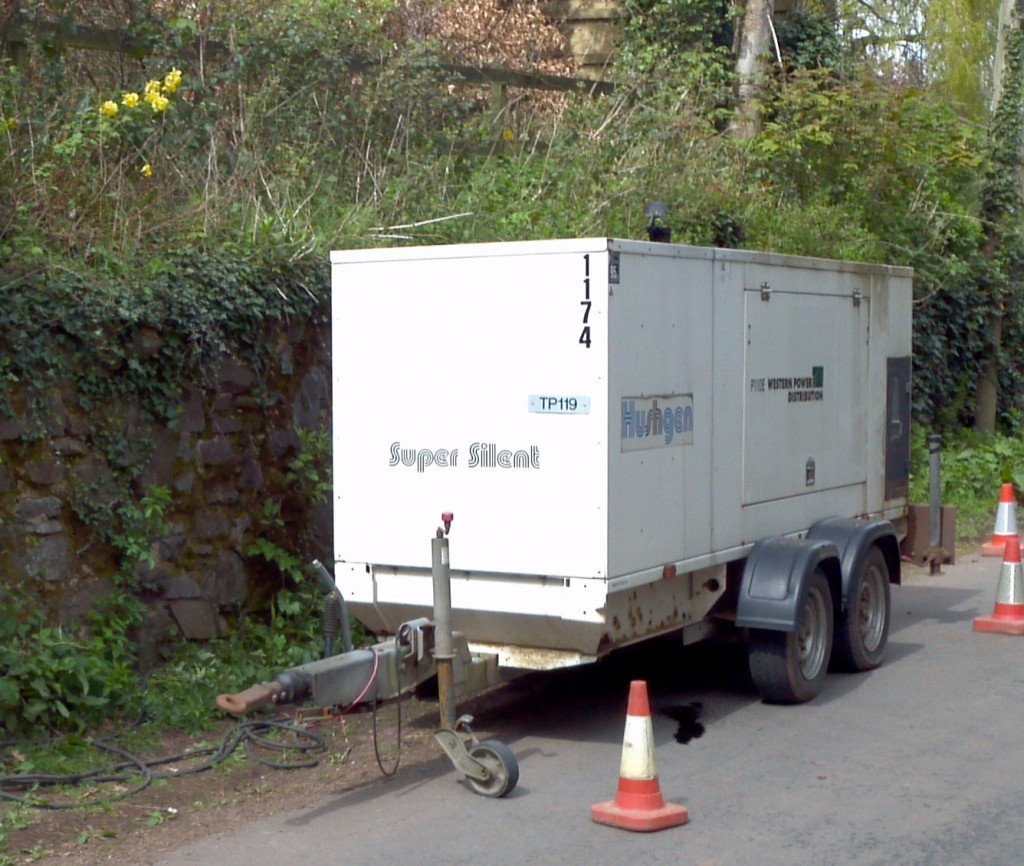
WPD Generator hard at work outside Pen Hill Cottage

WPD diesel generator hard at work outside Pen Hill Cottage

All in all, by the time everyone affected had their electricity supply restored, which in our case seems to have been at around 3:30 on Saturday morning, 9 diesel generators were scattered across the north side and ridge of Haldon Hill. WPD assured me there was no danger of any further power cuts, since every 12 hours or so they would be hauling a bowser around the local vicinity to top up the tanks of any generator that might be running low on diesel fuel.

Whilst they didn’t have such a thing last time I checked, during the recent winter storms, I was also informed that Western Power now provide an online power cut map. This is how it looked on the morning of Saturday April 12th 2014:
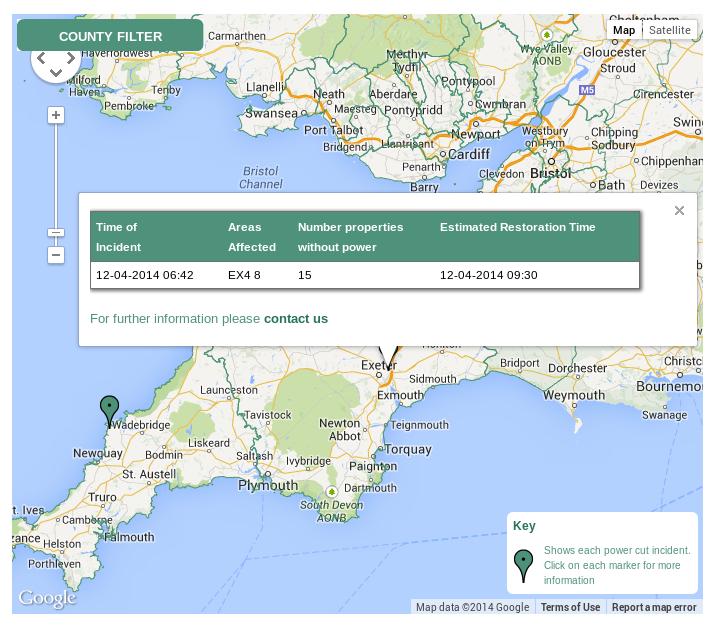
Western Power Distribution power cut map at 08:39 BST on Saturday April 12th

Western Power Distribution power cut map at 08:39 BST on Saturday April 12th


It seems as though “running off a generator” doesn’t count as a “power cut”, because Dunchideock isn’t on that map, all of which meant that WPD could now fix the problem as and when time permitted. Here’s how things were looking by Sunday evening:
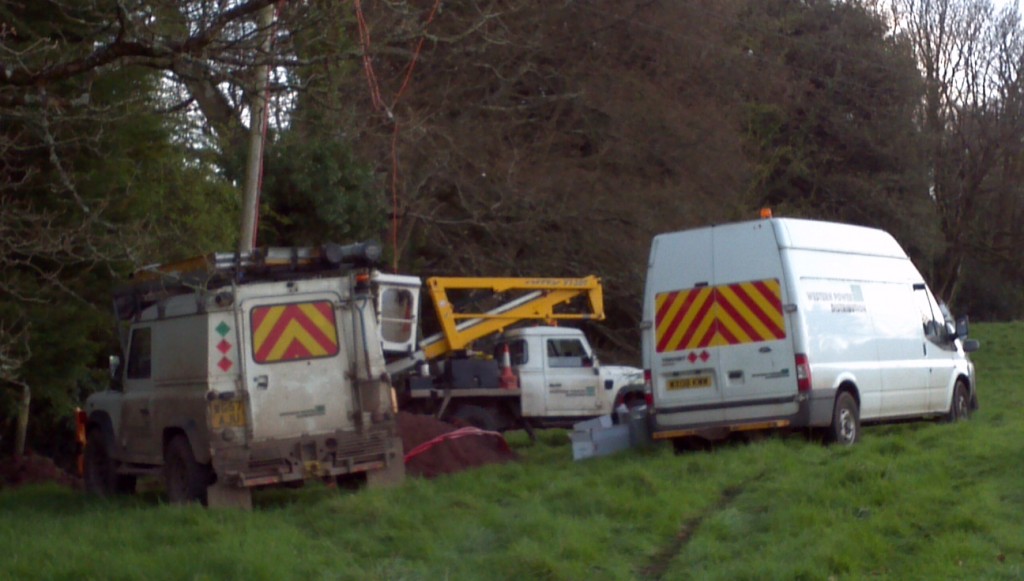
By Monday morning the epoxy resin in the Lovink red box had set, the big hole in the ground was filled in, and we were all back on mains power once again. All of which raises a few questions, in my mind at least.

In my conversations with WPD’s duty engineers I enquired whether this particular failure might be in any way attributable to the recent wet and windy winter weather here in South West England I alluded to earlier. I was told that while a causal link with any single failure was impossible to establish, it was conceivable that WPD’s electricity distribution network had suffered additional “stress” due to increased lightning strikes and the potential for trees to be more easily toppled by strong winds whilst their roots were sitting in sodden soil. I also idly enquired about the stresses placed on the network by renewable generation in the South West, but that story will require an article of its own at the very least.

In the meantime I’ve been pondering how this saga would have panned out if some of the homes in Dunchideock had already been in possession of an electric vehicle and some vehicle to home or even vehicle to grid technology. Since the powers that be here in the UK don’t seem to be wild about either of those concepts maybe a pile of shiny new lithium ion batteries from Tesla in the corner of each garage in Dunchideock might be more realistic to speculate about, or at the very least some second user EV batteries that are at least receiving some R&D funding on this side of the Atlantic? In that case perhaps we should add distributed storage to grid (or S2G for short) to our list of TLAs under consideration?

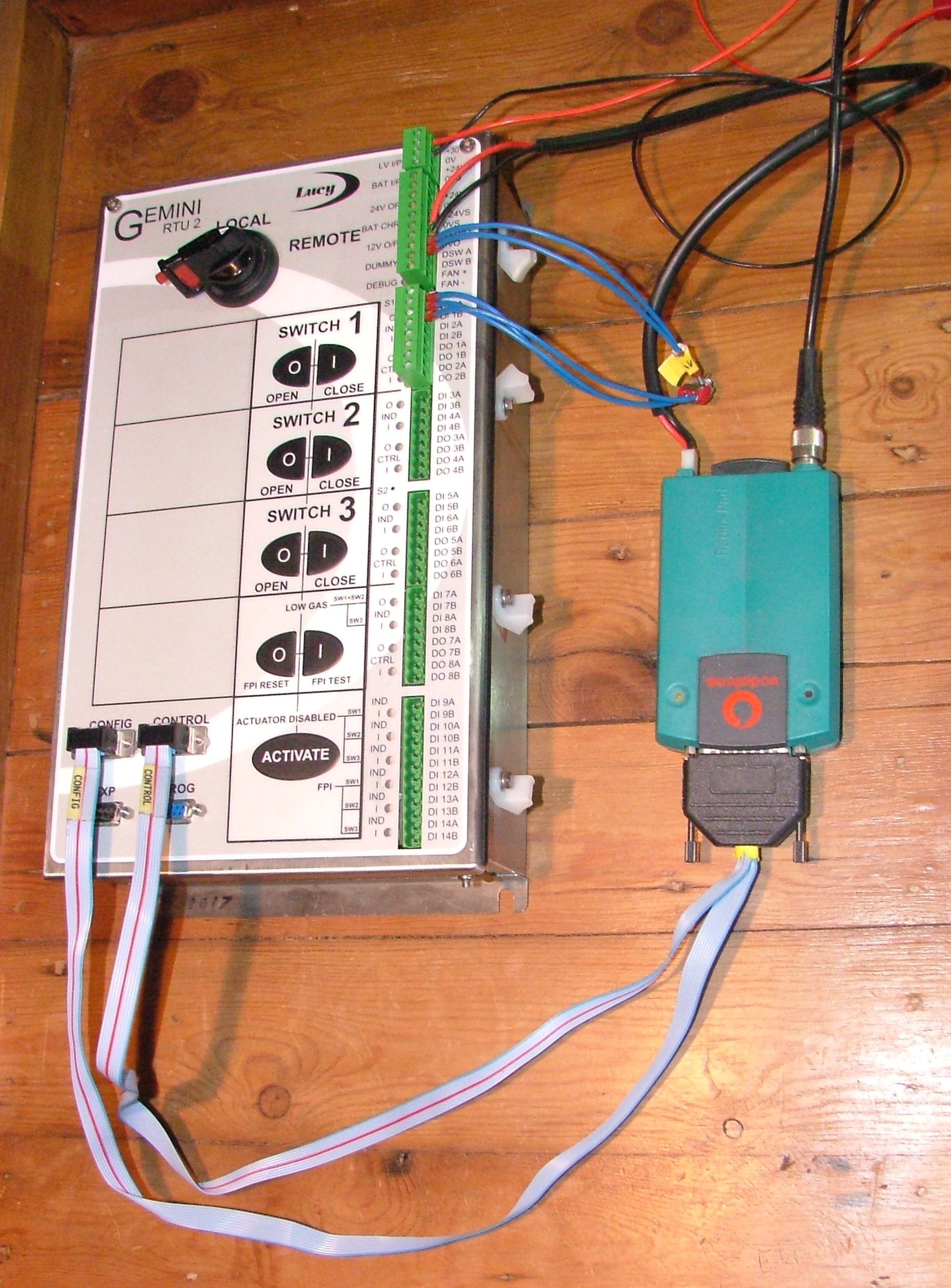
The lights wouldn’t have gone out in any V2H or storage equipped home. Their broadband would have kept on working too, so information about the failure could have been swiftly despatched to WPD’s control centre to enable the location of the fault to be pinpointed more swiftly. If some people had V2G and/or S2G installed as well, and subject to being suitably reimbursed for their public spiritedness, they could have kept their neighbours’ lights on as well as their own provided that WPD’s equipment was capable of sectionalising their network with greater granularity than at present. As luck would have it there is a pile of such equipment already in Dunchideock, although it’s only in the V2G lab at the moment rather than attached to any of the WPD poles I’ve mentioned apart from the one in Alphington, or in the corner of anyone else’s garage in Dunchideock. Here’s what a remote terminal unit looks like from the outside:
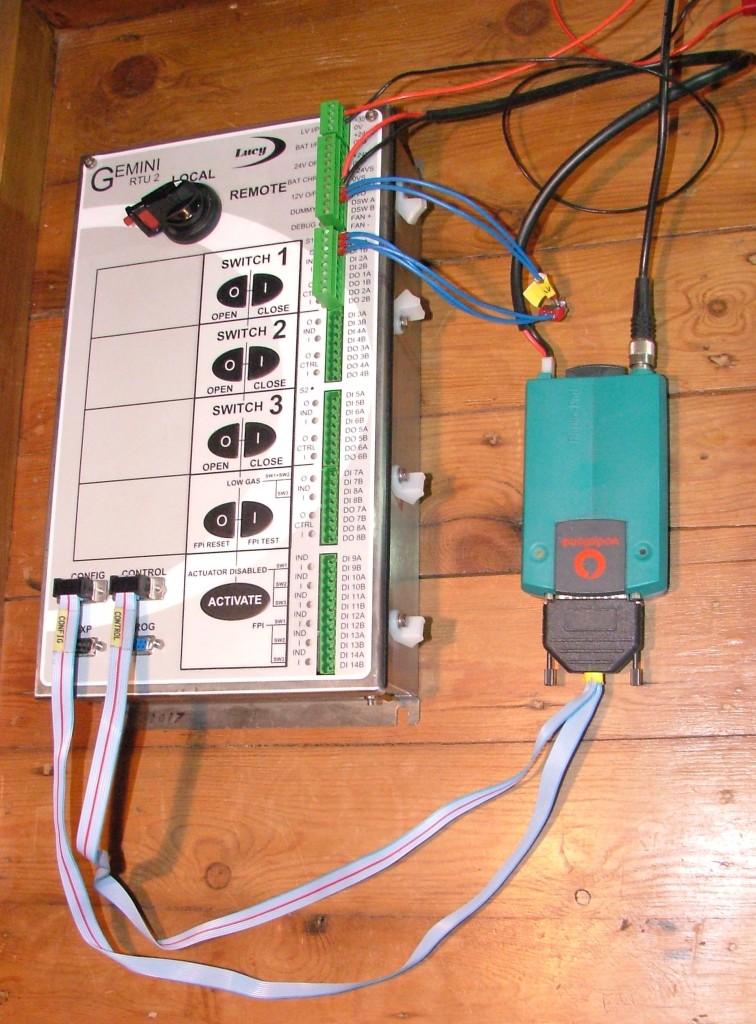
A Lucy Switchgear Gemini Remote Terminal Unit plus PakNet PAD

A Lucy Switchgear Gemini Remote Terminal Unit plus PakNet PAD

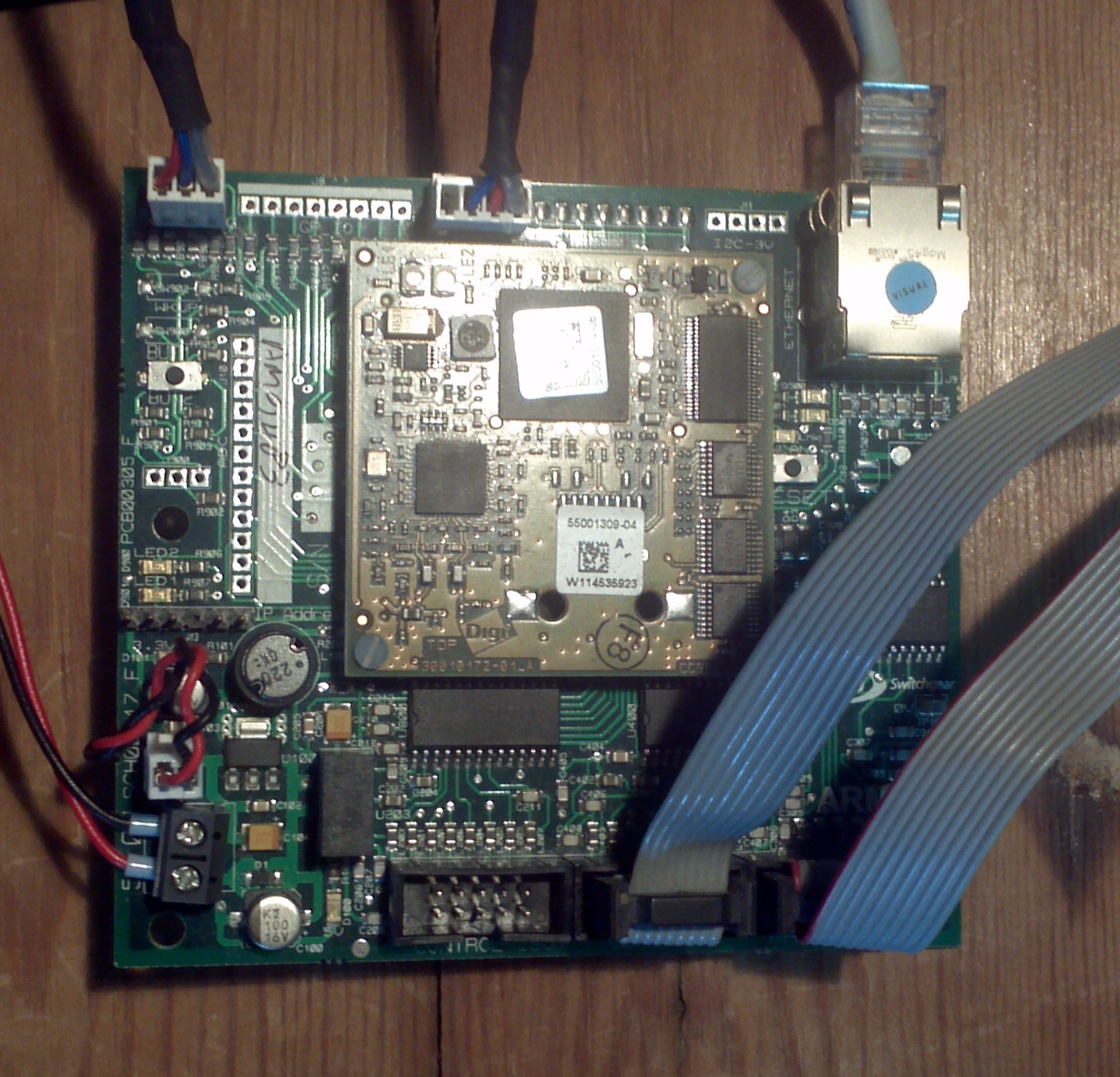
and here’s what the ARM powered CPU board on the inside looks like:
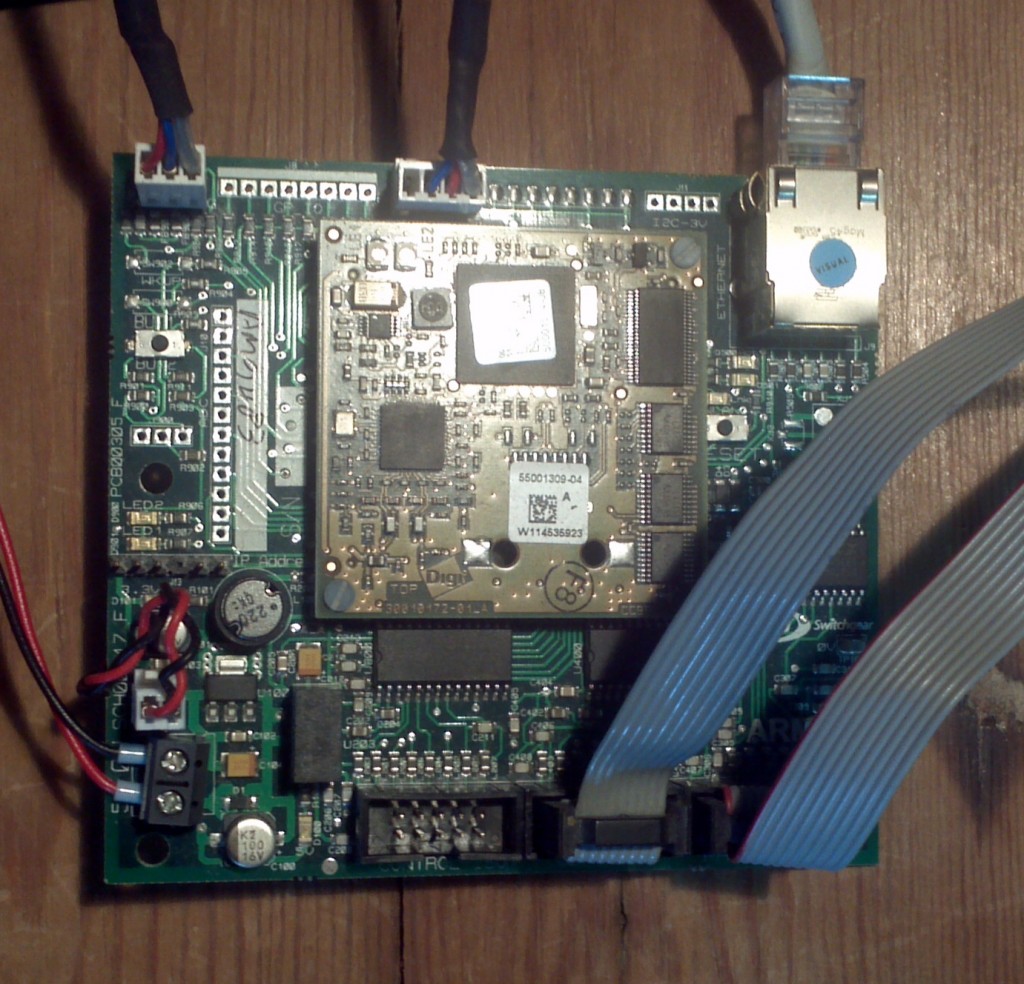
Gemini ARM CPU card

A Lucy Switchgear Gemini ARM CPU card, connected to the internet

As you can see, in actual fact it’s not a whole lot different to a Raspberry Pi, or the guts of the average smartphone for that matter:

A Raspberry Pi model B, connected to the internet

A Raspberry Pi model B, connected to the internet

Hence such a piece of electronics wouldn’t in and of itself add a whole lot to the price of an electric vehicle and/or a garage in Dunchideock, or anywhere else on the planet for that matter.

In conclusion, I also cannot help but wonder how much the Great Dunchideock Blackout cost Western Power Distribution, how much the evidently changing climate in this part of the world is costing and will cost them, and how their electricity distribution network is coping with the assorted stresses and strains generated by all the renewable power sources currently being tacked onto it down here in not so Sunny South West England that do not currently have any form of energy storage associated with them.


Used Nissan EV Batteries Now Provide Grid Scale Storage

Nissan have recently announced that:

The manmade island of Yumeshima in western Japan’s Osaka is now home to the world’s first large-scale energy storage system, a project that also highlights the potential to reuse electric vehicle batteries.

Hikari-no-Mori – or Forest of Light – is a mega-solar project of 36,000 solar panels built on top of a landfill and managed by Sumitomo Corporation.

The first paragraph is not strictly accurate, since as we reported a couple of years ago, such things have been in use in Spain for a while now. Sumitomo’s press release about the project was nearer the mark stating instead that:

Sumitomo Corporation has developed and installed the world’s first large-scale power storage system which utilizes used batteries collected from electric vehicles.

Nissan did however also release the following video, so we can see for ourselves what the partnership has in fact developed:

According to Sumitomo once more:

Over the next three years, the system will measure the smoothing effect of energy output fluctuation from the nearby “Hikari-no-mori,” solar farm, and will aim to establish a large-scale power storage technology by safely and effectively utilizing the huge quantities of discarded used EV batteries which will become available in the future. This project has been selected as a model project for “Verification of the battery storage control to promote renewable energy” for the fiscal year 2013 by the Ministry of the Environment of Japan.

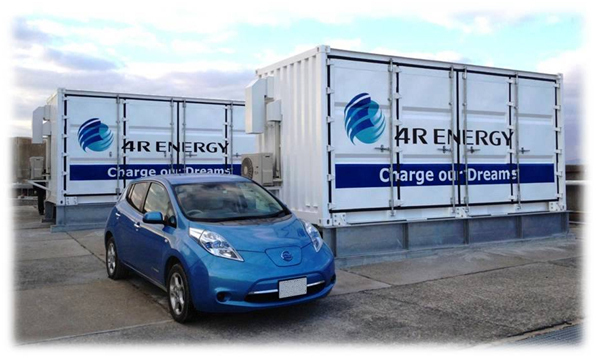
Sumitomo Corporation created the joint venture company, “4R Energy Corporation”, in collaboration with Nissan Motor Co., Ltd. in September 2010, to address the secondary use of EV lithium-ion batteries. The used EV batteries that will be recycled into this large-scale storage system have been recovered and have gone through thorough inspection and maintenance at 4R, to confirm safety and performance. This prototype system (600kW/400kWh) consists of sixteen used EV batteries.

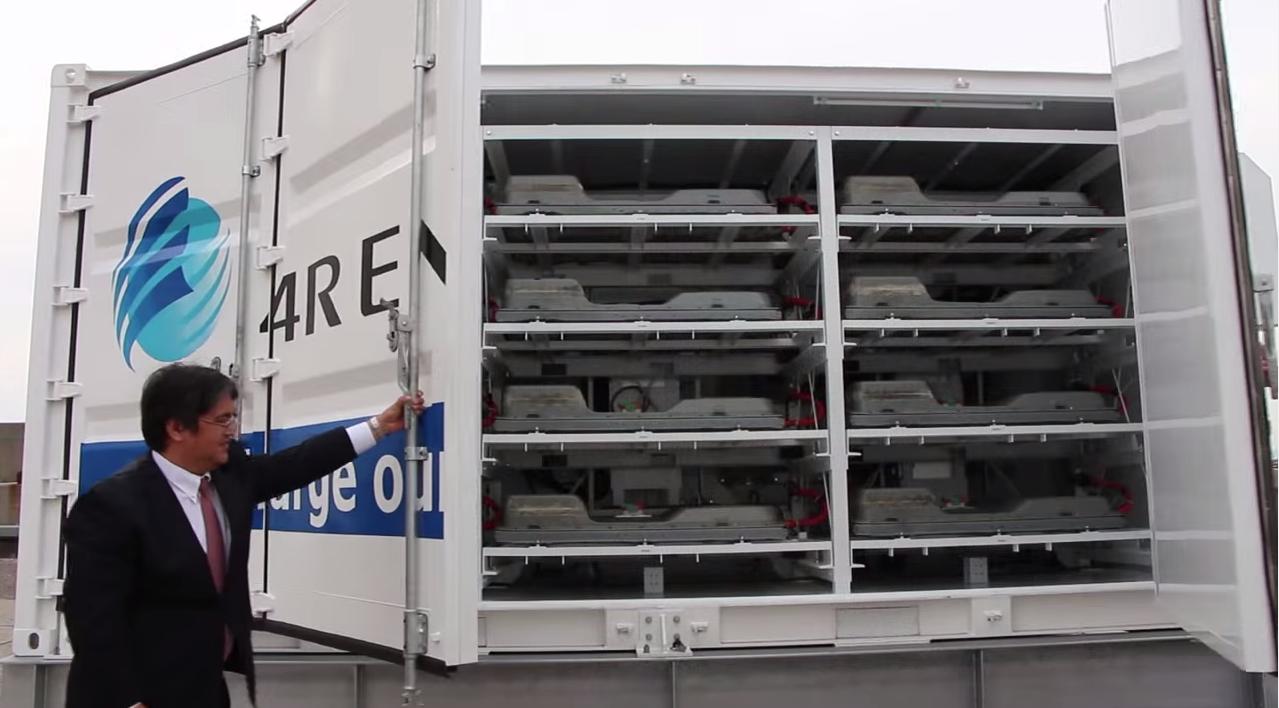
The 600kW/400kWh rating of the Japanese energy storage system compares unfavourably with the 1.1MW/560kWh of the lithium-ion battery Saft system installed in Spain, so it can’t even claim to be the largest such system in the world, but the French system uses new batteries rather than ones that are no longer up to the job of powering an electric vehicle. Here’s what the 4R system looks like:

A glimpse inside a 4R Energy used EV battery storage system

A glimpse inside a 4R Energy used EV battery storage system

It seems to have 12 battery packs per container, although Nissan claim that:

A joint venture between Sumitomo and Nissan called 4R Energy – Reuse, Resell, Refabricate and Recycle – uses 16 lithium-ion batteries from EVs to help monitor energy fluctuations and store the solar farm’s energy output.

Judging by both Nissan’s video and Sumitomo’s picture there looks to be two of those on the man-made island, so maybe the actual number is in fact 24?

Continuing with some further (hopefully accurate!) quotes from Nissan’s press release:

Natural energy sources, such as solar and wind, vary in strength and frequency, and the innovative battery management system developed by 4R is the first of its kind, says the firm’s President Eiji Makino.

“Depending on use, a battery’s degree and rate of deterioration and the battery’s condition vary by vehicle,” says Makino. “So 4R has created a technology that allows us to have optimal control in regulating those conditions.”

The project is part of a three-year test under Japan’s Environment Ministry to expand renewable energy resources and power grid management. In Japan, electricity liberalization will be realized after 2016.

The batteries have up to 70% of capacity remaining – the average left after 100,000 kilometers or five years of driving.

Sumitomo General Manager Norihiko Nonaka said his company, in cooperation with 4R, expects to make the results of the project commercially viable in 5 years or so.

“The electricity-value-chain is divided into 3 sections: electricity generation, transmission and distribution. We would like to focus on electricity generation and transmission. If we rely on renewables to obtain energy – like solar and wind – they don’t always generate the necessary amount of energy and that may cause an issue with supply-and-demand,” said Nonaka.

“On the other hand, if the cost of batteries is too high and is economically inefficient, 4R will have to continue to work and investigate the situation and market in the long term, about 5 years or maybe after 2020.

In conclusion I fear I may have to disagree slightly with Sumitomo for a change. Why should “the electricity-value-chain” not also include community renewable energy projects such as the South Brent Community Energy Society’s 250 kW wind turbine, which is located a few miles down the A38 from the V2G offices, and of which I am a proud (albeit modest) shareholder?