Regular readers will be aware that here at V2G UK we are concerned about the effect of internal combustion engine emissions on human health, particularly in the town of Camelford just down the road from us here in (Silic)Inny Valley. For more background please read on below the fold, but here is our urgent message of the day.
The Cornwall County Council consultation on their so called Air Quality Action Plan for Camelford closes on April 2nd 2018. If you want to have your say please complete the online questionnaire at:
The UK’s new “Industrial Strategy” was published last week. The last time we had a good look at UK plc’s strategy was three years ago, when we concluded that “it rather sounds as though ‘Storage to Grid’ (or S2G for short) is a more likely prospect here in the United Kingdom than fully fledged V2G”. So how about this year?
The foreword by Greg Clark, Secretary of State for Business,Energy and Industrial Strategy (or BEIS for short), states that:
This Industrial Strategy deliberately strengthens the five foundations of productivity: innovation, people, infrastructure, places and the business environment.
At the very least “innovation” and “infrastructure” sound like the sort of things we get up to here at V2G UK. Here’s how Gov.UK visualises our future infrastructure:
Moving on, Greg continues:
As well as setting a path to improved productivity, our Industrial Strategy sets out four areas where Britain can lead the global technological revolution. These four Grand Challenges – in artificial intelligence and big data; clean growth; the future of mobility; and meeting the needs of an ageing society – have been identified on the advice of the our leading scientists and technologists. They will be supported by investment from the Industrial Strategy Challenge Fund and matched by commercial investment.
There’s a video explaining the ISCF:
There’s even a video summarising each of the Grand Challenges. Electric vehicles get a mention in the one about mobility:
https://youtu.be/wlqQRp5vhOU
We’ve previously touched on the Government’s new “clean growth” strategy on the V2G blog, and obviously we’re inordinately interested in the “future of mobility”, so there really should be something of interest to us in the 131 page white paper. Let’s delve a little deeper shall we? Under the “infrastructure” heading we’re told that:
Our approach is to undertake a comprehensive package of measures to promote the uptake of zero emission vehicles. We have announced a further £100m for the plug-in car grant to incentivise the purchase of battery electric vehicles, and we are committing to 25 per cent of the cars in central government department fleets being electric by 2022. We are announcing an additional £200m of public investment, to be matched by private investment, to create a new £400m Charging Infrastructure Investment Fund, and we will regulate to support further expansion of the charging infrastructure network.
After the Grenfell Review, we will update building regulations to mandate that all new residential developments must contain the enabling cabling for charge-points in the homes. We will also provide £40m to support new technologies for on-street and wireless charging.
All of which sounds like very good news for our SaMDES project which envisages installing static battery storage and V2G charging stations in homes and small businesses across the South West of England. The news gets even better! A little further on we discover:
The zero emission road transport strategy, to be published in the coming months, and work on the options for the long-term decarbonisation of heating will build on this. They will support the growth of markets for technologies that create synergies between systems, such as energy storage, smart meters, vehicle-to-grid charging and heat networks.
Will the sweet music to our ears never stop? Not for the moment at least. Next we discover that:
We are determined to tackle air pollution and support affected areas, given the significant negative impact it has on public health, the economy and the environment. We will provide £220m for a new Clean Air Fund that will allow local authorities in England with the most challenging pollution problems to help individuals and businesses adapt as measures to improve air quality are implemented. This new fund is in addition to the £255m provided to implement the Air Quality plan earlier this year.
That sounds like more potential assistance for Camelford due to the town’s Air Quality Management Area status. Moving on once more, regular readers will be aware that we are proponents of energy efficiency. “Negawatts not Megawatts!” we cried when the predecessor to BEIS pulled the plug on zero carbon homes a couple of years ago. Will they make amends now? Unfortunately not really. There are a couple of sentences to the effect that:
In the more immediate term, energy efficiency and reforms to the retail energy market will provide the opportunity to lower bills. Up to £6bn could be saved in 2030 through investment in cost effective energy saving technologies in the industrial and commercial sector.
We will encourage greater investment in energy efficiency measures and technologies, including by developing a new scheme to support investment in industrial energy efficiency, to help large businesses install measures that will cut their energy use and bills, as we as improve their productivity.
Plus there’s:
We want to support greater collaboration between councils, a more strategic approach to planning housing and infrastructure, more innovation and high quality design in new homes and creating the right conditions for new private investment.
From where I’m sat I’m afraid that’s not a patch on “the proposed 2016 increase in on-site energy efficiency standards” that bit the dust in 2015. The white paper contains some great news if you’re into decarbonising transport, as we most certainly are. However unfortunately reducing the energy wasted by the UK’s poorly insulated housing stock, both old and new, still seems to be very much on UK plc’s back burner.
It seems as though we still have a long wait in store before homes like this will be constructed as a matter of urgency:
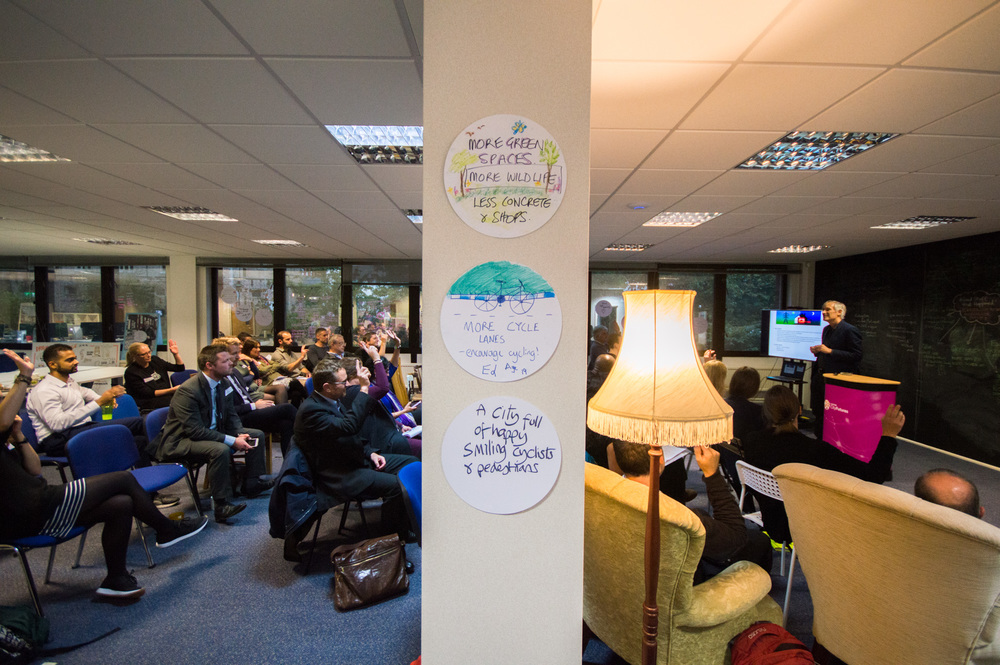
I’ve been out on the road this week, explaining the potential benefits of vehicle-to-grid technology to a variety of audiences. First up on Wednesday evening was the “Autumn Connect” event at Exeter City Futures, where I made a presentation entitled “V2G – How to simultaneously store energy and reduce congestion.”. I had the luxury of being allowed 5 minutes to present an “elevator pitch” on that subject to the assembled throng:
Here’s an expanded version of the PowerPoint slide deck I used. They all had Kasia’s “artist’s impression” of V2G in action at the top, so I’ll omit that part here. The first two slides are taken from a 2 minute pitch I presented at the Met Office on Thursday (see below) and have to conform to a template provided by the Knowledge Transfer Network. Hence:
V2G Limited
A small “smart grid” consultancy located amongst the wind and solar “farms” of North Cornwall
The “smart grid” is actually the “internet of big things”!
Producing embedded firmware for 35 years
Under a previous name provided multi-drop fleet routing interfaced to SAP for a FTSE 250 company
Long experience in electricity distribution. The Lucy Switchgear Gemini RTU firmware is our baby
Whilst we understand hardware our expertise is in designing software/firmware
Evangelising Vehicle-to-Grid technology for 5 years
I trust that is all self explanatory?! If not please see below or ask questions in the space made available for that purpose in the comments section at the bottom.
I always like to encourage some audience participation at these events, and Exeter City Futures delivered in spades! For the first time ever I didn’t need to blow my own bidirectional trumpet:
Timekeeper Lyndsey volunteered to blow the V2G trumpet for me, though ultimately it informed me that my time was up before I even managed to display the last slide, so make sure to read all about that below!
To make my “internet of big things” point I waved my trusty Raspberry Pi 3B at the audience. Here is what it looks like close up:
Dr. Sarah Ward from the University of Exeter correctly, if somewhat hesitantly, identified the mystery object. Now I’ve been programming the firmware (i.e. the software inside the hardware) in those sorts of devices for a very long time. 35 years ago single board computers were a lot slower and a lot bigger, but they still did the same sort of job. In those days they didn’t have USB ports like the Pi. Instead they had serial ports that conformed to the RS-232 standard. Getting two devices to talk to each other was always “interesting”!
I asked the audience to raise their hands if they’d previously heard of the “smart grid”. Quite a lot had:
Then I asked who had heard of the “internet of things”. Slightly more hands were raised. The point being that hardware a lot like the Raspberry Pi is at the heart of your smartphone, at the heart of the Smart Grid and (albeit in a smaller form factor) at the heart of the Internet of Things. The main difference being that the smart grid has been around quite a lot longer than the IoT! A point that some of my audience at the Met Office on Thursday seemed to agree with since they nodded their heads vigorously at that juncture!
Moving on to slide 2:
1. Our project idea
See the infographic above
North Cornwall is ideal!
Charge EVs on sunny lunchtimes
2. What’s innovative about it?
Nobody’s done it yet
On all sorts of levels!
Price signals / regulation?
3. The services we can offer?
Vast systems integration experience
Vast enthusiasm
AI for Energy Systems
4. The partners/services we seek?
Kite marked V2G hardware
An all electric car club
A suitable site
I asked the audience if it was obvious what the infographic represented. I was subsequently informed that a hand had gone up in the far corner of the room, but I didn’t notice at the time. To explain, imagine a conventional home with solar PV panels on the roof exporting excess electricity to the local distribution grid. Now add some static batteries in the utility room or the garage. Store any excess “free” energy generated when the sun is shining in that battery. When the household electric vehicle returns from the daily commute charge it up from the battery rather than from the mains, since by now the sun will be low in the sky or already below the horizon in winter.
If you have that basic hardware setup available then there’s lots of other things you can do with it! How about buying electricity from the grid when it’s cheap and storing it in your static and/or mobile batteries. Then just for starters you could sell it back to the grid when electricity’s more expensive? There are other possibilities too, which brings me on to slide 3:
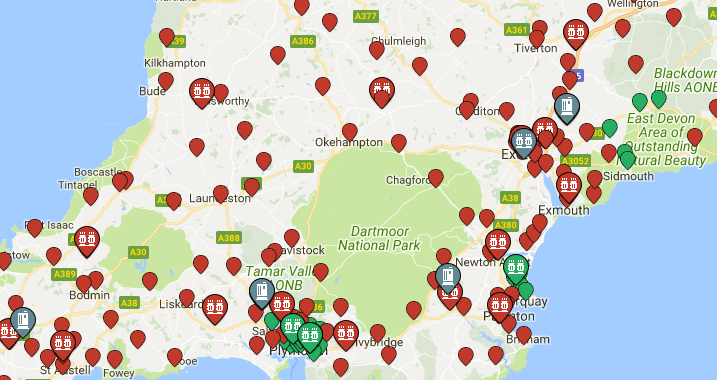
That’s a portion of Western Power Distribution‘s network constraint map. Note that most of Devon & Cornwall is plastered in red due to all the intermittent renewable electricity generation we have down here. One day (hopefully!) soon you’ll be able to earn money by allowing WPD to charge and discharge your batteries when it suits them, in order to help them cope with the stresses that intermittent generation can subject their electricity distribution grid to. The current fly in that particular pot of ointment are the rules and regulations currently enforced by Ofgem, which make it nigh on impossible for neighbouring energy “prosumers” to trade electricity with each other. Highlighting bullet point 2(c) I idly enquired if anybody else in the room “has had problems with Ofgem’s red tape?”. Not a single hand was raised in protest.
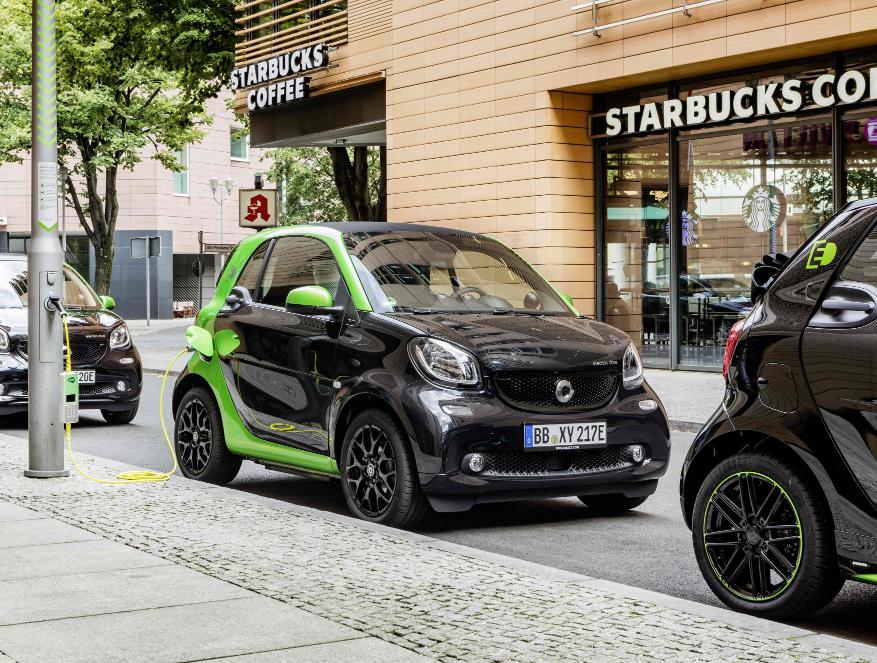
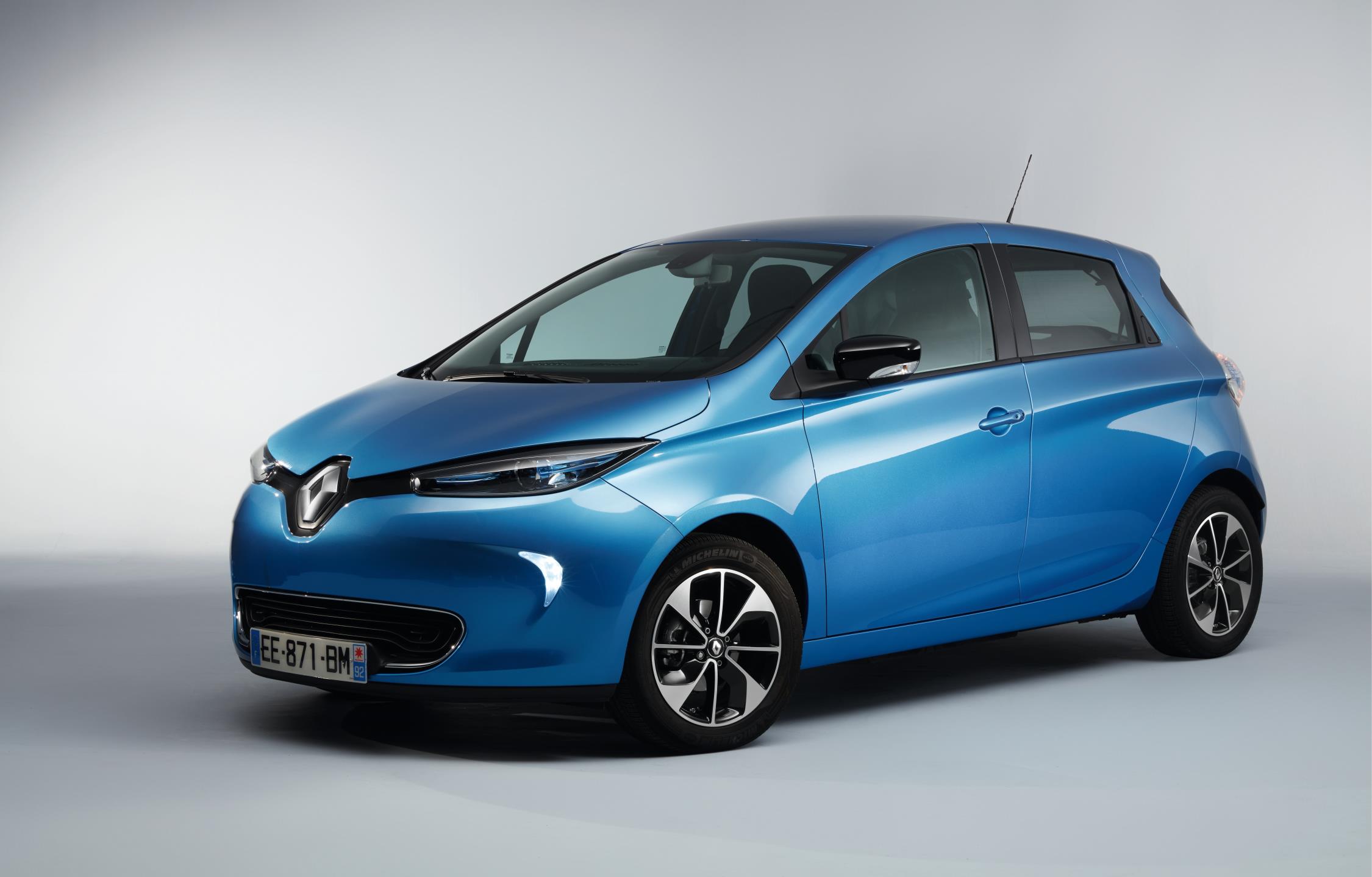
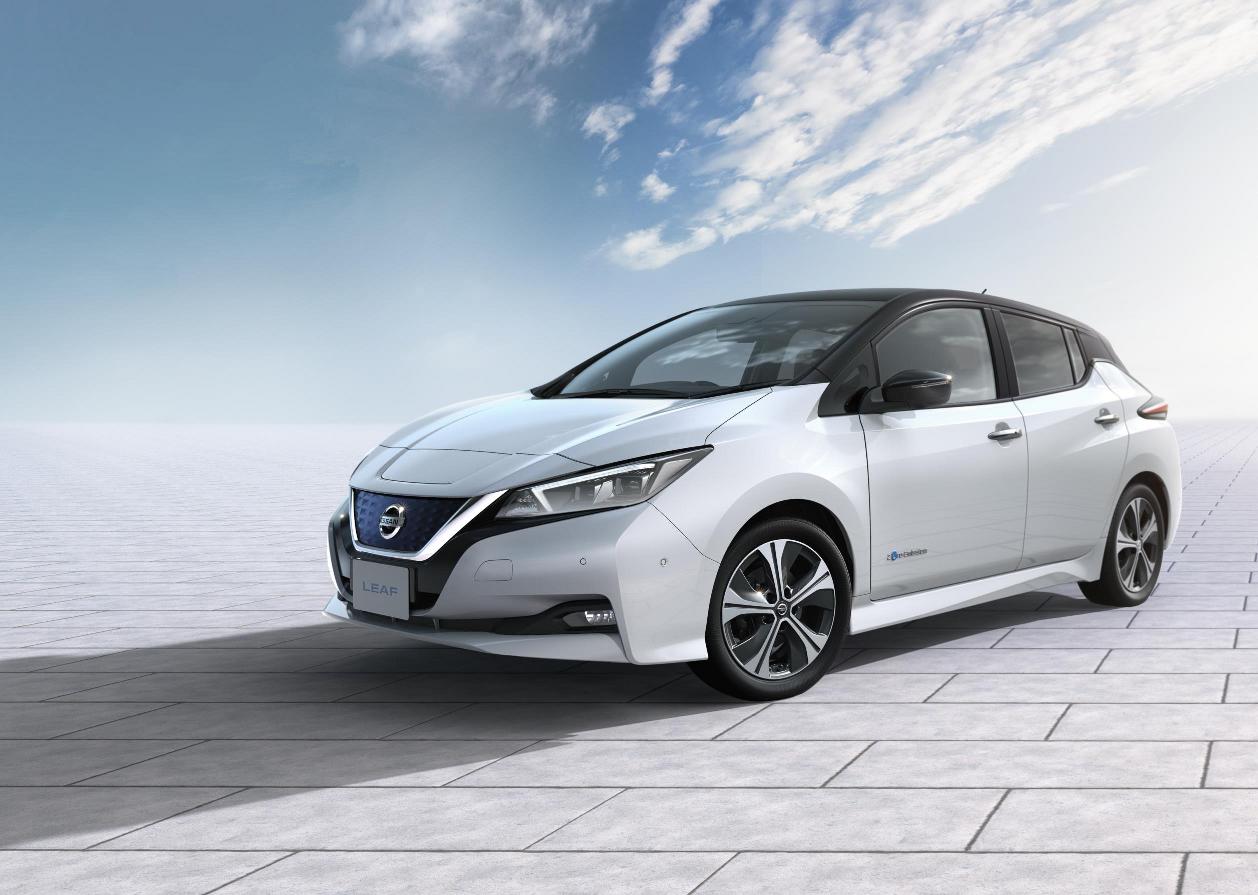
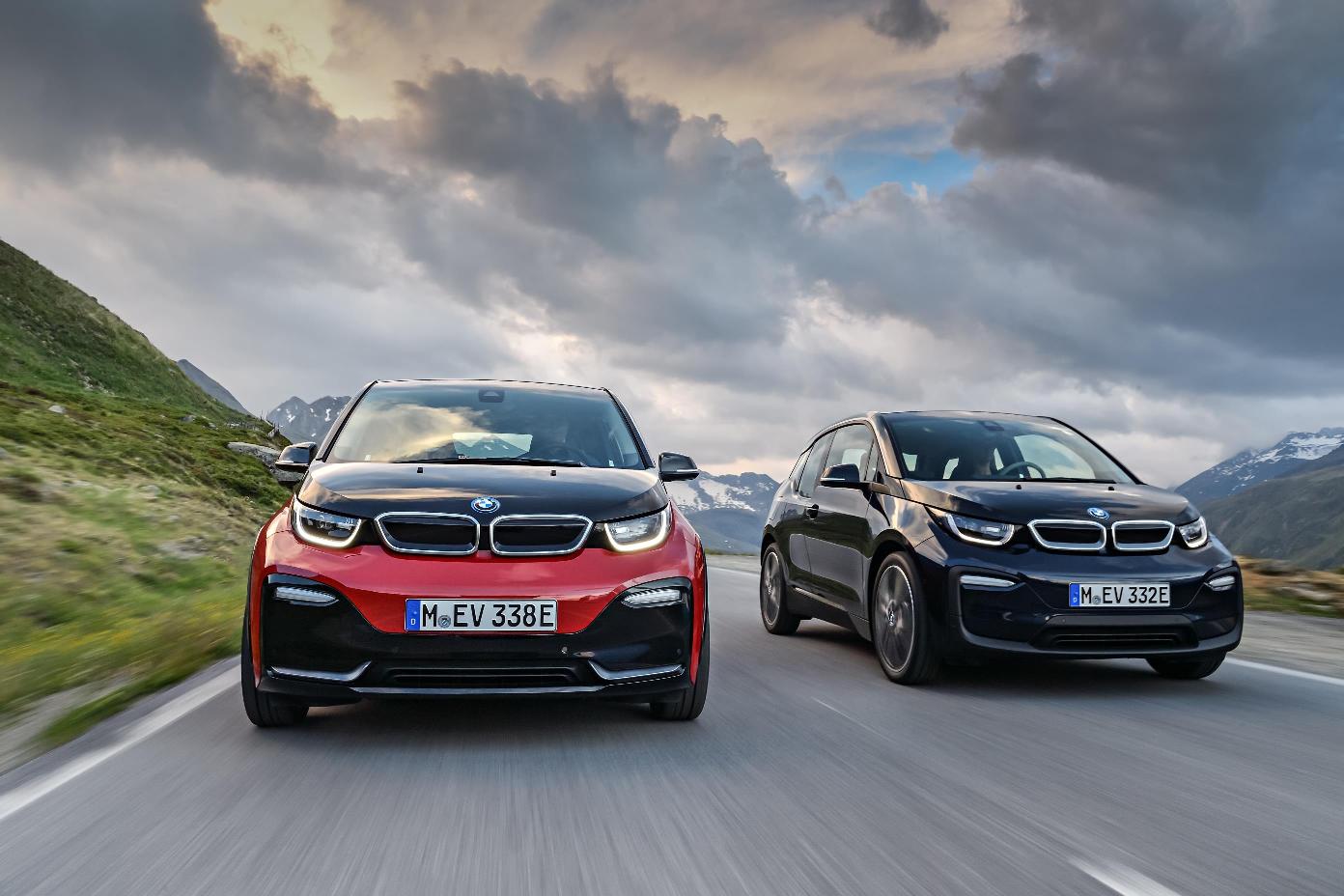
As regular readers will be aware, the town of Camelford in North Cornwall is an Air Quality Management Area (AQMA for short). Much like the centre of Exeter, the air quality in the centre of Camelford is fairly foul due to the noxious emissions of all the diesel engines that travel slowly through it. Electric vehicles can help with that, since they have no exhaust pipes and by and large use regenerative braking rather than rubbing dust off brake pads when they want to slow down. Hence slide 4 consisted of pictures of V2G capable examples of such vehicles, plus an image of the xStorage static battery storage device being produced from ex Nissan LEAF batteries by Eaton. An electric car club in Camelford and/or Exeter would be a small step along the road to reducing congestion and air pollution in both town and city centres, whilst V2G enabled vehicles in the fleet would also provide a mobile energy storage facility!
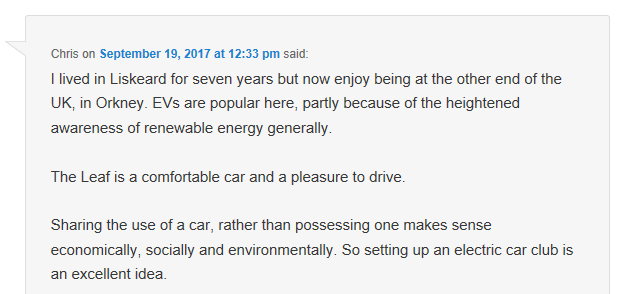
That’s about as far as I got on Wednesday before Lyndsey blew the metaphorical whistle on me, so I hastily concluded by mentioning this apposite comment from blog reader Chris:
It seems that struck a chord with at least one member of the audience. In the first image above you can see the back of Mark Hodgson’s head, if you know where to look. Mark’s Co-Cars car club certainly isn’t 100% electric, but it has just installed a couple of EV charging points in the Exeter area. That would seem to fit the bill for my bullet point 4(b) quite nicely?
Here’s the final slide I never had a chance to mention on Wednesday evening:
Of course solar PV isn’t the only form of RE generation, and batteries aren’t the only way of storing energy, at home or in the office. There’s also heat, and cold, and eddi & zappi: http://myenergi.uk/products/
What do you suppose that’s all about? To help answer that question let’s move on to Thursday and my trip to the Met Office. At least the previous evening’s rain had stopped:
I was presenting at a briefing event for Innovate UK’s Emerging and Enabling Technologies competition. I got the feeling that since this was (one of?) the first KTN briefing(s) held in Exeter most delegates weren’t making the most of the KTN’s “Meeting Mojo” facility. Anybody who ventured in there would have discovered that I was hoping to meet:
Partners who appreciate that the “Smart grid” is a subset of “The internet of things”, and predates the IoT!
whilst offering a potential consortium:
Smart Grid Consultancy: 5 years vehicle-to-grid, 15 years electricity distribution, 35 years system integration. Now with added blockchain!
Shortly before the event proper got underway I explained to the KTN’s Simon Yarwood, MC for the pitch session, that although I only had 2 slides in my deck I was actually representing 2 companies from a nascent V2G consortium. He graciously allowed me to overrun my allotted 2 minutes, and here’s what I added to the top two slides above:
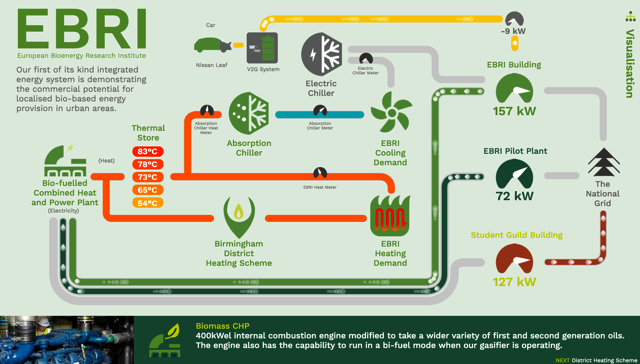
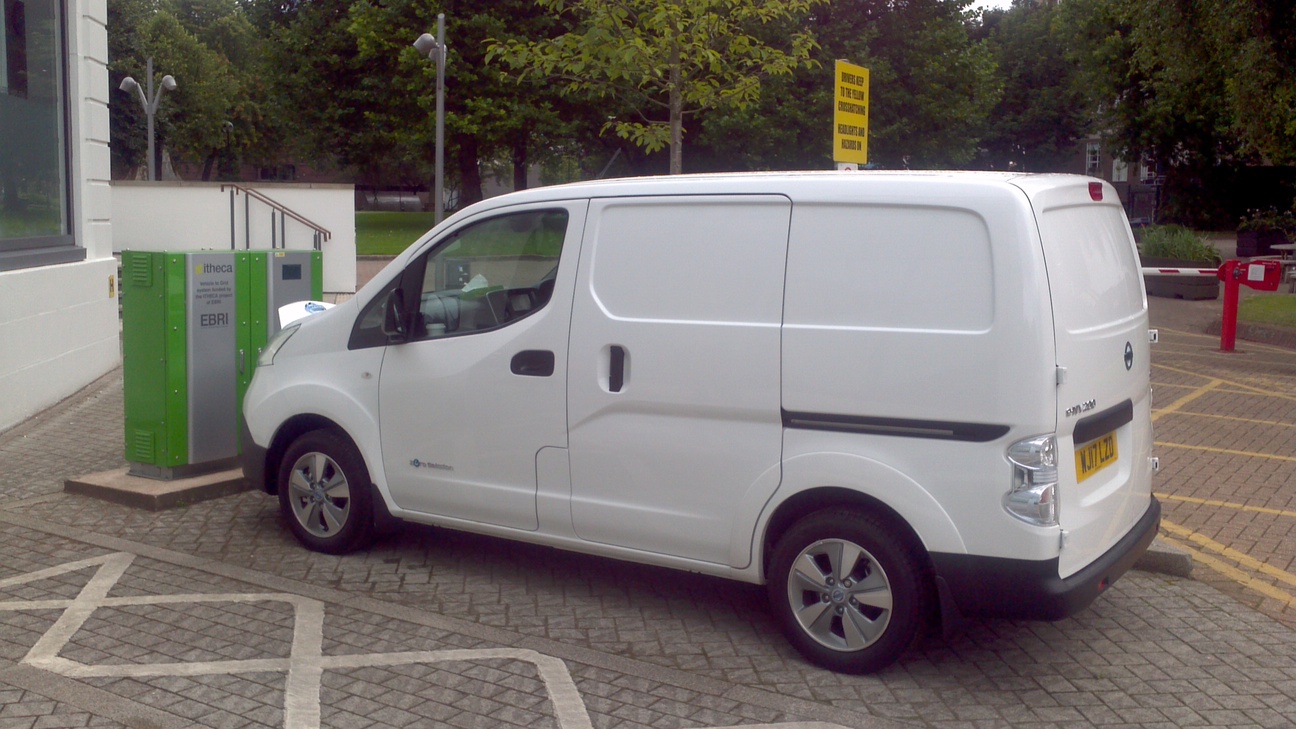
As you can see at the top of that page, a bidirectional charging station with associated static storage connected to a Nissan LEAF pool car is employed at EBRI as both an energy source and sink, in what is the UK’s first V2x pilot project. Strictly speaking it’s vehicle to building (V2B) rather than fully fledged V2G, but as far as the charging station itself is concerned that is of no consequence.
The BMS software at EBRI is now being further developed by Grid Edge Ltd. who assure me that it utilises various machine learning methods using a variety of inputs including weather forecasts, energy usage history, WiFi connections and football match schedules to optimise the overall energy use profile of the building and the assets within. As well as a modest amount of battery storage the EBRI building also includes energy storage in the form of large tanks of both hot and cold water in the basement, as indicated on the real time infographic shown above. That’s where the MyEnergi system depicted in slide 5 above comes in. It doesn’t use complex prediction or optimisation software, but it does attempt to sensibly direct the electricity generated by domestic solar PV panels to charge your EV, heat up your hot water, or if all else fails export some to the grid.
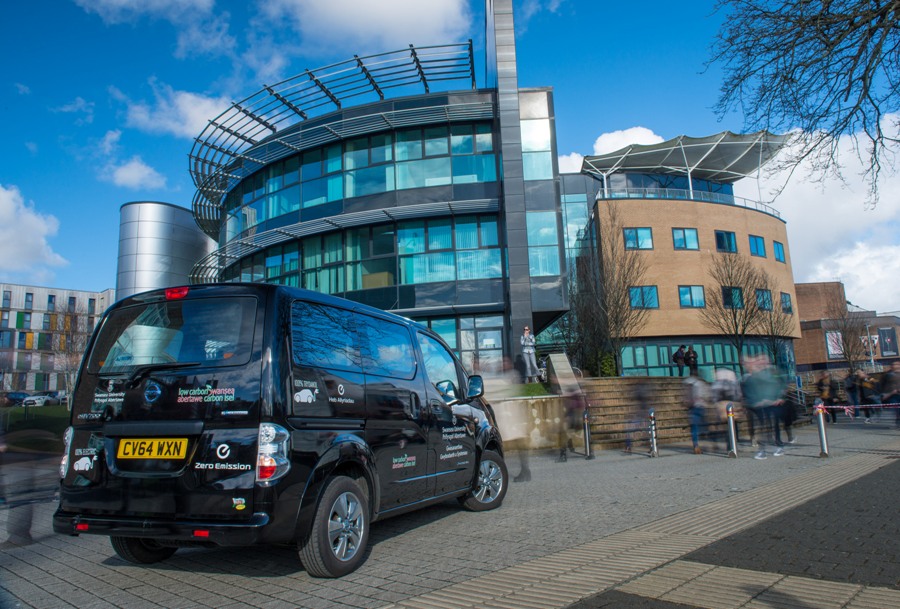
Nissan recently announced the new 2018 edition of their popular LEAF saloon, with increased range over the previous model thanks to a 40 kWh battery pack. Over the weekend a “leak” revealed that a 40 kWh version of Nissan’s e-NV200 van is on the way. That will provide a big increase in range over the e-NV200’s current 24 kWh battery pack, and make the “van” a much more realistic choice for a wide variety of small businesses. Note also that there is an MPV/taxi version of the e-NV200 known as the “Combi”, which I have taken a ride in over the North Sea in the Netherlands:
That means we’re really talking about an electric vehicle club, not a mere “car” club. That’s one way of implementing the concept known as “Mobility as a Service” (or MaaS for short).
Here’s another very good reason to try and put more electric vehicles on the streets of Camelford:
Earlier this year Camelford was declared an Air Quality Management Area (AQMA for short). According to the Town Council web site:
Cllr Claire Hewlett… said “I’m very pleased that Camelford has now been declared an air quality management area, as it means that Cornwall Council and Defra have offically acknowledged we have an air quality problem. The Clean Air Group have been working closely with Cornwall Council’s environmental protection team to get this far. Talking to people in town today, everyone is excited that something might actually happen.”
As part of the consultation, the council asked for residents and businesses to convey their ideas for improving air quality, and some of these will be investigated as part of a range of options before the final plan is published.
Now electric vehicles improve air quality in town and city centres by reducing nitrogen oxide emissions and particulates from exhaust pipes and brake dust, so here’s our idea.
Apart from improving air quality an electric vehicle club in Camelford would also reduce the number of cars sitting unused in garages and car parks for much of the time. One car club vehicle can result in 10-20 private cars being taken off the road. If you don’t possess a car you’re more likely to indulge in healthier alternatives such as walking or cycling for short journeys. In rural areas with poor public transport car clubs allow people who could never afford a car of their own to make occasional longer trips they would otherwise be unable to, except perhaps by taxi. For more on the benefits of car clubs see:
Obviously a few extra EVs in and around Camelford won’t initially result in a vast improvement in air quality if lots of diesel engines keep running whilst queueing along the A39, but you have to start somewhere! The same principle applies to charging infrastructure. Camelford has the advantage of already possessing a rapid charging point in the Churchfields car park, but additional lower power EV charging points would need to be installed. If that could be achieved then a 100% electric car club would allow people to experiment with driving an electric vehicle at very little cost, and thereby discover the many benefits of EVs for themselves. Assuming that hurdle can be overcome we’d like to perform a consultation of our own.
Please take our short survey and let us know your opinion about which sort of vehicle should be the first one to be made available to Camelford residents: