We covered the start of this story, and are now pleased to be able to report that the xStorage Buildings electricity storage system at the Johan Cruijff ArenA, home of Ajax Amsterdam, is now live. According to this morning’s press release:
Today the largest European energy storage system using second-life and new electric vehicle batteries in a commercial building was made live. Amsterdam Alderman Udo Kock, deputy mayor for Finance and Economic Affairs (Amsterdam) conducted the official opening ceremony.
This unique project is the result of collaboration between Nissan, Eaton, BAM, The Mobility House and the Johan Cruijff ArenA, supported by the Amsterdam Climate and Energy Fund (AKEF) and Interreg.
The 3 megawatt storage system provides a more reliable and efficient energy supply and usage for the stadium, its visitors, neighbors and the Dutch energy grid. Combining Eaton power conversion units and the equivalent of 148 Nissan LEAF batteries, the energy storage system not only enables a more sustainable energy system, it also creates a circular economy for electric vehicle batteries.
Europe’s largest energy storage system is now live at the the Johan Cruijff Arena
According to Henk van Raan, director of innovation at the Johan Cruijff ArenA:
Thanks to this energy storage system, the stadium will be able to use its own sustainable energy more intelligently and, as Amsterdam Energy ArenA BV, it can trade in the batteries’ available storage capacity.
The ArenA is assured of a considerable amount of power, even during an outage. As a result, the stadium will contribute to a stable Dutch energy grid. The Johan Cruijff ArenA is one of the most sustainable stadiums in the world and leads the way in introducing smart innovations like this unique energy storage system.
The press release continues:
The energy storage system plays an important role in balancing supply and demand of energy in the Johan Cruijff ArenA. The storage system has a total capacity of 3 megawatt, enough to power several thousand households. This capacity also means that the energy produced by the 4,200 solar panels on the roof of the ArenA can also be stored and used optimally. The energy storage system will provide back-up power, reducing the use of diesel generators, and provide relief to the energy grid by flattening the peaks that occur during concerts.
Finally, for the moment at least, here’s a video of the Ajax Amsterdam ArenA and it’s new static distributed energy storage system in action:
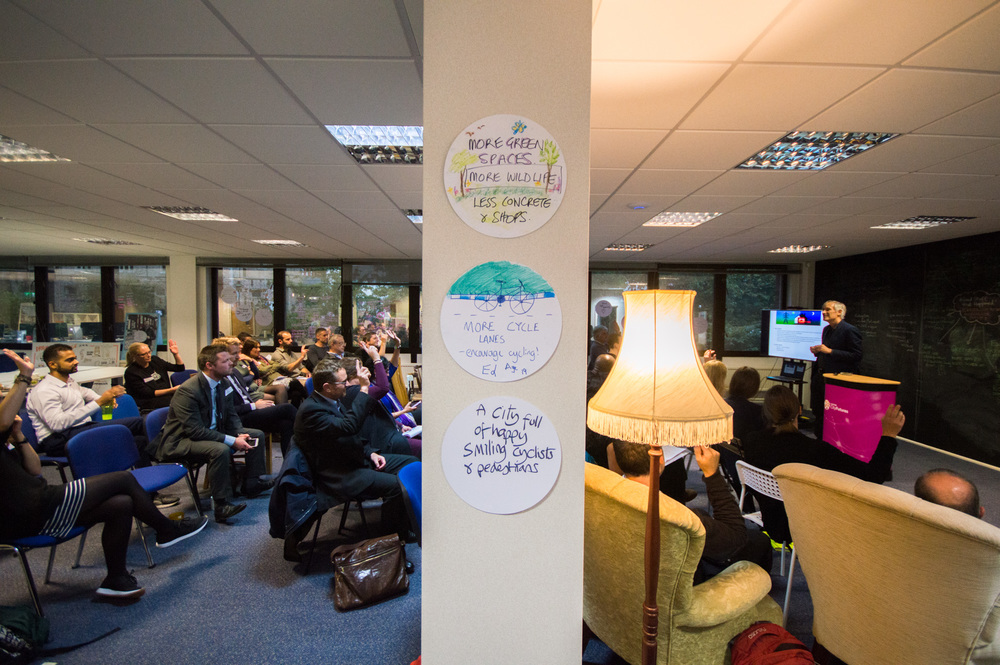
I’ve been out on the road this week, explaining the potential benefits of vehicle-to-grid technology to a variety of audiences. First up on Wednesday evening was the “Autumn Connect” event at Exeter City Futures, where I made a presentation entitled “V2G – How to simultaneously store energy and reduce congestion.”. I had the luxury of being allowed 5 minutes to present an “elevator pitch” on that subject to the assembled throng:
Here’s an expanded version of the PowerPoint slide deck I used. They all had Kasia’s “artist’s impression” of V2G in action at the top, so I’ll omit that part here. The first two slides are taken from a 2 minute pitch I presented at the Met Office on Thursday (see below) and have to conform to a template provided by the Knowledge Transfer Network. Hence:
V2G Limited
A small “smart grid” consultancy located amongst the wind and solar “farms” of North Cornwall
The “smart grid” is actually the “internet of big things”!
Producing embedded firmware for 35 years
Under a previous name provided multi-drop fleet routing interfaced to SAP for a FTSE 250 company
Long experience in electricity distribution. The Lucy Switchgear Gemini RTU firmware is our baby
Whilst we understand hardware our expertise is in designing software/firmware
Evangelising Vehicle-to-Grid technology for 5 years
I trust that is all self explanatory?! If not please see below or ask questions in the space made available for that purpose in the comments section at the bottom.
I always like to encourage some audience participation at these events, and Exeter City Futures delivered in spades! For the first time ever I didn’t need to blow my own bidirectional trumpet:
Timekeeper Lyndsey volunteered to blow the V2G trumpet for me, though ultimately it informed me that my time was up before I even managed to display the last slide, so make sure to read all about that below!
To make my “internet of big things” point I waved my trusty Raspberry Pi 3B at the audience. Here is what it looks like close up:
Dr. Sarah Ward from the University of Exeter correctly, if somewhat hesitantly, identified the mystery object. Now I’ve been programming the firmware (i.e. the software inside the hardware) in those sorts of devices for a very long time. 35 years ago single board computers were a lot slower and a lot bigger, but they still did the same sort of job. In those days they didn’t have USB ports like the Pi. Instead they had serial ports that conformed to the RS-232 standard. Getting two devices to talk to each other was always “interesting”!
I asked the audience to raise their hands if they’d previously heard of the “smart grid”. Quite a lot had:
Then I asked who had heard of the “internet of things”. Slightly more hands were raised. The point being that hardware a lot like the Raspberry Pi is at the heart of your smartphone, at the heart of the Smart Grid and (albeit in a smaller form factor) at the heart of the Internet of Things. The main difference being that the smart grid has been around quite a lot longer than the IoT! A point that some of my audience at the Met Office on Thursday seemed to agree with since they nodded their heads vigorously at that juncture!
Moving on to slide 2:
1. Our project idea
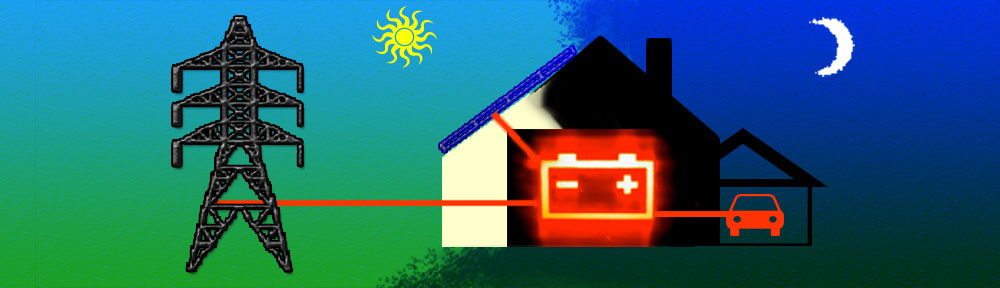
See the infographic above
North Cornwall is ideal!
Charge EVs on sunny lunchtimes
2. What’s innovative about it?
Nobody’s done it yet
On all sorts of levels!
Price signals / regulation?
3. The services we can offer?
Vast systems integration experience
Vast enthusiasm
AI for Energy Systems
4. The partners/services we seek?
Kite marked V2G hardware
An all electric car club
A suitable site
I asked the audience if it was obvious what the infographic represented. I was subsequently informed that a hand had gone up in the far corner of the room, but I didn’t notice at the time. To explain, imagine a conventional home with solar PV panels on the roof exporting excess electricity to the local distribution grid. Now add some static batteries in the utility room or the garage. Store any excess “free” energy generated when the sun is shining in that battery. When the household electric vehicle returns from the daily commute charge it up from the battery rather than from the mains, since by now the sun will be low in the sky or already below the horizon in winter.
If you have that basic hardware setup available then there’s lots of other things you can do with it! How about buying electricity from the grid when it’s cheap and storing it in your static and/or mobile batteries. Then just for starters you could sell it back to the grid when electricity’s more expensive? There are other possibilities too, which brings me on to slide 3:
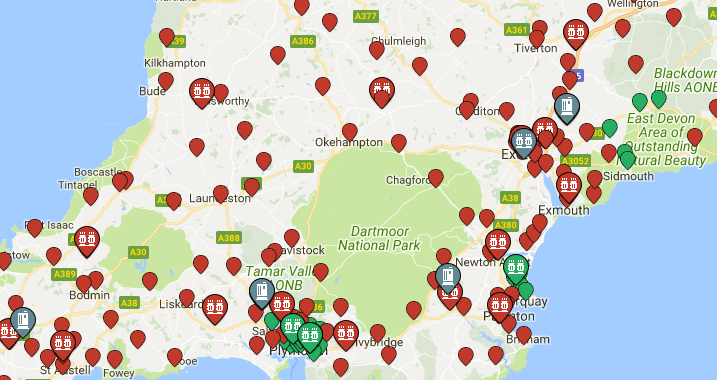
That’s a portion of Western Power Distribution‘s network constraint map. Note that most of Devon & Cornwall is plastered in red due to all the intermittent renewable electricity generation we have down here. One day (hopefully!) soon you’ll be able to earn money by allowing WPD to charge and discharge your batteries when it suits them, in order to help them cope with the stresses that intermittent generation can subject their electricity distribution grid to. The current fly in that particular pot of ointment are the rules and regulations currently enforced by Ofgem, which make it nigh on impossible for neighbouring energy “prosumers” to trade electricity with each other. Highlighting bullet point 2(c) I idly enquired if anybody else in the room “has had problems with Ofgem’s red tape?”. Not a single hand was raised in protest.
As regular readers will be aware, the town of Camelford in North Cornwall is an Air Quality Management Area (AQMA for short). Much like the centre of Exeter, the air quality in the centre of Camelford is fairly foul due to the noxious emissions of all the diesel engines that travel slowly through it. Electric vehicles can help with that, since they have no exhaust pipes and by and large use regenerative braking rather than rubbing dust off brake pads when they want to slow down. Hence slide 4 consisted of pictures of V2G capable examples of such vehicles, plus an image of the xStorage static battery storage device being produced from ex Nissan LEAF batteries by Eaton. An electric car club in Camelford and/or Exeter would be a small step along the road to reducing congestion and air pollution in both town and city centres, whilst V2G enabled vehicles in the fleet would also provide a mobile energy storage facility!
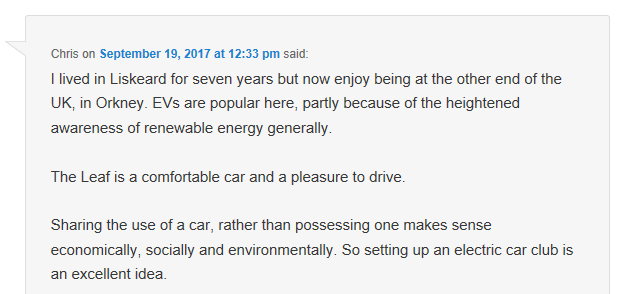
That’s about as far as I got on Wednesday before Lyndsey blew the metaphorical whistle on me, so I hastily concluded by mentioning this apposite comment from blog reader Chris:
It seems that struck a chord with at least one member of the audience. In the first image above you can see the back of Mark Hodgson’s head, if you know where to look. Mark’s Co-Cars car club certainly isn’t 100% electric, but it has just installed a couple of EV charging points in the Exeter area. That would seem to fit the bill for my bullet point 4(b) quite nicely?
Here’s the final slide I never had a chance to mention on Wednesday evening:
Of course solar PV isn’t the only form of RE generation, and batteries aren’t the only way of storing energy, at home or in the office. There’s also heat, and cold, and eddi & zappi: http://myenergi.uk/products/
What do you suppose that’s all about? To help answer that question let’s move on to Thursday and my trip to the Met Office. At least the previous evening’s rain had stopped:
I was presenting at a briefing event for Innovate UK’s Emerging and Enabling Technologies competition. I got the feeling that since this was (one of?) the first KTN briefing(s) held in Exeter most delegates weren’t making the most of the KTN’s “Meeting Mojo” facility. Anybody who ventured in there would have discovered that I was hoping to meet:
Partners who appreciate that the “Smart grid” is a subset of “The internet of things”, and predates the IoT!
whilst offering a potential consortium:
Smart Grid Consultancy: 5 years vehicle-to-grid, 15 years electricity distribution, 35 years system integration. Now with added blockchain!
Shortly before the event proper got underway I explained to the KTN’s Simon Yarwood, MC for the pitch session, that although I only had 2 slides in my deck I was actually representing 2 companies from a nascent V2G consortium. He graciously allowed me to overrun my allotted 2 minutes, and here’s what I added to the top two slides above:
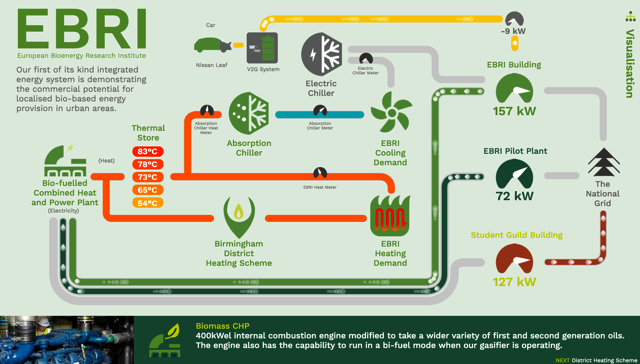
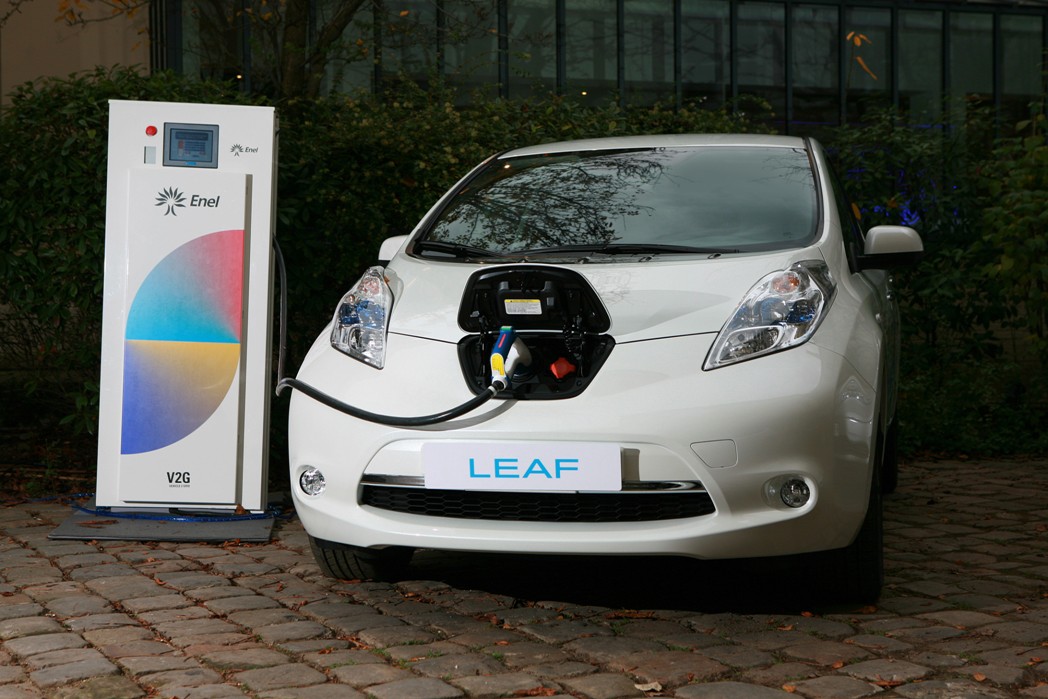
As you can see at the top of that page, a bidirectional charging station with associated static storage connected to a Nissan LEAF pool car is employed at EBRI as both an energy source and sink, in what is the UK’s first V2x pilot project. Strictly speaking it’s vehicle to building (V2B) rather than fully fledged V2G, but as far as the charging station itself is concerned that is of no consequence.
The BMS software at EBRI is now being further developed by Grid Edge Ltd. who assure me that it utilises various machine learning methods using a variety of inputs including weather forecasts, energy usage history, WiFi connections and football match schedules to optimise the overall energy use profile of the building and the assets within. As well as a modest amount of battery storage the EBRI building also includes energy storage in the form of large tanks of both hot and cold water in the basement, as indicated on the real time infographic shown above. That’s where the MyEnergi system depicted in slide 5 above comes in. It doesn’t use complex prediction or optimisation software, but it does attempt to sensibly direct the electricity generated by domestic solar PV panels to charge your EV, heat up your hot water, or if all else fails export some to the grid.
In two separate press releases there have been two interesting announcements from Nissan on the ex EV battery storage front. In the first there’s a football connection!
Nissan, power management leader Eaton and The Mobility House today signed a ground-breaking 10-year deal with Amsterdam ArenA – home of Ajax Football Club and world-famous entertainment venue – to provide back-up power from second life Nissan LEAF batteries.
The xStorage Buildings system efficiently stores and distributes energy when it’s needed, ensuring that the lights never go out at the renowned 55,000-seater stadium, which has played host to numerous high profile concerts and sporting events over the years.
By repurposing batteries from previously used electric vehicles, the xStorage Buildings system can draw energy from the grid, providing businesses with more control, better value and a more sustainable choice for their energy consumption.
Using 280 Nissan LEAF batteries, the system designed for the Amsterdam ArenA will be the largest energy storage system powered by second-life batteries used by a commercial business in Europe and will have four Megawatts of power and four Megawatts (sic) of storage capacity.
As well as providing vital back-up power services to the ArenA, xStorage Buildings also enables the Amsterdam ArenA to power the surrounding neighbourhood when necessary and protect the grid.
We’ll excuse Nissan PR the misprint because they’ve provided this nice video accompaniment to their announcement, which doesn’t make the same mistake:
Nissan and power management leader Eaton are broadening their portfolio of xStorage Home residential energy storage solutions by introducing a range of six product configurations, giving consumers greater choice to meet their energy needs. This announcement comes as pre-orders of xStorage Home begin today in the United Kingdom, Norway and Germany with other European markets to follow in the coming months.
The xStorage Home system can draw energy from the sun or from the grid, making energy consumption more affordable and encouraging home-owners to make a more sustainable choice. The cutting-edge technology in the xStorage Home system is also fit for the future, and can enable customers to sell energy back to the grid – an opportunity that is expected to be offered by energy companies in the future.
The system gives consumers greater control over how and when they use energy in their own homes enabling them to avoid expensive tariff periods. The expanded range will offer consumers greater choice over power capacity and price as well as units. Consumers can opt to purchase units powered by either second life batteries or new batteries.
xStorage Home units – which provide a sustainable second life for Nissan’s electric vehicle (EV) batteries after their first life in cars is over – will be priced competitively starting at €3,500 (excluding VAT and installation costs) for a power capacity of 3.5kW rising to just €3,900 for 6kW. Units powered by new Nissan batteries will start from €5,000 rising to €5,580 for the highest capacity and will come with an extended warranty period of ten years.
Connected to a residential power supply and/or renewable energy sources such as solar panels, the unit has the potential to revolutionise the way people manage energy usage in their own home, providing added flexibility.
xStorage Home comes with solar panel inverters already integrated meaning that if a home is equipped with solar panels, the consumer can connect directly to xStorage Home, storing and then powering their homes using clean, renewable energy. It can also save customers money on their utility bills by charging up when renewable energy is available or cheaper, and releasing that stored energy when demand and costs are high.
The xStorage Home unit also has the capability to provide energy back to the grid in countries where the conditions enable customers to do so. This provides another potential revenue stream as customers will be able to sell stored energy back to the grid when demand and costs are high.
The system also provides the ultimate back-up energy solution to consumers, ideal at a time when energy grids are coming under significant strain. With smartphone connectivity, it allows consumers to switch between energy sources at the touch of a button.
I wonder if Eaton have solved all the Great British G83 issues yet, and whether they will incorporate V2H functionality into their xStorage offering? I also cannot help but wonder how many Great British Pounds that €3,500 will translate to by the time UK deliveries eventually commence?
Nissan announced at the Geneva Motor Show today that:
Its new regional office in France will house the largest grid-integrated electric vehicle (EV) system and second life battery storage unit ever installed in a building, anywhere in the world.
The new building will feature 100 vehicle-to-grid chargers, from Nissan’s partner ENEL, allowing Nissan’s range of EVs to plug in and draw down energy from the grid at off-peak periods with the ability to “sell back” the stored energy to the grid. It will also feature a 1 MWh energy storage system, from Nissan’s partner EATON, the battery storage experts, powered by 64 Nissan LEAF second life EV batteries combined with solar energy generation.
The company hopes to extend this innovative battery technology to other major Nissan sites and facilities around the world over the next few years. The systems which will be installed at Nissan’s new French office will serve as a live test case of what can be achieved when electric cars are used to their full potential.
By reducing grid dependency and using excess energy stored in EV batteries in a smart way, Nissan believes today’s announcement will be a game-changer in the way people and businesses utilise electric vehicle fleets.
The new technology is expected to slash energy costs at the new France office by reducing drawdown of energy during peak periods in favour of off-peak tariffs. The new energy management system will also decrease the amount of contracted power consumed from the local electricity supplier.
Nissan announced plans to create a viable long-term solution to environmental protection in relation to energy use and storage at the COP21 climate conference in Paris last year. This included a partnership between Nissan and EATON on giving electric vehicle batteries a second life as stationary energy storage units and a partnership with ENEL on vehicle-to-grid integration. Grid integration trials have already begun in Denmark.